
The circle indicates the time we discuss in this section.
Jyokyu-no-Ran (承久の乱)
After Minamoto-no-Yoritomo (源頼朝) died, his son, Yoriie (頼家), became shogun. His mother, Hojo Masako (北条政子), Yoritomo‘s wife, thought her son was too incompetent. She worried others might take over the Kamakura bakufu (Kamakura government). To prevent this, she established a council of 13 members, including herself, her father, Hojo Tokimasa (北条時政), and her brother, Hojo Yoshitoki (北条義時).
Shogun Yoriie’s in-laws gained power over time. During the Heian and Kamakura periods, the wife’s family was considered very important. To suppress her son’s in-laws, Masako and her father, Tokimasa, planned and carried out Yoriie’s assassination.
After Yoriie‘s death, Masako’s younger son, Sanetomo (実朝), became the next shogun. Now, his grandfather, Hojo Tokimasa’s second wife, wanted her son-in-law to be the next shogun. To please his young wife, Hojo Tokimasa attempted to kill Sanetomo but failed. When she found out about the plot, Hojo Masako imprisoned her father, Tokimasa. Although Sanetomo was Masako’s son, she was once again very disappointed by his incompetence. Ultimately, Shogun Sanetomo was killed by his nephew Kugyo, the son of the previous shogun, Yoriie.
After all these incidents, Masako’s brother, Hojo Yoshitoki, took control of the Kamakura bakufu and installed a figurehead from the Fujiwara family, a powerful aristocratic family in Kyoto. After all the turmoil, the Hojo family eventually gained complete control of the Kamakura bakufu (government).
Meanwhile, in Kyoto, Emperor Gotoba was planning an attack on the Kamakura bakufu. He had built up military strength. When Sanetomo was killed, Emperor Gotoba saw an opportunity to attack Kamakura. He ordered local feudal lords to attack the Kamakura bakufu, but few obeyed. Instead, the Hojo family captured the emperor and exiled him to Oki Island. This happened in 1221 and is known as Jokyu-no-ran or Jokyu-no–hen.
Emperor Gotoba encouraged sword-making and showed respect for swordsmiths. After the Jokyu-no-ran, the Imperial family’s power declined, and the Kamakura bakufu became a strong and stable regime. From the time of Minamoto-no-Yoritomo‘s death until the end of the Jokyu-no-ran, the Kamakura bakufu remained unstable. It was Hojo Masako who led the Kamakura bakufu to a stable regime. She was called “Ama Shogun” or “Nun Shogun.” She was a sharp, talented, yet tough, critical, and often harsh politician.
Kamakura locals, including myself, hold Hojo Masako in high regard. Minamoto-no- Yoritomo and Hojo Masako are both buried in Kamakura City. Minamoto-no-Yoritomo is at Shirahata Shrine (白幡神社), and Hojo Masako is at Jufukuji Temple (寿福寺).
Kamakura is roughly an hour from Tokyo by train on the Yokosuka Line. Both Jufuku-ji Temple and Shirahata Shrine are within walking distance of Kamakura Station.
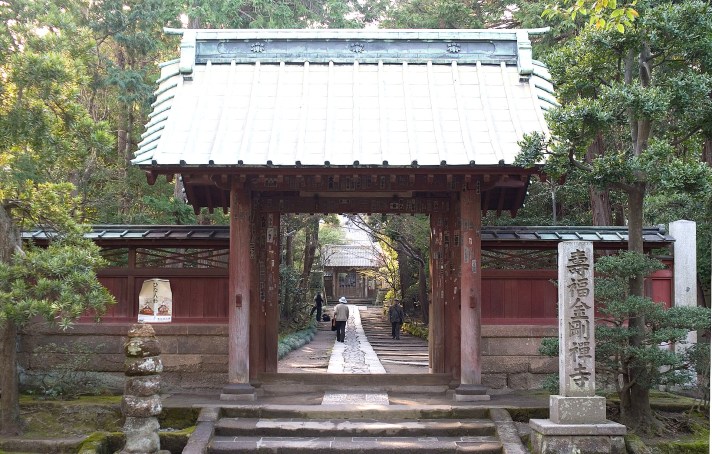 Jufuku-ji (寿福寺) Temple, sourced from Wikimedia Commons, the free media repository
 The tomb of Minamoto-no-Yoritomo. From Wikimedia Commons, the free media repository.

 Study of Japanese Sword