32| Japanese swords after WWII

Growing up in Azabu and Mita in Tokyo, and later in Kamakura, my father was deeply involved with a Japanese sword museum called “Nihon Bijutsu Token Hozon Kyokai.”   At that time, the organization’s heads were Dr. Honma and Dr. Sato. 

Initially, Dr. Honma and Dr. Sato worked in the sword department at the Tokyo National Museum in Ueno.  Later, a separate non-profit organization for the Japanese Sword Museum was built in Yoyogi, Shibuya.  Although its address was in Yoyogi, Shibuya, it was nearly in Shinjuku.  To construct this museum, my father, Mr. Watanabe (owner of Wataki, an apparel company), and Mr. Suzuki Katei (owner of a construction company) were heavily involved.  Those two friends used to come to our house all the time (literally all the time), spending hours talking and gossiping.  Currently, the museum has relocated to a new location, in Sumida-Ku (Sumida Ward), Tokyo, near the Sumo Arena in Ryogoku.  Please refer to the website below.

Dr. Honma, Dr. Sato, and all the other people involved at that time passed away many years ago, but they were in their prime then.  I am talking about the late 1960s to the 1970s. I was in my teens back then. 

Many people told me that Dr. Honma, Dr. Sato, and several other prominent figures visited General MacArthur’s headquarters during the occupation after World War II, and they convinced MacArthur that Japanese swords were not weapons but art objects.  They did this because MacArthur had ordered all Japanese to turn in their swords and forbidden them from owning any.  After considerable effort, Dr. Honma, Dr. Sato, and other high-ranking individuals changed MacArthur’s mind.  Yet, many swords had already been turned in at Akabane (a place in Tokyo), though some people hid valuable ones.  Those turned-in swords are called Akabane swords.

Many swords were taken by American soldiers and brought to the U.S. as souvenirs from Japan.  Those soldiers didn’t know whether they had taken a valuable or ordinary one.   About 25 years after the war, in the late 1960s and 1970s, Japanese sword dealers traveled to the U.S. to buy back many Japanese swords.  I have a few sword-dealer friends who did this.  They advertised in local newspapers that they would buy Japanese swords.  As you can imagine, many of those swords were in poor condition.  Some people used the wrong chemicals to remove the rust. Only a few swords were found in good condition.

Among those recovered was one of the famous missing national treasure swords that  Dr. Compton found.  He was the chairman of the board of Miles Laboratories in Elkhart, Indiana.  Miles Laboratories was a pharmaceutical company that produced a range of products, including Alka-Seltzer.  He had extensive knowledge of Japanese swords.  When he saw this sword in an antique store in Atlanta, he realized it was more than an ordinary sword.  He contacted Nihon Bijutsu Token Hozon Kyokai (日本美術刀剣保存協会) for consultation.  During this process, my father became close friends with him.  My father and I visited his house several times, and they visited ours.  Dr. Compton returned this sword to the Terukuni Shrine (照国神社) in Kagoshima Prefecture without compensation.  The story of Dr. Compton continues in the last part of  Chapter 45, Part 2 of — 11 Ikubi Kissak (猪首切先).  Although Japanese sword dealers bought many swords and brought them back to Japan, it seems many Japanese swords still remain in the U.S.

Nonprofit organization: Nihon Bijutsu Token Hozon Kyokai (日本美術刀剣保存協会)           1-12-9 Yokoami Sumida-Ku Tokyo Japan         〒130—0015                                                Tel: 03-6284-1000                                                                                            

https://www.touken.or.jp/   

*The above website explains access to the museum.

66| BIBLIOGRAPHY

REFERENCED RESOURCES (参考資料)

  • Nihon Bijutsu Token Hozon Kyokai.       “Nihon-to Taikan”                                            Supervising editors: Dr. Honma, J. and Dr. Sato, K. (1966)                                    Tokyo:  Otsuka Kogeisha  Co.,Ltd.   日本美術刀剣保存協会   本間順次, 佐藤貫一監修 (1966)  “日本刀大鑑”  東京: 大塚工芸社 
  • Hon’ami, K.  (1955)  “Nihonto no Okite to Tokucho”    Tokyo: Bijutsu Club Tokenbu.    本阿弥光遜著  (1955)  “日本刀の掟と特徴 “   東京:美術倶楽部刀剣部発行
  • Watanabe, T.  (1971)   “Sano Bijutsu-kan Zuroku”  Shizuoka: Sano Bijutsu-kan.             渡辺妙子著   (1971) “佐野美術館図録  静岡:佐野美術館発行 
  • Yoshihara, Y.,  Kapp, L., and Kapp, H. (2012) :The art of the Japanese Sword”            Italy: Paolo Saviolo   吉原義人, リーオン & ひろ子 キャップ著 (2012)  “日本刀美術”  イタリア:パオロ  サビオロ 発行  
  • Mochizuki, K. & Fujiki, K. (1966) “Shousetu Nihonshi”   Tokyo:Yamakawa Shuppan-sha  High school text book by the Ministry of Education   望月圭吾, 藤木邦彦著  (1966)   “詳説日本史”   東京:山川出版発行    文部省検定済教科書
  • Dr. Honma, J. & Dr. Sato, K. (1972)   “Shinpan Nihon-to Koza”                                      Tokyo: Yuzankaku Shuppan Inc.   本間順次,佐藤貫一著   (1972)   “新版日本刀講座”    東京: 雄山閣出版株式会社発行 
  • Dr. Honma, J. & Dr. Sato, K.  (1968)  “Nihon-to Zenshu”                                                  Tokyo: Tokuma Shoten Co., Ltd.   本間順次、佐藤貫一著 (1968)   “日本刀全集 “        東京: 徳間書店発行
  • Dr. Honma, J. & Dr. Sato, K.  (1979)  “Showa Dai Meito Zufu”                                     Tokyo: Nihon Bijutsu Token Hozon Kyokai     本間順次、佐藤貫一著 (1979)            “昭和大名刀図譜”  東京:日本美術刀剣保存協会 
  • Sano Museum.  (2019)  “Yomigaeru Meito (Reborn)”                                                      Shizuoka: Sano Museum Exhibition catalog.                                                                  佐野美術館 著   (2019)  “蘇る刀 Reborn”    静岡:佐野美術館編集発行
  • Hiroi, Y.    (1971)   “Token no Mikata”    Tokyo:  Dai-ichi Hoki Shuppan Co, Ltd.            広井雄一著   (1971)  “刀剣のみかた” 東京:第一法規出版株式会社発行   
  • The Japan House Gallery. Japan Society, Inc.  (1976)                                                    “Nippon-To Art Sword of Japan  The Walter A. Compton Collection”    Tokyo: Otsuka Kogeisha Co, Ltd.
  • Chapter 25                                                                                                                    *¹ヤン ヨーステン Jan Joosten van Lodenstijnhttps://www.weblio.jp  6/2018  *²  Names of Japan: Click the link Jipangu  on Wikipedia  6/2018 (閲覧日)  Cipangu described in the 1492 Martin Beham globe From Wikimedia Commons, the free media repository (Names of Japan)
  • Chapter 37                                                                                                                    Murasaki Shikibu, translated to modern Japanese by Tanizaki, J. (1967)                  Shin-shinyaku Tales of Genji.   Tokyo:  Chuo Koronsha, Inc.   谷崎潤一郎訳  (1967)  “新々訳源氏物語”  東京: 中央公論社
  •  Chapter 43                                                                                                                  *The three imperial regalia  www.touken-world.jp/tips/32747     Wikipedia                        三種の神器:ウキペディア 2/2019 (閲覧日)
  • Chapter 45                                                                                                                    Terukuni Jinjya website: http://terukunijinja.p-kit.com/page222400.html  2/2019            九州照国神社 ウエブサイト:http://terukunijinja.p-kit.com/page222400.html   
  • Chapter 47                                                                                                                 *Number of soldiers   https://kotobank.jp/word/元寇-60419.   Wikipedia                          兵力数 ウキペディア 3/2019 (閲覧日)   *Genko (元寇) https://kotobank.jp/word/%E5%85%83%E5%AF%87-60419              
  • Chapter 54                                                                                                                  Golden Pavillion (金閣寺):https://www.shokoku-ji.jp/kinkakuji/   6/2019 (閲覧日)
  • Chapter 56                                                                                                                   Honouji-no-hen (本能寺の変)   * Rekijin.com/?p=31448-キャッシュ    *Bushoojapan.com/scandal/2019/06/02/51145-キャッシュ    7/2019   (閲覧日)
  • Chapter 57                                                                                                                   Masamune Jittetsu ( 正宗十哲 ):                                                     https://www.touken-world.jp/tips/7194/        7/2019
  • Chapter 59  Osaka Summer campaign (大阪夏の陣)                                      www.thoughtco.com/toyoomi-hideyoshi-195660                                                     Battle of Sekigahara  (関ケ原の戦い)    senjp.com/Sekigahara     8/2019 (閲覧日)
  • Chapter 63   *Perry (ペリー) ja.wikipedia.org/wiki/黒船来航                   *Perry (ぺリー) ja.wikipedia.org/wiki/マシュー・ペリー   Wikipedia  9/2019 (閲覧日)


31|Sword Making Process

0-timeline - size 24 Kamakura Period

As part of the sword study, it is necessary to describe the process of making a sword. This chapter explains the basic procedure of sword-making.  It is a brief overview of the sword-making process, as I lack expertise in the field. 

When I was little, I watched the process of metal being heated in the furnace at my father’s factory.  He owned a machine tool company and a forging plant.  It was fascinating to see the metal heat up, be taken out of the furnace, pounded by two men, then put back in the furnace and pounded again and again.  To this day, I can still remember the exact color of the metal when it should be removed from the fire.  That was a strange thing for a little girl to learn.  Also, it was dangerous for children to be near the furnace when the metal was being heated.  But in those days, people’s idea of safety was different. 

I think the factory workers enjoyed seeing my brother and me, who were so impressed,  amazed, and looked up to them as heroes.  We kept visiting the shop until my father moved the factory to a larger location.  Today, I would never allow my grandchildren to be near a furnace.

Sword-making involves many detailed processes, and each swordsmith has his own secrets.  For those interested in more detailed explanations, please refer to a book written by a famous swordsmith, Mr. Yoshihara Yoshindo, and a DVD produced by his son. Their information is listed below.  Mr. Yoshihara’s book is available on Amazon.  And the DVD is available on Amazon Japan.  To purchase the DVD, you may need to use a proxy service, like Zen Market, since it is sold on Amazon Japan.

Book: The Art of the Japanese Sword:  The Craft of Sword Making and Its Appreciation by Yoshihara Yoshindo, Leon, and Hiroko Capp.  Published by Tuttle Publishing

DVD: Katana/On Ko So Shin (温故創新)——-Katana project by Yoshihara Yoshikazu (吉原義一).  Use the proxy service Zen Market, as only Amazon Japan sells it.

Tamahagane (玉鋼)

In the early days of sword-making time, swordsmiths extracted iron from iron sand and refined it themselves for sword material.  By the Kamakura period (see the timeline above), ironmaking was done by separate entities.  Swordsmiths bought iron known as “Tamahagane” from ironmakers.  Tamahagane is an essential part of sword-making.  It is iron produced using the tatara process, a unique Japanese smelting method.

32 Tamahagane 2

Tama-Hagane from Mr. Yoshihara

Kawa-gane (側鉄) and Shin-gane (芯鉄 )     

The Japanese sword is made from steel with two different hardness levels: kawa-gane for the outer steel and shin-gane for the inner steel.  Kawa-gane is the harder steel, with about 0.6% carbon content.  Shin-gane is a softer steel, with about 0.25% carbon content. Japanese swords are constructed with softer steel inside, wrapped around by harder steel; this design makes them resistant to bending and breaking.

Kawa-gane (側鉄: outer steel) —— Shita-gitae (下鍛: Base forging)

Heat a block of tamahagane → Strike it with a hammer to create flat pieces While the tamahagane is still hot, quickly quench it in water Break it into small pieces.

Forge a rectangular plate separately with tamahagane → attach this plate to a handle or lever to make a teko → carefully and closely attach the previously broken metal pieces onto the teko. 

32 Pile up drawing

Cover the stacked tamahagane with ashes and clay for protection → Heat it in the furnace → Remove it from the furnace and strike it with a hammer Repeat this process multiple times to stretch the tamahagane to about twice its original length.

While the tamahagane is still hot, make a notch in the center and fold it in half. → Continue the same process of heating, hammering to stretch, and folding it in half (alternating widthwise and lengthwise, 6 or 7 times, depending on the original carbon level in tamahagane).  This process reduces the carbon content to the desired level.
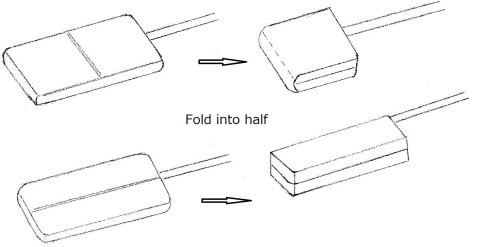
32 folding drawing

Kawagane (側鉄: Outer steel) —– Age-gitae (上鍛: Finish forging )

At the end of shita-gitae, chisel the block of tamahagane so that it can be separated into two or three sections Quench in water Cool down Break it into pieces along the markings  Combine these pieces, and repeat the heating, hammering, and folding processes.       

Usually, the folding process happens 6 to 7 times for shita-gitae (base forging) and 6 to 7 times for age-gitae (finish forging).  The total is about 12 times, depending on the original carbon content in the tamahagane used.  This process is for kawa-gane (側金).

Purpose of heating hammering and folding

  • Each time the heating and folding process is done, tamahagane loses some carbon content.  For outer steel, the ideal carbon content should be about 0.6%.  If the carbon content is too high, the steel is hard, so the sword may crack.   If it is too low, the sword will be too soft and may bend.  Swordsmiths rely on their eyes to judge the correct level of carbon content. This is the professionalism and the artistry of sword-making.
  • Removing slag and impurities from tamahagane.
  • Each heating and folding process creates multiple layers of thin steel that form the ji-hada pattern (surface designs such as wood grain, burl look, straight grain, or a combination of these).

Shin-gane (inner steel 芯鉄)       

Shin-gane is the inner metal, which is a softer steel with less carbon.  Having a softer inside makes the sword more flexible.  Having a hard outer steel with higher carbon and softer steel inside prevents the sword from cracking or breaking.  To make the shin-gane, mix softer steel with tamahagane.   Repeat the same process as you would with kawa-gane.

Tsukuri-komi (造り込み) Sunobe (素延)

Wrap the shin-gane with the kawa-gane, then weld the two pieces together by heating, hammering, and stretching to form a steel bar.  There are several ways to wrap the shin-gane, but the most common is called kobuse (甲伏). The illustration below shows a cross-section.

32 Kobuse drawing

Sword Micro (3)

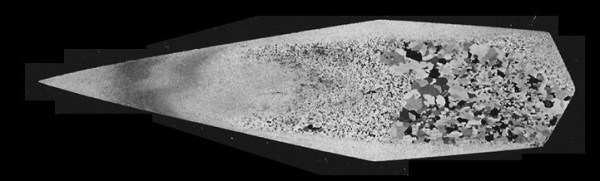
The photo above (taken by my husband) shows a cross-section of a sword. Many years ago, a member of our sword club gave us a very rusty, damaged sword.  My husband cut the blade and took a micro photo of the cross-section. This sword has a more complex construction than the usual kobuse method. It appears to have three or four different hardnesses of steel. It seems that this sword was once one of the finest made by a top sword-maker.

Hizukuri (火造)

Hizukuri is the process of shaping the final form of the sword from sunobe through heating and hammering.  At this stage, the ha (cutting edge) becomes thinner, the shinogi side rises higher, and the sword’s shape begins to take form.

Arashiage (荒仕上げ)

This process is a rough finish.

Tsuchitori (土取)

Mix clay, pine tree ash, ground stone, and water.  Coat the sword with this muddy mixture.  Scrape off a thin layer of the mixture slightly around the hamon area, then let it dry.  By doing the tsuchitori process, the hamon is created, and the cutting edge hardens at the same time.

Yaki-Ire (焼入れ)

After the muddy paste dries, heat the sword evenly in the furnace.  Judging by the color of the heated sword, pull it out of the furnace and quickly quench it in water.  Usually, this process is done after sunset so that the swordsmith can see the metal’s color and gauge the heated sword’s temperature more accurately. This is the most critical step, as all the work done up to this point can be ruined if he fails to judge the heated sword’s precise color, water temperature, and the timing of quenching.

The final step is to send the sword to a polisher.  The polisher, called a togishi, polishes and sharpens the blade.   He brings out the beauty of the surface and the sword’s sharpness.  This completes the entire sword-making process.  Every step is crucial, but the polisher’s final work is as important as all the other stages.