This chapter is a detailed part of Chapter 11, Ikubi Kissaki. Please read Chapter 11 before reading this section.

The red circle above indicates the time we discuss in this section.
The middle Kamakura period was the golden age of sword-making. We cannot deny that this was because of Gotoba Joko’s (see Chapter 10 and Chapter 43 ) high regard for skilled swordsmiths. After the Jokyu-no-ran, samurai started favoring grand-looking swords. These were ikubi-kissaki swords. It is said that there were no mediocre swords among the ikubi-kissaki swords. In this chapter, we discussed the swordsmiths who were famous for their ikubi-kissaki works.
Bizen Osafune Mitsutada (備前長船光忠)
Bizen Osafune Mitsutada is famous for his ikubi-kissaki swords. His blades are the most highly sought-after among sword collectors. He was the founder of the Osafune group, succeeded by his son Nagamitsu (長光), then by his grandson Kagemitsu (景光), and followed by other descendants.
- Sugata (shape) ———— Grand appearance with Ikubi-kissaki. The body is relatively thick with Hamaguri-ha (see 11| Ikubi Kissaki (猪首切先). Often suriage.
- Hi (engraving) ———- Often Bo–hi (wide groove). The end of Bo-hi above Machi often shows Kakudome (square end).
- Hamon (Tempered line) ————- Yakihaba (Hamon width) is a mixture of wide and narrow Hamon. Nioi base. Large Choji, Kawazuko-choji (tadpole head shape, see the illustration below, second from the last), Inazuma, and Kinsuji (refer to the drawing in 14| Late Kamakura Period: Sword (鎌倉末太刀) .
- Boshi ————————— Yakizume. Yakizume with a short turn back.
- Ji-hada ————————- Fine and soft-looking surface. Chikei appears.
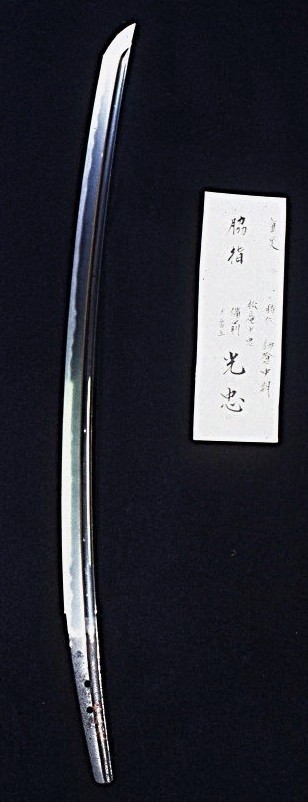
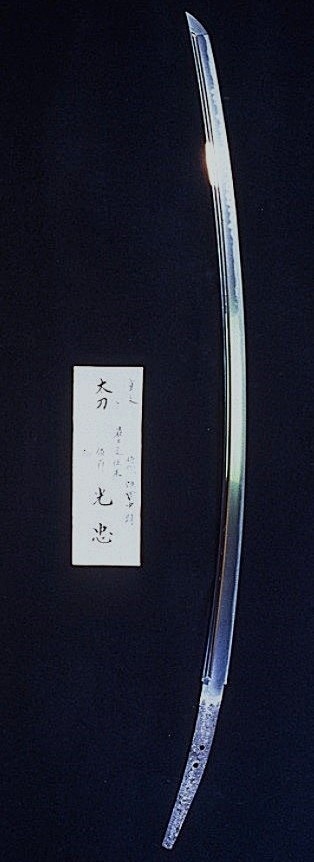
Osafune Mitsutada (Juyo Bunkazai) Osafune Mitsutada (Juyo Bunkazai)
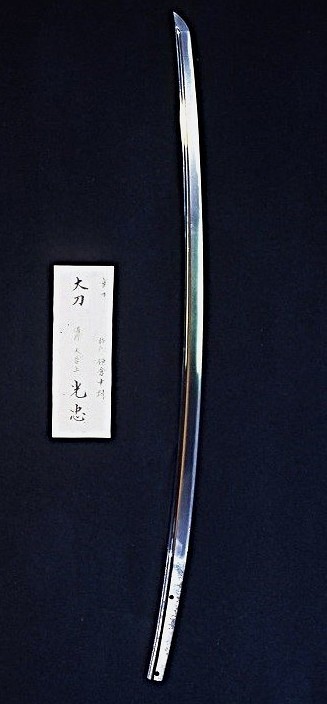
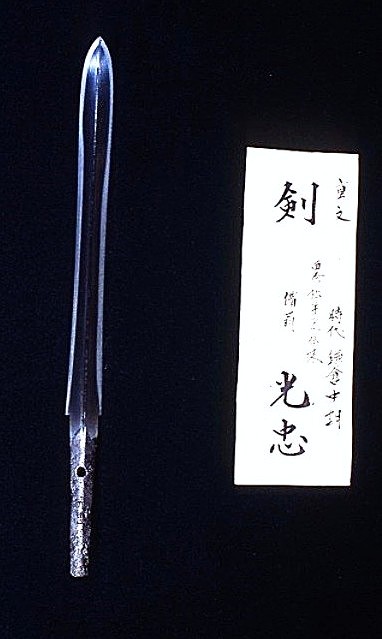
Osafune Mitsutada (Juyo Token) Osafune Mitsutada (Juyo Bunkazai) Above 4, once my family sword
I have shown the four photos above several times on other pages. Those were Mitsutada swords owned by my father. My father did the calligraphy and took these pictures himself. He was very proud that he had collected four Mitsutada swords and had monogrammed “Mitsutada” inside his suit jacket. It is said that Oda Nobunaga (織田信長), with his wealth and political power, collected twenty-eight Mitsutada swords.
I understand these photos might not be very good. To avoid any potential copyright infringement or intellectual property rights issues, the photos are limited to my father’s photographs (not so wonderful, though), Sano Museum Catalog photos (with permission), some public-domain photos from Wikipedia, and a few other sources. Please bear with me, as I don’t have high-quality pictures.
Bizen Osafune Nagamitsu (備前長船長光)
Nagamitsu is Mitsutada’s son.
- Sugata ——————– Shape resembles the early Kamakura period style, with Funbari and a narrow top. This is called Nagamitsu Sugata.
- Hamon ——————- Wide tempered line. Nioi base. O-choji Midare (large clove shape) mixed with Kawazuko-choji (see below). Many Ashi appear. Also, he does Suguha-choji (straight with Choji mixed). It may show the works of Inazuma and Kinsuji.
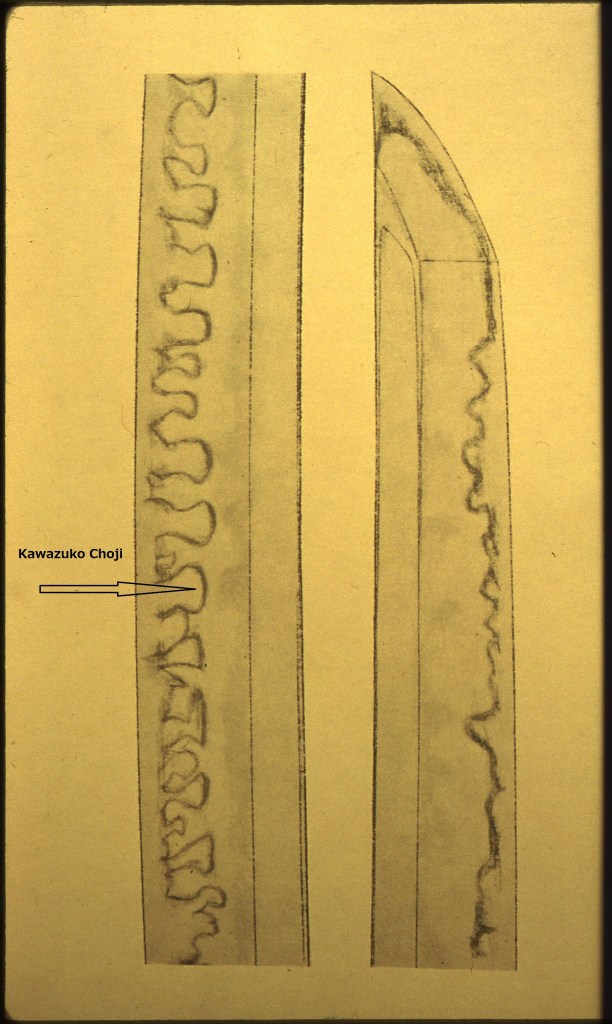
Kawazuko Choji (tadpole head-like) Sano Museum Catalogue (permission granted). The Kawazuko Choji on the sword above is a clear example, almost like a textbook example. However, they are often less obvious than this.
- Boshi —————————— Yakizume or turn back a little.
- Ji-hada ——————— Fine wood grain pattern. Well known for Utsuri (shadow). Choji Utsuri (Shadow of Choji) or Botan Utsuri ( resembles a peony flower). Choji Utsuri is shown in the above picture.
The next poster advertises an exhibit of swords at the Museum of Tetsu (iron) in Sakaki, Nagano, 2003. The central objects in the poster are Nagamitsu’s sword and koshirae (scabbard). It was our family’s sword then. Toyotomi Hideyoshi (豊臣秀吉), a prominent daimyo of the Sengoku period, awarded this sword to his famous war strategist, Takenaka Hanbei (竹中半兵衛).


 Study of Japanese Sword
Where is chapter 12 please?!?!?? I have not received chapter 12?!?!?!?! Arigatou
Sasha
On Mon, 11 Feb 2019 at 6:40 pm Study of Japanese Sword wrote:
> Yurie Endo 遠藤由利江 posted: “This chapter is a detailed chapter of chapter > 12. Please read chapter 12 before reading this section. Middle Kamakura > period was the golden age of the sword making. We can not deny it was a > great part due to the Gotoba-Joko treating the swordsmiths hi” >
LikeLike
Chapter 12 «part 2» is right after the table of contents.
I try to put the table of contents on the top page. Next to the table of contents is the newest post.
You can look for the original chapter 12 under the table of contents. Click the chapter 12, then it will take you to chapter 12.
Thank you
LikeLike