55 |Part 2 of —–21 Muromachi Period Sword (室町時代刀)

Chapter 55 is a detailed section of Chapter 21, Muromachi Period Sword.  Please read Chapter 21 before reading this part.

57 Muromach-timeline size 22

                         The circle above indicates the time we discuss in this section

After the Muromachi period, swords shifted to katana(刀) from tachi (太刀), as described in Chapter 21, Muromachi Period Sword.  Refer to Chapter 21, Muromachi Period Sword.  By the end of the Nanboku-cho period, sword lengths had shortened to about 2 feet ± a few inches.  The 3-to-5-foot-long swords seen during the Nanboku-cho period were no longer produced.  This change occurred because, during the Nanboku-cho period, warriors mainly fought on horseback, but after the Muromachi period, infantry combat became more common.

Oei Bizen (応永備前)                                                                                                              The pronunciation of Oei is “O” as in “Oh” and “ei” as in “A” from ABC.  The Muromachi period was a declining time for sword-making.  The swords made during the early Muromachi period in the Bizen area is known as Oei BizenOsafune Morimitsu (長船盛光), Osafune Yasumitsu (長船康光), and Osafune Moromitsu (長船師光) were the main Oei Bizen swordsmiths.  Soshu Hiromasa (相州広正) and Yamashiro Nobukuni (山城信國) were also similar to the Oei Bizen style.  Please refer to Chapter 21, Muromachi Period Sword, for details on the  Muromachi sword shape, Hamon, Boshi, and Ji-hada.
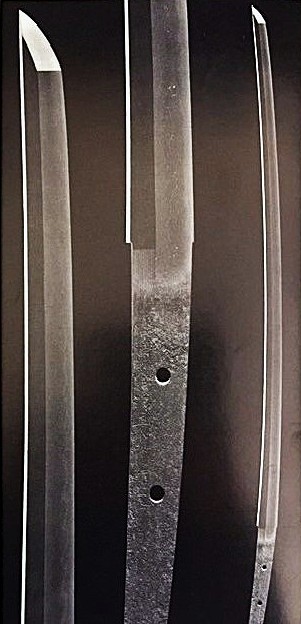
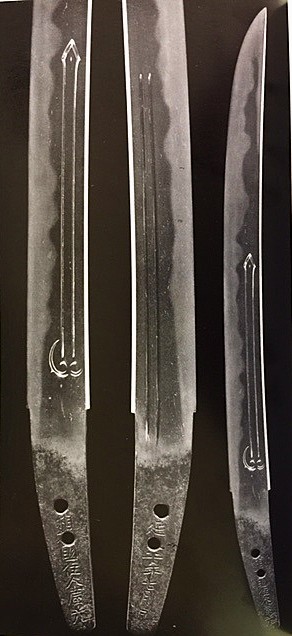
                       Bishu Osafune Moromitsu (備州長船師光)   from Sano Museum Catalogue ((permission granted)

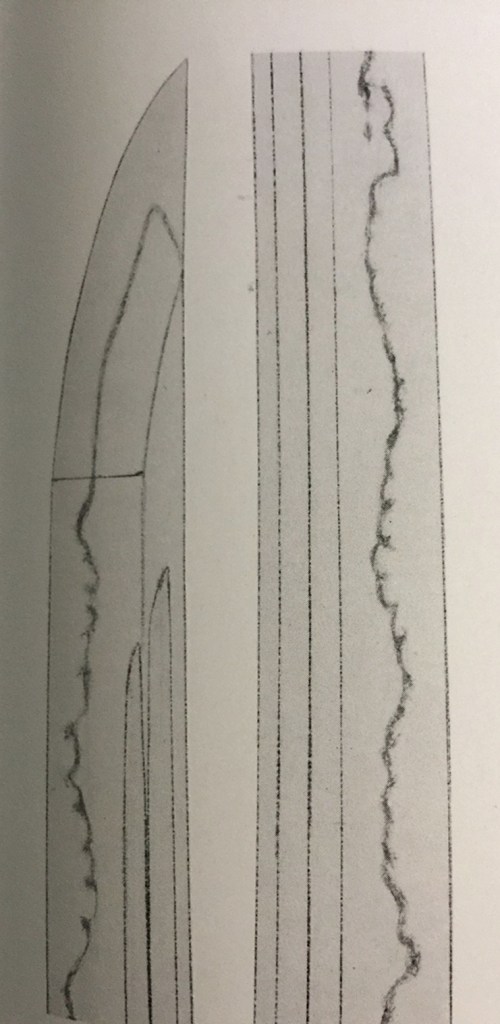
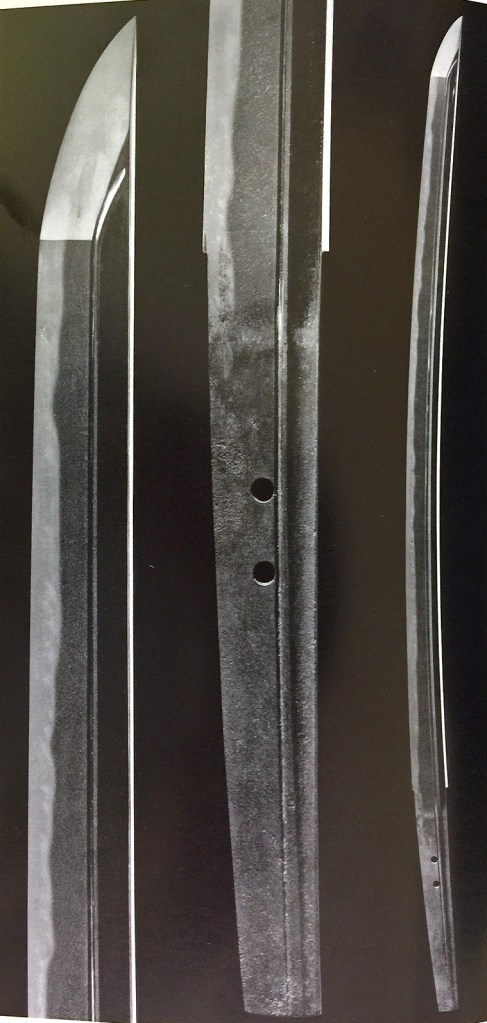
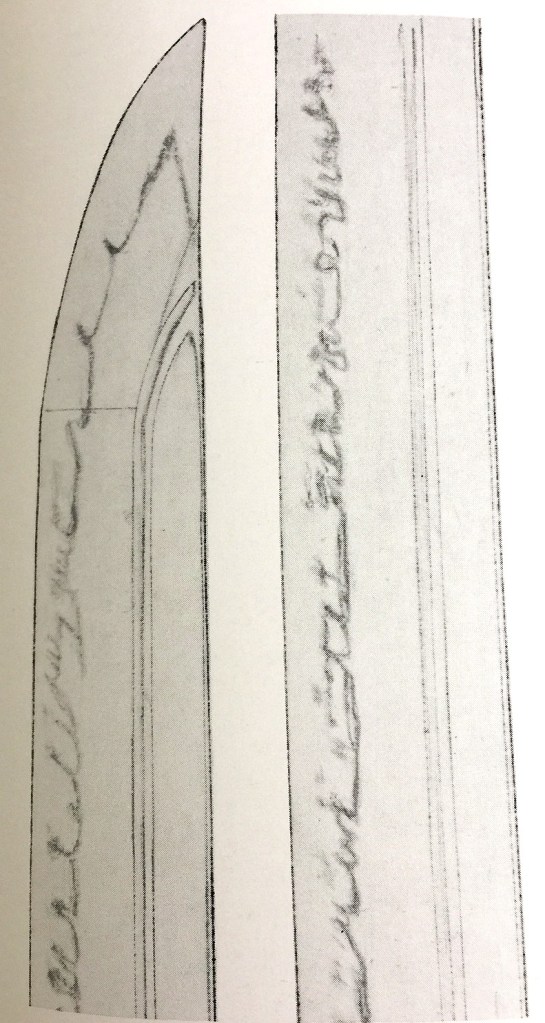
The Osafune Moromitsu sword shown above measures 2 feet 5 inches in length and has a medium kissaki.  Its hamon has a small wave-like pattern with continuous gunome (a lined half-circle pattern).  The boshi area shows irregular waviness with a slightly pointed tip.  Very faint bo-utsuri (a soft shadow shaped like a strip of wood) appears on ji-hadaBo-utsuri is a distinctive feature among all the Oei Bizen

Before the Muromachi period, many swordsmith groups operated in the Bizen region. However, by the Muromachi period, Osafune (長船) was the only remaining group.

Osafune (長船) is the name of a region, but it became the surname of swordsmiths during the Muromachi period.  Two other well-known swordsmiths from Oei Bizen are Osafune Morimitsu (盛光) and Osafune Yasumitsu (康光).  The hamon created by Morimitsu and Yasumitsu is more detailed than that of the sword in the photo above.  Chapter 21, Muromachi period swords, shows the hamon of Morimitsu and Yasumitsu and describes the typical characteristics of swords from the Muromachi period.

                                                 Hirazukuri Ko-Wakizashi Tanto
58 Hirazukuri Ko-Wakizashi Tanto

Hirazukuri Ko-Wakizashi Tanto Shape                                                                       

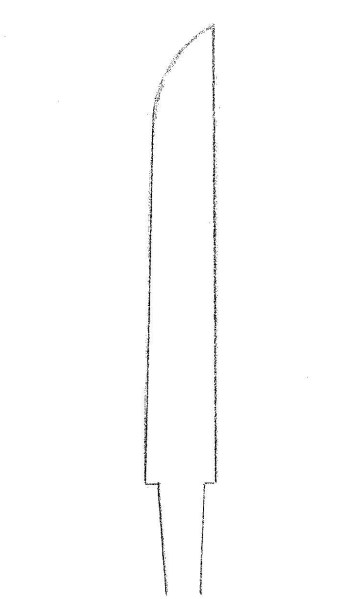
Hirazukuri ko-wakizashi tanto was a popular style during the early Muromachi period. Swordsmiths from various regions produced tantos similar to the one shown above. However, most of these types were made by Oei Bizen swordsmiths.

The characteristics of the Hirazukuri ko-wakizashi tanto ————-Typically about one foot and 1 or 2 inches long.  No yokote line, no shinogi, and no sori (meaning no curvature, straight back).  Average thickness.  Narrow width.  Gyo-no-mune (refer to Chapter 12, Middle Kamakura Period Tanto).
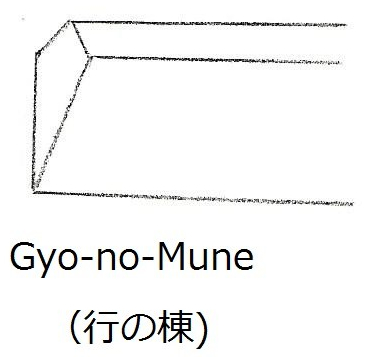
13 Mune drawing

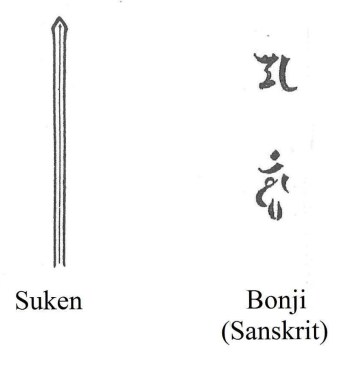
Hirazukuri Ko-wakizashi tanto often shows many engravings.  Hi with soe-hi (double lines, wide and narrow side by side), Tokko-tsuki-ken, Tsume-tsuki-ken, Bonji, and more.

.
9 Hi, Suken, Bonji20 Tokko, tume Ken  58 tsumetukiken and Hi

*drawings from “Nihonto no Okite to Tokucho” by Honami Koson


54|Part 2 of — 20|Muromachi Period History (室町時代歴史)

This is a detailed section of Chapter 20, Muromachi Period History.  Please read Chapter 20 before reading this part.


0-timeline - size 24 Nuromach & Sengoku

                      The red circleabove indicate the time we discuss in this chapter

Until the Muromachi (室町) period, the study of political history and sword history ran in parallel.  The timelines above show that the middle line represents sword history, and the bottom line represents political history.  

The styles of swords were distinctly different between the Muromachi and Sengoku periods (戦国時代).  Therefore, for sword study, the Muromachi and Sengoku periods should be separated.   Japanese history textbooks define the Muromachi period as 1393 (the end of the Nanboku-cho) to 1573, when Oda Nobunaga (織田信長) deposed Shogun Ashikaga Yoshiaki (足利義昭) from Kyoto (the fall of the Muromachi bakufu).   In these textbooks, the Sengoku period is considered part of the Muromachi period.  However, we need to distinguish between the Muromachi and Sengoku periods for the study of swords.

 Ashikaga Yoshimitsu (足利義満)

The best period during the Muromachi era was when Shogun Ashikaga Yoshimitsu (足利義満: grandson of Ashikaga Takauji) was in power.  He moved the bakufu to Muromachi (室町) in Kyoto; therefore, this era is called the Muromachi period.  By the time most of the South Dynasty’s samurai had surrendered to the North Dynasty, the South Dynasty had accepted Shogun Yoshimitsu’s offer to stop fighting against the North.  This acceptance established the Ashikaga family’s power within the Muromachi Bakufu

Shogun Ashikaga Yoshimitsu generated tremendous profits from trade with China (Ming). He built a famous resort villa in Kyoto, the Golden Pavilion (Kinkaku-ji Temple 金閣寺*). It is believed that he created the Golden Pavilion to display his power and wealth. The beautiful culture known as Kitayama Bunka (Kitayama culture 北山文化) flourished during this period.

*Golden Pavilion (金閣寺: Kinkaku-ji Temple) —– Its official name is Rokuon-ji Temple (鹿苑寺).  Saionji Kintsune (西園寺公経) originally built it as his resort house during the Kamakura period.  Shogun Yoshimitsu acquired it in 1397 and turned it into his villa.  He also used it as an official guesthouse. 

After Shogun Yoshimitsu’s death, the villa was converted into Rokuon-ji Temple.  It is part of the Rinzaishu Sokoku-ji Temple, which served as the main temple of a Zen sect denomination, called the Rinzaishu Sokoku-ji group (臨済宗相国寺派).  Kinkaku-ji is a reliquary hall that contains relics of the Buddha.  Kinkaku-ji Temple represents the grand Kitayama Bunka (Kitayama culture).  In 1994, it was designated a UNESCO World Cultural Heritage Site. https://www.shokoku-ji.jp/kinkakuji/


57 Kinkakuji trip 2019                                                               My photo  May 2019,

Ashikaga Yoshimasa (足利義政)

After the death of Shogun Ashikaga Yoshimitsu (足利義満), the Muromachi bakufu became less financially stable, and its military power declined.  Consequently, the daimyo (feudal lords) increased their control.  A few generations after Shogun Yoshimitsu, Ashikaga Yoshimasa, the eighth Shogun, took power.  His wife was the well-known Hino Tomiko (see Hino Tomiko in Chapter 20, Muromachi Period History). 

It is said that Shogun Yoshimasa was not interested in his role as shogun; instead, he was more interested in art and culture.  He laid the foundation for today’s Japanese art and culture, including the Japanese garden, Shoin-zukuri (書院造) interior design, the tea ceremony, flower arrangements, painting, and other art forms.  His cultural influence is known as Higashiyama Bunka (Higashiyama culture (東山文化).  

As described in Chapter 20, Muromachi Period History (室町時代), Shogun Yoshimasa did not have any children.  His brother Yoshimi (義視) was expected to become the next Shogun. However, his wife, Hino Tomiko, gave birth to a son, Yoshihisa (義尚).  Hino Tomiko sought support from Yamana Sozen (山名宗全: a powerful family) to back her son.  Meanwhile, the brother, Yoshimi, was connected with Hosokawa Katsumoto (細川勝元: another powerful family).  The problem was that Shogun Yoshimasa paid too much attention to his cultural pursuits and failed to address the issue he created by not being clear about who should succeed him as Shogun.  He did not hand over the shogunate to either party. 

In 1467, in addition to the succession problem and conflicts of interest among powerful daimyo, a civil war, known as “Onin-no-run (応仁の乱),” broke out.  All daimyo were divided, siding with either the Hosokawa or the Yamana factions.   Eventually, the war spread throughout Japan and lasted more than 10 years.  Finally, in 1477, after the deaths of Hosokawa Katsumoto and Yamana Sozen, Shogun Yoshimasa decided to transfer the shogunate to his son Yoshihisa.  As a result of this war, Kyoto was devastated, and the power of the Muromachi Bakufu declined significantly. 

While all this was happening and people were suffering, Yoshimasa continued to spend money on building the Ginkaku-ji Temple (銀閣寺: The Silver Pavilion).  He died before seeing the completion of Ginkaku-ji Temple.  The Onin-no-ran would lead to the next Sengoku period, a 100-year-long Warring States period.

*Shoin-zukuri (書院造)———- A traditional Japanese residential interior style with Tatami mats, a nook, and shoji screens (sliding doors).  This style forms the basis for interior design in modern Japanese homes.

Shoin Zukuri style Japanese room

57 Shoin zukuri

Public Domain   GFDL,cc-by-sa-2.5,2.0,1.0 file: Takagike CC BY-SA 3.0view terms      File: Takagike Kashihara JPN 001.jpg

My japanese room                                                                      My Japanese room

53| Part 2 of — 19 Nanboku-cho Period Tanto (南北朝短刀)

This chapter is a detailed section of Chapter 19.  Please read Chapter 19, Nanboku-cho Period Tanto, before proceeding on to this part. 

0-timeline - size 24 Nanboku-cho

                          The red circle above indicates the time we discuss in this section

20 Enbun Jyoji Kowakizashi Tanto

The drawing above shows a typical shape of a Nanboku-cho-period tanto. This drawing was in Chapter 19.  I exaggerated the features of the Enbun Joji ko-wakizashi tanto to better show you.  At the end of Chapter 19, Nanboku-cho Tanto, there is a list of swordsmiths’ names from that period.  Hiromitsu (広光) and Akihiro (秋広) represent the Nanboku-cho style.

56 cropped Hiromitu photo 20 HitatsuraHiromitsu from the Sano Museum Catalogue (permission to use granted)

Enbun Joji Ko-wakizashi tanto is also called Sun-nobi tanto (>10 inches) because its length is longer than the standard size (about 10 inches) tanto.  The upper part of the tanto curves outward slightly.  This type is called sakizori.

Characteristics of Hiromitsu (広光) and Akihiro (秋広)

  • Shape———————— Usually, one foot and one to two inches long (Sun-nobi).   Wide width.  Thin blade.  Sakizori.
  • Hamon ———————- A mix of wide and narrow hamon.  The hamon around the yakidashi (just above the machi) area is narrow but gradually widens as it moves up.  The hamon around the fukura area shows most work.  Mainly nie.  Sunagashi, kinsuji, gunome, umanoha-midare (horse teeth-shaped hamon), or hitatsura appear (drawing above).                 
  • Boshi———-Irregular and unevenly tempered.  The hamon covers almost the entire boshi. Deep turn back. 
  • Jihada ———————————————————Wood-grained pattern
  • Nakago —————–Tanago-bara shape.  Refer to 19 Nanboku-cho Period Tanto.

Nobukuni (Below is my sword)

Shodai Nobukuni (the first-generation Nobukuni) was a student of Sadamune.  He was one of the Sadamune San Tetsu (貞宗三哲, Sadamune’s top three students).  Nobukuni’s characteristics resembled those of Hiromitsu and Akihiro, as described above.  Nobukuni also created sun-nobi tanto.  The sword below has a hoso-suguha, ko-mokume (small burl pattern), and ko-maru boshi (small round). 

56 Nobukuni 1 Nobukuni4

56 Nobukuni 2This is the certification of my sword.  Shodai Nobukuni (初代信國).   Juyo Token (重要刀剣)
Certification

Number: Juyo 3220, Certification Juyo-Token

Wakizashi:  Nobukuni (信国), 31.4cm long, 0.3cm curvature, hirazukuri, mitsumune (three-sided mune), sun-nobi.  The ji-hada shows a wood grain and ji-nie (surface nie, between shinogi and hamon). The hamon is a chu-suguha (medium straight). The front carving shows bonji (Sanskrit) and sanko-ken. The back engraving is bonji and hoko (pike).   Original nakago.  Examined by the Nihon Bijutsu Token Hozon Kyokai.  It is certified as a Juyo Token.  The Chairman, Moritatu HosokawaShowa 45 June 1 (June 1, 1970)

52| Part 2 of — 18 Nanboku-Cho Period Swords (南北朝太刀)

This chapter is a detailed part of Chapter 18, Nanboku-cho Sword.  Please read Chapter 18 before reading this section. 

    0-timeline - size 24 Nanboku-cho                     
                      The red circle above indicates the time we discuss in this section

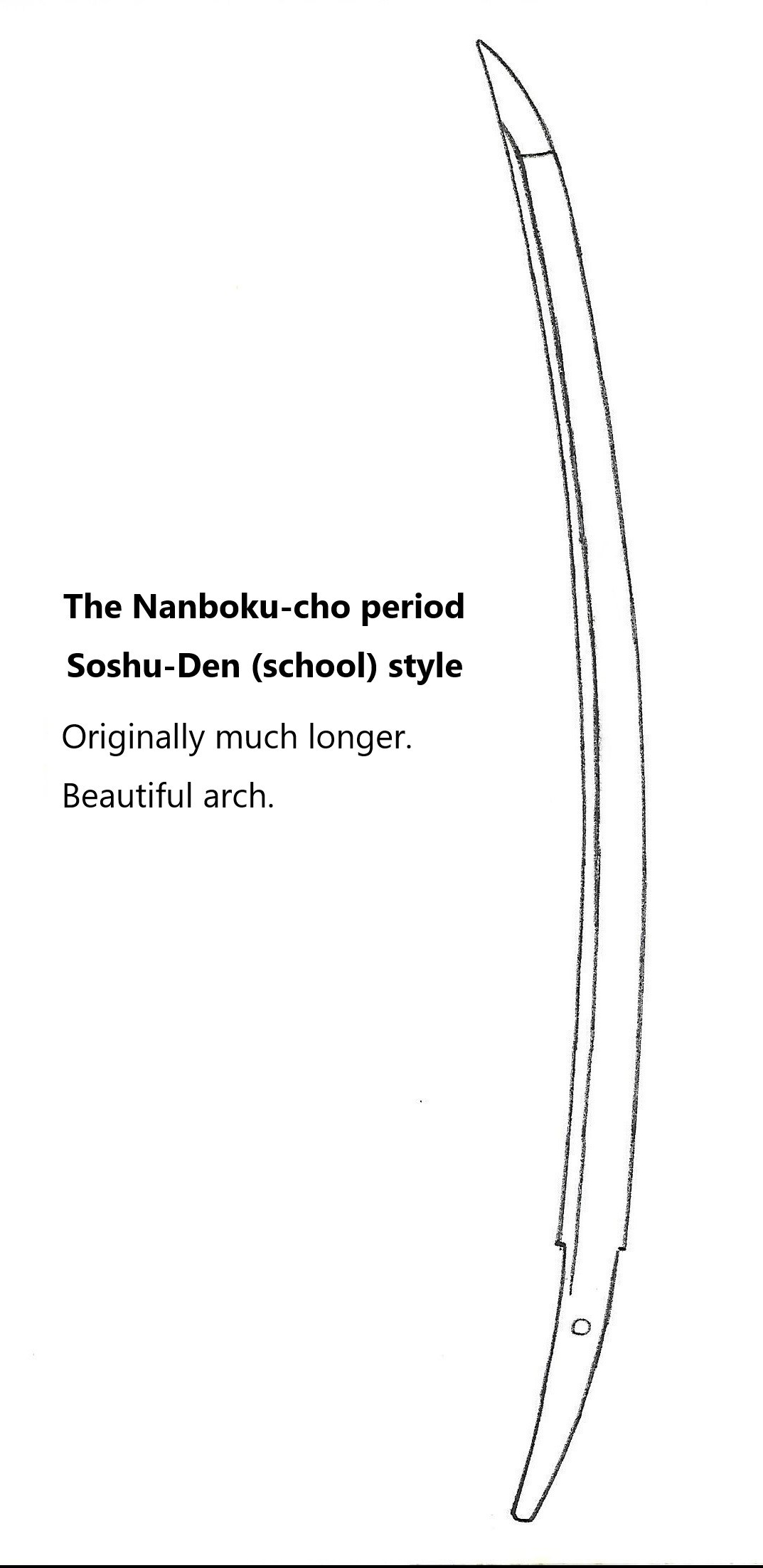
The drawing below is an illustration from Chapter 18, Nanboku-cho Period Sword.  Please compare this drawing to the photo on the right.  It shows the similarity in shape.  Keep in mind that this illustration depicts the shape of a once very long sword that was shortened at a later time.   During the Nanboku-cho period, swordsmiths created 3, 4, or even 5-foot-long blades, but they were later shortened to about 2 to 2.5 feet or so.

19 Nanboku-cho Sword style   55 Sa photo                                         ” Sa” from Sano Museum Catalogue “Reborn” (Permission granted).    Sa” is pronounced like the first sound of “sabotage.”

Chogi* from Sano Museum Catalogue (Permission granted)

        Chogi* is pronounced: Chocho-san’s “cho” and giggle “gi.” 

Chogi‘s sword style is categorized within the Soden-Bizen groupSee, 18 Nanboku-Cho Period Sword.  Chogi (長義) was a swordsmith from the Bizen-den school who created swords with features of the Soshu-denTherefore, in short, it is called Soden-Bizen (Bizen swordsmiths forged in Soshu-den).

 Chogi characteristics

  • Shape ——- Originally very long, but it was shortened to approximately 2 to 2.5 feet.  
  • Hamon ——–Wide showy tempered line.  Nioi, and nie appear.  Sunagashi (砂流し, a brush stroke-like pattern) appears.  Notare (wavy) mixed with gunome.  Sometimes Chogi created the double gunome-style hamon (a connected pair of half-circles). This shape resembles a pair of earlobes.  Therefore, it is called Chogi’s mimigatamidare (irregular hamon mixed with a pattern resembling the earlobe).                                                                                                                  
  • Boshi ——————————— Irregular midare and sharp turn back
  • Ji-hada —————————————— Itame (a wood grain pattern)

 Aoe from Sano Museum Catalogue (Permission granted)

55 Aoe  55 Aoe ilustlation                

Aoe (青江) is pronounced “A” like apple, “o” like original, and “e” like an egg.  Aoe was a swordsmith from Bittchu (備中) province, located next to Bizen.  Therefore, the characteristics of Ko-aoe (old Aoe) and Ko-Bizen (old Bizen) are similar.

55 Bizen Bittchu map

Characteristic of Aoe (青江)

The height of the Aoe group occurred from the middle Kamakura period to the Nanboku-cho period.

One of the characteristics of the Aoe sword is its Aoe-zori shape, which curves a lot at the lower part.                                                                                                              During the Nanboku-cho period, since the Soshu-den was a popular style, even Bizen swordsmiths forged nie, although their main characteristic was nioi.   However, the Bittchu group continued to use nioi.                                                                                       The tempered area tends to be wide.  Sakasa-choji, which means inverted or backward style choji (see the illustration above), is Aoe’s most notable characteristic.  Also, boshi often has a pointed hamon.  It is often said that if you see Sakasa-choji, the sword has a good chance of being from either the Aoe or Katayama Ichimonji groups.  Sumitetu (澄鉄:  black core metal shows through) is another characteristic of Aoe’s.