This chapter is a detailed part of Chapter 18, Nanboku-cho Sword. Please read Chapter 18 before reading this section.

The red circle above indicates the time we discuss in this section
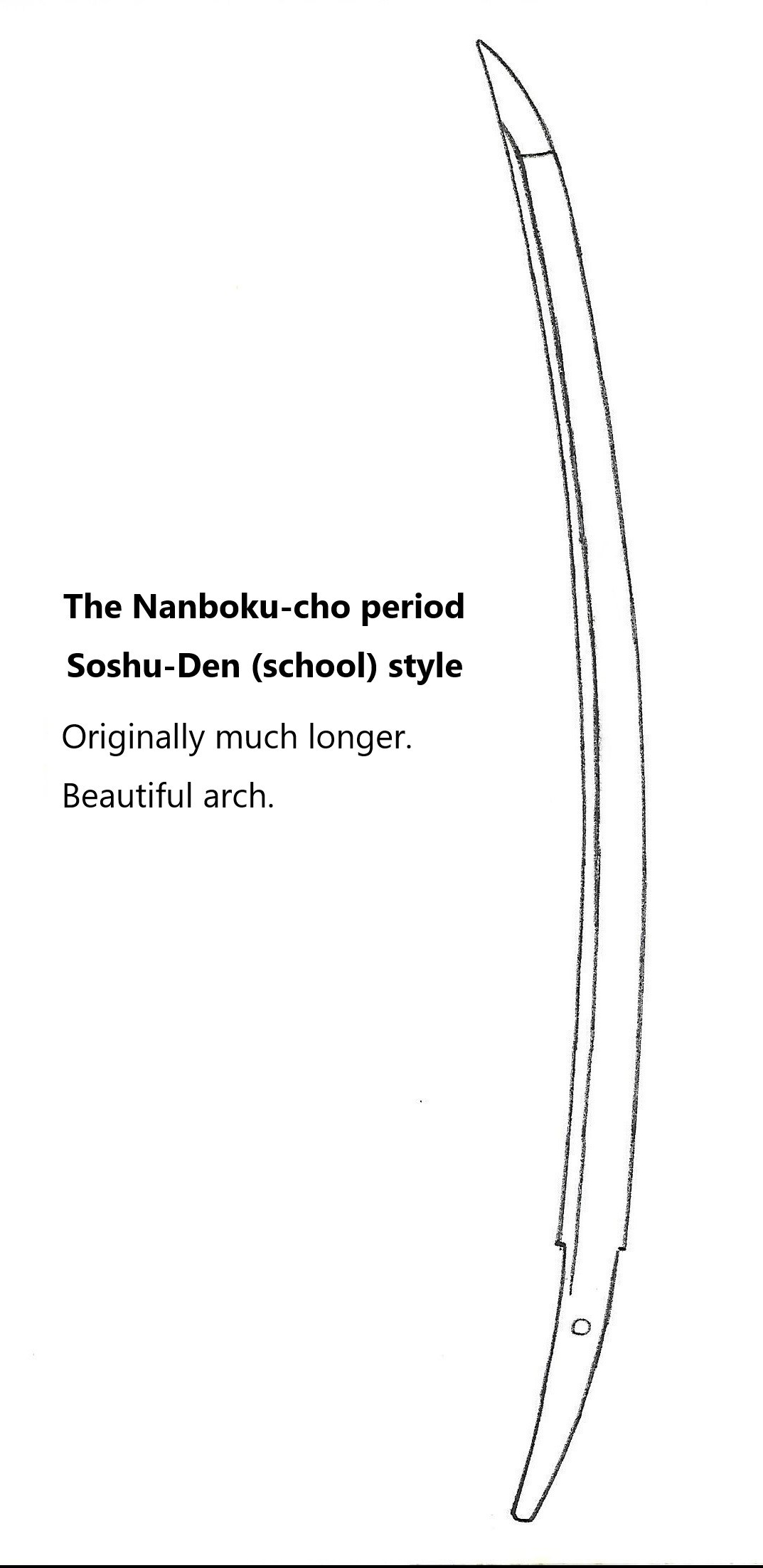
The drawing below is an illustration from Chapter 18, Nanboku-cho Period Sword. Please compare this drawing to the photo on the right. It shows the similarity in shape. Keep in mind that this illustration depicts the shape of a once very long sword that was shortened at a later time. During the Nanboku-cho period, swordsmiths created 3, 4, or even 5-foot-long blades, but they were later shortened to about 2 to 2.5 feet or so.
 ” Sa” from Sano Museum Catalogue “Reborn” (Permission granted). “Sa” is pronounced like the first sound of “sabotage.”
Chogi* from Sano Museum Catalogue (Permission granted)

 Chogi* is pronounced: Chocho-san’s “cho” and giggle “gi.”
Chogi‘s sword style is categorized within the Soden-Bizen group. See, 18 Nanboku-Cho Period Sword. Chogi (長義) was a swordsmith from the Bizen-den school who created swords with features of the Soshu-den. Therefore, in short, it is called Soden-Bizen (Bizen swordsmiths forged in Soshu-den).
Chogi characteristics
- Shape ——- Originally very long, but it was shortened to approximately 2 to 2.5 feet.
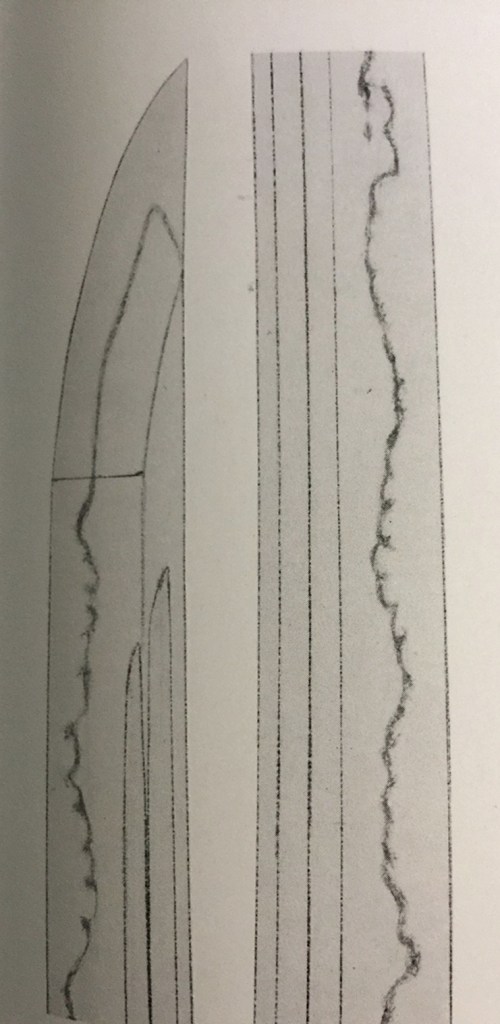
- Hamon ——–Wide showy tempered line. Nioi, and nie appear. Sunagashi (砂流し, a brush stroke-like pattern) appears. Notare (wavy) mixed with gunome. Sometimes Chogi created the double gunome-style hamon (a connected pair of half-circles). This shape resembles a pair of earlobes. Therefore, it is called Chogi’s mimigata–midare (irregular hamon mixed with a pattern resembling the earlobe).
- Boshi ——————————— Irregular midare and sharp turn back
- Ji-hada —————————————— Itame (a wood grain pattern)
Aoe from Sano Museum Catalogue (Permission granted)
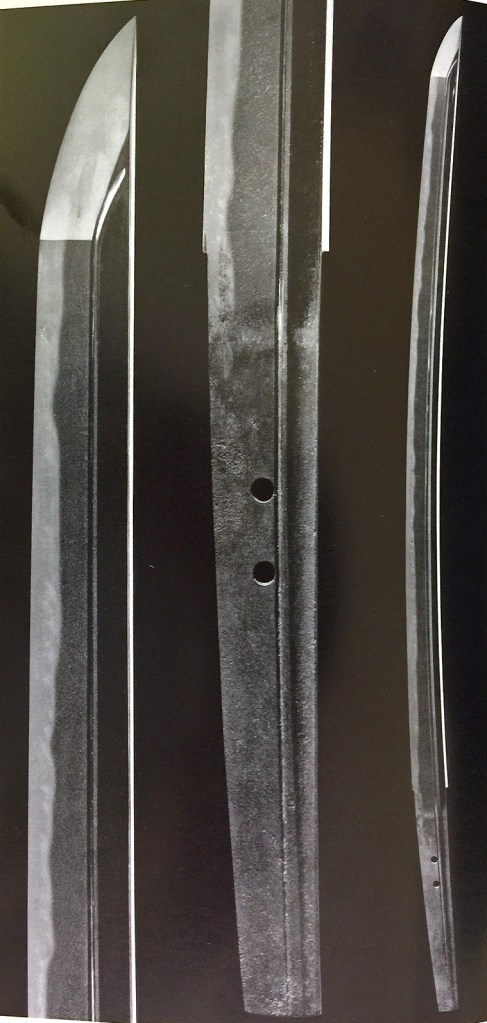
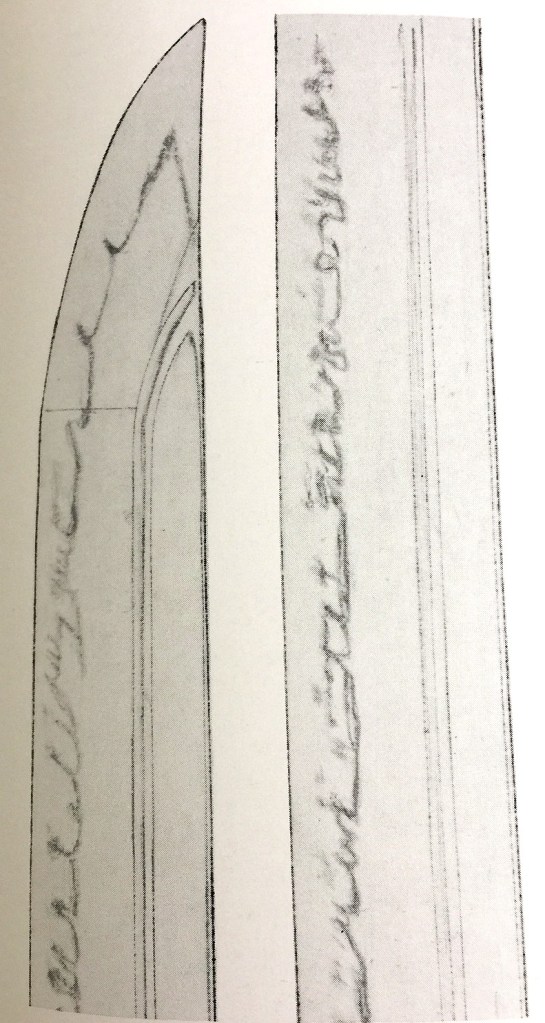 Aoe (青江) is pronounced “A” as in apple, “o” as in original, and “e” as in an egg. Aoe was a swordsmith from Bittchu (備中) province, located next to Bizen. Therefore, the characteristics of Ko-aoe (old Aoe) and Ko-Bizen (old Bizen) are similar.

Characteristic of Aoe (青江)
The height of the Aoe group occurred from the middle Kamakura period to the Nanboku-cho period.
One of the characteristics of the Aoe sword is its Aoe-zori shape, which curves a lot at the lower part. During the Nanboku-cho period, when the Soshu-den was a popular style, even Bizen swordsmiths forged nie, although their main characteristic was nioi. However, the Bittchu group continued to use nioi. The tempered area tends to be wide. Sakasa-choji, which means inverted or backward style choji (see the illustration above), is Aoe’s most notable characteristic. Also, boshi often has a pointed hamon. It is often said that if you see Sakasa-choji, the sword has a good chance of being from either the Aoe or Katayama Ichimonji groups. Sumitetu (澄鉄: black core metal shows through) is another characteristic of Aoe’s.

 Study of Japanese Sword
Lovely long sword!!
Must be very useful for horsemen chasing their targets on the horse!
Thank you very much
LikeLike
Thank you so much for your wonderfull job!!! The best writing on swords and general history of Japan ever!
You are doing one of the most valuable job in Japan historical study as the role and importance of the sword is clearly obvious. You have namaged to show and prove that NIHON TO was THE KEY ELEMENT IN shaping Yamato DAMASHI !!
Kindest regards and thanks
Sasha Sydney, Australia ( originally from Russia)
On Tue, 4 Jun 2019 at 3:15 am Study of Japanese Sword wrote:
> Yurie Endo 遠藤由利江 posted: “This chapter is more detailed part of Chapter > 19. Please read Chapter 19 before this chapter. The drawing below is the > illustration from chapter 19. Compare this illustration and the photos > underneath of it. It shows the similarity of the shape. Keep” >
LikeLike