This chapter explains the process for handling the sword.
- Wear white gloves or hold a handkerchief in both hands.


-
Lightly bow. Hold the tsuka (hilt) with your right hand and the saya (scabbard) with your left hand. Keep the back of the saya facing downward, and the ha facing up. The mune should rest on the inside of the saya. Carefully pull the blade out. Do not let the ha touch the inside wall of the saya to avoid scratches.

- . Place the saya to the left of the sword. Prepare the sword tool.

-
. Push out the mekugi (peg) from the tsuka using the sword tool.

5. Incert the mekugi into the tsuka hole to prevent it from losing it.

6. Remove the habaki (the gold metal square piece above the tsuka) and placeit on the right.


-
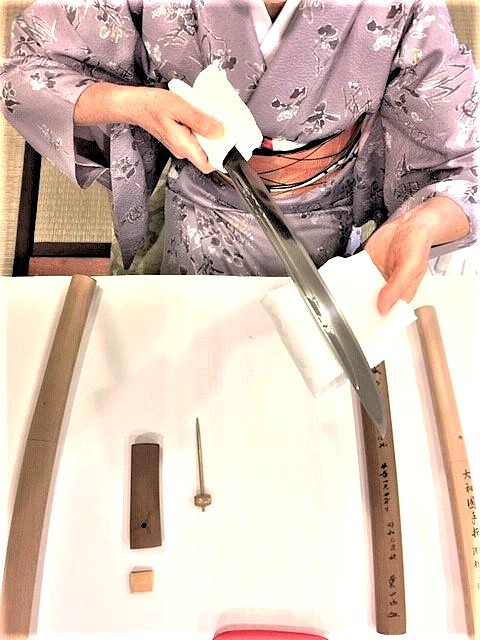
Hold the nakago in your right hand. Support the blade from underneath with your left hand using washi (Japanese rice paper), a handkerchief, or tissue paper.
-
Use light reflection on the blade’s surface, examine the jigane, hamon, boshi, mei, and other features. To observe the hamon, jigane, and boshi clearly, move the sword up, down, or sideways, or rotate it to reflect the light at the proper angle.

-
When you finish examining the sword, bow lightly, and put it back together by reversing the order process.

 Study of Japanese Sword