51| Part 2 of — 17 Nanboku-Cho Period History 1333 – 1392 (南北朝歴史)

This chapter is a detailed part of Chapter 17|Nanboku(Yoshino) Cho Period History (1333-1392).  Please read Chapter 17 before reading this section.

0-timeline - size 24 Nanboku-cho

                      The red circle above indicates the time we discuss in this section

The Nanboku-cho period (1333 – 1392) was between the fall of the Kamakura bakufu and the beginning of the Muromachi bakufu.  It was a time when the Northern and Southern Dynasties coexisted.  Around the time of the Mongolian invasion, Emperor Go-saga died without naming a successor.  Because of that, his two heirs and their family lines, the Daigakuji-to (大覚寺統) and the Jimyoin-to (持明院統), alternately assumed the imperial position after Emperor Go-saga‘s death.  This system was politically unstable.  Additionally, many inconvenient problems arose; for example, while one emperor was still very young, the next-in-line emperor died young from a head injury while playing on a slippery stone.

At a time like this, Go-daigo (後醍醐天皇) became the emperor.  He was placed on the throne as a temporary emperor until the young emperors reached maturity.  Around this time, the emperors’ power was declining.  The Kamakura bakufu (government) controlled the emperors.  After the Mongolian invasion, even though typhoons drove the Mongolian troops away, the Kamakura bakufu faced financial troubles due to the costs of war.  Many samurai who fought during the Mongolian invasion did not receive any rewards or compensation for their expenses and were also financially troubled.  All these problems piled up and caused the resentment against the Kamakura bakufu.

Emperor Go-Daigo refused to be merely a placeholder emperor.  He decided to stay as emperor and attack the Kamakura bakufu.  For some reason, the Kamakura bakufu found out about his plans.  Emperor Go-Daigo somehow managed to avoid being accused of being the instigator.  Afterwards, the Kamakura bakufu appointed another heir for the next emperor.  However, Go-Daigo insisted on remaining emperor.  He planned another attack once more.  This time, he had carefully planned and allied with prominent, powerful temples in Yamato (Nara today) since the Kamakura bakufu did not control themRefer to 15 Revival of Yamato Den (大和伝復活)  and 49 Part 2 of– 15 The Revival of Yamato Den. 

This time again, the rebellion plot came to light.  Go-Daigo sneaked out of Kyoto and fought against the Kamakura army.  Although Go-Daigo’s army had fewer soldiers than the Kamakura army, several groups opposing the Kamakura bakufu rose up in various parts of Japan.  Eventually, Go-Daigo was captured and sent to Oki Island (the same place where Emperor Go-Toba was exiled).  

Even after exiling Emperor Go-Daigo to Oki Island, the Kamakura bakufu still had to fight against other uprising groups.  One of the most famous rebels was Kusunoki Masashige (楠正成).  Go-Daigo’s son also actively fought against the Kamakura bakufu and managed to ally with more factions.

More and more people sought to overthrow the Kamakura bakufu.   Even Ashikaga Takauji (足利尊氏), one of the top men of the Kamakura bakufu who fought against Emperor Go-Daigo, betrayed the Kamakura and switched sides, becoming the emperor’s ally.  Meanwhile, Go-Daigo escaped from Oki Island.  More and more uprisings against the Kamakura bakufu increased across the country.  Eventually, the main political center, Rokuhara Tandai (六波羅探題) of the Kamakura bakufu, fell.  Nitta Yoshisada (新田義貞)*, who led another uprising group, attacked Kamakura and won.  The Kamakura bakufu fell in 1333. 

Emperor Go-Daigo initiated a new political system called Kenmu no Shinsei (建武の新政).  However, his new system turned out to be a disaster.  He made great efforts to set things right and drastically changed the old political system.  Yet, this political reform created big unrest.  It was not beneficial for anyone, and no one gained anything.  Ashikaga Takauji (one of the key figures of merit) and his men did not receive any high-ranking positions.  This reform was highly idealistic and too advanced for its time.  It proved disadvantageous for the noblemen.  His new policies only caused chaos and corruption.

Now, Ashikaga Takauji turned against Go-Daigo and defeated him.  Go-Daigo left the Imperial Palace and established a new government in Yoshino, south of Kyoto.         Therefore, it was called the Southern Dynasty.  Meanwhile, Ashikaga Takauji set up a new emperor, Emperor Komyo (光明), in Kyoto and established the Northern Dynasty.     This is how the Northern and Southern Dynasties arose. 

Two dynasties co-existed for about 60 years.  Gradually, many samurai groups moved to the Northern Dynasty, and after Go-Daigo and several of his key men died, the Southern Dynasty weakened.  Eventually, the Southern Dynasty accepted an offer from the Ashikaga side, and the North and South united in 1392.  Throughout these conflicts between the emperor and the Kamakura bakufu, sword styles became broader and longer, reaching 3, 4, or even 5 feet.  Later, most Nanboku-cho (North and South Dynasties) style long swords were shortened.

53 Ashikaga Takauji

Kibamusha (騎馬武者蔵) This portrait was once believed to depict Ashikaga Takauji, but now some claim otherwise. “Public Domain” owned by the Kyoto National Museum

 *Nitta Yoshisada (新田義貞)

When Minamoto-no-Yoritomo established the Kamakura bakufu, he chose the Kamakura area as its center because it is surrounded by mountains on three sides and one side faces the ocean.  This made it hard to be attacked and easier for them to defend themselves.  They built seven narrow, steep roads through the mountains called Kir- toshi (切り通し), connecting with several major cities.  These seven routes were the only roads in and out of Kamakura

When Nitta Yoshisada attempted to attack Kamakura, he first attempted the land route but failed.  He then approached the town from the ocean side, but the cliff stretched far out into the sea, making it impossible for them to pass.  The legend says that when Nitta Yoshisada reached the area called Inamura Gasaki (稲村ヶ崎), he threw his golden sword into the ocean and prayed.  Then the tide receded, allowing all the soldiers to walk around the cliff on foot.  They charged into Kamakura, and the Kamakura bakufu fell.  There are several different views on this story.  Some scholars argue it is not true; some say it happened, but the date was wrong; others say that an unusual ebb tide occurred that day, and so on.  

Today, Inamura Gasaki in the Shonan area (湘南) is one of the favorite evening dating spots for young people.  The evening view at Inamura Gasaki is beautiful.    The sunset over Inamura Gasaki towards Enoshima (江の島, a small island with a shrine on the hilltop) is stunning.   My parents’ house used to sit above the cliff in an area called Kamakura-yama, overlooking the ocean.
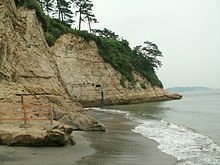
53 Inamura gasaki

Inamura Gasaki      Photo is “Creative Commons” CC 表示-継承 3.0 File: Inamuragasaki tottanbu.jpg    Public domain

40|Part 2 of — 7 Overview of Kamakura Period Sword (鎌倉太刀概要)

This chapter is a detailed part of Chapter 7, an overview of the Kamakura Period Swords.  Please read  Chapter 7, Overview of the Kamakura Period Swords, before reading this section. 

0-timeline - size 24 Kamakura Period

                         The red circle above indicates the time we discuss in this section.

The Kamakura period was a golden age of sword-making.  About half of the well-known swords today were produced during this time.  This is probably because the war between the Genji and the Heishi demanded many swords, and swordsmiths improved their skills through wartime experience.  Also, Emperor Gotoba (後鳥羽) invited many talented swordsmiths to his palace, treated them favorably, and encouraged them to create excellent swords by granting them high ranks.  During the Kamakura period, sword-making techniques greatly improved.

Middle Kamakura Period —- Yamashiro-den (山城伝)

The middle Kamakura period was the height of the Yamashiro-den.  Within the Yamashiro-den, there were three main groups: the Ayanokoji group (綾小路), Awataguchi group (粟田口), and Rai group (来).                                                                                                                       Among the Awataguchi group, six swordsmiths received the honor of “Goban-kaji ” from Emperor Gotoba (後鳥羽上皇).  Awataguchi is the name of an area in Kyoto. 

The Ayanokoji ( 綾小路 ) group lived in the Ayanokoji area of Kyoto.  My sword textbook had a note indicating that I had seen Ayanokoji Sadatoshi (綾小路定利) on March 22, 1972.  My note was brief, only a few words: o-suriage, funbari, narrowbody, and ji-nie

The Rai group originated from Rai Kuniyuki (来国行 ).  Rai Kuniyuki and Ayanokoji Sadatoshi were believed to have been close friends.  Rai Kuniyuki created many well-known swords.  His famous Fudo Kuniyuki (不動国行) was once owned by Shogun Ashikaga Yoshiteru (足利義輝 ), then passed to Matsunaga Danjo (松永弾正), then to Oda Nobunaga ( 織田信長 ), then to Akechi Mitsuhide (明智光秀 ), and eventually to Toyotomi Hideyoshi (豊臣秀吉).  All of them were historically famous and influential daimyo.  It is said that Toyotomi Hideyoshi held this sword during the memorial service for Oda Nobunaga.  Rai Kuniyuki’s son was Niji Kunitoshi.  He also forged well-known swords. 

Middle Kamakura Period —– Bizen-den (備前伝)                                                              

The Bizen-den during the Heian period was called Ko-bizen.  They are similar to those in the Yamashiro-den style.  The true height of the Bizen-den was during the middle Kamakura period.  The Bizen area (today’s Okayama Prefecture) had many ideal conditions for sword-making: a good climate, abundant iron resources, plenty of wood for fuel, and a convenient location.  Naturally, many swordsmiths moved there, and it became a major center for sword production. 

The Bizen region produced many swords of higher quality and superior to those of other sword groups and more famous swordsmiths.  Fukuoka Ichimonji Norimune (則宗) and his son Sukemune (助宗 ) received the honor of the Goban-kaji from Emperor Gotoba.   Among the Osafune group (長船), the famous Mitsutada (光忠) and Nagamitsu (長光) appeared.  My father owned four Mitsutada bladesThree tachis and one tanto.  He was so proud of owning four Mitsutada blades that he asked his tailor to monogram Mitsutada on the inside pocket of his suit jacket. 

From the Hatakeda group (畠田), Hatakeda Moriie (畠田守家), and from the Ugai (鵜飼) group, Unsho (雲生 ) and Unji (雲次) appeared.  The famous Kunimune (国宗) also emerged around this time.   Since many swordsmiths worked in the Bizen-den, many Bizen swords exist today.  Each swordsmith displayed his own characteristics in the swords.  Therefore, doing the kantei of Bizen swords can be quite complex. 

The classification of the sword ranking from the top

  1. Kokuho (国宝: National Treasure)
  2. Jyuyo Bunkazai (重要文化財: Important Cultural Property)
  3. Jyuyo Bijutsu Hin (重要美術品: Important Artwork)
  4. Juyo Token (重要刀剣: Important Sword)        more to follow

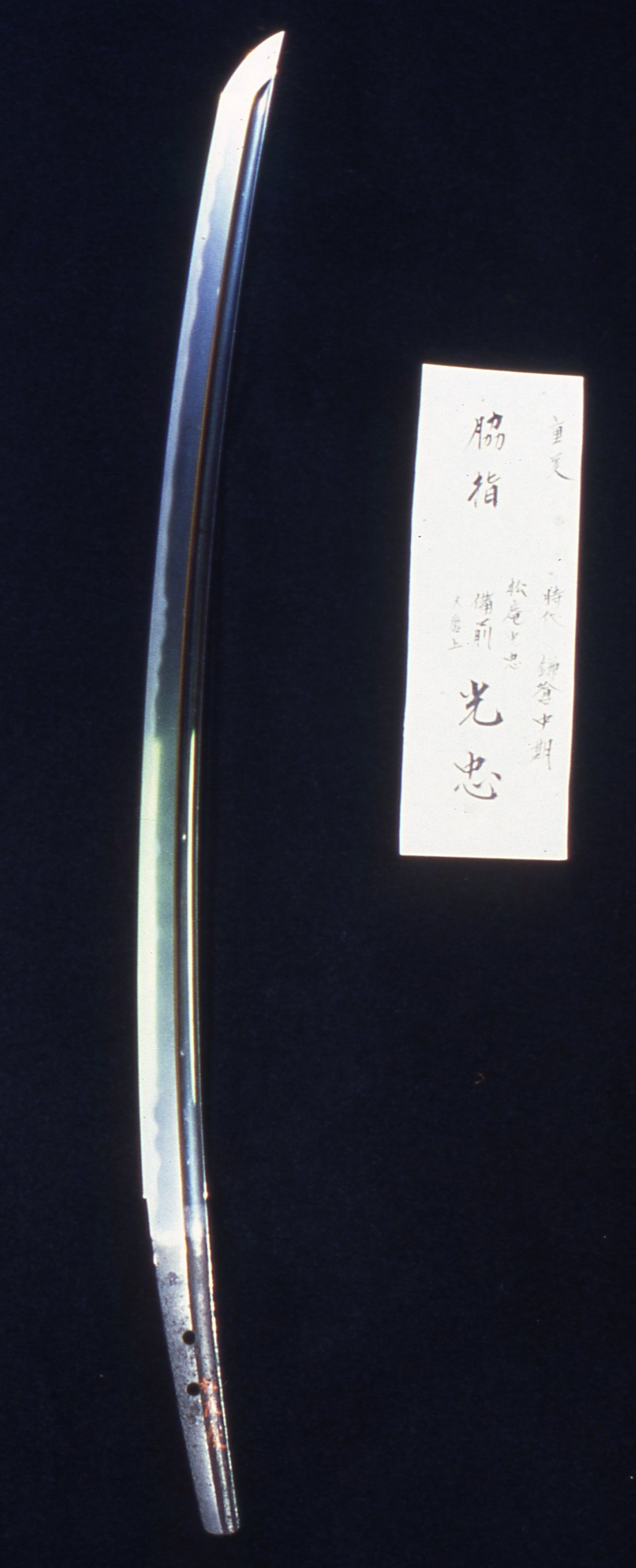
Here are my father’s four Bizen Osafune Mitsutada swords. He took these pictures many years ago at home. It is clear that he was not much of a photographer.  On a rectangular  sheet of white paper, he wrote the name of the swordsmith, the period when the sword was made, the name(s) of the daimyo who owned it in the past, and its classification.

img027               img028                Osafune Mitsutada (Juyo Bukazai)                 Osafune Mitsutada (Juyo Bunakzai)
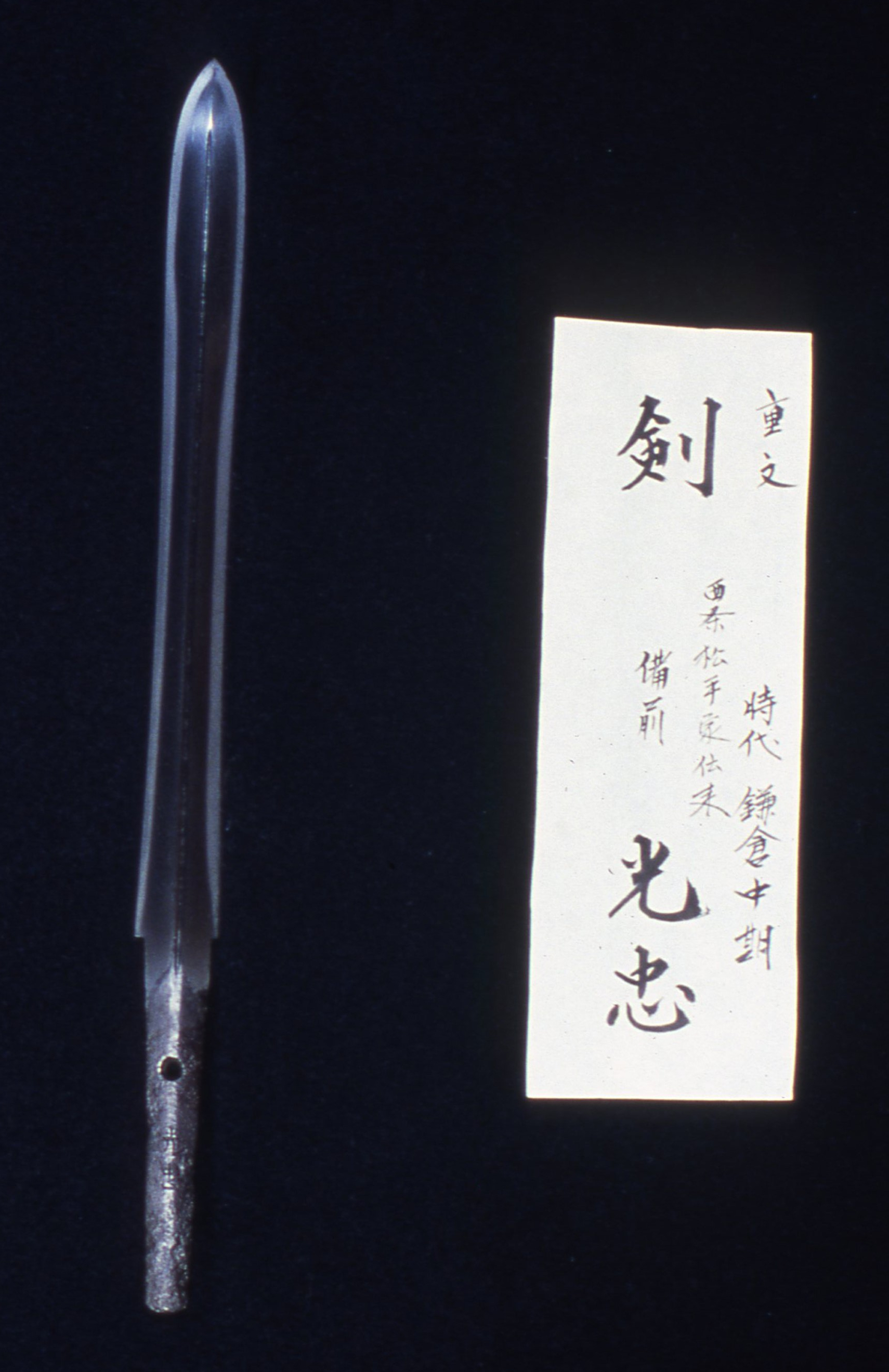
img029            img030 Osafune Mitsutada (Juyo Token)                 Osafune Mitsutada(Juyo Bunkazai)
Late Kamakura Period —– Soshu Den (相州伝 )

Yamashiro-den began to decline in the latter part of the Kamakura period.  At this time, many swordsmiths moved to the Kamakura area under the new power of the Kamakura bakufu (鎌倉幕府), led by the Hojo clan.  The new group, Soshu-den (相州伝 ), began to emerge.  Fukuoka Ichimonji Sukezane (福岡一文字助真) and Kunimune (国宗) from Bizen moved to KamakuraToroku Sakon Kunitsuna (藤六左近国綱) from the Awataguchi group of Yamashiro-den also moved to Kamakura.  These three are considered the founders of the Soshu-den in Kamakura.  Kunitsunas son was Tosaburo Yukimitsu, and his grandson was the famous Masamune (正宗)Outside Kamakura, Yamashiro Rai Kunitsugu (来国次), Go-no-Yoshihiro (郷義弘) from the Ettchu (越中) province, and Samoji  (左文字) from Chikuzen Province (筑前) were active swordsmiths.

10| Jokyu-no-ran 1221 (承久の乱)

0-timeline - size 24 jyokyuu no ran
 
 The circle indicates the time we discuss in this section.

Jyokyu-no-Ran (承久の乱)

After Minamoto-no-Yoritomo (源頼朝) died, his son, Yoriie (頼家), became shogun.  His mother, Hojo Masako (北条政子), Yoritomo‘s wife, thought her son was too incompetent.  She worried others might take over the Kamakura bakufu (Kamakura government).  To prevent this, she established a council of 13 members, including herself, her father, Hojo Tokimasa (北条時政), and her brother, Hojo Yoshitoki (北条義時). 

Shogun Yoriie’s in-laws gained power over time.  During the Heian and Kamakura periods, the wife’s family was considered very important.  To suppress her son’s in-laws, Masako and her father, Tokimasa, planned and carried out Yoriie’s assassination.

After Yoriie‘s death, Masako’s younger son, Sanetomo (実朝), became the next shogun.  Now, his grandfather, Hojo Tokimasa’s second wife, wanted her son-in-law to be the next shogun.  To please his young wife, Hojo Tokimasa attempted to kill Sanetomo but failed.  When she found out about the plot, Hojo Masako imprisoned her father, Tokimasa.  Although Sanetomo was Masako’s son, she was once again very disappointed by his incompetence.  Ultimately, Shogun Sanetomo was killed by his nephew Kugyo, the son of the previous shogun, Yoriie

After all these incidents, Masako’s brother, Hojo Yoshitoki, took control of the Kamakura bakufu and installed a figurehead from the Fujiwara family, a powerful aristocratic family in Kyoto.   After all the turmoil, the Hojo family eventually gained complete control of the Kamakura bakufu (government).

Meanwhile, in Kyoto, Emperor Gotoba was planning an attack on the Kamakura bakufu.  He had built up military strength.  When Sanetomo was killed, Emperor Gotoba saw an opportunity to attack Kamakura.  He ordered local feudal lords to attack the Kamakura bakufu, but few obeyed.  Instead, the Hojo family captured the emperor and exiled him to Oki Island.  This occurred in 1221 and is known as Jokyu-no-ran or Jokyu-nohen.

Emperor Gotoba encouraged sword-making and showed respect for swordsmiths.     After the Jokyu-no-ran, the Imperial family’s power declined, and the Kamakura bakufu became a strong and stable regime.  From the time of Minamoto-no-Yoritomo‘s death until the end of the Jokyu-no-ran, the Kamakura bakufu remained unstable.  It was Hojo Masako who led the Kamakura bakufu to a stable regime.  She was called “Ama Shogun” or “Nun Shogun.”   She was a sharp, talented, yet tough, critical, and often harsh politician.

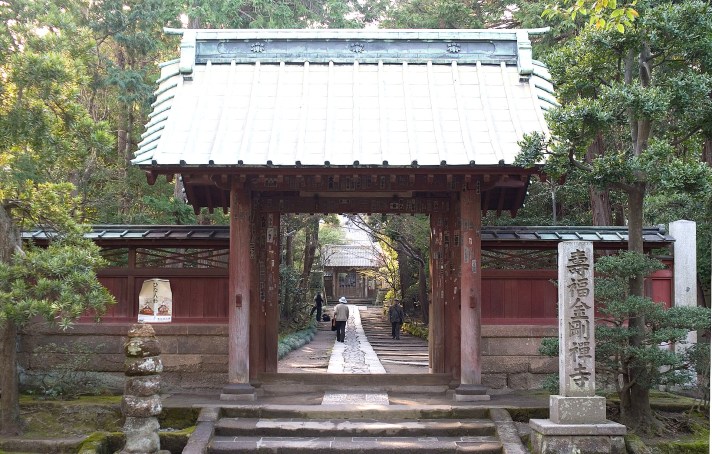
Kamakura locals, including myself, hold Hojo Masako in high regard Minamoto-no- Yoritomo and Hojo Masako are both buried in Kamakura City.  Minamoto-no-Yoritomo is at Shirahata Shrine (白幡神社), and Hojo Masako is at Jufukuji Temple (寿福寺). 

Kamakura is roughly an hour from Tokyo by train on the Yokosuka Line.  Both Jufuku-ji Temple and Shirahata Shrine are within walking distance of Kamakura Station.


Jufuku-ji (寿福寺) Temple, sourced from Wikimedia Commons, the free media repository

The tomb of Minamoto-no-Yoritomo.  From Wikimedia Commons, the free media repository.