43 | Part 2 of –10 Jyokyu-no-Ran and Gotoba-joko (承久の乱)

This chapter is a detailed part of Chapter 10, Jyokyu-no-Ran (承久の乱 ) 1221.  Please read Chapter 10 before reading this section.

0-timeline - size 24 jyokyuu no ran

                            The red circle above indicates the time we discuss in this chapter.

Chapter 10 explained how Jokyu-no-ran (承久の乱) started.  In the end, Emperor Gotoba (or Gotoba Joko) was exiled to Oki Island (隠岐の島). 

Emperor Gotoba was a highly talented individual in many fields.  He was good at waka (和歌), a Japanese short poem.   To compose a waka requires including several elements, such as scenery, the season, personal feelings expressed with refined sentiment, or the surrounding environment, all within a very limited number of words.  It requires literary talent.  He was also proficient in equestrianism, kemari (a ball game played by the upper class at that time), swimming, sumo wrestling, music, archery, swordsmanship, calligraphy, painting, and even sword-making.  His contributions to the sword field led to the golden age of sword-making during the middle Kamakura period.  Surprisingly, Gotoba Joko was not only talented in many different arts but also mastered them at the highest level.  His waka (poetry) was particularly highly regarded.  He edited the Shin- Kokin- wakashu (新古今集), a collection of 1980 waka poems.                                                                          

Emperor Gotoba, Enthroned at the Age Four

Emperor Gotoba was enthroned at the age of four (some say three).  The problem was that Emperor Antoku was already on the throne.  They were both about the same age.  Having two emperors simultaneously creates a problem.  How did this happen? 

To establish a new emperor, the head of the imperial family must appoint the next emperor.  While Emperor Go-Shirakawa (後白河天皇) was imprisoned, Emperor Antoku was appointed by Taira-no-Kiyomori (平清盛).  Although Kiyomori was the head of the Heishi, the most powerful samurai group, he was not a member of the imperial family.  That went against tradition.  This was unacceptable to Emperor Go-Shirakawa (後白河天皇).  Emperor Go-Shirakawa was furious at Taira-no-Kiyomori; he chose Emperor Gotoba and enthroned him.  This is why the two emperors coexisted.  

There was one more thing.  To be an emperor, one must possess the Sanshu-no-jingi (三種の神器: Three imperial regalia). These are the three items an emperor needs to have to be a legitimate emperor.  They are a mirror, a sacred sword, and a magatama (jewelry)*.   

However, the Sanshu-no-jingi were taken by the Heike family along with Emperor Antoku when they fled from the Genji.  The Heike clan was chased by the Genji all the way to Dan-no-ura (壇ノ浦), where they were defeated.   Dan-no-ura is a sea located between Kyushu (九州) and Honshu (本州).  When it became clear to the Heike family that they had been defeated, all of the Heike people, including the young Emperor Antoku, jumped into the sea and drowned.  They took the Sanshu-no-jingi with them into the sea.  

Later, people frantically searched for the Sanshu-no-jingi; however, they only recovered the jewelry and the mirror, not the sword.  Because of tradition, the emperor must possess the Sanshu-no-jingi; otherwise, he would not be recognized as a legitimate emperor.  Gotoba Joko was tormented for a long time for not having all three. 

Today, the jewelry is with the current emperor’s family, and the mirror is at the Ise Jingu Shrine (伊勢神宮).  The sword is still missing somewhere in the ocean.  Some say that the sword that fell into the sea was a replica, and the one kept at Atsuta Jingu Shrine (熱田神宮) is the real one.                                                                                                                                                 * Sanshu-no-Jingi (三種の神器) ————- 1. The sword; Kusanagi-no-tsurugi (草薙の剣)   2. The mirror; Yata-no-kagami (八咫の鏡),   3. The magatama (Jewelry); Yasakani-no-magatama (八尺瓊勾玉) by Token World: www.touken-world.jp/tips/32747/

Politics by Emperor Gotoba

Emperor Gotoba sought to regain political power from the Kamakura bakufu.  He was impulsive, passionate, unpredictable, and quick-tempered.  He tried to revive the Chotei (朝廷) power.  The Chotei is the central government controlled by the emperor and aristocrats.  Emperor Gotoba decided to rely on the armed forces to achieve this goal and established the Saimen no Bushi (armed forces directly under the emperor).

Upon seeing Minamoto-no-Sanetomo dead, he realized that the Kamakura bakufu was in turmoil.  Recognizing this as a good chance, he sent out the emperor’s order to all the daimyo to fight against the Kamakura bakufu.  He expected an easy victory, but the Kamakura bushi remained strongly united and fought well under Hojo Masako’s leadership, the “Nun Shogun.”   She organized a strongly united armed force, while Emperor Gotoba’s side was disorganized.  They were not accustomed to fighting.   

In the end, Emperor Gotoba’s side lost.  When he realized he had lost, he claimed it was not he but his men who had acted independently.  He insisted that it had nothing to do with him.  Therefore, it was wrong to punish him.  But of course, Hojo Masako and the Kamakura bakufu did not believe Emperor Gotoba and exiled him to Oki Island.  Emperor Gotoba ended his life there.  Although he was intelligent and accomplished in many areas, he could not defeat the grandma, “Nun Shogun,” Hojo Masako.

Sword-Making by Gotoba Joko

Gotoba Joko had an exceptional ability to evaluate swords, and he became a great swordsmith himself.   He invited many top-level swordsmiths from various groups to his court, gave them titles, and treated them with respect.  He also appointed them as his instructors and assistants.  Gotoba Joko brought in skilled swordsmiths from various places in rotation.  Those who were invited to the palace were called gobankaji (御番鍛冶), an honorary title.  On the sword he created, he inscribed a chrysanthemum with 16 petals.  The current emperor still uses this design as his imperial crest.  The sword with the chrysanthemum design is called Kikugosaku (菊御作).                                                                                                

Today, you can visit the Emperor Gotoba Museum on Oki Island, where some sites are believed to be the emperor’s sword-making site.  Some people say it is debatable whether these sites are real.  Today, Oki Island is a beautiful resort destination.  It can be reached by ferry from Shimane Prefecture, which takes about two hours.  It can also be reached by airplane directly from Osaka.
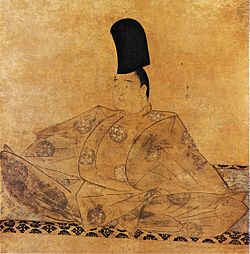
11 «part 2» Gotoba Joko photo

          Gotoba Joko, owned by Minase Shrine (This picture is in the public domain)

40|Part 2 of — 7 Overview of Kamakura Period Sword (鎌倉太刀概要)

This chapter is a detailed part of Chapter 7, an overview of the Kamakura Period Swords.  Please read  Chapter 7, Overview of the Kamakura Period Swords, before reading this section. 

0-timeline - size 24 Kamakura Period

                         The red circle above indicates the time we discuss in this section.

The Kamakura period was a golden age of sword-making.  About half of the well-known swords today were produced during this time.  This is probably because the war between the Genji and the Heishi demanded many swords, and swordsmiths improved their skills through wartime experience.  Also, Emperor Gotoba (後鳥羽) invited many talented swordsmiths to his palace, treated them favorably, and encouraged them to create excellent swords by granting them high ranks.  During the Kamakura period, sword-making techniques greatly improved.

Middle Kamakura Period —- Yamashiro-den (山城伝)

The middle Kamakura period was the height of the Yamashiro-den.  Within the Yamashiro-den, there were three main groups: the Ayanokoji group (綾小路), Awataguchi group (粟田口), and Rai group (来).                                                                                                                       Among the Awataguchi group, six swordsmiths received the honor of “Goban-kaji ” from Emperor Gotoba (後鳥羽上皇).  Awataguchi is the name of an area in Kyoto. 

The Ayanokoji ( 綾小路 ) group lived in the Ayanokoji area of Kyoto.  My sword textbook had a note indicating that I had seen Ayanokoji Sadatoshi (綾小路定利) on March 22, 1972.  My note was brief, only a few words: o-suriage, funbari, narrowbody, and ji-nie

The Rai group originated from Rai Kuniyuki (来国行 ).  Rai Kuniyuki and Ayanokoji Sadatoshi were believed to have been close friends.  Rai Kuniyuki created many well-known swords.  His famous Fudo Kuniyuki (不動国行) was once owned by Shogun Ashikaga Yoshiteru (足利義輝 ), then passed to Matsunaga Danjo (松永弾正), then to Oda Nobunaga ( 織田信長 ), then to Akechi Mitsuhide (明智光秀 ), and eventually to Toyotomi Hideyoshi (豊臣秀吉).  All of them were historically famous and influential daimyo.  It is said that Toyotomi Hideyoshi held this sword during the memorial service for Oda Nobunaga.  Rai Kuniyuki’s son was Niji Kunitoshi.  He also forged well-known swords. 

Middle Kamakura Period —– Bizen-den (備前伝)                                                              

The Bizen-den during the Heian period was called Ko-bizen.  They are similar to those in the Yamashiro-den style.  The true height of the Bizen-den was during the middle Kamakura period.  The Bizen area (today’s Okayama Prefecture) had many ideal conditions for sword-making: a good climate, abundant iron resources, plenty of wood for fuel, and a convenient location.  Naturally, many swordsmiths moved there, and it became a major center for sword production. 

The Bizen region produced many swords of higher quality and superior to those of other sword groups and more famous swordsmiths.  Fukuoka Ichimonji Norimune (則宗) and his son Sukemune (助宗 ) received the honor of the Goban-kaji from Emperor Gotoba.   Among the Osafune group (長船), the famous Mitsutada (光忠) and Nagamitsu (長光) appeared.  My father owned four Mitsutada bladesThree tachis and one tanto.  He was so proud of owning four Mitsutada blades that he asked his tailor to monogram Mitsutada on the inside pocket of his suit jacket. 

From the Hatakeda group (畠田), Hatakeda Moriie (畠田守家), and from the Ugai (鵜飼) group, Unsho (雲生 ) and Unji (雲次) appeared.  The famous Kunimune (国宗) also emerged around this time.   Since many swordsmiths worked in the Bizen-den, many Bizen swords exist today.  Each swordsmith displayed his own characteristics in the swords.  Therefore, doing the kantei of Bizen swords can be quite complex. 

The classification of the sword ranking from the top

  1. Kokuho (国宝: National Treasure)
  2. Jyuyo Bunkazai (重要文化財: Important Cultural Property)
  3. Jyuyo Bijutsu Hin (重要美術品: Important Artwork)
  4. Juyo Token (重要刀剣: Important Sword)        more to follow

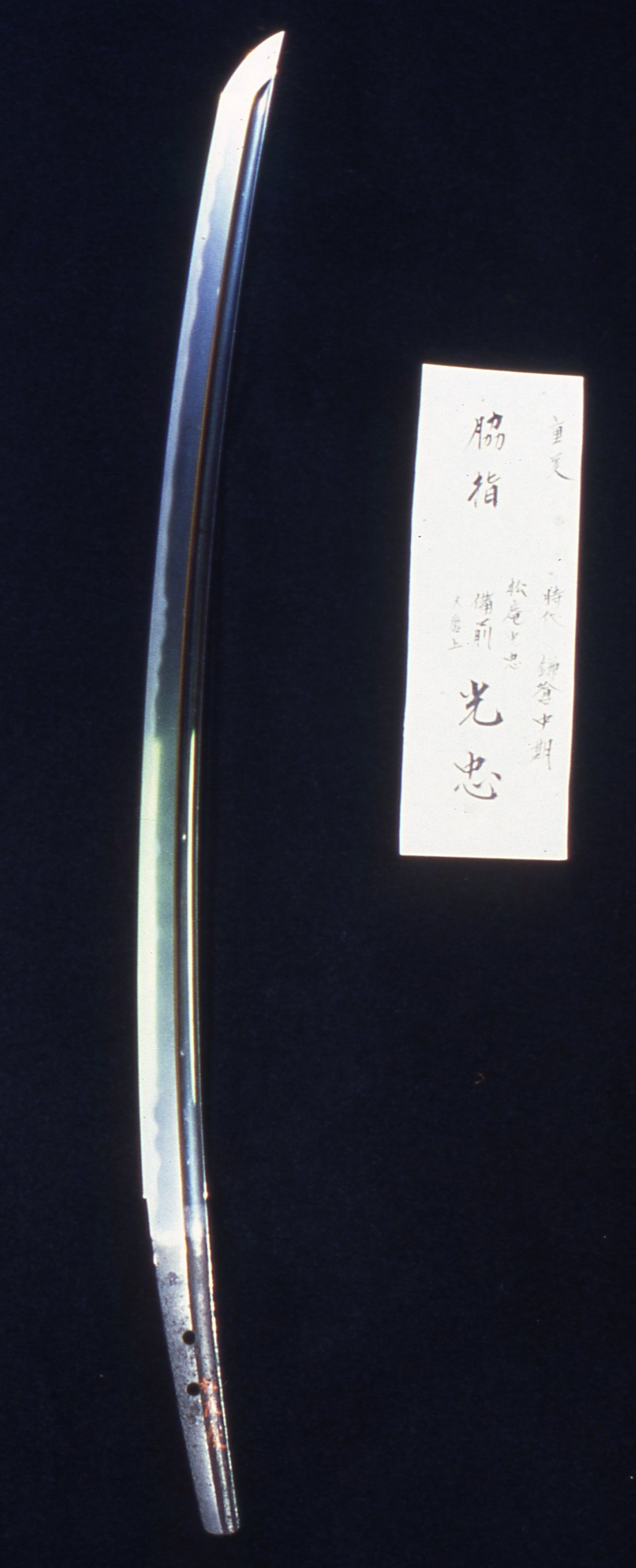
Here are my father’s four Bizen Osafune Mitsutada swords. He took these pictures many years ago at home. It is clear that he was not much of a photographer.  On a rectangular  sheet of white paper, he wrote the name of the swordsmith, the period when the sword was made, the name(s) of the daimyo who owned it in the past, and its classification.

img027               img028                Osafune Mitsutada (Juyo Bukazai)                 Osafune Mitsutada (Juyo Bunakzai)
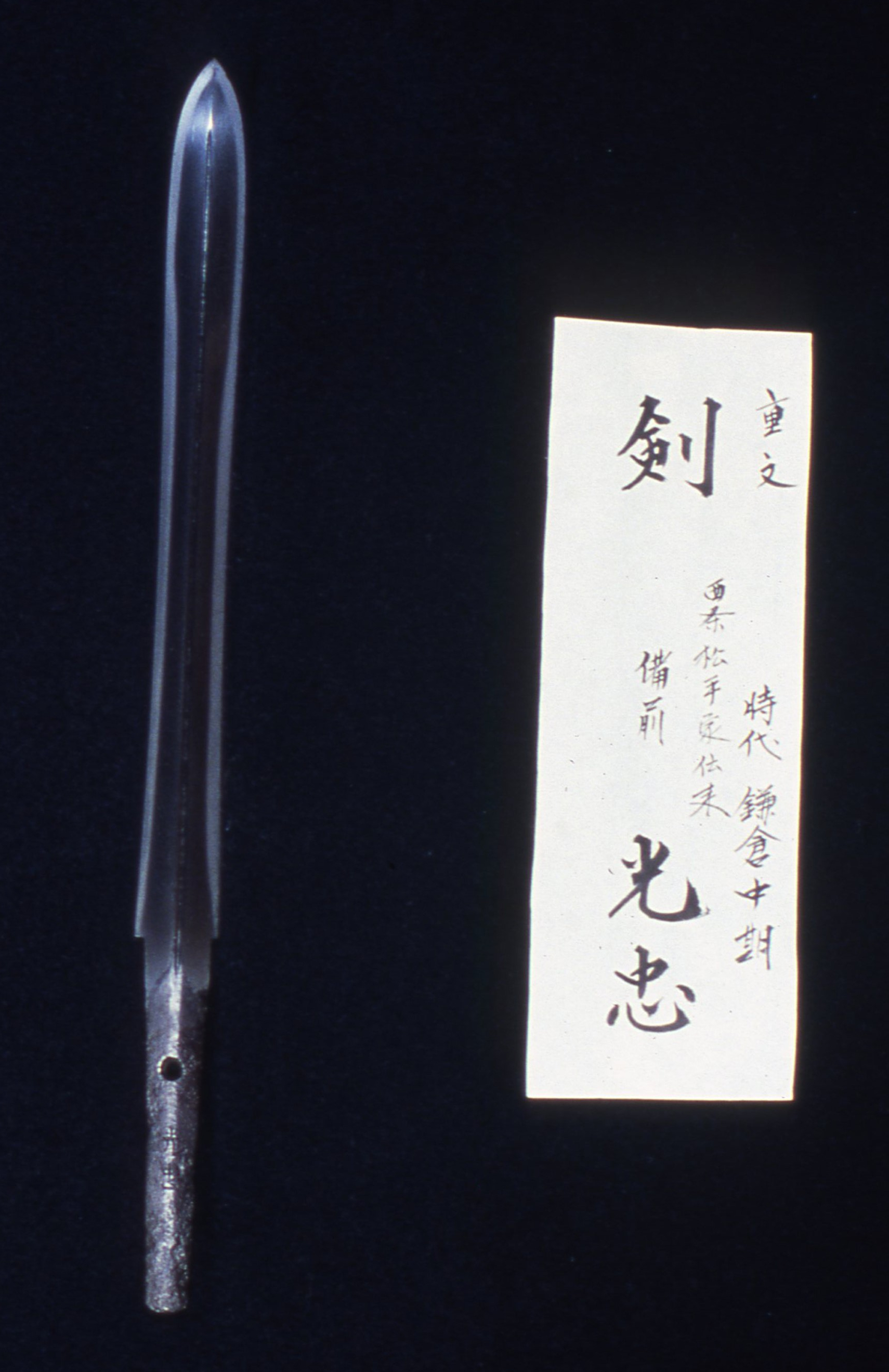
img029            img030 Osafune Mitsutada (Juyo Token)                 Osafune Mitsutada(Juyo Bunkazai)

Late Kamakura Period —– Soshu Den (相州伝 )

Yamashiro-den began to decline in the latter part of the Kamakura period.  At this time, many swordsmiths moved to the Kamakura area under the new power of the Kamakura bakufu (鎌倉幕府), led by the Hojo clan.  The new group, Soshu-den (相州伝 ), began to emerge.  Fukuoka Ichimonji Sukezane (福岡一文字助真) and Kunimune (国宗) from Bizen moved to KamakuraToroku Sakon Kunitsuna (藤六左近国綱) from the Awataguchi group of Yamashiro-den also moved to Kamakura.  These three are considered the founders of the Soshu-den in Kamakura.  Kunitsunas son was Tosaburo Yukimitsu, and his grandson was the famous Masamune (正宗)Outside Kamakura, Yamashiro Rai Kunitsugu (来国次), Go-no-Yoshihiro (郷義弘) from the Ettchu (越中) province, and Samoji  (左文字) from Chikuzen Province (筑前) were active swordsmiths.

39|Part 2 of — 6 Kamakura Period History 1192 – 1333 (鎌倉時代歴史 )

This chapter is a detailed part of Chapter 6, Kamakura Period History 1192 – 1333. Please read Chapter 6 before reading this section. Since this continues from chapter 6, some of the information here may overlap with Chapter 6.

0-timeline - size 24 Kamakura Period                         The red circle above indicates the time we discuss in this section

Taira-no-Kiyomori (平清盛)

Chapter 6, Kamakura Period History, describes two major samurai groups, the Genji (源氏) and the Heishi (平氏), at the end of the Heian period.  The leader of the Genji was Minamoto-no-Yoshitomo (源義朝), and the leader of the Heishi (or Heike) was Taira-no-Kiyomori (平清盛).  They were childhood friends.  However, due to political situations and circumstances, they became enemies by the time they reached adulthood.  After several power struggles, the Genji lost, and Taira-no-Kiyomori gained considerable power.  He favored his followers, gave them high positions, and arranged for his daughter to marry the emperor.   As a result, Kiyomori’s power went even beyond that of the emperor.  This was when people would say, “If you are not a part of the Heishi family, you are not a human being.”   A situation like this created too many opponents against him.  Eventually, the suppressed Genji and other samurai groups united, raised an army, fought the Heishi, and defeated them.

While Taira-no-Kiyomori was in power, he began trading with China, which contributed to Japan’s economic prosperity.  The picture below is the Itsukushima Jinja Shrine (厳島神社), built by Taira-no-Kiyomori.  It is registered as a UNESCO World Heritage Site.

shutterstock_252533968-600x375

From Wikipedia.  The photo is in the public domain. Author: Rdsmith4      File Itsukushima Floating Shrine.jpg 8 /05/04

Minamoto-no-Yoshitsune (源頼朝)

Minamoto-no-Yoritomo (源頼朝) was the son of Minamoto-no- Yoshitomo(源義朝).  After Yoshitomo was defeated by Taira-no-Kiyomori (平清盛), the direct bloodline of Genji, Minamoto-no-Yoritomo was sent to Izu Island.  He was in his early teens. 

Yoritomo grew up as a young man on Izu Island, where he met Hojo Masako (北条政子).  She was the daughter of Hojo Tokimasa (北条時政), a local government official.  While Tokimasa was away on a business trip to Kyoto, Yoritomo and Masako had a baby.  Tokimasa feared that if the Heishi found out about his daughter and Yoritomo, the Hojo family could get into trouble.  So, he planned to have Masako marry someone else.  However, she eloped with Yoritomo the night before the wedding.  It is said that this story was written in the famous Japanese history book “Azuma Kagami: 吾妻鏡” and a few other books.  People started to believe this was how it happened between them

However, some argue that the story might not be exactly how it happened.  Meanwhile, in Kyoto, the Heishi became very powerful and tyrannical within the central government, called Chotei (朝廷), and suppressed their opponents.  All the angry, dissatisfied groups formed an army to attack the Heishi.  Minamoto-no-Yoritomo was the leader of these opposing groups, and his army grew larger and stronger with the help of Masako‘s father, Hojo Tokimasa.  By this time, Hojo Tokimasa came to realize that he would have had a better chance if he had sided with his son-in-law.  The Genji army pushed the Heishi all the way to the southern part of Japan.  The Heishi was defeated at a place called Dan-no-Ura (壇ノ浦) near Kyushu (九州) in 1185.

Yoritomo established the Kamakura Bakufu (Kamakura government) in Kamakura.  After Yoritomo‘s death, his wife Masako proved her ability as a leader. She saved the Kamakura bakufu when the central government, Chotei, attacked it. 

Here is a well-known story about her.  When Yoritomo used to go around to visit other women in Kamakura, Masako would send her men to follow her husband and had them set fire to the house of the woman whom her husband was after.  In her mind, the Hojo were the ones who made Yoritomo the head of the Kamakura bakufu.  Without the Hojo family’s assistance, Yoritomo could not have achieved his success.

1024px-Kaguraden-Hachimangu_Kamakura

Tsurugaoka Hachiman-gu  in Kamakura  Author: Urashimataro      From Wikipedia  Photo is public domain

Tsurugaoka Hachimangu is one of the main shrines in Kamakura.  It is within walking distance of the Kamakura train station.  The photo above shows a large shrine at the top of the long stairs.  Every year on Dec 31, a large number of people visit the shrine to hear the Joya-no-kane (除夜の鐘: the night watch bells on New Year’s Eve)

Minamoto-no-Yoshitsune (源義経)

Minamoto-no-Yoritomo (源頼朝) had several half-brothers.  Taira-no-Kiyomori (平清盛) saved the lives of these young boys on the condition that they would become monks when they grew up.  For Kiyomori, they were the sons of childhood friends, after all.  One of them was Ushiwaka-maru (牛若丸: later Minamoto-no-Yoshitsune源義経), whom Taira-no-Kiyomori raised as his own child.  Ushiwaka-maru believed that Kiyomori was his father.  Later, Yoshitsune was raised at Kurama Yama Temple. 

He lived there until he became a teenager.  After that, he went to live with the O-shu Fujiwara (奥州藤原) family.   They resided in the northern part of Japan, quite a distance away from Kyoto The O-shu Fujiwara clan was very wealthy.  They had a luxurious culture there.  Because of the distance from Chotei (the central government), they acted as if they were an independent country.   They created great wealth by mining gold and trading it with countries outside Japan. 

Yoshitsune lived there quite happily for a while, but when he heard that his half-brother Yoritomo had raised an army to attack the Heishi, he decided to join them.  Yoshitsune was highly skilled in battles.  He won many famous battles, which were critical for the Genji to win the war.  

Yoritomo had a grand political plan for how to proceed to take over the Heishi’s power.   However, Yoshitsune did not understand it.  He was a skilled warrior, but not a politician.  That made Yoritomo irritated and angry with him.  On top of that, Yoshitsune became quite popular in Kyoto.  That made Yoritomo anxious, and he decided to eliminate Yoshitsune

Yoshitsune fled to O-shu, Fujiwara.  Initially, the O-shu Fujiwara protected Yoshitsune but could not hold against Yoritomo’s army.  Ultimately, Yoritomo destroyed the O-shu Fujiwara entirely in the end.  Today, a grand structure built by the O-shu Fujiwara has been restored.  You can visit “Konjiki-do: 金色堂” inside “Chuson-ji Temple: 中尊寺.”

The  Chinese knew about the wealth of O-shu Fujiwara.  Later, Marco Polo heard about this wealthy small country further east. He mentioned this wealthy small island in his book, “The Travels of Marco Polo.”  In this book, he wrote, “All the houses are made of gold,” referring to O-shu Fujiwara.  Of course, not all the houses were made of gold.


Marco Polo introduced Japan as “Zipangu” in his book.  It means the golden country. The name “Zipangu” evolved into Japan.  However, we Japanese don’t call our country  Japan.  We call it “Nihon” or “Nippon,” and both are correct. 

37|Part 2of — 4 Heian Period History  794-1192   (平安時代歴史)

This chapter continues from Chapter 4, Heian Period History. Please read Chapter 4 before proceeding with this section.

0-timeline - size 24 Heian

The circle above indicates the time we discuss in this section

Around the middle of the Heian period, a novel, “Genji Monogatari” (The Tales of Genji,源氏物語), was written by a female author, Murasaki Shikibu (紫式部).  She was a high-ranking court lady.  Her father, Fujiwara Tametoki (藤原為時), was a scholar. While several novels and essays were written by female authors around that time, “The Tales of Genji” is a world-renowned literary masterpiece, considered the greatest Japanese literary work.  “The Tales of Genji“ is a treasure for the Japanese.  We love this novel so much that the Japan Mint issued a 2000-yen bill*ᴵ.  See the photo below.  The author herself is shown in the lower right corner on the back of the bill.  The bill is so beautiful that people just keep it instead of using it.   Therefore, it does not circulate much.  I have four of these bills, and I cannot bring myself to use them.  It is too nice to use. 

The novel is about Hikaru Genji’s (the hero, 光源氏) love history (yes, history) from when he was around 16 years old until his death.  Ten chapters after his death are titled “Uji Jyu-jyo.”  This section tells the story of his son and grandson.  The chapter in which the hero Hikaru Genji dies is titled “Vanishes into the Cloud (雲隠れ),” a very poetic title.  The Tales of Genji depict the daily life, customs, lifestyle, and thoughts of the people in the aristocratic society of that time.  Surprisingly, although they did not have the technology we have today, their way of thinking was not significantly different from ours.  The description of the courting process is in Chapter 4, Heian Period History. 

The author created Hikaru Genji (光源氏), the main character, as a high-ranking aristocrat and the illegitimate son of an emperor. He is portrayed as a charming, handsome, intelligent, and sophisticated aristocrat, and all the women fall for him.  He would go around with various women, one after another: a beautiful woman, a not-so-attractive but brilliant woman, a young woman, an older woman, even his stepmother, a wealthy or not-so-wealthy woman, and more.   It sounds like a story from a tabloid magazine.  Still, Murasaki Shikibu depicted the heroes’ and heroines’ thoughts, emotions, and daily lives, as well as how the men thought about the women and vice versa, with her excellent writing skills.  The author, Murasaki Shikibu, wrote this novel to entertain the female audience at the court where she resided.  It became so popular that even the emperor asked her how the next story would develop.  “Genji Monogatari” has been translated into English.  You can purchase the translated book on Amazon or go to YouTube and search for “Genji Monogatari” or “The Tales of Genji.”   You will find many “Genji Monogatari” in anime, old TV programs, and classic movies, available in whole or as short clips. 

Another female author, Sei Sho-nagon (清少納言), wrote an essay titled “Makura no Soshi “(枕草子) around the same time.  In it, she described the daily lives of court ladies.   In one chapter, she mentioned kakigori (shaved ice: かき氷).  High-status people then must have had the chance to enjoy shaved ice, even though the ice was not easy to come by during the summer in the middle of the Heian period.  

Once you understand the life of a Heian aristocrat, you will see why the Heian sword is shaped the way it is.  It becomes easier to distinguish a Heian sword from other swords made in different periods and regions.  All sword styles reflect the society in which the swordsmiths lived.  During the Heian period, the Yamashiro-den style represented the sword style.  In the next chapter, the focus will be on the Yamashiro-den, even though other sword groups existed in different regions.

*1  The back of 2000 yen bill

39 Part 2 Shikibu with arrow

5 Heian 3 photoes.jpgPart of the Burke Album, a property of Mary Griggs Burke (Public Domain).  Paintings by Mitsukuni (土佐光国), 17th century.   The scenes are based on “The Tales of Genji.