55 |Part 2 of —–21 Muromachi Period Sword (室町時代刀)

Chapter 55 is a detailed section of Chapter 21, Muromachi Period Sword.  Please read Chapter 21 before reading this part.

57 Muromach-timeline size 22

                         The circle above indicates the time we discuss in this section

After the Muromachi period, swords shifted to katana(刀) from tachi (太刀), as described in Chapter 21, Muromachi Period Sword.  Refer to Chapter 21, Muromachi Period Sword.  By the end of the Nanboku-cho period, sword lengths had shortened to about 2 feet ± a few inches.  The 3-to-5-foot-long swords seen during the Nanboku-cho period were no longer produced.  This change occurred because, during the Nanboku-cho period, warriors mainly fought on horseback, but after the Muromachi period, infantry combat became more common.

Oei Bizen (応永備前)                                                                                                              The pronunciation of Oei is “O” as in “Oh” and “ei” as in “A” from ABC.  The Muromachi period was a declining time for sword-making.  The swords made during the early Muromachi period in the Bizen area is known as Oei BizenOsafune Morimitsu (長船盛光), Osafune Yasumitsu (長船康光), and Osafune Moromitsu (長船師光) were the main Oei Bizen swordsmiths.  Soshu Hiromasa (相州広正) and Yamashiro Nobukuni (山城信國) were also similar to the Oei Bizen style.  Please refer to Chapter 21, Muromachi Period Sword, for details on the  Muromachi sword shape, Hamon, Boshi, and Ji-hada.
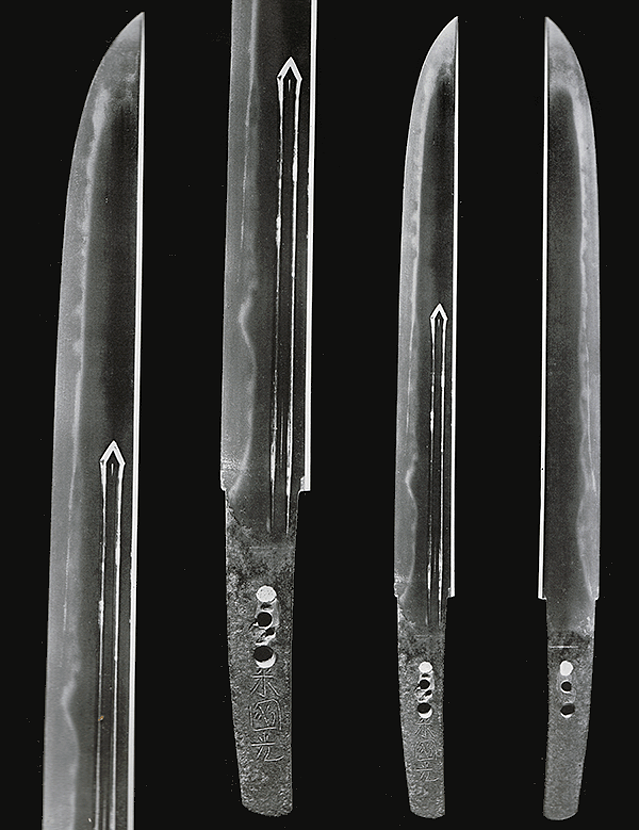
                       Bishu Osafune Moromitsu (備州長船師光)   from Sano Museum Catalogue ((permission granted)

The Osafune Moromitsu sword shown above measures 2 feet 5 inches in length and has a medium kissaki.  Its hamon has a small wave-like pattern with continuous gunome (a lined half-circle pattern).  The boshi area shows irregular waviness with a slightly pointed tip.  Very faint bo-utsuri (a soft shadow shaped like a strip of wood) appears on ji-hadaBo-utsuri is a distinctive feature among all the Oei Bizen

Before the Muromachi period, many swordsmith groups operated in the Bizen region. However, by the Muromachi period, Osafune (長船) was the only remaining group.

Osafune (長船) is the name of a region, but it became the surname of swordsmiths during the Muromachi period.  Two other well-known swordsmiths from Oei Bizen are Osafune Morimitsu (盛光) and Osafune Yasumitsu (康光).  The hamon created by Morimitsu and Yasumitsu is more detailed than that of the sword in the photo above.  Chapter 21, Muromachi period swords, shows the hamon of Morimitsu and Yasumitsu and describes the typical characteristics of swords from the Muromachi period.

                                                 Hirazukuri Ko-Wakizashi Tanto
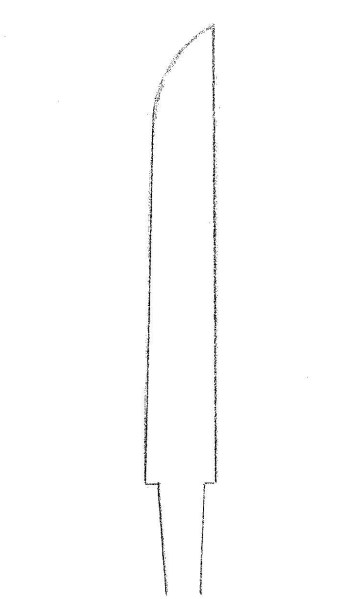
58 Hirazukuri Ko-Wakizashi Tanto

Hirazukuri Ko-Wakizashi Tanto Shape                                                                       

Hirazukuri ko-wakizashi tanto was a popular style during the early Muromachi period. Swordsmiths from various regions produced tantos similar to the one shown above. However, most of these types were made by Oei Bizen swordsmiths.

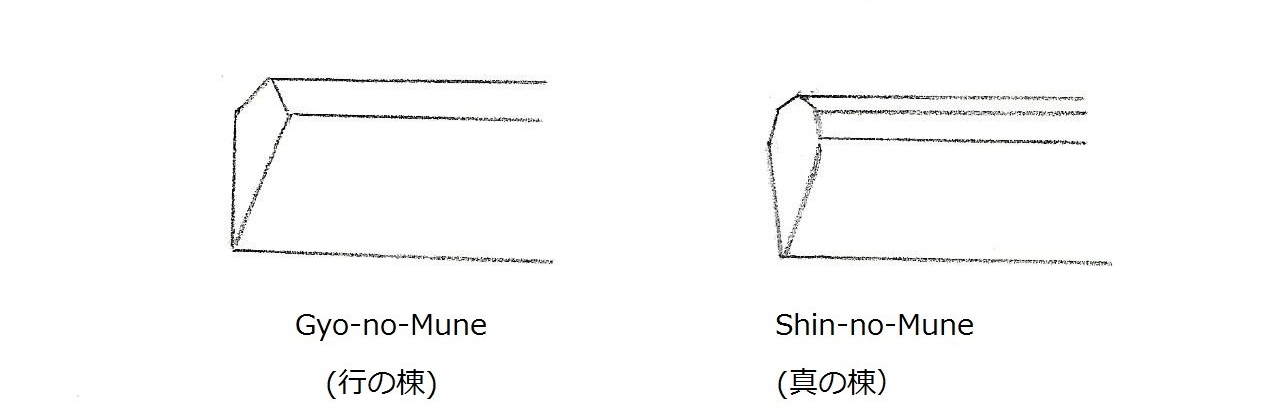
The characteristics of the Hirazukuri ko-wakizashi tanto ————-Typically about one foot and 1 or 2 inches long.  No yokote line, no shinogi, and no sori (meaning no curvature, straight back).  Average thickness.  Narrow width.  Gyo-no-mune (refer to Chapter 12, Middle Kamakura Period Tanto).
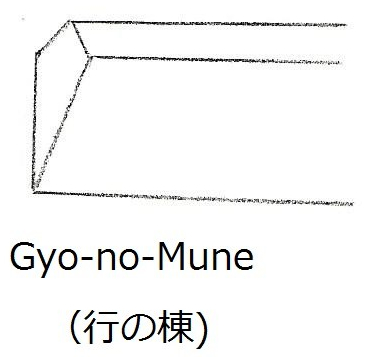
13 Mune drawing

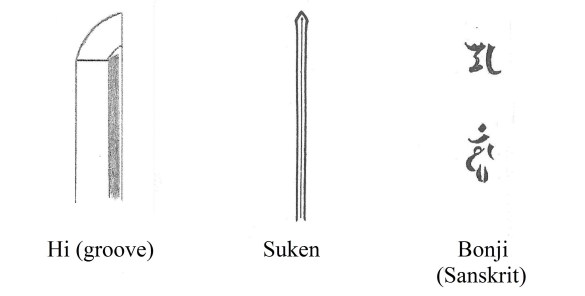
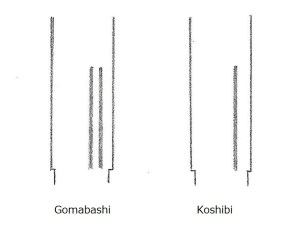
Hirazukuri Ko-wakizashi tanto often shows many engravings.  Hi with soe-hi (double lines, wide and narrow side by side), Tokko-tsuki-ken, Tsume-tsuki-ken, Bonji, and more.

.
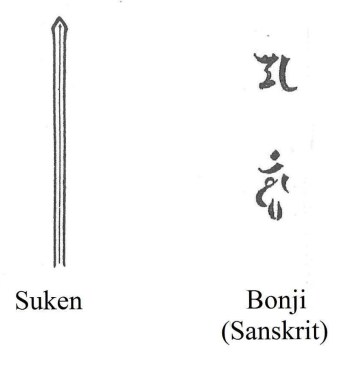
9 Hi, Suken, Bonji20 Tokko, tume Ken  58 tsumetukiken and Hi

*drawings from “Nihonto no Okite to Tokucho” by Honami Koson


26 |Over view of Shinto (新刀概要)

                                   
0-timeline - size 24 Shin-to
                           The circle indicates the subject discuss in this section 

The previous chapter 25 stated that the Edo period lasted from 1603 to 1868.  This is for political history.  The third timeline above shows that the Momoyama period overlaps with the Edo period.  Some people believe the Momoyama period was from 1573 to 1600. In general history, there are several opinions on how to divide these transitional periods.  For sword history, it is straightforward.  Swords made between approximately 1596 (慶長: Keicho era) and 1781 (天明: Tenmei era) are called shin-to.  Swords made between the Tenmei and Meiji eras are referred to as shin-to. 

After Toyotomi Hideyoshi nearly unified the country, the people could enjoy a period of peace.  This period of peace shifted the geographic distribution of swordsmiths. There were three main regions where sword forging took place.  These areas include Kyoto, Osaka, and Edo (Tokyo now).  The remaining swordsmiths gathered near the castles of major daimyo (大名: feudal lords).

Kyoto—- The Umetada Myoju (梅忠明寿) group thrived, followed by swordsmiths such as  Horikawa Kunihiro (堀川国広), Kunimichi (国路), Kunisada (国貞), and Kunisuke (国助).

Osaka——–Osaka was established as a commercial city and became the center of commerce.  It produced swords and distributed them to other regions across the country.  The well-known swordsmiths in Osaka: Tsuda Sukehiro (津田助広) and Inoue Shinkai (井上真改).

Edo————-Many swordsmiths gathered in Edo (江, now Tokyo), where Shogun Tokugawa Iyeyasu livedThe well-known swordsmiths in EdoNagasone Kotetsu (長曽祢虎徹), Yasutsugu (康継), Noda Hannkei (野田繁慶).

By the time Tokugawa Iyeyasu’s grandson, Tokugawa Iyemitsu, became shogun (寛永:Kan’ei era 1624 – 1643), swordsmiths had spread beyond the three areas mentioned above.  In each daimyo territory, swordsmiths operated shops near the castles to meet the needs of the daimyo and their subjects.  By the Genroku era (元禄: 1695), sword-making had declined, and people preferred more picturesque hamon designs, such as kikusui (菊水: flower design) and fujimi (富士見: Mount Fuji).

63 fuji sakura hamon
Fujimi                           Kikusui

Difference between Koto  and Shinto 

The following section describes the differences between Ko-to and Shin-to.   However, remember that there are always exceptions to these rules.

  1. The length of the shin-to katana is typically about two feet three inches ± a little.  The wakizashi is about one foot six inches.   Shallow curvature.  Wide width.  Thick body.   Gyo-no-mune.  Chu-gissaki with a slightly stretched appearance.

13 Mune drawing

  1. The ko-to sword feels light, while the shin-to feels heavy.
  2. The bottom of the hi is rounded above the machi. Shin-to’s bo-hi ends slightly below the yokote line.

27. Hisaki & marudome

  1. Generally, carvings are less common on shin-to. However, some swordsmiths are famous for their carvings.  The designs are refined and detailed.  Umetada Myoju (埋忠明寿) is well-known for his carvings.
  2. For shin-to, if it is mainly nie, it is usually a coarse nie.
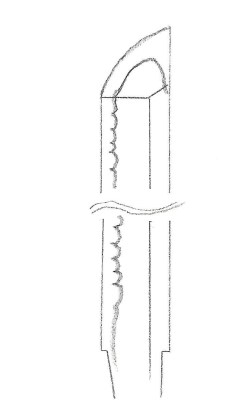
  3. In the machi area, the hamon begins with a straight tempered line (the bottom part of the blade shown in the illustration below), followed by midare, or various types of hamon in the middle, and ends with suguha (straight hamon) in the boshi area (the top part).  Generally, this is the standard Hamon style of shin-to, but there are always exceptions. 

27 Keshou Yasuri & suguha

  1. For shin-to, the type of iron used for the blade is consistent throughout Japan.  A few variations of iron were used across Japan, with a very hard, dark color and a glossy look.
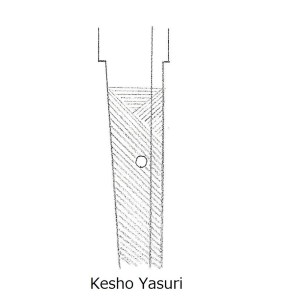
  2. The nakago has a well-balanced shape.  The bottom of the nakagotapers gradually.  The type of yasuri-me (file mark) is often a kesho-yasuri. Engraved inscriptions display the swordsmith’s name, location, province, and year of creation.

27 Keshou Yasuri & suguha

18| Nanboku-Cho Period Sword (南北朝太刀)

0-timeline - size 24 Nanboku-cho

                           The circle indicates the time we discuss in this section

During the Nanboku-cho period, samurai sought large, elaborate, impressive, yet practical swords.  The Soshu-den style sword from Nanboku-cho time was just that.    This was the most popular style at the time.  The Nanboku-cho period marked the peak and height of the Soshu-den sword.  Many swordsmiths moved from other provinces to the Kamakura area and forged Soshu-den style swords.  Other schools and provinces outside the Kamakura area also produced Soshu-den-style swords in their own areas.


19 Nanboku-cho Sword style

Sugata (姿: Shape) —————–The original length of a sword ranged from three to five feet, but it was later shortened to about two and a half feet.  A significantly shortened blade is called o-suriage. 

The Nanboku-cho style sword features shallow kyo-zori (also called torii-zori).  Refer to Chapter 5, Heian Period Sword.  The highest curvature occurs around the middle of the body. It has a wide body, high shinogi, narrow shinogi-ji  (Chapter 3, Names of parts),  and thin kasane (blade thickness), which are distinctive features of the Nanboku-cho style.  High gyo-no-mune or shin-no-mune, and sometimes a maru-mune (round back).

19 Nanboku-cho 3 kinds Mune

Hi (: groove) and Horimono (彫刻: engraving) ——– Often, a single hi (bo-hi), double hi, suken (dagger), Bonji (Sanskrit), and/or dragon are engraved on the shinogi-ji area.  Refer to Chapter 3, Names of Parts.

9 Hi, Suken, Bonji

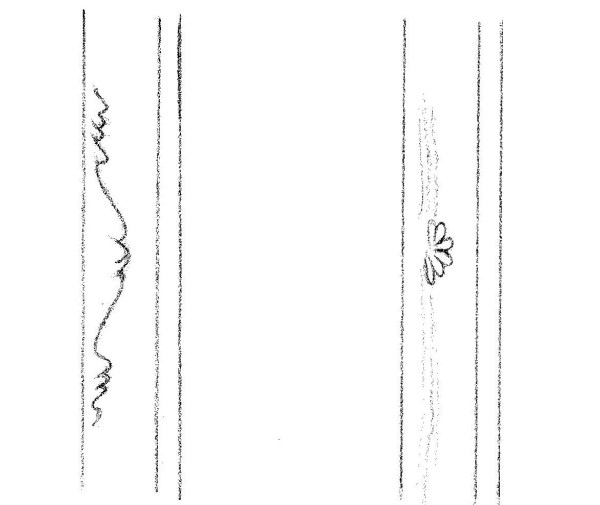
Hamon (: Tempered line) —- The lower part of the body exhibits a narrow-tempered line; gradually, this line becomes wider and showier.  Course nie. O-midare (large, irregular, wavy hamon), Notare-midare (wavy, irregular hamon), and Gunome-midare (a combination of repeated half-circular and irregular hamon). Inazuma and kinsuji (see Chapter 14, Late Kamakura Period Sword) sometimes appear.

19 Hamon Notare 319 Mamon choji gunome19 Hitatsura Hamon Hiromitsu

                                  *From Sano Museum Catalogue ( Permission granted).

Ji-hada (地肌: the area between the shinogi and the tempered line) ———————-Wood-grain pattern (itame 板目). Sometimes tobiyaki (patchy tempered spots) appear on ji-hada.  For ji-hada, refer to Chapter 3, Names of Parts.

Kissaki (切っ先) and Boshi (tempered line at the kissaki area) ———- O-kissaki (long and large kissaki). Fukura kareru (less arc kissaki).  Midare-komi (the body and boshi have a similar tempered pattern), with kaeri-fukashi (hamon deeply turns back), and sometimes hitatsura (entirely tempered).  See the illustration above.

Sword-smiths during Nanboku-Cho Period Soshu Den (school)

  • From Soshu—————————————————Hiromitsu (広光)  Akihiro (秋広)  
  • From Yamashiro ———————————————Hasebe Kunishige (長谷部国重) 
  • From Bizen (called So-den Bizen)——-Chogi (長儀 )group  Kanemitsu (兼光 ) group 
  • From Chikuzen ———————————————————-Samoji (左文字 ) group

Chogi (長義)from The Sano Museum catalog. Permission to use is granted

The distinctive characteristics of the Nanboku-Cho period sword in the photo above      

  • The trace of an engraving of suken on the inside of the nakago indicates that this area was once a part of the main body.
  • Large and long kissaki

12| The Middle Kamakura Period: Tanto (Dagger 鎌倉中期短刀)

0-timeline - size 24 Middle Kamakura

The red circle indicates the area we discuss in this chapter 

It is rare to find a tanto (短刀 dagger) made during the Heian period.  During the middle Kamakura period, many high-quality tanto were produced.  They were called takenoko-zori shaped tanto, with “takenoko” meaning bamboo shoot.  The back of the tanto curves inward slightly.


                              Middle Kamakura Period                                                                                                      Yamashiro School Tanto

12Tanto drawing Mid Kamakur

Sugata (shape)———-Hirazukuri.  This means there is no shinogi, no yokote line.  See the illustration above.  The standard tanto length is approximately ten inches.  The width is neither too wide nor too narrow, making it well-proportioned.  The body is slightly thick.  High gyo-no-mune (行の棟) and shin-no-mune (真の棟). 

13 Mune drawing

Hamon (刃文) ——————— The tempered area is narrow.  Nie base.  Suguha-midare (a straight-line pattern with an irregular wavy shape) or suguha-choji (a straight-line pattern with small choji)The tempered edge line may display a frayed pattern.

Boshi(tempered line at Kissaki area) ———Yakizume,   Kaen,   Nie-kuzure.

13 Hamon and Hi

Engravings (彫刻) ———- Often, various types of engravings are applied to the lower part of the body.   These may include one or two grooves, Sanskrit, suken (spear), dragon, etc.  For the Sanskrit and spear, refer to the illustration in Chapter 8.

13 Hamon and Hi

Tanto Swordsmiths in the Middle Kamakura Period

Awataguchi group(粟田口)———————————Awataguchi Yoshimitu (粟田口吉光)  Rai group (来) ——————————————————————-Rai Kunitoshi(来国俊)  Soushu Group  (相州) ——————————————Shintougo Kunimitu (新藤五国光)  Bizen group (備前) —————————————————— Bizen Kagemitu (備前景光) Bungo no Kuni Group (豊後の国) ——————–Bungo-no-kuni Yukihira (豊後の国行平)

                          来国光(Rai Kunimitsu)

This Photo by an unknown author is licensed under CC BY-SA        Creative Commons Free Media  Attribution-Share Alike 3.0 Unported (CC BY-SA 3.0)