Chapter 58 is a detailed section of Chapter 24, Sengoku Period Tanto. Please read Chapter 24, Sengoku Period Tanto, before reading this part.

The red circle above indicates the time we discuss in this section
Muramasa (村正)
This chapter discusses the famous Muramasa (村正). Usually, many well-known swordsmiths come from one of the Goka-den (五家伝: the five main schools: Yamashiro-den, Bizen-den, Soshu-den, Yamato-den, and Mino-den). However, Muramasa was not from Goka-den but from Ise Province. The first-generation Muramasa was known as a student of He’ian-jo Nagayoshi (平安城長吉) of Yamashiro-den. The Muramasa family existed through the mid-Muromachi period. They spanned three generations from the mid-Muromachi to the Sengoku period.

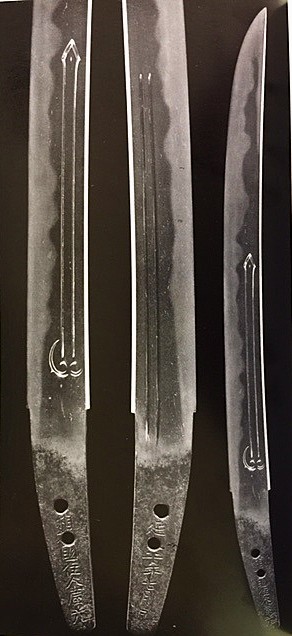
Below is one of Muramasa’s tantos, made during the Sengoku period. Since it was made during the Sengoku era, the blade shows the style of Sengoku-period swords. It reflects Mino-den characteristics, combined with Soshu-den traits.

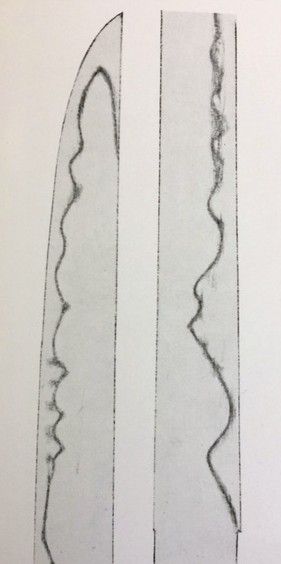
Muramasa (村正) from Sano Museum Catalogue (permission granted)
Characteristics on this Tanto
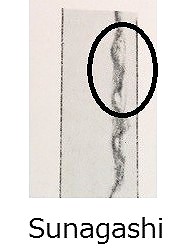
Muramasa’s tantos are typically about ten inches ± half an inch or so. Hirazukuri (平作り). Thin blades with a sharp look. The nioi base with small nie and sunagashi patterns (brushed sand-like patterns, as shown in the illustration below) appears. The boshi (the top part of the hamon) is jizo (a side view of a human head). The tempered line varies with both wide and narrow areas. Some areas are so narrow, almost close to the edge of the blade, while others are broader. Hako midare (box-like shape) and gunome (lined-up bead pattern) appear. O-notare (large, gentle waviness) is a signature characteristic of Muramasa. The pointed-tempered line is a typical characteristic of Mino-den (Sanbon-sugi). Refer to Chapter 23, Sengoku Period Sword, and Chapter 24, Sengoku Period Tanto.


 Hiromitsu from the Sano Museum Catalogue (permission to use granted)

 This is the certification of my sword. Shodai Nobukuni (初代信國). Juyo Token (重要刀剣)


 来国光(Rai Kunimitsu)
 Study of Japanese Sword