 The red circle above indicates the time we discuss in this section
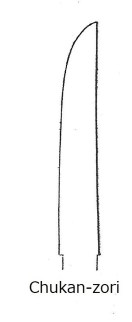
Chukan-zori (中間反り) ————– The chukan-zori tanto features a straight mune (back). Its back does not curve either inward or outward.
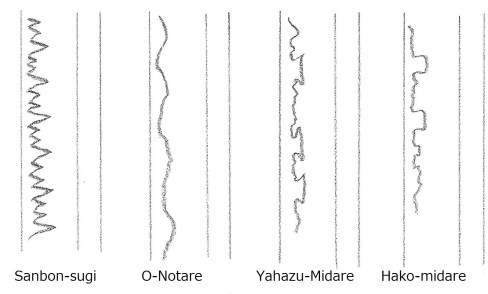
Hamon (刃文: Tempered line) ————————————-Sanbon-sugi (三本杉), o-notare (大湾), yahazu-midare (矢筈乱), hako-midare (箱乱), gunome-choji (互の目丁子), chu-suguha (中直刃). See below.
Horimono (彫り物: Carving) —————Often Hi (grooves) is curved
Tanto Length ————————— The standard tanto length should not exceed one shaku*¹ (about 12 inches, 30.5cm). The standard size tanto is called a Jo-sun tanto, which is roughly 8.5 shaku (about 10 inches, 25.7cm). Longer than jo-sun is called sun-nobi tanto (寸延). Shorter than jo-sun is called sun-zumari tanto (寸詰).
Sun-nobi Tanto > Jo-sun Tanto (approx. 10 inches) > Sun-zumari Tanto
**¹ Shaku is a traditional Japanese unit of length measurement.
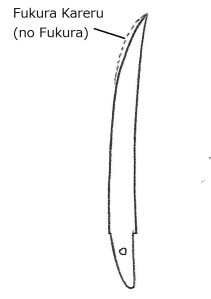
Takenoko-zori jo-sun tanto (筍反定寸短刀)————– The takenoko-zori jo-sun tanto was made during the Sengoku period. It resembles swords made by Rai Kunimitsu of Yamashiro–den. (illustration below)
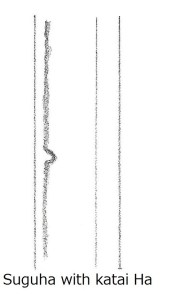
Hamon (刃文: Tempered line) ————– Hoso-suguha (細直刃: Narrow straight hamon). Katai-ha (illustration below) appears somewhere on the blade. Masame–hada (straight grain pattern) may be visible on the mune side.

Ji-hada (地肌: The area between the shinogi and the tempered line)————– Some shirake (白け: a whitish surface) may sometimes appear. Some utsuri (a light, whitish, cloud-like effect) appears on the ji-hada.
Sun-nobi Tanto (寸延短刀)–————–This type of tanto resembles the sakizori tanto from the late Soshu-den period. You may see a hitatsura-type hamon. (illustration below). Unlike the Soshu-den style, the hitatsura pattern is more visible in the lower part of the tanto and less in the upper part.
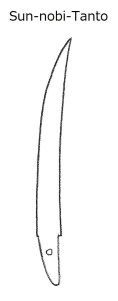

Hirazukuri Takenokozori Sunzumari Tanto (平造筍反寸詰短刀)
This is a unique tanto from the Sengoku period. Hirazukuri means a flat-surfaced sword without a shinogi, yokote line, or obvious kissaki. Takenoko-zori refers to a bamboo shoot shape (the back of the sword curves inward). Sun-zumari indicates a blade shorter than 10 inches (less than 8.5 shaku or 25.7 cm). The lower part of the blade is wide and thick, while the tip is narrow and thin. It has a piercing, sharp appearance.
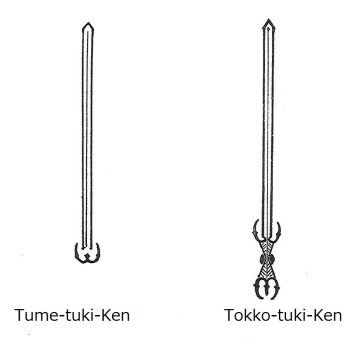
- Horimono (彫物: Engraving) ————- Deeply carved ken-maki ryu (a dragon wrapped around a spear).
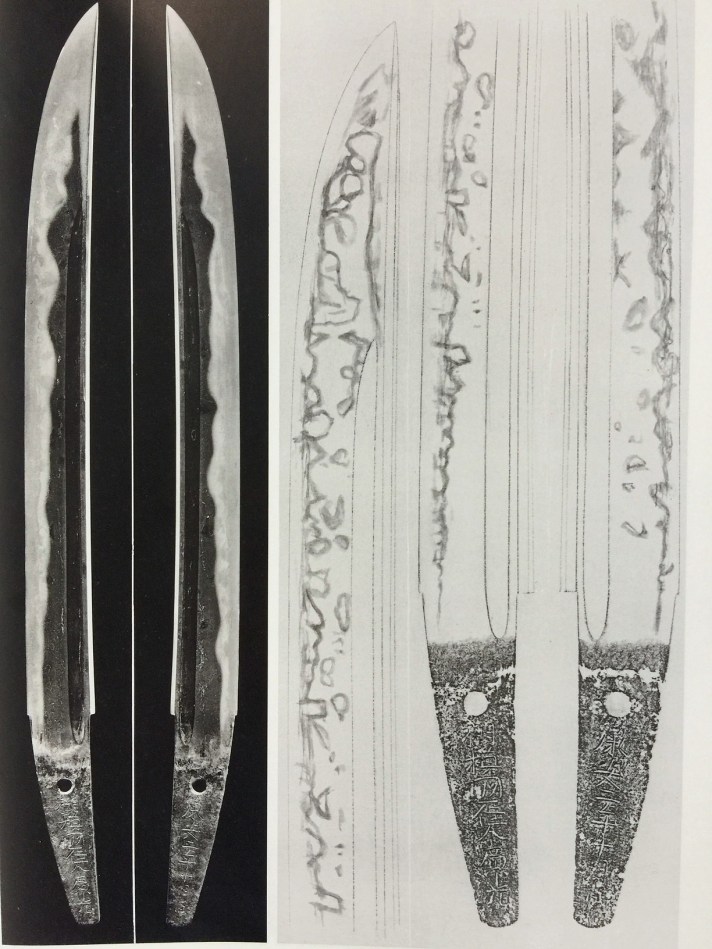
- Hamon (刃文: Tempered line)——— Wide tempered line, with a nioi base. Irregular hamon, with wide suguha (straight), and chu-suguha (medium straight). The hamon in the boshi area curves back deeply.
- Ji-hada (地肌)———– fine ji-gane and wood burl pattern.
Moroha-tanto (諸刃短刀: Double-edged sword)
A double-edged sword with a hamon on both cutting edges. Often, Bonji (Sanskrit) is curved.
- Hamon (刃文: Tempered line) ——— Wide tempered line. Nioi base. Irregular hamon, wide suguha (straight tempered line), and chu-suguha (medium straight tempered line). The hamon turns back deeply.
- Ji-hada (地肌: The area between the shinogi and the tempered line)——- Fine ji-gane and wood burl pattern.
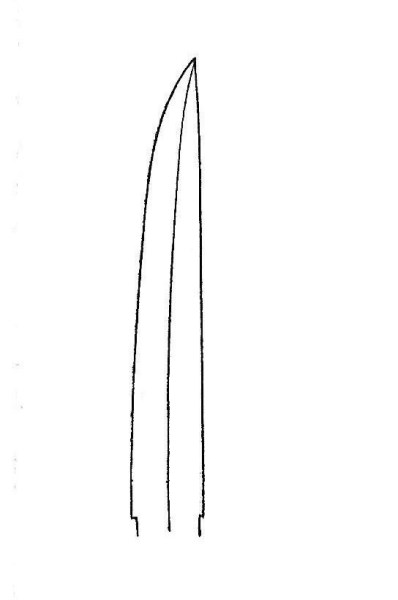 Moroha Tanto
The Swordsmith for Tanto during the Sengoku Period
The Bizen swords from the Sengoku period are called sue-bizen. Sue is pronounced “su” and “e“ as in egg. Bizen Osafune Yoso-Zaemon Sukesada (与三左衛門祐定) is the most famous swordsmith of the Sengoku period. He also forged tantos. One thing to note is that many swordsmiths had the name Sukesada. Yoso-Zaemon Sukesada is the one who best represents the era.





 Study of Japanese Sword