43 | Part 2 of –10 Jyokyu-no-Ran and Gotoba-joko (承久の乱)

This chapter is a detailed part of Chapter 10, Jyokyu-no-Ran (承久の乱 ) 1221.  Please read Chapter 10 before reading this section.

0-timeline - size 24 jyokyuu no ran

                            The red circle above indicates the time we discuss in this chapter.

Chapter 10 explained how Jokyu-no-ran (承久の乱) started.  In the end, Emperor Gotoba (or Gotoba Joko) was exiled to Oki Island (隠岐の島). 

Emperor Gotoba was a highly talented individual in many fields.  He was good at waka (和歌), a Japanese short poem.   To compose a waka requires including several elements, such as scenery, the season, personal feelings expressed with refined sentiment, or the surrounding environment, all within a very limited number of words.  It requires literary talent.  He was also proficient in equestrianism, kemari (a ball game played by the upper class at that time), swimming, sumo wrestling, music, archery, swordsmanship, calligraphy, painting, and even sword-making.  His contributions to the sword field led to the golden age of sword-making during the middle Kamakura period.  Surprisingly, Gotoba Joko was not only talented in many different arts but also mastered them at the highest level.  His waka (poetry) was particularly highly regarded.  He edited the Shin- Kokin- wakashu (新古今集), a collection of 1980 waka poems.                                                                          

Emperor Gotoba, Enthroned at the Age Four

Emperor Gotoba was enthroned at the age of four (some say three).  The problem was that Emperor Antoku was already on the throne.  They were both about the same age.  Having two emperors simultaneously creates a problem.  How did this happen? 

To establish a new emperor, the head of the imperial family must appoint the next emperor.  While Emperor Go-Shirakawa (後白河天皇) was imprisoned, Emperor Antoku was appointed by Taira-no-Kiyomori (平清盛).  Although Kiyomori was the head of the Heishi, the most powerful samurai group, he was not a member of the imperial family.  That went against tradition.  This was unacceptable to Emperor Go-Shirakawa (後白河天皇).  Emperor Go-Shirakawa was furious at Taira-no-Kiyomori; he chose Emperor Gotoba and enthroned him.  This is why the two emperors coexisted.  

There was one more thing.  To be an emperor, one must possess the Sanshu-no-jingi (三種の神器: Three imperial regalia). These are the three items an emperor needs to have to be a legitimate emperor.  They are a mirror, a sacred sword, and a magatama (jewelry)*.   

However, the Sanshu-no-jingi were taken by the Heike family along with Emperor Antoku when they fled from the Genji.  The Heike clan was chased by the Genji all the way to Dan-no-ura (壇ノ浦), where they were defeated.   Dan-no-ura is a sea located between Kyushu (九州) and Honshu (本州).  When it became clear to the Heike family that they had been defeated, all of the Heike people, including the young Emperor Antoku, jumped into the sea and drowned.  They took the Sanshu-no-jingi with them into the sea.  

Later, people frantically searched for the Sanshu-no-jingi; however, they only recovered the jewelry and the mirror, not the sword.  Because of tradition, the emperor must possess the Sanshu-no-jingi; otherwise, he would not be recognized as a legitimate emperor.  Gotoba Joko was tormented for a long time for not having all three. 

Today, the jewelry is with the current emperor’s family, and the mirror is at the Ise Jingu Shrine (伊勢神宮).  The sword is still missing somewhere in the ocean.  Some say that the sword that fell into the sea was a replica, and the one kept at Atsuta Jingu Shrine (熱田神宮) is the real one.                                                                                                                                                 * Sanshu-no-Jingi (三種の神器) ————- 1. The sword; Kusanagi-no-tsurugi (草薙の剣)   2. The mirror; Yata-no-kagami (八咫の鏡),   3. The magatama (Jewelry); Yasakani-no-magatama (八尺瓊勾玉) by Token World: www.touken-world.jp/tips/32747/

Politics by Emperor Gotoba

Emperor Gotoba sought to regain political power from the Kamakura bakufu.  He was impulsive, passionate, unpredictable, and quick-tempered.  He tried to revive the Chotei (朝廷) power.  The Chotei is the central government controlled by the emperor and aristocrats.  Emperor Gotoba decided to rely on the armed forces to achieve this goal and established the Saimen no Bushi (armed forces directly under the emperor).

Upon seeing Minamoto-no-Sanetomo dead, he realized that the Kamakura bakufu was in turmoil.  Recognizing this as a good chance, he sent out the emperor’s order to all the daimyo to fight against the Kamakura bakufu.  He expected an easy victory, but the Kamakura bushi remained strongly united and fought well under Hojo Masako’s leadership, the “Nun Shogun.”   She organized a strongly united armed force, while Emperor Gotoba’s side was disorganized.  They were not accustomed to fighting.   

In the end, Emperor Gotoba’s side lost.  When he realized he had lost, he claimed it was not he but his men who had acted independently.  He insisted that it had nothing to do with him.  Therefore, it was wrong to punish him.  But of course, Hojo Masako and the Kamakura bakufu did not believe Emperor Gotoba and exiled him to Oki Island.  Emperor Gotoba ended his life there.  Although he was intelligent and accomplished in many areas, he could not defeat the grandma, “Nun Shogun,” Hojo Masako.

Sword-Making by Gotoba Joko

Gotoba Joko had an exceptional ability to evaluate swords, and he became a great swordsmith himself.   He invited many top-level swordsmiths from various groups to his court, gave them titles, and treated them with respect.  He also appointed them as his instructors and assistants.  Gotoba Joko brought in skilled swordsmiths from various places in rotation.  Those who were invited to the palace were called gobankaji (御番鍛冶), an honorary title.  On the sword he created, he inscribed a chrysanthemum with 16 petals.  The current emperor still uses this design as his imperial crest.  The sword with the chrysanthemum design is called Kikugosaku (菊御作).                                                                                                

Today, you can visit the Emperor Gotoba Museum on Oki Island, where some sites are believed to be the emperor’s sword-making site.  Some people say it is debatable whether these sites are real.  Today, Oki Island is a beautiful resort destination.  It can be reached by ferry from Shimane Prefecture, which takes about two hours.  It can also be reached by airplane directly from Osaka.
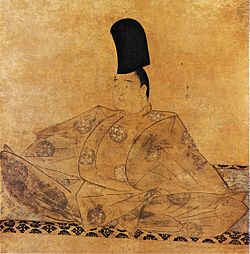
11 «part 2» Gotoba Joko photo

          Gotoba Joko, owned by Minase Shrine (This picture is in the public domain)

39|Part 2 of — 6 Kamakura Period History 1192 – 1333 (鎌倉時代歴史 )

This chapter is a detailed part of Chapter 6, Kamakura Period History 1192 – 1333. Please read Chapter 6 before reading this section. Since this continues from chapter 6, some of the information here may overlap with Chapter 6.

0-timeline - size 24 Kamakura Period                         The red circle above indicates the time we discuss in this section

Taira-no-Kiyomori (平清盛)

Chapter 6, Kamakura Period History, describes two major samurai groups, the Genji (源氏) and the Heishi (平氏), at the end of the Heian period.  The leader of the Genji was Minamoto-no-Yoshitomo (源義朝), and the leader of the Heishi (or Heike) was Taira-no-Kiyomori (平清盛).  They were childhood friends.  However, due to political situations and circumstances, they became enemies by the time they reached adulthood.  After several power struggles, the Genji lost, and Taira-no-Kiyomori gained considerable power.  He favored his followers, gave them high positions, and arranged for his daughter to marry the emperor.   As a result, Kiyomori’s power went even beyond that of the emperor.  This was when people would say, “If you are not a part of the Heishi family, you are not a human being.”   A situation like this created too many opponents against him.  Eventually, the suppressed Genji and other samurai groups united, raised an army, fought the Heishi, and defeated them.

While Taira-no-Kiyomori was in power, he began trading with China, which contributed to Japan’s economic prosperity.  The picture below is the Itsukushima Jinja Shrine (厳島神社), built by Taira-no-Kiyomori.  It is registered as a UNESCO World Heritage Site.

shutterstock_252533968-600x375

From Wikipedia.  The photo is in the public domain. Author: Rdsmith4      File Itsukushima Floating Shrine.jpg 8 /05/04

Minamoto-no-Yoshitsune (源頼朝)

Minamoto-no-Yoritomo (源頼朝) was the son of Minamoto-no- Yoshitomo(源義朝).  After Yoshitomo was defeated by Taira-no-Kiyomori (平清盛), the direct bloodline of Genji, Minamoto-no-Yoritomo was sent to Izu Island.  He was in his early teens. 

Yoritomo grew up as a young man on Izu Island, where he met Hojo Masako (北条政子).  She was the daughter of Hojo Tokimasa (北条時政), a local government official.  While Tokimasa was away on a business trip to Kyoto, Yoritomo and Masako had a baby.  Tokimasa feared that if the Heishi found out about his daughter and Yoritomo, the Hojo family could get into trouble.  So, he planned to have Masako marry someone else.  However, she eloped with Yoritomo the night before the wedding.  It is said that this story was written in the famous Japanese history book “Azuma Kagami: 吾妻鏡” and a few other books.  People started to believe this was how it happened between them

However, some argue that the story might not be exactly how it happened.  Meanwhile, in Kyoto, the Heishi became very powerful and tyrannical within the central government, called Chotei (朝廷), and suppressed their opponents.  All the angry, dissatisfied groups formed an army to attack the Heishi.  Minamoto-no-Yoritomo was the leader of these opposing groups, and his army grew larger and stronger with the help of Masako‘s father, Hojo Tokimasa.  By this time, Hojo Tokimasa came to realize that he would have had a better chance if he had sided with his son-in-law.  The Genji army pushed the Heishi all the way to the southern part of Japan.  The Heishi was defeated at a place called Dan-no-Ura (壇ノ浦) near Kyushu (九州) in 1185.

Yoritomo established the Kamakura Bakufu (Kamakura government) in Kamakura.  After Yoritomo‘s death, his wife Masako proved her ability as a leader. She saved the Kamakura bakufu when the central government, Chotei, attacked it. 

Here is a well-known story about her.  When Yoritomo used to go around to visit other women in Kamakura, Masako would send her men to follow her husband and had them set fire to the house of the woman whom her husband was after.  In her mind, the Hojo were the ones who made Yoritomo the head of the Kamakura bakufu.  Without the Hojo family’s assistance, Yoritomo could not have achieved his success.

1024px-Kaguraden-Hachimangu_Kamakura

Tsurugaoka Hachiman-gu  in Kamakura  Author: Urashimataro      From Wikipedia  Photo is public domain

Tsurugaoka Hachimangu is one of the main shrines in Kamakura.  It is within walking distance of the Kamakura train station.  The photo above shows a large shrine at the top of the long stairs.  Every year on Dec 31, a large number of people visit the shrine to hear the Joya-no-kane (除夜の鐘: the night watch bells on New Year’s Eve)

Minamoto-no-Yoshitsune (源義経)

Minamoto-no-Yoritomo (源頼朝) had several half-brothers.  Taira-no-Kiyomori (平清盛) saved the lives of these young boys on the condition that they would become monks when they grew up.  For Kiyomori, they were the sons of childhood friends, after all.  One of them was Ushiwaka-maru (牛若丸: later Minamoto-no-Yoshitsune源義経), whom Taira-no-Kiyomori raised as his own child.  Ushiwaka-maru believed that Kiyomori was his father.  Later, Yoshitsune was raised at Kurama Yama Temple. 

He lived there until he became a teenager.  After that, he went to live with the O-shu Fujiwara (奥州藤原) family.   They resided in the northern part of Japan, quite a distance away from Kyoto The O-shu Fujiwara clan was very wealthy.  They had a luxurious culture there.  Because of the distance from Chotei (the central government), they acted as if they were an independent country.   They created great wealth by mining gold and trading it with countries outside Japan. 

Yoshitsune lived there quite happily for a while, but when he heard that his half-brother Yoritomo had raised an army to attack the Heishi, he decided to join them.  Yoshitsune was highly skilled in battles.  He won many famous battles, which were critical for the Genji to win the war.  

Yoritomo had a grand political plan for how to proceed to take over the Heishi’s power.   However, Yoshitsune did not understand it.  He was a skilled warrior, but not a politician.  That made Yoritomo irritated and angry with him.  On top of that, Yoshitsune became quite popular in Kyoto.  That made Yoritomo anxious, and he decided to eliminate Yoshitsune

Yoshitsune fled to O-shu, Fujiwara.  Initially, the O-shu Fujiwara protected Yoshitsune but could not hold against Yoritomo’s army.  Ultimately, Yoritomo destroyed the O-shu Fujiwara entirely in the end.  Today, a grand structure built by the O-shu Fujiwara has been restored.  You can visit “Konjiki-do: 金色堂” inside “Chuson-ji Temple: 中尊寺.”

The  Chinese knew about the wealth of O-shu Fujiwara.  Later, Marco Polo heard about this wealthy small country further east. He mentioned this wealthy small island in his book, “The Travels of Marco Polo.”  In this book, he wrote, “All the houses are made of gold,” referring to O-shu Fujiwara.  Of course, not all the houses were made of gold.


Marco Polo introduced Japan as “Zipangu” in his book.  It means the golden country. The name “Zipangu” evolved into Japan.  However, we Japanese don’t call our country  Japan.  We call it “Nihon” or “Nippon,” and both are correct. 

10| Jokyu-no-ran 1221 (承久の乱)

0-timeline - size 24 jyokyuu no ran
 
 The circle indicates the time we discuss in this section.

Jyokyu-no-Ran (承久の乱)

After Minamoto-no-Yoritomo (源頼朝) died, his son, Yoriie (頼家), became shogun.  His mother, Hojo Masako (北条政子), Yoritomo‘s wife, thought her son was too incompetent.  She worried others might take over the Kamakura bakufu (Kamakura government).  To prevent this, she established a council of 13 members, including herself, her father, Hojo Tokimasa (北条時政), and her brother, Hojo Yoshitoki (北条義時). 

Shogun Yoriie’s in-laws gained power over time.  During the Heian and Kamakura periods, the wife’s family was considered very important.  To suppress her son’s in-laws, Masako and her father, Tokimasa, planned and carried out Yoriie’s assassination.

After Yoriie‘s death, Masako’s younger son, Sanetomo (実朝), became the next shogun.  Now, his grandfather, Hojo Tokimasa’s second wife, wanted her son-in-law to be the next shogun.  To please his young wife, Hojo Tokimasa attempted to kill Sanetomo but failed.  When she found out about the plot, Hojo Masako imprisoned her father, Tokimasa.  Although Sanetomo was Masako’s son, she was once again very disappointed by his incompetence.  Ultimately, Shogun Sanetomo was killed by his nephew Kugyo, the son of the previous shogun, Yoriie

After all these incidents, Masako’s brother, Hojo Yoshitoki, took control of the Kamakura bakufu and installed a figurehead from the Fujiwara family, a powerful aristocratic family in Kyoto.   After all the turmoil, the Hojo family eventually gained complete control of the Kamakura bakufu (government).

Meanwhile, in Kyoto, Emperor Gotoba was planning an attack on the Kamakura bakufu.  He had built up military strength.  When Sanetomo was killed, Emperor Gotoba saw an opportunity to attack Kamakura.  He ordered local feudal lords to attack the Kamakura bakufu, but few obeyed.  Instead, the Hojo family captured the emperor and exiled him to Oki Island.  This occurred in 1221 and is known as Jokyu-no-ran or Jokyu-nohen.

Emperor Gotoba encouraged sword-making and showed respect for swordsmiths.     After the Jokyu-no-ran, the Imperial family’s power declined, and the Kamakura bakufu became a strong and stable regime.  From the time of Minamoto-no-Yoritomo‘s death until the end of the Jokyu-no-ran, the Kamakura bakufu remained unstable.  It was Hojo Masako who led the Kamakura bakufu to a stable regime.  She was called “Ama Shogun” or “Nun Shogun.”   She was a sharp, talented, yet tough, critical, and often harsh politician.

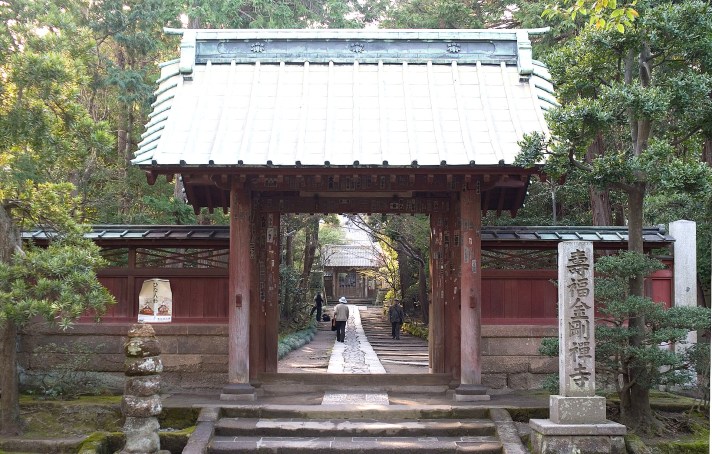
Kamakura locals, including myself, hold Hojo Masako in high regard Minamoto-no- Yoritomo and Hojo Masako are both buried in Kamakura City.  Minamoto-no-Yoritomo is at Shirahata Shrine (白幡神社), and Hojo Masako is at Jufukuji Temple (寿福寺). 

Kamakura is roughly an hour from Tokyo by train on the Yokosuka Line.  Both Jufuku-ji Temple and Shirahata Shrine are within walking distance of Kamakura Station.


Jufuku-ji (寿福寺) Temple, sourced from Wikimedia Commons, the free media repository

The tomb of Minamoto-no-Yoritomo.  From Wikimedia Commons, the free media repository.