18| Nanboku-Cho Period Sword (南北朝太刀)

0-timeline - size 24 Nanboku-cho

                           The circle indicates the time we discuss in this section

During the Nanboku-cho period, samurai sought large, elaborate, impressive, yet practical swords.  The Soshu-den style sword from Nanboku-cho time was just that.    This was the most popular style at the time.  The Nanboku-cho period marked the peak and height of the Soshu-den sword.  Many swordsmiths moved from other provinces to the Kamakura area and forged Soshu-den style swords.  Other schools and provinces outside the Kamakura area also produced Soshu-den-style swords in their own areas.


19 Nanboku-cho Sword style

Sugata (姿: Shape) —————–The original length of a sword ranged from three to five feet, but it was later shortened to about two and a half feet.  A significantly shortened blade is called o-suriage. 

The Nanboku-cho style sword features shallow kyo-zori (also called torii-zori).  Refer to Chapter 5, Heian Period Sword.  The highest curvature occurs around the middle of the body. It has a wide body, high shinogi, narrow shinogi-ji  (Chapter 3, Names of parts),  and thin kasane (blade thickness), which are distinctive features of the Nanboku-cho style.  High gyo-no-mune or shin-no-mune, and sometimes a maru-mune (round back).

19 Nanboku-cho 3 kinds Mune

Hi (: groove) and Horimono (彫刻: engraving) ——– Often, a single hi (bo-hi), double hi, suken (dagger), Bonji (Sanskrit), and/or dragon are engraved on the shinogi-ji area.  Refer to Chapter 3, Names of Parts.
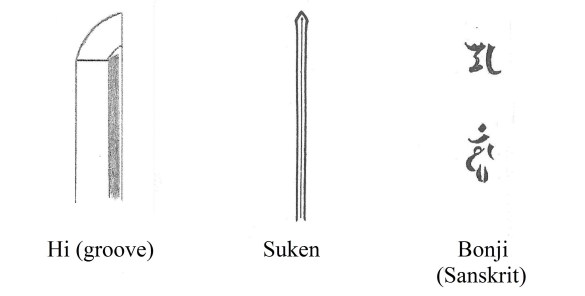
9 Hi, Suken, Bonji

Hamon (: Tempered line) —- The lower part of the body exhibits a narrow-tempered line; gradually, this line becomes wider and showier.  Course nie. O-midare (large, irregular, wavy hamon), Notare-midare (wavy, irregular hamon), and Gunome-midare (a combination of repeated half-circular and irregular hamon). Inazuma and kinsuji (see Chapter 14, Late Kamakura Period Sword) sometimes appear.

19 Hamon Notare 319 Mamon choji gunome19 Hitatsura Hamon Hiromitsu

                                  *From Sano Museum Catalogue ( Permission granted).

Ji-hada (地肌: the area between the shinogi and the tempered line) ———————-Wood-grain pattern (itame 板目). Sometimes tobiyaki (patchy tempered spots) appear on ji-hada.  For ji-hada, refer to Chapter 3, Names of Parts.

Kissaki (切っ先) and Boshi (tempered line at the kissaki area) ———- O-kissaki (long and large kissaki). Fukura kareru (less arc kissaki).  Midare-komi (the body and boshi have a similar tempered pattern), with kaeri-fukashi (hamon deeply turns back), and sometimes hitatsura (entirely tempered).  See the illustration above.

Sword-smiths during Nanboku-Cho Period Soshu Den (school)

  • From Soshu—————————————————Hiromitsu (広光)  Akihiro (秋広)  
  • From Yamashiro ———————————————Hasebe Kunishige (長谷部国重) 
  • From Bizen (called So-den Bizen)——-Chogi (長儀 )group  Kanemitsu (兼光 ) group 
  • From Chikuzen ———————————————————-Samoji (左文字 ) group

Chogi (長義)from The Sano Museum catalog. Permission to use is granted

The distinctive characteristics of the Nanboku-Cho period sword in the photo above      

  • The trace of an engraving of suken on the inside of the nakago indicates that this area was once a part of the main body.
  • Large and long kissaki

9 | Middle Kamakura Period: Bizen Den (鎌倉中期備前伝)

0-timeline - size 24 Middle Kamakura
The circle indicates the time we discuss in this section 

Many swordsmiths worked in the Bizen (備前) school during the early Kamakura period.  However, their sword style is generally somewhat similar to the Yamashiro style.  Therefore, they are called Ko-bizen (古備前), meaning old Bizen.

The true Bizen school style appeared during the Middle Kamakura period.  Bizen Province had many advantages for producing great swords.  The area produced high-quality iron and abundant firewood.  Also, its location was conveniently located for people to travel from different regions.  As a result, many swordsmiths gathered there and produced large quantities of swords.  Due to competition among these smiths, the quality of Bizen swords is generally higher than that of other schools.  Therefore, it is often difficult to appraise Bizen swords because of the many subtle differences among the different swordsmiths.

The following three features are the most distinctive characteristics of the Bizen school.  

1.   Nioi-base tempered line.  The Nioi-base tempered line has finer dots than the Nie-base.   These dots are so small that they almost appear as a line. Technically, the tempering processes of these two are identical.  See the illustration below.                        2.   Ji-hada (surface of the body) appears soft.                                                                  3.  Reflection (utsuri) appears on the surface.

10 Nie & Nioi

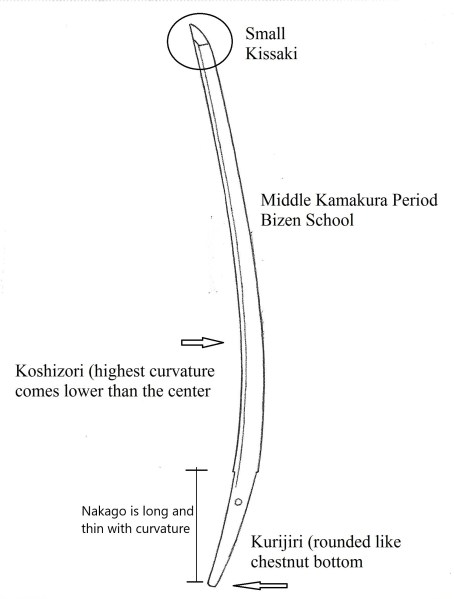
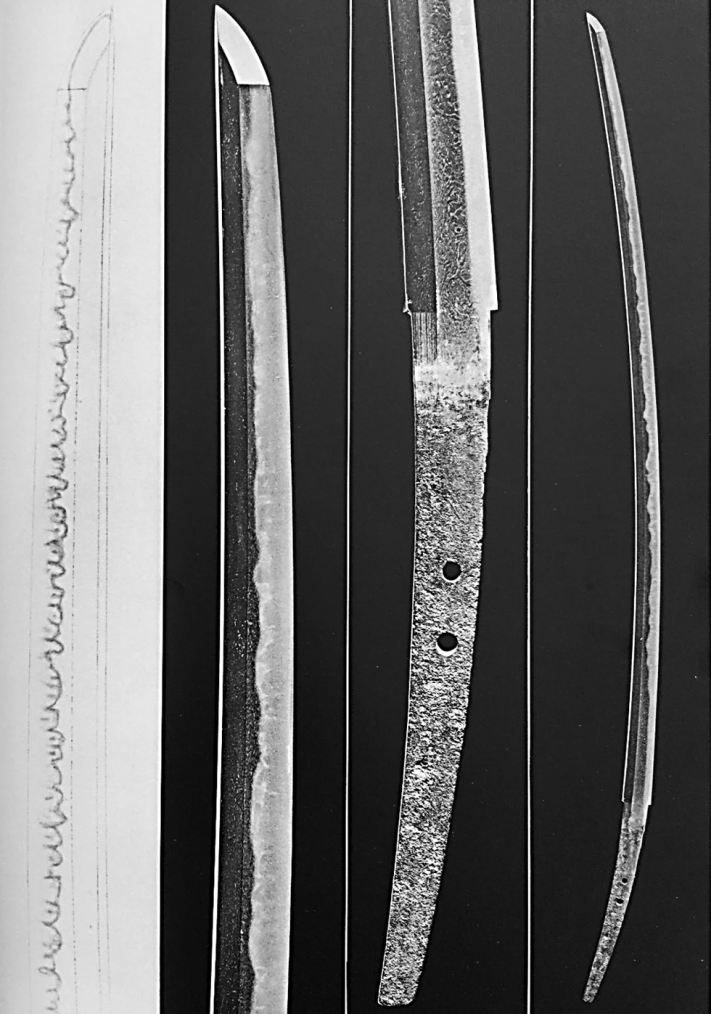
Sugata (shape) —The length is approximately 33 inches ± a few inches. The blade is slightly wide and appears sturdy. The curvature of the blade is koshizori (腰反), meaning the deepest curve is at the lower part.  The body has an average thickness, and the kissaki is small.

 10 Middle Kamakura ---備前刀姿

Horimono (engraving) ——Engravings are rare.  The tip of the hi extends all the way to ko-shinogi, filling the entire area.

8 Hi

Nakago ——– Long and thin with a curve. The end of the nakago is rounded and resembles the bottom of a chestnut (kuri).  This shape is called kurijiri.   Refer to the illustration of the sword above.

Hamon (tempered area pattern)—— Nioi base. The tempered area is wide and consistent width.  The size of the midare (irregular wavy tempered pattern) is uniform.

Boshi ——– The same tempered pattern continues upward to the boshi area, and it often shows choji- midare (clove-shaped wavy pattern) or yakizume.

10 Boshi --- Bizen

Ji-hada ———— Fine and well forged.  The steel appears soft.  On the steel surface,  small and large wood-grain patterns are mixed.  Chikei (condensation of nie) and utsuri (cloud-like reflection) appear.

Bizen School Sword Smiths during Middle Kamakura Period

  • Fukuoka Ichimonji (福岡一文字) group ————-Norimune (則宗)  Sukemune (助宗) 
  • Yoshioka Ichimonji (吉岡一文字) group ——–Sukeyoshi (助吉) Sukemitsu (助光)        
  • Sho-chu Ichimonji (正中一文字) group —————Yoshiuji (吉氏)   Yoshimori (吉守)     
  • Osafune (長船) group ———–Mitsutada (光忠)  Nagamitsu (長光) Kagemitsu (景光)   
  • Hatakeda(畠田) group ————————————-Moriie (守家)  Sanemori (真守)  
  • Ugai (鵜飼) group ————————————————- Unsho (雲生) Unji (雲次)

              9 Middle Kamakura Bizen Fukuoka ichimonji 

Fukuoka Ichimonji (一文字) from “Nippon-to Art Swords of Japan”                                     The Walter A. Compton Collection