61|Part 2 of — 27 Shin-to Main 7 Regions (part A)

Chapter 61 is a detailed part of Chapter 27, Shinto Main 7 Regions (part A).  Please read Chapter 27 before reading this section. 

0-timeline - size 24 Shin-to                        The red circle above indicates the time we discuss in this section

Chapter 27, Shin-to Main 7 Regions (Part A), and Chapter 28, Shin-to Main 7 Regions (Part B), describe an overview of the seven main regions.  This chapter and the next chapter show photos of representative swords from these regions.  They are Yamashiro (山城, in Kyoto), Settsu (摂津, today’s Osaka), Musashi (武蔵, Edo), and Satsuma (薩摩, Kyushu).  However, Echizen (越前), Kaga (加賀), and Hizen (肥前) are omitted.
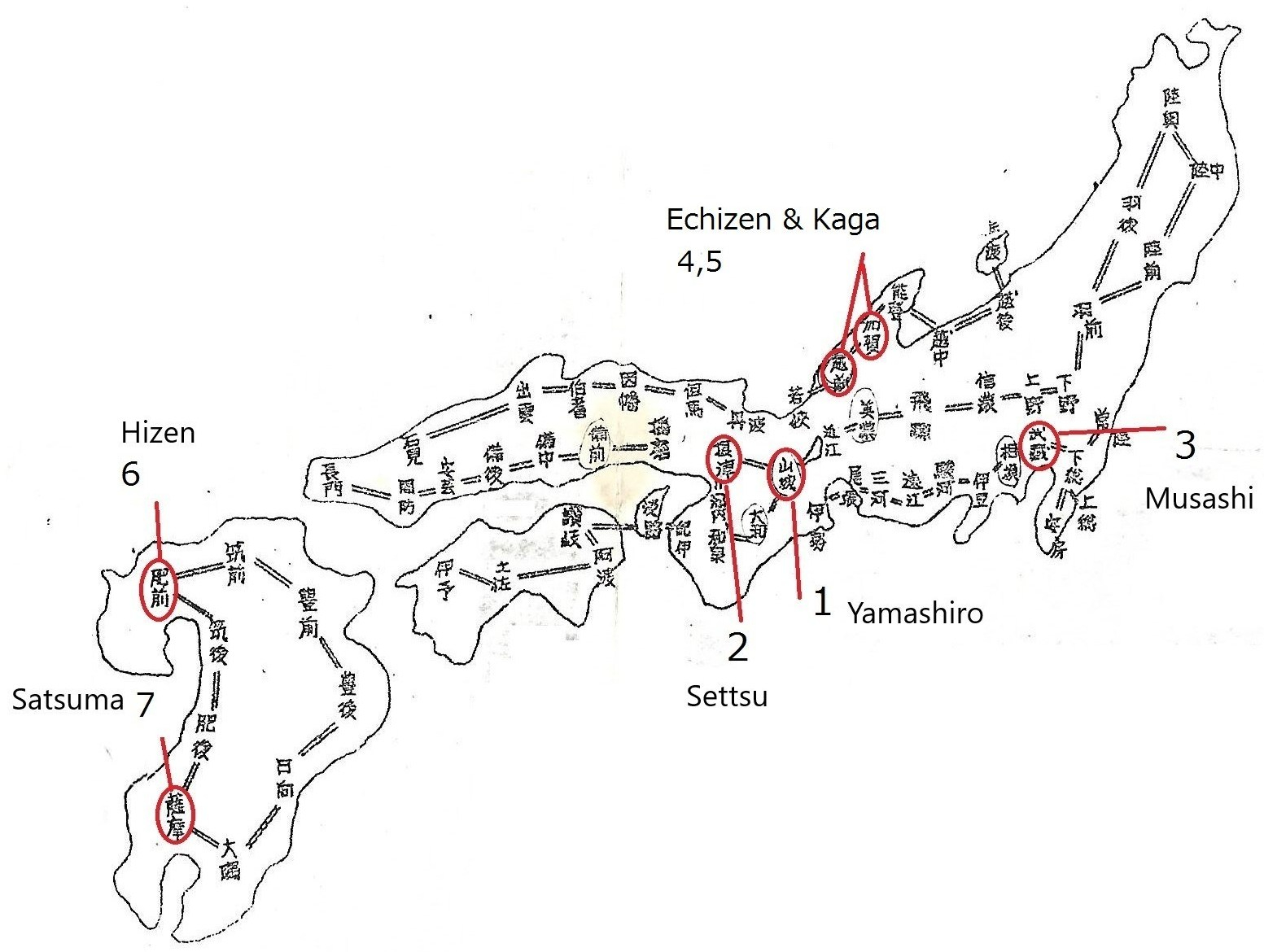
29 Map with number 7

With ko-to swords, features such as the condition of the hamon, kissaki size, length, and  shape of the nakago, etc., indicate when the sword was made.  During the ko-to period, Bizen swordsmiths produced Bizen-den swords, Yamashiro swordsmiths made Yamashiro-den swords, and Mino swordsmiths made Mino-den swords.  However, during the shin-to period, that is not the case.  The den and the swordsmith’s location often do not match.  For shin-to swords, we study the swordsmiths and swords from the seven main regions along with their characteristics.

Regarding swords made during the ko-to period, if a sword has a wide hamon line with  nie, usually, its ji-hada shows a large wood grain or a large burl grain.  Also, when you see a narrow hamon line, it typically features a fine ji-hada.

However, with shin-to swords, if a sword shows a wide hamon with nie, it often has a small wood grain or small burl grain pattern on ji-hada.  If it has a narrow hamon line, it may have a large wood grain pattern on the ji-hada.  This is a shin-to characteristic.   

Here is an exception: some early Soshu-den swords from the late Kamakura period may show a wide hamon with nie, which has small burls on the ji-hada.  Because of that, whether it is ko-to or shin-to can be confusing.  Even so, other features such as ji-hada or other parts should indicate whether it is shin-to or ko-to.

Yamashiro (山城: Kyoto)
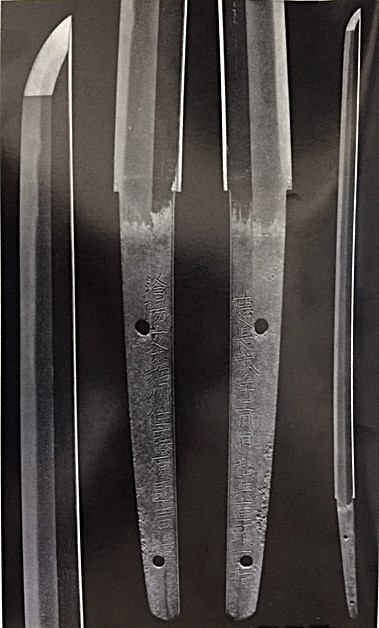
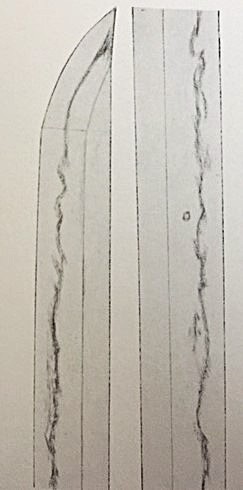
 Horikawa Kunihiro   (堀川国広)   From Sano Museum Catalogue (permission granted)

Horikawa Kunihiro (堀川国広)

Horikawa Kunihiro was regarded as a master swordsmith among shin-to swordsmiths.  He forged swords in many styles with various characteristics.  The hamon types are o-notare, o-gunome, togari-ba (pointed hamon), chu-suguha with hotsure (frayed look), hiro-suguha with a sunagashi effect, inazuma, and kinsujiKunihiro preferred to shape his swords to resemble an o-suriage (shortened Nanboku-cho style long sword).  Kunihiro‘s blades give a powerful impression.  Kunihiro‘s swords often feature beautiful carvings; designs include dragons, Sanskrit letters, and more.  Because he created swords in many different styles, there is no general characteristic that defines his work other than the hamon mainly being nie.  His ji-hada is finely forged.                                                                                                                                                                                                                                                                                                                                                     
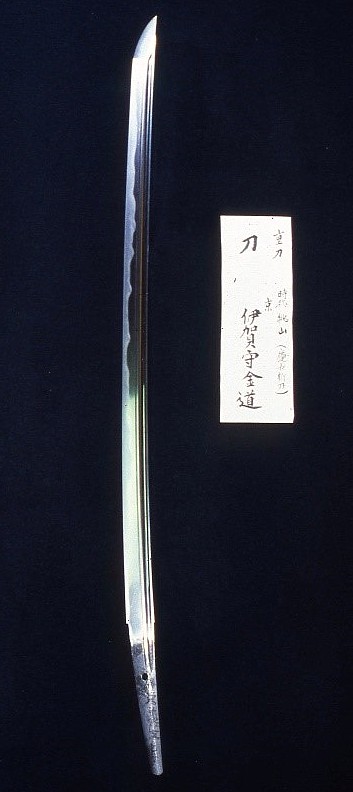
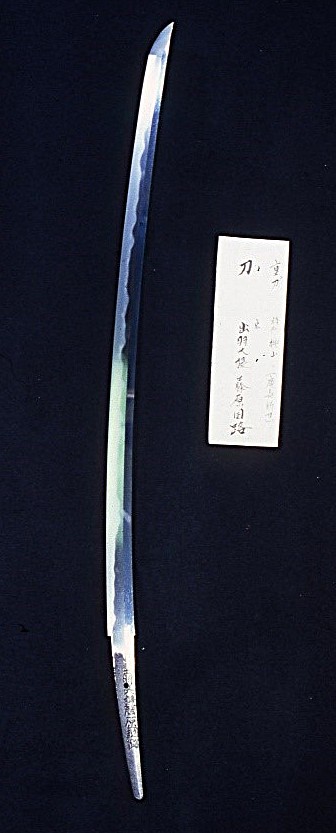
img067.jpg  img068.jpg      Iga-no-Kami Kinnmichi (伊賀守金道)           Dewa Daijyo Kunimichi (出羽大掾国路)        Both Juyo Token (重要刀剣), once my family owned, photos were taken by my father.

Iga-no-Kami Kinmichi ( 伊賀守金道)

The Kinmichi family is called the Mishina group.  Refer to 27 Shinto Main 7 Regions  Part A.   Iga-no-Kami Kinmichi was awarded the Japanese Imperial chrysanthemum crest. 

The characteristics of Kinmichi ——– Wide sword, shallow curvature, an extended kissaki, sakizori (curvature at 1/3 top),  a wide tempered line, kyo-yakidashi (see 27 Shinto Main 7 Regions  A ), hiro-suguha (wide straight hamon), o-notare (large wavy), yahazu-midare, hako-midare (refer to 24 Sengoku Period Tanto).  Mishina-boshi, refer to 27 Shin-to Main 7 Regions A.  Fine wood burl, masame appear in the shinogi-ji area.   

Dewa Daijo Kunimichi (出羽大掾国路)                                                                                 

Dewa Daijo Kunimichi was the top student of Horikawa Kunihiro.  The right photo above.  Like Kunihiro, the sword resembles a shortened Nanboku-cho sword.  Shallow curvature, a wide body, a somewhat elongated kissaki, and fukura-kareru (less arch in fukura).  Wide tempered lines, large gunome, nie with sunagashi, or inazuma shows.  Double gunome (two gunome side by side) appears.  Fine ji-hada.                                                                                                                                                                                                                

  1. Settu (摂津) Osaka (大阪 )

Settu (Osaka) is home to many famous swordsmiths.  They are Kawachi-no-Kami Kunisuke (河内守国助), Tsuda Echizen-no-Kami Sukehiro (津田越前守助広), Inoue Shinkai (井上真改), and Ikkanshi Tadatsuna (一竿子忠綱), among others.                          The main characteristic of the Settsu (Osaka) sword ——– The surface is beautiful and fine, almost like a solid surface with no pattern or design.  The two photos below are of the Settsu sword.
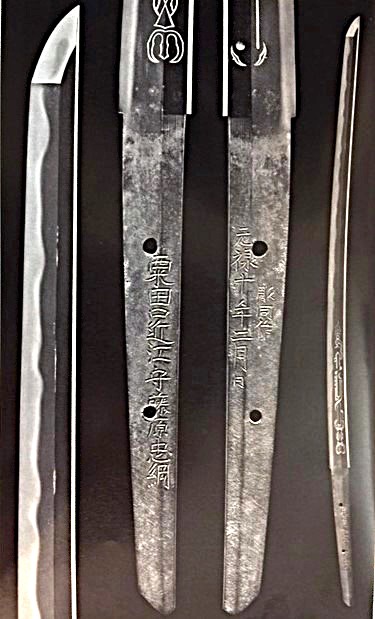
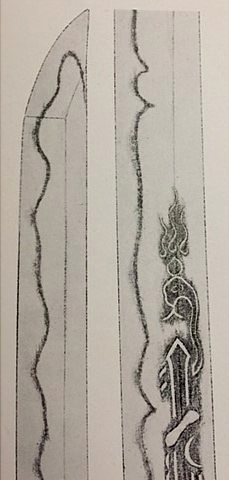
              Ikkanshi Tadatsuna from the Sano Museum Catalogue.  Permission granted to use.

Ikkanshi Tadatsuna (一竿子忠綱)

Ikkanshi Tadatsuna was famous for his carvings.  His father was also a well-known swordsmith, Omi-no-Kami Tadatsuna (近江守忠綱)Consequently, he was known as Awataguchi Omi-no-Kami Fujiwara Tadatsuna (粟田口近江守藤原忠綱), as shown in the nakago photo above.     

The characteristics of Ikkanshi Tadatsuna ——-A longer kissaki and a wide-tempered line with nie.  The Osaka yakidashi (transition between the suguha above machi and midare is smooth.  Refer to 27 Shin-to Sword – Main 7 Regions (Part A) for details on Osaka yakidashi.  O-notare with gunome, komaru-boshi with a turn back, and very fine ji-hada with almost no pattern on the surface.
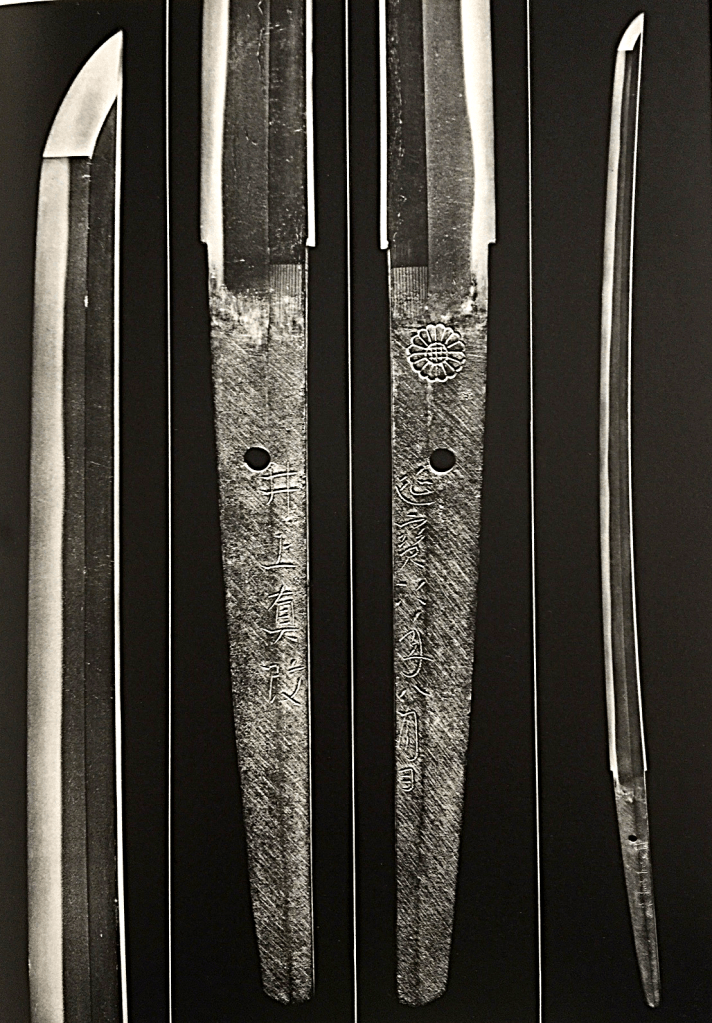
                        Inoue Shinkai (井上真改) from “Nippon-to Art Swords of Japan” The Walter A. Compton Collection

Inoue Shinkai (井上真改)

Inoue Shinkai was the second generation of Izumi-no-Kami Kunisada (和泉守国貞), who was a student of Kunihiro.                                                                                                  The characteristic of Inoue Shinkai’s swords —————- Osaka yakidashi, the tempered line gradually widens toward the top.  O-notare and deep nie.  Very fine ji-hada with almost no surface design.

40|Part 2 of — 7 Overview of Kamakura Period Sword (鎌倉太刀概要)

This chapter is a detailed part of Chapter 7, an overview of the Kamakura Period Swords.  Please read  Chapter 7, Overview of the Kamakura Period Swords, before reading this section. 

0-timeline - size 24 Kamakura Period

                         The red circle above indicates the time we discuss in this section.

The Kamakura period was a golden age of sword-making.  About half of the well-known swords today were produced during this time.  This is probably because the war between the Genji and the Heishi demanded many swords, and swordsmiths improved their skills through wartime experience.  Also, Emperor Gotoba (後鳥羽) invited many talented swordsmiths to his palace, treated them favorably, and encouraged them to create excellent swords by granting them high ranks.  During the Kamakura period, sword-making techniques greatly improved.

Middle Kamakura Period —- Yamashiro-den (山城伝)

The middle Kamakura period was the height of the Yamashiro-den.  Within the Yamashiro-den, there were three main groups: the Ayanokoji group (綾小路), Awataguchi group (粟田口), and Rai group (来).                                                                                                                       Among the Awataguchi group, six swordsmiths received the honor of “Goban-kaji ” from Emperor Gotoba (後鳥羽上皇).  Awataguchi is the name of an area in Kyoto. 

The Ayanokoji ( 綾小路 ) group lived in the Ayanokoji area of Kyoto.  My sword textbook had a note indicating that I had seen Ayanokoji Sadatoshi (綾小路定利) on March 22, 1972.  My note was brief, only a few words: o-suriage, funbari, narrowbody, and ji-nie

The Rai group originated from Rai Kuniyuki (来国行 ).  Rai Kuniyuki and Ayanokoji Sadatoshi were believed to have been close friends.  Rai Kuniyuki created many well-known swords.  His famous Fudo Kuniyuki (不動国行) was once owned by Shogun Ashikaga Yoshiteru (足利義輝 ), then passed to Matsunaga Danjo (松永弾正), then to Oda Nobunaga ( 織田信長 ), then to Akechi Mitsuhide (明智光秀 ), and eventually to Toyotomi Hideyoshi (豊臣秀吉).  All of them were historically famous and influential daimyo.  It is said that Toyotomi Hideyoshi held this sword during the memorial service for Oda Nobunaga.  Rai Kuniyuki’s son was Niji Kunitoshi.  He also forged well-known swords. 

Middle Kamakura Period —– Bizen-den (備前伝)                                                              

The Bizen-den during the Heian period was called Ko-bizen.  They are similar to those in the Yamashiro-den style.  The true height of the Bizen-den was during the middle Kamakura period.  The Bizen area (today’s Okayama Prefecture) had many ideal conditions for sword-making: a good climate, abundant iron resources, plenty of wood for fuel, and a convenient location.  Naturally, many swordsmiths moved there, and it became a major center for sword production. 

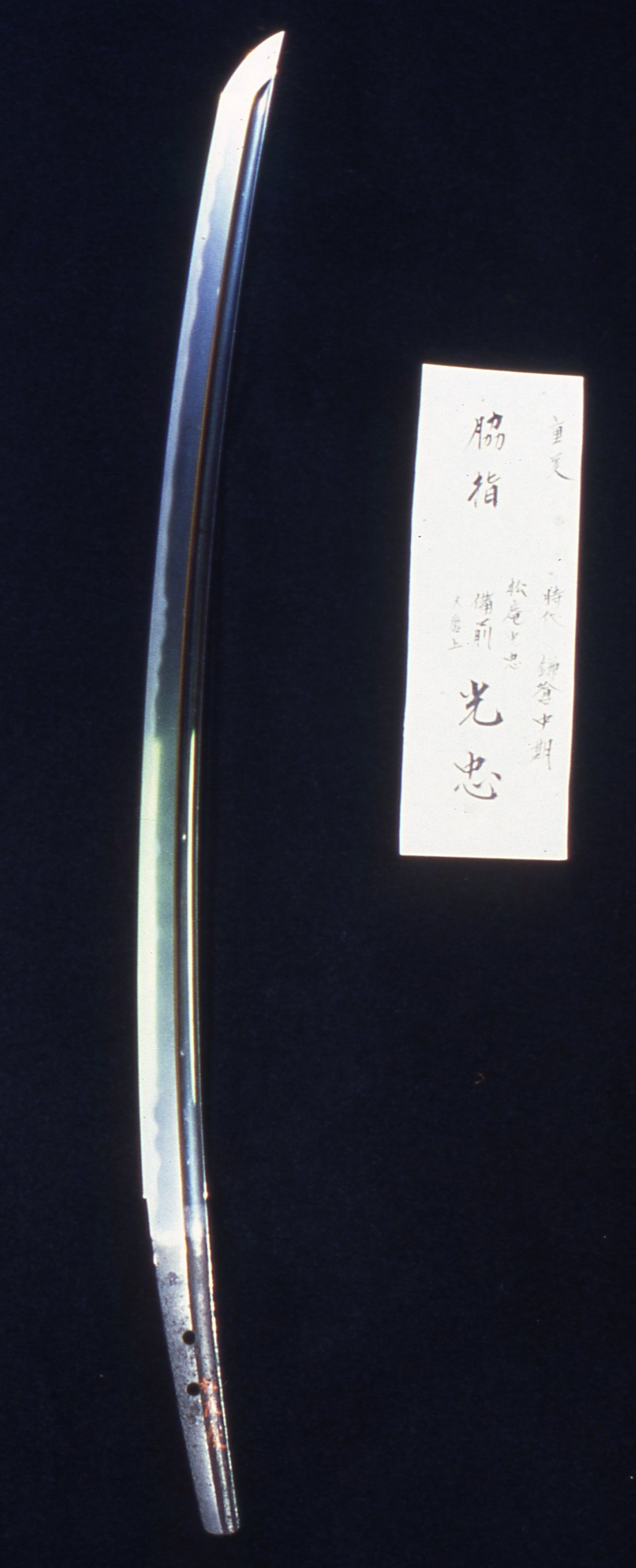
The Bizen region produced many swords of higher quality and superior to those of other sword groups and more famous swordsmiths.  Fukuoka Ichimonji Norimune (則宗) and his son Sukemune (助宗 ) received the honor of the Goban-kaji from Emperor Gotoba.   Among the Osafune group (長船), the famous Mitsutada (光忠) and Nagamitsu (長光) appeared.  My father owned four Mitsutada bladesThree tachis and one tanto.  He was so proud of owning four Mitsutada blades that he asked his tailor to monogram Mitsutada on the inside pocket of his suit jacket. 

From the Hatakeda group (畠田), Hatakeda Moriie (畠田守家), and from the Ugai (鵜飼) group, Unsho (雲生 ) and Unji (雲次) appeared.  The famous Kunimune (国宗) also emerged around this time.   Since many swordsmiths worked in the Bizen-den, many Bizen swords exist today.  Each swordsmith displayed his own characteristics in the swords.  Therefore, doing the kantei of Bizen swords can be quite complex. 

The classification of the sword ranking from the top

  1. Kokuho (国宝: National Treasure)
  2. Jyuyo Bunkazai (重要文化財: Important Cultural Property)
  3. Jyuyo Bijutsu Hin (重要美術品: Important Artwork)
  4. Juyo Token (重要刀剣: Important Sword)        more to follow

Here are my father’s four Bizen Osafune Mitsutada swords. He took these pictures many years ago at home. It is clear that he was not much of a photographer.  On a rectangular  sheet of white paper, he wrote the name of the swordsmith, the period when the sword was made, the name(s) of the daimyo who owned it in the past, and its classification.

img027               img028                Osafune Mitsutada (Juyo Bukazai)                 Osafune Mitsutada (Juyo Bunakzai)
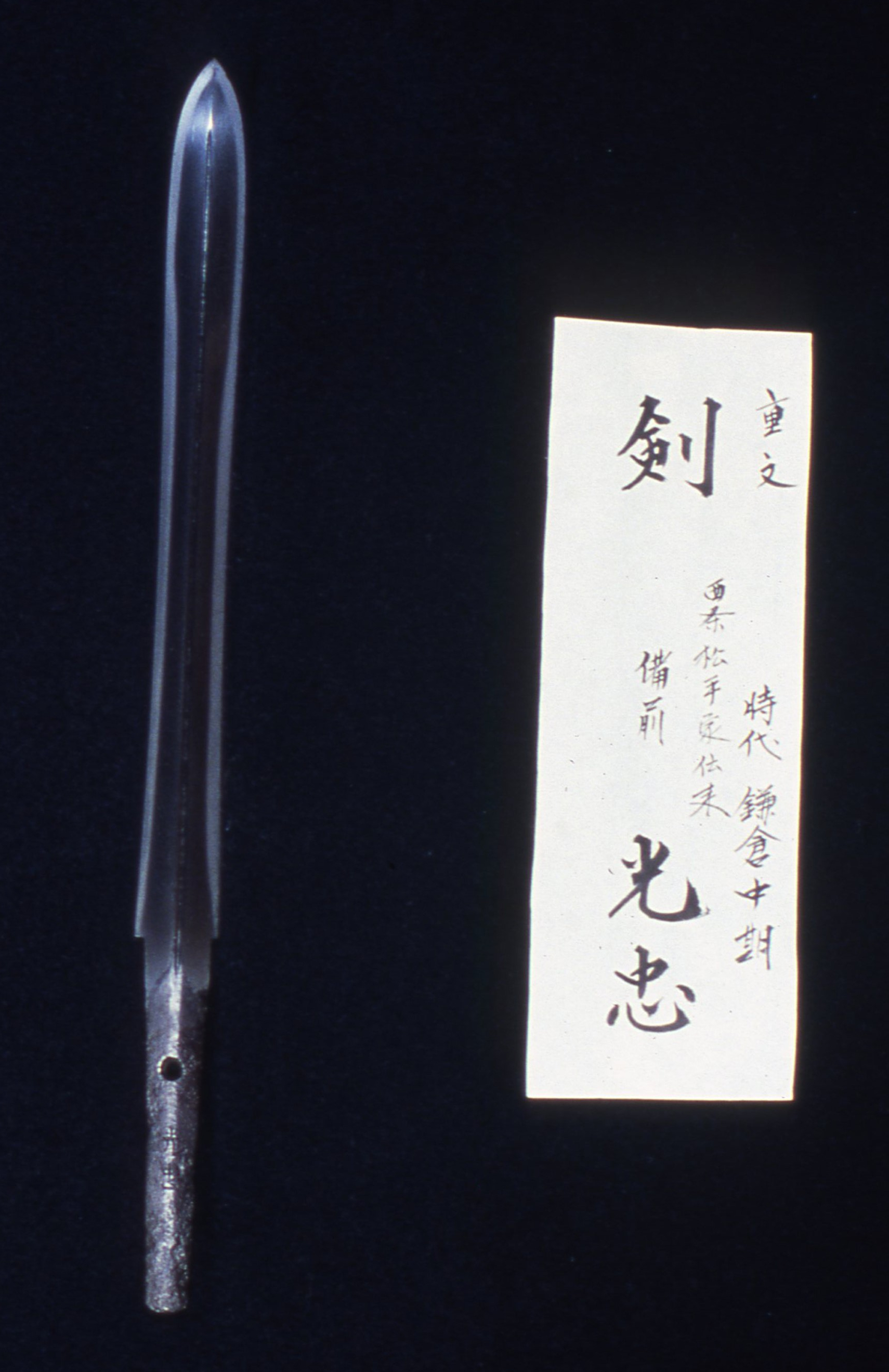
img029            img030 Osafune Mitsutada (Juyo Token)                 Osafune Mitsutada(Juyo Bunkazai)

Late Kamakura Period —– Soshu Den (相州伝 )

Yamashiro-den began to decline in the latter part of the Kamakura period.  At this time, many swordsmiths moved to the Kamakura area under the new power of the Kamakura bakufu (鎌倉幕府), led by the Hojo clan.  The new group, Soshu-den (相州伝 ), began to emerge.  Fukuoka Ichimonji Sukezane (福岡一文字助真) and Kunimune (国宗) from Bizen moved to KamakuraToroku Sakon Kunitsuna (藤六左近国綱) from the Awataguchi group of Yamashiro-den also moved to Kamakura.  These three are considered the founders of the Soshu-den in Kamakura.  Kunitsunas son was Tosaburo Yukimitsu, and his grandson was the famous Masamune (正宗)Outside Kamakura, Yamashiro Rai Kunitsugu (来国次), Go-no-Yoshihiro (郷義弘) from the Ettchu (越中) province, and Samoji  (左文字) from Chikuzen Province (筑前) were active swordsmiths.

21| Muromachi Period Sword (室町時代刀)

0-timeline - size 24 Muromach

       The red circle above indicates the time we discuss in this section

The Muromachi period was a relatively peaceful and prosperous time until shortly before the “Onin-no-ran,” which occurred at the end of the Muromachi periodRefer to Chapter 20, Muromachi Period History (室町時代歴史).   The Nanboku-cho style long swords became outdated; as a result, they were shortened.  The shortened blade is called suriage.  Overall, the Muromachi period was a declining time for sword-making.

Tachi and Katana 

Until the end of the Nanboku-cho period or the beginning of the Muromachi period, samurai wore swords suspended from their waists with the blade facing down.  When a sword was worn this way, the swordsmith inscribed his name on the side facing outward, meaning the blade is on your right when you see the inscription.  In this case, the sword is called a tachi.

During the Muromachi period, a sword was worn between the belt, with the blade facing up.   The swordsmith inscribed his name so that it faced outward when it was worn. Therefore, when you see the inscription, the cutting edge is to your left.  This is classified as a katana. 

Around the beginning of the Muromachi period, samurai started to wear a pair of swords called dai-sho (大小), meaning large and small.  The longer sword is a katana, and the shorter one is a wakizashi.  In general, a tachi is longer than a katana.  A katana is longer than a wakizashi, and a wakizashi is longer than a tanto.  Here is the order of their lengths. 

                                       Tachi   >   Katana   >   Wakizashi   >  Tanto                                  Tachi and katana differ in how they are worn, not in length.   

O-suriage ( 大磨上: Katana shortened by great length) 

How much the sword should be shortened depends on its original length and how much the owner wants it shortened.  O-suriage is a type of sword that is significantly shortened.  Once the blade is shortened by that length, the inscription of the maker’s name is cut off.  When the Hon’ami family (本阿弥家, a family of sword connoisseurs who have appraised Japanese swords for generations from the Muromachi period to today) appraises such a suriage sword, they write the make of the sword and the swordsmith’s name on the front side of the hilt, and the connoisseur’s name with his kaou (similar to a signature) on the back.  There are several levels of writing.  The level at which it should be done depends on the sword’s quality and the owner’s preference.  Below is the order of levels (high to low).

Shu-Mei (朱明 )————————————————————-name written in Vermilion  Kinpun-Mei (金粉名 )———————————————–name lacquered in gold powder  Gin-Zougan (銀象嵌 )————————————————————name inlaid in silver  Kin-Zougan (金象嵌 )————————————————————-name inlaid in gold

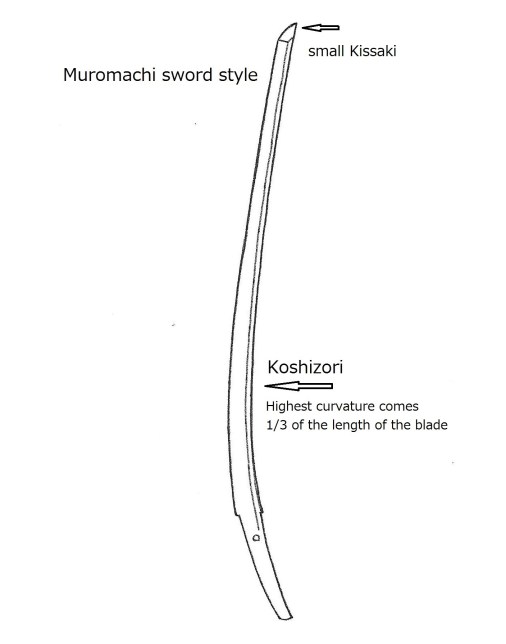
Sugata (姿: Shape) ——— The average length is typically two feet three to four inches (68~71cm).  The shape of the Muromachi period katana is somewhat similar to that of the Heian period tachi.  However, Muromachi katana are less grand or graceful than those from the Heian period swords.  The curvature is usually of the koshizori style.  Koshizori refers to the highest curvature being near the lower part of the blade.  The length and shape are suitable for wearing between the body and the belt.  The width and thickness are well-balanced with the size of the sword.  Small kissaki.

22 Muromachi sword shape

Hirazukuri-Wakizashi ———– Hirazukuri refers to a flat surface without a shinogi or yokote line.  Usually, it is 1 foot and 1 to 2 inches long.  No curvature.  Hirazukuri-wakizashi appeared during the Muromachi period.

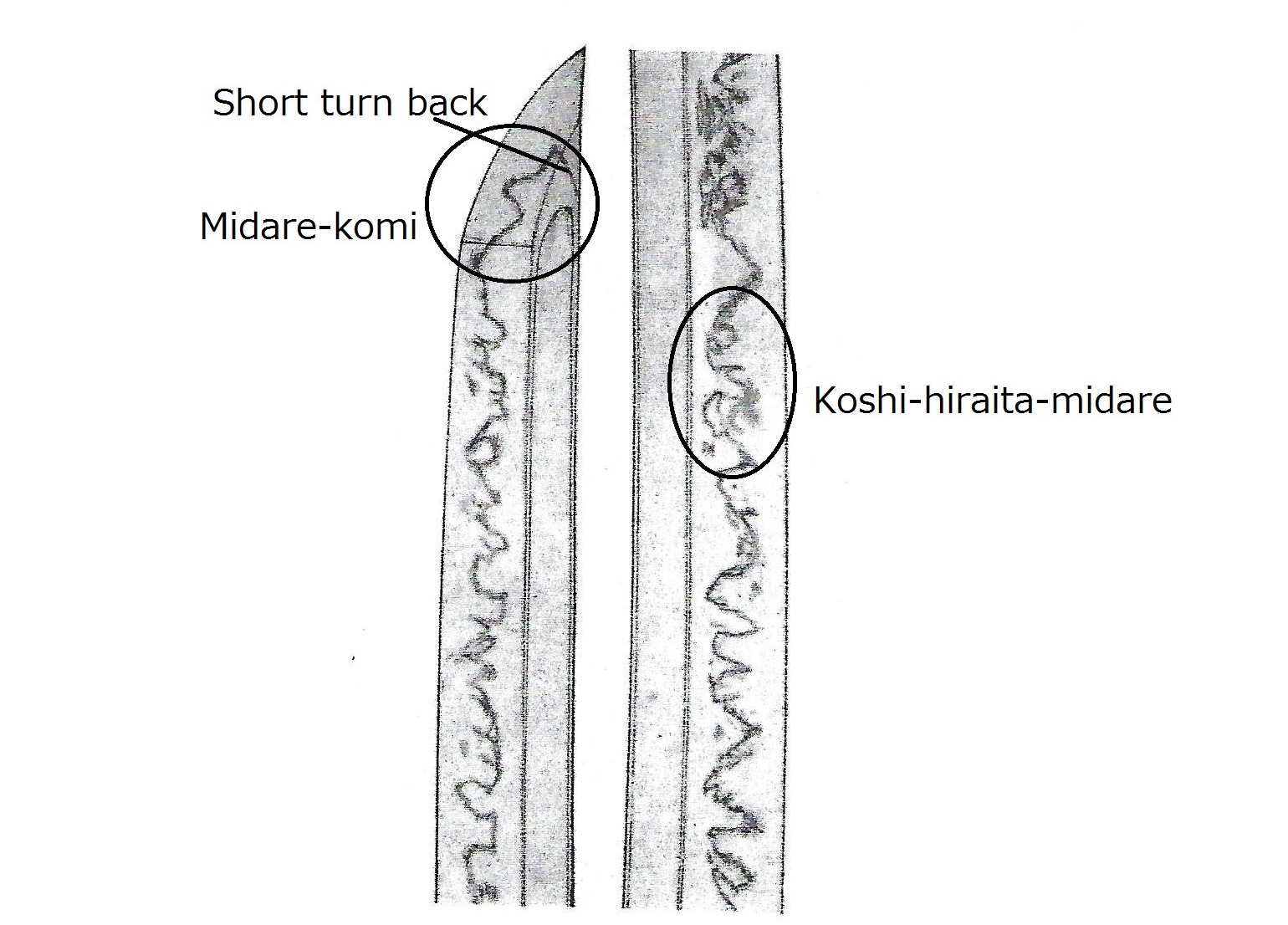
Hamon (刃文: tempered line) ———————- Nioi base.  The tempered area is well balanced with the blade’s width.  Koshi-hiraita-midare is mixed with choji-midare.

22Hamon (Koshi Hiraita midare)
from Sano Museum Catalogue (permission granted)
  • Boshi (Tempered line at Kissaki area) ————– Midare-komi, a short turn back.  See the above illustration.  Midare is an irregular wave-like pattern.
  • Ji-hada (地肌: An area between the tempered line and Shinogi)- Soft look, a large wood grain pattern, Ji-utsuri (faint smoke or cloud-like effect) shows.
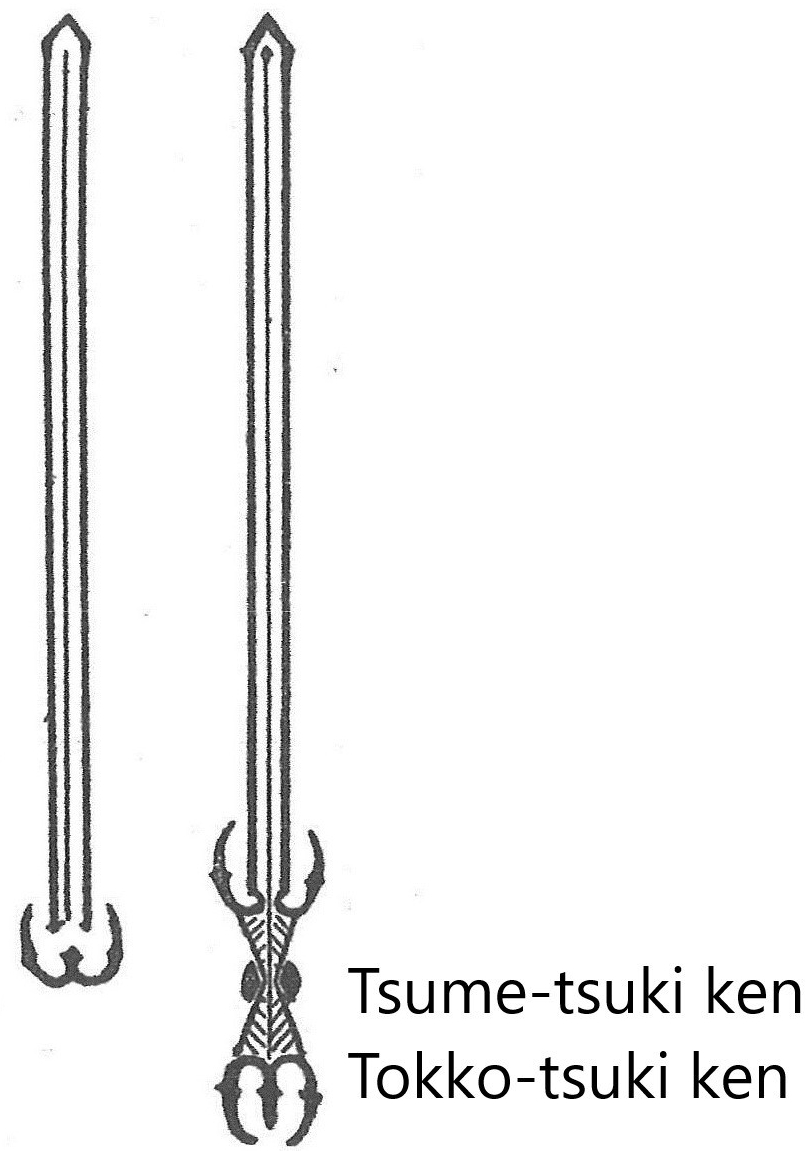
  • Horimono (彫物Engravings) ———- Bo-hi (single groove), Soe-hi (a thin groove alongside the main hi), Futasuji-hi (double narrow groove), Sanskrit, Tokko-tsuki ken, Tsume-tsuki Ken, name of God, and dragon.  Carvings became elaborate.

8 Hi, Suken, Bonji                  21 Tsume-tuki-ken tokko with caption

Sword Smiths during Muromachi Period

  • Bizen Den ——–Osafune Morimitsu (長船盛光), Yasumitsu (康光), Moromitsu (師光)
  • Yamashiro Den————————————————-Yamashiro Nobukuni (山城信国)

21 Muromachi sword from Sano

Ise Masashige (伊勢正重),                     Bizen Osafune Naomitsu (備前長船尚光)         Juyo Token(重要刀剣)                           Sano Museum Catalogue (permission granted)    once my family sword