48|Part 2 of — 14|Late Kamakura Period Sword : Early Soshu Den (鎌倉末刀)

This is a detailed section of Chapter 14| Late Kamakura Period Sword.  Please read Chapter 14 before this part.

0-timeline - size 24 Late Kamakura

                         The red circle above indicates the time we discuss in this section.

14 Ikubi kissaki Damadge

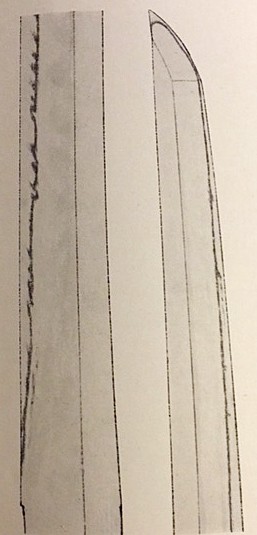
In Chapter 14, “Late Kamakura Period Sword (鎌倉末太刀),” the ikubi-kissaki sword is explained.  The illustration above shows a flaw caused when the damaged area was repaired.  To compensate for this flaw, swordsmiths developed a new sword style during the late Kamakura period.  They forged swords with a longer kissaki and lowered the tip of the hi below the yokote line.   This way, if the yokote line were lowered during repairs, the tip of the hi would remain below the yokote line.
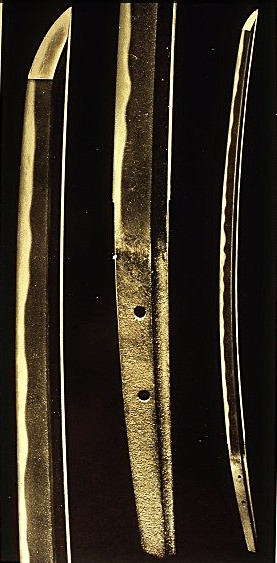
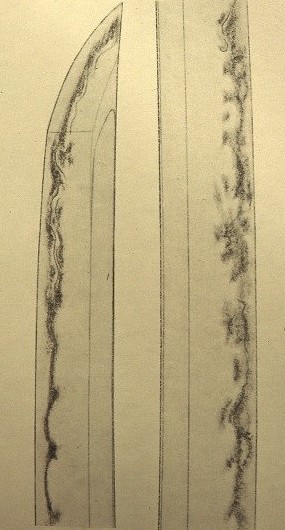
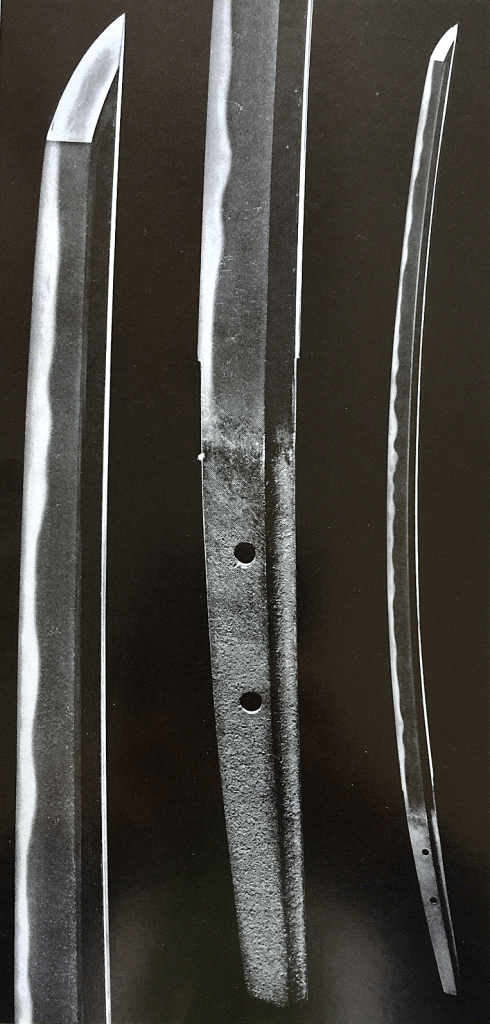
15 Masamune (Sano)   15 Masamune hamon (Sano)

The above photo shows a sword by Goro Nyudo Masamune (五郎入道正宗).  Please observe the size and shape of the kissaki.  This differs from the previous ikubi-kissaki and ko-gissaki stylesThis style represents a typical late Kamakura period kissaki style.  It is o-suriage (a largely shortened form). 

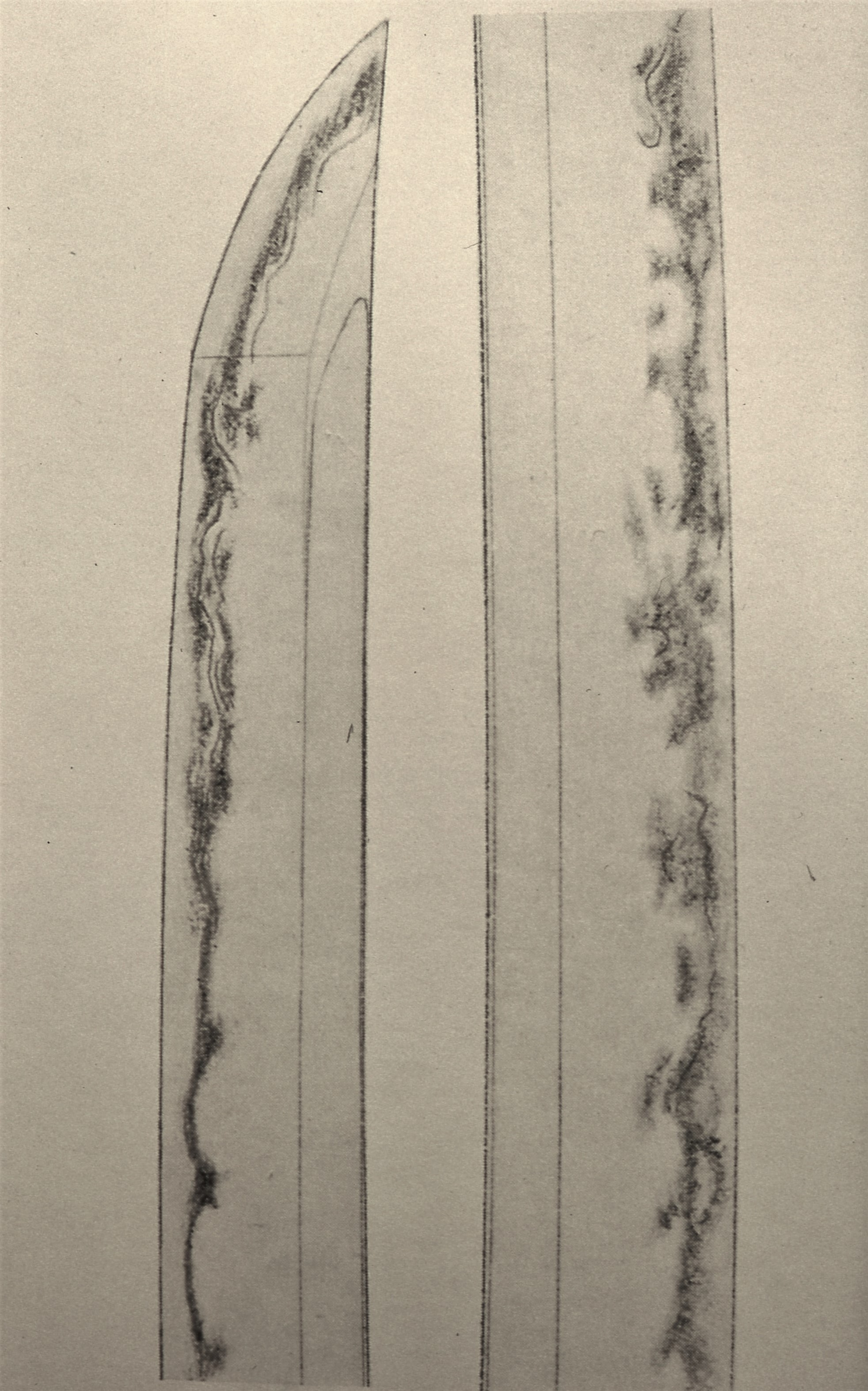
Under the Kamakura Bakufu, many swordsmiths moved to KamakuraThey were Toroku Sakon Kunituna (藤六左近国綱) of the Yamashiro Awataguchi group (山城粟田口), Fukuoka Ichimonji Sukezane (福岡一文字助真), and Kunimune (国宗) from the Bizen area.  They were the origin of Soshu-den (相州伝)Eventually, Tosaburo Yukimitsu (藤三郎行光) and his famous son, Masamune (正宗), emergedIn the drawing above, kinsuji and inazuma are shown within the hamon.  The shining lines inside the hamon are inazuma and kinsuji.  Inazuma and kinsuji are collections of nie.  Masamune is well-known for his inazuma and kinsuji.  He lived in Kamakura, a seaside town, and his hamon resembles ocean waves when viewed from the side.
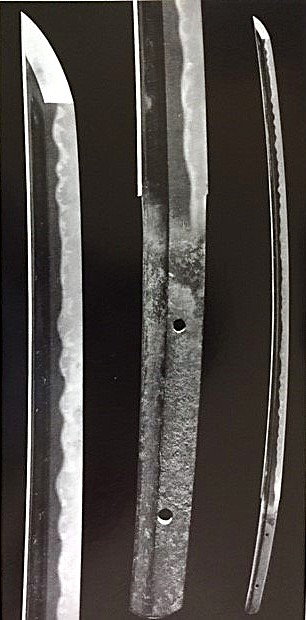
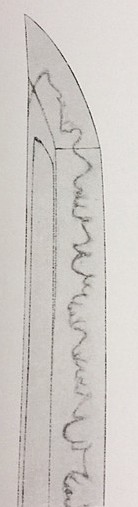
50 part 2 of 15 吉岡.photo 50 part 2 of 15 吉岡

The picture above shows a sword made by the swordsmith Yoshioka Ichimonji group (吉岡一文字).  The kissaki resembles one of Masamune’s swordsIt is longer than the previous ikubi-kissaki or ko-gissaki.  This is chu-gissaki.  The kissaki, like this, is one of the key points in determining the period when the sword was made.  The hamon has choji, gunome, togariba (pointed tip), and very tight nie.
50 part 2 of 15 運生 photo 50 part 2 of 15 運生 

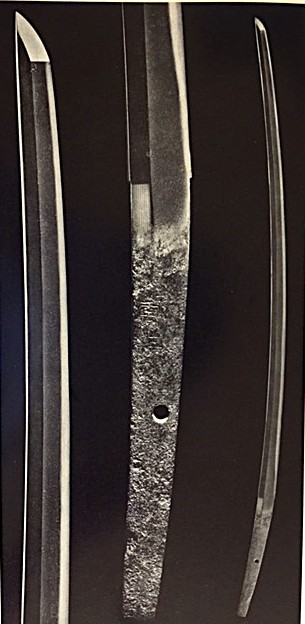
The photo above shows a sword by Ukai Unsho (鵜飼雲生) from Bizen-den.  This sword is also from the late Kamakura period, but it has a ko-gissaki.  This sword does not have the late Kamakura period chu-gissaki style.  Narrow hoso-suguha are more characteristic of an earlier time than the late Kamakura periodThis sword indicates that swords do not always exhibit the style of their period.  To kantei*: first examine the style and shape, then give yourself an idea of the period it was made in.  However, the kissaki in this case does not indicate the late Kamakura period.  The next step is to look at the various characteristics of the sword one by one, such as the hamon, nie or nioi, ji-hada, etc., to determine the period, the den, and the province, and then come up with the name. This process is called kantei.

*Kantei – the process of identifying a swordsmith’s name by analyzing the sword’s characteristics without seeing the mei (the inscribed smith’s name).  The mei might be gone if it has been shortened.   All the photos above are from the Sano Museum Catalogue.  Permission to use them is granted.

40|Part 2 of — 7 Overview of Kamakura Period Sword (鎌倉太刀概要)

This chapter is a detailed part of Chapter 7, an overview of the Kamakura Period Swords.  Please read  Chapter 7, Overview of the Kamakura Period Swords, before reading this section. 

0-timeline - size 24 Kamakura Period

                         The red circle above indicates the time we discuss in this section.

The Kamakura period was a golden age of sword-making.  About half of the well-known swords today were produced during this time.  This is probably because the war between the Genji and the Heishi demanded many swords, and swordsmiths improved their skills through wartime experience.  Also, Emperor Gotoba (後鳥羽) invited many talented swordsmiths to his palace, treated them favorably, and encouraged them to create excellent swords by granting them high ranks.  During the Kamakura period, sword-making techniques greatly improved.

Middle Kamakura Period —- Yamashiro-den (山城伝)

The middle Kamakura period was the height of the Yamashiro-den.  Within the Yamashiro-den, there were three main groups: the Ayanokoji group (綾小路), Awataguchi group (粟田口), and Rai group (来).                                                                                                                       Among the Awataguchi group, six swordsmiths received the honor of “Goban-kaji ” from Emperor Gotoba (後鳥羽上皇).  Awataguchi is the name of an area in Kyoto. 

The Ayanokoji ( 綾小路 ) group lived in the Ayanokoji area of Kyoto.  My sword textbook had a note indicating that I had seen Ayanokoji Sadatoshi (綾小路定利) on March 22, 1972.  My note was brief, only a few words: o-suriage, funbari, narrowbody, and ji-nie

The Rai group originated from Rai Kuniyuki (来国行 ).  Rai Kuniyuki and Ayanokoji Sadatoshi were believed to have been close friends.  Rai Kuniyuki created many well-known swords.  His famous Fudo Kuniyuki (不動国行) was once owned by Shogun Ashikaga Yoshiteru (足利義輝 ), then passed to Matsunaga Danjo (松永弾正), then to Oda Nobunaga ( 織田信長 ), then to Akechi Mitsuhide (明智光秀 ), and eventually to Toyotomi Hideyoshi (豊臣秀吉).  All of them were historically famous and influential daimyo.  It is said that Toyotomi Hideyoshi held this sword during the memorial service for Oda Nobunaga.  Rai Kuniyuki’s son was Niji Kunitoshi.  He also forged well-known swords. 

Middle Kamakura Period —– Bizen-den (備前伝)                                                              

The Bizen-den during the Heian period was called Ko-bizen.  They are similar to those in the Yamashiro-den style.  The true height of the Bizen-den was during the middle Kamakura period.  The Bizen area (today’s Okayama Prefecture) had many ideal conditions for sword-making: a good climate, abundant iron resources, plenty of wood for fuel, and a convenient location.  Naturally, many swordsmiths moved there, and it became a major center for sword production. 

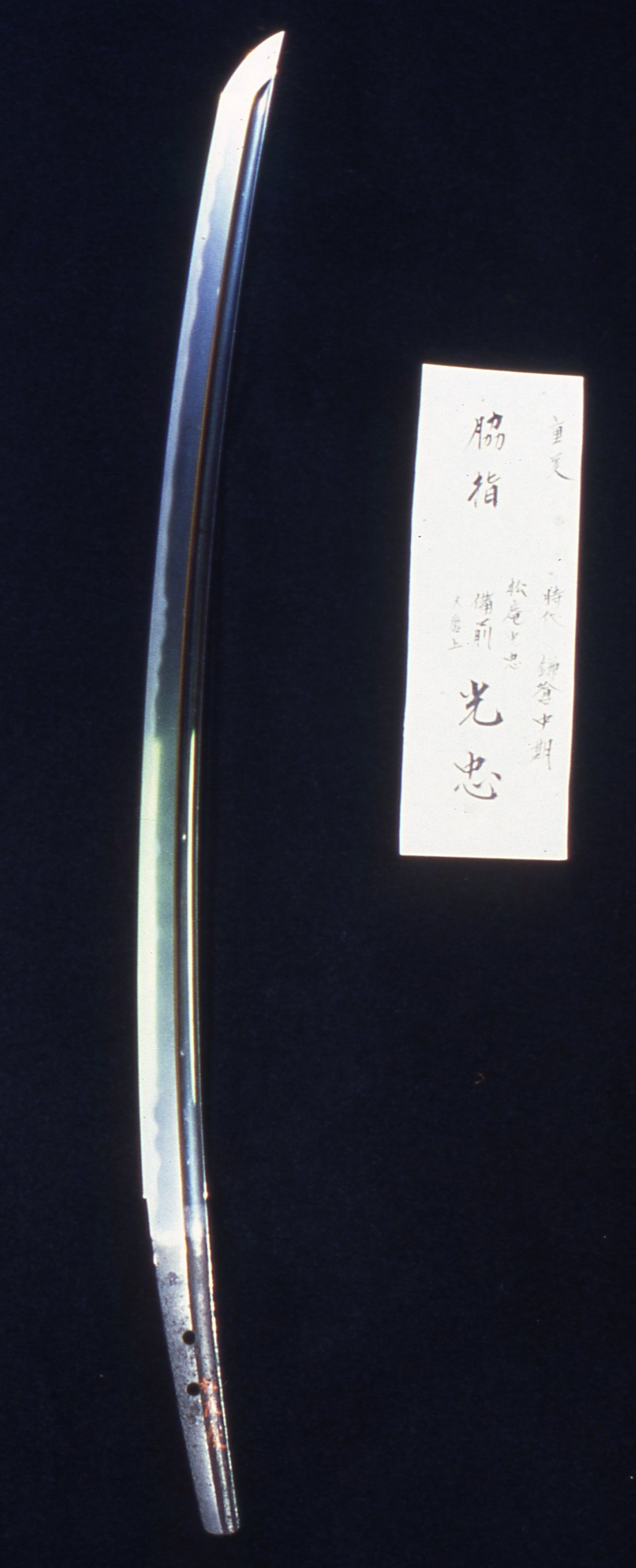
The Bizen region produced many swords of higher quality and superior to those of other sword groups and more famous swordsmiths.  Fukuoka Ichimonji Norimune (則宗) and his son Sukemune (助宗 ) received the honor of the Goban-kaji from Emperor Gotoba.   Among the Osafune group (長船), the famous Mitsutada (光忠) and Nagamitsu (長光) appeared.  My father owned four Mitsutada bladesThree tachis and one tanto.  He was so proud of owning four Mitsutada blades that he asked his tailor to monogram Mitsutada on the inside pocket of his suit jacket. 

From the Hatakeda group (畠田), Hatakeda Moriie (畠田守家), and from the Ugai (鵜飼) group, Unsho (雲生 ) and Unji (雲次) appeared.  The famous Kunimune (国宗) also emerged around this time.   Since many swordsmiths worked in the Bizen-den, many Bizen swords exist today.  Each swordsmith displayed his own characteristics in the swords.  Therefore, doing the kantei of Bizen swords can be quite complex. 

The classification of the sword ranking from the top

  1. Kokuho (国宝: National Treasure)
  2. Jyuyo Bunkazai (重要文化財: Important Cultural Property)
  3. Jyuyo Bijutsu Hin (重要美術品: Important Artwork)
  4. Juyo Token (重要刀剣: Important Sword)        more to follow

Here are my father’s four Bizen Osafune Mitsutada swords. He took these pictures many years ago at home. It is clear that he was not much of a photographer.  On a rectangular  sheet of white paper, he wrote the name of the swordsmith, the period when the sword was made, the name(s) of the daimyo who owned it in the past, and its classification.

img027               img028                Osafune Mitsutada (Juyo Bukazai)                 Osafune Mitsutada (Juyo Bunakzai)
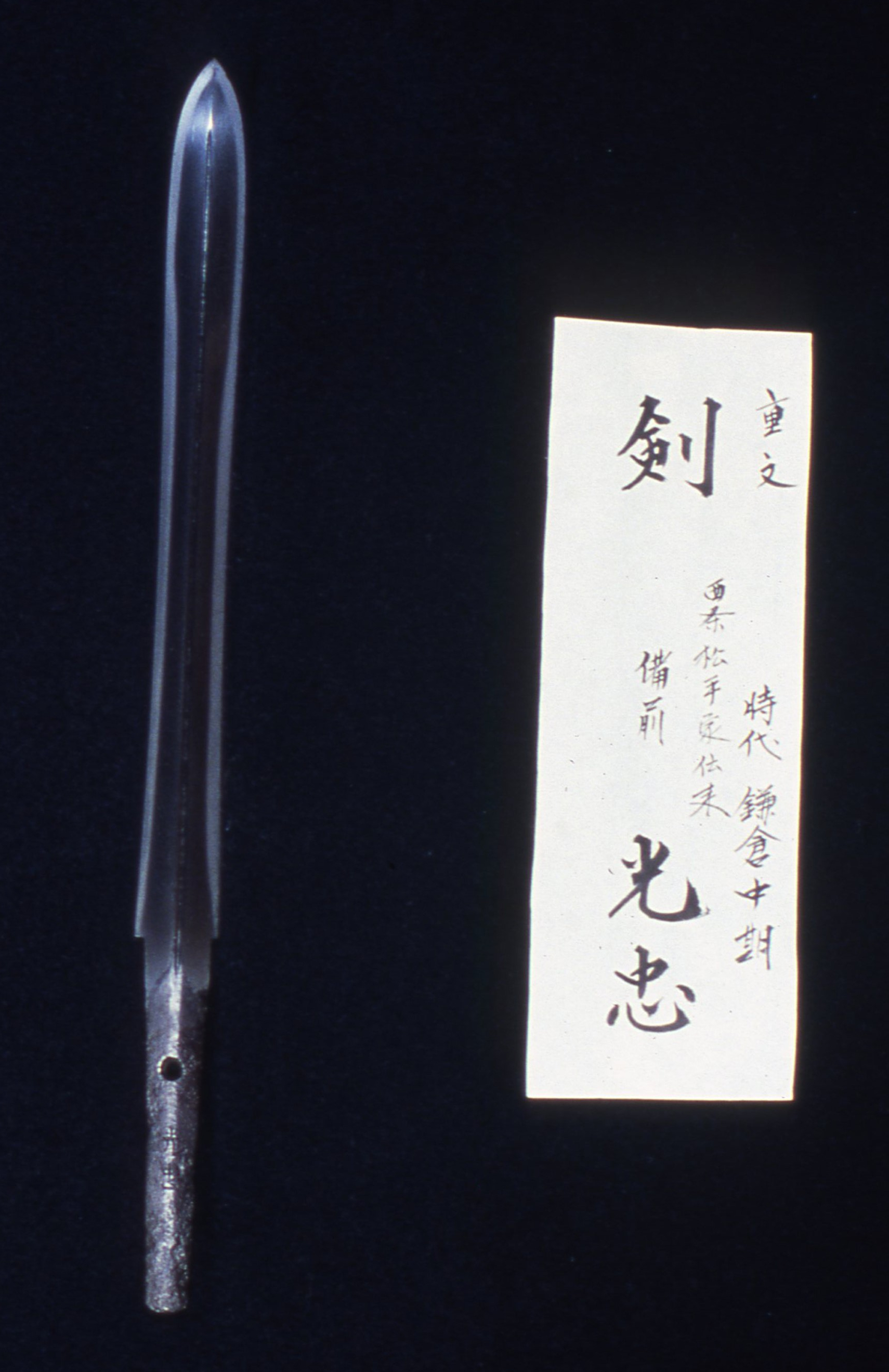
img029            img030 Osafune Mitsutada (Juyo Token)                 Osafune Mitsutada(Juyo Bunkazai)
Late Kamakura Period —– Soshu Den (相州伝 )

Yamashiro-den began to decline in the latter part of the Kamakura period.  At this time, many swordsmiths moved to the Kamakura area under the new power of the Kamakura bakufu (鎌倉幕府), led by the Hojo clan.  The new group, Soshu-den (相州伝 ), began to emerge.  Fukuoka Ichimonji Sukezane (福岡一文字助真) and Kunimune (国宗) from Bizen moved to KamakuraToroku Sakon Kunitsuna (藤六左近国綱) from the Awataguchi group of Yamashiro-den also moved to Kamakura.  These three are considered the founders of the Soshu-den in Kamakura.  Kunitsunas son was Tosaburo Yukimitsu, and his grandson was the famous Masamune (正宗)Outside Kamakura, Yamashiro Rai Kunitsugu (来国次), Go-no-Yoshihiro (郷義弘) from the Ettchu (越中) province, and Samoji  (左文字) from Chikuzen Province (筑前) were active swordsmiths.

17| Nanboku-cho Period History 1333-1392(南北朝歴史)

0-timeline - size 24 Nanboku-cho

            The red circle above indicates the time we discuss in this section.

After Jokyu-no-ran (Chapter 10 Jokyu-no-ran), the power of the Imperial Court declined significantly.  The successor, the Hojo clan, which was a dominant force during the Kamakura period, also began to face financial difficulties and began to lose control over regional lords.  One reason was the costs incurred by the Mongol invasion.  The Kamakura bakufu (government) could not adequately reward the samurai who fought hard during the war.  As a result, they became very dissatisfied with the bakufu.  Seeing this as an opportunity, Emperor Go-Daigo attempted to attack the Kamakura bakufu twice but failed both times.  He was exiled to Oki Island.  In the meantime, Ashikaga Takauji (足利尊氏) and several groups of anti-Kamakura samurai gathered armed forces and succeeded in destroying the Kamakura bakufu in 1333.  This war ended the Kamakura period.                                                                                                                                                  

Emperor Go-Daigo, who had been exiled to Oki Island, returned to Kyoto and attempted political reforms.  This reform was known as Kenmu-no-chuko (or Kenmu-no-shinsei, 建武の中興).  However, his reforms failed to satisfy most of the ruling class.  Seeing an opportunity, Ashikaga Takauji attacked the Imperial Court in Kyoto, deposed Emperor Go-Daigo, and installed a member of a different branch of the Imperial family as emperor. 

Emperor Go-Daigo, however, insisted on his legitimacy, moved to Yoshino in the south of Kyoto, and established another Imperial court.  Thus, the Northern and  Southern Dynasties began.  With much strife between these rival courts and internal problems within each court,  more samurai groups began to move to the Northern Dynasty.  About sixty years later, the Southern Dynasty was forced to accept the Northern Dynasty’s proposal.  Consequently, the Northern Dynasty became the legitimate imperial court.  This sixty-year period is referred to as the Nanboku-cho or Yoshino-cho period. 

During the Nanboku-cho period, samurai preferred longer, more elaborate, yet practical swords.  The Soshu-den was at the height of its prominence.  However, the Soshu group was not the only one to produce Soshu-den-style swords.  Other schools and provinces in different areas also made Soshu-den-style swords.

Late Kamakura Period Swordsmiths (Early Soshu-Den time)

  • Tosaburo Yukimitsu (藤三郎行光)  
  • Goro Nyudo Masamune (五郎入道正宗)     
  • Hikoshiro Sadamune (彦四郎貞宗)

 17 Masamune hamon (Sano)             Masamune from Sano Museum Catalog (permission granted)
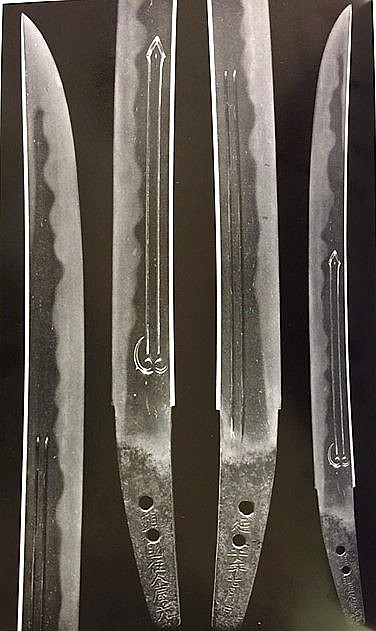
Nanboku-cho Period Swordsmiths  (Middle Soshu-Den time)

  • Hiromitsu (広光)   
  • Akihiro (秋広)

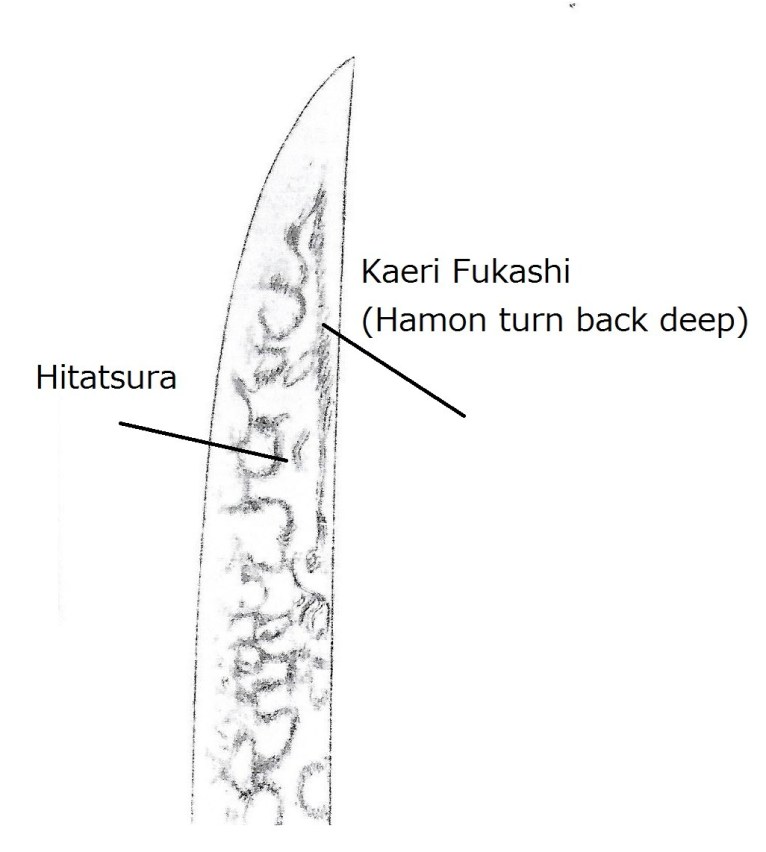
 20 Hitatsura Hiromitsu Hitatura )                  Hiromitsu from Sano Museum Catalog (permission granted)
Muromachi Period Swordsmiths (Late Soshu-Den time)

  • Hiromasa (広正)    
  • Masahiro (正広)

13| Late Kamakura Period: Genko (鎌倉末元寇)

0-timeline - size 24 Late Kamakura

                       The circle represents the time we discuss in this section

GENKO 元寇  (1274 and 1281)

Kublai Khan, the grandson of Genghis Khan, attempted to invade Japan twice, in 1274 and 1281.  Both times, a powerful typhoon struck Japan.  The Mongols sent a large number of soldiers, along with all kinds of supplies, on numerous ships to Japan.  These ships had to stay very close to each other, side by side, front and back, within the limited offshore area of Kyushu.  When the strong winds arrived, the ships swayed, collided, and capsized.  Many people fell into the ocean, drowned, and lost supplies in the water.

Although Mongol soldiers landed and fought against the Japanese army, they had little choice but to retreat from Japan due to a typhoon and shipwrecks.   As a result of this strong wind, Japan was saved, and it seemed like Japan had won.  This was when the famous Japanese word “kamikaze” (divine wind) was created.

The Mongols had far superior weapons compared to the Japanese.  They had guns, which the Japanese did not.  Their team fighting tactics were far more effective than the Japanese’s one-on-one combat style.

After the Mongolian invasion, it became clear that the Ikubi-kissaki style sword needed to change.  When swords were used in battle, the most frequently damaged part was the kissaki.  Japanese soldiers primarily used ikubi-kissaki swords in this war.  An ikubi-kissaki tachi has a short kissaki.  When the damaged part of the kissaki is whetted out, the top part of the yakiba (tempered area) disappears, and the hi (a groove) rises too high into the boshi area (the top, triangle-like section).  The short ikubi-kissaki becomes even shorter, and the hi rises too high into the boshi area.  Aesthetically, this appears unattractive.  Functionally, it does not work well.  To fix this flaw, a new style started to emerge toward the end of the Kamakura period.

14 Ikubi kissaki Damadge

During the latter part of the Kamakura period, swordsmiths began creating a new style to address this flaw.  Additionally, pride and confidence grew among people after driving the Mongols away, which was reflected in the appearance of swords.  Generally, the hamon and the sword’s shape became stronger, more pronounced, and showier.

The Kamakura area prospered under the Hojo family’s rule.  Many swordsmiths moved to Kamakura from Bizen, Kyoto, and other regions during this time and created a new style.  This marks the beginning of the Soshuden (Soshu is the Kanagawa area today).  Many renowned swordsmiths appeared during this period.

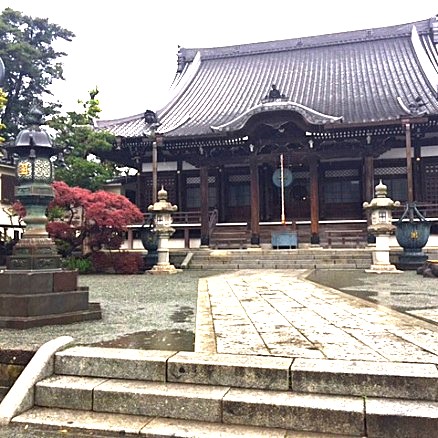
One of the famous swordsmiths is Goro-nyudo Masamune (五郎入道正宗).  You can easily visit Masamune’s tomb in Kamakura.  It is located at Honkaku-Ji Temple, about a 5 to 6-minute walk from Kamakura train station. 

While I was attending Mori Sensei’s (teacher) sword study group, I studied with a student who is a twenty-fourth-generation descendant of Masamune.   Although he does not carry the Masamune name, he has been making excellent swords in Kamakura.  He also makes high-quality kitchen knives.  His shop is called “Masamune Kogei (正宗工芸).”  It is a short walk from Kamakura Station.  To find his shop, ask at the information center at the train station.

            with  Mr. Tsunahiro Yamamura                    Honkaku-Ji Temple