51| Part 2 of — 17 Nanboku-Cho Period History 1333 – 1392 (南北朝歴史)

This chapter is a detailed part of Chapter 17|Nanboku(Yoshino) Cho Period History (1333-1392).  Please read Chapter 17 before reading this section.

0-timeline - size 24 Nanboku-cho

                      The red circle above indicates the time we discuss in this section

The Nanboku-cho period (1333 – 1392) was between the fall of the Kamakura bakufu and the beginning of the Muromachi bakufu.  It was a time when the Northern and Southern Dynasties coexisted.  Around the time of the Mongolian invasion, Emperor Go-saga died without naming a successor.  Because of that, his two heirs and their family lines, the Daigakuji-to (大覚寺統) and the Jimyoin-to (持明院統), alternately assumed the imperial position after Emperor Go-saga‘s death.  This system was politically unstable.  Additionally, many inconvenient problems arose; for example, while one emperor was still very young, the next-in-line emperor died young from a head injury while playing on a slippery stone.

At a time like this, Go-daigo (後醍醐天皇) became the emperor.  He was placed on the throne as a temporary emperor until the young emperors reached maturity.  Around this time, the emperors’ power was declining.  The Kamakura bakufu (government) controlled the emperors.  After the Mongolian invasion, even though typhoons drove the Mongolian troops away, the Kamakura bakufu faced financial troubles due to the costs of war.  Many samurai who fought during the Mongolian invasion did not receive any rewards or compensation for their expenses and were also financially troubled.  All these problems piled up and caused the resentment against the Kamakura bakufu.

Emperor Go-Daigo refused to be merely a placeholder emperor.  He decided to stay as emperor and attack the Kamakura bakufu.  For some reason, the Kamakura bakufu found out about his plans.  Emperor Go-Daigo somehow managed to avoid being accused of being the instigator.  Afterwards, the Kamakura bakufu appointed another heir for the next emperor.  However, Go-Daigo insisted on remaining emperor.  He planned another attack once more.  This time, he had carefully planned and allied with prominent, powerful temples in Yamato (Nara today) since the Kamakura bakufu did not control themRefer to 15 Revival of Yamato Den (大和伝復活)  and 49 Part 2 of– 15 The Revival of Yamato Den. 

This time again, the rebellion plot came to light.  Go-Daigo sneaked out of Kyoto and fought against the Kamakura army.  Although Go-Daigo’s army had fewer soldiers than the Kamakura army, several groups opposing the Kamakura bakufu rose up in various parts of Japan.  Eventually, Go-Daigo was captured and sent to Oki Island (the same place where Emperor Go-Toba was exiled).  

Even after exiling Emperor Go-Daigo to Oki Island, the Kamakura bakufu still had to fight against other uprising groups.  One of the most famous rebels was Kusunoki Masashige (楠正成).  Go-Daigo’s son also actively fought against the Kamakura bakufu and managed to ally with more factions.

More and more people sought to overthrow the Kamakura bakufu.   Even Ashikaga Takauji (足利尊氏), one of the top men of the Kamakura bakufu who fought against Emperor Go-Daigo, betrayed the Kamakura and switched sides, becoming the emperor’s ally.  Meanwhile, Go-Daigo escaped from Oki Island.  More and more uprisings against the Kamakura bakufu increased across the country.  Eventually, the main political center, Rokuhara Tandai (六波羅探題) of the Kamakura bakufu, fell.  Nitta Yoshisada (新田義貞)*, who led another uprising group, attacked Kamakura and won.  The Kamakura bakufu fell in 1333. 

Emperor Go-Daigo initiated a new political system called Kenmu no Shinsei (建武の新政).  However, his new system turned out to be a disaster.  He made great efforts to set things right and drastically changed the old political system.  Yet, this political reform created big unrest.  It was not beneficial for anyone, and no one gained anything.  Ashikaga Takauji (one of the key figures of merit) and his men did not receive any high-ranking positions.  This reform was highly idealistic and too advanced for its time.  It proved disadvantageous for the noblemen.  His new policies only caused chaos and corruption.

Now, Ashikaga Takauji turned against Go-Daigo and defeated him.  Go-Daigo left the Imperial Palace and established a new government in Yoshino, south of Kyoto.         Therefore, it was called the Southern Dynasty.  Meanwhile, Ashikaga Takauji set up a new emperor, Emperor Komyo (光明), in Kyoto and established the Northern Dynasty.     This is how the Northern and Southern Dynasties arose. 

Two dynasties co-existed for about 60 years.  Gradually, many samurai groups moved to the Northern Dynasty, and after Go-Daigo and several of his key men died, the Southern Dynasty weakened.  Eventually, the Southern Dynasty accepted an offer from the Ashikaga side, and the North and South united in 1392.  Throughout these conflicts between the emperor and the Kamakura bakufu, sword styles became broader and longer, reaching 3, 4, or even 5 feet.  Later, most Nanboku-cho (North and South Dynasties) style long swords were shortened.

53 Ashikaga Takauji

Kibamusha (騎馬武者蔵) This portrait was once believed to depict Ashikaga Takauji, but now some claim otherwise. “Public Domain” owned by the Kyoto National Museum

 *Nitta Yoshisada (新田義貞)

When Minamoto-no-Yoritomo established the Kamakura bakufu, he chose the Kamakura area as its center because it is surrounded by mountains on three sides and one side faces the ocean.  This made it hard to be attacked and easier for them to defend themselves.  They built seven narrow, steep roads through the mountains called Kir- toshi (切り通し), connecting with several major cities.  These seven routes were the only roads in and out of Kamakura

When Nitta Yoshisada attempted to attack Kamakura, he first attempted the land route but failed.  He then approached the town from the ocean side, but the cliff stretched far out into the sea, making it impossible for them to pass.  The legend says that when Nitta Yoshisada reached the area called Inamura Gasaki (稲村ヶ崎), he threw his golden sword into the ocean and prayed.  Then the tide receded, allowing all the soldiers to walk around the cliff on foot.  They charged into Kamakura, and the Kamakura bakufu fell.  There are several different views on this story.  Some scholars argue it is not true; some say it happened, but the date was wrong; others say that an unusual ebb tide occurred that day, and so on.  

Today, Inamura Gasaki in the Shonan area (湘南) is one of the favorite evening dating spots for young people.  The evening view at Inamura Gasaki is beautiful.    The sunset over Inamura Gasaki towards Enoshima (江の島, a small island with a shrine on the hilltop) is stunning.   My parents’ house used to sit above the cliff in an area called Kamakura-yama, overlooking the ocean.
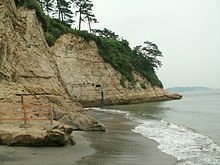
53 Inamura gasaki

Inamura Gasaki      Photo is “Creative Commons” CC 表示-継承 3.0 File: Inamuragasaki tottanbu.jpg    Public domain

47| Part 2 of –13 Late Kamakura Period: Genko (鎌倉末元寇)

This is a detailed section of Chapter 13, Late Kamakura Period, Genko(鎌倉末元寇).  Please read Chapter 13 before reading this section.

0-timeline - size 24 Late Kamakura

                      The red circle above indicates the time we discuss in this section.

Genko (元寇):  Mongolian Invasion 

Chapter 13 briefly describes the Mongolian invasion.  Here is a more detailed description.  The Mongol Empire was a vast empire that stretched from present-day Mongolia to Eastern Europe during the 13th and 14th centuries.  The grandson of Genghis Khan, Kublai Khan, sent several official letters to Japan demanding that it become a dependent state of the Mongol Empire (元: Yuan) and ordering Japan to send tribute.  They threatened Japan, warning that they would invade if Japan did not meet their demands.  Hojo Tokimune (北条時宗), who was in power at the Kamakura bakufu (government) at the time, refused and ignored the letters multiple times.  This led to two invasions by the Mongol Empire.  It is often said that a powerful typhoon hit Japan on each occasion, and these two powerful typhoons drove the Mongols away.  This is correct, but the whole story was much more than this.

Bun’ei-no-eki (文永の役)  1274

The first Mongolian invasion was called Bun’ei-no-eki.  In early October 1274, Mongol troops (Mongols, Han Chinese, and Koreans) totaling around 40,000 men* set out from the Korean Peninsula on about 900* large and small ships and headed toward Japan.  After arriving on Tsushima Island (対馬), Mongol soldiers burned villages and killed many residents, including local villagers.  Villagers were captured and sent to the top Mongol officials as slaves.  It was a heartbreaking scene. 

The Mongols moved to Iki Island (壱岐の島), Hizen Shore (肥前), Hirado Island (平戸)、Taka Island (鷹島), and Hakata Bay (博多).  In each location, the disastrous and sorrowful scenes were the same as everywhere.    On every battlefield, Japanese soldiers and villagers were killed in large numbers.  The Kamakura bakufu sent a large number of samurai troops into battle.  The Japanese forces sometimes won and pushed the Mongols back, but they mostly lost.  Many Japanese wives and children near the battlefields were captured. 

Eventually, no soldiers dared to fight the Mongols. The Mongols’ arrows were short and not very powerful, but they coated the tips with poison and shot them all at once like rain.  Also, this was the first time the Japanese faced firearms. The loud sound of explosions frightened horses and samurai.  Japanese troops had to retreat, and the situation was grim for them.  But one morning, there was a big surprise!  All the ships had vanished from the shore.  They were all gone on the morning of October 21 (today’s date, November 19).  All the Mongols had disappeared from the coast of Hakata

What happened was that the Mongols decided to end the fight and head back home.  The reason was that, although they were winning, they had also lost many soldiers and one of their key leaders in the army.  The Mongols realized that no matter how many victories they achieved, the Japanese kept coming more and more from everywhere.  Also, the Mongols realized they could not expect reinforcements from their homeland across the ocean.  Their supplies of weapons were running low.  The Mongols decided to go back.  However, there was a twist.  Around the end of October (November by today’s calendar), the sea between Hakata (where the Mongols were stationed) and Korea was very dangerous because of bad weather—only clear days with south winds allowed sailing across the sea.  The sea they had to cross is called Genkai Nada (玄界灘), known for its rough waters.  For some reason, the Mongols decided to go back during the night.  That was a mistake.  They might have caught a brief moment of the south wind, but it did not last long.  Consequently, they encountered a usual severe rainstorm.  Many ships collided with each other, crashed into cliffs, capsized, and people fell into the ocean.  Several wrecked vessels were found on the shores of Japan. 

The Mongol invasion ended here.  This war is called Bun’ei-no-eki (文永の役).  The Mongols lost many people, ships, soldiers, food, and weapons.  In fact, Korea suffered greatly.  They were forced to supply the Mongols with people, food, weapons, and more.  After the war, in Korea, only older men and children were left to work on farms.  Additionally, they faced both drought and prolonged rainfall.

Ko’an-no-eki (弘安の役) 1281

The second Mongolian invasion, known as Ko’an-no-eki, occurred in 1281.  After the first attempt to invade Japan, Kublai Khan kept sending messengers to Japan, demanding that Japan become a Mongol dependency.  The Kamakura bakufu ignored and executed these messengers.  Kublai Khan decided to attack Japan again in 1281.  His top advisers tried to persuade him not to go through with it because the ocean was too dangerous, the country was too small, the distance was too far, and there was nothing to gain even if they succeeded.  Despite these, Kublai Khan insisted on the attack. 

This time, they arrived in two groups.  One was the east-route troops with 40,000* soldiers on 900 ships, and the other was the south-route troops with 100,000* soldiers on 3,500 ships.  This was one of the largest forces in history.  They planned to depart from their designated port and meet on Iki Island (壱岐の島) by June 15 to fight together.  The east-route troops arrived there before the south-route troops.  Instead of  waiting for the south-route forces to arrive, the east-route troops started attacking Hakata Bay (博多) on their own.  However, since the previous invasion of the Bun’ei-no-eki, Japan had prepared for battle by building a 20-kilometer-long stone wall.  This stone wall was 3 meters high and 2 meters thick.  The troops had to give up landing at Hakata and moved to Shiga-no-Shima Island (志賀島).  There, the fight between the Mongols and Japanese was evenly matched, but ultimately, the east-route troops lost and retreated to Iki Island, where they decided to wait for the south-route forces to arrive. 

The south-route troops never arrived. They had changed their plans.  On top of that, while waiting for the south-route forces to come, they lost over 3,000 men to an epidemic.  Some suggested returning home because of the difficulties, but they chose to wait for the south-route troops as long as their supplies lasted. 

Meanwhile, the south-route troops decided to head to Hirado Island (平戸島), which was closer to Dazaifu (太宰府).  Dazaifu was the final and most important place they wanted to attack.   Later, the east-route troops found that the south-route troops had gone to Hirado Island.  Finally, the two forces joined on Hirado Island, with each group stationed on a nearby island called Takashima Island (鷹島).  The problem was that the ships were not easily maneuverable because this island had very high tides and low tides.

Meanwhile, 60,000 Japanese men headed toward the area where the Mongols were stationed.  Before the Japanese soldiers arrived to fight the Mongols, a massive typhoon struck on July 30, and the Mongols were caught in a huge storm.  Their ships collided, and many sank.  People fell overboard and drowned.

By this time, it had been about three months since the east-route troops left Mongolia in early May.  That means they had been at sea for roughly three months.  In northern Kyushu (九州), typhoons usually occur about 3.2 times between July and September.  The Mongols had been at sea and along Japan’s coast for around three months.  So, they were likely to be hit by a typhoon sooner or later.

The Mongol Empire lost 2/3 of its naval forces during the event at Ko’an-no-eki.   Even after the Mongols failed in two invasions, Kublai Khan still insisted on attacking Japan again, despite his advisers’ warnings not to.  Ultimately, the plan was delayed and then terminated due to numerous rebellions and upheavals, and no lumber was left to build ships.  Soon after, Kublai died in 1294.  Historical records of the Mongols indicate that Mongolian officials highly praised Japanese swords.  Some even suggest that one reason it was difficult to defeat Japan was because of its long, sharp swords. The experience of the Mongolian invasion changed the ikubi kissaki (猪首切先) sword into a new Soshu-den (相州伝) style.  The next chapter describes this new style of sword, the Soshu-den swords.

49 Photo of part 2 of 14 Late KamakuraThe stone wall scene.  Photo from Wikipedia.  Public Domain

* Number of soldiers by https://kotobank.jp/word/元寇-60419 .  Referred to several different reference sources.  They all have similar numbers of soldiers and ships.