This chapter is a detailed part of Chapter 7, an overview of the Kamakura Period Swords. Please read Chapter 7, Overview of the Kamakura Period Swords, before reading this section.

The red circle above indicates the time we discuss in this section.
The Kamakura period was a golden age of sword-making. About half of the well-known swords today were produced during this time. This is probably because the war between the Genji and the Heishi demanded many swords, and swordsmiths improved their skills through wartime experience. Also, Emperor Gotoba (後鳥羽) invited many talented swordsmiths to his palace, treated them favorably, and encouraged them to create excellent swords by granting them high ranks. During the Kamakura period, sword-making techniques significantly improved.
Middle Kamakura Period —- Yamashiro-den (山城伝)
The middle Kamakura period was the height of the Yamashiro-den. Within the Yamashiro-den, there were three main groups: the Ayanokoji group (綾小路), Awataguchi group (粟田口), and Rai group (来). Among the Awataguchi group, six swordsmiths received the honor of “Goban-kaji ” from Emperor Gotoba (後鳥羽上皇). Awataguchi is the name of an area in Kyoto.
The Ayanokoji ( 綾小路 ) group lived in the Ayanokoji area of Kyoto. My sword textbook had a note indicating that I had seen Ayanokoji Sadatoshi (綾小路定利) on March 22, 1972. My note was brief, only a few words: o-suriage, funbari, narrow–body, and ji-nie.
The Rai group originated from Rai Kuniyuki (来国行 ). Rai Kuniyuki and Ayanokoji Sadatoshi were believed to have been close friends. Rai Kuniyuki created many well-known swords. His famous Fudo Kuniyuki (不動国行) was once owned by Shogun Ashikaga Yoshiteru (足利義輝 ), then passed to Matsunaga Danjo (松永弾正), then to Oda Nobunaga ( 織田信長 ), then to Akechi Mitsuhide (明智光秀 ), and eventually to Toyotomi Hideyoshi (豊臣秀吉). All of them were historically famous and influential daimyo. It is said that Toyotomi Hideyoshi held this sword during the memorial service for Oda Nobunaga. Rai Kuniyuki’s son was Niji Kunitoshi. He also forged well-known swords.
Middle Kamakura Period —– Bizen-den (備前伝)
The Bizen-den during the Heian period was called Ko-bizen. They are similar to those in the Yamashiro-den style. The true height of the Bizen-den was during the middle Kamakura period. The Bizen area (present -day Okayama Prefecture) had many ideal conditions for sword-making: a good climate, abundant iron resources, plenty of wood for fuel, and a convenient location. Naturally, many swordsmiths moved there, and it became a major center for sword production.
The Bizen region produced many swords of higher quality and superior to those of other sword groups and more famous swordsmiths. Fukuoka Ichimonji Norimune (則宗) and his son Sukemune (助宗 ) received the honor of the Goban-kaji from Emperor Gotoba. Among the Osafune group (長船), the famous Mitsutada (光忠) and Nagamitsu (長光) appeared. My father owned four Mitsutada blades. Three tachis and one tanto. He was so proud of owning four Mitsutada blades that he asked his tailor to monogram Mitsutada on the inside pocket of his suit jacket.
From the Hatakeda group (畠田), Hatakeda Moriie (畠田守家), and from the Ugai (鵜飼) group, Unsho (雲生 ) and Unji (雲次) appeared. The famous Kunimune (国宗) also emerged around this time. Since many swordsmiths worked in the Bizen-den, many Bizen swords exist today. Each swordsmith displayed his own characteristics in the swords. Therefore, doing the kantei of Bizen swords can be quite complex.
The classification of the sword ranking from the top
- Kokuho (国宝: National Treasure)
- Jyuyo Bunkazai (重要文化財: Important Cultural Property)
- Jyuyo Bijutsu Hin (重要美術品: Important Artwork)
- Juyo Token (重要刀剣: Important Sword) more to follow
Here are my father’s four Bizen Osafune Mitsutada swords. He took these pictures many years ago at home. It is clear that he was not much of a photographer. On a rectangular sheet of white paper, he wrote the name of the swordsmith, the period when the sword was made, the name(s) of the daimyo who owned it in the past, and its classification.

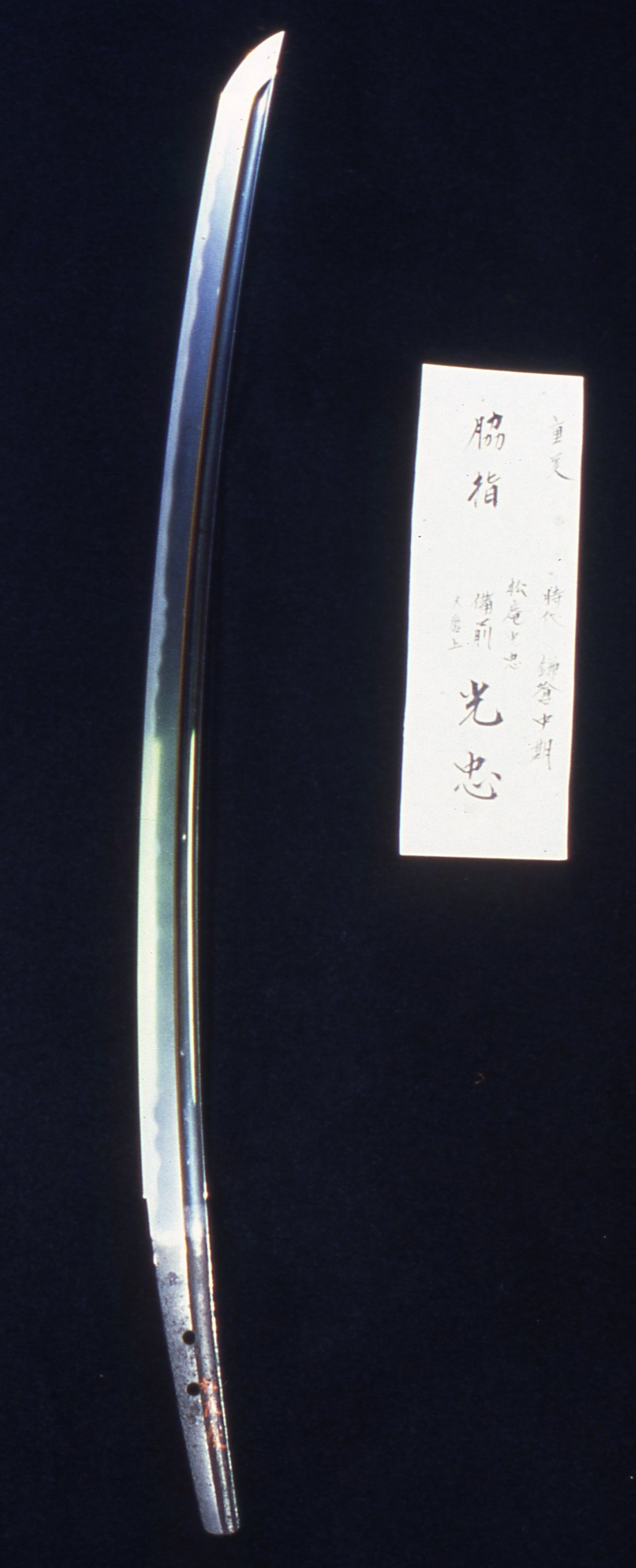 Osafune Mitsutada (Juyo Bukazai) Osafune Mitsutada (Juyo Bunakzai)

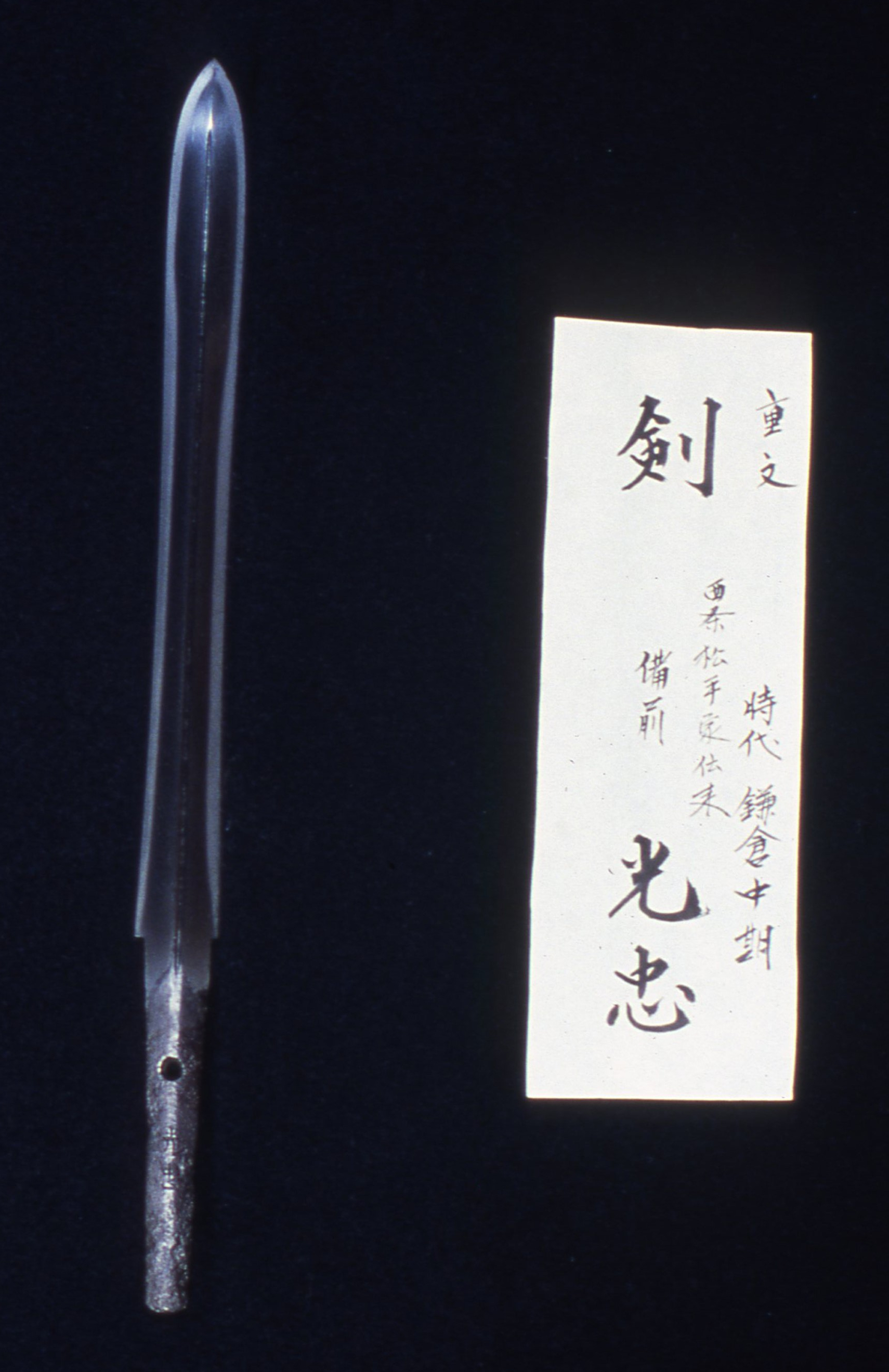 Osafune Mitsutada (Juyo Token) Osafune Mitsutada(Juyo Bunkazai)
Late Kamakura Period —– Soshu Den (相州伝 )
Yamashiro-den began to decline in the latter part of the Kamakura period. At this time, many swordsmiths moved to the Kamakura area under the new power of the Kamakura bakufu (鎌倉幕府), led by the Hojo clan. The new group, Soshu-den (相州伝 ), began to emerge. Fukuoka Ichimonji Sukezane (福岡一文字助真) and Kunimune (国宗) from Bizen moved to Kamakura. Toroku Sakon Kunitsuna (藤六左近国綱) from the Awataguchi group of Yamashiro-den also moved to Kamakura. These three are considered the founders of the Soshu-den in Kamakura. Kunitsuna‘s son was Tosaburo Yukimitsu, and his grandson was the famous Masamune (正宗). Outside Kamakura, Yamashiro Rai Kunitsugu (来国次), Go-no-Yoshihiro (郷義弘) from the Ettchu (越中) province, and Samoji (左文字) from Chikuzen Province (筑前) were active swordsmiths.





 Study of Japanese Sword