19 | Nanboku-Cho Period Tanto(南北朝短刀)

0-timeline - size 24 Nanboku-cho
The circle indicates the time we discuss in this section

During the Nanboku-cho period, a type of tanto called hirazukuri ko-wakizashi sun-nobi tanto was made.  Hirazukuri means flat swords without the yokote line or shinogi.  Ko-wakizashi refers to a shorter sword.  Sun-nobi tanto means longer than a standard tanto.  This type is also known as Enbun Jyoji ko-wakizashi tanto because most of these tantos were created during the Enbun and Jyoji eras of the imperial period.  In Japan, a new imperial era begins when a new emperor ascends to the throne.  The Enbun era spanned 1356-1361, while the Jyoji period spanned 1362-1368.

20 Enbun Jyoji Kowakizashi Tanto

Sugata (姿: shape) ————A standard tanto measure is approximately one shaku.  Shaku is an old Japanese unit of measurement for length, and one shaku is roughly equal to one foot.  

8.5 sun (the sun is another old Japanese measurement unit of length) is approximately ten inches.  Ten inches is the standard size for a tanto, known as a josun tanto.  Anything longer than a josun tanto is called a sun-nobi tanto.  Anything shorter than a josun is called a sun-zumari tanto. 

Most of the Nanboku-cho tantos are longer than a josun tanto, approximately one foot two inches.  Therefore, they are called hirazukuri ko-wakizashi sun-nobi tantoSaki-zori (curved outward at the top.  See the illustration above).   Wide in width and thin in body.  Fukura kareru (no fukura means less arc).  Shin-no-mune.  See the drawing below.
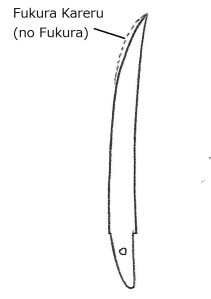
20 Fukura           20 Shin-no-Mune

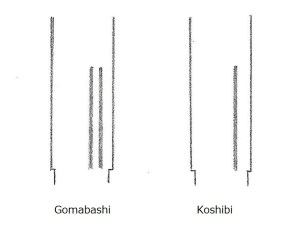
Hi, (: Grooves) and Horimono (彫り物: Engraving) ——- A groove or grooves on the mune side.  Bonji (Sanskrit, see Chapter 16 Late Kamakura Period (Early Soshu-Den Tanto),  koshi-bi (short groove),  tumetuki ken, and tokko-tsuki ken (see below) appear. The ken (dagger) is curved widely and deeply in the upper part and shallower and narrower in the lower part.  This is called Soshu-bori (Soshu-style carving).
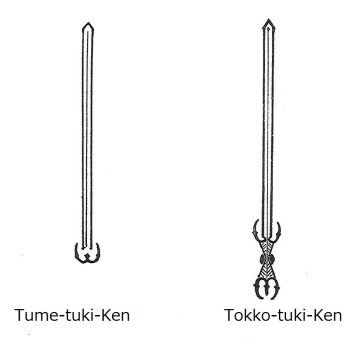
20 Tokko, tume Ken

Hamon (: Tempered line) ——- The narrowly tempered section at the lower part gradually widens toward the top.  A similar wide hamon pattern extends into the boshi area.  The hamon in the kissaki area is kaeri-fukashi (deep turn back).  See the illustration below.  Coarse nie.  O-midare (large irregular hamon pattern).

20 Hitatsura

                                        From Sano Museum Catalogue

Ji-hada (地肌: the area between shinogi-ji and the tempered line) ——– a loose wood grain pattern called itame.  Yubashiri (see Chapter 16, Late Kamakura Period) and tobiyaki (irregular patchy tempered spots) appear.  Dense tobiyaki is called hitatsura (see the drawing above).

Nakago (: Tang) —- Short tanago-bara.  Tanago-bara refers to the shape of the belly of a Japanese fish called tanago (bitterling).

20 Tanago Bara

Tanto Swordsmiths during the Nanboku-Cho Period

Soshu Den ———————————————————-Hiromitu( 広光) Akihiro (秋広) Yamashiro Den ————————————————–Hasebe Kunishige (長谷部国重)   Bizen Den ——————————————————— Kanemitu (兼光) Chogi (長義 )
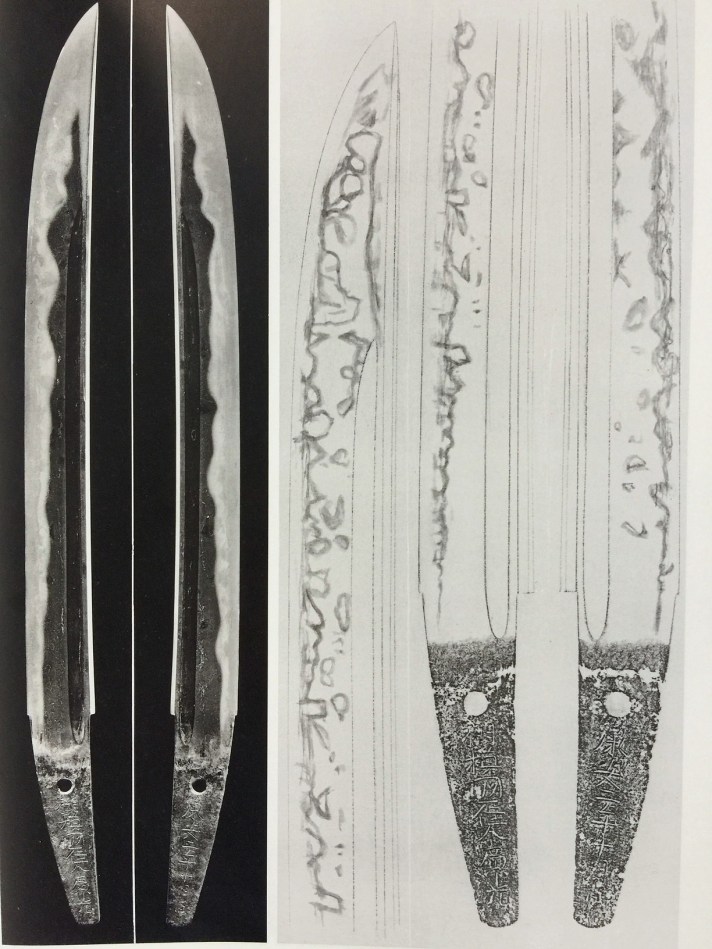
    Soshu Hiromitsu     “Nippon-To Art Sword of Japan “   The Walter A. Compton Collection

18| Nanboku-Cho Period Sword (南北朝太刀)

0-timeline - size 24 Nanboku-cho

                           The circle indicates the time we discuss in this section

During the Nanboku-cho period, samurai sought large, elaborate, impressive, yet practical swords.  The Soshu-den style sword from Nanboku-cho time was just that.    This was the most popular style at the time.  The Nanboku-cho period marked the peak and height of the Soshu-den sword.  Many swordsmiths moved from other provinces to the Kamakura area and forged Soshu-den style swords.  Other schools and provinces outside the Kamakura area also produced Soshu-den-style swords in their own areas.


19 Nanboku-cho Sword style

Sugata (姿: Shape) —————–The original length of a sword ranged from three to five feet, but it was later shortened to about two and a half feet.  A significantly shortened blade is called o-suriage. 

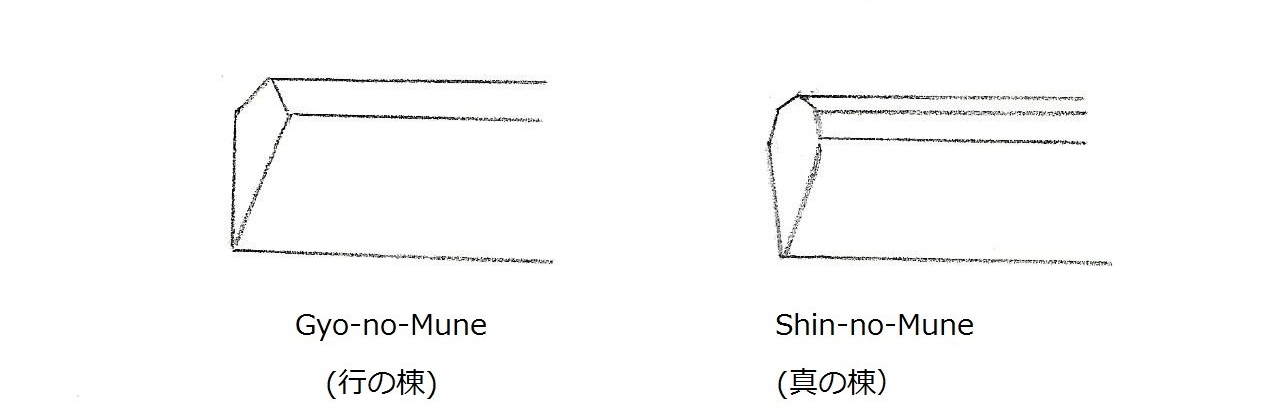
The Nanboku-cho style sword features shallow kyo-zori (also called torii-zori).  Refer to Chapter 5, Heian Period Sword.  The highest curvature occurs around the middle of the body. It has a wide body, high shinogi, narrow shinogi-ji  (Chapter 3, Names of parts),  and thin kasane (blade thickness), which are distinctive features of the Nanboku-cho style.  High gyo-no-mune or shin-no-mune, and sometimes a maru-mune (round back).

19 Nanboku-cho 3 kinds Mune

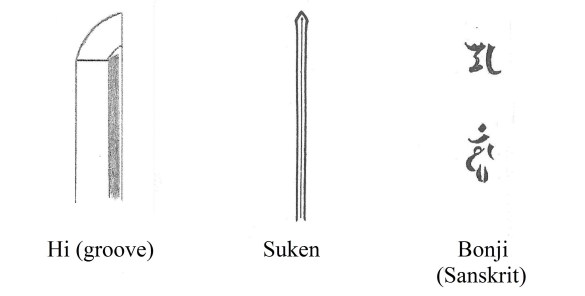
Hi (: groove) and Horimono (彫刻: engraving) ——– Often, a single hi (bo-hi), double hi, suken (dagger), Bonji (Sanskrit), and/or dragon are engraved on the shinogi-ji area.  Refer to Chapter 3, Names of Parts.

9 Hi, Suken, Bonji

Hamon (: Tempered line) —- The lower part of the body exhibits a narrow-tempered line; gradually, this line becomes wider and showier.  Course nie. O-midare (large, irregular, wavy hamon), Notare-midare (wavy, irregular hamon), and Gunome-midare (a combination of repeated half-circular and irregular hamon). Inazuma and kinsuji (see Chapter 14, Late Kamakura Period Sword) sometimes appear.

19 Hamon Notare 319 Mamon choji gunome19 Hitatsura Hamon Hiromitsu

                                  *From Sano Museum Catalogue ( Permission granted).

Ji-hada (地肌: the area between the shinogi and the tempered line) ———————-Wood-grain pattern (itame 板目). Sometimes tobiyaki (patchy tempered spots) appear on ji-hada.  For ji-hada, refer to Chapter 3, Names of Parts.

Kissaki (切っ先) and Boshi (tempered line at the kissaki area) ———- O-kissaki (long and large kissaki). Fukura kareru (less arc kissaki).  Midare-komi (the body and boshi have a similar tempered pattern), with kaeri-fukashi (hamon deeply turns back), and sometimes hitatsura (entirely tempered).  See the illustration above.

Sword-smiths during Nanboku-Cho Period Soshu Den (school)

  • From Soshu—————————————————Hiromitsu (広光)  Akihiro (秋広)  
  • From Yamashiro ———————————————Hasebe Kunishige (長谷部国重) 
  • From Bizen (called So-den Bizen)——-Chogi (長儀 )group  Kanemitsu (兼光 ) group 
  • From Chikuzen ———————————————————-Samoji (左文字 ) group

Chogi (長義)from The Sano Museum catalog. Permission to use is granted

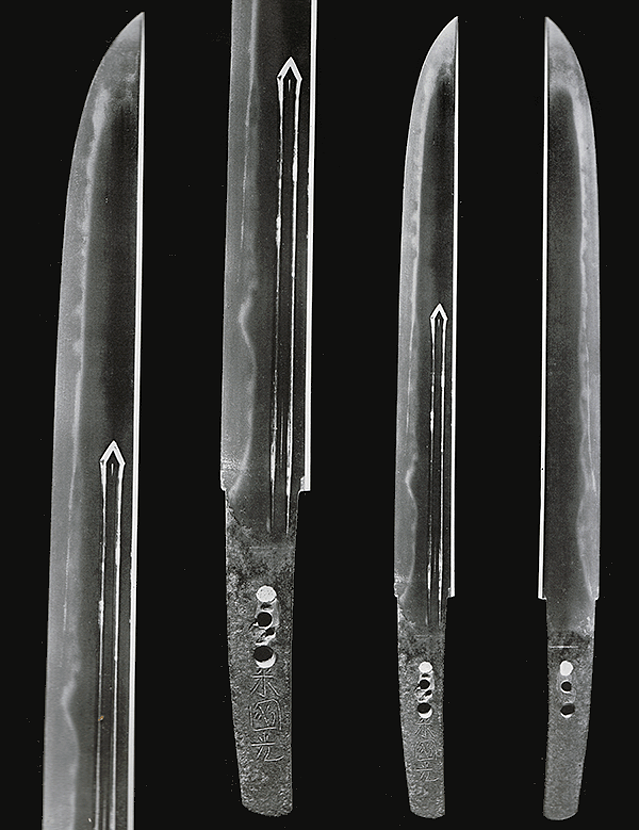
The distinctive characteristics of the Nanboku-Cho period sword in the photo above      

  • The trace of an engraving of suken on the inside of the nakago indicates that this area was once a part of the main body.
  • Large and long kissaki

12| The Middle Kamakura Period: Tanto (Dagger 鎌倉中期短刀)

0-timeline - size 24 Middle Kamakura

The red circle indicates the area we discuss in this chapter 

It is rare to find a tanto (短刀 dagger) made during the Heian period.  During the middle Kamakura period, many high-quality tanto were produced.  They were called takenoko-zori shaped tanto, with “takenoko” meaning bamboo shoot.  The back of the tanto curves inward slightly.


                              Middle Kamakura Period                                                                                                      Yamashiro School Tanto

12Tanto drawing Mid Kamakur

Sugata (shape)———-Hirazukuri.  This means there is no shinogi, no yokote line.  See the illustration above.  The standard tanto length is approximately ten inches.  The width is neither too wide nor too narrow, making it well-proportioned.  The body is slightly thick.  High gyo-no-mune (行の棟) and shin-no-mune (真の棟). 

13 Mune drawing

Hamon (刃文) ——————— The tempered area is narrow.  Nie base.  Suguha-midare (a straight-line pattern with an irregular wavy shape) or suguha-choji (a straight-line pattern with small choji)The tempered edge line may display a frayed pattern.

Boshi(tempered line at Kissaki area) ———Yakizume,   Kaen,   Nie-kuzure.

13 Hamon and Hi

Engravings (彫刻) ———- Often, various types of engravings are applied to the lower part of the body.   These may include one or two grooves, Sanskrit, suken (spear), dragon, etc.  For the Sanskrit and spear, refer to the illustration in Chapter 8.

13 Hamon and Hi

Tanto Swordsmiths in the Middle Kamakura Period

Awataguchi group(粟田口)———————————Awataguchi Yoshimitu (粟田口吉光)  Rai group (来) ——————————————————————-Rai Kunitoshi(来国俊)  Soushu Group  (相州) ——————————————Shintougo Kunimitu (新藤五国光)  Bizen group (備前) —————————————————— Bizen Kagemitu (備前景光) Bungo no Kuni Group (豊後の国) ——————–Bungo-no-kuni Yukihira (豊後の国行平)

                          来国光(Rai Kunimitsu)

This Photo by an unknown author is licensed under CC BY-SA        Creative Commons Free Media  Attribution-Share Alike 3.0 Unported (CC BY-SA 3.0)