53| Part 2 of — 19 Nanboku-cho Period Tanto (南北朝短刀)

This chapter is a detailed section of Chapter 19.  Please read Chapter 19, Nanboku-cho Period Tanto, before proceeding on to this part. 

0-timeline - size 24 Nanboku-cho

                          The red circle above indicates the time we discuss in this section

20 Enbun Jyoji Kowakizashi Tanto

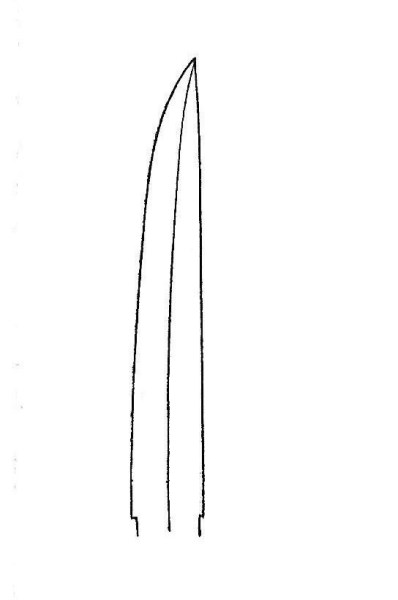
The drawing above shows a typical shape of a Nanboku-cho-period tanto. This drawing was in Chapter 19.  I exaggerated the features of the Enbun Joji ko-wakizashi tanto to better show you.  At the end of Chapter 19, Nanboku-cho Tanto, there is a list of swordsmiths’ names from that period.  Hiromitsu (広光) and Akihiro (秋広) represent the Nanboku-cho style.
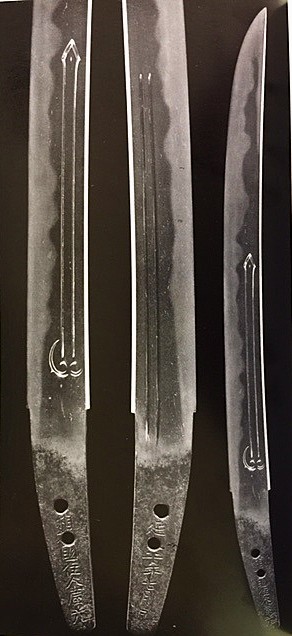
56 cropped Hiromitu photo 20 HitatsuraHiromitsu from the Sano Museum Catalogue (permission to use granted)

Enbun Joji Ko-wakizashi tanto is also called Sun-nobi tanto (>10 inches) because its length is longer than the standard size (about 10 inches) tanto.  The upper part of the tanto curves outward slightly.  This type is called sakizori.

Characteristics of Hiromitsu (広光) and Akihiro (秋広)

  • Shape———————— Usually, one foot and one to two inches long (Sun-nobi).   Wide width.  Thin blade.  Sakizori.
  • Hamon ———————- A mix of wide and narrow hamon.  The hamon around the yakidashi (just above the machi) area is narrow but gradually widens as it moves up.  The hamon around the fukura area shows most work.  Mainly nie.  Sunagashi, kinsuji, gunome, umanoha-midare (horse teeth-shaped hamon), or hitatsura appear (drawing above).                 
  • Boshi———-Irregular and unevenly tempered.  The hamon covers almost the entire boshi. Deep turn back. 
  • Jihada ———————————————————Wood-grained pattern
  • Nakago —————–Tanago-bara shape.  Refer to 19 Nanboku-cho Period Tanto.

Nobukuni (Below is my sword)

Shodai Nobukuni (the first-generation Nobukuni) was a student of Sadamune.  He was one of the Sadamune San Tetsu (貞宗三哲, Sadamune’s top three students).  Nobukuni’s characteristics resembled those of Hiromitsu and Akihiro, as described above.  Nobukuni also created sun-nobi tanto.  The sword below has a hoso-suguha, ko-mokume (small burl pattern), and ko-maru boshi (small round). 

56 Nobukuni 1 Nobukuni4

56 Nobukuni 2This is the certification of my sword.  Shodai Nobukuni (初代信國).   Juyo Token (重要刀剣)

Certification

Number: Juyo 3220, Certification Juyo-Token

Wakizashi:  Nobukuni (信国), 31.4cm long, 0.3cm curvature, hirazukuri, mitsumune (three-sided mune), sun-nobi.  The ji-hada shows a wood grain and ji-nie (surface nie, between shinogi and hamon). The hamon is a chu-suguha (medium straight). The front carving shows bonji (Sanskrit) and sanko-ken. The back engraving is bonji and hoko (pike).   Original nakago.  Examined by the Nihon Bijutsu Token Hozon Kyokai.  It is certified as a Juyo Token.  The Chairman, Moritatu HosokawaShowa 45 June 1 (June 1, 1970)

24| Sengoku Period Tanto (戦国時代短刀)

0-timeline - size 24 Sengoku Period                             The red circle above indicates the time we discuss in this section

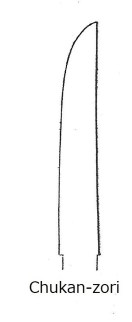
25 Chukanzori Tanto

Chukan-zori (中間反り) ————– The chukan-zori tanto features a straight mune (back).  Its back does not curve either inward or outward.   

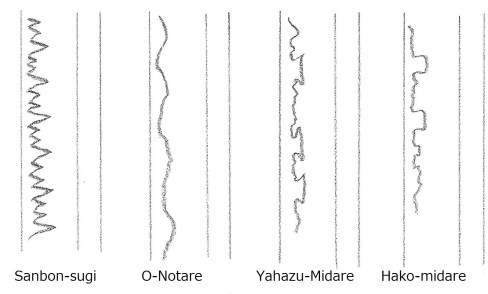
Hamon (刃文: Tempered line) ————————————-Sanbon-sugi (三本杉), o-notare (大湾), yahazu-midare (矢筈乱), hako-midare (箱乱), gunome-choji (互の目丁子), chu-suguha (中直刃).   See below.

24 Sannbon sugi,hako, yahazu, O-midare)

Horimono (彫り物: Carving) —————Often Hi (grooves) is curved

Tanto Length ————————— The standard tanto length should not exceed one shaku*¹ (about 12 inches, 30.5cm).  The standard size tanto is called a Jo-sun tanto, which is roughly 8.5 shaku (about 10 inches, 25.7cm).  Longer than jo-sun is called sun-nobi tanto (寸延)Shorter than jo-sun is called sun-zumari tanto (寸詰).

             Sun-nobi Tanto  >  Jo-sun Tanto (approx. 10 inches) >  Sun-zumari Tanto

*Shaku is a traditional Japanese unit of length measurement.

Takenoko-zori jo-sun tanto (筍反定寸短刀)————– The takenoko-zori jo-sun tanto was made during the Sengoku period.  It resembles swords made by Rai Kunimitsu of Yamashiro–den.  (illustration below)

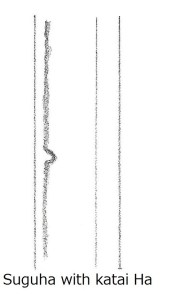
Hamon (刃文: Tempered line) ————– Hoso-suguha (細直刃: Narrow straight hamon). Katai-ha (illustration below) appears somewhere on the blade.  Masamehada (straight grain pattern) may be visible on the mune side.

                13 Middle Kamakura Period Tanto                 24 Suguha katai-ha

Ji-hada (地肌: The area between the shinogi and the tempered line)————– Some shirake (白け: a whitish surface) may sometimes appear.  Some utsuri (a light, whitish, cloud-like effect) appears on the ji-hada.

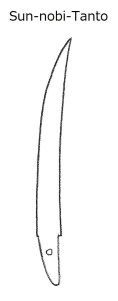
Sun-nobi Tanto (寸延短刀)————–This type of tanto resembles the sakizori tanto from the late Soshu-den period.  You may see a hitatsura-type hamon.  (illustration below).   Unlike the Soshu-den style, the hitatsura pattern is more visible in the lower part of the tanto and less in the upper part.

                                             25 Sun-Nobi Tanto      25 Hitatsura

Hirazukuri Takenokozori Sunzumari Tanto (平造筍反寸詰短刀)                                  

This is a unique tanto from the Sengoku period.   Hirazukuri means a flat-surfaced sword without a shinogi, yokote line, or obvious kissaki.   Takenoko-zori refers to a bamboo shoot shape (the back of the sword curves inward).   Sun-zumari indicates a blade shorter than 10 inches (less than 8.5 shaku or 25.7 cm).  The lower part of the blade is wide and thick, while the tip is narrow and thin.  It has a piercing, sharp appearance.

  • Horimono (彫物: Engraving) ————- Deeply carved ken-maki ryu (a dragon wrapped around a spear).
  • Hamon (刃文: Tempered line)——— Wide tempered line, with a nioi baseIrregular hamon, with wide suguha (straight), and chu-suguha (medium straight).  The hamon in the boshi area curves back deeply.
  • Ji-hada (地肌)———– fine ji-gane and wood burl pattern.

Moroha-tanto (諸刃短刀: Double-edged sword)

A double-edged sword with a hamon on both cutting edges.  Often, Bonji (Sanskrit) is curved.

  • Hamon (刃文: Tempered line) ——— Wide tempered line.   Nioi base.  Irregular hamon, wide suguha (straight tempered line), and chu-suguha (medium straight  tempered line).  The hamon turns back deeply.
  • Ji-hada (地肌: The area between the shinogi and the tempered line)——- Fine ji-gane and wood burl pattern.

25-moroha-tanto1 Moroha Tanto

The Swordsmith for Tanto during the Sengoku Period 

The Bizen swords from the Sengoku period are called sue-bizenSue is pronounced “su” and “e“ as in egg.   Bizen Osafune Yoso-Zaemon Sukesada (与三左衛門祐定) is the most famous swordsmith of the Sengoku period.  He also forged tantos.  One thing to note is that many swordsmiths had the name Sukesada.  Yoso-Zaemon Sukesada is the one who best represents the era.