55 |Part 2 of —–21 Muromachi Period Sword (室町時代刀)

Chapter 55 is a detailed section of Chapter 21, Muromachi Period Sword.  Please read Chapter 21 before reading this part.

57 Muromach-timeline size 22

                         The circle above indicates the time we discuss in this section

After the Muromachi period, swords shifted to katana(刀) from tachi (太刀), as described in Chapter 21, Muromachi Period Sword.  Refer to Chapter 21, Muromachi Period Sword.  By the end of the Nanboku-cho period, sword lengths had shortened to about 2 feet ± a few inches.  The 3-to-5-foot-long swords seen during the Nanboku-cho period were no longer produced.  This change occurred because, during the Nanboku-cho period, warriors mainly fought on horseback, but after the Muromachi period, infantry combat became more common.

Oei Bizen (応永備前)                                                                                                              The pronunciation of Oei is “O” as in “Oh” and “ei” as in “A” from ABC.  The Muromachi period was a declining time for sword-making.  The swords made during the early Muromachi period in the Bizen area is known as Oei BizenOsafune Morimitsu (長船盛光), Osafune Yasumitsu (長船康光), and Osafune Moromitsu (長船師光) were the main Oei Bizen swordsmiths.  Soshu Hiromasa (相州広正) and Yamashiro Nobukuni (山城信國) were also similar to the Oei Bizen style.  Please refer to Chapter 21, Muromachi Period Sword, for details on the  Muromachi sword shape, Hamon, Boshi, and Ji-hada.
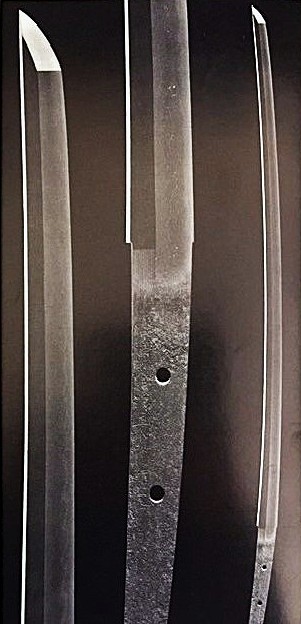
                       Bishu Osafune Moromitsu (備州長船師光)   from Sano Museum Catalogue ((permission granted)

The Osafune Moromitsu sword shown above measures 2 feet 5 inches in length and has a medium kissaki.  Its hamon has a small wave-like pattern with continuous gunome (a lined half-circle pattern).  The boshi area shows irregular waviness with a slightly pointed tip.  Very faint bo-utsuri (a soft shadow shaped like a strip of wood) appears on ji-hadaBo-utsuri is a distinctive feature among all the Oei Bizen

Before the Muromachi period, many swordsmith groups operated in the Bizen region. However, by the Muromachi period, Osafune (長船) was the only remaining group.

Osafune (長船) is the name of a region, but it became the surname of swordsmiths during the Muromachi period.  Two other well-known swordsmiths from Oei Bizen are Osafune Morimitsu (盛光) and Osafune Yasumitsu (康光).  The hamon created by Morimitsu and Yasumitsu is more detailed than that of the sword in the photo above.  Chapter 21, Muromachi period swords, shows the hamon of Morimitsu and Yasumitsu and describes the typical characteristics of swords from the Muromachi period.

                                                 Hirazukuri Ko-Wakizashi Tanto
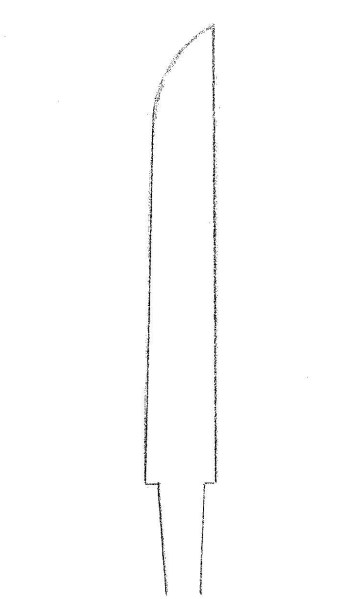
58 Hirazukuri Ko-Wakizashi Tanto

Hirazukuri Ko-Wakizashi Tanto Shape                                                                       

Hirazukuri ko-wakizashi tanto was a popular style during the early Muromachi period. Swordsmiths from various regions produced tantos similar to the one shown above. However, most of these types were made by Oei Bizen swordsmiths.

The characteristics of the Hirazukuri ko-wakizashi tanto ————-Typically about one foot and 1 or 2 inches long.  No yokote line, no shinogi, and no sori (meaning no curvature, straight back).  Average thickness.  Narrow width.  Gyo-no-mune (refer to Chapter 12, Middle Kamakura Period Tanto).
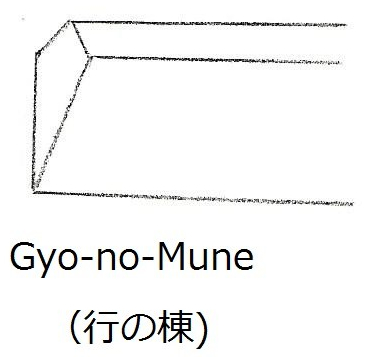
13 Mune drawing

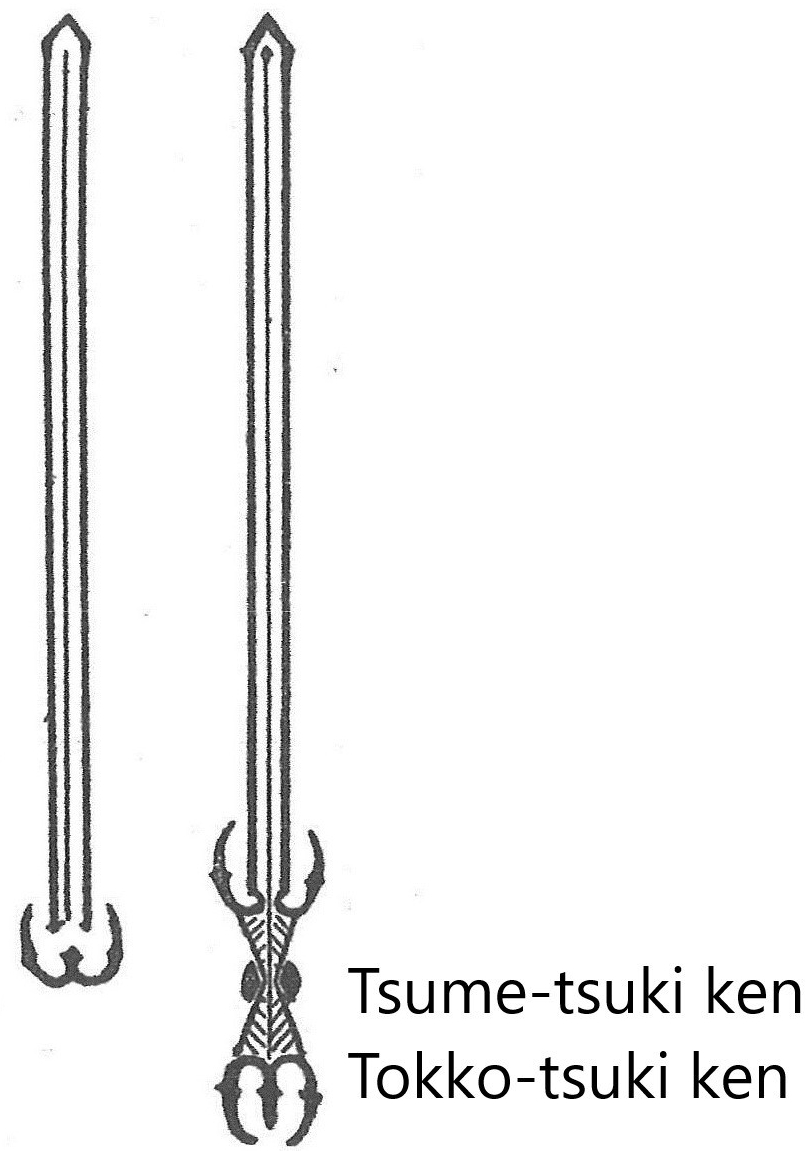
Hirazukuri Ko-wakizashi tanto often shows many engravings.  Hi with soe-hi (double lines, wide and narrow side by side), Tokko-tsuki-ken, Tsume-tsuki-ken, Bonji, and more.

.
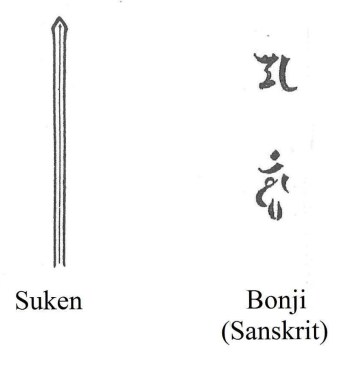
9 Hi, Suken, Bonji20 Tokko, tume Ken  58 tsumetukiken and Hi

*drawings from “Nihonto no Okite to Tokucho” by Honami Koson


21| Muromachi Period Sword (室町時代刀)

0-timeline - size 24 Muromach

       The red circle above indicates the time we discuss in this section

The Muromachi period was a relatively peaceful and prosperous time until shortly before the “Onin-no-ran,” which occurred at the end of the Muromachi periodRefer to Chapter 20, Muromachi Period History (室町時代歴史).   The Nanboku-cho style long swords became outdated; as a result, they were shortened.  The shortened blade is called suriage.  Overall, the Muromachi period was a declining time for sword-making.

Tachi and Katana 

Until the end of the Nanboku-cho period or the beginning of the Muromachi period, samurai wore swords suspended from their waists with the blade facing down.  When a sword was worn this way, the swordsmith inscribed his name on the side facing outward, meaning the blade is on your right when you see the inscription.  In this case, the sword is called a tachi.

During the Muromachi period, a sword was worn between the belt, with the blade facing up.   The swordsmith inscribed his name so that it faced outward when it was worn. Therefore, when you see the inscription, the cutting edge is to your left.  This is classified as a katana. 

Around the beginning of the Muromachi period, samurai started to wear a pair of swords called dai-sho (大小), meaning large and small.  The longer sword is a katana, and the shorter one is a wakizashi.  In general, a tachi is longer than a katana.  A katana is longer than a wakizashi, and a wakizashi is longer than a tanto.  Here is the order of their lengths. 

                                       Tachi   >   Katana   >   Wakizashi   >  Tanto                                  Tachi and katana differ in how they are worn, not in length.   

O-suriage ( 大磨上: Katana shortened by great length) 

How much the sword should be shortened depends on its original length and how much the owner wants it shortened.  O-suriage is a type of sword that is significantly shortened.  Once the blade is shortened by that length, the inscription of the maker’s name is cut off.  When the Hon’ami family (本阿弥家, a family of sword connoisseurs who have appraised Japanese swords for generations from the Muromachi period to today) appraises such a suriage sword, they write the make of the sword and the swordsmith’s name on the front side of the hilt, and the connoisseur’s name with his kaou (similar to a signature) on the back.  There are several levels of writing.  The level at which it should be done depends on the sword’s quality and the owner’s preference.  Below is the order of levels (high to low).

Shu-Mei (朱明 )————————————————————-name written in Vermilion  Kinpun-Mei (金粉名 )———————————————–name lacquered in gold powder  Gin-Zougan (銀象嵌 )————————————————————name inlaid in silver  Kin-Zougan (金象嵌 )————————————————————-name inlaid in gold

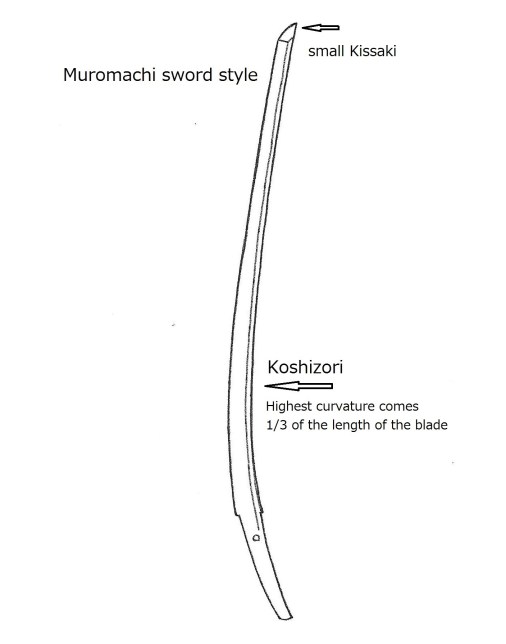
Sugata (姿: Shape) ——— The average length is typically two feet three to four inches (68~71cm).  The shape of the Muromachi period katana is somewhat similar to that of the Heian period tachi.  However, Muromachi katana are less grand or graceful than those from the Heian period swords.  The curvature is usually of the koshizori style.  Koshizori refers to the highest curvature being near the lower part of the blade.  The length and shape are suitable for wearing between the body and the belt.  The width and thickness are well-balanced with the size of the sword.  Small kissaki.

22 Muromachi sword shape

Hirazukuri-Wakizashi ———– Hirazukuri refers to a flat surface without a shinogi or yokote line.  Usually, it is 1 foot and 1 to 2 inches long.  No curvature.  Hirazukuri-wakizashi appeared during the Muromachi period.

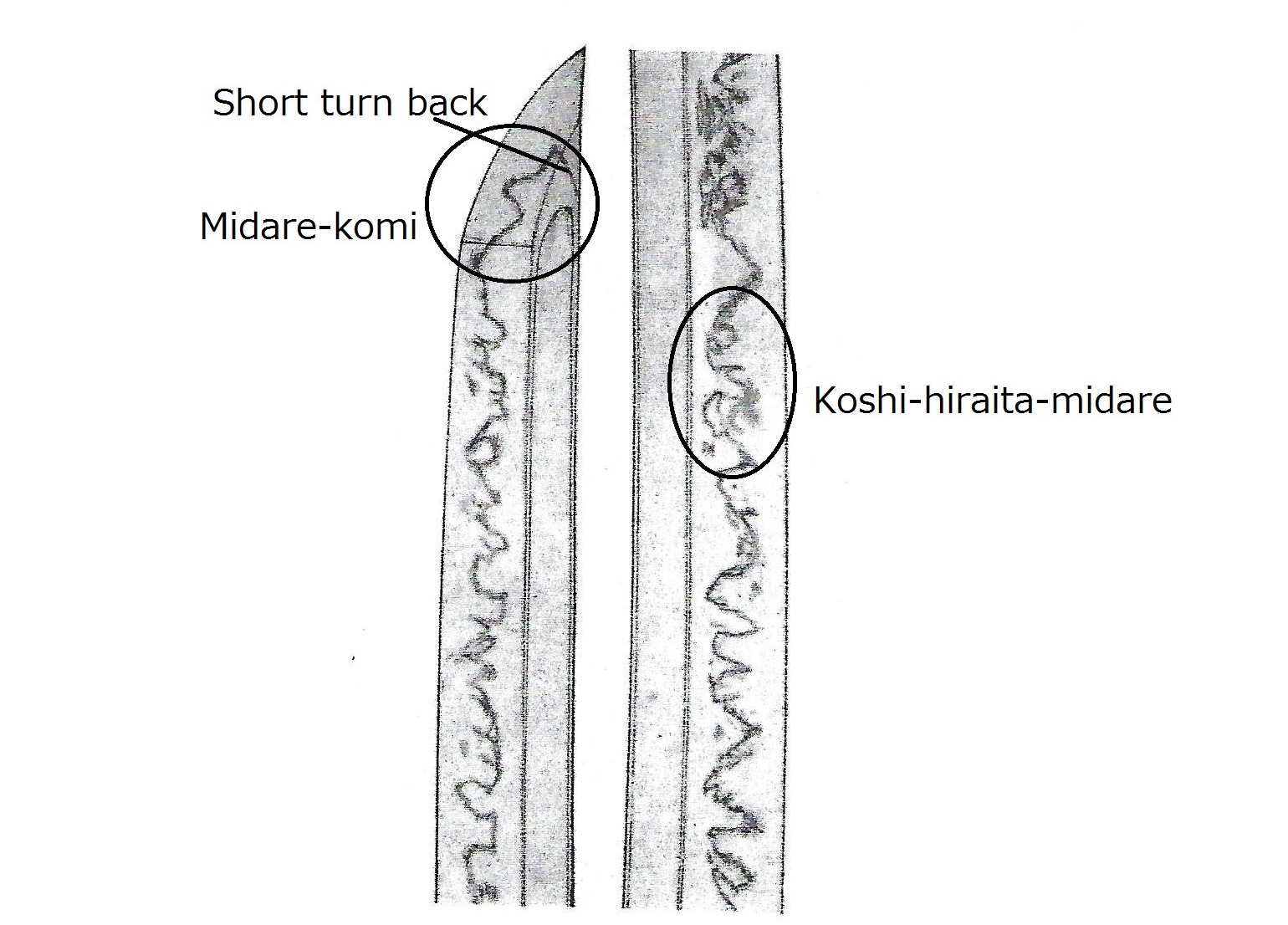
Hamon (刃文: tempered line) ———————- Nioi base.  The tempered area is well balanced with the blade’s width.  Koshi-hiraita-midare is mixed with choji-midare.

22Hamon (Koshi Hiraita midare)
from Sano Museum Catalogue (permission granted)
  • Boshi (Tempered line at Kissaki area) ————– Midare-komi, a short turn back.  See the above illustration.  Midare is an irregular wave-like pattern.
  • Ji-hada (地肌: An area between the tempered line and Shinogi)- Soft look, a large wood grain pattern, Ji-utsuri (faint smoke or cloud-like effect) shows.
  • Horimono (彫物Engravings) ———- Bo-hi (single groove), Soe-hi (a thin groove alongside the main hi), Futasuji-hi (double narrow groove), Sanskrit, Tokko-tsuki ken, Tsume-tsuki Ken, name of God, and dragon.  Carvings became elaborate.

8 Hi, Suken, Bonji                  21 Tsume-tuki-ken tokko with caption

Sword Smiths during Muromachi Period

  • Bizen Den ——–Osafune Morimitsu (長船盛光), Yasumitsu (康光), Moromitsu (師光)
  • Yamashiro Den————————————————-Yamashiro Nobukuni (山城信国)

21 Muromachi sword from Sano

Ise Masashige (伊勢正重),                     Bizen Osafune Naomitsu (備前長船尚光)         Juyo Token(重要刀剣)                           Sano Museum Catalogue (permission granted)    once my family sword