10| Jokyu-no-ran 1221 (承久の乱)

0-timeline - size 24 jyokyuu no ran
 
 The circle indicates the time we discuss in this section.

Jyokyu-no-Ran (承久の乱)

After Minamoto-no-Yoritomo (源頼朝) died, his son, Yoriie (頼家), became shogun.  His mother, Hojo Masako (北条政子), Yoritomo‘s wife, thought her son was too incompetent.  She worried others might take over the Kamakura bakufu (Kamakura government).  To prevent this, she established a council of 13 members, including herself, her father, Hojo Tokimasa (北条時政), and her brother, Hojo Yoshitoki (北条義時). 

Shogun Yoriie’s in-laws gained power over time.  During the Heian and Kamakura periods, the wife’s family was considered very important.  To suppress her son’s in-laws, Masako and her father, Tokimasa, planned and carried out Yoriie’s assassination.

After Yoriie‘s death, Masako’s younger son, Sanetomo (実朝), became the next shogun.  Now, his grandfather, Hojo Tokimasa’s second wife, wanted her son-in-law to be the next shogun.  To please his young wife, Hojo Tokimasa attempted to kill Sanetomo but failed.  When she found out about the plot, Hojo Masako imprisoned her father, Tokimasa.  Although Sanetomo was Masako’s son, she was once again very disappointed by his incompetence.  Ultimately, Shogun Sanetomo was killed by his nephew Kugyo, the son of the previous shogun, Yoriie

After all these incidents, Masako’s brother, Hojo Yoshitoki, took control of the Kamakura bakufu and installed a figurehead from the Fujiwara family, a powerful aristocratic family in Kyoto.   After all the turmoil, the Hojo family eventually gained complete control of the Kamakura bakufu (government).

Meanwhile, in Kyoto, Emperor Gotoba was planning an attack on the Kamakura bakufu.  He had built up military strength.  When Sanetomo was killed, Emperor Gotoba saw an opportunity to attack Kamakura.  He ordered local feudal lords to attack the Kamakura bakufu, but few obeyed.  Instead, the Hojo family captured the emperor and exiled him to Oki Island.  This occurred in 1221 and is known as Jokyu-no-ran or Jokyu-nohen.

Emperor Gotoba encouraged sword-making and showed respect for swordsmiths.     After the Jokyu-no-ran, the Imperial family’s power declined, and the Kamakura bakufu became a strong and stable regime.  From the time of Minamoto-no-Yoritomo‘s death until the end of the Jokyu-no-ran, the Kamakura bakufu remained unstable.  It was Hojo Masako who led the Kamakura bakufu to a stable regime.  She was called “Ama Shogun” or “Nun Shogun.”   She was a sharp, talented, yet tough, critical, and often harsh politician.

Kamakura locals, including myself, hold Hojo Masako in high regard Minamoto-no- Yoritomo and Hojo Masako are both buried in Kamakura City.  Minamoto-no-Yoritomo is at Shirahata Shrine (白幡神社), and Hojo Masako is at Jufukuji Temple (寿福寺). 

Kamakura is roughly an hour from Tokyo by train on the Yokosuka Line.  Both Jufuku-ji Temple and Shirahata Shrine are within walking distance of Kamakura Station.
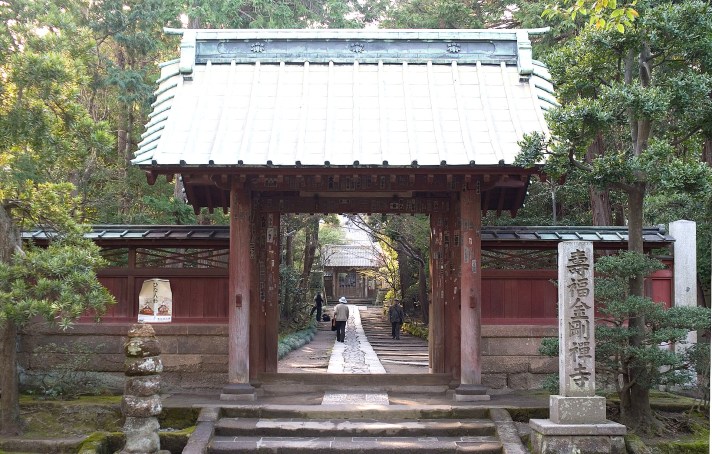
 

Jufuku-ji (寿福寺) Temple, sourced from Wikimedia Commons, the free media repository

The tomb of Minamoto-no-Yoritomo.  From Wikimedia Commons, the free media repository. 

9 | Middle Kamakura Period: Bizen Den (鎌倉中期備前伝)

0-timeline - size 24 Middle Kamakura
The circle indicates the time we discuss in this section 

Many swordsmiths worked in the Bizen (備前) school during the early Kamakura period.  However, their sword style is generally somewhat similar to the Yamashiro style.  Therefore, they are called Ko-bizen (古備前), meaning old Bizen.

The true Bizen school style appeared during the Middle Kamakura period.  Bizen Province had many advantages for producing great swords.  The area produced high-quality iron and abundant firewood.  Also, its location was conveniently located for people to travel from different regions.  As a result, many swordsmiths gathered there and produced large quantities of swords.  Due to competition among these smiths, the quality of Bizen swords is generally higher than that of other schools.  Therefore, it is often difficult to appraise Bizen swords because of the many subtle differences among the different swordsmiths.

The following three features are the most distinctive characteristics of the Bizen school.  

1.   Nioi-base tempered line.  The Nioi-base tempered line has finer dots than the Nie-base.   These dots are so small that they almost appear as a line. Technically, the tempering processes of these two are identical.  See the illustration below.                        2.   Ji-hada (surface of the body) appears soft.                                                                  3.  Reflection (utsuri) appears on the surface.

10 Nie & Nioi

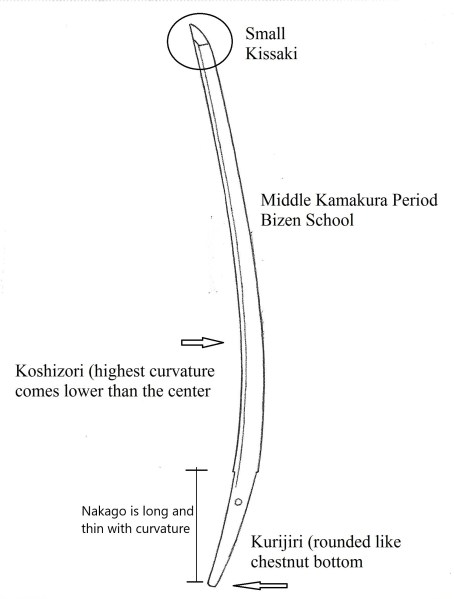
Sugata (shape) —The length is approximately 33 inches ± a few inches. The blade is slightly wide and appears sturdy. The curvature of the blade is koshizori (腰反), meaning the deepest curve is at the lower part.  The body has an average thickness, and the kissaki is small.

 10 Middle Kamakura ---備前刀姿

Horimono (engraving) ——Engravings are rare.  The tip of the hi extends all the way to ko-shinogi, filling the entire area.

8 Hi

Nakago ——– Long and thin with a curve. The end of the nakago is rounded and resembles the bottom of a chestnut (kuri).  This shape is called kurijiri.   Refer to the illustration of the sword above.

Hamon (tempered area pattern)—— Nioi base. The tempered area is wide and consistent width.  The size of the midare (irregular wavy tempered pattern) is uniform.

Boshi ——– The same tempered pattern continues upward to the boshi area, and it often shows choji- midare (clove-shaped wavy pattern) or yakizume.

10 Boshi --- Bizen

Ji-hada ———— Fine and well forged.  The steel appears soft.  On the steel surface,  small and large wood-grain patterns are mixed.  Chikei (condensation of nie) and utsuri (cloud-like reflection) appear.

Bizen School Sword Smiths during Middle Kamakura Period

  • Fukuoka Ichimonji (福岡一文字) group ————-Norimune (則宗)  Sukemune (助宗) 
  • Yoshioka Ichimonji (吉岡一文字) group ——–Sukeyoshi (助吉) Sukemitsu (助光)        
  • Sho-chu Ichimonji (正中一文字) group —————Yoshiuji (吉氏)   Yoshimori (吉守)     
  • Osafune (長船) group ———–Mitsutada (光忠)  Nagamitsu (長光) Kagemitsu (景光)   
  • Hatakeda(畠田) group ————————————-Moriie (守家)  Sanemori (真守)  
  • Ugai (鵜飼) group ————————————————- Unsho (雲生) Unji (雲次)

              9 Middle Kamakura Bizen Fukuoka ichimonji 

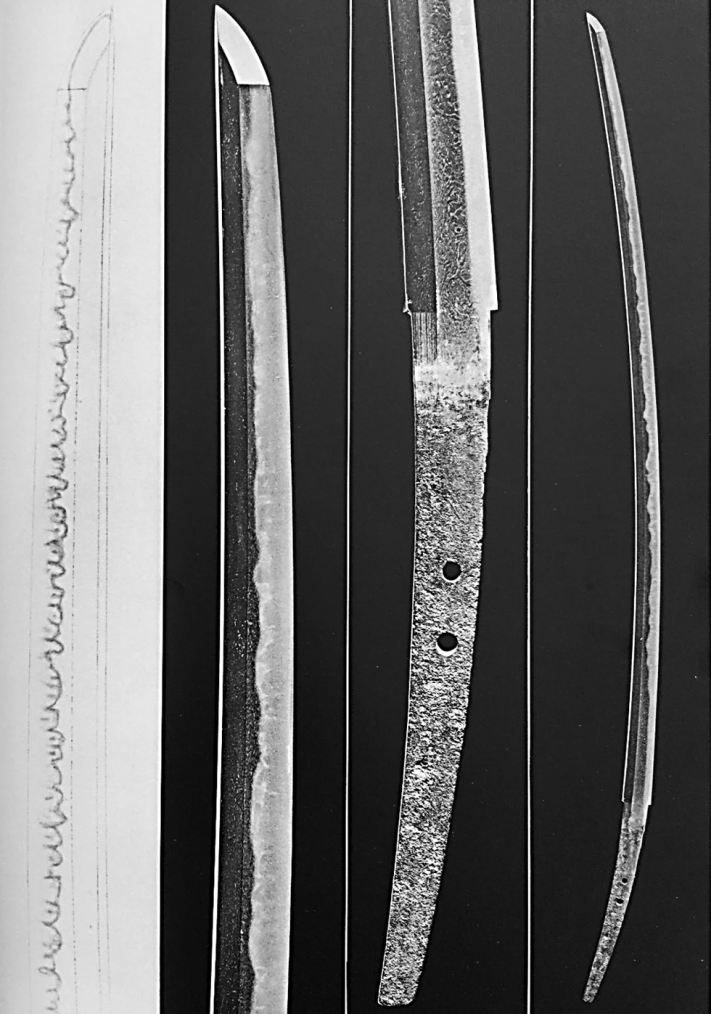
Fukuoka Ichimonji (一文字) from “Nippon-to Art Swords of Japan”                                     The Walter A. Compton Collection

8| Middle Kamakura Period: Yamashiro Den (鎌倉中期山城伝)


0-timeline - size 24 Middle Kamakura                          The circle indicates the time we discuss in this section

The characteristics of Yamashiro Den swords

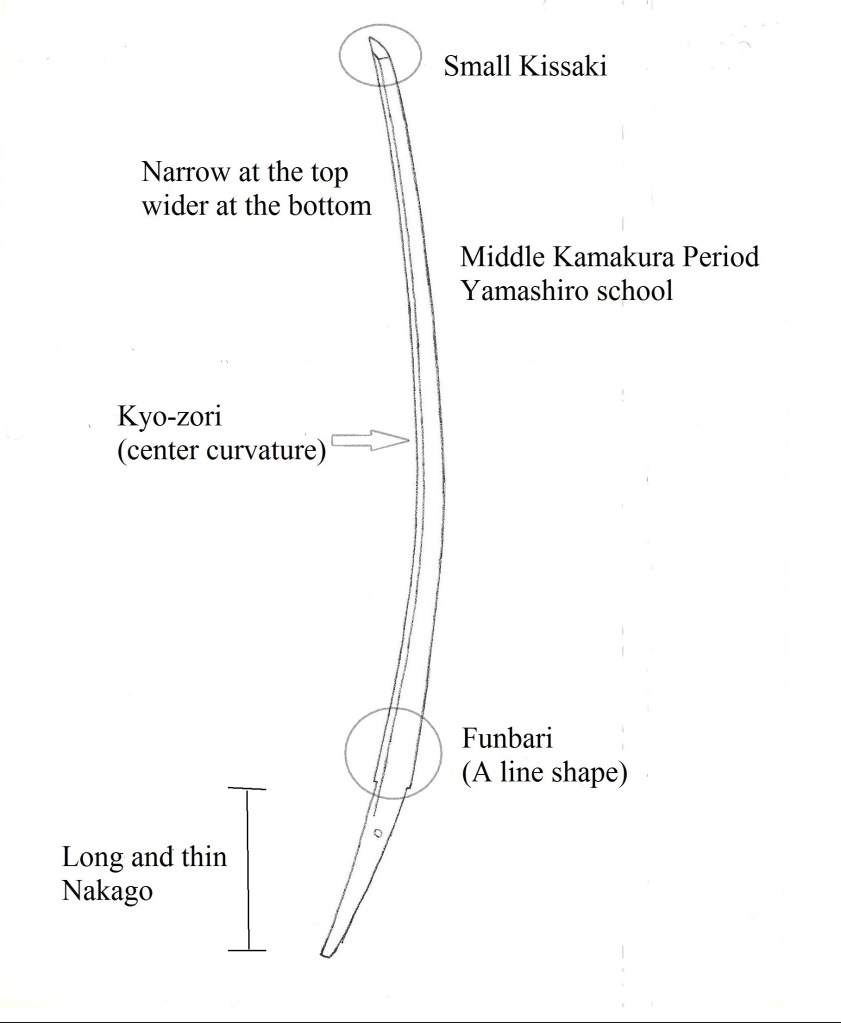
Sugata (shape)—– Generally, the blade is narrow, especially near the yokote line.  The bottom of the blade has funbari (an A-line shape).  Kasane is thick, and the curvature type is usually kyo-zori (the deepest curvature is around the middle).  It has a small kissaki with fukura.   Shinogi is thick, with gyo-no-mune or shin-no-mune.  Please refer to the three illustrations below for sugata.

13 Mune drawing

9 鎌倉中期刀姿

8 Fukura

Horimono (Engraving)—– The tip of a Hi (樋, groove) follows the exact shape of the Ko-shinogi line.  Sometimes you may see Bonj (Sanscrit) and Suken (see the illustration).

9 Hi, Suken, Bonji

Nakago (hilt: 中心) ——————–Long and thin with a slight curve.                                  Hamon (tempered line: 刃文) —————-Mostly suguha (straight line), niju-ba (double hamon), or suguha with an irregular wavy line.  Sometimes, a thin gold lightning-like line called inazuma appears faintly.  The tempered line is mostly nie.  Below is suguha.

 
豊後国行平(Bungo-no-Kuni-Yukihira)  Sano Museum Catalog permission granted

   * Bungo-no-Kuni-Yukihira was a Yamashiro Den swordsmith from the Bungo region.

Boshi(鋩子)——– Komaru-boshi (small round)   Omaru-boshi (large round)                    Ji-hada (地肌) ——-Well forged fine surface.  Small burl pattern.  Jinie (地沸) on the surface.

Names of the swordsmiths during the middle Kamakura period

  • Ayano-Koji group ———————————– Ayano-Koji Sadatoshi (綾小路 定利 )
  • Awataguchi group ————————————- Awataguchi kunitsuna (粟田口国綱)
  • Rai group ————————-Rai kuniyuki (来国行) Rai Nijikunitoshi (来ニ字国俊)

Rai Kunitoshi (来国俊)       Sano Museum Catalogue, Permission granted