42|Part 2 of — 9 Middle Kamakura Period : Bizen Den (鎌倉中期備前伝)

This chapter is a detailed part of Chapter 9.  Please read 9 | Middle Kamakura Period (Bizen Den) 鎌倉中期備前伝  before reading this chapter.

0-timeline - size 24 Middle Kamakura

                         The red circle indicates the time we discuss in this section

The middle Kamakura period marked the height of the Bizen-den.  In many regions outside Bizen, sword styles often reflected local preferences and politics in specific areas.  However, the Bizen sword has its own style and has not been significantly influenced by these elements throughout time.  The clients of Bizen swords come from all over the country.  Therefore, Bizen swordsmiths created swords that appealed to everyone. 

The general style of Bizen Den

  • In general, their style appeals to everyone.
  • The shape, the width of the blade, the thickness of the body, and tempered line are of standard size or usual design, rarely out of the ordinary.
  • Nioi base
  • Soft feeling Ji-gane (steel)
  • Utsuri (cloud-like shadow) appears.
  • The tempered line tends to have a consistent width, neither too wide nor too narrow.

Fukuoka Ichimonji group

 Names of swordsmiths among the Fukuoka Ichimonji group

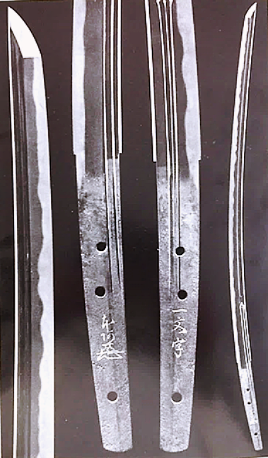
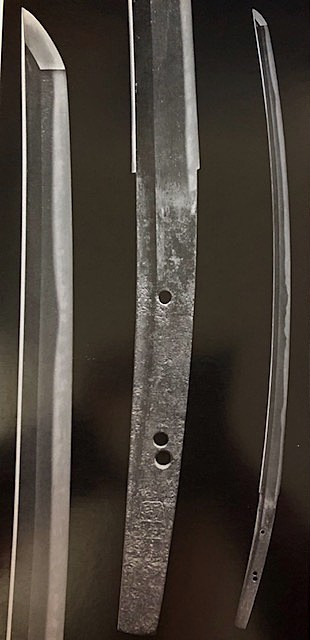
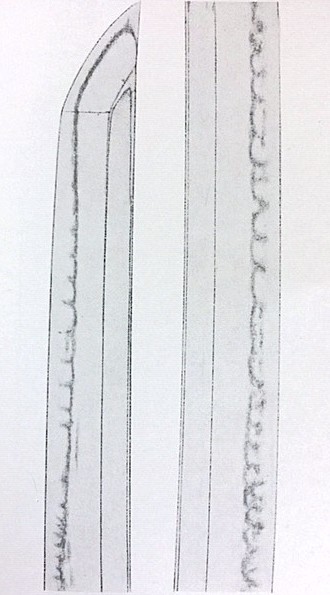
Fukuoka Ichimonji Norimune (福岡一文字則宗) and Fukuoka Ichimonji Sukemune (福岡一文字助宗) were the main swordsmiths of the Fukuoka Ichimonji group (福岡一文字).   From this group, six swordsmiths, including Norimune and Sukemune, received the honor of “Gobankaji” from Emperor Gotoba (後鳥羽上皇).   I saw Fukuoka Ichimonji Muneyoshi (福岡一文字宗吉) in Mori Sensei’s class on June 25, 1972.  My note pointed out a lot of utsuri (shadow) on the blade.

Sugata (shape) ——————- A graceful and elegant shape.  Generally, it has well-balanced proportions.  The difference between the top width and the bottom width is minimal.  Occasionally, a stout-looking kissaki called ikubi-kissaki (refer to Chapter 11, Ikubi Kissaki (猪首切先) appears.

Hi and Engraving ———–The tip of the hi may follow the ko-shinogi line.  See below.  The end of the hi goes under machi, ends with a square or kakinagashi (see Chapter 41)

44 hisaki agaru

Hamon  ———- Wide ichimonji-choji tempered line.  It indicates the consistent width of the tempered line from the bottom to the top.  The same hamon appears on both sides.  O-choji-midare  (large clove-like pattern), juka-choji (overwrapped-looking choji).  Nie base.  Inazuma and/or kinsuji may appear.

Boshi ————– Same Hamon continues into the Boshi area and ends with Yakizume or turn slightly.  Sometimes O-maru.

Jihada ———– A fine and soft appearance.  Itame (woodgrain pattern).   Lots of utsuri (cloud-like shadow or reflection)

     44 Ichimonjio hamon

Ichimonji  Sano Museum Catalogue (佐野美術館) Permission granted

*The sword above is o-suriage.  The end of the hi is lower than the mekugi-ana inside the nakago.


41| Part 2 of — 8 Middle Kamakura Period: Yamashiro Den 鎌倉中期山城伝

This chapter is a detailed part of Chapter 8| Middle Kamakura Period –Yamashiro Den(鎌倉中期山城伝).   Please read Chapter 8 before reading this chapter.

0-timeline - size 24 Middle Kamakura

      The red circle indicates the time we discuss in this section

During the middle Kamakura period, the Yamashiroden consisted of 3 main groups: the Ayano-koji (綾小路) group, the Awataguchi (粟田口) group, and the Rai (来) group.

When referring to a specific group, we use terms like “xxx ha,” “xxx ippa,” or “xxx ichimon.”   We use these three terms interchangeably.  They all mean “group.”   For example, when we say “Ayano-koji ippa,” we refer to the Ayano-koji group.

Ayano-koji Ippa (綾小路)

Sugata (shape) —————–Generally, a gentle or graceful kyo-zori shape.  The difference in width between the yokote line and the machi is minimal.  The sword is slender, yet thick, with a small kissaki.                                                                                                                         

Hi and Engraving ———————– Bo-hi (single groove) or futasuji-hi (double grooves) 

Hamon ——————— Nie base with ko-choji (small clove shape) and ko-midare (small irregular).  Small inazuma (lightning-like lines) and kinsuji (golden streaks) may be present.   Double ko-choji (two ko-choji side by side) may appear.   

Boshi (tempered line at the kissaki area) ———————– Ko-maru (small round), yakizume (see the illustration below ), and kaen (flame-like pattern)   

Ji-hada —————– Small wood grain with a little masame (straight grain).  Ji-nie shows. 

Nakago (hilt) ———————— Long, slightly thick feel  

Ayano-koji Ippa swordsmiths ———-Ayano-koji Sadatoshi (綾小路定利)  Sadanori (定則)        

Awataguchi Ichimon (粟田口)

Many swordsmiths from the Awataguchi Ichimon (or Awataguchi group) were honored as the Goban Kaji (the top swordsmith) by Gotoba Joko, Emperor Gotoba (後鳥羽上皇).  Their general characteristics are as follows.

Sugata (Shape) ————————- Elegant torii-zori (or kyo-zori) shape.     

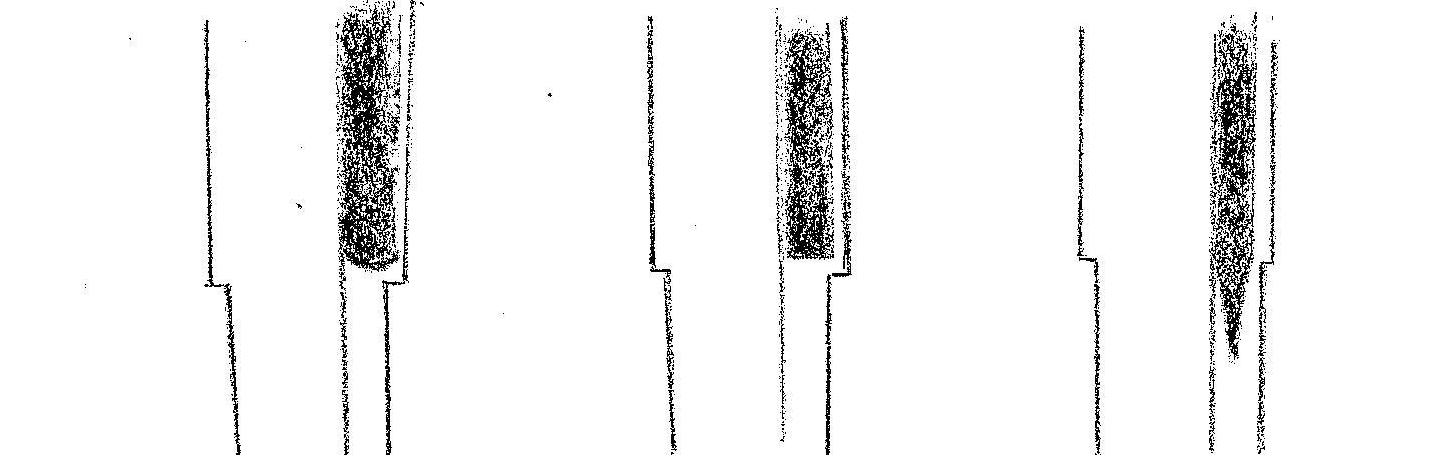
Hi and Engraving ————– The tip of the hi extends all the way up and fills in the ko-shinogi.   The end of the hi can be maru-dome (the end is round), kaku-dome (the end is square), or kakinagashi.


9 «part 2» 大小丸,焼詰,丸角止, 掻流     

              Maru-dome (rounded end)             Kaku-dome (square)          Kakinagashi

  • Hamon ———— The slightly wider tempered line at the bottom, then it becomes narrower at the top.  Nie base (called Nie-hon’i).  A straight tempered line mixed with ko-choji (small cloves) or a wide straight line combined with choji.  Awataguchi-nie appears.  Awataguchi-nie, which refers to a fine, deep, sharp, shiny nie that appears around the tempered line area. Fine inazuma (lightning-like lines) and kinsuji (golden streaks) emerge.

  • Boshi (tempered line at the tip area) —————— Ko-maru (small round)  and/or O-maru (large round).   The return is sharrow.  Yakizume, Nie Kuzure, and Kaen (flame)9-«part-2»-大小丸焼詰丸角止-掻流-1-e1547925390685.jpg

       Yakizume      O-maru     Ko-maru         Yakikuzure

  • Ji-hada ————– Fine ko-mokume (wood swirls) with ji-nie.  Ji-nie is nie on ji-hada. Yubashiri and/or chikei appear.                                                                               
  • Nakago ——————————– Often featuresa two-letter inscription
  • Names of Awataguchi swordsmiths —– Awataguchi Kunitomo (粟田口国友 ),  Hisakuni (久国), Kuniyasu (国安),  Kuniyasu (国安), Kunikiyo (国清)

 Rai Ha ()

The general characteristics of the Rai group are as follows.  However, each swordsmith has their own unique traits.

Sugata (shape) ——– Graceful and dignified.  Thick body.  Rai forged Ikubi Kissaki.         Hi and Engravings ————————- Wide and shallow hi.                                      Hamon ————————- Nie base.  Suguha (straight).  Wide suguha with ko-midare (small irregular) and choji (cloves).  Sometimes, there is a large choji at the lower part and a narrow suguha at the top.  Inazuma and Kinsuji appear around the yokote area.      Boshi ————————————- Komaru, yakizume (see the illustration above)            Ji-hada ——————— Finely forged itame (small wood grain).  Sometimes mixed with masame (parallel grain).  Fine nie.  Rai group’s swords occasionally show yowai tetsu (weak surface), which may be the core iron.    

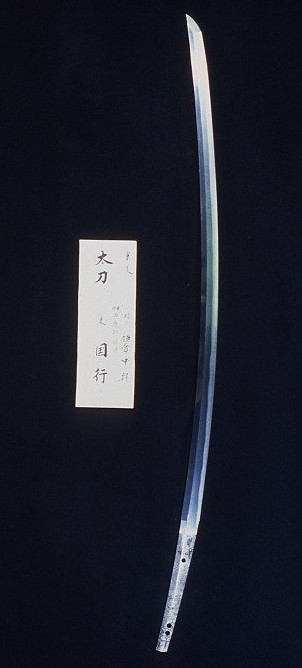
Rai Ha swordsmiths———————- Rai Kuniyuki (来国行),  Rai Kunitoshi (来国俊) or Niji Kunitoshi (二字国俊),  Ryokai (了戒 ).  Rai Kunitoshi is said to be the son of Rai Kuniyuki. Ryokai is said to be the son of Rai Kunitoshi.

img017

    Rai Kuniyuki (来国行)Once my family sword, photo taken by my father with his  writing.    
9 «part 2» Rai Kuniyuki photo.jpg       Rai Kuniyuki hamon
 
Rai Kuniyuki (来国行)Sano Museum Catalogue (佐野美術館)  (permission granted)

40|Part 2 of — 7 Overview of Kamakura Period Sword (鎌倉太刀概要)

This chapter is a detailed part of Chapter 7, an overview of the Kamakura Period Swords.  Please read  Chapter 7, Overview of the Kamakura Period Swords, before reading this section. 

0-timeline - size 24 Kamakura Period

                         The red circle above indicates the time we discuss in this section.

The Kamakura period was a golden age of sword-making.  About half of the well-known swords today were produced during this time.  This is probably because the war between the Genji and the Heishi demanded many swords, and swordsmiths improved their skills through wartime experience.  Also, Emperor Gotoba (後鳥羽) invited many talented swordsmiths to his palace, treated them favorably, and encouraged them to create excellent swords by granting them high ranks.  During the Kamakura period, sword-making techniques greatly improved.

Middle Kamakura Period —- Yamashiro-den (山城伝)

The middle Kamakura period was the height of the Yamashiro-den.  Within the Yamashiro-den, there were three main groups: the Ayanokoji group (綾小路), Awataguchi group (粟田口), and Rai group (来).                                                                                                                       Among the Awataguchi group, six swordsmiths received the honor of “Goban-kaji ” from Emperor Gotoba (後鳥羽上皇).  Awataguchi is the name of an area in Kyoto. 

The Ayanokoji ( 綾小路 ) group lived in the Ayanokoji area of Kyoto.  My sword textbook had a note indicating that I had seen Ayanokoji Sadatoshi (綾小路定利) on March 22, 1972.  My note was brief, only a few words: o-suriage, funbari, narrowbody, and ji-nie

The Rai group originated from Rai Kuniyuki (来国行 ).  Rai Kuniyuki and Ayanokoji Sadatoshi were believed to have been close friends.  Rai Kuniyuki created many well-known swords.  His famous Fudo Kuniyuki (不動国行) was once owned by Shogun Ashikaga Yoshiteru (足利義輝 ), then passed to Matsunaga Danjo (松永弾正), then to Oda Nobunaga ( 織田信長 ), then to Akechi Mitsuhide (明智光秀 ), and eventually to Toyotomi Hideyoshi (豊臣秀吉).  All of them were historically famous and influential daimyo.  It is said that Toyotomi Hideyoshi held this sword during the memorial service for Oda Nobunaga.  Rai Kuniyuki’s son was Niji Kunitoshi.  He also forged well-known swords. 

Middle Kamakura Period —– Bizen-den (備前伝)                                                              

The Bizen-den during the Heian period was called Ko-bizen.  They are similar to those in the Yamashiro-den style.  The true height of the Bizen-den was during the middle Kamakura period.  The Bizen area (today’s Okayama Prefecture) had many ideal conditions for sword-making: a good climate, abundant iron resources, plenty of wood for fuel, and a convenient location.  Naturally, many swordsmiths moved there, and it became a major center for sword production. 

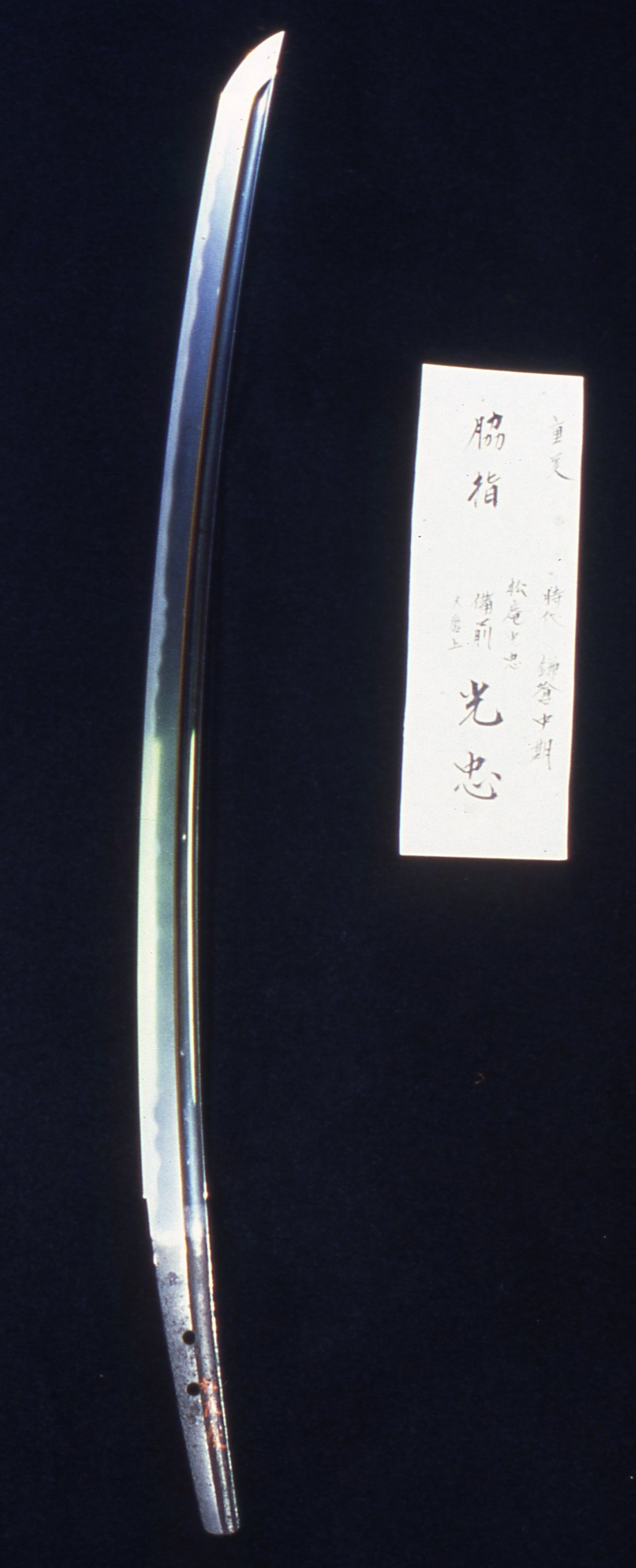
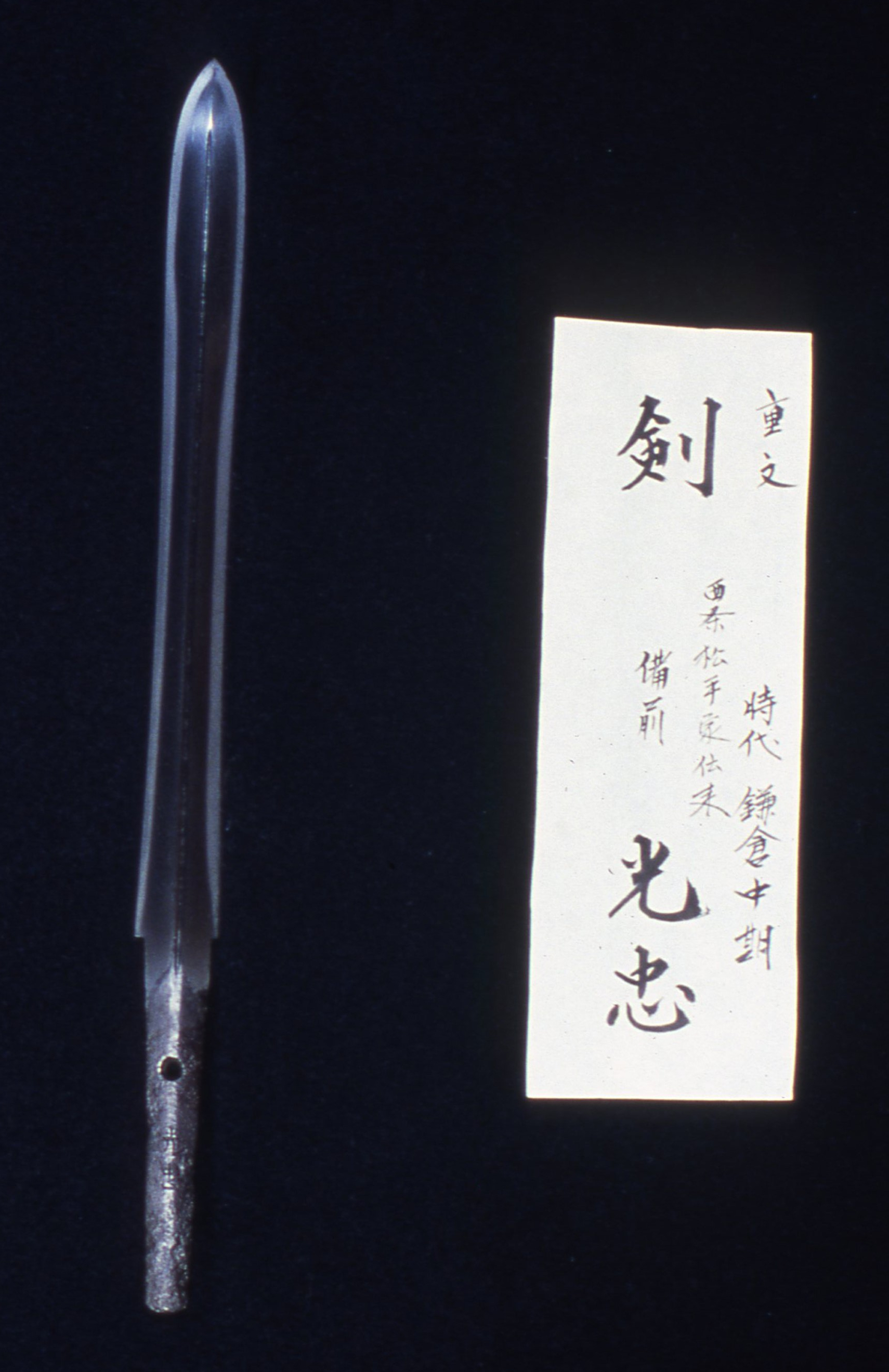
The Bizen region produced many swords of higher quality and superior to those of other sword groups and more famous swordsmiths.  Fukuoka Ichimonji Norimune (則宗) and his son Sukemune (助宗 ) received the honor of the Goban-kaji from Emperor Gotoba.   Among the Osafune group (長船), the famous Mitsutada (光忠) and Nagamitsu (長光) appeared.  My father owned four Mitsutada bladesThree tachis and one tanto.  He was so proud of owning four Mitsutada blades that he asked his tailor to monogram Mitsutada on the inside pocket of his suit jacket. 

From the Hatakeda group (畠田), Hatakeda Moriie (畠田守家), and from the Ugai (鵜飼) group, Unsho (雲生 ) and Unji (雲次) appeared.  The famous Kunimune (国宗) also emerged around this time.   Since many swordsmiths worked in the Bizen-den, many Bizen swords exist today.  Each swordsmith displayed his own characteristics in the swords.  Therefore, doing the kantei of Bizen swords can be quite complex. 

The classification of the sword ranking from the top

  1. Kokuho (国宝: National Treasure)
  2. Jyuyo Bunkazai (重要文化財: Important Cultural Property)
  3. Jyuyo Bijutsu Hin (重要美術品: Important Artwork)
  4. Juyo Token (重要刀剣: Important Sword)        more to follow

Here are my father’s four Bizen Osafune Mitsutada swords. He took these pictures many years ago at home. It is clear that he was not much of a photographer.  On a rectangular  sheet of white paper, he wrote the name of the swordsmith, the period when the sword was made, the name(s) of the daimyo who owned it in the past, and its classification.

img027               img028                Osafune Mitsutada (Juyo Bukazai)                 Osafune Mitsutada (Juyo Bunakzai)

img029            img030 Osafune Mitsutada (Juyo Token)                 Osafune Mitsutada(Juyo Bunkazai)

Late Kamakura Period —– Soshu Den (相州伝 )

Yamashiro-den began to decline in the latter part of the Kamakura period.  At this time, many swordsmiths moved to the Kamakura area under the new power of the Kamakura bakufu (鎌倉幕府), led by the Hojo clan.  The new group, Soshu-den (相州伝 ), began to emerge.  Fukuoka Ichimonji Sukezane (福岡一文字助真) and Kunimune (国宗) from Bizen moved to KamakuraToroku Sakon Kunitsuna (藤六左近国綱) from the Awataguchi group of Yamashiro-den also moved to Kamakura.  These three are considered the founders of the Soshu-den in Kamakura.  Kunitsunas son was Tosaburo Yukimitsu, and his grandson was the famous Masamune (正宗)Outside Kamakura, Yamashiro Rai Kunitsugu (来国次), Go-no-Yoshihiro (郷義弘) from the Ettchu (越中) province, and Samoji  (左文字) from Chikuzen Province (筑前) were active swordsmiths.

39|Part 2 of — 6 Kamakura Period History 1192 – 1333 (鎌倉時代歴史 )

This chapter is a detailed part of Chapter 6, Kamakura Period History 1192 – 1333. Please read Chapter 6 before reading this section. Since this continues from chapter 6, some of the information here may overlap with Chapter 6.

0-timeline - size 24 Kamakura Period                         The red circle above indicates the time we discuss in this section

Taira-no-Kiyomori (平清盛)

Chapter 6, Kamakura Period History, describes two major samurai groups, the Genji (源氏) and the Heishi (平氏), at the end of the Heian period.  The leader of the Genji was Minamoto-no-Yoshitomo (源義朝), and the leader of the Heishi (or Heike) was Taira-no-Kiyomori (平清盛).  They were childhood friends.  However, due to political situations and circumstances, they became enemies by the time they reached adulthood.  After several power struggles, the Genji lost, and Taira-no-Kiyomori gained considerable power.  He favored his followers, gave them high positions, and arranged for his daughter to marry the emperor.   As a result, Kiyomori’s power went even beyond that of the emperor.  This was when people would say, “If you are not a part of the Heishi family, you are not a human being.”   A situation like this created too many opponents against him.  Eventually, the suppressed Genji and other samurai groups united, raised an army, fought the Heishi, and defeated them.

While Taira-no-Kiyomori was in power, he began trading with China, which contributed to Japan’s economic prosperity.  The picture below is the Itsukushima Jinja Shrine (厳島神社), built by Taira-no-Kiyomori.  It is registered as a UNESCO World Heritage Site.

shutterstock_252533968-600x375

From Wikipedia.  The photo is in the public domain. Author: Rdsmith4      File Itsukushima Floating Shrine.jpg 8 /05/04

Minamoto-no-Yoshitsune (源頼朝)

Minamoto-no-Yoritomo (源頼朝) was the son of Minamoto-no- Yoshitomo(源義朝).  After Yoshitomo was defeated by Taira-no-Kiyomori (平清盛), the direct bloodline of Genji, Minamoto-no-Yoritomo was sent to Izu Island.  He was in his early teens. 

Yoritomo grew up as a young man on Izu Island, where he met Hojo Masako (北条政子).  She was the daughter of Hojo Tokimasa (北条時政), a local government official.  While Tokimasa was away on a business trip to Kyoto, Yoritomo and Masako had a baby.  Tokimasa feared that if the Heishi found out about his daughter and Yoritomo, the Hojo family could get into trouble.  So, he planned to have Masako marry someone else.  However, she eloped with Yoritomo the night before the wedding.  It is said that this story was written in the famous Japanese history book “Azuma Kagami: 吾妻鏡” and a few other books.  People started to believe this was how it happened between them

However, some argue that the story might not be exactly how it happened.  Meanwhile, in Kyoto, the Heishi became very powerful and tyrannical within the central government, called Chotei (朝廷), and suppressed their opponents.  All the angry, dissatisfied groups formed an army to attack the Heishi.  Minamoto-no-Yoritomo was the leader of these opposing groups, and his army grew larger and stronger with the help of Masako‘s father, Hojo Tokimasa.  By this time, Hojo Tokimasa came to realize that he would have had a better chance if he had sided with his son-in-law.  The Genji army pushed the Heishi all the way to the southern part of Japan.  The Heishi was defeated at a place called Dan-no-Ura (壇ノ浦) near Kyushu (九州) in 1185.

Yoritomo established the Kamakura Bakufu (Kamakura government) in Kamakura.  After Yoritomo‘s death, his wife Masako proved her ability as a leader. She saved the Kamakura bakufu when the central government, Chotei, attacked it. 

Here is a well-known story about her.  When Yoritomo used to go around to visit other women in Kamakura, Masako would send her men to follow her husband and had them set fire to the house of the woman whom her husband was after.  In her mind, the Hojo were the ones who made Yoritomo the head of the Kamakura bakufu.  Without the Hojo family’s assistance, Yoritomo could not have achieved his success.

1024px-Kaguraden-Hachimangu_Kamakura

Tsurugaoka Hachiman-gu  in Kamakura  Author: Urashimataro      From Wikipedia  Photo is public domain

Tsurugaoka Hachimangu is one of the main shrines in Kamakura.  It is within walking distance of the Kamakura train station.  The photo above shows a large shrine at the top of the long stairs.  Every year on Dec 31, a large number of people visit the shrine to hear the Joya-no-kane (除夜の鐘: the night watch bells on New Year’s Eve)

Minamoto-no-Yoshitsune (源義経)

Minamoto-no-Yoritomo (源頼朝) had several half-brothers.  Taira-no-Kiyomori (平清盛) saved the lives of these young boys on the condition that they would become monks when they grew up.  For Kiyomori, they were the sons of childhood friends, after all.  One of them was Ushiwaka-maru (牛若丸: later Minamoto-no-Yoshitsune源義経), whom Taira-no-Kiyomori raised as his own child.  Ushiwaka-maru believed that Kiyomori was his father.  Later, Yoshitsune was raised at Kurama Yama Temple. 

He lived there until he became a teenager.  After that, he went to live with the O-shu Fujiwara (奥州藤原) family.   They resided in the northern part of Japan, quite a distance away from Kyoto The O-shu Fujiwara clan was very wealthy.  They had a luxurious culture there.  Because of the distance from Chotei (the central government), they acted as if they were an independent country.   They created great wealth by mining gold and trading it with countries outside Japan. 

Yoshitsune lived there quite happily for a while, but when he heard that his half-brother Yoritomo had raised an army to attack the Heishi, he decided to join them.  Yoshitsune was highly skilled in battles.  He won many famous battles, which were critical for the Genji to win the war.  

Yoritomo had a grand political plan for how to proceed to take over the Heishi’s power.   However, Yoshitsune did not understand it.  He was a skilled warrior, but not a politician.  That made Yoritomo irritated and angry with him.  On top of that, Yoshitsune became quite popular in Kyoto.  That made Yoritomo anxious, and he decided to eliminate Yoshitsune

Yoshitsune fled to O-shu, Fujiwara.  Initially, the O-shu Fujiwara protected Yoshitsune but could not hold against Yoritomo’s army.  Ultimately, Yoritomo destroyed the O-shu Fujiwara entirely in the end.  Today, a grand structure built by the O-shu Fujiwara has been restored.  You can visit “Konjiki-do: 金色堂” inside “Chuson-ji Temple: 中尊寺.”

The  Chinese knew about the wealth of O-shu Fujiwara.  Later, Marco Polo heard about this wealthy small country further east. He mentioned this wealthy small island in his book, “The Travels of Marco Polo.”  In this book, he wrote, “All the houses are made of gold,” referring to O-shu Fujiwara.  Of course, not all the houses were made of gold.


Marco Polo introduced Japan as “Zipangu” in his book.  It means the golden country. The name “Zipangu” evolved into Japan.  However, we Japanese don’t call our country  Japan.  We call it “Nihon” or “Nippon,” and both are correct.