This chapter is a datiled part of chapter of 12| Middle Kamakura Period Tanto ( 短刀) . Please read Chapter 12 before reading this section.

The circle above indicates the time we discuss in this section
In Chapter 12, Middle Kamakura Period: Tanto, it is described that the tanto shape called takenoko-zori appeared during the middle Kamakura period. This type of tanto curves slightly inward at the tip. The drawing below may be somewhat exaggerated to show the curve. The actual curvature of the takenoko-zori is not very noticeable. Perhaps only a few millimeters inward.
Usually, the length of a tanto is around 12 inches. Tantos are categorized as follows: if it is approximately ten inches, it is called a josun tanto (定寸短刀), longer than ten inches is called a sun-nobi tanto (寸延び短刀), and shorter than ten inches is called a sun-zumari tanto (寸詰短刀).

Sun-nobi Tanto (寸延び) > Jyosun Tanto (定寸) > sun-zumari Tanto (寸詰り) (longer than 10 inches) (approx. 10 inches) (less than 10 inches


Shintogo Kunimitsu (新藤五国光) Sano Museum Catalogue, permission granted to use
The style above is called kanmuri-otoshi (冠落); the mune side (opposite side of the cutting edge) is shaved off. The length is approx. 10 inches: woodgrain pattern surface with nie on ji (refer to Chapter 3, Names of parts). Very finely forged. The hamon is a medium suguha (straight). The boshi is ko-maru (small round). Due to the kanmuri-otoshi style, it may not be easy to see the takenoko-zori; the mune side slightly curves inward. Shintogo Kunimitsu is regarded as the top tanto maker.
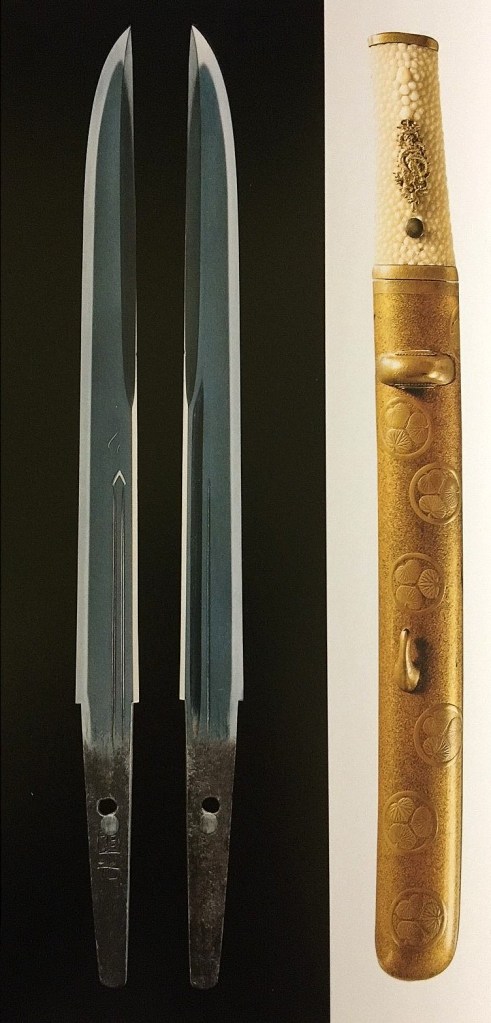
The photo above is also by Shintogo Kunimitsu (新藤五国光), with Saya. Saya is the scabbard. The handle of the scabbard (white part) is made of sharkskin. Both photos are from the Sano Museum Catalog “Reborn.” Permission granted.

 Study of Japanese Sword