Chapter 34 is a continued part of Chapter 1 Time line. Please read Chapter 1 before reading this section.
 The red circle indicates the time we discuss here
In the “Chapter 1 Timeline,” the gendai-to (現代刀) are swords made from the Meiji Restoration (明治維新1868) up to the present day. It has been about 150 years since the Meiji Restoration. Although all swords made after the Meiji Restoration are grouped under the gendai-to, there are many differences in quality and style. One notably different type is the gun-to (軍刀). These are military swords forged during World War I and World War II. Some of them have a saber-like handle. With a few exceptions, these were made without using traditional sword-making techniques of heating and folding. Among the gendai-to, gun-to are usually considered less valuable. The gun-to swords made around and during World War II are called Showa-to. It often has a brown leather scabbard. Gun-to is not a part of the study of the Japanese sword.
*Refer to” https://en.wikipedia.org/wiki/Gunt%C5%8D” for the Japanese military sword.
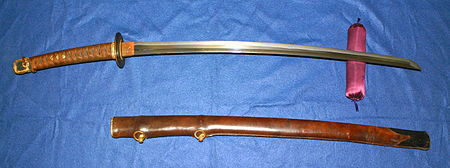
Gun-to From Wikimedia Commons, the free media repository
At the time of the Meiji Restoration (明治維新), swords called Meiji-ishin-to (明治維新刀) or Kin’no-to (勤王刀) were made. These swords were owned by famous historical figures such as Saigo Takamori (西郷隆盛) and Sakamoto Ryoma (坂本龍馬). They are important historical figures who advanced the Meiji Restoration. These swords are long, some almost 3 feet long, and have no curvature.
Today, many famous swordsmiths are making excellent swords. Some are recognized as living national treasures. Gendai-to refers to swords made after the Meiji Restoration to the present, but keep in mind that there is a wide range of differences in quality, type, and purpose among them.
 Study of Japanese Sword