
The red circle iabove ndicates the time we discuss in this section
The Muromachi period started after Ashikaga Takauji (足利尊氏) and several other key leaders ended the Nanboku-cho period. Discussed in 17|Nanboku-cho Period History (1333-1393).
The grandson of Ashikaga Takauji, Ashikaga Yoshimitsu (足利義満, often called Shogun Yoshimitsu), constructed a beautiful new palace in the Muromachi (室町) area of Kyoto. The palace became the center of government, known as the Muromachi bakufu (室町幕府: Muromachi government). This is the beginning of the Muromachi period. Ashikaga Yoshimitsu also built the famous “Kinkaku-ji Temple” * (Golden Pavilion) in Kyoto as his second residence.
Kinkaku-ji Temple* (金閣寺: Golden Pavilion) —————Ashikaga Yoshimitsu (足利義満) built Kinkaku-ji in 1397. Later, it became a Rinzai-Shu (臨済宗) Buddhist temple, but it was originally built as the secondary residence of Ashikaga Yoshimitsu and a guest house for official visitors. Today, it is a designated World Heritage site. The temple was burned down by an arsonist in 1950, but was rebuilt in 1955. Novelist Mishima Yukio wrote a novel, “Kinkaku-ji,” which relates to this temple and the arsonist. A famous quote from his book is, “The ho-oh (a mythic golden bird, a Chinese version of the phoenix) on the roof of Kinkaku-ji Temple is stationary, but it flies through time eternally.”
During the Muromachi period, the emperor’s power declined. The shogun (将軍) held all the political power. Gradually, several groups of samurai who were officially appointed as shugo daimyo (守護大名: high-ranking officials) began to gain political and economic power by occupying key positions in the Muromachi bakufu. They also owned extensive land. Two powerful shugo daimyo families were the Hosokawa (細川) and Yamana (山名).
The Ashikaga family made great efforts to establish the Muromachi bakufu as a stable and strong government through political measures. The beginning of the Muromachi period was peaceful and prosperous. However, by the time Ashikaga Yoshimasa (足利義政) became the eighth shogun, the Muromachi bakufu had become severely corrupt. Shogun Yoshimasa paid little attention to governing the country. Instead, he pursued women (his mother scolded him for this), spent large amounts of money building the Silver Pavilion called “Ginkaku-ji Temple (銀閣寺),” and retreated there. Since Shogun Yoshimasa did not have an heir, his brother, Yoshimi (義視), was appointed as the next shogun.
However, later, Yoshimasa’s wife, Hino Tomiko (日野富子)*, gave birth to a son, Yoshihisa (義尚). Now, brother Yoshimi (義視) allied with the high-ranking officials, the Hosokawa (細川), while his son, Yoshihisa, allied with another powerful family, the Yamana (山名). Several smaller samurai groups allied with either side, and the war broke out. This war, called Onin-no-ran (応仁の乱), occurred in 1467. It spread across the country and lasted for eleven years.
Hino Tomiko (日野富子)*————————-The wife of Shogun Yoshimasa. She took advantage of her political privileges to generate substantial income by investing in the rice market, thereby controlling prices and selling at high profits. Then, she loans this money to high-ranking officials at steep interest rates. The corruption reached an uncontrollable level.
As a result of the Onin-no-ran, beautiful Kyoto was burned to the ground. The authority of the Muromachi bakufu only extended to small areas of nearby Kyoto. The Onin-no-ran led to the next period called the Sengoku period (戦国時代), or the Warring States period. During the Sengoku period, Japan was divided into about thirty small, independent states that fought one another until Oda Nobunaga, Toyotomi Hideyoshi, and Tokugawa Ieyasu unified them.
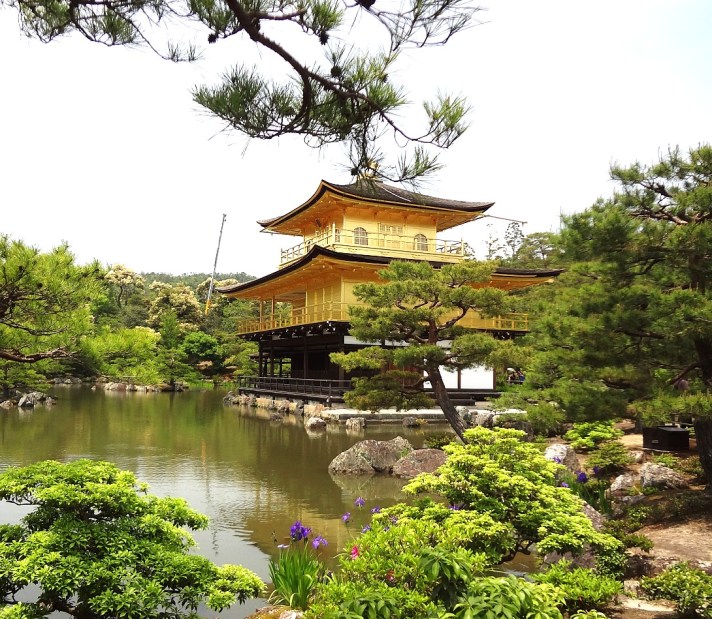
The photo was taken in May 2019, a family trip to Kyoto
 Study of Japanese Sword