56| Part 2 of — 22 Sengoku Period History (戦国時代歴史) 

Chapter 56 is a detailed section of Chapter 22, Sengoku Period History.  Please read Chapter 22, Sengoku Period History, before reading this part.


0-timeline - size 24 Sengoku Period                               
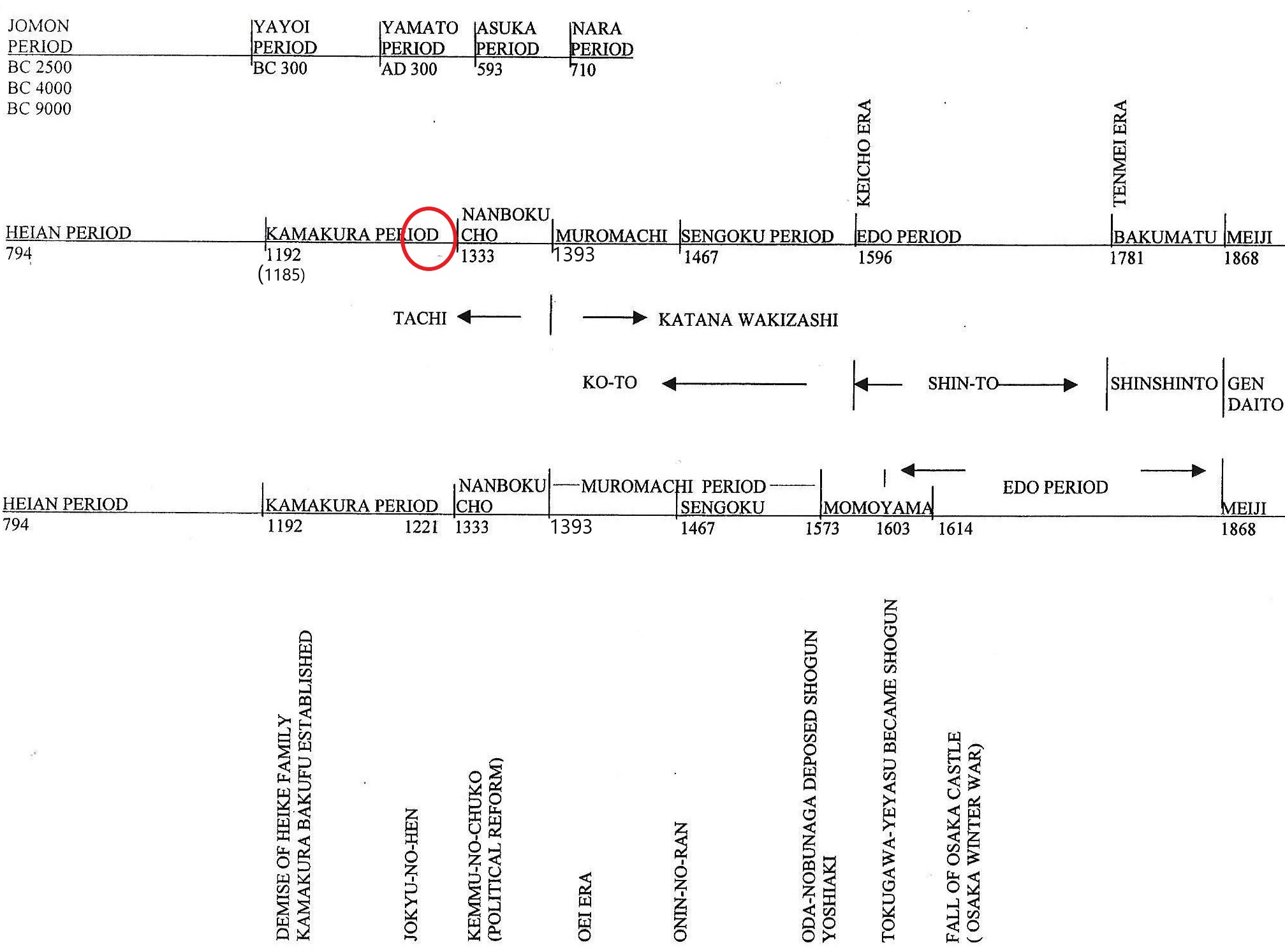
                               The circle above indicate the time we discuss in this section

Chapter 22, Sengoku Period History, explains why we divide the Muromachi period into the Muromachi and Sengoku periods based on sword styles.  The center timeline above indicates that the Sengoku period (戦国時代) ended in 1596, according to sword history. 

1596 is the start of the Keicho (慶長) era.  Swords made during and after the Keicho era are called shin-to (new swords), and swords before the Keicho era are called ko-to (old swords).  Therefore, the start of the Keicho era is the dividing line.  The swords made during the Keicho time are technically shin-to, but they are specially called Keicho shin-to.                  

Chapter 22, Sengoku Period History, describes an overview of the Sengoku period.  At the beginning of the Sengoku period, about thirty small Sengoku daimyo (warlords) fought fiercely against each other.  They formed alliances with neighboring territories on and off, and occasionally betrayed one another.  The more powerful daimyo took over the territories of the weaker ones.  Gradually, the number of daimyo decreased.   Well-known powerful daimyo include Imagawa Yoshimoto (今川義元), Takeda Shingen (武田信玄), Uesugi Kenshin (上杉謙信), Hojo Soun (北条早雲), Oda Nobunaga (織田信長),  Tokugawa Ieyasu  (徳川家康), and Toyotomi Hideyoshi (豊臣秀吉).  Their ultimate goal was to defeat their rivals and advance to Kyoto (京都) to establish themselves as the supreme political power.    

Oda Nobunaga (織田信長) defeated Imagawa Yoshimoto in Okehazama (桶狭間)

Around 1560, Imagawa Yoshimoto (今川義元) controlled a significant part of Suruga (now Shizuoka Prefecture).  See the map below for the location. He was a powerful Sengoku daimyo, strong enough to be the country’s top ruler. 

The Imagawa clan decided to move their army to Kyoto to take control of the government.  He took 25,000 men with him. On his way to Kyoto, they needed to pass through Owari (尾張: Aichi Prefecture today; see the location below), Oda Nobunaga’s territory.  

Oda Nobunaga (織田信長) was a young man with far fewer resources than Imagawa Yoshimoto.  It was clear that Oda Nobunaga had little chance of defeating Imagawa.  He had just become the head of Owari after his father’s death.  At that time, Nobunaga was called “the idiot of Owari” because of his eccentric behavior (although he was a genius). 

Few people had trusted in Nobunaga.  Among  Od’s vassals, some insisted on staying inside the castle instead of going out to fight, since Nobunaga could only gather  3,000 men.  But in the end, to everyone’s surprise, the Oda side won.  Here is how it happened. 

While Imagawa Yoshimoto was advancing, Nobunaga scouted which route Imagawa would take.  Imagawa’s side was confident they would win this easy battle because the Oda clan was small, and the head of the clan was an idiot.  The Imagawa troops decided to stop and rest at a place called Okehazama.  The road passing through Okehazama was long and narrow.  Knowing that Imagawa’s troops would come this way, Nobunaga sent out his men disguised as farmers and offered food and sake to the Imagawa soldiersWhile they were having a good time, Oda Nobunaga launched a surprise attack on the Imagawa troops.  On top of that, it suddenly began raining heavily.  The rain was so intense that the Imagawa troops could not see the Oda troops approaching.  Ultimately, Imagawa Yoshimoto was killed in battle by Oda forces.  Afterward, the Imagawa clan declined.
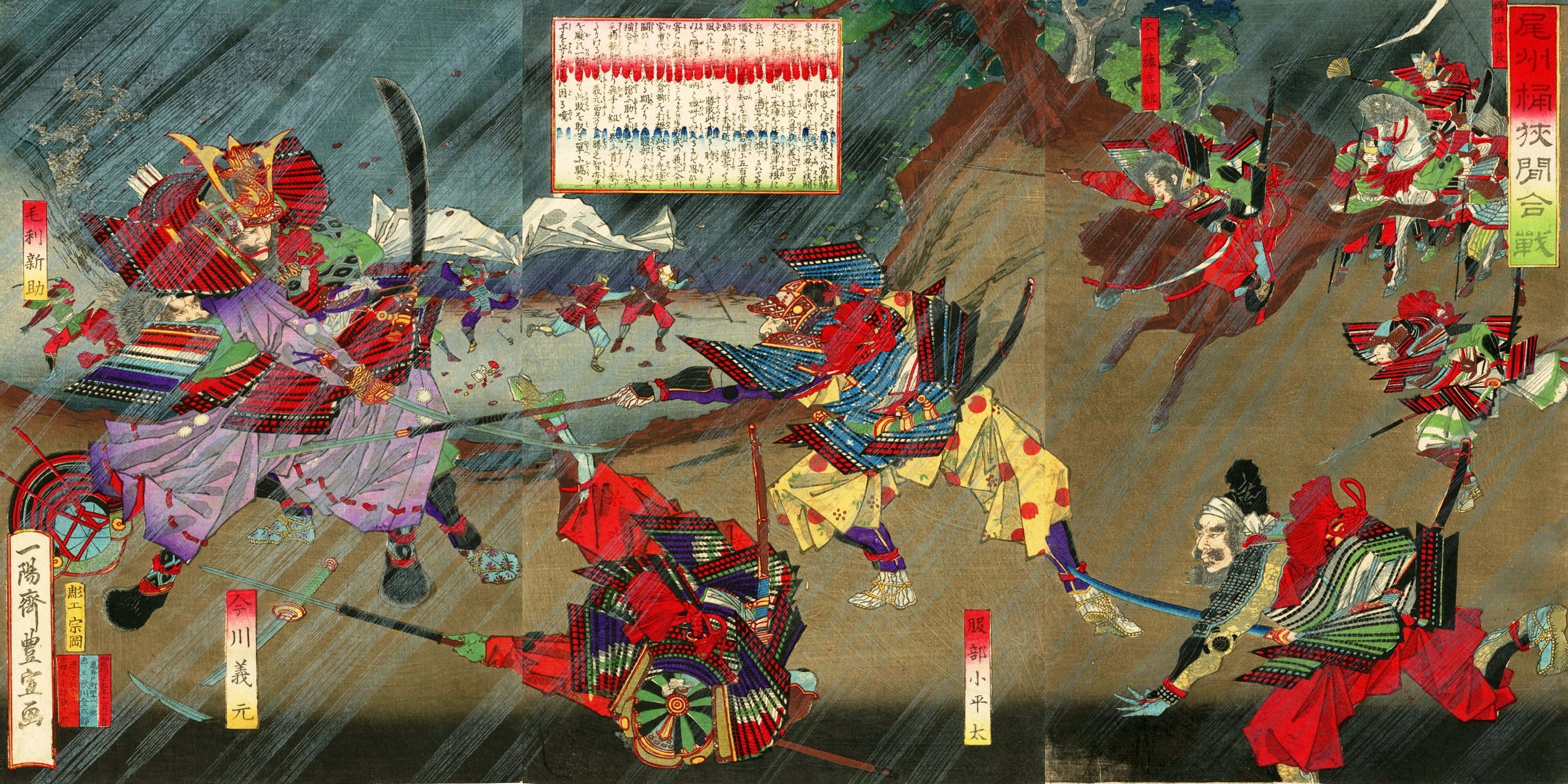
59 Okehazama drawing

Bishu Okehazama Gassen (備州桶狭間合戦) by Utagawa Toyonobu (歌川豊信)   Public Domain (http://morimiya.net/online/ukiyoe-big-files/U896.html)
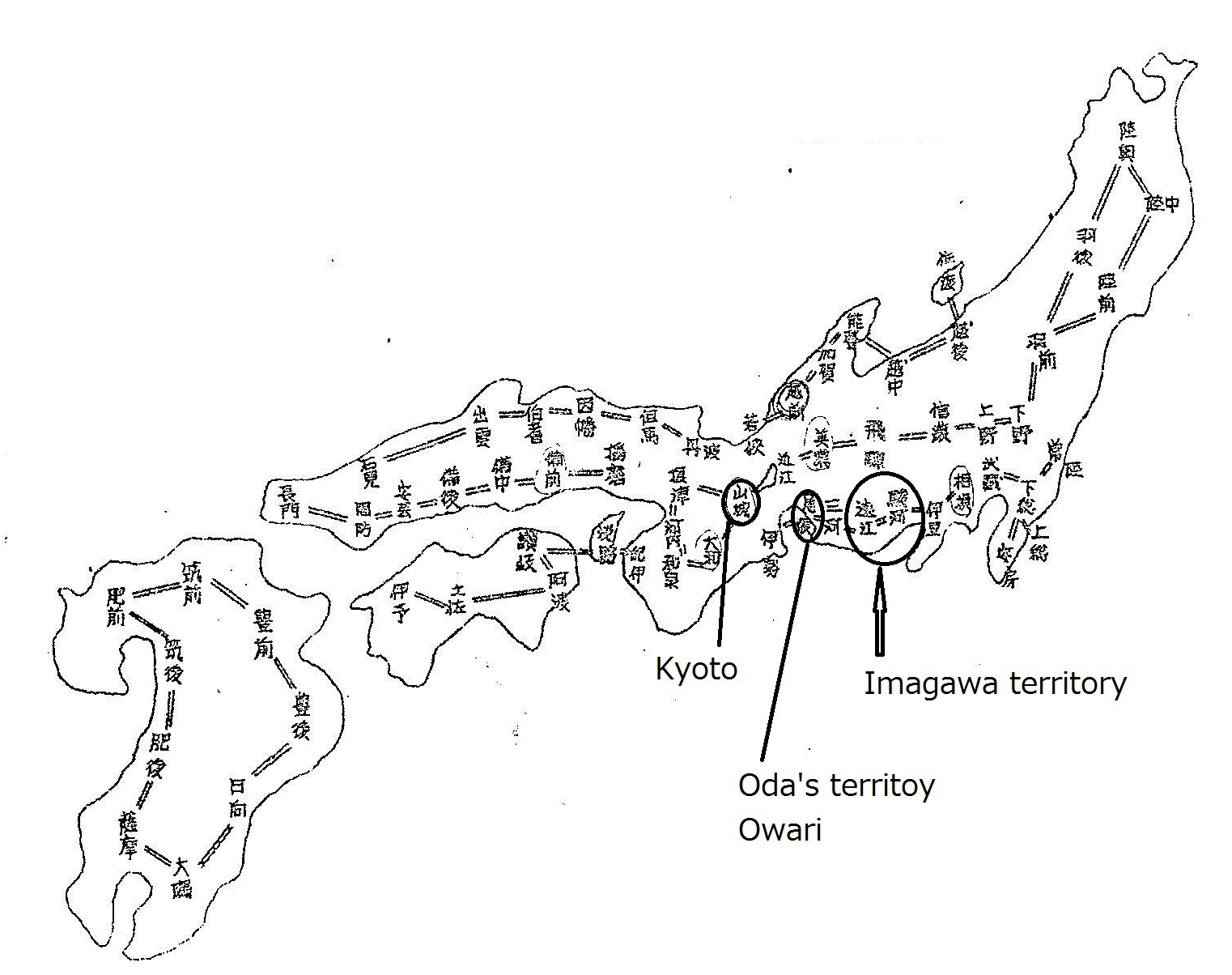
59-imagawa-and-oda-map.jpg

Oda Nobunaga(織田信長) and Akechi Mitsuhide(明智光秀)

After the Battle of Okehazama, the Oda clan rapidly expanded.  Oda Nobunaga became the dominant power.  During his rule, he carried out several brutal acts, such as burning the Enryaku-ji temple (延暦寺) and killing many people, including civilians,  yet his economic policies encouraged commercial activities. 

Things were going fairly smoothly for Nobunaga late in his life.  However, in 1582, Nobunaga was killed by his top vassal, Akechi Mitsuhide (明智光秀), at the Hon’nou-ji (本能寺) temple in KyotoNobunaga was 49 years old. 

There are several theories about why Akechi attacked and killed Nobunaga, but we don’t know exactly what happened.  One speculation is that Akechi held a grudge against Nobunaga.  There were numerous incidents where Nobunaga mistreated himAnother theory suggests that Akechi saw an opportunity to attack Nobunaga (Nobunaga was with very few men that day), and he took the chance.  Another one is that Shogun Ashikaga Yoshiaki (足利義昭) and his allies ordered Akechi to kill Nobunaga because Akechi had once worked for him.  Shogun Yoshiaki was afraid Nobunaga would become too powerful.  More theories exist.  We don’t know the true reason; it is still debated today.  It remains one of the big mysteries in Japanese history.  

After this occurred, the news was sent to Toyotomi Hideyoshi, who was Akechi’s counterpart under Nobunaga.  At that time, Hideyoshi was in Bicchu (備中, today’s Okayama Prefecture ), about 230 km (143 miles) from Kyoto (see the map below).   Hideyoshi quickly returned to Kyoto with his troops to avenge his master against Akechi and killed him. 

Here is another mystery.  The time between Nobunaga’s death and Akechi’s death was only ten days.  Hideyoshi was 230 km (143 miles) away, with mountains and rivers between them.  This means that within 10 days, Hideyoshi received news of Nobunaga’s death, packed up, and hurried back 230 km (143 miles) to Kyoto with his large number of soldiers, and fought against Akechi and killed him.  Their means of transportation at the time were limited.  Although Hideyoshi maintained a constant communication channel with Nobunaga’s inner circle, his reaction was somewhat too rapid.  There are also speculations that Akechi and Hideyoshi were both behind together(?) or that there was some other secret plot behind the incidents. 

59-bicchu-map.jpg

After Hideyoshi killed Akechi, he cleverly maneuvered his way to the top of power.  While Hideyoshi was in charge, he mined enormous quantities of gold from the mines he owned.  Records state that Hideyoshi buried a large amount of gold somewhere.  However, it has not yet been found.

Hideyoshi was the son of a poor farmer who rose to become Japan’s most powerful man. His success story fascinates the Japanese people.  Nobunaga, Hideyoshi, and Tokugawa Ieyasu are the most frequently depicted subjects in television shows and films.  After Hideyoshi died of natural causes, Tokugawa Ieyasu became Shogun, and the Edo period began.

The reference source                                                                                                      *Rekijin.com/?p=31448-キャッシュ                                                                                    *Bushoojapan.com/scandal/2019/06/02/51145-キャッシュ            

55 |Part 2 of —–21 Muromachi Period Sword (室町時代刀)

Chapter 55 is a detailed section of Chapter 21, Muromachi Period Sword.  Please read Chapter 21 before reading this part.

57 Muromach-timeline size 22

                         The circle above indicates the time we discuss in this section

After the Muromachi period, swords shifted to katana(刀) from tachi (太刀), as described in Chapter 21, Muromachi Period Sword.  Refer to Chapter 21, Muromachi Period Sword.  By the end of the Nanboku-cho period, sword lengths had shortened to about 2 feet ± a few inches.  The 3-to-5-foot-long swords seen during the Nanboku-cho period were no longer produced.  This change occurred because, during the Nanboku-cho period, warriors mainly fought on horseback, but after the Muromachi period, infantry combat became more common.

Oei Bizen (応永備前)                                                                                                              The pronunciation of Oei is “O” as in “Oh” and “ei” as in “A” from ABC.  The Muromachi period was a declining time for sword-making.  The swords made during the early Muromachi period in the Bizen area is known as Oei BizenOsafune Morimitsu (長船盛光), Osafune Yasumitsu (長船康光), and Osafune Moromitsu (長船師光) were the main Oei Bizen swordsmiths.  Soshu Hiromasa (相州広正) and Yamashiro Nobukuni (山城信國) were also similar to the Oei Bizen style.  Please refer to Chapter 21, Muromachi Period Sword, for details on the  Muromachi sword shape, Hamon, Boshi, and Ji-hada.

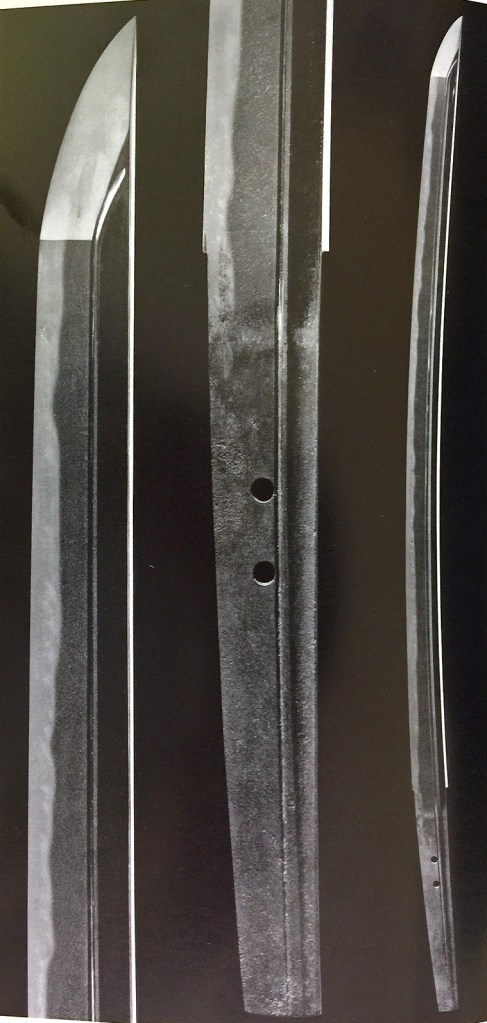
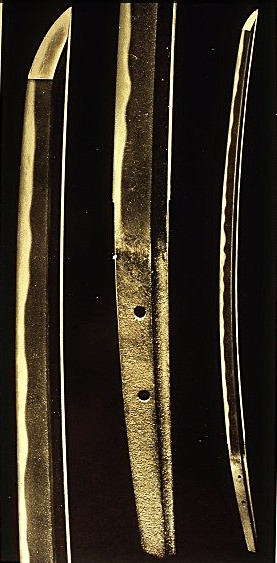
                       Bishu Osafune Moromitsu (備州長船師光)   from Sano Museum Catalogue ((permission granted)
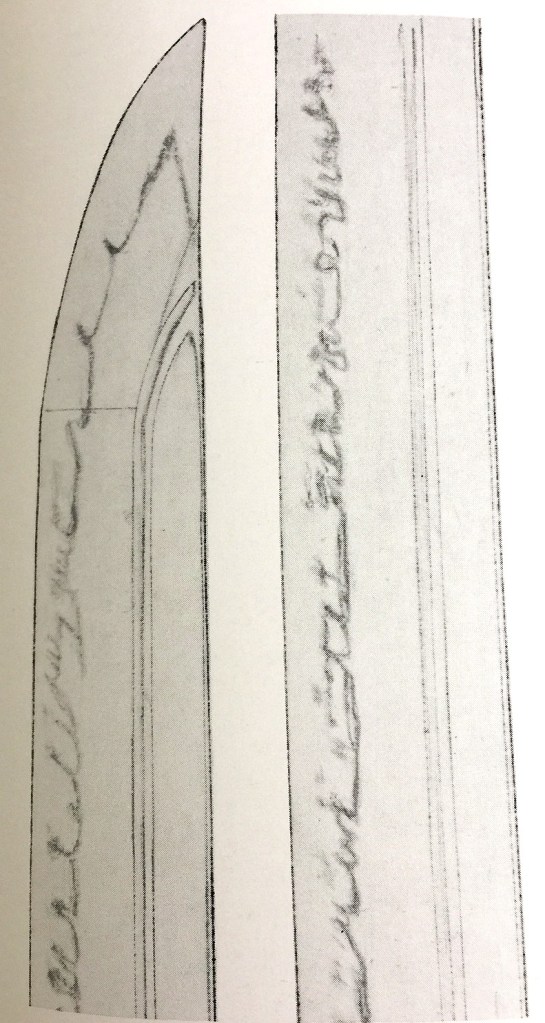
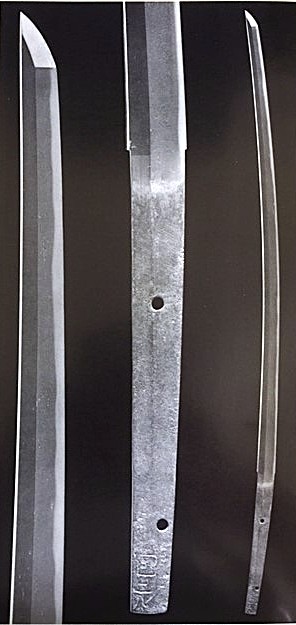
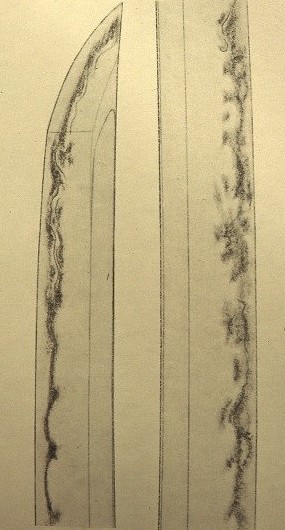
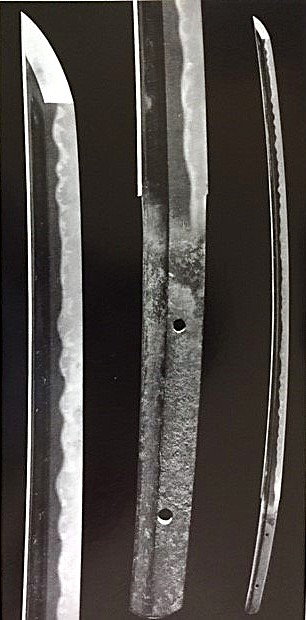
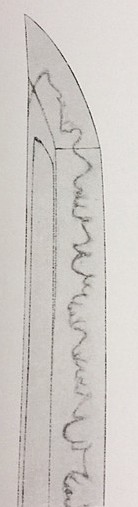
The Osafune Moromitsu sword shown above measures 2 feet 5 inches in length and has a medium kissaki.  Its hamon has a small wave-like pattern with continuous gunome (a lined half-circle pattern).  The boshi area shows irregular waviness with a slightly pointed tip.  Very faint bo-utsuri (a soft shadow shaped like a strip of wood) appears on ji-hadaBo-utsuri is a distinctive feature among all the Oei Bizen

Before the Muromachi period, many swordsmith groups operated in the Bizen region. However, by the Muromachi period, Osafune (長船) was the only remaining group.

Osafune (長船) is the name of a region, but it became the surname of swordsmiths during the Muromachi period.  Two other well-known swordsmiths from Oei Bizen are Osafune Morimitsu (盛光) and Osafune Yasumitsu (康光).  The hamon created by Morimitsu and Yasumitsu is more detailed than that of the sword in the photo above.  Chapter 21, Muromachi period swords, shows the hamon of Morimitsu and Yasumitsu and describes the typical characteristics of swords from the Muromachi period.

                                                 Hirazukuri Ko-Wakizashi Tanto

58 Hirazukuri Ko-Wakizashi Tanto

Hirazukuri Ko-Wakizashi Tanto Shape                                                                       

Hirazukuri ko-wakizashi tanto was a popular style during the early Muromachi period. Swordsmiths from various regions produced tantos similar to the one shown above. However, most of these types were made by Oei Bizen swordsmiths.

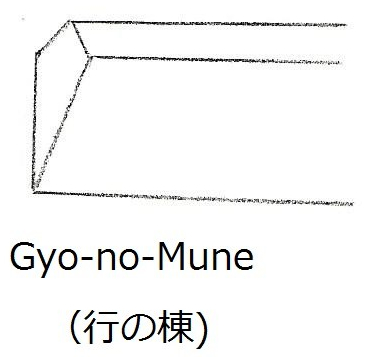
The characteristics of the Hirazukuri ko-wakizashi tanto ————-Typically about one foot and 1 or 2 inches long.  No yokote line, no shinogi, and no sori (meaning no curvature, straight back).  Average thickness.  Narrow width.  Gyo-no-mune (refer to Chapter 12, Middle Kamakura Period Tanto).

13 Mune drawing

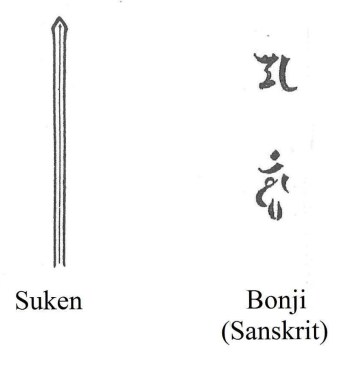
Hirazukuri Ko-wakizashi tanto often shows many engravings.  Hi with soe-hi (double lines, wide and narrow side by side), Tokko-tsuki-ken, Tsume-tsuki-ken, Bonji, and more.

.

9 Hi, Suken, Bonji20 Tokko, tume Ken  58 tsumetukiken and Hi

*drawings from “Nihonto no Okite to Tokucho” by Honami Koson


54|Part 2 of — 20|Muromachi Period History (室町時代歴史)

This is a detailed section of Chapter 20, Muromachi Period History.  Please read Chapter 20 before reading this part.


0-timeline - size 24 Nuromach & Sengoku

                      The red circleabove indicate the time we discuss in this chapter

Until the Muromachi (室町) period, the study of political history and sword history ran in parallel.  The timelines above show that the middle line represents sword history, and the bottom line represents political history.  

The styles of swords were distinctly different between the Muromachi and Sengoku periods (戦国時代).  Therefore, for sword study, the Muromachi and Sengoku periods should be separated.   Japanese history textbooks define the Muromachi period as 1393 (the end of the Nanboku-cho) to 1573, when Oda Nobunaga (織田信長) deposed Shogun Ashikaga Yoshiaki (足利義昭) from Kyoto (the fall of the Muromachi bakufu).   In these textbooks, the Sengoku period is considered part of the Muromachi period.  However, we need to distinguish between the Muromachi and Sengoku periods for the study of swords.

 Ashikaga Yoshimitsu (足利義満)

The best period during the Muromachi era was when Shogun Ashikaga Yoshimitsu (足利義満: grandson of Ashikaga Takauji) was in power.  He moved the bakufu to Muromachi (室町) in Kyoto; therefore, this era is called the Muromachi period.  By the time most of the South Dynasty’s samurai had surrendered to the North Dynasty, the South Dynasty had accepted Shogun Yoshimitsu’s offer to stop fighting against the North.  This acceptance established the Ashikaga family’s power within the Muromachi Bakufu

Shogun Ashikaga Yoshimitsu generated tremendous profits from trade with China (Ming). He built a famous resort villa in Kyoto, the Golden Pavilion (Kinkaku-ji Temple 金閣寺*). It is believed that he created the Golden Pavilion to display his power and wealth. The beautiful culture known as Kitayama Bunka (Kitayama culture 北山文化) flourished during this period.

*Golden Pavilion (金閣寺: Kinkaku-ji Temple) —– Its official name is Rokuon-ji Temple (鹿苑寺).  Saionji Kintsune (西園寺公経) originally built it as his resort house during the Kamakura period.  Shogun Yoshimitsu acquired it in 1397 and turned it into his villa.  He also used it as an official guesthouse. 

After Shogun Yoshimitsu’s death, the villa was converted into Rokuon-ji Temple.  It is part of the Rinzaishu Sokoku-ji Temple, which served as the main temple of a Zen sect denomination, called the Rinzaishu Sokoku-ji group (臨済宗相国寺派).  Kinkaku-ji is a reliquary hall that contains relics of the Buddha.  Kinkaku-ji Temple represents the grand Kitayama Bunka (Kitayama culture).  In 1994, it was designated a UNESCO World Cultural Heritage Site. https://www.shokoku-ji.jp/kinkakuji/


57 Kinkakuji trip 2019                                                               My photo  May 2019,

Ashikaga Yoshimasa (足利義政)

After the death of Shogun Ashikaga Yoshimitsu (足利義満), the Muromachi bakufu became less financially stable, and its military power declined.  Consequently, the daimyo (feudal lords) increased their control.  A few generations after Shogun Yoshimitsu, Ashikaga Yoshimasa, the eighth Shogun, took power.  His wife was the well-known Hino Tomiko (see Hino Tomiko in Chapter 20, Muromachi Period History). 

It is said that Shogun Yoshimasa was not interested in his role as shogun; instead, he was more interested in art and culture.  He laid the foundation for today’s Japanese art and culture, including the Japanese garden, Shoin-zukuri (書院造) interior design, the tea ceremony, flower arrangements, painting, and other art forms.  His cultural influence is known as Higashiyama Bunka (Higashiyama culture (東山文化).  

As described in Chapter 20, Muromachi Period History (室町時代), Shogun Yoshimasa did not have any children.  His brother Yoshimi (義視) was expected to become the next Shogun. However, his wife, Hino Tomiko, gave birth to a son, Yoshihisa (義尚).  Hino Tomiko sought support from Yamana Sozen (山名宗全: a powerful family) to back her son.  Meanwhile, the brother, Yoshimi, was connected with Hosokawa Katsumoto (細川勝元: another powerful family).  The problem was that Shogun Yoshimasa paid too much attention to his cultural pursuits and failed to address the issue he created by not being clear about who should succeed him as Shogun.  He did not hand over the shogunate to either party. 

In 1467, in addition to the succession problem and conflicts of interest among powerful daimyo, a civil war, known as “Onin-no-run (応仁の乱),” broke out.  All daimyo were divided, siding with either the Hosokawa or the Yamana factions.   Eventually, the war spread throughout Japan and lasted more than 10 years.  Finally, in 1477, after the deaths of Hosokawa Katsumoto and Yamana Sozen, Shogun Yoshimasa decided to transfer the shogunate to his son Yoshihisa.  As a result of this war, Kyoto was devastated, and the power of the Muromachi Bakufu declined significantly. 

While all this was happening and people were suffering, Yoshimasa continued to spend money on building the Ginkaku-ji Temple (銀閣寺: The Silver Pavilion).  He died before seeing the completion of Ginkaku-ji Temple.  The Onin-no-ran would lead to the next Sengoku period, a 100-year-long Warring States period.

*Shoin-zukuri (書院造)———- A traditional Japanese residential interior style with Tatami mats, a nook, and shoji screens (sliding doors).  This style forms the basis for interior design in modern Japanese homes.

Shoin Zukuri style Japanese room

57 Shoin zukuri

Public Domain   GFDL,cc-by-sa-2.5,2.0,1.0 file: Takagike CC BY-SA 3.0view terms      File: Takagike Kashihara JPN 001.jpg

My japanese room                                                                      My Japanese room

53| Part 2 of — 19 Nanboku-cho Period Tanto (南北朝短刀)

This chapter is a detailed section of Chapter 19.  Please read Chapter 19, Nanboku-cho Period Tanto, before proceeding on to this part. 

0-timeline - size 24 Nanboku-cho

                          The red circle above indicates the time we discuss in this section

20 Enbun Jyoji Kowakizashi Tanto

The drawing above shows a typical shape of a Nanboku-cho-period tanto. This drawing was in Chapter 19.  I exaggerated the features of the Enbun Joji ko-wakizashi tanto to better show you.  At the end of Chapter 19, Nanboku-cho Tanto, there is a list of swordsmiths’ names from that period.  Hiromitsu (広光) and Akihiro (秋広) represent the Nanboku-cho style.

56 cropped Hiromitu photo 20 HitatsuraHiromitsu from the Sano Museum Catalogue (permission to use granted)

Enbun Joji Ko-wakizashi tanto is also called Sun-nobi tanto (>10 inches) because its length is longer than the standard size (about 10 inches) tanto.  The upper part of the tanto curves outward slightly.  This type is called sakizori.

Characteristics of Hiromitsu (広光) and Akihiro (秋広)

  • Shape———————— Usually, one foot and one to two inches long (Sun-nobi).   Wide width.  Thin blade.  Sakizori.
  • Hamon ———————- A mix of wide and narrow hamon.  The hamon around the yakidashi (just above the machi) area is narrow but gradually widens as it moves up.  The hamon around the fukura area shows most work.  Mainly nie.  Sunagashi, kinsuji, gunome, umanoha-midare (horse teeth-shaped hamon), or hitatsura appear (drawing above).                 
  • Boshi———-Irregular and unevenly tempered.  The hamon covers almost the entire boshi. Deep turn back. 
  • Jihada ———————————————————Wood-grained pattern
  • Nakago —————–Tanago-bara shape.  Refer to 19 Nanboku-cho Period Tanto.

Nobukuni (Below is my sword)

Shodai Nobukuni (the first-generation Nobukuni) was a student of Sadamune.  He was one of the Sadamune San Tetsu (貞宗三哲, Sadamune’s top three students).  Nobukuni’s characteristics resembled those of Hiromitsu and Akihiro, as described above.  Nobukuni also created sun-nobi tanto.  The sword below has a hoso-suguha, ko-mokume (small burl pattern), and ko-maru boshi (small round). 

56 Nobukuni 1 Nobukuni4

56 Nobukuni 2This is the certification of my sword.  Shodai Nobukuni (初代信國).   Juyo Token (重要刀剣)
Certification

Number: Juyo 3220, Certification Juyo-Token

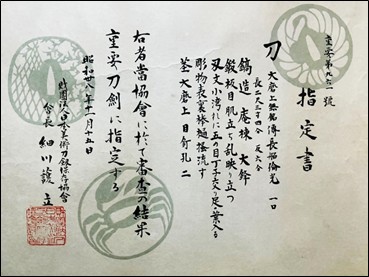
Wakizashi:  Nobukuni (信国), 31.4cm long, 0.3cm curvature, hirazukuri, mitsumune (three-sided mune), sun-nobi.  The ji-hada shows a wood grain and ji-nie (surface nie, between shinogi and hamon). The hamon is a chu-suguha (medium straight). The front carving shows bonji (Sanskrit) and sanko-ken. The back engraving is bonji and hoko (pike).   Original nakago.  Examined by the Nihon Bijutsu Token Hozon Kyokai.  It is certified as a Juyo Token.  The Chairman, Moritatu HosokawaShowa 45 June 1 (June 1, 1970)

52| Part 2 of — 18 Nanboku-Cho Period Swords (南北朝太刀)

This chapter is a detailed part of Chapter 18, Nanboku-cho Sword.  Please read Chapter 18 before reading this section. 

    0-timeline - size 24 Nanboku-cho                     
                      The red circle above indicates the time we discuss in this section

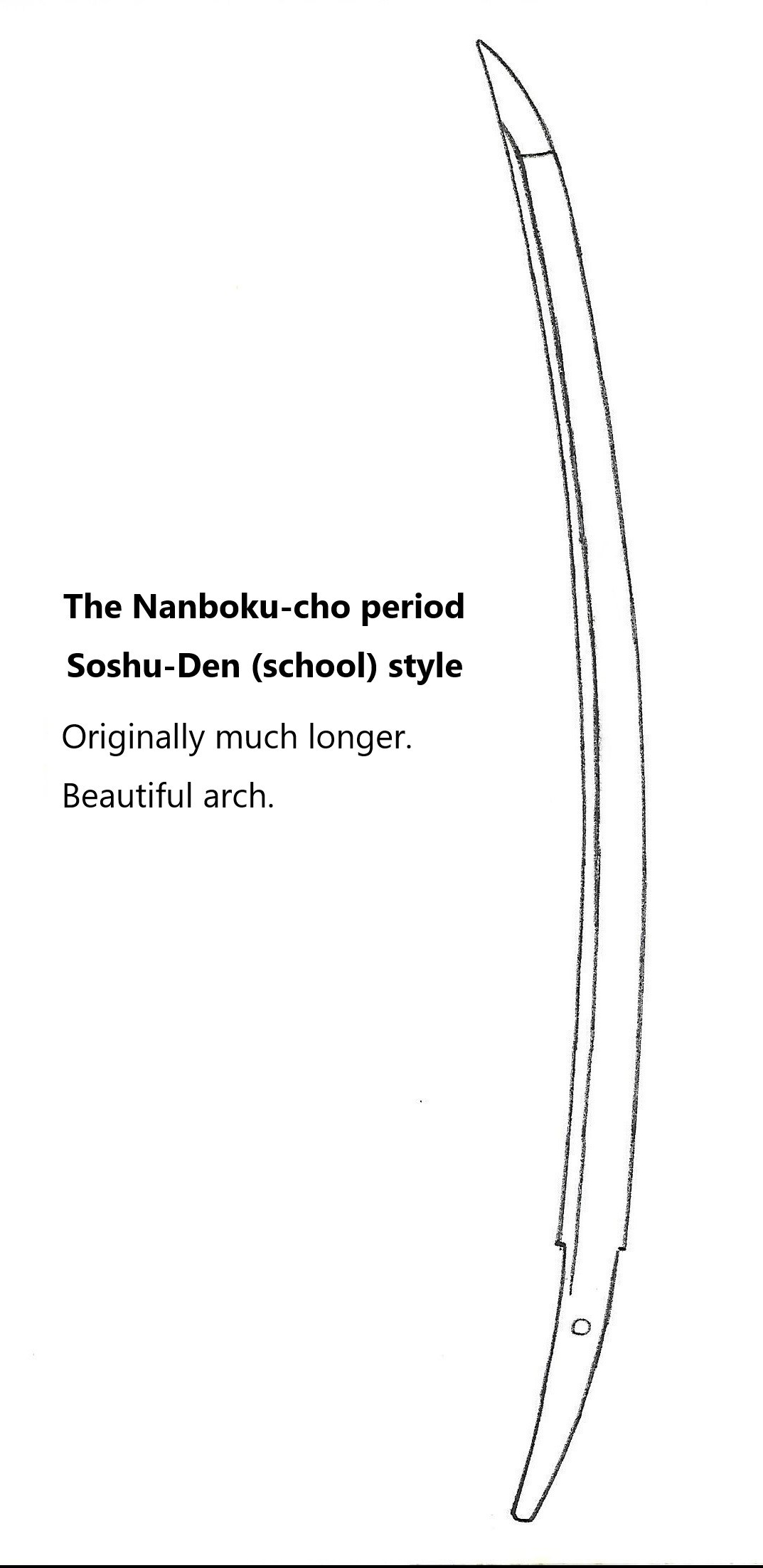
The drawing below is an illustration from Chapter 18, Nanboku-cho Period Sword.  Please compare this drawing to the photo on the right.  It shows the similarity in shape.  Keep in mind that this illustration depicts the shape of a once very long sword that was shortened at a later time.   During the Nanboku-cho period, swordsmiths created 3, 4, or even 5-foot-long blades, but they were later shortened to about 2 to 2.5 feet or so.

19 Nanboku-cho Sword style   55 Sa photo                                         ” Sa” from Sano Museum Catalogue “Reborn” (Permission granted).    Sa” is pronounced like the first sound of “sabotage.”

Chogi* from Sano Museum Catalogue (Permission granted)

        Chogi* is pronounced: Chocho-san’s “cho” and giggle “gi.” 

Chogi‘s sword style is categorized within the Soden-Bizen groupSee, 18 Nanboku-Cho Period Sword.  Chogi (長義) was a swordsmith from the Bizen-den school who created swords with features of the Soshu-denTherefore, in short, it is called Soden-Bizen (Bizen swordsmiths forged in Soshu-den).

 Chogi characteristics

  • Shape ——- Originally very long, but it was shortened to approximately 2 to 2.5 feet.  
  • Hamon ——–Wide showy tempered line.  Nioi, and nie appear.  Sunagashi (砂流し, a brush stroke-like pattern) appears.  Notare (wavy) mixed with gunome.  Sometimes Chogi created the double gunome-style hamon (a connected pair of half-circles). This shape resembles a pair of earlobes.  Therefore, it is called Chogi’s mimigatamidare (irregular hamon mixed with a pattern resembling the earlobe).                                                                                                                  
  • Boshi ——————————— Irregular midare and sharp turn back
  • Ji-hada —————————————— Itame (a wood grain pattern)

 Aoe from Sano Museum Catalogue (Permission granted)

55 Aoe  55 Aoe ilustlation                

Aoe (青江) is pronounced “A” like apple, “o” like original, and “e” like an egg.  Aoe was a swordsmith from Bittchu (備中) province, located next to Bizen.  Therefore, the characteristics of Ko-aoe (old Aoe) and Ko-Bizen (old Bizen) are similar.
55 Bizen Bittchu map

Characteristic of Aoe (青江)

The height of the Aoe group occurred from the middle Kamakura period to the Nanboku-cho period.

One of the characteristics of the Aoe sword is its Aoe-zori shape, which curves a lot at the lower part.                                                                                                              During the Nanboku-cho period, since the Soshu-den was a popular style, even Bizen swordsmiths forged nie, although their main characteristic was nioi.   However, the Bittchu group continued to use nioi.                                                                                       The tempered area tends to be wide.  Sakasa-choji, which means inverted or backward style choji (see the illustration above), is Aoe’s most notable characteristic.  Also, boshi often has a pointed hamon.  It is often said that if you see Sakasa-choji, the sword has a good chance of being from either the Aoe or Katayama Ichimonji groups.  Sumitetu (澄鉄:  black core metal shows through) is another characteristic of Aoe’s.

50|Part 2 of –16 Late Kamakura Period: Tanto (Early Soshu-Den 鎌倉末短刀, 正宗墓)

Chapter 50 is a detailed part of  Chapter 16, Late Kamakura Period Tanto (Early Soshu-Den).  Please read Chapter 16 before this section.

0-timeline - size 24 Late Kamakura

                     The red circle above indicates the time we discuss in this section.

In  Chapter 16, Late Kamakura Period Tanto (Early Soshu-Den), the general features of the late Kamakura period tanto style (early Soshu-den) are described.  The following two photos show the typical characteristics of early Soshu-den tanto.

Masamune

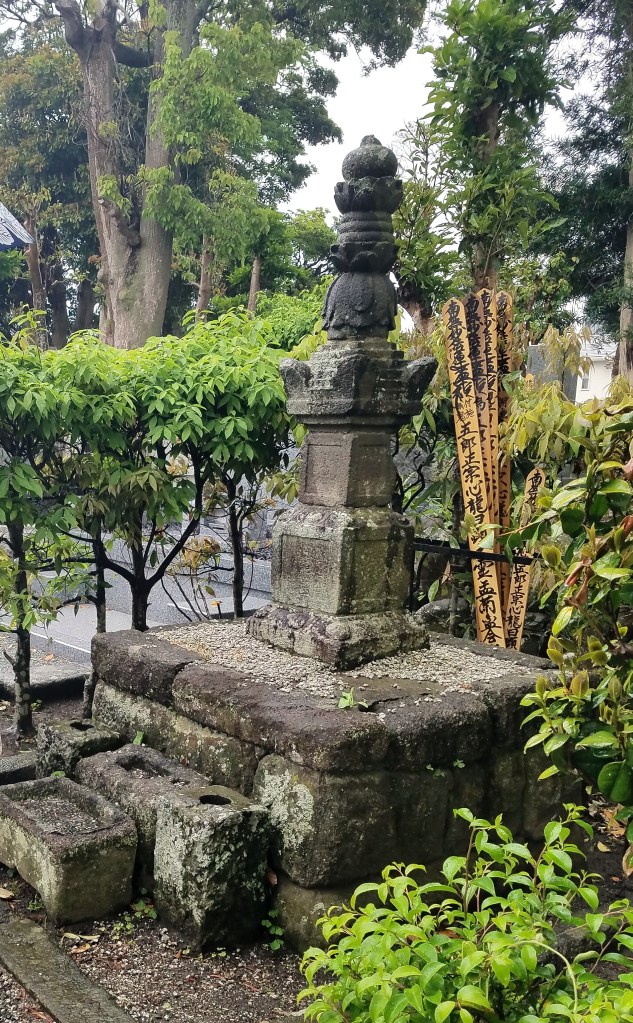
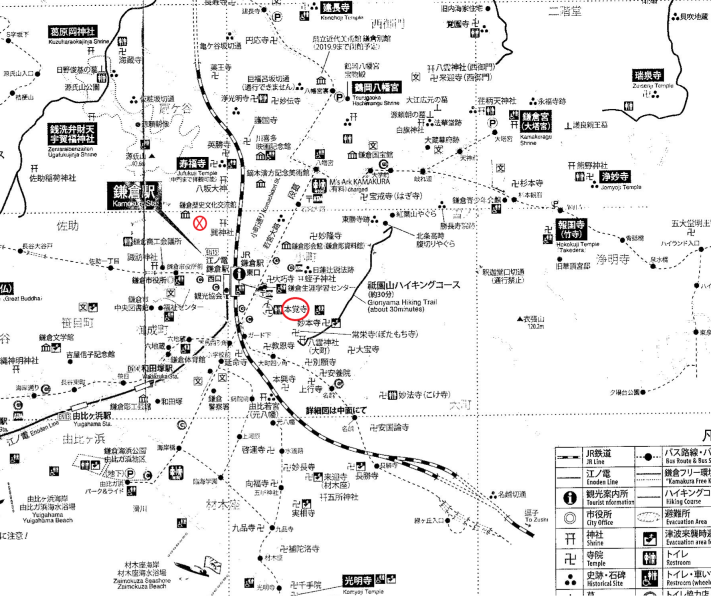
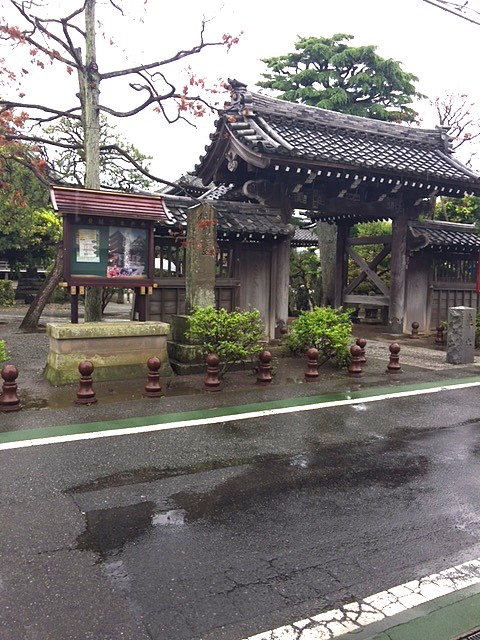
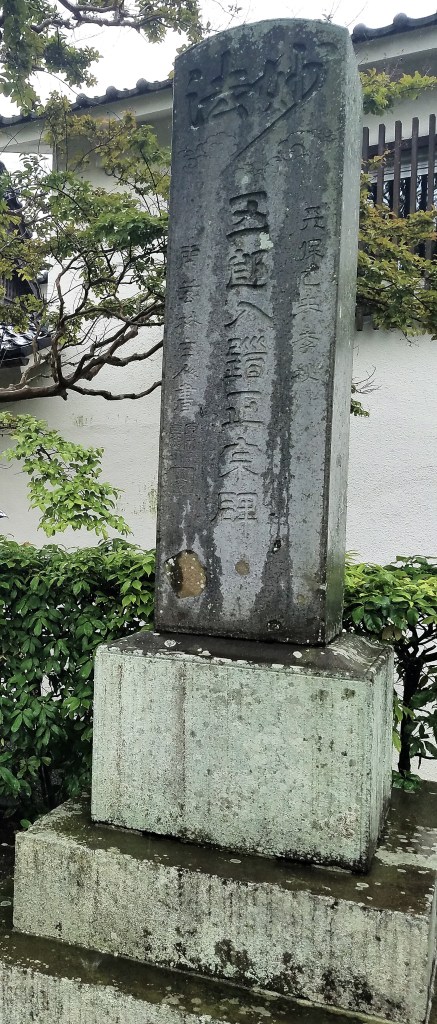
Goro Nyudo Masamune (五郎入道正宗) was born in Kamakura as the son of Tosaburo Yukimitu (藤三郎行光)Today, Masamune is a well-known swordsmith, even among those unfamiliar with Japanese swords.  His father, Tosaburo Yukimitsu, was also among the top swordsmiths in early Soshu-den.  Masamune’s tomb is located at Honkaku-ji (本覚寺) Temple, about a 6-minute walk from Kamakura Station. 

Goro Nyudo Masamune (五郎入道正宗) Sano Museum Catalog (permission granted)
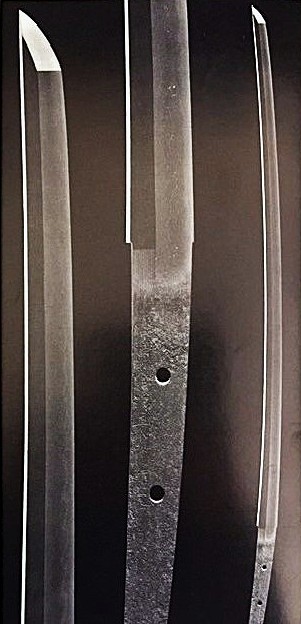
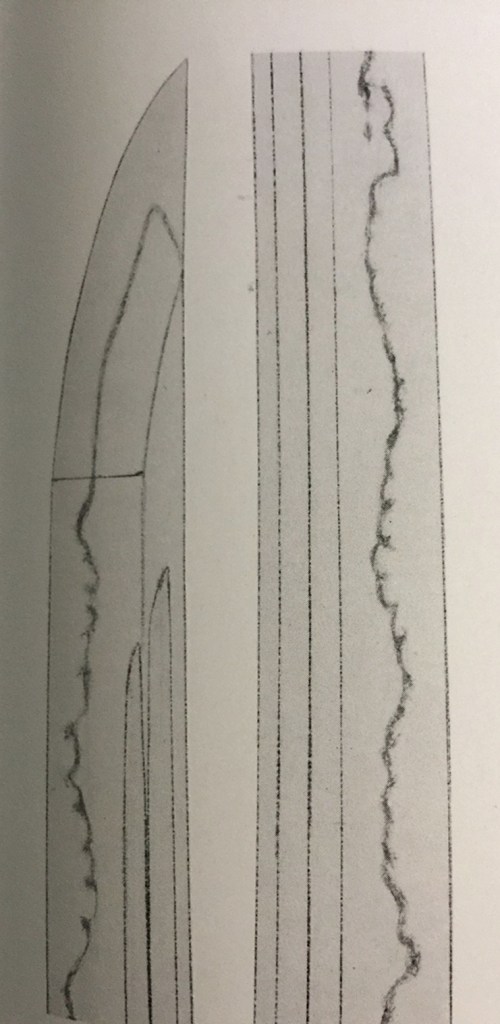
Masamune photo (above) —– Hira-zukuri (flat).  Sakizori is very slightly curved (the tip area curves slightly outward).  Bo-hi and tsure-hi (parallel thin grooves).  Komaru-boshiItame-hada (wood grain pattern).  The Hamon is notare (wavy).  The illustration above shows sunagashi and niju-ba (double hamon).  This type of nakago is called tanago-bara.  The Masamune tanto is often mu-mei (unsigned). This particular tanto is called Komatsu Masamune (小松政宗).  The catalog from the Sano Museum’s description stated that connoisseurs in the past had difficulty determining this as a Masamune swordBecause the wide mihaba with sori and hamon slightly differed from those of another Masamune.  Judging from the clear nie, chikei, and kinsuji, it was determined to be a Masamune tanto.

Enju Photo below

               Higo Province Enju Kunisuke from Sano Museum Catalog (permission granted)
The Enju (延寿) group lived in Higo (肥後) Province on Kyushu.  The characteristics of the Enju group closely resemble those of the Yamashiro-den because Enju Kunimura was related to Rai Kuniyuki, a member of the Yamashiro-den.

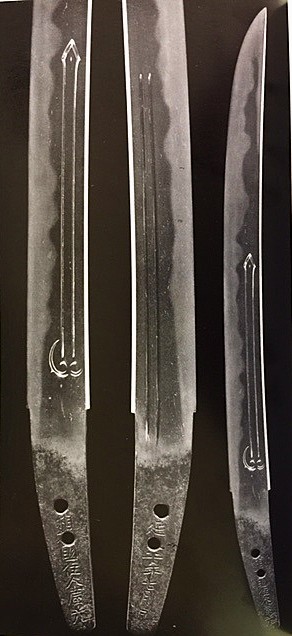
Enju (photo above) —-Hamon is hoso-suguha (straight temper line).  The boshi is komaru.  The front engraving is suken (above left photo, left side), and the engraving on the back is gomabashi (left photo, right side).  Tight itame ji-hada.  It can be confusing to kantei (determine who made the sword) a sword like this because, although it is from the late Kamakura period, it does not have the typical early Soshu-den appearance.

Masamune’s Tomb in Honkaku-ji Temple

Masamune’s (正宗) tomb is located inside Honkaku-ji Temple (本覚寺) in Kamakura.  Here is a map of Honkaku-ji Temple and the Masamune Kogei store in Kamakura.  The store is owned by Tsunahiro Yamamura, the 24th generation of MasamuneHonkaku-ji Temple is circled on the map, and the Masamune Kogei store is a red circle with an X.  Both are about a 6 to 7-minute walk from Kamakura Station. 

To reach to Honkaku-Ji Temple from Tokyo                                                                           Take the Yokosuka Line train from Tokyo Station (approx. one hour) → Get off at Kamakura Station (one stop after Kita-Kamakura) → Exit through the East Exit (front exit) → Walk straight and cross the street → Turn right and walk to the post office → Turn left at the post office (Honkaku-ji Temple sign is at the corner of the post office)

From Kamakura Tourist map

52 Honnkakuji 2 54 large Masamune monument only

52 Honkakuji 54 Small Masamune tomb only

Honkakuji Temple (本覚寺) and Masamune Tomb (正宗墓 )

49| Part 2 of — 15 The Revival of Yamato Den (大和伝復活)

This chapter is a detailed part of Chapter 15, Revival of Yamato Den.  Please read Chapter 15 before reading this section.

0-timeline - size 24 Late Kamakura                          The red circle above indicates the time we discuss in this section

At the end of the Kamakura period, powerful temples expanded their territories in the Yamato region.  Refer to the map below for the location of the Yamato region.  Several prominent temples, especially those with large territories, held political and military power to control the area at the end of the Kamakura period.  These large territories were called shoen (荘園).  They employed many monk soldiers known as so-hei.  The demand for swords increased because of the rising number of Sohei (僧兵).  This increased demand revived the Yamatoden.  

Some prominent temples had their own swordsmiths within their territories. Todaiji Temple (東大寺) supported the Tegai (手掻) sword group.  The Senjuin (千手院) sword group lived near Senju-do (千手堂), where Senju Kannon (千手観音) is enshrined.  The Taima sword group originated from the Taima-ji Temple (当麻寺).  The Shikkake group (尻懸) and the Hosho group (保昌) were also part of the Yamato-den sword groups.  These five groups are known as Yamato Goha (the Yamato five groups).

51 Japan map Yamato

General Characteristic of Yamato Den

The Yamato-den (大和伝) sword always shows masame (柾目: straight grain-like pattern) somewhere on the ji-hada, ji-gane, or hamon.  Refer to Chapter 15, Revival of Yamato Den.   Masame is sometimes mixed with mokume (burl-like pattern) or itame (wood-grain-like pattern).  Either way, Yamato-den always shows masame somewhere.  Some swords display masame across the entire blade, while others show less.  Because of the masame, the hamon often shows sunagashi (a brush stroke-like pattern) or a double line called niju-ha.

Taima (or Taema) group (当麻)

  • Shape ———————– Middle Kamakura period style and Ikubi-kissaki style    
  • Hamon ———–Mainly medium Suguha.  Double HamonSuguha mixed with Choji.  Often shows Inazuma and Kinsuji, especially Inazuma appear under the Yokote line.
  • Boshi ————————- Often Yakizume.  Refer Yakizume on 15| The Revival of Yamato Den(大和伝復活)
  • Ji-hada ——————– Small wood grain pattern and well-kneaded surface.  At the top part of the sword, the wood grain pattern becomes Masame.

Shikkake Group (尻懸 

  • Shape —————- Late Kamakura period shape. Refer 14| Late Kamakura Period: Sword (鎌倉末太刀) 
  • Hamon ————————- Mainly Nie (we say Nie-hon’i).  Medium frayed Suguha, mixed with small irregular and Gunome (half-circle pattern).  A double-lined, brush-stroke-like Pattern may appear.  Small Inazuma and Kinsuji may also be shown.      
  • Boshi ———————— Yakizume, Hakikake (bloom trace like pattern) and Ko-maru (small round)     
  • Ji-hada ———- Small burl mixed with Masame.  The Shikkake group sometimes shows Shikkake-hada (the Ha side shows Masame, and the mune side shows burl.)

Tegai Group ( 手掻 )

  • Shape —— Early Kamakura style with thick Kasane (body).  High ShinogiKoshizori.
  • Hamon ————- Narrow tempered line with medium Suguha hotsure (frayed Suguha).   Mainly Nie.   Double tempered line.  Inazuma and Kinsuji may show.                                                                 
  • Boshi ————————————— Yakizume (no turn back), Kaen (flame-like).   
  • Ji-Hada ————————————————— Fine burl mixed with Masame. 

51 Kanenaga photo Yamato51 Kanenaga ilustration Yamato

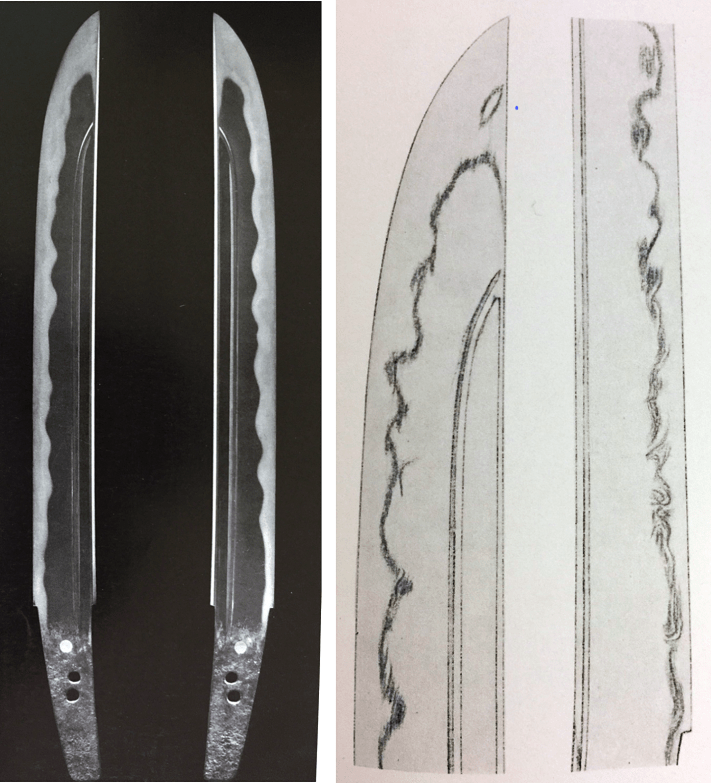
Tegai Kanenaga of Yamato.  From the Sano Museum Catalogue (permission granted).   The illustration (called Oshigata) shows notare (wave-like hamon) and suguha-hotsure (frayed suguha pattern) with kinsuji.

My Yamato sword Acquired at the Annual San Francisco Swords Show.

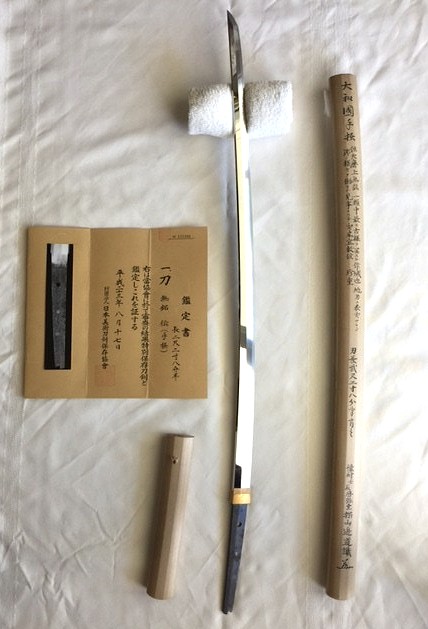
Characteristics: Munei (shortened and without signature).  Yamato-den, Tegai-ha (Yamato school Tegai group).  Length is two shaku, two sun, eight &1/2 bu (27 1/4 inches), small kissaki and funbari. HamonNiju-ba, Sunagashi.  Boshi: Yakizume.  Ji-hada: Itame with masame, Nie-hon’i .                                                                                                                                     

My Yamato sword

The full view of the sword and Kantei-sho (NBTHK Certification). “Tokubetsu Hozon Token”.

My Yamato sword 5

My Yamato sword 4

My Yamato sword.jpg 2

My sword: acquired at Dai Token Ichi (大刀剣市)Bizen Osafune Tomomitsu (備前長船倫光) Length: 2 feet 4 inches,  Shape: Shinogi zukuri,  Hada:itame midare-utsuri, Hamon: konotare gunome choji

48|Part 2 of — 14|Late Kamakura Period Sword : Early Soshu Den (鎌倉末刀)

This is a detailed section of Chapter 14| Late Kamakura Period Sword.  Please read Chapter 14 before this part.

0-timeline - size 24 Late Kamakura

                         The red circle above indicates the time we discuss in this section.

14 Ikubi kissaki Damadge

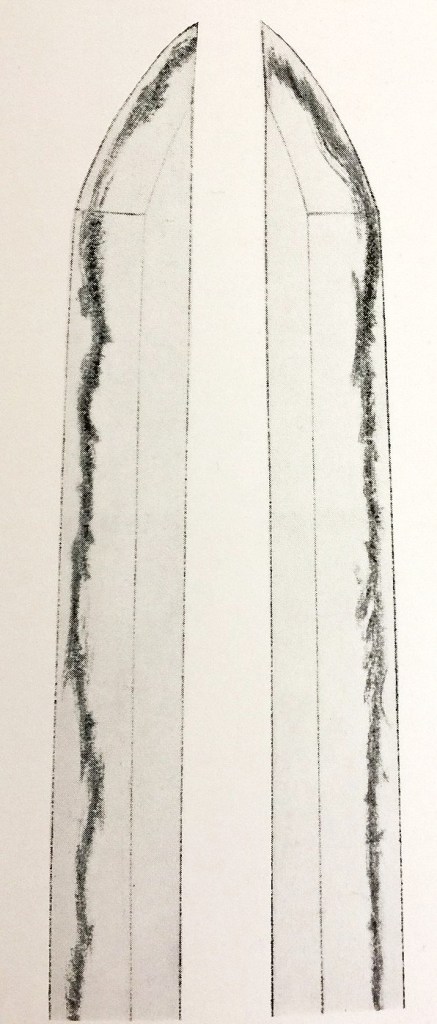
In Chapter 14, “Late Kamakura Period Sword (鎌倉末太刀),” the ikubi-kissaki sword is explained.  The illustration above shows a flaw caused when the damaged area was repaired.  To compensate for this flaw, swordsmiths developed a new sword style during the late Kamakura period.  They forged swords with a longer kissaki and lowered the tip of the hi below the yokote line.   This way, if the yokote line were lowered during repairs, the tip of the hi would remain below the yokote line.

15 Masamune (Sano)   15 Masamune hamon (Sano)

The above photo shows a sword by Goro Nyudo Masamune (五郎入道正宗).  Please observe the size and shape of the kissaki.  This differs from the previous ikubi-kissaki and ko-gissaki stylesThis style represents a typical late Kamakura period kissaki style.  It is o-suriage (a largely shortened form). 

Under the Kamakura Bakufu, many swordsmiths moved to KamakuraThey were Toroku Sakon Kunituna (藤六左近国綱) of the Yamashiro Awataguchi group (山城粟田口), Fukuoka Ichimonji Sukezane (福岡一文字助真), and Kunimune (国宗) from the Bizen area.  They were the origin of Soshu-den (相州伝)Eventually, Tosaburo Yukimitsu (藤三郎行光) and his famous son, Masamune (正宗), emergedIn the drawing above, kinsuji and inazuma are shown within the hamon.  The shining lines inside the hamon are inazuma and kinsuji.  Inazuma and kinsuji are collections of nie.  Masamune is well-known for his inazuma and kinsuji.  He lived in Kamakura, a seaside town, and his hamon resembles ocean waves when viewed from the side.

50 part 2 of 15 吉岡.photo 50 part 2 of 15 吉岡

The picture above shows a sword made by the swordsmith Yoshioka Ichimonji group (吉岡一文字).  The kissaki resembles one of Masamune’s swordsIt is longer than the previous ikubi-kissaki or ko-gissaki.  This is chu-gissaki.  The kissaki, like this, is one of the key points in determining the period when the sword was made.  The hamon has choji, gunome, togariba (pointed tip), and very tight nie.

50 part 2 of 15 運生 photo 50 part 2 of 15 運生 

The photo above shows a sword by Ukai Unsho (鵜飼雲生) from Bizen-den.  This sword is also from the late Kamakura period, but it has a ko-gissaki.  This sword does not have the late Kamakura period chu-gissaki style.  Narrow hoso-suguha are more characteristic of an earlier time than the late Kamakura periodThis sword indicates that swords do not always exhibit the style of their period.  To kantei*: first examine the style and shape, then give yourself an idea of the period it was made in.  However, the kissaki in this case does not indicate the late Kamakura period.  The next step is to look at the various characteristics of the sword one by one, such as the hamon, nie or nioi, ji-hada, etc., to determine the period, the den, and the province, and then come up with the name. This process is called kantei.

*Kantei – the process of identifying a swordsmith’s name by analyzing the sword’s characteristics without seeing the mei (the inscribed smith’s name).  The mei might be gone if it has been shortened.   All the photos above are from the Sano Museum Catalogue.  Permission to use them is granted.

47| Part 2 of –13 Late Kamakura Period: Genko (鎌倉末元寇)

This is a detailed section of Chapter 13, Late Kamakura Period, Genko(鎌倉末元寇).  Please read Chapter 13 before reading this section.

0-timeline - size 24 Late Kamakura

                      The red circle above indicates the time we discuss in this section.

Genko (元寇):  Mongolian Invasion 

Chapter 13 briefly describes the Mongolian invasion.  Here is a more detailed description.  The Mongol Empire was a vast empire that stretched from present-day Mongolia to Eastern Europe during the 13th and 14th centuries.  The grandson of Genghis Khan, Kublai Khan, sent several official letters to Japan demanding that it become a dependent state of the Mongol Empire (元: Yuan) and ordering Japan to send tribute.  They threatened Japan, warning that they would invade if Japan did not meet their demands.  Hojo Tokimune (北条時宗), who was in power at the Kamakura bakufu (government) at the time, refused and ignored the letters multiple times.  This led to two invasions by the Mongol Empire.  It is often said that a powerful typhoon hit Japan on each occasion, and these two powerful typhoons drove the Mongols away.  This is correct, but the whole story was much more than this.

Bun’ei-no-eki (文永の役)  1274

The first Mongolian invasion was called Bun’ei-no-eki.  In early October 1274, Mongol troops (Mongols, Han Chinese, and Koreans) totaling around 40,000 men* set out from the Korean Peninsula on about 900* large and small ships and headed toward Japan.  After arriving on Tsushima Island (対馬), Mongol soldiers burned villages and killed many residents, including local villagers.  Villagers were captured and sent to the top Mongol officials as slaves.  It was a heartbreaking scene. 

The Mongols moved to Iki Island (壱岐の島), Hizen Shore (肥前), Hirado Island (平戸)、Taka Island (鷹島), and Hakata Bay (博多).  In each location, the disastrous and sorrowful scenes were the same as everywhere.    On every battlefield, Japanese soldiers and villagers were killed in large numbers.  The Kamakura bakufu sent a large number of samurai troops into battle.  The Japanese forces sometimes won and pushed the Mongols back, but they mostly lost.  Many Japanese wives and children near the battlefields were captured. 

Eventually, no soldiers dared to fight the Mongols. The Mongols’ arrows were short and not very powerful, but they coated the tips with poison and shot them all at once like rain.  Also, this was the first time the Japanese faced firearms. The loud sound of explosions frightened horses and samurai.  Japanese troops had to retreat, and the situation was grim for them.  But one morning, there was a big surprise!  All the ships had vanished from the shore.  They were all gone on the morning of October 21 (today’s date, November 19).  All the Mongols had disappeared from the coast of Hakata

What happened was that the Mongols decided to end the fight and head back home.  The reason was that, although they were winning, they had also lost many soldiers and one of their key leaders in the army.  The Mongols realized that no matter how many victories they achieved, the Japanese kept coming more and more from everywhere.  Also, the Mongols realized they could not expect reinforcements from their homeland across the ocean.  Their supplies of weapons were running low.  The Mongols decided to go back.  However, there was a twist.  Around the end of October (November by today’s calendar), the sea between Hakata (where the Mongols were stationed) and Korea was very dangerous because of bad weather—only clear days with south winds allowed sailing across the sea.  The sea they had to cross is called Genkai Nada (玄界灘), known for its rough waters.  For some reason, the Mongols decided to go back during the night.  That was a mistake.  They might have caught a brief moment of the south wind, but it did not last long.  Consequently, they encountered a usual severe rainstorm.  Many ships collided with each other, crashed into cliffs, capsized, and people fell into the ocean.  Several wrecked vessels were found on the shores of Japan. 

The Mongol invasion ended here.  This war is called Bun’ei-no-eki (文永の役).  The Mongols lost many people, ships, soldiers, food, and weapons.  In fact, Korea suffered greatly.  They were forced to supply the Mongols with people, food, weapons, and more.  After the war, in Korea, only older men and children were left to work on farms.  Additionally, they faced both drought and prolonged rainfall.

Ko’an-no-eki (弘安の役) 1281

The second Mongolian invasion, known as Ko’an-no-eki, occurred in 1281.  After the first attempt to invade Japan, Kublai Khan kept sending messengers to Japan, demanding that Japan become a Mongol dependency.  The Kamakura bakufu ignored and executed these messengers.  Kublai Khan decided to attack Japan again in 1281.  His top advisers tried to persuade him not to go through with it because the ocean was too dangerous, the country was too small, the distance was too far, and there was nothing to gain even if they succeeded.  Despite these, Kublai Khan insisted on the attack. 

This time, they arrived in two groups.  One was the east-route troops with 40,000* soldiers on 900 ships, and the other was the south-route troops with 100,000* soldiers on 3,500 ships.  This was one of the largest forces in history.  They planned to depart from their designated port and meet on Iki Island (壱岐の島) by June 15 to fight together.  The east-route troops arrived there before the south-route troops.  Instead of  waiting for the south-route forces to arrive, the east-route troops started attacking Hakata Bay (博多) on their own.  However, since the previous invasion of the Bun’ei-no-eki, Japan had prepared for battle by building a 20-kilometer-long stone wall.  This stone wall was 3 meters high and 2 meters thick.  The troops had to give up landing at Hakata and moved to Shiga-no-Shima Island (志賀島).  There, the fight between the Mongols and Japanese was evenly matched, but ultimately, the east-route troops lost and retreated to Iki Island, where they decided to wait for the south-route forces to arrive. 

The south-route troops never arrived. They had changed their plans.  On top of that, while waiting for the south-route forces to come, they lost over 3,000 men to an epidemic.  Some suggested returning home because of the difficulties, but they chose to wait for the south-route troops as long as their supplies lasted. 

Meanwhile, the south-route troops decided to head to Hirado Island (平戸島), which was closer to Dazaifu (太宰府).  Dazaifu was the final and most important place they wanted to attack.   Later, the east-route troops found that the south-route troops had gone to Hirado Island.  Finally, the two forces joined on Hirado Island, with each group stationed on a nearby island called Takashima Island (鷹島).  The problem was that the ships were not easily maneuverable because this island had very high tides and low tides.

Meanwhile, 60,000 Japanese men headed toward the area where the Mongols were stationed.  Before the Japanese soldiers arrived to fight the Mongols, a massive typhoon struck on July 30, and the Mongols were caught in a huge storm.  Their ships collided, and many sank.  People fell overboard and drowned.

By this time, it had been about three months since the east-route troops left Mongolia in early May.  That means they had been at sea for roughly three months.  In northern Kyushu (九州), typhoons usually occur about 3.2 times between July and September.  The Mongols had been at sea and along Japan’s coast for around three months.  So, they were likely to be hit by a typhoon sooner or later.

The Mongol Empire lost 2/3 of its naval forces during the event at Ko’an-no-eki.   Even after the Mongols failed in two invasions, Kublai Khan still insisted on attacking Japan again, despite his advisers’ warnings not to.  Ultimately, the plan was delayed and then terminated due to numerous rebellions and upheavals, and no lumber was left to build ships.  Soon after, Kublai died in 1294.  Historical records of the Mongols indicate that Mongolian officials highly praised Japanese swords.  Some even suggest that one reason it was difficult to defeat Japan was because of its long, sharp swords. The experience of the Mongolian invasion changed the ikubi kissaki (猪首切先) sword into a new Soshu-den (相州伝) style.  The next chapter describes this new style of sword, the Soshu-den swords.

49 Photo of part 2 of 14 Late KamakuraThe stone wall scene.  Photo from Wikipedia.  Public Domain

* Number of soldiers by https://kotobank.jp/word/元寇-60419 .  Referred to several different reference sources.  They all have similar numbers of soldiers and ships.

46|Part 2 of — 12|Middle Kamakura Period: Tanto 鎌倉中期短刀

This chapter is a datiled part of chapter of 12| Middle Kamakura Period Tanto ( 短刀) .  Please read Chapter 12 before reading this section.

0-timeline - size 24 Middle Kamakura

                   The circle above indicates the time we discuss in this section


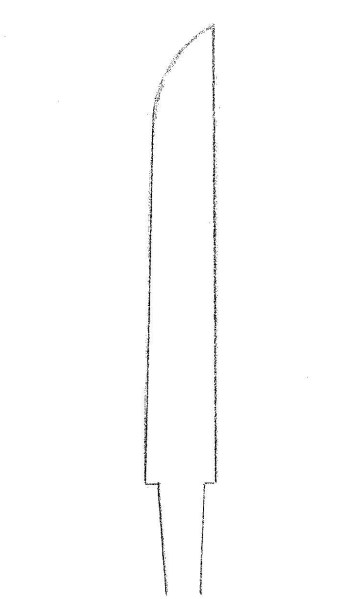
In Chapter 12, Middle Kamakura Period: Tanto, it is described that the tanto shape called takenoko-zori appeared during the middle Kamakura period.  This type of tanto  curves slightly inward at the tip.  The drawing below may be somewhat exaggerated to show the curve.  The actual curvature of the takenoko-zori is not very noticeable.  Perhaps only a few millimeters inward. 

Usually, the length of a tanto is around 12 inches.  Tantos are categorized as follows: if it is approximately ten inches, it is called a josun tanto (定寸短刀), longer than ten inches is called a sun-nobi tanto (寸延び短刀), and shorter than ten inches is called a sun-zumari tanto (寸詰短刀).

12Tanto drawing Mid Kamakur

Sun-nobi Tanto (寸延び)   >   Jyosun Tanto (定寸)   >  sun-zumari Tanto (寸詰り)  (longer than 10 inches)           (approx. 10 inches)                (less than 10 inches

13 «Part 2» Tanto photo

 46 Shintogo Kunimitsu Oshigata

Shintogo Kunimitsu (新藤五国光)  Sano Museum Catalogue, permission granted to use

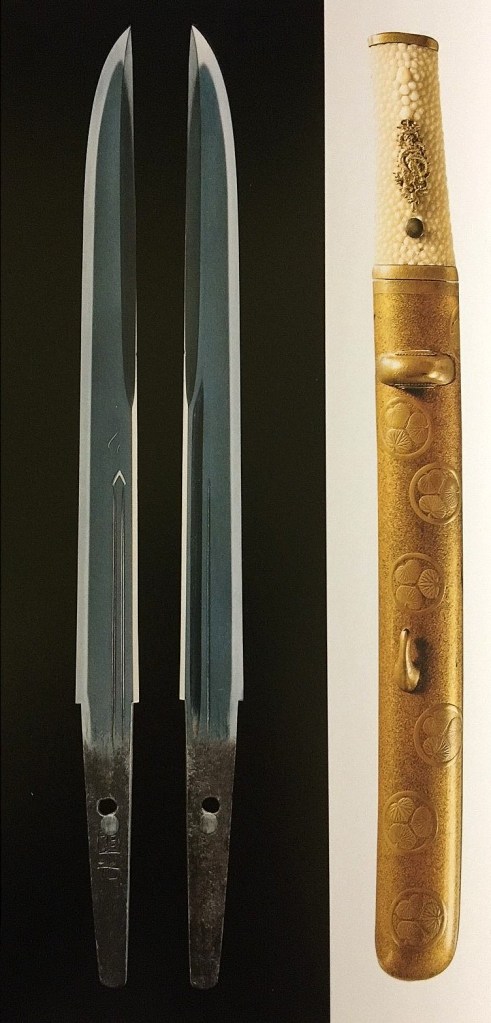
The style above is called kanmuri-otoshi (冠落); the mune side (opposite side of the  cutting edge) is shaved off.  The length is approx. 10 inches: woodgrain pattern surface  with nie on ji (refer to Chapter 3, Names of parts).   Very finely forgedThe hamon is a medium suguha (straight).  The boshi is ko-maru (small round).  Due to the kanmuri-otoshi style, it may not be easy to see the takenoko-zori; the mune side slightly bends inward.  Shintogo Kunimitsu is regarded as the top tanto maker.

13 «Part 2»Tanto photo with Saya

The above photo is also by Shintogo Kunimitsu (新藤五国光) with Saya.  Saya is the scabbard.  The handle of the scabbard (white part) is made of sharkskin.  Both photos are from the  Sano Museum Catalog “Reborn.”  Permission granted.