59| Part 2 of — 25 Edo Period History (江戸時代歴史)

Chapter 59 is a detailed section of Chapter 25 Edo Period History (江戸時代歴史).  Please read Chapter 25 before reading this part.

0-timeline - size 24 edo Period                            The red circle above indicates the time we discuss in this section

Battle of Sekigahara  (関ヶ原合戦)

Toyotomi Hideyoshi (豊臣秀吉), the most powerful figure during the Sengoku and Momoyama periods, died in 1598. His heir, Hideyori (秀頼), was only five years old. Before his death, Hideyoshi established a council system composed of the top five daimyo to oversee Hideyori’s affairs as regents until he reached adulthood.  

At Hideyoshi’s deathbed, all five Daimyo agreed to serve as guardians of Hideyori.  However, over time, Ishida Mitsunari (石田三成) and Tokugawa Ieyasu (徳川家康) began to disagree.  In 1600, finally, the two main Daimyo clashed, leading to the Battle of Sekigahara.  One side is called Seigun (the Western army), led by Ishida Mitsunari and the other is Togun (the Eastern army), led by Tokugawa Ieyasu.  All the daimyo across the country sided either with Tokugawa or with Ishida Mitsunari.  It is said that Mitsunari’s forces had 100,000 men, while Tokugawa’s forces had 70,000.      Ieyasu had fewer soldiers, but he ultimately won.  Ieyasu became the chief retainer of the Toyotomi clan, meaning he was virtually the top figure since Hideyori was still a child.   

In 1603, Ieyasu became a Shogun.  Now, Ieyasu took control of Japan, establishing the Tokugawa Bakufu (government) in Edo and eliminating the council system. 

Toyotomi Hideyori lived with his mother, Yodo-gimi (or Yodo-dono), at Osaka Castle, which Hideyoshi had built before his death.  Over time, tensions arose between Hideyori and Yodo-gimi in Osaka and Ieyasu in Edo.  Yodo-gimi was a proud and headstrong person, and she had good reasons for it.  She was the niece of Oda Nobunaga, the wife of Toyotomi Hideyoshi, and the mother of Hideyori, the head of the Toyotomi clan.  Later, her pride led her into trouble and contributed to the Toyotomi clan’s downfall. 

Siege of Osaka: Winter (1614) and Summer ( 1615) Campaigns

During the 15 years between the Battle of Sekigahara and the Siege of Osaka Castle, tensions between the Tokugawa Shogunate and the Toyotomi clan steadily increased.  Before the Battle of Sekigahara, the Toyotomi clan ruled Japan.  After Sekigahara, the Tokugawa bakufu took control of Japan.  The Toyotomi clan lost many key advisors and vassals in the battle.  As a result, Toyotomi’s power remained centered on Yodo-gimi.  By the time of the siege, Hideyori had grown into a fine young man, but Yodo-gimi had overly protected and controlled her son.  She wouldn’t even let Hideyori practice kendo (the traditional Japanese swordsmanship), claiming it was too dangerous. 

She persistently acted as if the Toyotomi clan still held the highest power.  Tokugawa Ieyasu tried to ease tensions by arranging for his granddaughter, Sen-hime, to marry Hideyori.  A few advisors suggested that Yodo-gimi should yield to Tokugawa, but she insisted that Tokugawa must subordinate himself to Toyotomi.   Rumors began circulating that the Toyotomi side was recruiting and gathering many ronin (unemployed samurai) within Osaka Castle.  Several key figures tried to mediate between the Toyotomi and Tokugawa clans but were unsuccessful.

Finally, Ieyasu led his army to Osaka, and in November 1614, he launched a campaign to siege Osaka Castle (the Winter Campaign)It is said that the Toyotomi side had 100,000 soldiers, though some were merely mercenariesHowever, Osaka Castle was built almost like a fortress, making it very difficult to attack.  The Tokugawa army attacked fiercely and fired cannons daily, but they realized the castle was so well built that it was a waste of time to keep trying. 

Eventually, both sides entered peace negotiations.  They agreed on several items in the treaty.  One of them was to fill the outer moat of Osaka Castle.  However, the Tokugawa side filled both the outer and inner moats.  That angered the Toyotomi side, and they became suspicious that the Tokugawa might not keep the agreement.   

Another agreement was the disarmament of the Toyotomi clan.  However, the Toyotomi side kept their soldiers inside the castle.  Tokugawa issued a final ultimatum to the Toyotomi side: remove all soldiers from the castle or vacate it.  Yodo-gimi refused both demands. 

After that, another siege started in the summer of 1615 (the Summer Campaign).  It is said that the Toyotomi had 70,000 men, whereas the Tokugawa had 150,000.  Both sides fought in several battles here and there, but the early battles did not go well for either side due to thick fog, delayed troop arrivals, and miscommunication. The final battle took place at Osaka Castle.  The Toyotomi decided to stay inside the castle, but soon, a fire broke out from within and burned the castle down.  Yodo-gimi and Hideyori hid inside a storage building, waiting for Ieyasu’s response to their pleas for mercy.  They hoped their daughter-in-law could negotiate the terms of the deal.  However, it was not accepted, and both died inside the storage building.

Nene and Yodo-gimi

Nene was the lawful wife of Toyotomi Hideyoshi.  She was a bright and wise person, despite not being of noble birth.  Everyone respected her, including Tokugawa Ieyasu.  Even Hideyoshi often valued her opinions on political matters.   She helped Hideyoshi rise through the ranks.  However, Nene was unable to have children.  Toyotomi Hideyoshi sought out other women everywhere, hoping to produce an heir, but none could have his child except Yodo-gimi.  Naturally, rumors circulated about who the real biological father was.  Speculation pointed to several men, one of whom was Ishida Mitsunari.   

62 Yodo Gimi

伝 淀殿画像(possibly of Yodo-dono, but not confirmed)Owned by the Nara Museum of Art, Public Domain:  Yodo-dono cropped.jpg from Wikimedia Commons, the free media repository.
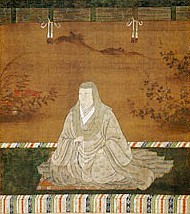
Nene (Kodai-in), the legitimate wife of Toyotomi Hideyoshi. Image in the public domain from Wikimedia, owned by Kodai-Ji
 

57| Part 2 of — 23 Sengoku Period Sword (戦国時代刀)

Chapter 57 is a detailed section of Chapter 23, Sengoku Period Sword.  Please read Chapter 23, Sengoku Period Sword, before reading this part.

0-timeline - size 24 Sengoku Period

                         The red circle above indicates the time we discuss in this section

During the Sengoku period (Warring States era), the Mino-den and Bizen Osafune groups were the leading sword makers.  For nearly 100 years during the Warring States period, all daimyo needed numerous swords.  Having suppliers nearby was more advantageous.  Many Sengoku daimyo (戦国大名: warlords) could easily access the Mino region because of its central location.  Since the Heian period, Mino swordsmiths have been producing swords there.  One of the well-known swordsmiths of Mino-den at the end of the Kamakura period was Shizu Kane’uji (志津兼氏).  He was one of the Masamune juttettu (正宗十哲)*.  However, the true peak of the Mino-den came during the Sengoku periodDuring the Sengoku period, the Shizu and Tegai groups from the Yamato region, and swordsmiths from the Yamashiro area, moved to Mino.  Mino became the busiest center for sword-making, producing practical swords for feudal lords.

60-mino-map.jpg

*Masamune Juttetsu (正宗十哲) ———-The original meaning of Masamune Juttetsu was the top 10 Masamune studentsHowever, the term was later used more broadly.  Masamune Juttetsu (正宗十哲):https://www.touken-world.jp/tips/7194/

Three examples of Sengoku period swords

The three swords listed below are examples of swords from the Sengoku period.  Note that each sword is unique.  Even when the same swordsmith forged swords, each one is different.  Please refer to Chapter 23, Sengoku Period Sword, for the key characteristics of swords made during the Sengoku period.

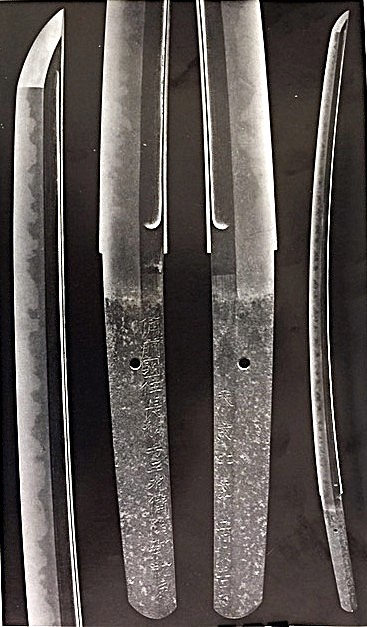
            Bizen Osafune Yosozaemon Sukesada (備前国住長船与三左衛門尉祐定) from Sano Museum Catalog (permission granted).
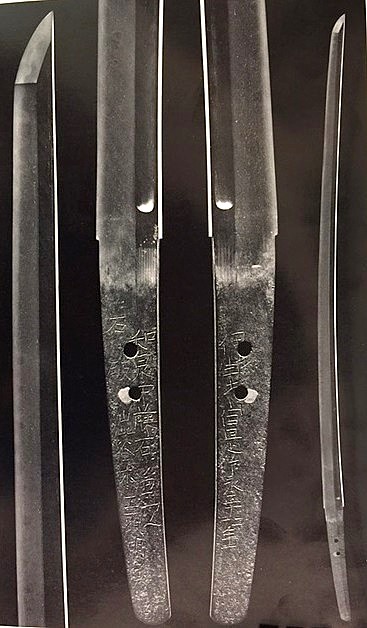
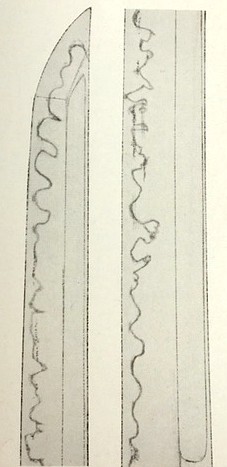
 Characteristis on the sword above

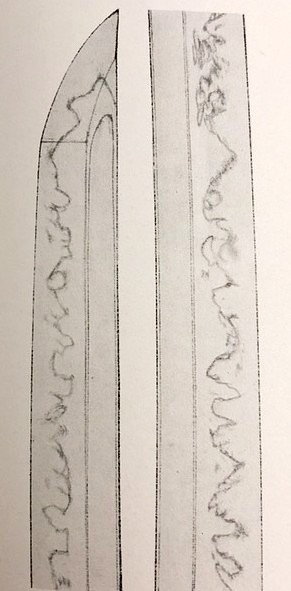
Hamon is Kani-no-tsume (crab-claw pattern; see the hamon above).  The Kani-no-tsume pattern hamon never appeared during the Heian, Kamakura, or Nanboku-cho periods.  This type of hamon is one of the key factors in determining whether a sword is from the  Sengoku Period.  Marudome-hi (the end of the groove is rounded) often appears on Bizen-den swords during the Sengoku period.  Wide tempered area.  The midare-komi boshi (where the hamon on the body and the boshi share the same pattern) has a long turn-back that stops abruptly.  The hamon has a nioi base, and most Bizen swords feature nioi, though a few exceptions exist.

60 kanesada illustration Izuminokami Fujiwara Kanesada (和泉守藤原兼) from Sano Museum Catalog

Characteristic  on the sword above

The last character of the kanji (Chinese characters) in the swordsmith’s name above is “.”  We use this uncommon character instead of the standard “定” for him.  Because there are two Kanesada.  To distinguish him from the other Kanesada (兼定), we use the character “ “and call him Nosada “のさだ.”

Izuminokami Fujiwara Kanesada (AKA Nosada) was the leading swordsmith of Mino-den during that time.  The sword’s shape is typical of the Sengoku period: shallow curvature, a chu-gissaki (medium-sized kissaki), and a pointed gunome hamon.  The hamon width can be wide and narrow.  Nosada and other Mino-den swordsmiths often exhibit wood-grain patterns with masame on the ji-hadaNioi base, mixed with coarse nie. 

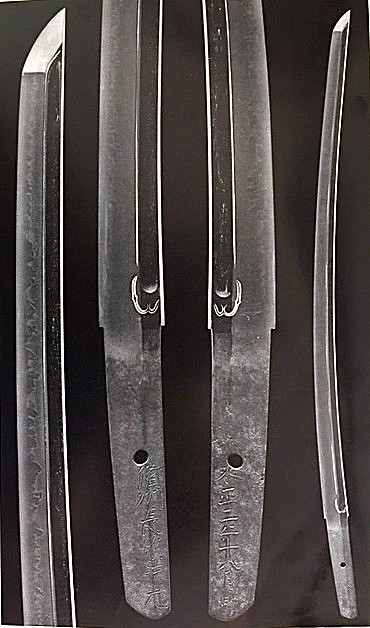
      Bizen Osafune Norimitsu (備前長船法光) from Sano Museum Catalog, permission granted.

Characteristic of the sword above

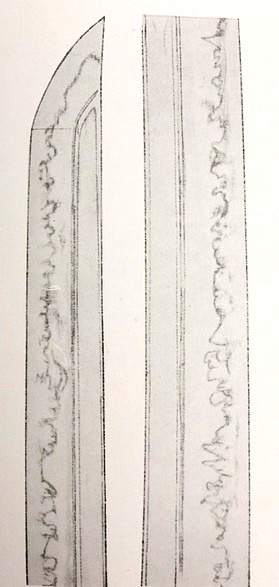
Shallow curvature.  Sturdy appearance.   Marudome-hi (the hi ends are rounded)The pointed hamon is called togari-ba (尖り刃).  Nioi base, mixed with nie.  Slight masame and wood grain patterns on Ji-hada.


54|Part 2 of — 20|Muromachi Period History (室町時代歴史)

This is a detailed section of Chapter 20, Muromachi Period History.  Please read Chapter 20 before reading this part.


0-timeline - size 24 Nuromach & Sengoku

                      The red circleabove indicate the time we discuss in this chapter

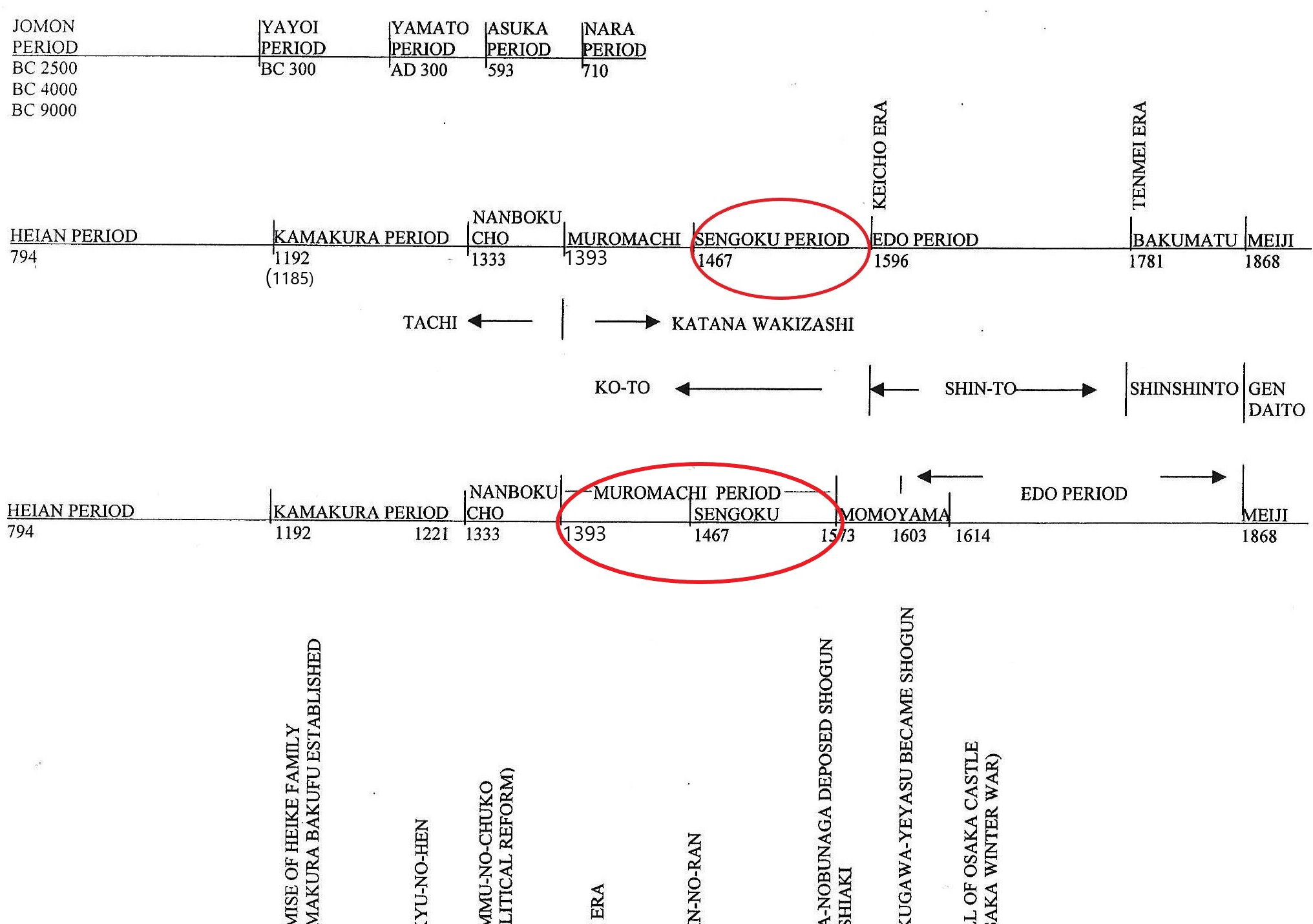
Until the Muromachi (室町) period, the study of political history and sword history ran in parallel.  The timelines above show that the middle line represents sword history, and the bottom line represents political history.  

The styles of swords were distinctly different between the Muromachi and Sengoku periods (戦国時代).  Therefore, for sword study, the Muromachi and Sengoku periods should be separated.   Japanese history textbooks define the Muromachi period as 1393 (the end of the Nanboku-cho) to 1573, when Oda Nobunaga (織田信長) deposed Shogun Ashikaga Yoshiaki (足利義昭) from Kyoto (the fall of the Muromachi bakufu).   In these textbooks, the Sengoku period is considered part of the Muromachi period.  However, we need to distinguish between the Muromachi and Sengoku periods for the study of swords.

 Ashikaga Yoshimitsu (足利義満)

The best period during the Muromachi era was when Shogun Ashikaga Yoshimitsu (足利義満: grandson of Ashikaga Takauji) was in power.  He moved the bakufu to Muromachi (室町) in Kyoto; therefore, this era is called the Muromachi period.  By the time most of the South Dynasty’s samurai had surrendered to the North Dynasty, the South Dynasty had accepted Shogun Yoshimitsu’s offer to stop fighting against the North.  This acceptance established the Ashikaga family’s power within the Muromachi Bakufu

Shogun Ashikaga Yoshimitsu generated tremendous profits from trade with China (Ming). He built a famous resort villa in Kyoto, the Golden Pavilion (Kinkaku-ji Temple 金閣寺*). It is believed that he created the Golden Pavilion to display his power and wealth. The beautiful culture known as Kitayama Bunka (Kitayama culture 北山文化) flourished during this period.

*Golden Pavilion (金閣寺: Kinkaku-ji Temple) —– Its official name is Rokuon-ji Temple (鹿苑寺).  Saionji Kintsune (西園寺公経) originally built it as his resort house during the Kamakura period.  Shogun Yoshimitsu acquired it in 1397 and turned it into his villa.  He also used it as an official guesthouse. 

After Shogun Yoshimitsu’s death, the villa was converted into Rokuon-ji Temple.  It is part of the Rinzaishu Sokoku-ji Temple, which served as the main temple of a Zen sect denomination, called the Rinzaishu Sokoku-ji group (臨済宗相国寺派).  Kinkaku-ji is a reliquary hall that contains relics of the Buddha.  Kinkaku-ji Temple represents the grand Kitayama Bunka (Kitayama culture).  In 1994, it was designated a UNESCO World Cultural Heritage Site. https://www.shokoku-ji.jp/kinkakuji/


57 Kinkakuji trip 2019                                                               My photo  May 2019,

Ashikaga Yoshimasa (足利義政)

After the death of Shogun Ashikaga Yoshimitsu (足利義満), the Muromachi bakufu became less financially stable, and its military power declined.  Consequently, the daimyo (feudal lords) increased their control.  A few generations after Shogun Yoshimitsu, Ashikaga Yoshimasa, the eighth Shogun, took power.  His wife was the well-known Hino Tomiko (see Hino Tomiko in Chapter 20, Muromachi Period History). 

It is said that Shogun Yoshimasa was not interested in his role as shogun; instead, he was more interested in art and culture.  He laid the foundation for today’s Japanese art and culture, including the Japanese garden, Shoin-zukuri (書院造) interior design, the tea ceremony, flower arrangements, painting, and other art forms.  His cultural influence is known as Higashiyama Bunka (Higashiyama culture (東山文化).  

As described in Chapter 20, Muromachi Period History (室町時代), Shogun Yoshimasa did not have any children.  His brother Yoshimi (義視) was expected to become the next Shogun. However, his wife, Hino Tomiko, gave birth to a son, Yoshihisa (義尚).  Hino Tomiko sought support from Yamana Sozen (山名宗全: a powerful family) to back her son.  Meanwhile, the brother, Yoshimi, was connected with Hosokawa Katsumoto (細川勝元: another powerful family).  The problem was that Shogun Yoshimasa paid too much attention to his cultural pursuits and failed to address the issue he created by not being clear about who should succeed him as Shogun.  He did not hand over the shogunate to either party. 

In 1467, in addition to the succession problem and conflicts of interest among powerful daimyo, a civil war, known as “Onin-no-run (応仁の乱),” broke out.  All daimyo were divided, siding with either the Hosokawa or the Yamana factions.   Eventually, the war spread throughout Japan and lasted more than 10 years.  Finally, in 1477, after the deaths of Hosokawa Katsumoto and Yamana Sozen, Shogun Yoshimasa decided to transfer the shogunate to his son Yoshihisa.  As a result of this war, Kyoto was devastated, and the power of the Muromachi Bakufu declined significantly. 

While all this was happening and people were suffering, Yoshimasa continued to spend money on building the Ginkaku-ji Temple (銀閣寺: The Silver Pavilion).  He died before seeing the completion of Ginkaku-ji Temple.  The Onin-no-ran would lead to the next Sengoku period, a 100-year-long Warring States period.

*Shoin-zukuri (書院造)———- A traditional Japanese residential interior style with Tatami mats, a nook, and shoji screens (sliding doors).  This style forms the basis for interior design in modern Japanese homes.

Shoin Zukuri style Japanese room

57 Shoin zukuri

Public Domain   GFDL,cc-by-sa-2.5,2.0,1.0 file: Takagike CC BY-SA 3.0view terms      File: Takagike Kashihara JPN 001.jpg

My japanese room                                                                      My Japanese room

26 |Over view of Shinto (新刀概要)

                                   
0-timeline - size 24 Shin-to
                           The circle indicates the subject discuss in this section 

The previous chapter 25 stated that the Edo period lasted from 1603 to 1868.  This is for political history.  The third timeline above shows that the Momoyama period overlaps with the Edo period.  Some people believe the Momoyama period was from 1573 to 1600. In general history, there are several opinions on how to divide these transitional periods.  For sword history, it is straightforward.  Swords made between approximately 1596 (慶長: Keicho era) and 1781 (天明: Tenmei era) are called shin-to.  Swords made between the Tenmei and Meiji eras are referred to as shin-to. 

After Toyotomi Hideyoshi nearly unified the country, the people could enjoy a period of peace.  This period of peace shifted the geographic distribution of swordsmiths. There were three main regions where sword forging took place.  These areas include Kyoto, Osaka, and Edo (Tokyo now).  The remaining swordsmiths gathered near the castles of major daimyo (大名: feudal lords).

Kyoto—- The Umetada Myoju (梅忠明寿) group thrived, followed by swordsmiths such as  Horikawa Kunihiro (堀川国広), Kunimichi (国路), Kunisada (国貞), and Kunisuke (国助).

Osaka——–Osaka was established as a commercial city and became the center of commerce.  It produced swords and distributed them to other regions across the country.  The well-known swordsmiths in Osaka: Tsuda Sukehiro (津田助広) and Inoue Shinkai (井上真改).

Edo————-Many swordsmiths gathered in Edo (江, now Tokyo), where Shogun Tokugawa Iyeyasu livedThe well-known swordsmiths in EdoNagasone Kotetsu (長曽祢虎徹), Yasutsugu (康継), Noda Hannkei (野田繁慶).

By the time Tokugawa Iyeyasu’s grandson, Tokugawa Iyemitsu, became shogun (寛永:Kan’ei era 1624 – 1643), swordsmiths had spread beyond the three areas mentioned above.  In each daimyo territory, swordsmiths operated shops near the castles to meet the needs of the daimyo and their subjects.  By the Genroku era (元禄: 1695), sword-making had declined, and people preferred more picturesque hamon designs, such as kikusui (菊水: flower design) and fujimi (富士見: Mount Fuji).

63 fuji sakura hamon
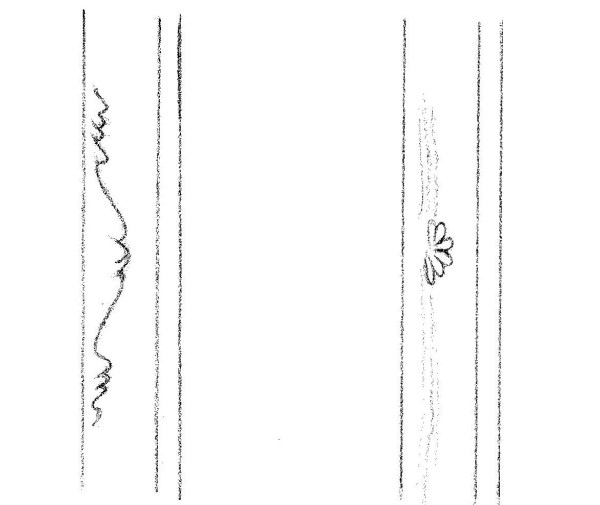
Fujimi                           Kikusui

Difference between Koto  and Shinto 

The following section describes the differences between Ko-to and Shin-to.   However, remember that there are always exceptions to these rules.

  1. The length of the shin-to katana is typically about two feet three inches ± a little.  The wakizashi is about one foot six inches.   Shallow curvature.  Wide width.  Thick body.   Gyo-no-mune.  Chu-gissaki with a slightly stretched appearance.

13 Mune drawing

  1. The ko-to sword feels light, while the shin-to feels heavy.
  2. The bottom of the hi is rounded above the machi. Shin-to’s bo-hi ends slightly below the yokote line.

27. Hisaki & marudome

  1. Generally, carvings are less common on shin-to. However, some swordsmiths are famous for their carvings.  The designs are refined and detailed.  Umetada Myoju (埋忠明寿) is well-known for his carvings.
  2. For shin-to, if it is mainly nie, it is usually a coarse nie.
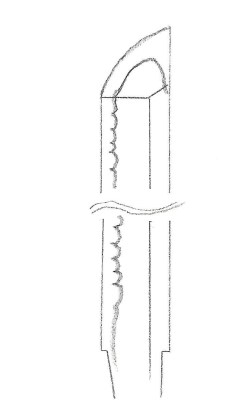
  3. In the machi area, the hamon begins with a straight tempered line (the bottom part of the blade shown in the illustration below), followed by midare, or various types of hamon in the middle, and ends with suguha (straight hamon) in the boshi area (the top part).  Generally, this is the standard Hamon style of shin-to, but there are always exceptions. 

27 Keshou Yasuri & suguha

  1. For shin-to, the type of iron used for the blade is consistent throughout Japan.  A few variations of iron were used across Japan, with a very hard, dark color and a glossy look.
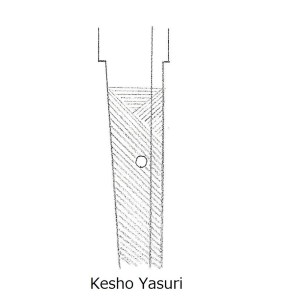
  2. The nakago has a well-balanced shape.  The bottom of the nakagotapers gradually.  The type of yasuri-me (file mark) is often a kesho-yasuri. Engraved inscriptions display the swordsmith’s name, location, province, and year of creation.

27 Keshou Yasuri & suguha

22| Sengoku Period History (戦国時代歴史)

0-timeline - size 24 Sengoku Period 0

The red circle above indicates the time we discuss in this section

The timeline above shows two circles.  In political history, the Sengoku period (戦国時代) is part of the Muromachi period (室町), which is the lower circle.   However, in sword history, we separate the Muromachi and Sengoku periods (Warring States period), the top circle.  In sword history, we divide the time this way because, during those two periods, sword styles changed, and the environment of sword-making also changed.

After the Onin-no-ran (応仁の乱) began (discussed in 20|Muromachi Period History), the beautiful capital city of Kyoto (京都) was in a devastated condition.  The shogun’s (将軍) power reached only over a small area.  The rest of the country was divided into about thirty small independent states.  The leaders of these independent states were called shugo daimyo (守護大名).  They were originally government officials who were appointed and sent there by the central government.

Powerful local samurai often became the leaders of these states.  They fought against each other to take over each other’s land.  During the Sengoku period, vassals would kill their lords and steal their domains, or farmers would revolt against their lords.  A state like this is called “gekoku-jo” (lower-class samurai overthrow the superior). 

This was the time of the Warring States, known as the Sengoku period.  The leader of each state was called a Sengoku daimyo (戦国大名: Warlord).  The Sengoku period lasted about 100 years.  Gradually, powerful states defeated weaker ones through long, fierce battles, expanding their territory.  Around thirty small countries became twenty, then ten, and so on.  Eventually, only a few dominant sengoku daimyo (warlords) remained.  Each daimyo from those states fought their way to Kyoto and tried to become the top ruler of Japan.  The first one who almost succeeded was Oda Nobunaga (織田信長).  However, he was killed by his vassal, Akechi Mitsuhide (明智光秀), and soon Akechi was killed by his colleague, Toyotomi Hideyoshi (豊臣秀吉).  

After Toyotomi Hideyoshi defeated Akechi Mitsuhide, his troops, and other major warlords, he nearly completed the unification of Japan.  Yet, Hideyoshi still had one more rival to deal with to finish his goal.  That was Tokugawa Iyeyasu (徳川家康).  Now, Toyotomi Hideyoshi and Tokugawa Ieyasu are the last contenders for the top position.  Both recognized that their opponents were smart and capable.  Any wrong move could be disastrous.  Therefore, they decided to maintain a friendly coexistence on the surface for the time being.  Although Toyotomi Hideyoshi tried to make Tokugawa Ieyasu his vassal, Tokugawa Ieyasu somehow managed to avoid that.  In Tokugawa Ieyasu’s mind, being younger than Toyotomi Hideyoshi, he knew he could simply wait until Hideyoshi‘s natural death, which eventually happened. 

After Hideyoshi’s death, Tokugawa Ieyasu fought Hideyoshi’s vassals and won at the Battle of Sekigahara (関ヶ原の戦い) in 1600.  Then, in 1615, at the Battle of the Osaka Natsu-no-jin (Osaka Summer Campaign: 大阪夏の陣), Tokugawa defeated Hideyoshi’s son’s army.  Following this, the Toyotomi clan was dissolved entirely, and the Edo (江戸) period began.  It is called the Edo period because Tokugawa Ieyasu lived in Edo, which is now Tokyo (東京).

*The Sengoku period is frequently depicted in TV dramas and movies.  People who lived through that era had a tough time, but it was also the most exciting time for creating TV shows and films.  The lives of Oda Nobunaga, Toyotomi Hideyoshi, and Tokugawa Ieyasu are among the most popular stories in Japan.  In particular, the story of Toyotomi Hideyoshi is among the most popular.  His background was that of a poor farmer, but he rose to become the top ruler of Japan.  That is a fascinating success story.


23 Toyotomi_hideyoshi

Portrait of Toyotomi Hideyoshi (豊臣秀吉) by Kano Mitsunobu, owned by Kodai-Ji Temple      From Wikimedia Commons, the free media repositon.