61|Part 2 of — 27 Shin-to Main 7 Regions (part A)

Chapter 61 is a detailed part of Chapter 27, Shinto Main 7 Regions (part A).  Please read Chapter 27 before reading this section. 

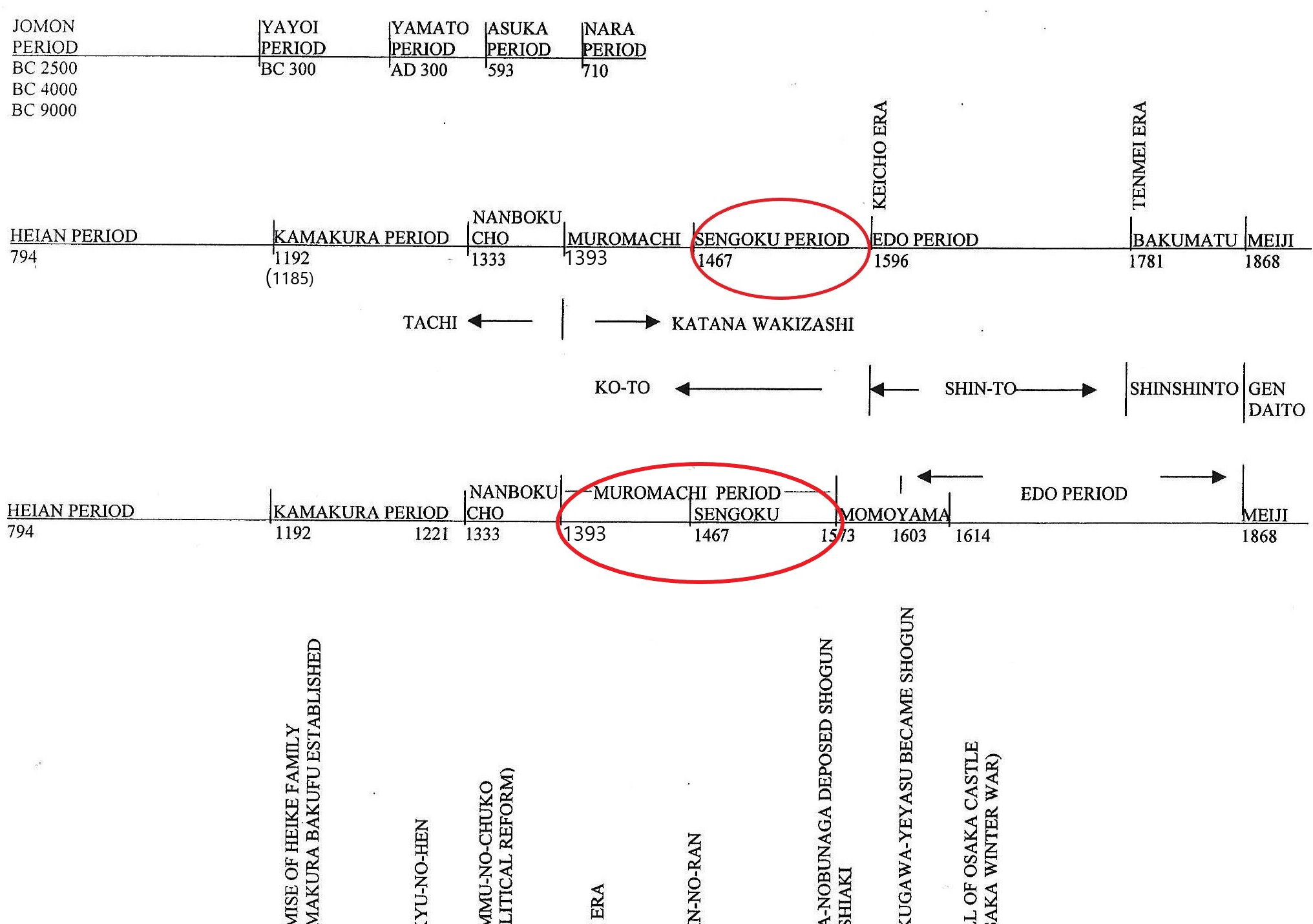
0-timeline - size 24 Shin-to                        The red circle above indicates the time we discuss in this section

Chapter 27, Shin-to Main 7 Regions (Part A), and Chapter 28, Shin-to Main 7 Regions (Part B), describe an overview of the seven main regions.  This chapter and the next chapter show photos of representative swords from these regions.  They are Yamashiro (山城, in Kyoto), Settsu (摂津, today’s Osaka), Musashi (武蔵, Edo), and Satsuma (薩摩, Kyushu).  However, Echizen (越前), Kaga (加賀), and Hizen (肥前) are omitted.
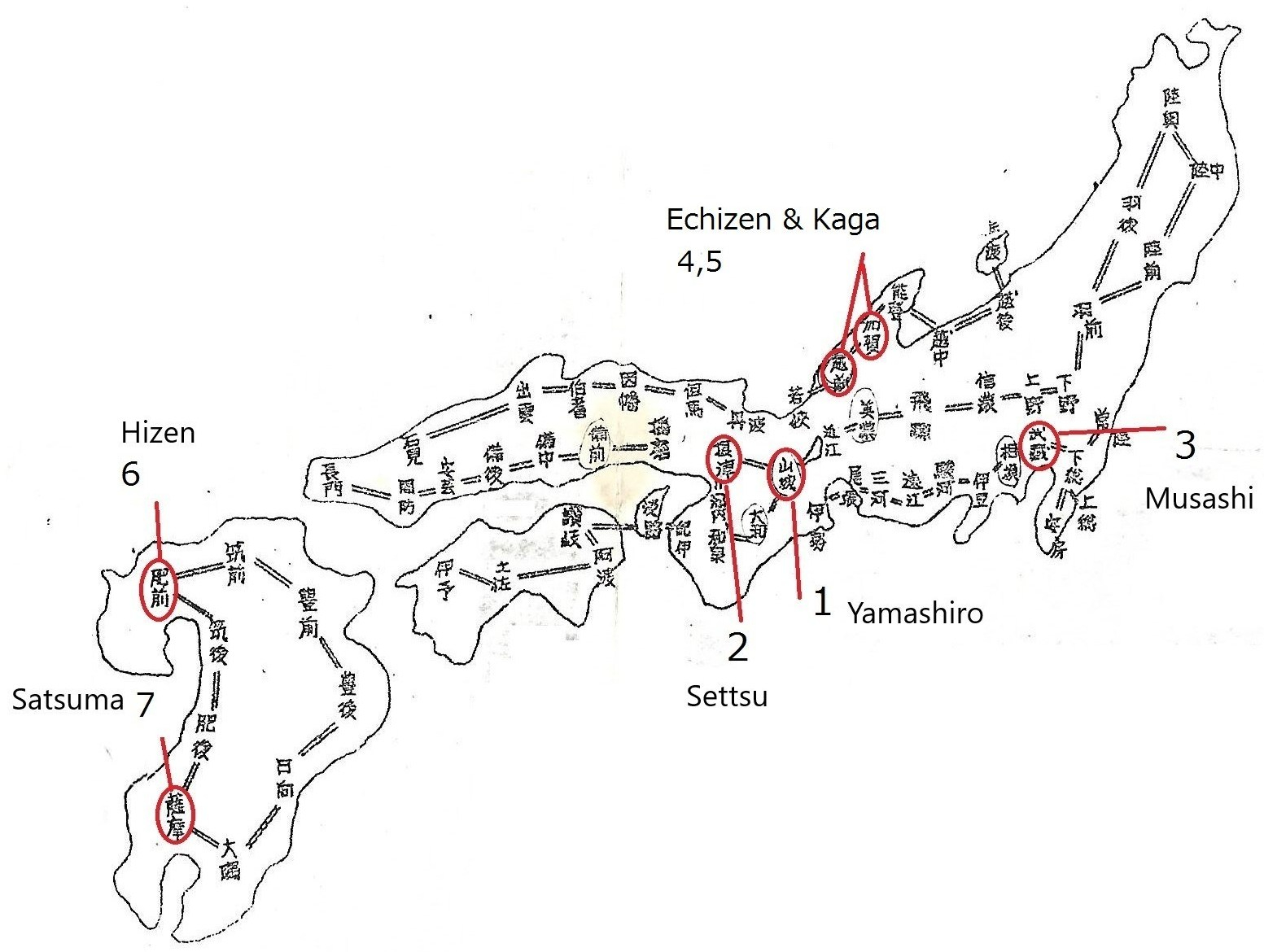
29 Map with number 7

With ko-to swords, features such as the condition of the hamon, kissaki size, length, and  shape of the nakago, etc., indicate when the sword was made.  During the ko-to period, Bizen swordsmiths produced Bizen-den swords, Yamashiro swordsmiths made Yamashiro-den swords, and Mino swordsmiths made Mino-den swords.  However, during the shin-to period, that is not the case.  The den and the swordsmith’s location often do not match.  For shin-to swords, we study the swordsmiths and swords from the seven main regions along with their characteristics.

Regarding swords made during the ko-to period, if a sword has a wide hamon line with  nie, usually, its ji-hada shows a large wood grain or a large burl grain.  Also, when you see a narrow hamon line, it typically features a fine ji-hada.

However, with shin-to swords, if a sword shows a wide hamon with nie, it often has a small wood grain or small burl grain pattern on ji-hada.  If it has a narrow hamon line, it may have a large wood grain pattern on the ji-hada.  This is a shin-to characteristic.   

Here is an exception: some early Soshu-den swords from the late Kamakura period may show a wide hamon with nie, which has small burls on the ji-hada.  Because of that, whether it is ko-to or shin-to can be confusing.  Even so, other features such as ji-hada or other parts should indicate whether it is shin-to or ko-to.

Yamashiro (山城: Kyoto)
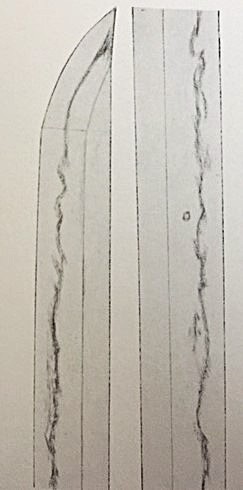
 Horikawa Kunihiro   (堀川国広)   From Sano Museum Catalogue (permission granted)

Horikawa Kunihiro (堀川国広)

Horikawa Kunihiro was regarded as a master swordsmith among shin-to swordsmiths.  He forged swords in many styles with various characteristics.  The hamon types are o-notare, o-gunome, togari-ba (pointed hamon), chu-suguha with hotsure (frayed look), hiro-suguha with a sunagashi effect, inazuma, and kinsujiKunihiro preferred to shape his swords to resemble an o-suriage (shortened Nanboku-cho style long sword).  Kunihiro‘s blades give a powerful impression.  Kunihiro‘s swords often feature beautiful carvings; designs include dragons, Sanskrit letters, and more.  Because he created swords in many different styles, there is no general characteristic that defines his work other than the hamon mainly being nie.  His ji-hada is finely forged.                                                                                                                                                                                                                                                                                                                                                     
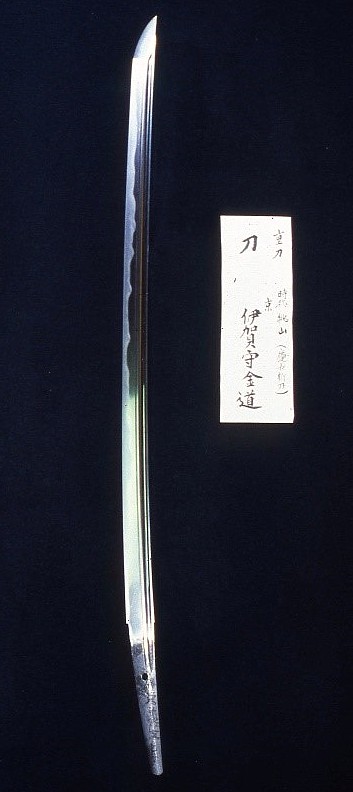
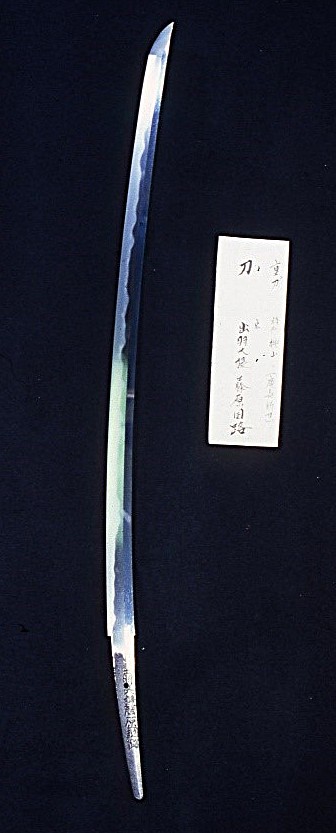
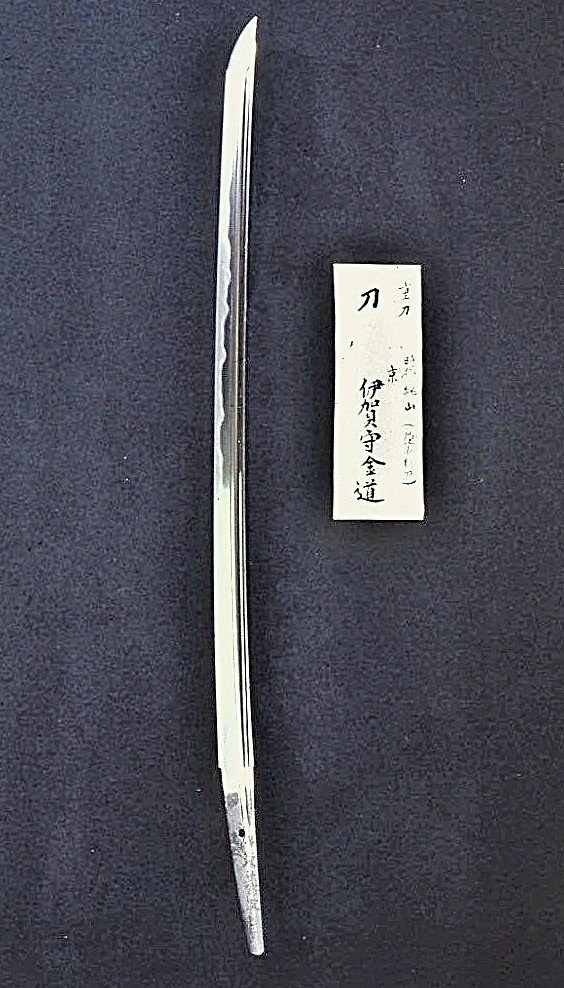
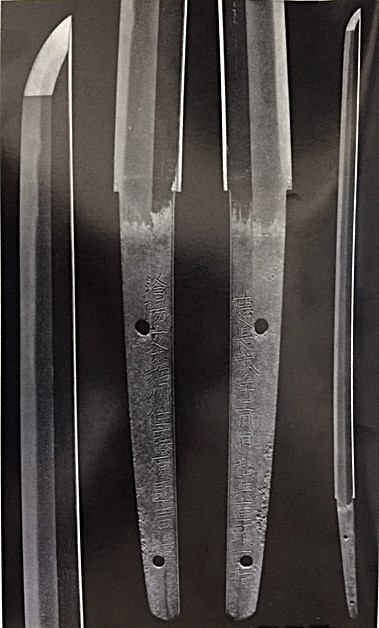
img067.jpg  img068.jpg      Iga-no-Kami Kinnmichi (伊賀守金道)           Dewa Daijyo Kunimichi (出羽大掾国路)        Both Juyo Token (重要刀剣), once my family owned, photos were taken by my father.

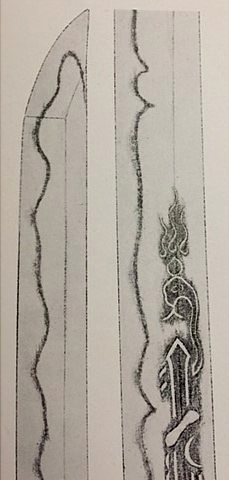
Iga-no-Kami Kinmichi ( 伊賀守金道)

The Kinmichi family is called the Mishina group.  Refer to 27 Shinto Main 7 Regions  Part A.   Iga-no-Kami Kinmichi was awarded the Japanese Imperial chrysanthemum crest. 

The characteristics of Kinmichi ——– Wide sword, shallow curvature, an extended kissaki, sakizori (curvature at 1/3 top),  a wide tempered line, kyo-yakidashi (see 27 Shinto Main 7 Regions  A ), hiro-suguha (wide straight hamon), o-notare (large wavy), yahazu-midare, hako-midare (refer to 24 Sengoku Period Tanto).  Mishina-boshi, refer to 27 Shin-to Main 7 Regions A.  Fine wood burl, masame appear in the shinogi-ji area.   

Dewa Daijo Kunimichi (出羽大掾国路)                                                                                 

Dewa Daijo Kunimichi was the top student of Horikawa Kunihiro.  The right photo above.  Like Kunihiro, the sword resembles a shortened Nanboku-cho sword.  Shallow curvature, a wide body, a somewhat elongated kissaki, and fukura-kareru (less arch in fukura).  Wide tempered lines, large gunome, nie with sunagashi, or inazuma shows.  Double gunome (two gunome side by side) appears.  Fine ji-hada.                                                                                                                                                                                                                

  1. Settu (摂津) Osaka (大阪 )

Settu (Osaka) is home to many famous swordsmiths.  They are Kawachi-no-Kami Kunisuke (河内守国助), Tsuda Echizen-no-Kami Sukehiro (津田越前守助広), Inoue Shinkai (井上真改), and Ikkanshi Tadatsuna (一竿子忠綱), among others.                          The main characteristic of the Settsu (Osaka) sword ——– The surface is beautiful and fine, almost like a solid surface with no pattern or design.  The two photos below are of the Settsu sword.
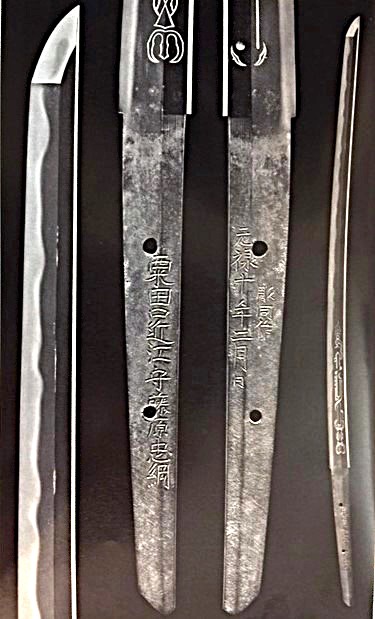
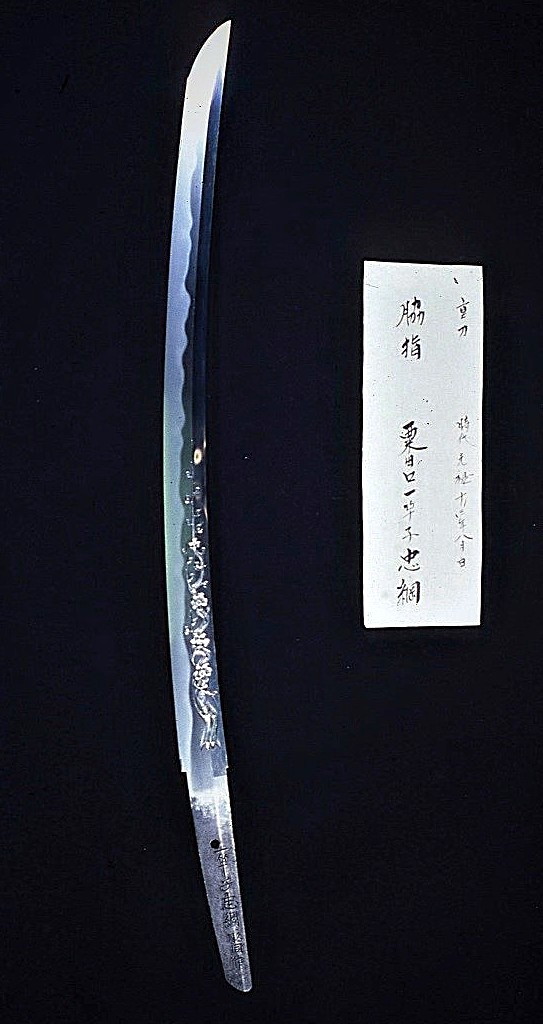
              Ikkanshi Tadatsuna from the Sano Museum Catalogue.  Permission granted to use.

Ikkanshi Tadatsuna (一竿子忠綱)

Ikkanshi Tadatsuna was famous for his carvings.  His father was also a well-known swordsmith, Omi-no-Kami Tadatsuna (近江守忠綱)Consequently, he was known as Awataguchi Omi-no-Kami Fujiwara Tadatsuna (粟田口近江守藤原忠綱), as shown in the nakago photo above.     

The characteristics of Ikkanshi Tadatsuna ——-A longer kissaki and a wide-tempered line with nie.  The Osaka yakidashi (transition between the suguha above machi and midare is smooth.  Refer to 27 Shin-to Sword – Main 7 Regions (Part A) for details on Osaka yakidashi.  O-notare with gunome, komaru-boshi with a turn back, and very fine ji-hada with almost no pattern on the surface.
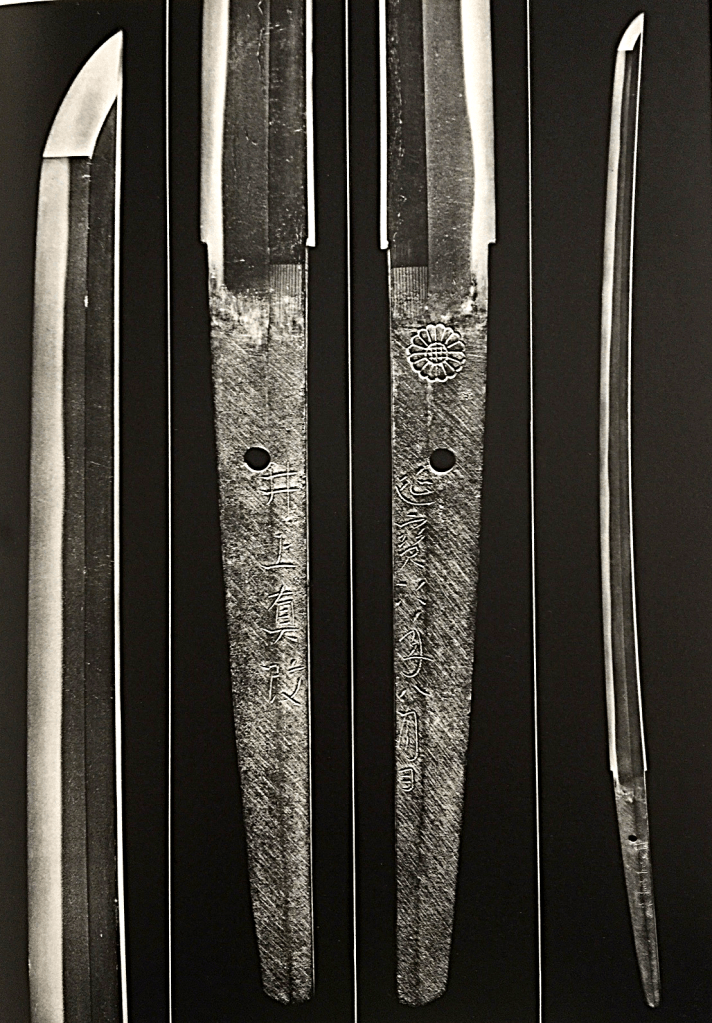
                        Inoue Shinkai (井上真改) from “Nippon-to Art Swords of Japan” The Walter A. Compton Collection

Inoue Shinkai (井上真改)

Inoue Shinkai was the second generation of Izumi-no-Kami Kunisada (和泉守国貞), who was a student of Kunihiro.                                                                                                  The characteristic of Inoue Shinkai’s swords —————- Osaka yakidashi, the tempered line gradually widens toward the top.  O-notare and deep nie.  Very fine ji-hada with almost no surface design.
27|Shinto Sword — Main Seven Regions (Part A :主要7刀匠地)

0-timeline - size 24 Shin-to

                            The red circle indicates the subject we discuss in this section

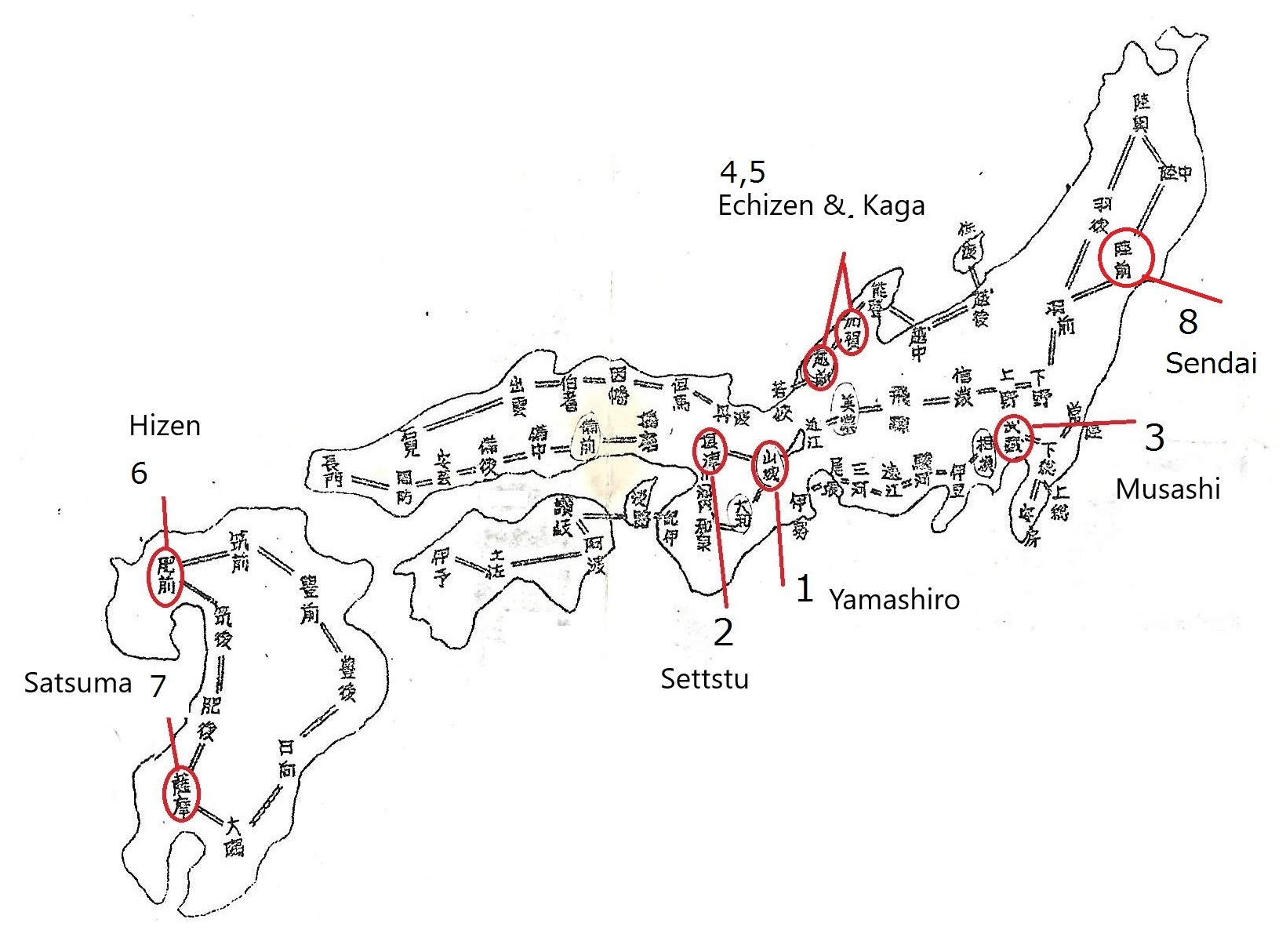
During the Shinto era, there were seven main prosperous regions where many swordsmiths gathered and actively forged swords.  These are Yamashiro (山城) in Kyoto, Settsu (摂津) in Osaka, Musashi (武蔵 ) in Edo, Hizen (肥前) in Saga, Satsuma (薩摩) in Kagoshima, Echizen (越前) in Fukui,  and Kaga (加賀) in Kanazawa.  Swordsmiths from each area shared common regional characteristics of their places.  Knowing each of these characteristics is the easiest way to understand Shin-to.  However, it is important to remember that each swordsmith within a group had their own unique way of sword-making.  The following are only general descriptions of these characteristics.

Below is a map of Japan.  Hokkaido is not shown on the map because swords were not made there during that time.

64Map with number with 8

1.  Yamashiro (山城) Kyoto

The Yamashiro shin-to sword has a solid and strong look.  The hamon near the lower part of the blade, just above the machi (区) area, shows suguha (straight hamon).  This is called kyo-yakidashi (京焼出し, meaning it starts with a straight hamon.  Then, it shows a sudden shift to a design of o-midare (大乱).  The o-midare (large irregular waviness) becomes less wavy about one or two inches below the yokote line, then continues into the boshi as a wavy hamon.  The design in the boshi is komaru-boshi.   See the illustration below. 

Ji-hada ———— Somewhat rough, (depending on the swordsmith).  Masame-hada (straight grain pattern) may show on shinogi-ji (between the ridgeline and back). 

Among the Yamashiro shin-to group, there was a group called the Mishina group (三品).  They were related to Mino-den (美濃).  Therefore, their boshi was often jizo-boshi (地蔵鋩子).  This is called Mishina-boshi (三品鋩子).  Jizo-boshi is an image of a man’s head.

The Well-known swordsmiths in Yamashiro area: Umetada Myoju (梅忠明寿)                                                                                                   Horikawa Kunihiro (堀川国広)                                                                                               Dewadaijyo Kunimichi (出羽大掾国路)

28 Mishina-Boshi Komaru-boshi, Kyo-Yakidashi

                                                        Iganokami Kinnmichi (伊賀守金道) Yamashiro Den, once my family sword

2.Settu (摂津) Osaka (大阪)

Settsu (Osaka) produced more wakizashi than katana.  They tend to make it slightly sakizori (the top half curving outward) with a slightly stretched boshi. A Settsu sword also shows yakidashi, similar to the previous Yamashiro sword.  However, unlike Yamashiro’s sword, the transition is not abrupt but relatively smooth, where suguha changes into notare (wavy pattern).  This is called Osaka Yakidashi.

Osaka Boshi ——-Hamon continues up to the yokote line, then komaru with a turn back.   Ji-hada————-Very fine,  almost no pattern, a solid surface like, especially, shinogi-ji (between the ridgeline and the back).  This is called Osaka-tetsu (iron).

29 Osaka Yakidashi Komaru Boshi

Well-known swordsmiths in Settsu area— Osaka Tsuda Sukehiro (大阪津田助広)                                                                                 Tsuda Sukenao (津田助直)                                                                                                   Ikkanshi Tadatsuna (一竿子 忠綱)

                                                                 Ikkanshi Tadatsuna (一竿子忠綱), once my family sword 

22| Sengoku Period History (戦国時代歴史)

0-timeline - size 24 Sengoku Period 0

The red circle above indicates the time we discuss in this section

The timeline above shows two circles.  In political history, the Sengoku period (戦国時代) is part of the Muromachi period (室町), which is the lower circle.   However, in sword history, we separate the Muromachi and Sengoku periods (Warring States period), the top circle.  In sword history, we divide the time this way because, during those two periods, sword styles changed, and the environment of sword-making also changed.

After the Onin-no-ran (応仁の乱) began (discussed in 20|Muromachi Period History), the beautiful capital city of Kyoto (京都) was in a devastated condition.  The shogun’s (将軍) power reached only over a small area.  The rest of the country was divided into about thirty small independent states.  The leaders of these independent states were called shugo daimyo (守護大名).  They were originally government officials who were appointed and sent there by the central government.

Powerful local samurai often became the leaders of these states.  They fought against each other to take over each other’s land.  During the Sengoku period, vassals would kill their lords and steal their domains, or farmers would revolt against their lords.  A state like this is called “gekoku-jo” (lower-class samurai overthrow the superior). 

This was the time of the Warring States, known as the Sengoku period.  The leader of each state was called a Sengoku daimyo (戦国大名: Warlord).  The Sengoku period lasted about 100 years.  Gradually, powerful states defeated weaker ones through long, fierce battles, expanding their territory.  Around thirty small countries became twenty, then ten, and so on.  Eventually, only a few dominant sengoku daimyo (warlords) remained.  Each daimyo from those states fought their way to Kyoto and tried to become the top ruler of Japan.  The first one who almost succeeded was Oda Nobunaga (織田信長).  However, he was killed by his vassal, Akechi Mitsuhide (明智光秀), and soon Akechi was killed by his colleague, Toyotomi Hideyoshi (豊臣秀吉).  

After Toyotomi Hideyoshi defeated Akechi Mitsuhide, his troops, and other major warlords, he nearly completed the unification of Japan.  Yet, Hideyoshi still had one more rival to deal with to finish his goal.  That was Tokugawa Iyeyasu (徳川家康).  Now, Toyotomi Hideyoshi and Tokugawa Ieyasu are the last contenders for the top position.  Both recognized that their opponents were smart and capable.  Any wrong move could be disastrous.  Therefore, they decided to maintain a friendly coexistence on the surface for the time being.  Although Toyotomi Hideyoshi tried to make Tokugawa Ieyasu his vassal, Tokugawa Ieyasu somehow managed to avoid that.  In Tokugawa Ieyasu’s mind, being younger than Toyotomi Hideyoshi, he knew he could simply wait until Hideyoshi‘s natural death, which eventually happened. 

After Hideyoshi’s death, Tokugawa Ieyasu fought Hideyoshi’s vassals and won at the Battle of Sekigahara (関ヶ原の戦い) in 1600.  Then, in 1615, at the Battle of the Osaka Natsu-no-jin (Osaka Summer Campaign: 大阪夏の陣), Tokugawa defeated Hideyoshi’s son’s army.  Following this, the Toyotomi clan was dissolved entirely, and the Edo (江戸) period began.  It is called the Edo period because Tokugawa Ieyasu lived in Edo, which is now Tokyo (東京).

*The Sengoku period is frequently depicted in TV dramas and movies.  People who lived through that era had a tough time, but it was also the most exciting time for creating TV shows and films.  The lives of Oda Nobunaga, Toyotomi Hideyoshi, and Tokugawa Ieyasu are among the most popular stories in Japan.  In particular, the story of Toyotomi Hideyoshi is among the most popular.  His background was that of a poor farmer, but he rose to become the top ruler of Japan.  That is a fascinating success story.


23 Toyotomi_hideyoshi

Portrait of Toyotomi Hideyoshi (豊臣秀吉) by Kano Mitsunobu, owned by Kodai-Ji Temple      From Wikimedia Commons, the free media repositon.