45|Part 2 of –11 Ikubi Kissaki (continued from Chapter 44)

This chapter is a detailed section of Chapter 11, Ikubi-kissaki, and continues from Chapter 44|Part 2 of 11 Ikubi-kissaki Sword.  Please read Chapter 11 and Chapter 44 before proceeding with this section.

0-timeline - size 24 Middle Kamakura

 The red circle above indicates the time we discuss in this section.

Bizen Saburo Kunimune (備前三郎国宗)

Another swordsmith worth mentioning in this section is Bizen Saburo Kunimune (備前三郎国宗).  During the middle Kamakura period, the Hojo clan invited top swordsmiths to Kamakura.  Awataguchi Kunitsuna (粟田口国綱) from Yamashiro in Kyoto, Fukuoka Ichimonji Sukezane (福岡一文字助真) from the Bizen area, and Bizen Kunimune (備前国宗) from the Bizen area moved to Kamakura with their circle of people.  These three groups started the Soshu-den (相州伝).  Refer to Chapter 14, Late Kamakura Period Swords.

  • Sugata (shape)  ——————— Ikubi-kissaki style.  Sometimes Chu-gissaki.  Thick body.  Koshi-zori. Narrow Shinogi width.                                                                                                
  • Horimono (Engravings)  —————- Often narrow Bo-hi (single groove)
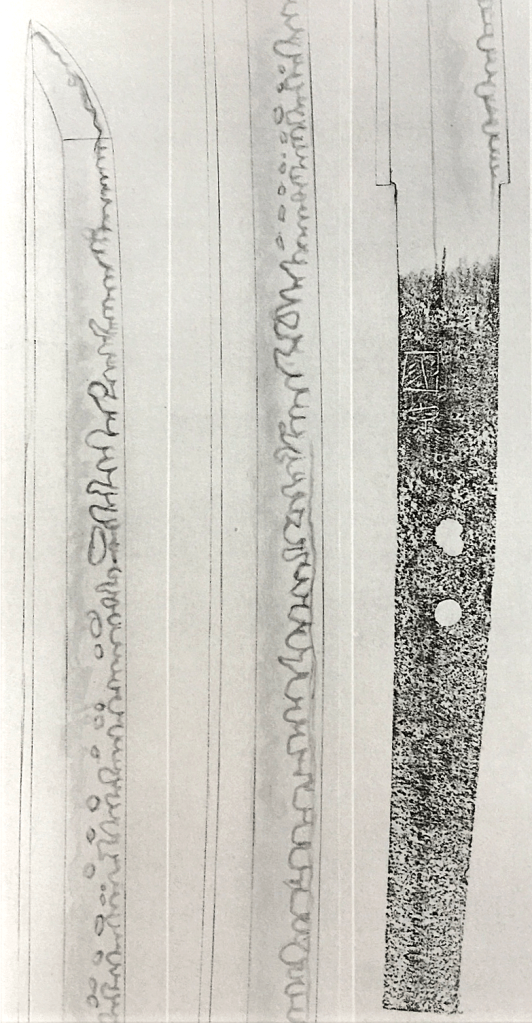
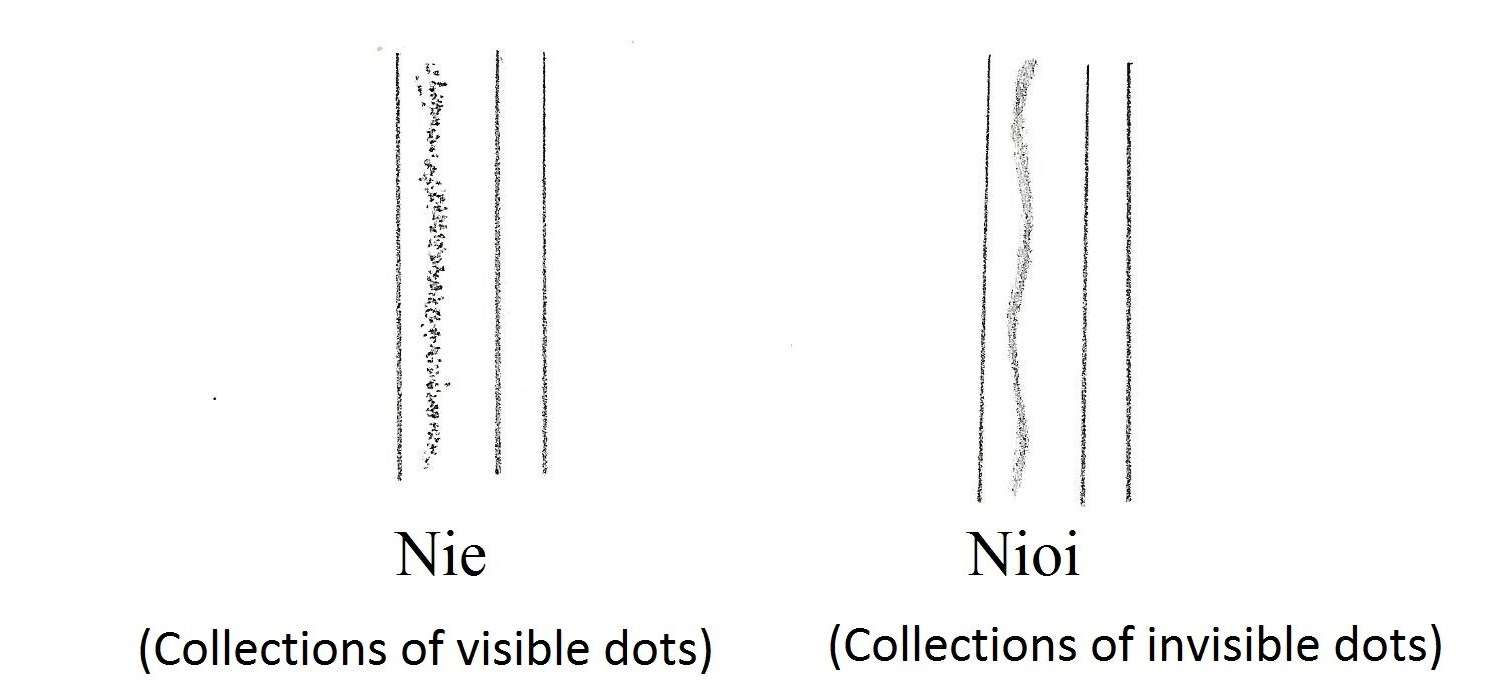
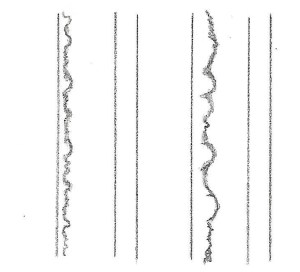
  • Hamon (Tempered line) ————- O-choji Midare (irregular large clove shape) with Ashi.  Or Ko-choji Midare (irregular small clove shape) with AshiNioi base with Ji-nie (Nie in the Hada area).  Some Hamon appear squarish with less Kubire (less narrow at the bottom of the clove).   Hajimi (刃染み rough surface) may show.  The Kunimune swords often show a lower part with Choji and an upper part with less activity without Ashi                                                                                                                                                                                                                        

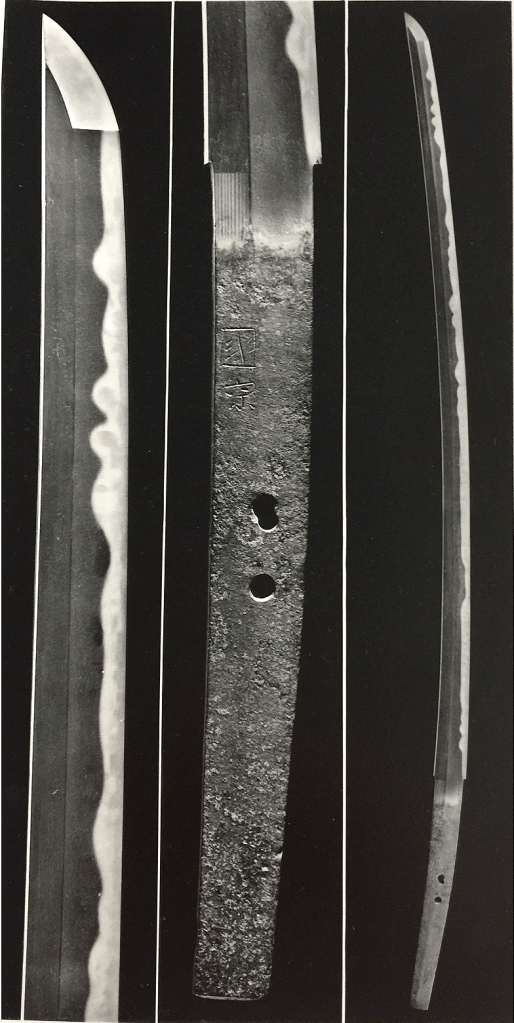
Kunimune Compton 1 Kunimune Compton 2Bizen Saburo Kunimune (備前三郎国宗)   Photo from “Nippon-to Art Sword of Japan, ” The Walter A. Compton Collection.   National Treasure

  • Boshi  ———————— Small irregular.  Yakizume or short turn back.
  • Ji-hada —————-Wood-grain pattern.  Fine Ji-hada with some Ji-nie (Nie inside Ji-hada).  Midare-utsuri (irregular shadow) is visible.  A few Hajimi (rough surface).
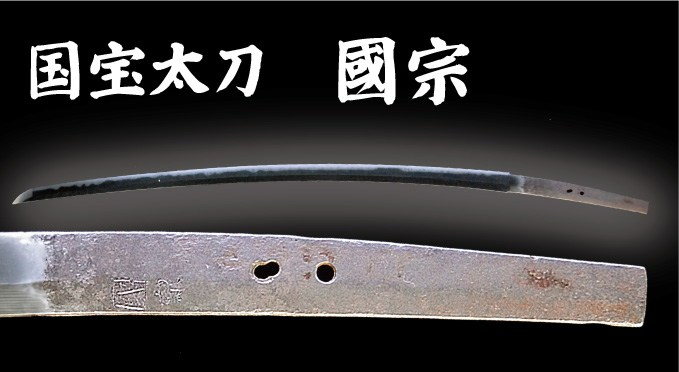
12 (second part 2) 照国神社The above photo is from the official website of the Terukuni Jinja Shrine in Kyushu.    http://terukunijinja.pkit.com/page222400.html

This is the national treasure, Kunimune, preserved at the Terukuni Jinja Shrine in Kagoshima Prefecture.  See the photos on the previous page.  This Kunimune sword was lost after WWII.  Dr. Compton, chairman of the board at Miles Laboratories in Elkhart, Indiana, found it in an antique shop in Atlanta.  I mentioned Dr. Compton in Chapter 32, Japanese Swords, after World War II.  When he saw this sword, he realized it was not just an ordinary sword.  He bought it and inquired at the Nihon Bijutsu Token Hozon Kyokai (The Japanese Sword Museum) in Tokyo.  It turned out to be the famous missing national treasure, Kunimune, from the Terukuni Jinja shrineHe returned the sword to the shrine without compensation in 1963. 

My father became close friends with him around this time through Dr. Homma and Dr. Sato, both leading sword experts.  Later, Dr. Compton asked Dr. Honma and my father to examine his collection of swords at his house, where he had many, as well as those at the Metropolitan Museum of Art in New York, the Philadelphia Museum of Art, and the Museum of Fine Arts in Boston.  My father wrote about this trip and the swords he examined in those museums and published a book in 1965 titled “Katana Angya (刀行脚).” 

For Dr. Compton and my father, those days must have been the best times of their lives.  Their business was doing well, and they could spend a lot of time on their interests and enjoy themselves.  It was also the best time for me.  One time, when I visited Compton’s house, he spent hours showing me his swords in the basement for hours, nearly all day.  His house was large, and the basement, which he had built as his study, had a fire prevention system. The lighting system was perfect for viewing swords and other art objects. 

His wife, Phoebe, told him he shouldn’t keep a young girl (I was a college student at the time) in the basement all day.  He agreed and took me to his cornfield to pick some corn for dinner.  From a basement to a cornfield, not much of an improvement?  So, Phoebe decided to take me shopping and have lunch in Chicago.  Good idea,  but it was too far.  Compton’s house was in Elkhart, Indiana.  The distance between Elkhart and Chicago was about 2.5 hours by car. It was too far just for shopping and lunch.  To my surprise, the company’s employee flew us to the rooftop of a department store, we did some shopping, had lunch, and then flew back.

Miles Laboratories and a well-known Japanese large pharmaceutical company had a business partnership at that time.  Dr. Compton frequently traveled to Japan for business purposes.  However, whenever he visited Japan, he spent days with sword people, including my father, and I usually followed him.  One of the female workers’ jobs at this pharmaceutical company was to translate the sword book into English. 

My parents’ house was filled with Miles’ products.  Miles Laboratories had a large research facility in Elkhart, Indiana.  I visited there several times.  One day, I sat with Dr. Compton in his office, looking into a sword book with our heads close together.  That day, movie actor John Forsythe visited the research lab.  He was the host of a TV program sponsored by  Miles Laboratories.  All the female employees were making a big fuss over him.  Then he entered Dr. Compton’s room to greet him, expecting the chairman to be sitting in his big chair at his desk, looking like a chairman.  But he saw Dr. Compton looking into the sword book seriously, with his head against mine.  Dr. Compton’s appearance was just like that of any chairman of the board of a major company, as one might imagine, and I was a Japanese college student looking like a college student.  John Forsythe showed a strange expression as if he did not know what to think.


24| Sengoku Period Tanto (戦国時代短刀)

0-timeline - size 24 Sengoku Period                             The red circle above indicates the time we discuss in this section

25 Chukanzori Tanto

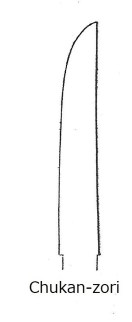
Chukan-zori (中間反り) ————– The chukan-zori tanto features a straight mune (back).  Its back does not curve either inward or outward.   

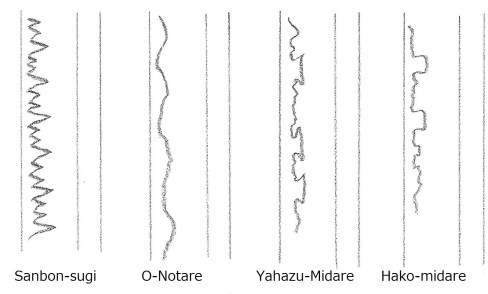
Hamon (刃文: Tempered line) ————————————-Sanbon-sugi (三本杉), o-notare (大湾), yahazu-midare (矢筈乱), hako-midare (箱乱), gunome-choji (互の目丁子), chu-suguha (中直刃).   See below.

24 Sannbon sugi,hako, yahazu, O-midare)

Horimono (彫り物: Carving) —————Often Hi (grooves) is curved

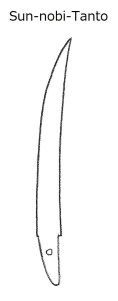
Tanto Length ————————— The standard tanto length should not exceed one shaku*¹ (about 12 inches, 30.5cm).  The standard size tanto is called a Jo-sun tanto, which is roughly 8.5 shaku (about 10 inches, 25.7cm).  Longer than jo-sun is called sun-nobi tanto (寸延)Shorter than jo-sun is called sun-zumari tanto (寸詰).

             Sun-nobi Tanto  >  Jo-sun Tanto (approx. 10 inches) >  Sun-zumari Tanto

*Shaku is a traditional Japanese unit of length measurement.

Takenoko-zori jo-sun tanto (筍反定寸短刀)————– The takenoko-zori jo-sun tanto was made during the Sengoku period.  It resembles swords made by Rai Kunimitsu of Yamashiro–den.  (illustration below)

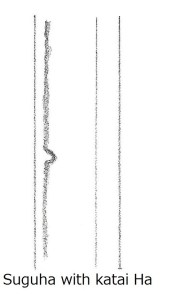
Hamon (刃文: Tempered line) ————– Hoso-suguha (細直刃: Narrow straight hamon). Katai-ha (illustration below) appears somewhere on the blade.  Masamehada (straight grain pattern) may be visible on the mune side.

                13 Middle Kamakura Period Tanto                 24 Suguha katai-ha

Ji-hada (地肌: The area between the shinogi and the tempered line)————– Some shirake (白け: a whitish surface) may sometimes appear.  Some utsuri (a light, whitish, cloud-like effect) appears on the ji-hada.

Sun-nobi Tanto (寸延短刀)————–This type of tanto resembles the sakizori tanto from the late Soshu-den period.  You may see a hitatsura-type hamon.  (illustration below).   Unlike the Soshu-den style, the hitatsura pattern is more visible in the lower part of the tanto and less in the upper part.

                                             25 Sun-Nobi Tanto      25 Hitatsura

Hirazukuri Takenokozori Sunzumari Tanto (平造筍反寸詰短刀)                                  

This is a unique tanto from the Sengoku period.   Hirazukuri means a flat-surfaced sword without a shinogi, yokote line, or obvious kissaki.   Takenoko-zori refers to a bamboo shoot shape (the back of the sword curves inward).   Sun-zumari indicates a blade shorter than 10 inches (less than 8.5 shaku or 25.7 cm).  The lower part of the blade is wide and thick, while the tip is narrow and thin.  It has a piercing, sharp appearance.

  • Horimono (彫物: Engraving) ————- Deeply carved ken-maki ryu (a dragon wrapped around a spear).
  • Hamon (刃文: Tempered line)——— Wide tempered line, with a nioi baseIrregular hamon, with wide suguha (straight), and chu-suguha (medium straight).  The hamon in the boshi area curves back deeply.
  • Ji-hada (地肌)———– fine ji-gane and wood burl pattern.

Moroha-tanto (諸刃短刀: Double-edged sword)

A double-edged sword with a hamon on both cutting edges.  Often, Bonji (Sanskrit) is curved.

  • Hamon (刃文: Tempered line) ——— Wide tempered line.   Nioi base.  Irregular hamon, wide suguha (straight tempered line), and chu-suguha (medium straight  tempered line).  The hamon turns back deeply.
  • Ji-hada (地肌: The area between the shinogi and the tempered line)——- Fine ji-gane and wood burl pattern.

25-moroha-tanto1 Moroha Tanto

The Swordsmith for Tanto during the Sengoku Period 

The Bizen swords from the Sengoku period are called sue-bizenSue is pronounced “su” and “e“ as in egg.   Bizen Osafune Yoso-Zaemon Sukesada (与三左衛門祐定) is the most famous swordsmith of the Sengoku period.  He also forged tantos.  One thing to note is that many swordsmiths had the name Sukesada.  Yoso-Zaemon Sukesada is the one who best represents the era.

21| Muromachi Period Sword (室町時代刀)

0-timeline - size 24 Muromach

       The red circle above indicates the time we discuss in this section

The Muromachi period was a relatively peaceful and prosperous time until shortly before the “Onin-no-ran,” which occurred at the end of the Muromachi periodRefer to Chapter 20, Muromachi Period History (室町時代歴史).   The Nanboku-cho style long swords became outdated; as a result, they were shortened.  The shortened blade is called suriage.  Overall, the Muromachi period was a declining time for sword-making.

Tachi and Katana 

Until the end of the Nanboku-cho period or the beginning of the Muromachi period, samurai wore swords suspended from their waists with the blade facing down.  When a sword was worn this way, the swordsmith inscribed his name on the side facing outward, meaning the blade is on your right when you see the inscription.  In this case, the sword is called a tachi.

During the Muromachi period, a sword was worn between the belt, with the blade facing up.   The swordsmith inscribed his name so that it faced outward when it was worn. Therefore, when you see the inscription, the cutting edge is to your left.  This is classified as a katana. 

Around the beginning of the Muromachi period, samurai started to wear a pair of swords called dai-sho (大小), meaning large and small.  The longer sword is a katana, and the shorter one is a wakizashi.  In general, a tachi is longer than a katana.  A katana is longer than a wakizashi, and a wakizashi is longer than a tanto.  Here is the order of their lengths. 

                                       Tachi   >   Katana   >   Wakizashi   >  Tanto                                  Tachi and katana differ in how they are worn, not in length.   

O-suriage ( 大磨上: Katana shortened by great length) 

How much the sword should be shortened depends on its original length and how much the owner wants it shortened.  O-suriage is a type of sword that is significantly shortened.  Once the blade is shortened by that length, the inscription of the maker’s name is cut off.  When the Hon’ami family (本阿弥家, a family of sword connoisseurs who have appraised Japanese swords for generations from the Muromachi period to today) appraises such a suriage sword, they write the make of the sword and the swordsmith’s name on the front side of the hilt, and the connoisseur’s name with his kaou (similar to a signature) on the back.  There are several levels of writing.  The level at which it should be done depends on the sword’s quality and the owner’s preference.  Below is the order of levels (high to low).

Shu-Mei (朱明 )————————————————————-name written in Vermilion  Kinpun-Mei (金粉名 )———————————————–name lacquered in gold powder  Gin-Zougan (銀象嵌 )————————————————————name inlaid in silver  Kin-Zougan (金象嵌 )————————————————————-name inlaid in gold

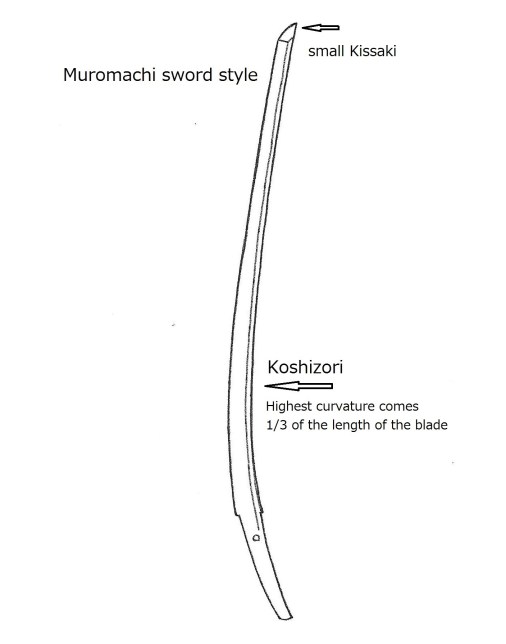
Sugata (姿: Shape) ——— The average length is typically two feet three to four inches (68~71cm).  The shape of the Muromachi period katana is somewhat similar to that of the Heian period tachi.  However, Muromachi katana are less grand or graceful than those from the Heian period swords.  The curvature is usually of the koshizori style.  Koshizori refers to the highest curvature being near the lower part of the blade.  The length and shape are suitable for wearing between the body and the belt.  The width and thickness are well-balanced with the size of the sword.  Small kissaki.

22 Muromachi sword shape

Hirazukuri-Wakizashi ———– Hirazukuri refers to a flat surface without a shinogi or yokote line.  Usually, it is 1 foot and 1 to 2 inches long.  No curvature.  Hirazukuri-wakizashi appeared during the Muromachi period.

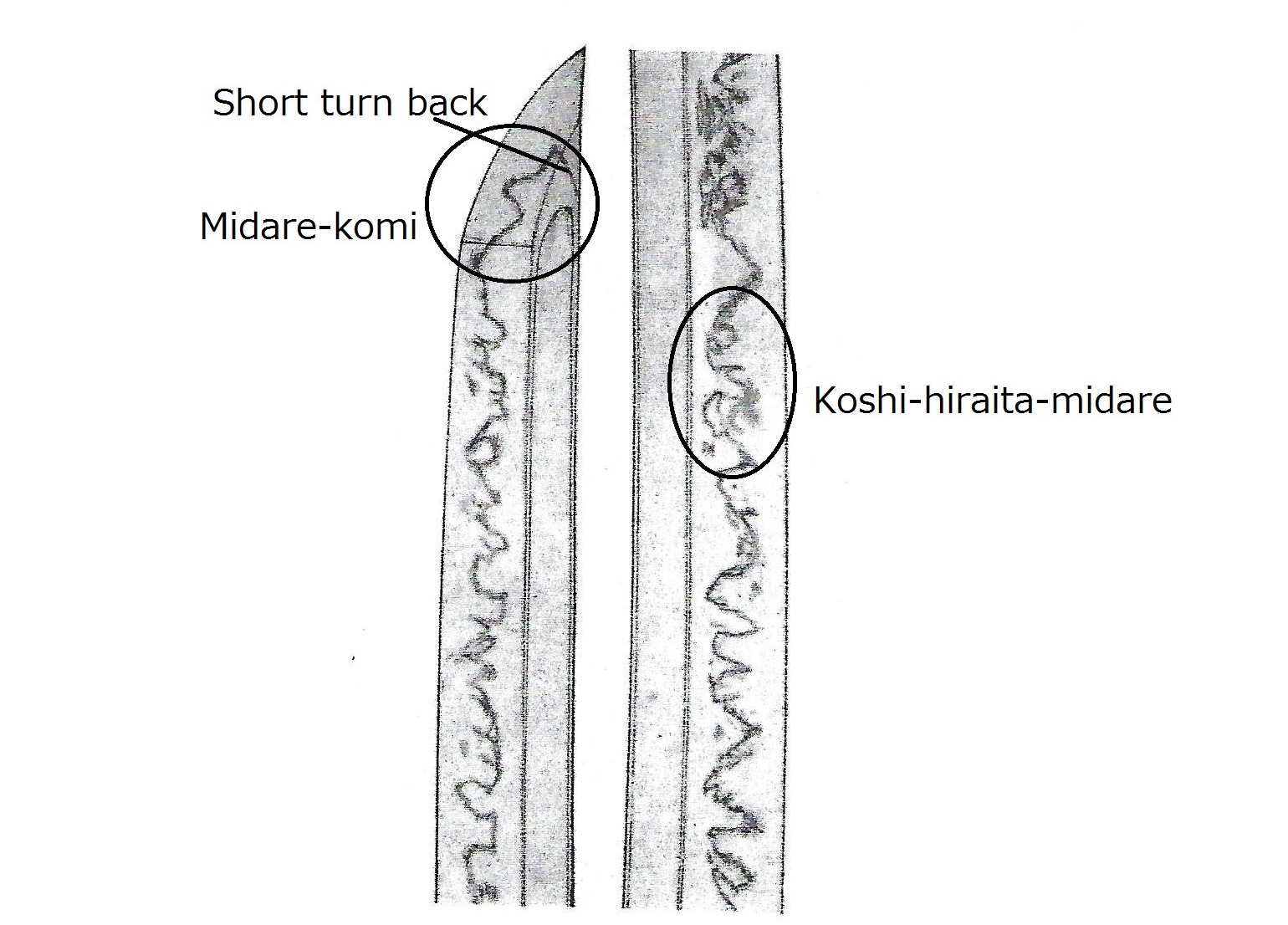
Hamon (刃文: tempered line) ———————- Nioi base.  The tempered area is well balanced with the blade’s width.  Koshi-hiraita-midare is mixed with choji-midare.

22Hamon (Koshi Hiraita midare)
from Sano Museum Catalogue (permission granted)
  • Boshi (Tempered line at Kissaki area) ————– Midare-komi, a short turn back.  See the above illustration.  Midare is an irregular wave-like pattern.
  • Ji-hada (地肌: An area between the tempered line and Shinogi)- Soft look, a large wood grain pattern, Ji-utsuri (faint smoke or cloud-like effect) shows.
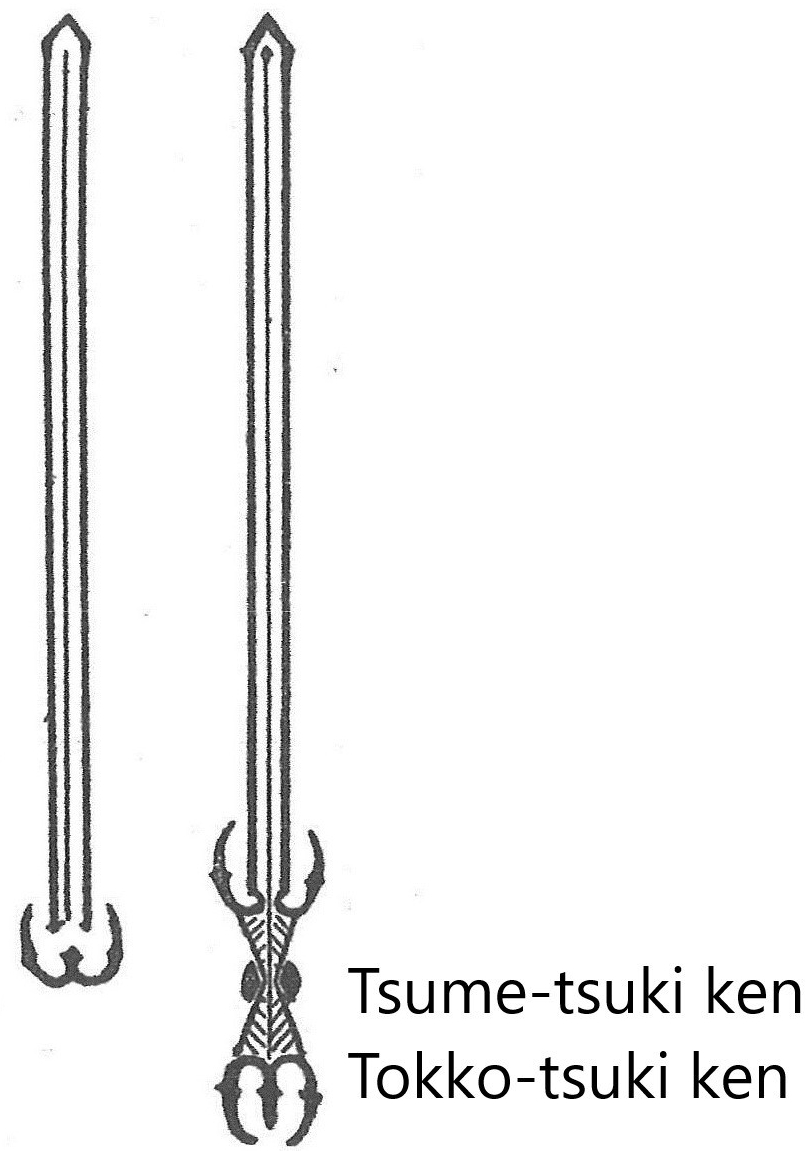
  • Horimono (彫物Engravings) ———- Bo-hi (single groove), Soe-hi (a thin groove alongside the main hi), Futasuji-hi (double narrow groove), Sanskrit, Tokko-tsuki ken, Tsume-tsuki Ken, name of God, and dragon.  Carvings became elaborate.

8 Hi, Suken, Bonji                  21 Tsume-tuki-ken tokko with caption

Sword Smiths during Muromachi Period

  • Bizen Den ——–Osafune Morimitsu (長船盛光), Yasumitsu (康光), Moromitsu (師光)
  • Yamashiro Den————————————————-Yamashiro Nobukuni (山城信国)

21 Muromachi sword from Sano

Ise Masashige (伊勢正重),                     Bizen Osafune Naomitsu (備前長船尚光)         Juyo Token(重要刀剣)                           Sano Museum Catalogue (permission granted)    once my family sword


15| The Revival of Yamato Den(大和伝復活)

0-timeline - size 24 Late Kamakura

        The red circle above indicates the time we discuss in this section

It is believed that sword-making first started in Yamato province (now Nara Prefecture) during the Nara period (710 to 794).  In the early days of sword-making, the forging techniques were primitive.  At that time, many swordsmiths lived in Yamato, but over time, sword-making in this region declined.

At the end of the Kamakura period, several powerful Buddhist temples emerged in the Yamato area, leading to conflicts among them.  Temples held significant political and military power to control large territories called shoen (荘園) through their large numbers of warrior monks, known as sohei (僧兵).  The most dominant group was Nanto Sohei (南都僧兵)*.  These groups of sohei demanded more swords to arm themselves, which revitalized the Yamato-den (school) and increased the number of swordsmiths in the Yamato area.   As a result, the Yamato-den group became active again.  The Yamato-den style is somewhat similar to the Yamashiro-den.    

*Nanto Sohei (南都僧兵)—————-Since around the 11th century, Buddhist temples grew powerful under the protection of the Joko (retired emperors).  These temples had many sohei (low-level monks who also served as soldiers). When power struggles arose among the temples, sohei fought as their soldiers on the battlefields.  Nanto Sohei were such soldiers at Kofuku-Ji Temple (興福寺).  Several large temples, such as Todai-ji (東大寺) Temple, controlled the Yamato area.

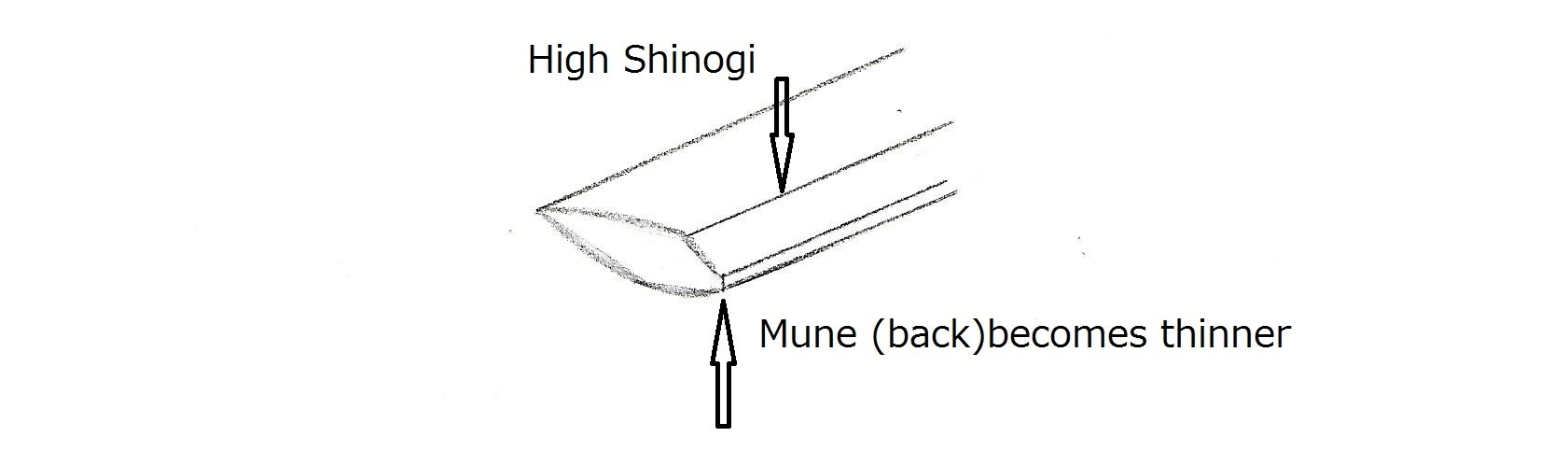
Sugata (姿: Shape) —————- Not much difference in style during the early part of Yamatoden and Yamashiro-den.  Shinogi is high.  Mune is thin.   Some Yamato-den have a shallow sori (curvature).

16 Yamato sword cross section

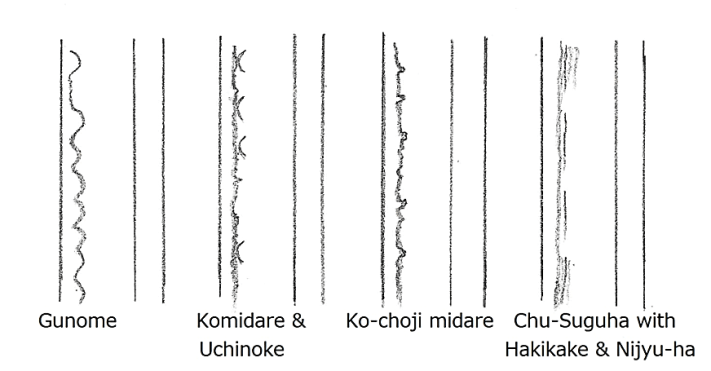
Hamon (刃文Tempered line) ——————Narrow tempered line.  Mainly nie (沸).  Chu-suguha-hotsure (中直刃ほつれ: a medium straight line with a frayed pattern), ko-choji-midare (小丁子: a mixture of small clove-like patterns and irregular wavy lines), ko-midare (小乱: small irregular wavy lines), ko-gunome-komidare (小五の目小乱: small continuous half-circles mixed with wavy lines). 

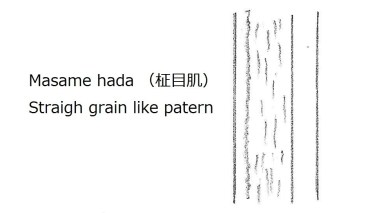
The main features of the Yamatoden style sword are masame (straight grain).  Its tempered line often shows nijyu-ha (double straight lines), hakikake (brush mark trace), uchinoke (a crescent-shaped line), or a combination of these.   See the illustration below.


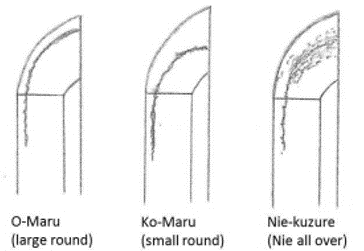
Boshi (鋩子: Tempered line at Kissaki area) ———- In the boshi area, a straight grain hamon pattern appears.  Yakizume or kaen. (Refer to Chapter 12, Middle Kamakura period: Tanto).  O-maru, ko-maru, nie-kuzure.  (Refer to Chapter 14, Late Kamakura Period Sword.  See the illustration below.)


15 Omaru Komaru Niekuzure

Ji-hada (地肌):Area between the shinogi and the tempered line)———— mostly masame-hada (straight grain pattern 柾目肌). Fine ji-nie, chikei, or yubashiri.  (Refer to Chapter 14, Late Kamakura Period Sword (鎌倉末太刀).  See below.)

16 Masame Hada

Nakago (Hilt) ———————– Often displays Higaki Yasuri (檜垣), the finishing file pattern, as illustrated below. 

16 Higaki Yasuri

Names of the Yamato School Sword-smiths

Taema(当麻) Group————–Taema Kuniyuki(当麻国行) Taema Tomokiyo(当麻友清) Shikkake (尻懸) Group———————————————-Shikkake Norinaga (尻懸則長) Tegai (手掻) group ——————Tegai Kanenaga (手掻包永) Tegai Kanekiyo(手掻包清) Hoshou (保昌) group———Hosho Sadayoshi ( 保昌貞吉) Hosho Sadamune (保昌貞宗)

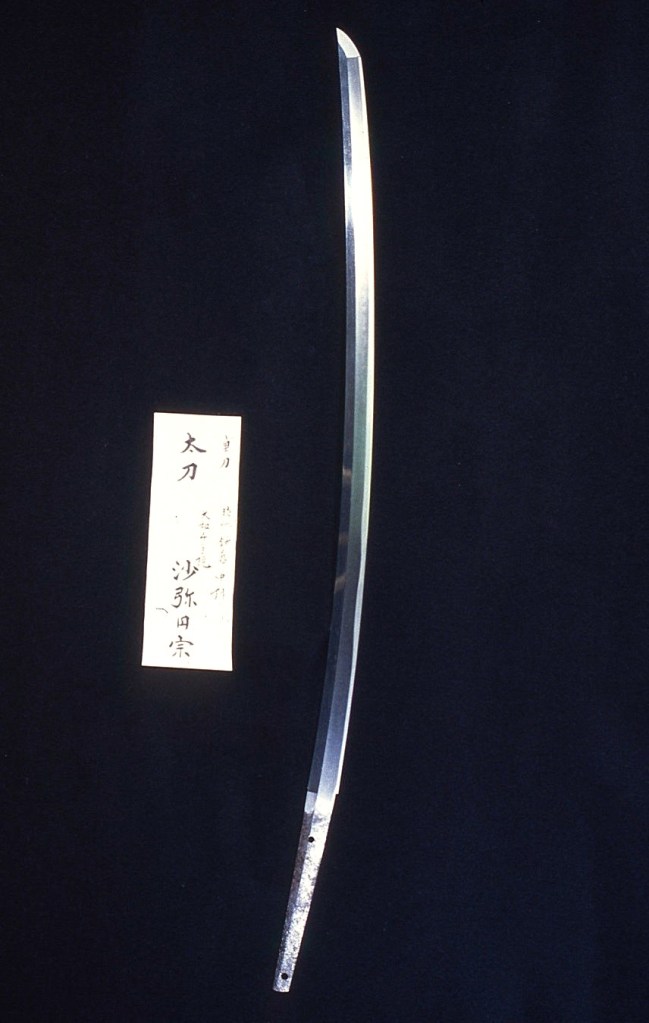
Yamato Senjuin Saya Enso (大和千手院沙弥円宗)  once my family sword

14| Late Kamakura Period Sword (鎌倉末太刀)

0-timeline - size 24 Late Kamakura

The red circle above indicates the time we discuss in this section

The beginning of the Soshu style

A new sword style called Soshu-den appeared after the Mongolian invasion during the later part of the Kamakura period.  The Kamakura region became prosperous under the rule of the Hojo family (北条).  Many swordsmiths moved to Kamakura.  These included the Kunitsuna group (国綱)  from the Yamashiro area and Fukuoka Ichimonji Sukezane (福岡一文字助真) and Kunimune (国宗) from the Bizen area.  They are the originators of Soshu-den (相州伝).  A well-known swordsmith, Goro-Nyudo-Masamune (五郎入道正宗), emerged during this time.

15 Soshu sword with explanation

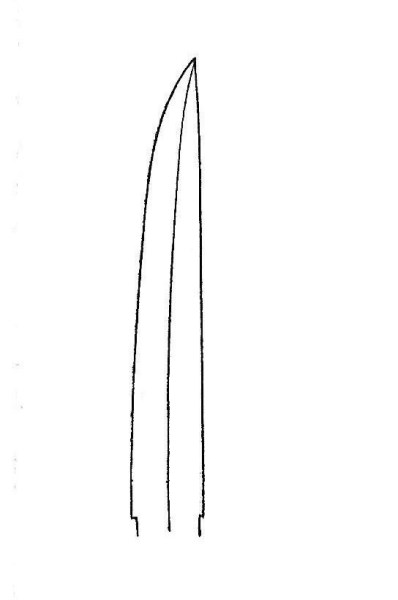
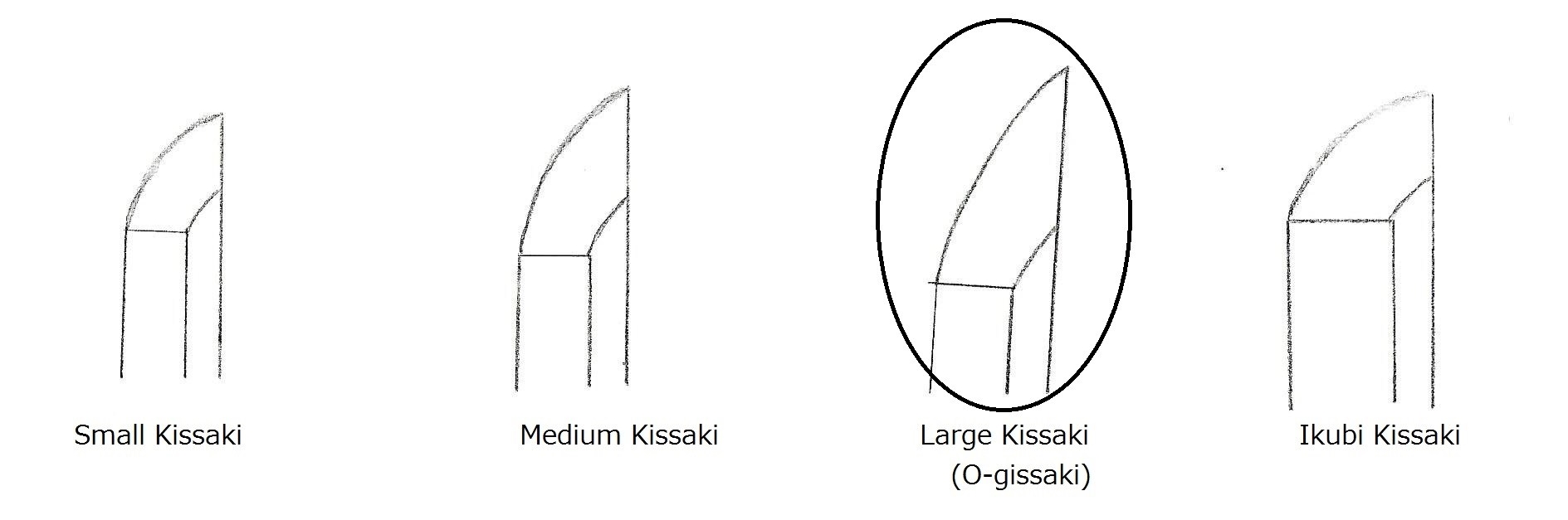
Sugata (Shape 姿) ——- Okissaki (large kissaki: 大切先) and chu-kissaki (medium kissaki: 中切先).   The tip of the hi ends lower (see the illustration below).  Hamaguriha is no longer in style.  The body has become thinner.  The original length was approximately three feet or longer, but most were later shortened to two feet, three inches, or four inches.  The shortened sword is called o-suriage (大磨上).

15 Kissak shape of 4

14 Hi end lower

Hamon——————–Narrow Hamon and wide Hamon.     

Narrow Hamon ——- A mix of Suguha (straight),  Ko-choji (small clove-like pattern), and Ko-gunome (small half-circle pattern).  Small Nie base. (shown below)

10 Nie & Nioi

Wide Hamon ——– Notare midare (wavy).  O-gunome.  Nie base.  Ashi-iri (short line toward the blade, the right drawing below). Inazuma (lightning-like line) or kinsuji (bright line) may appear on a tempered line.  However, inazuma and kinsuji require trained eyes to detect.  It is difficult for beginners to see inazuma or kinsuji.  

15 Late Kamakura Soshu Hamon

Boshi————The main body and boshi have the same type of hamon.  At the tip of the kissaki, angle it back slightly or yakizume.  You might also see o-maru (large round), ko-maru (small round), kaen (flame-like), or nie-kuzureYakizume and kaen (Chapter 12).

15 three boshi name

Ji-hada (between the shinogi and the tempered line) ——-Strong ji-nie (地沸), which are sand-like small dots appearing on the ji (between the tempered line and the mune).  Yubashiri (a cluster of ji-nie), kinsuji (a bright, radiant line formed by nie), inazuma (a lightning-like irregular line), or chikei (similar to kinsuji) may appear on the ji-hada.

15 Yubashiri, Chikei, Inazuma

Late Kamakura Period Soshu School Sword Smiths

From Bizen————–Fukuoka Ichimonji Sukezane (福岡一文字助真) Kunimune (国宗 )   From Yamashiro ————————————–Toroku- Sakon- Kunituna (藤六左近国綱) 

The three swordsmiths mentioned above originated the Soshu-den (school) in Kamakura.  Later, Tosaburo Yukimitu and his son, the famous Goro Nyudo Masamune, emerged.

More  Soshu Den swordsmiths other than above

From Yamashiro (山城)———- Rai Kunitsugu (来国次), Hasebe Kunishige (長谷部国重) From Etchu (越中) province ———————Gou- no-Yoshihiro (郷義弘) Norishige (則重) From   Mino (美濃) province ——————————————-Kaneuji (兼氏) Kinjyu (金重) From   Chikuzen (筑前) province —————————————————-Samoji (左文字)

Goro Nyudo Masamune (正宗): his hamon is like ocean waves. (Sano Museum permission granted)        

Masamune  (政宗)                                          Yoshioka Ichimonji (吉岡一文字)

Once owned by my family