51| Part 2 of — 17 Nanboku-Cho Period History 1333 – 1392 (南北朝歴史)

This chapter is a detailed part of Chapter 17|Nanboku(Yoshino) Cho Period History (1333-1392).  Please read Chapter 17 before reading this section.

0-timeline - size 24 Nanboku-cho

                      The red circle above indicates the time we discuss in this section

The Nanboku-cho period (1333 – 1392) was between the fall of the Kamakura bakufu and the beginning of the Muromachi bakufu.  It was a time when the Northern and Southern Dynasties coexisted.  Around the time of the Mongolian invasion, Emperor Go-saga died without naming a successor.  Because of that, his two heirs and their family lines, the Daigakuji-to (大覚寺統) and the Jimyoin-to (持明院統), alternately assumed the imperial position after Emperor Go-saga‘s death.  This system was politically unstable.  Additionally, many inconvenient problems arose; for example, while one emperor was still very young, the next-in-line emperor died young from a head injury while playing on a slippery stone.

At a time like this, Go-daigo (後醍醐天皇) became the emperor.  He was placed on the throne as a temporary emperor until the young emperors reached maturity.  Around this time, the emperors’ power was declining.  The Kamakura bakufu (government) controlled the emperors.  After the Mongolian invasion, even though typhoons drove the Mongolian troops away, the Kamakura bakufu faced financial troubles due to the costs of war.  Many samurai who fought during the Mongolian invasion did not receive any rewards or compensation for their expenses and were also financially troubled.  All these problems piled up and caused the resentment against the Kamakura bakufu.

Emperor Go-Daigo refused to be merely a placeholder emperor.  He decided to stay as emperor and attack the Kamakura bakufu.  For some reason, the Kamakura bakufu found out about his plans.  Emperor Go-Daigo somehow managed to avoid being accused of being the instigator.  Afterwards, the Kamakura bakufu appointed another heir for the next emperor.  However, Go-Daigo insisted on remaining emperor.  He planned another attack once more.  This time, he had carefully planned and allied with prominent, powerful temples in Yamato (Nara today) since the Kamakura bakufu did not control themRefer to 15 Revival of Yamato Den (大和伝復活)  and 49 Part 2 of– 15 The Revival of Yamato Den. 

This time again, the rebellion plot came to light.  Go-Daigo sneaked out of Kyoto and fought against the Kamakura army.  Although Go-Daigo’s army had fewer soldiers than the Kamakura army, several groups opposing the Kamakura bakufu rose up in various parts of Japan.  Eventually, Go-Daigo was captured and sent to Oki Island (the same place where Emperor Go-Toba was exiled).  

Even after exiling Emperor Go-Daigo to Oki Island, the Kamakura bakufu still had to fight against other uprising groups.  One of the most famous rebels was Kusunoki Masashige (楠正成).  Go-Daigo’s son also actively fought against the Kamakura bakufu and managed to ally with more factions.

More and more people sought to overthrow the Kamakura bakufu.   Even Ashikaga Takauji (足利尊氏), one of the top men of the Kamakura bakufu who fought against Emperor Go-Daigo, betrayed the Kamakura and switched sides, becoming the emperor’s ally.  Meanwhile, Go-Daigo escaped from Oki Island.  More and more uprisings against the Kamakura bakufu increased across the country.  Eventually, the main political center, Rokuhara Tandai (六波羅探題) of the Kamakura bakufu, fell.  Nitta Yoshisada (新田義貞)*, who led another uprising group, attacked Kamakura and won.  The Kamakura bakufu fell in 1333. 

Emperor Go-Daigo initiated a new political system called Kenmu no Shinsei (建武の新政).  However, his new system turned out to be a disaster.  He made great efforts to set things right and drastically changed the old political system.  Yet, this political reform created big unrest.  It was not beneficial for anyone, and no one gained anything.  Ashikaga Takauji (one of the key figures of merit) and his men did not receive any high-ranking positions.  This reform was highly idealistic and too advanced for its time.  It proved disadvantageous for the noblemen.  His new policies only caused chaos and corruption.

Now, Ashikaga Takauji turned against Go-Daigo and defeated him.  Go-Daigo left the Imperial Palace and established a new government in Yoshino, south of Kyoto.         Therefore, it was called the Southern Dynasty.  Meanwhile, Ashikaga Takauji set up a new emperor, Emperor Komyo (光明), in Kyoto and established the Northern Dynasty.     This is how the Northern and Southern Dynasties arose. 

Two dynasties co-existed for about 60 years.  Gradually, many samurai groups moved to the Northern Dynasty, and after Go-Daigo and several of his key men died, the Southern Dynasty weakened.  Eventually, the Southern Dynasty accepted an offer from the Ashikaga side, and the North and South united in 1392.  Throughout these conflicts between the emperor and the Kamakura bakufu, sword styles became broader and longer, reaching 3, 4, or even 5 feet.  Later, most Nanboku-cho (North and South Dynasties) style long swords were shortened.

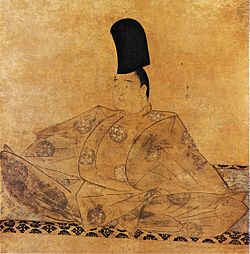
53 Ashikaga Takauji

Kibamusha (騎馬武者蔵) This portrait was once believed to depict Ashikaga Takauji, but now some claim otherwise. “Public Domain” owned by the Kyoto National Museum

 *Nitta Yoshisada (新田義貞)

When Minamoto-no-Yoritomo established the Kamakura bakufu, he chose the Kamakura area as its center because it is surrounded by mountains on three sides and one side faces the ocean.  This made it hard to be attacked and easier for them to defend themselves.  They built seven narrow, steep roads through the mountains called Kir- toshi (切り通し), connecting with several major cities.  These seven routes were the only roads in and out of Kamakura

When Nitta Yoshisada attempted to attack Kamakura, he first attempted the land route but failed.  He then approached the town from the ocean side, but the cliff stretched far out into the sea, making it impossible for them to pass.  The legend says that when Nitta Yoshisada reached the area called Inamura Gasaki (稲村ヶ崎), he threw his golden sword into the ocean and prayed.  Then the tide receded, allowing all the soldiers to walk around the cliff on foot.  They charged into Kamakura, and the Kamakura bakufu fell.  There are several different views on this story.  Some scholars argue it is not true; some say it happened, but the date was wrong; others say that an unusual ebb tide occurred that day, and so on.  

Today, Inamura Gasaki in the Shonan area (湘南) is one of the favorite evening dating spots for young people.  The evening view at Inamura Gasaki is beautiful.    The sunset over Inamura Gasaki towards Enoshima (江の島, a small island with a shrine on the hilltop) is stunning.   My parents’ house used to sit above the cliff in an area called Kamakura-yama, overlooking the ocean.
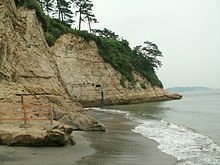
53 Inamura gasaki

Inamura Gasaki      Photo is “Creative Commons” CC 表示-継承 3.0 File: Inamuragasaki tottanbu.jpg    Public domain

47| Part 2 of –13 Late Kamakura Period: Genko (鎌倉末元寇)

This is a detailed section of Chapter 13, Late Kamakura Period, Genko(鎌倉末元寇).  Please read Chapter 13 before reading this section.

0-timeline - size 24 Late Kamakura

                      The red circle above indicates the time we discuss in this section.

Genko (元寇):  Mongolian Invasion 

Chapter 13 briefly describes the Mongolian invasion.  Here is a more detailed description.  The Mongol Empire was a vast empire that stretched from present-day Mongolia to Eastern Europe during the 13th and 14th centuries.  The grandson of Genghis Khan, Kublai Khan, sent several official letters to Japan demanding that it become a dependent state of the Mongol Empire (元: Yuan) and ordering Japan to send tribute.  They threatened Japan, warning that they would invade if Japan did not meet their demands.  Hojo Tokimune (北条時宗), who was in power at the Kamakura bakufu (government) at the time, refused and ignored the letters multiple times.  This led to two invasions by the Mongol Empire.  It is often said that a powerful typhoon hit Japan on each occasion, and these two powerful typhoons drove the Mongols away.  This is correct, but the whole story was much more than this.

Bun’ei-no-eki (文永の役)  1274

The first Mongolian invasion was called Bun’ei-no-eki.  In early October 1274, Mongol troops (Mongols, Han Chinese, and Koreans) totaling around 40,000 men* set out from the Korean Peninsula on about 900* large and small ships and headed toward Japan.  After arriving on Tsushima Island (対馬), Mongol soldiers burned villages and killed many residents, including local villagers.  Villagers were captured and sent to the top Mongol officials as slaves.  It was a heartbreaking scene. 

The Mongols moved to Iki Island (壱岐の島), Hizen Shore (肥前), Hirado Island (平戸)、Taka Island (鷹島), and Hakata Bay (博多).  In each location, the disastrous and sorrowful scenes were the same as everywhere.    On every battlefield, Japanese soldiers and villagers were killed in large numbers.  The Kamakura bakufu sent a large number of samurai troops into battle.  The Japanese forces sometimes won and pushed the Mongols back, but they mostly lost.  Many Japanese wives and children near the battlefields were captured. 

Eventually, no soldiers dared to fight the Mongols. The Mongols’ arrows were short and not very powerful, but they coated the tips with poison and shot them all at once like rain.  Also, this was the first time the Japanese faced firearms. The loud sound of explosions frightened horses and samurai.  Japanese troops had to retreat, and the situation was grim for them.  But one morning, there was a big surprise!  All the ships had vanished from the shore.  They were all gone on the morning of October 21 (today’s date, November 19).  All the Mongols had disappeared from the coast of Hakata

What happened was that the Mongols decided to end the fight and head back home.  The reason was that, although they were winning, they had also lost many soldiers and one of their key leaders in the army.  The Mongols realized that no matter how many victories they achieved, the Japanese kept coming more and more from everywhere.  Also, the Mongols realized they could not expect reinforcements from their homeland across the ocean.  Their supplies of weapons were running low.  The Mongols decided to go back.  However, there was a twist.  Around the end of October (November by today’s calendar), the sea between Hakata (where the Mongols were stationed) and Korea was very dangerous because of bad weather—only clear days with south winds allowed sailing across the sea.  The sea they had to cross is called Genkai Nada (玄界灘), known for its rough waters.  For some reason, the Mongols decided to go back during the night.  That was a mistake.  They might have caught a brief moment of the south wind, but it did not last long.  Consequently, they encountered a usual severe rainstorm.  Many ships collided with each other, crashed into cliffs, capsized, and people fell into the ocean.  Several wrecked vessels were found on the shores of Japan. 

The Mongol invasion ended here.  This war is called Bun’ei-no-eki (文永の役).  The Mongols lost many people, ships, soldiers, food, and weapons.  In fact, Korea suffered greatly.  They were forced to supply the Mongols with people, food, weapons, and more.  After the war, in Korea, only older men and children were left to work on farms.  Additionally, they faced both drought and prolonged rainfall.

Ko’an-no-eki (弘安の役) 1281

The second Mongolian invasion, known as Ko’an-no-eki, occurred in 1281.  After the first attempt to invade Japan, Kublai Khan kept sending messengers to Japan, demanding that Japan become a Mongol dependency.  The Kamakura bakufu ignored and executed these messengers.  Kublai Khan decided to attack Japan again in 1281.  His top advisers tried to persuade him not to go through with it because the ocean was too dangerous, the country was too small, the distance was too far, and there was nothing to gain even if they succeeded.  Despite these, Kublai Khan insisted on the attack. 

This time, they arrived in two groups.  One was the east-route troops with 40,000* soldiers on 900 ships, and the other was the south-route troops with 100,000* soldiers on 3,500 ships.  This was one of the largest forces in history.  They planned to depart from their designated port and meet on Iki Island (壱岐の島) by June 15 to fight together.  The east-route troops arrived there before the south-route troops.  Instead of  waiting for the south-route forces to arrive, the east-route troops started attacking Hakata Bay (博多) on their own.  However, since the previous invasion of the Bun’ei-no-eki, Japan had prepared for battle by building a 20-kilometer-long stone wall.  This stone wall was 3 meters high and 2 meters thick.  The troops had to give up landing at Hakata and moved to Shiga-no-Shima Island (志賀島).  There, the fight between the Mongols and Japanese was evenly matched, but ultimately, the east-route troops lost and retreated to Iki Island, where they decided to wait for the south-route forces to arrive. 

The south-route troops never arrived. They had changed their plans.  On top of that, while waiting for the south-route forces to come, they lost over 3,000 men to an epidemic.  Some suggested returning home because of the difficulties, but they chose to wait for the south-route troops as long as their supplies lasted. 

Meanwhile, the south-route troops decided to head to Hirado Island (平戸島), which was closer to Dazaifu (太宰府).  Dazaifu was the final and most important place they wanted to attack.   Later, the east-route troops found that the south-route troops had gone to Hirado Island.  Finally, the two forces joined on Hirado Island, with each group stationed on a nearby island called Takashima Island (鷹島).  The problem was that the ships were not easily maneuverable because this island had very high tides and low tides.

Meanwhile, 60,000 Japanese men headed toward the area where the Mongols were stationed.  Before the Japanese soldiers arrived to fight the Mongols, a massive typhoon struck on July 30, and the Mongols were caught in a huge storm.  Their ships collided, and many sank.  People fell overboard and drowned.

By this time, it had been about three months since the east-route troops left Mongolia in early May.  That means they had been at sea for roughly three months.  In northern Kyushu (九州), typhoons usually occur about 3.2 times between July and September.  The Mongols had been at sea and along Japan’s coast for around three months.  So, they were likely to be hit by a typhoon sooner or later.

The Mongol Empire lost 2/3 of its naval forces during the event at Ko’an-no-eki.   Even after the Mongols failed in two invasions, Kublai Khan still insisted on attacking Japan again, despite his advisers’ warnings not to.  Ultimately, the plan was delayed and then terminated due to numerous rebellions and upheavals, and no lumber was left to build ships.  Soon after, Kublai died in 1294.  Historical records of the Mongols indicate that Mongolian officials highly praised Japanese swords.  Some even suggest that one reason it was difficult to defeat Japan was because of its long, sharp swords. The experience of the Mongolian invasion changed the ikubi kissaki (猪首切先) sword into a new Soshu-den (相州伝) style.  The next chapter describes this new style of sword, the Soshu-den swords.

49 Photo of part 2 of 14 Late KamakuraThe stone wall scene.  Photo from Wikipedia.  Public Domain
* Number of soldiers by https://kotobank.jp/word/元寇-60419 .  Referred to several different reference sources.  They all have similar numbers of soldiers and ships.

43 | Part 2 of –10 Jyokyu-no-Ran and Gotoba-joko (承久の乱)

This chapter is a detailed part of Chapter 10, Jyokyu-no-Ran (承久の乱 ) 1221.  Please read Chapter 10 before reading this section.

0-timeline - size 24 jyokyuu no ran

                            The red circle above indicates the time we discuss in this chapter.

Chapter 10 explained how Jokyu-no-ran (承久の乱) started.  In the end, Emperor Gotoba (or Gotoba Joko) was exiled to Oki Island (隠岐の島). 

Emperor Gotoba was a highly talented individual in many fields.  He was good at waka (和歌), a Japanese short poem.   To compose a waka requires including several elements, such as scenery, the season, personal feelings expressed with refined sentiment, or the surrounding environment, all within a very limited number of words.  It requires literary talent.  He was also proficient in equestrianism, kemari (a ball game played by the upper class at that time), swimming, sumo wrestling, music, archery, swordsmanship, calligraphy, painting, and even sword-making.  His contributions to the sword field led to the golden age of sword-making during the middle Kamakura period.  Surprisingly, Gotoba Joko was not only talented in many different arts but also mastered them at the highest level.  His waka (poetry) was particularly highly regarded.  He edited the Shin- Kokin- wakashu (新古今集), a collection of 1980 waka poems.                                                                          

Emperor Gotoba, Enthroned at the Age Four

Emperor Gotoba was enthroned at the age of four (some say three).  The problem was that Emperor Antoku was already on the throne.  They were both about the same age.  Having two emperors simultaneously creates a problem.  How did this happen? 

To establish a new emperor, the head of the imperial family must appoint the next emperor.  While Emperor Go-Shirakawa (後白河天皇) was imprisoned, Emperor Antoku was appointed by Taira-no-Kiyomori (平清盛).  Although Kiyomori was the head of the Heishi, the most powerful samurai group, he was not a member of the imperial family.  That went against tradition.  This was unacceptable to Emperor Go-Shirakawa (後白河天皇).  Emperor Go-Shirakawa was furious at Taira-no-Kiyomori; he chose Emperor Gotoba and enthroned him.  This is why the two emperors coexisted.  

There was one more thing.  To be an emperor, one must possess the Sanshu-no-jingi (三種の神器: Three imperial regalia). These are the three items an emperor needs to have to be a legitimate emperor.  They are a mirror, a sacred sword, and a magatama (jewelry)*.   

However, the Sanshu-no-jingi were taken by the Heike family along with Emperor Antoku when they fled from the Genji.  The Heike clan was chased by the Genji all the way to Dan-no-ura (壇ノ浦), where they were defeated.   Dan-no-ura is a sea located between Kyushu (九州) and Honshu (本州).  When it became clear to the Heike family that they had been defeated, all of the Heike people, including the young Emperor Antoku, jumped into the sea and drowned.  They took the Sanshu-no-jingi with them into the sea.  

Later, people frantically searched for the Sanshu-no-jingi; however, they only recovered the jewelry and the mirror, not the sword.  Because of tradition, the emperor must possess the Sanshu-no-jingi; otherwise, he would not be recognized as a legitimate emperor.  Gotoba Joko was tormented for a long time for not having all three. 

Today, the jewelry is with the current emperor’s family, and the mirror is at the Ise Jingu Shrine (伊勢神宮).  The sword is still missing somewhere in the ocean.  Some say that the sword that fell into the sea was a replica, and the one kept at Atsuta Jingu Shrine (熱田神宮) is the real one.                                                                                                                                                 * Sanshu-no-Jingi (三種の神器) ————- 1. The sword; Kusanagi-no-tsurugi (草薙の剣)   2. The mirror; Yata-no-kagami (八咫の鏡),   3. The magatama (Jewelry); Yasakani-no-magatama (八尺瓊勾玉) by Token World: www.touken-world.jp/tips/32747/

Politics by Emperor Gotoba

Emperor Gotoba sought to regain political power from the Kamakura bakufu.  He was impulsive, passionate, unpredictable, and quick-tempered.  He tried to revive the Chotei (朝廷) power.  The Chotei is the central government controlled by the emperor and aristocrats.  Emperor Gotoba decided to rely on the armed forces to achieve this goal and established the Saimen no Bushi (armed forces directly under the emperor).

Upon seeing Minamoto-no-Sanetomo dead, he realized that the Kamakura bakufu was in turmoil.  Recognizing this as a good chance, he sent out the emperor’s order to all the daimyo to fight against the Kamakura bakufu.  He expected an easy victory, but the Kamakura bushi remained strongly united and fought well under Hojo Masako’s leadership, the “Nun Shogun.”   She organized a strongly united armed force, while Emperor Gotoba’s side was disorganized.  They were not accustomed to fighting.   

In the end, Emperor Gotoba’s side lost.  When he realized he had lost, he claimed it was not he but his men who had acted independently.  He insisted that it had nothing to do with him.  Therefore, it was wrong to punish him.  But of course, Hojo Masako and the Kamakura bakufu did not believe Emperor Gotoba and exiled him to Oki Island.  Emperor Gotoba ended his life there.  Although he was intelligent and accomplished in many areas, he could not defeat the grandma, “Nun Shogun,” Hojo Masako.

Sword-Making by Gotoba Joko

Gotoba Joko had an exceptional ability to evaluate swords, and he became a great swordsmith himself.   He invited many top-level swordsmiths from various groups to his court, gave them titles, and treated them with respect.  He also appointed them as his instructors and assistants.  Gotoba Joko brought in skilled swordsmiths from various places in rotation.  Those who were invited to the palace were called gobankaji (御番鍛冶), an honorary title.  On the sword he created, he inscribed a chrysanthemum with 16 petals.  The current emperor still uses this design as his imperial crest.  The sword with the chrysanthemum design is called Kikugosaku (菊御作).                                                                                                

Today, you can visit the Emperor Gotoba Museum on Oki Island, where some sites are believed to be the emperor’s sword-making site.  Some people say it is debatable whether these sites are real.  Today, Oki Island is a beautiful resort destination.  It can be reached by ferry from Shimane Prefecture, which takes about two hours.  It can also be reached by airplane directly from Osaka.

11 «part 2» Gotoba Joko photo

          Gotoba Joko, owned by Minase Shrine (This picture is in the public domain)

40|Part 2 of — 7 Overview of Kamakura Period Sword (鎌倉太刀概要)

This chapter is a detailed part of Chapter 7, an overview of the Kamakura Period Swords.  Please read  Chapter 7, Overview of the Kamakura Period Swords, before reading this section. 

0-timeline - size 24 Kamakura Period

                         The red circle above indicates the time we discuss in this section.

The Kamakura period was a golden age of sword-making.  About half of the well-known swords today were produced during this time.  This is probably because the war between the Genji and the Heishi demanded many swords, and swordsmiths improved their skills through wartime experience.  Also, Emperor Gotoba (後鳥羽) invited many talented swordsmiths to his palace, treated them favorably, and encouraged them to create excellent swords by granting them high ranks.  During the Kamakura period, sword-making techniques greatly improved.

Middle Kamakura Period —- Yamashiro-den (山城伝)

The middle Kamakura period was the height of the Yamashiro-den.  Within the Yamashiro-den, there were three main groups: the Ayanokoji group (綾小路), Awataguchi group (粟田口), and Rai group (来).                                                                                                                       Among the Awataguchi group, six swordsmiths received the honor of “Goban-kaji ” from Emperor Gotoba (後鳥羽上皇).  Awataguchi is the name of an area in Kyoto. 

The Ayanokoji ( 綾小路 ) group lived in the Ayanokoji area of Kyoto.  My sword textbook had a note indicating that I had seen Ayanokoji Sadatoshi (綾小路定利) on March 22, 1972.  My note was brief, only a few words: o-suriage, funbari, narrowbody, and ji-nie

The Rai group originated from Rai Kuniyuki (来国行 ).  Rai Kuniyuki and Ayanokoji Sadatoshi were believed to have been close friends.  Rai Kuniyuki created many well-known swords.  His famous Fudo Kuniyuki (不動国行) was once owned by Shogun Ashikaga Yoshiteru (足利義輝 ), then passed to Matsunaga Danjo (松永弾正), then to Oda Nobunaga ( 織田信長 ), then to Akechi Mitsuhide (明智光秀 ), and eventually to Toyotomi Hideyoshi (豊臣秀吉).  All of them were historically famous and influential daimyo.  It is said that Toyotomi Hideyoshi held this sword during the memorial service for Oda Nobunaga.  Rai Kuniyuki’s son was Niji Kunitoshi.  He also forged well-known swords. 

Middle Kamakura Period —– Bizen-den (備前伝)                                                              

The Bizen-den during the Heian period was called Ko-bizen.  They are similar to those in the Yamashiro-den style.  The true height of the Bizen-den was during the middle Kamakura period.  The Bizen area (today’s Okayama Prefecture) had many ideal conditions for sword-making: a good climate, abundant iron resources, plenty of wood for fuel, and a convenient location.  Naturally, many swordsmiths moved there, and it became a major center for sword production. 

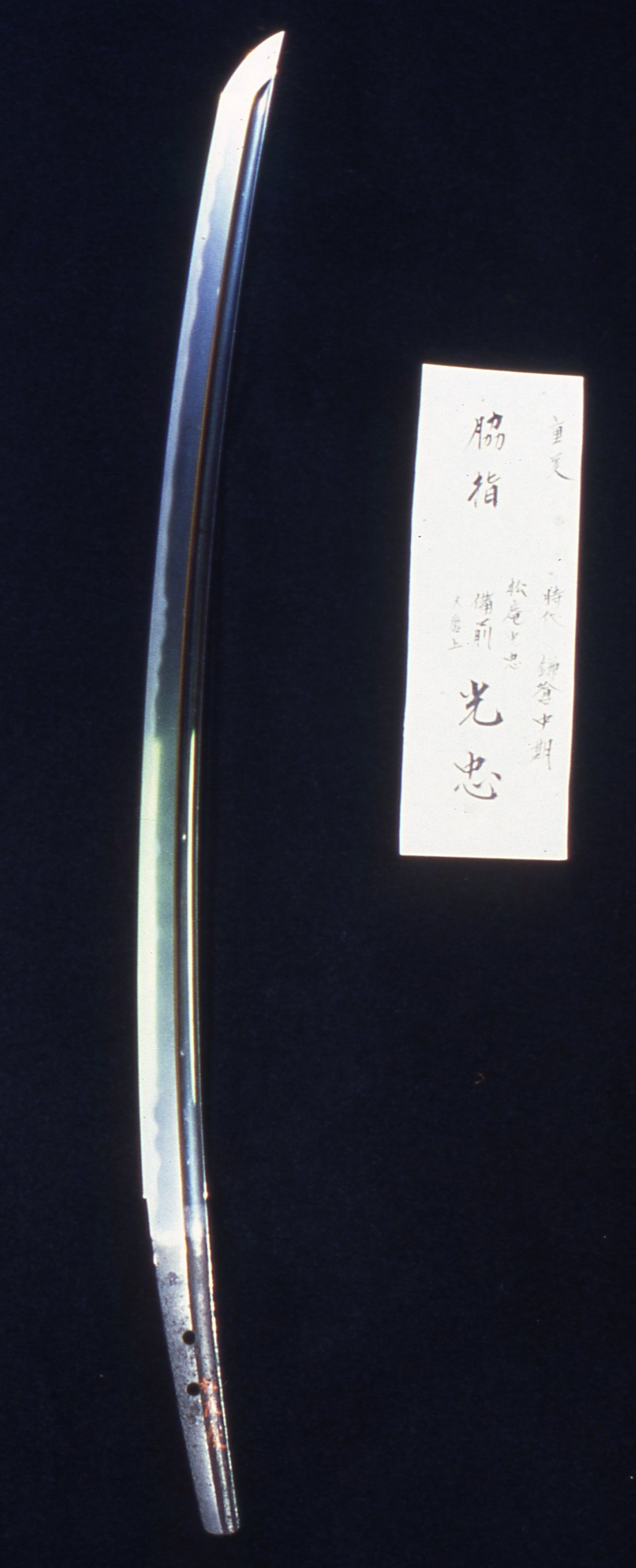
The Bizen region produced many swords of higher quality and superior to those of other sword groups and more famous swordsmiths.  Fukuoka Ichimonji Norimune (則宗) and his son Sukemune (助宗 ) received the honor of the Goban-kaji from Emperor Gotoba.   Among the Osafune group (長船), the famous Mitsutada (光忠) and Nagamitsu (長光) appeared.  My father owned four Mitsutada bladesThree tachis and one tanto.  He was so proud of owning four Mitsutada blades that he asked his tailor to monogram Mitsutada on the inside pocket of his suit jacket. 

From the Hatakeda group (畠田), Hatakeda Moriie (畠田守家), and from the Ugai (鵜飼) group, Unsho (雲生 ) and Unji (雲次) appeared.  The famous Kunimune (国宗) also emerged around this time.   Since many swordsmiths worked in the Bizen-den, many Bizen swords exist today.  Each swordsmith displayed his own characteristics in the swords.  Therefore, doing the kantei of Bizen swords can be quite complex. 

The classification of the sword ranking from the top

  1. Kokuho (国宝: National Treasure)
  2. Jyuyo Bunkazai (重要文化財: Important Cultural Property)
  3. Jyuyo Bijutsu Hin (重要美術品: Important Artwork)
  4. Juyo Token (重要刀剣: Important Sword)        more to follow

Here are my father’s four Bizen Osafune Mitsutada swords. He took these pictures many years ago at home. It is clear that he was not much of a photographer.  On a rectangular  sheet of white paper, he wrote the name of the swordsmith, the period when the sword was made, the name(s) of the daimyo who owned it in the past, and its classification.

img027               img028                Osafune Mitsutada (Juyo Bukazai)                 Osafune Mitsutada (Juyo Bunakzai)
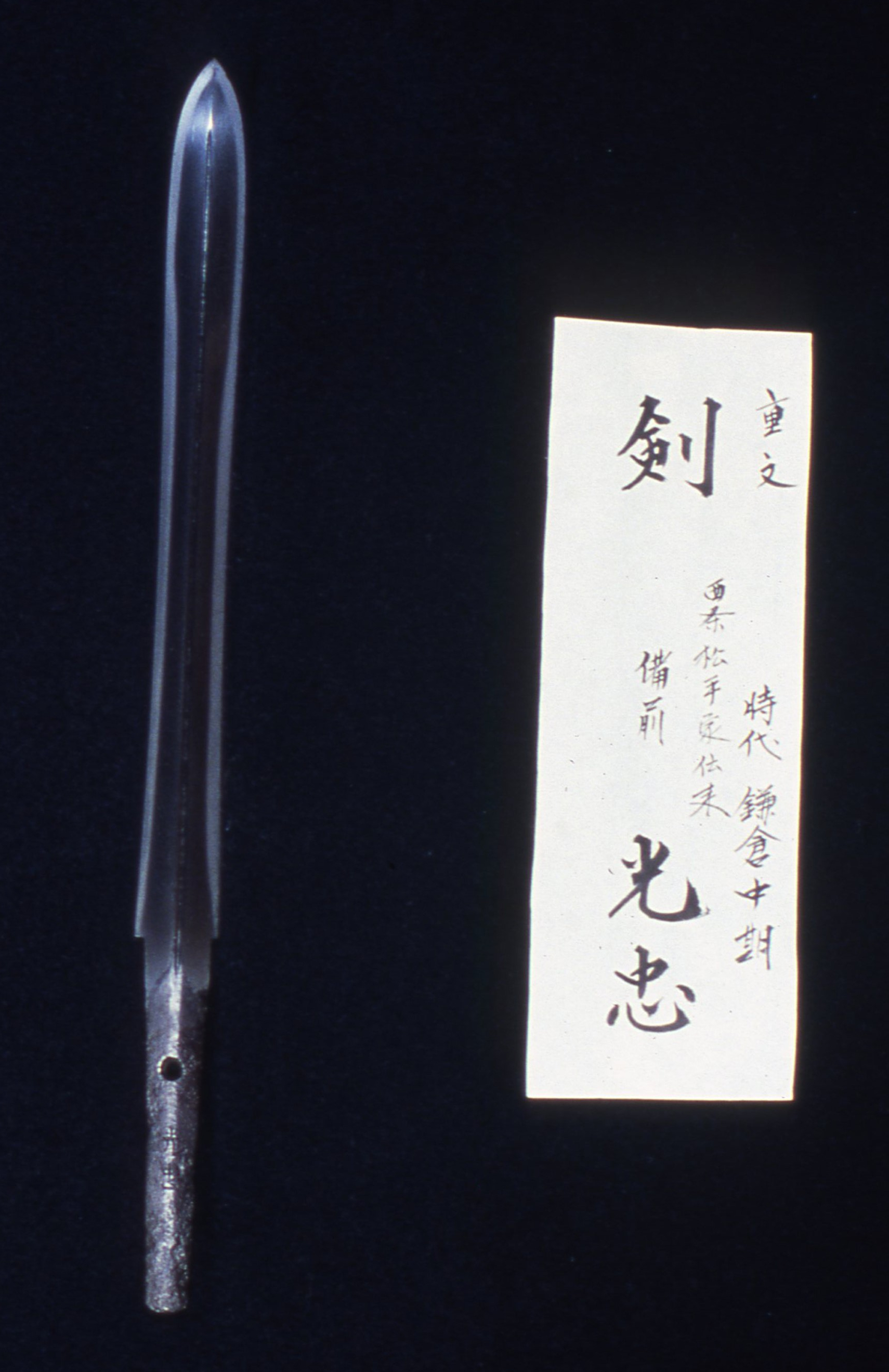
img029            img030 Osafune Mitsutada (Juyo Token)                 Osafune Mitsutada(Juyo Bunkazai)

Late Kamakura Period —– Soshu Den (相州伝 )

Yamashiro-den began to decline in the latter part of the Kamakura period.  At this time, many swordsmiths moved to the Kamakura area under the new power of the Kamakura bakufu (鎌倉幕府), led by the Hojo clan.  The new group, Soshu-den (相州伝 ), began to emerge.  Fukuoka Ichimonji Sukezane (福岡一文字助真) and Kunimune (国宗) from Bizen moved to KamakuraToroku Sakon Kunitsuna (藤六左近国綱) from the Awataguchi group of Yamashiro-den also moved to Kamakura.  These three are considered the founders of the Soshu-den in Kamakura.  Kunitsunas son was Tosaburo Yukimitsu, and his grandson was the famous Masamune (正宗)Outside Kamakura, Yamashiro Rai Kunitsugu (来国次), Go-no-Yoshihiro (郷義弘) from the Ettchu (越中) province, and Samoji  (左文字) from Chikuzen Province (筑前) were active swordsmiths.

39|Part 2 of — 6 Kamakura Period History 1192 – 1333 (鎌倉時代歴史 )

This chapter is a detailed part of Chapter 6, Kamakura Period History 1192 – 1333. Please read Chapter 6 before reading this section. Since this continues from chapter 6, some of the information here may overlap with Chapter 6.

0-timeline - size 24 Kamakura Period                         The red circle above indicates the time we discuss in this section

Taira-no-Kiyomori (平清盛)

Chapter 6, Kamakura Period History, describes two major samurai groups, the Genji (源氏) and the Heishi (平氏), at the end of the Heian period.  The leader of the Genji was Minamoto-no-Yoshitomo (源義朝), and the leader of the Heishi (or Heike) was Taira-no-Kiyomori (平清盛).  They were childhood friends.  However, due to political situations and circumstances, they became enemies by the time they reached adulthood.  After several power struggles, the Genji lost, and Taira-no-Kiyomori gained considerable power.  He favored his followers, gave them high positions, and arranged for his daughter to marry the emperor.   As a result, Kiyomori’s power went even beyond that of the emperor.  This was when people would say, “If you are not a part of the Heishi family, you are not a human being.”   A situation like this created too many opponents against him.  Eventually, the suppressed Genji and other samurai groups united, raised an army, fought the Heishi, and defeated them.

While Taira-no-Kiyomori was in power, he began trading with China, which contributed to Japan’s economic prosperity.  The picture below is the Itsukushima Jinja Shrine (厳島神社), built by Taira-no-Kiyomori.  It is registered as a UNESCO World Heritage Site.

shutterstock_252533968-600x375

From Wikipedia.  The photo is in the public domain. Author: Rdsmith4      File Itsukushima Floating Shrine.jpg 8 /05/04

Minamoto-no-Yoshitsune (源頼朝)

Minamoto-no-Yoritomo (源頼朝) was the son of Minamoto-no- Yoshitomo(源義朝).  After Yoshitomo was defeated by Taira-no-Kiyomori (平清盛), the direct bloodline of Genji, Minamoto-no-Yoritomo was sent to Izu Island.  He was in his early teens. 

Yoritomo grew up as a young man on Izu Island, where he met Hojo Masako (北条政子).  She was the daughter of Hojo Tokimasa (北条時政), a local government official.  While Tokimasa was away on a business trip to Kyoto, Yoritomo and Masako had a baby.  Tokimasa feared that if the Heishi found out about his daughter and Yoritomo, the Hojo family could get into trouble.  So, he planned to have Masako marry someone else.  However, she eloped with Yoritomo the night before the wedding.  It is said that this story was written in the famous Japanese history book “Azuma Kagami: 吾妻鏡” and a few other books.  People started to believe this was how it happened between them

However, some argue that the story might not be exactly how it happened.  Meanwhile, in Kyoto, the Heishi became very powerful and tyrannical within the central government, called Chotei (朝廷), and suppressed their opponents.  All the angry, dissatisfied groups formed an army to attack the Heishi.  Minamoto-no-Yoritomo was the leader of these opposing groups, and his army grew larger and stronger with the help of Masako‘s father, Hojo Tokimasa.  By this time, Hojo Tokimasa came to realize that he would have had a better chance if he had sided with his son-in-law.  The Genji army pushed the Heishi all the way to the southern part of Japan.  The Heishi was defeated at a place called Dan-no-Ura (壇ノ浦) near Kyushu (九州) in 1185.

Yoritomo established the Kamakura Bakufu (Kamakura government) in Kamakura.  After Yoritomo‘s death, his wife Masako proved her ability as a leader. She saved the Kamakura bakufu when the central government, Chotei, attacked it. 

Here is a well-known story about her.  When Yoritomo used to go around to visit other women in Kamakura, Masako would send her men to follow her husband and had them set fire to the house of the woman whom her husband was after.  In her mind, the Hojo were the ones who made Yoritomo the head of the Kamakura bakufu.  Without the Hojo family’s assistance, Yoritomo could not have achieved his success.

1024px-Kaguraden-Hachimangu_Kamakura

Tsurugaoka Hachiman-gu  in Kamakura  Author: Urashimataro      From Wikipedia  Photo is public domain

Tsurugaoka Hachimangu is one of the main shrines in Kamakura.  It is within walking distance of the Kamakura train station.  The photo above shows a large shrine at the top of the long stairs.  Every year on Dec 31, a large number of people visit the shrine to hear the Joya-no-kane (除夜の鐘: the night watch bells on New Year’s Eve)

Minamoto-no-Yoshitsune (源義経)

Minamoto-no-Yoritomo (源頼朝) had several half-brothers.  Taira-no-Kiyomori (平清盛) saved the lives of these young boys on the condition that they would become monks when they grew up.  For Kiyomori, they were the sons of childhood friends, after all.  One of them was Ushiwaka-maru (牛若丸: later Minamoto-no-Yoshitsune源義経), whom Taira-no-Kiyomori raised as his own child.  Ushiwaka-maru believed that Kiyomori was his father.  Later, Yoshitsune was raised at Kurama Yama Temple. 

He lived there until he became a teenager.  After that, he went to live with the O-shu Fujiwara (奥州藤原) family.   They resided in the northern part of Japan, quite a distance away from Kyoto The O-shu Fujiwara clan was very wealthy.  They had a luxurious culture there.  Because of the distance from Chotei (the central government), they acted as if they were an independent country.   They created great wealth by mining gold and trading it with countries outside Japan. 

Yoshitsune lived there quite happily for a while, but when he heard that his half-brother Yoritomo had raised an army to attack the Heishi, he decided to join them.  Yoshitsune was highly skilled in battles.  He won many famous battles, which were critical for the Genji to win the war.  

Yoritomo had a grand political plan for how to proceed to take over the Heishi’s power.   However, Yoshitsune did not understand it.  He was a skilled warrior, but not a politician.  That made Yoritomo irritated and angry with him.  On top of that, Yoshitsune became quite popular in Kyoto.  That made Yoritomo anxious, and he decided to eliminate Yoshitsune

Yoshitsune fled to O-shu, Fujiwara.  Initially, the O-shu Fujiwara protected Yoshitsune but could not hold against Yoritomo’s army.  Ultimately, Yoritomo destroyed the O-shu Fujiwara entirely in the end.  Today, a grand structure built by the O-shu Fujiwara has been restored.  You can visit “Konjiki-do: 金色堂” inside “Chuson-ji Temple: 中尊寺.”

The  Chinese knew about the wealth of O-shu Fujiwara.  Later, Marco Polo heard about this wealthy small country further east. He mentioned this wealthy small island in his book, “The Travels of Marco Polo.”  In this book, he wrote, “All the houses are made of gold,” referring to O-shu Fujiwara.  Of course, not all the houses were made of gold.


Marco Polo introduced Japan as “Zipangu” in his book.  It means the golden country. The name “Zipangu” evolved into Japan.  However, we Japanese don’t call our country  Japan.  We call it “Nihon” or “Nippon,” and both are correct. 

20|Muromachi Period History (室町時代歴史)    

0-timeline - size 24 Muromach
                   The red circle iabove ndicates the time we discuss in this section

The Muromachi period started after Ashikaga Takauji (足利尊氏) and several other key leaders ended the Nanboku-cho period.  Discussed in 17|Nanboku-cho Period History (1333-1393).

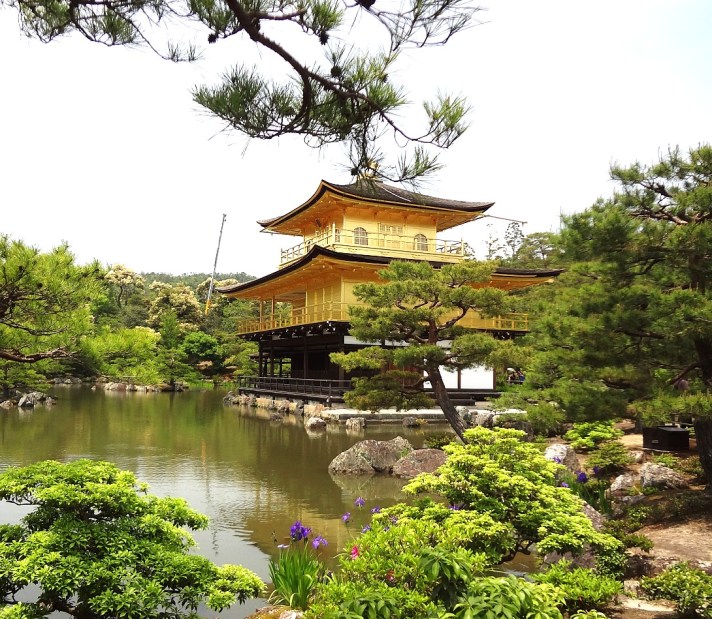
The grandson of Ashikaga Takauji, Ashikaga Yoshimitsu (足利義満, often called Shogun Yoshimitsu), constructed a beautiful new palace in the Muromachi (室町) area of Kyoto.  The palace became the center of government, known as the Muromachi bakufu (室町幕府: Muromachi government).   This is the beginning of the Muromachi period.  Ashikaga Yoshimitsu also built the famous “Kinkaku-ji Temple” * (Golden Pavilion) in Kyoto as his second residence.

Kinkaku-ji Temple* (金閣寺: Golden Pavilion) —————Ashikaga Yoshimitsu (足利義満) built Kinkaku-ji in 1397.   Later, it became a Rinzai-Shu (臨済宗) Buddhist temple, but it was originally built as the secondary residence of Ashikaga Yoshimitsu and a guest house for official visitors.  Today, it is a designated World Heritage site.  The temple was burned down by an arsonist in 1950 but was rebuilt in 1955.  Novelist Mishima Yukio wrote a novel, “Kinkaku-ji,” which relates to this temple and the arsonist.  A famous quote from his book is, “The ho-oh (a mythic golden bird, a Chinese version of the phoenix) on the roof of Kinkaku-ji Temple is stationary, but it flies through time eternally.”

During the Muromachi period, the emperor’s power declined.  The shogun (将軍) held all the political power.  Gradually, several groups of samurai who were officially appointed as shugo daimyo (守護大名: high-ranking officials) began to gain political and economic power by occupying key positions in the Muromachi bakufu.  They also owned extensive land.  Two powerful shugo daimyo families were the Hosokawa (細川) and Yamana (山名).

The Ashikaga family made great efforts to establish the Muromachi bakufu as a stable and strong government through political measures.  The beginning of the Muromachi period was peaceful and prosperous.  However, by the time Ashikaga Yoshimasa (足利義政) became the eighth shogun, the Muromachi bakufu had become severely corrupt.  Shogun Yoshimasa paid little attention to governing the country.  Instead, he pursued women (his mother scolded him for this), spent large amounts of money building the Silver Pavilion called “Ginkaku-ji Temple (銀閣寺),” and retreated there.  Since Shogun Yoshimasa did not have an heir, his brother, Yoshimi (義視), was appointed as the next shogun.

However, later, Yoshimasa’s wife, Hino Tomiko (日野富子)*, gave birth to a son, Yoshihisa (義尚).  Now, brother Yoshimi (義視) allied with the high-ranking officials, the Hosokawa (細川), while his son, Yoshihisa, allied with another powerful family, the Yamana (山名).  Several smaller samurai groups allied with either side, and the war broke out.  This war, called Onin-no-ran (応仁の乱), occurred in 1467.  It spread across the country and lasted for eleven years.

Hino Tomiko (日野富子)*————————-The wife of Shogun Yoshimasa.  She took advantage of her political privileges to generate substantial income by investing in the rice market, thereby controlling prices and selling at high profits.  Then, she loans this money to high-ranking officials at steep interest rates.  The corruption reached an uncontrollable level.

As a result of the Onin-no-ran, beautiful Kyoto was burned to the ground.  The authority of the Muromachi bakufu only extended to small areas of nearby Kyoto.  The Onin-no-ran led to the next period called the Sengoku period (戦国時代), or the Warring States period.  During the Sengoku period, Japan was divided into approximately thirty small, independent states that fought one another until Oda Nobunaga, Toyotomi Hideyoshi, and Tokugawa Ieyasu unified them.

57 Kinkakuji trip 2019

 The photo was taken in May 2019, a family trip to Kyoto

10| Jokyu-no-ran 1221 (承久の乱)

0-timeline - size 24 jyokyuu no ran
 
 The circle indicates the time we discuss in this section.

Jyokyu-no-Ran (承久の乱)

After Minamoto-no-Yoritomo (源頼朝) died, his son, Yoriie (頼家), became shogun.  His mother, Hojo Masako (北条政子), Yoritomo‘s wife, thought her son was too incompetent.  She worried others might take over the Kamakura bakufu (Kamakura government).  To prevent this, she established a council of 13 members, including herself, her father, Hojo Tokimasa (北条時政), and her brother, Hojo Yoshitoki (北条義時). 

Shogun Yoriie’s in-laws gained power over time.  During the Heian and Kamakura periods, the wife’s family was considered very important.  To suppress her son’s in-laws, Masako and her father, Tokimasa, planned and carried out Yoriie’s assassination.

After Yoriie‘s death, Masako’s younger son, Sanetomo (実朝), became the next shogun.  Now, his grandfather, Hojo Tokimasa’s second wife, wanted her son-in-law to be the next shogun.  To please his young wife, Hojo Tokimasa attempted to kill Sanetomo but failed.  When she found out about the plot, Hojo Masako imprisoned her father, Tokimasa.  Although Sanetomo was Masako’s son, she was once again very disappointed by his incompetence.  Ultimately, Shogun Sanetomo was killed by his nephew Kugyo, the son of the previous shogun, Yoriie

After all these incidents, Masako’s brother, Hojo Yoshitoki, took control of the Kamakura bakufu and installed a figurehead from the Fujiwara family, a powerful aristocratic family in Kyoto.   After all the turmoil, the Hojo family eventually gained complete control of the Kamakura bakufu (government).

Meanwhile, in Kyoto, Emperor Gotoba was planning an attack on the Kamakura bakufu.  He had built up military strength.  When Sanetomo was killed, Emperor Gotoba saw an opportunity to attack Kamakura.  He ordered local feudal lords to attack the Kamakura bakufu, but few obeyed.  Instead, the Hojo family captured the emperor and exiled him to Oki Island.  This occurred in 1221 and is known as Jokyu-no-ran or Jokyu-nohen.

Emperor Gotoba encouraged sword-making and showed respect for swordsmiths.     After the Jokyu-no-ran, the Imperial family’s power declined, and the Kamakura bakufu became a strong and stable regime.  From the time of Minamoto-no-Yoritomo‘s death until the end of the Jokyu-no-ran, the Kamakura bakufu remained unstable.  It was Hojo Masako who led the Kamakura bakufu to a stable regime.  She was called “Ama Shogun” or “Nun Shogun.”   She was a sharp, talented, yet tough, critical, and often harsh politician.

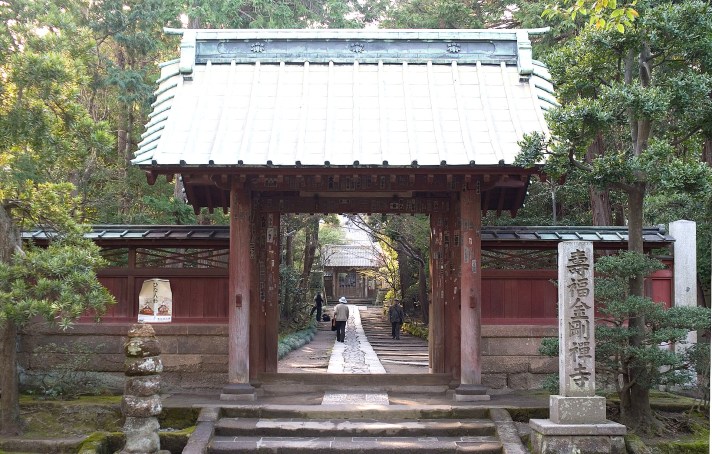
Kamakura locals, including myself, hold Hojo Masako in high regard Minamoto-no- Yoritomo and Hojo Masako are both buried in Kamakura City.  Minamoto-no-Yoritomo is at Shirahata Shrine (白幡神社), and Hojo Masako is at Jufukuji Temple (寿福寺). 

Kamakura is roughly an hour from Tokyo by train on the Yokosuka Line.  Both Jufuku-ji Temple and Shirahata Shrine are within walking distance of Kamakura Station.


Jufuku-ji (寿福寺) Temple, sourced from Wikimedia Commons, the free media repository

The tomb of Minamoto-no-Yoritomo.  From Wikimedia Commons, the free media repository.