64| Part 2 of –30 Shin Shin-To : Bakumatsu sword (新々刀)

This Chapter is a detailed Chapter of the 30|Bakumatsu Period, Shin Shin-to.  Please read Chapter 30 before reading this chapter.

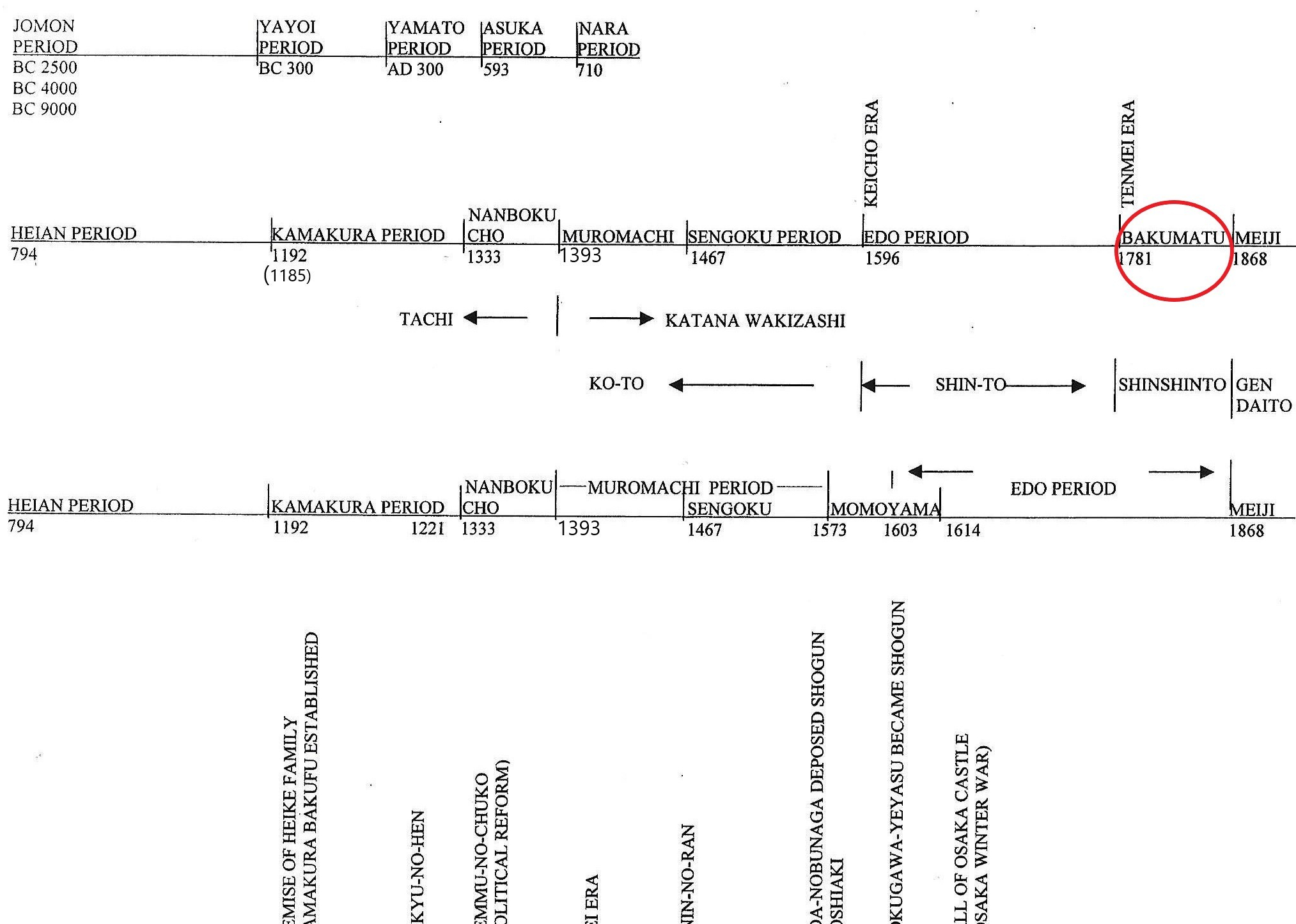
0-timeline - size 24 Bakumatsu

                  The circle Above indicates the time we discuss in this chapter.

Swords made between the Tennmei era (天明 1781) and the end of the Keio era (慶應) are called shin shin-to.  Please refer to the timeline above.  This period was when Japan was moving toward the Meiji Restoration, known as the Bakumatsu era.  During this time, sword-making became active again.  Below are the well-known swordsmiths from the main areas.

Musashi no Kuni  (武蔵の国: Tokyo today)                                                       

Suishinshi Masahide (水心子正秀) ——— When Suishinshi Masahide made Yamashiro-den style swords, their shapes resembled those of ko-to period swords; funbari, an elegant shape; chu-suguha (medium straight); komaru-boshi, with fine wood grain. When he forged in the Bizen style, he made a Koshi-zori shape, similar to a ko-to made by Bizen Osafune.  Nioi with ko-choji, and katai-ha (refer to  30| Bakumatsu Period Sword 新々刀).  In my old sword textbook, I noted that  I saw Suishinshi in November 1970 and October 1971.

Taikei Naotane (大慶直胤) ————————–Although Taikei Naotane was part of the Suishinshi group, he was one of the top swordsmiths.  He had an exceptional ability to forge a wide range of sword styles beautifully.  When he made a Bizen-den style, it resembled Nagamitsu from the Ko-to era, with nioi.  Also, he did sakasa-choji as Katayama Ichimonji had done.  Katai-ha appearsThe notes in my old textbook indicate I saw Naotane in August 1971.

Minamoto no Kiyomaro (源清麿) ————————– Kiyomaro wanted to join the Meiji Restoration movement as a samurai; however, his guardian recognized Kiyomaro’s talent as a master swordsmith and helped him become one.  It is said that because Kiyomaro had a drinking problem, he was not very eager to make swords.  At age 42, he committed seppukuKiyomaro, who lived in Yotsuya (now part of Shinjuku, Tokyo), was called Yotsuya Masamune because he was as good as Masamune.  His swords featured wide-width, shallow sori, stretched kissaki, and fukura-kereru.  The boshi is komaru-boshi.  Fine wood grain ji-gane.

Settsu no Kuni   ( 摂津の国:  Osaka today)

Gassan Sadakazu (月山貞一) ———- Gassan excelled in the Soshu-den and Bizen-den styles, but he was capable of making in any style.  He was as much a genius as Taikei Naotane.  You must pay close attention to notice a sword made by Gassan from genuine ko-to.  He also had remarkable carving skills.  His hirazukuri-kowakizashi, forged in the Soshu-den style, looks just like a Masamune or a Yukimitsu.  He forged in the Yamashiro-den style, with Takenoko-zori, hoso-suguha, or chu-suguha in nie.  Additionally, he forged the Yamato-den style with masame-hada.


61|Part 2 of — 27 Shin-to Main 7 Regions (part A)

Chapter 61 is a detailed part of Chapter 27, Shinto Main 7 Regions (part A).  Please read Chapter 27 before reading this section. 

0-timeline - size 24 Shin-to                        The red circle above indicates the time we discuss in this section

Chapter 27, Shin-to Main 7 Regions (Part A), and Chapter 28, Shin-to Main 7 Regions (Part B), describe an overview of the seven main regions.  This chapter and the next chapter show photos of representative swords from these regions.  They are Yamashiro (山城, in Kyoto), Settsu (摂津, today’s Osaka), Musashi (武蔵, Edo), and Satsuma (薩摩, Kyushu).  However, Echizen (越前), Kaga (加賀), and Hizen (肥前) are omitted.
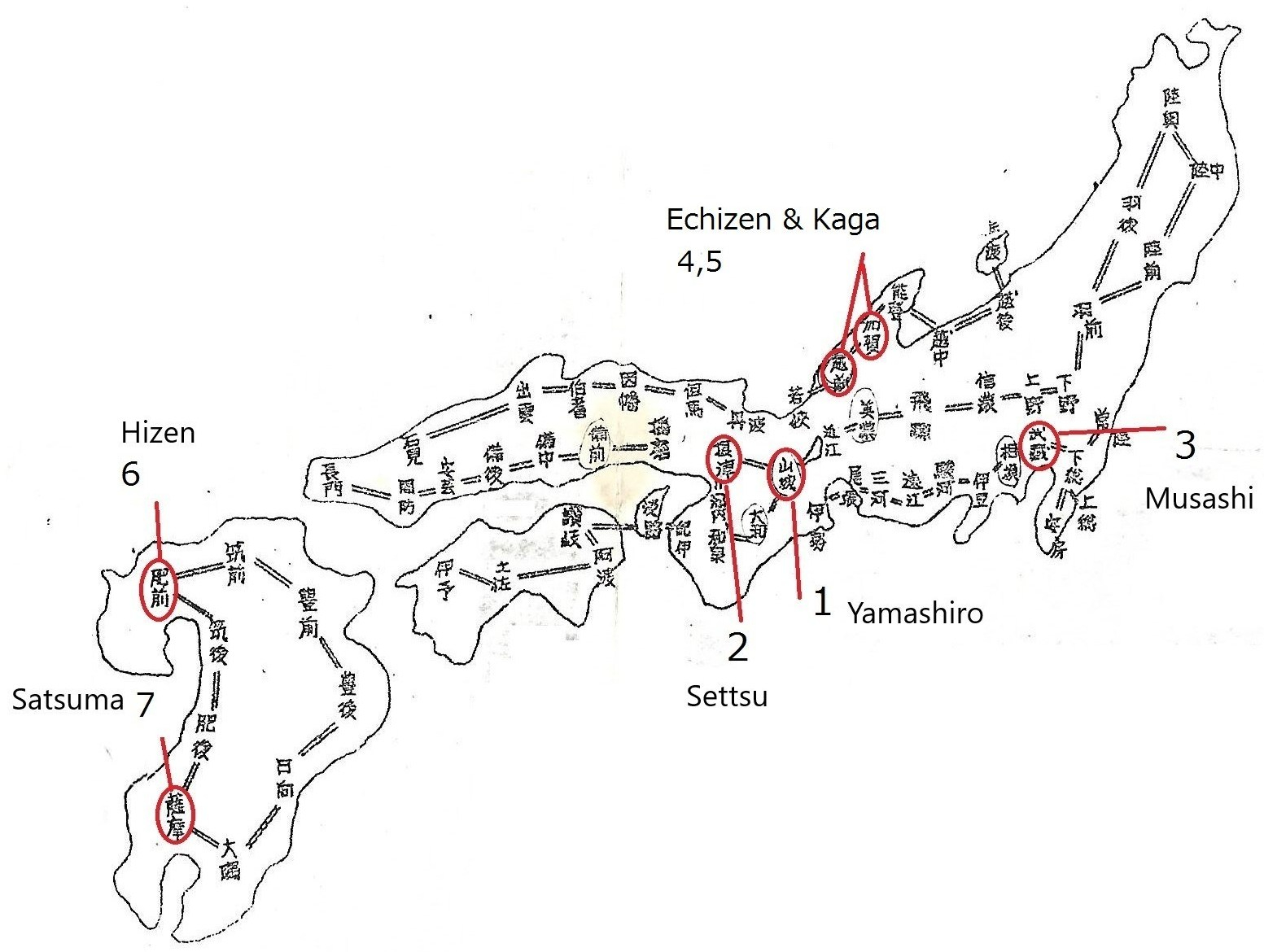
29 Map with number 7

With ko-to swords, features such as the condition of the hamon, kissaki size, length, and  shape of the nakago, etc., indicate when the sword was made.  During the ko-to period, Bizen swordsmiths produced Bizen-den swords, Yamashiro swordsmiths made Yamashiro-den swords, and Mino swordsmiths made Mino-den swords.  However, during the shin-to period, that is not the case.  The den and the swordsmith’s location often do not match.  For shin-to swords, we study the swordsmiths and swords from the seven main regions along with their characteristics.

Regarding swords made during the ko-to period, if a sword has a wide hamon line with  nie, usually, its ji-hada shows a large wood grain or a large burl grain.  Also, when you see a narrow hamon line, it typically features a fine ji-hada.

However, with shin-to swords, if a sword shows a wide hamon with nie, it often has a small wood grain or small burl grain pattern on ji-hada.  If it has a narrow hamon line, it may have a large wood grain pattern on the ji-hada.  This is a shin-to characteristic.   

Here is an exception: some early Soshu-den swords from the late Kamakura period may show a wide hamon with nie, which has small burls on the ji-hada.  Because of that, whether it is ko-to or shin-to can be confusing.  Even so, other features such as ji-hada or other parts should indicate whether it is shin-to or ko-to.

Yamashiro (山城: Kyoto)
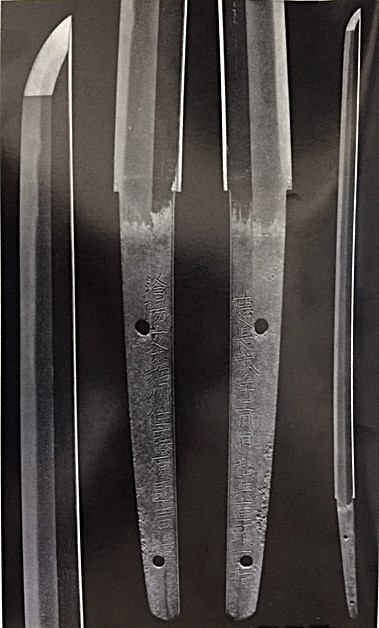
 Horikawa Kunihiro   (堀川国広)   From Sano Museum Catalogue (permission granted)

Horikawa Kunihiro (堀川国広)

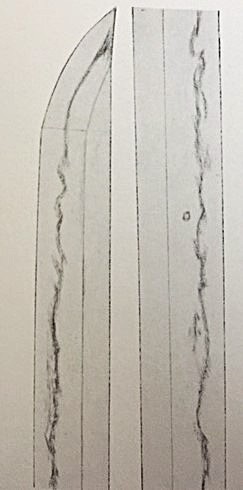
Horikawa Kunihiro was regarded as a master swordsmith among shin-to swordsmiths.  He forged swords in many styles with various characteristics.  The hamon types are o-notare, o-gunome, togari-ba (pointed hamon), chu-suguha with hotsure (frayed look), hiro-suguha with a sunagashi effect, inazuma, and kinsujiKunihiro preferred to shape his swords to resemble an o-suriage (shortened Nanboku-cho style long sword).  Kunihiro‘s blades give a powerful impression.  Kunihiro‘s swords often feature beautiful carvings; designs include dragons, Sanskrit letters, and more.  Because he created swords in many different styles, there is no general characteristic that defines his work other than the hamon mainly being nie.  His ji-hada is finely forged.                                                                                                                                                                                                                                                                                                                                                     
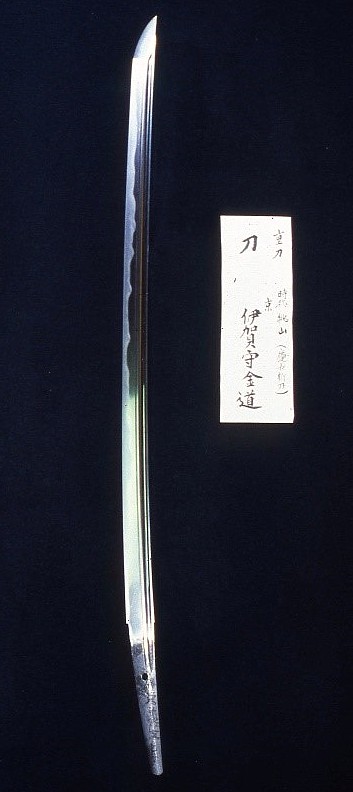
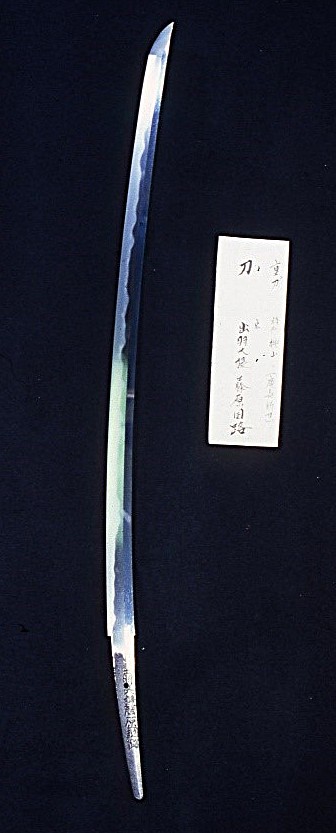
img067.jpg  img068.jpg      Iga-no-Kami Kinnmichi (伊賀守金道)           Dewa Daijyo Kunimichi (出羽大掾国路)        Both Juyo Token (重要刀剣), once my family owned, photos were taken by my father.

Iga-no-Kami Kinmichi ( 伊賀守金道)

The Kinmichi family is called the Mishina group.  Refer to 27 Shinto Main 7 Regions  Part A.   Iga-no-Kami Kinmichi was awarded the Japanese Imperial chrysanthemum crest. 

The characteristics of Kinmichi ——– Wide sword, shallow curvature, an extended kissaki, sakizori (curvature at 1/3 top),  a wide tempered line, kyo-yakidashi (see 27 Shinto Main 7 Regions  A ), hiro-suguha (wide straight hamon), o-notare (large wavy), yahazu-midare, hako-midare (refer to 24 Sengoku Period Tanto).  Mishina-boshi, refer to 27 Shin-to Main 7 Regions A.  Fine wood burl, masame appear in the shinogi-ji area.   

Dewa Daijo Kunimichi (出羽大掾国路)                                                                                 

Dewa Daijo Kunimichi was the top student of Horikawa Kunihiro.  The right photo above.  Like Kunihiro, the sword resembles a shortened Nanboku-cho sword.  Shallow curvature, a wide body, a somewhat elongated kissaki, and fukura-kareru (less arch in fukura).  Wide tempered lines, large gunome, nie with sunagashi, or inazuma shows.  Double gunome (two gunome side by side) appears.  Fine ji-hada.                                                                                                                                                                                                                

  1. Settu (摂津) Osaka (大阪 )

Settu (Osaka) is home to many famous swordsmiths.  They are Kawachi-no-Kami Kunisuke (河内守国助), Tsuda Echizen-no-Kami Sukehiro (津田越前守助広), Inoue Shinkai (井上真改), and Ikkanshi Tadatsuna (一竿子忠綱), among others.                          The main characteristic of the Settsu (Osaka) sword ——– The surface is beautiful and fine, almost like a solid surface with no pattern or design.  The two photos below are of the Settsu sword.
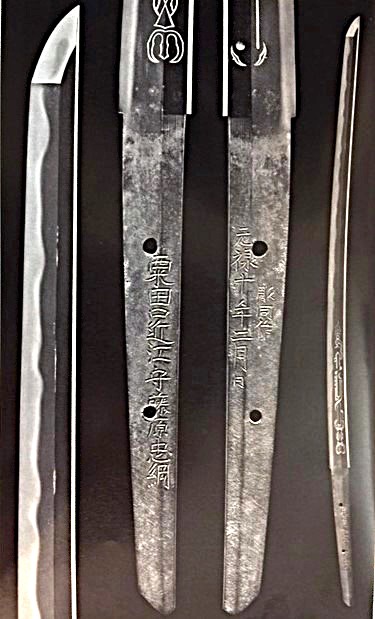
              Ikkanshi Tadatsuna from the Sano Museum Catalogue.  Permission granted to use.

Ikkanshi Tadatsuna (一竿子忠綱)

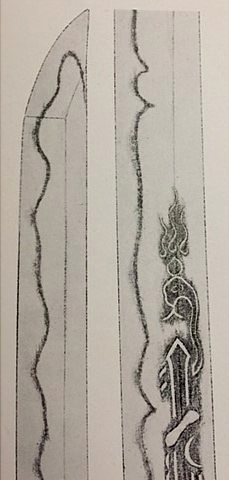
Ikkanshi Tadatsuna was famous for his carvings.  His father was also a well-known swordsmith, Omi-no-Kami Tadatsuna (近江守忠綱)Consequently, he was known as Awataguchi Omi-no-Kami Fujiwara Tadatsuna (粟田口近江守藤原忠綱), as shown in the nakago photo above.     

The characteristics of Ikkanshi Tadatsuna ——-A longer kissaki and a wide-tempered line with nie.  The Osaka yakidashi (transition between the suguha above machi and midare is smooth.  Refer to 27 Shin-to Sword – Main 7 Regions (Part A) for details on Osaka yakidashi.  O-notare with gunome, komaru-boshi with a turn back, and very fine ji-hada with almost no pattern on the surface.
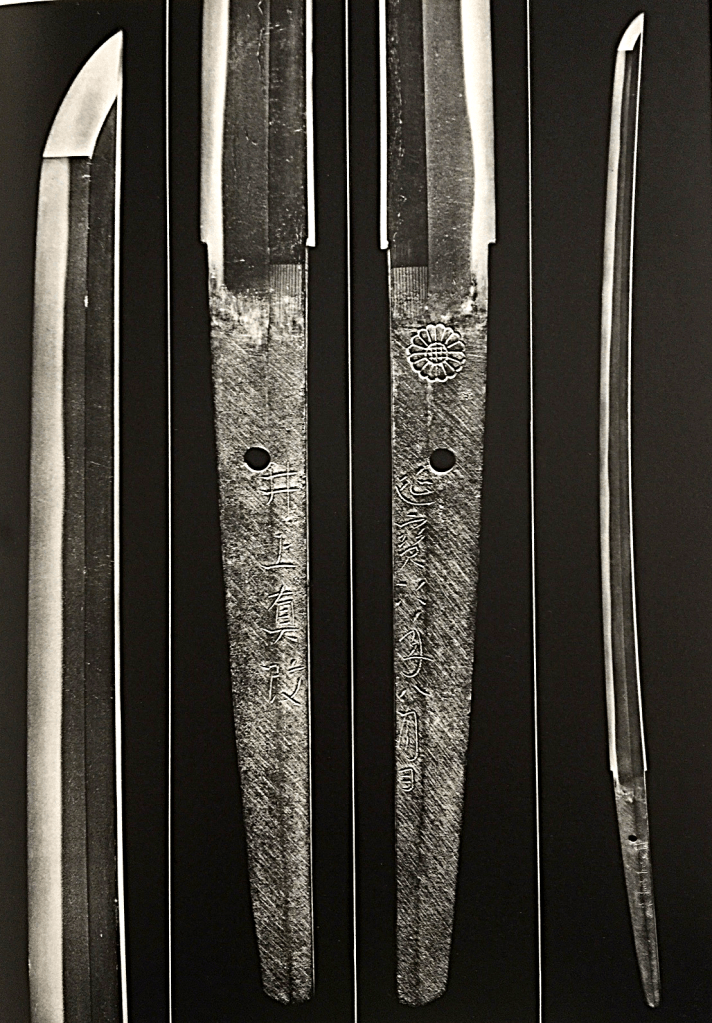
                        Inoue Shinkai (井上真改) from “Nippon-to Art Swords of Japan” The Walter A. Compton Collection

Inoue Shinkai (井上真改)

Inoue Shinkai was the second generation of Izumi-no-Kami Kunisada (和泉守国貞), who was a student of Kunihiro.                                                                                                  The characteristic of Inoue Shinkai’s swords —————- Osaka yakidashi, the tempered line gradually widens toward the top.  O-notare and deep nie.  Very fine ji-hada with almost no surface design.
56| Part 2 of — 22 Sengoku Period History (戦国時代歴史) 

Chapter 56 is a detailed section of Chapter 22, Sengoku Period History.  Please read Chapter 22, Sengoku Period History, before reading this part.


0-timeline - size 24 Sengoku Period                               
                               The circle above indicate the time we discuss in this section

Chapter 22, Sengoku Period History, explains why we divide the Muromachi period into the Muromachi and Sengoku periods based on sword styles.  The center timeline above indicates that the Sengoku period (戦国時代) ended in 1596, according to sword history. 

1596 is the start of the Keicho (慶長) era.  Swords made during and after the Keicho era are called shin-to (new swords), and swords before the Keicho era are called ko-to (old swords).  Therefore, the start of the Keicho era is the dividing line.  The swords made during the Keicho time are technically shin-to, but they are specially called Keicho shin-to.                  

Chapter 22, Sengoku Period History, describes an overview of the Sengoku period.  At the beginning of the Sengoku period, about thirty small Sengoku daimyo (warlords) fought fiercely against each other.  They formed alliances with neighboring territories on and off, and occasionally betrayed one another.  The more powerful daimyo took over the territories of the weaker ones.  Gradually, the number of daimyo decreased.   Well-known powerful daimyo include Imagawa Yoshimoto (今川義元), Takeda Shingen (武田信玄), Uesugi Kenshin (上杉謙信), Hojo Soun (北条早雲), Oda Nobunaga (織田信長),  Tokugawa Ieyasu  (徳川家康), and Toyotomi Hideyoshi (豊臣秀吉).  Their ultimate goal was to defeat their rivals and advance to Kyoto (京都) to establish themselves as the supreme political power.    

Oda Nobunaga (織田信長) defeated Imagawa Yoshimoto in Okehazama (桶狭間)

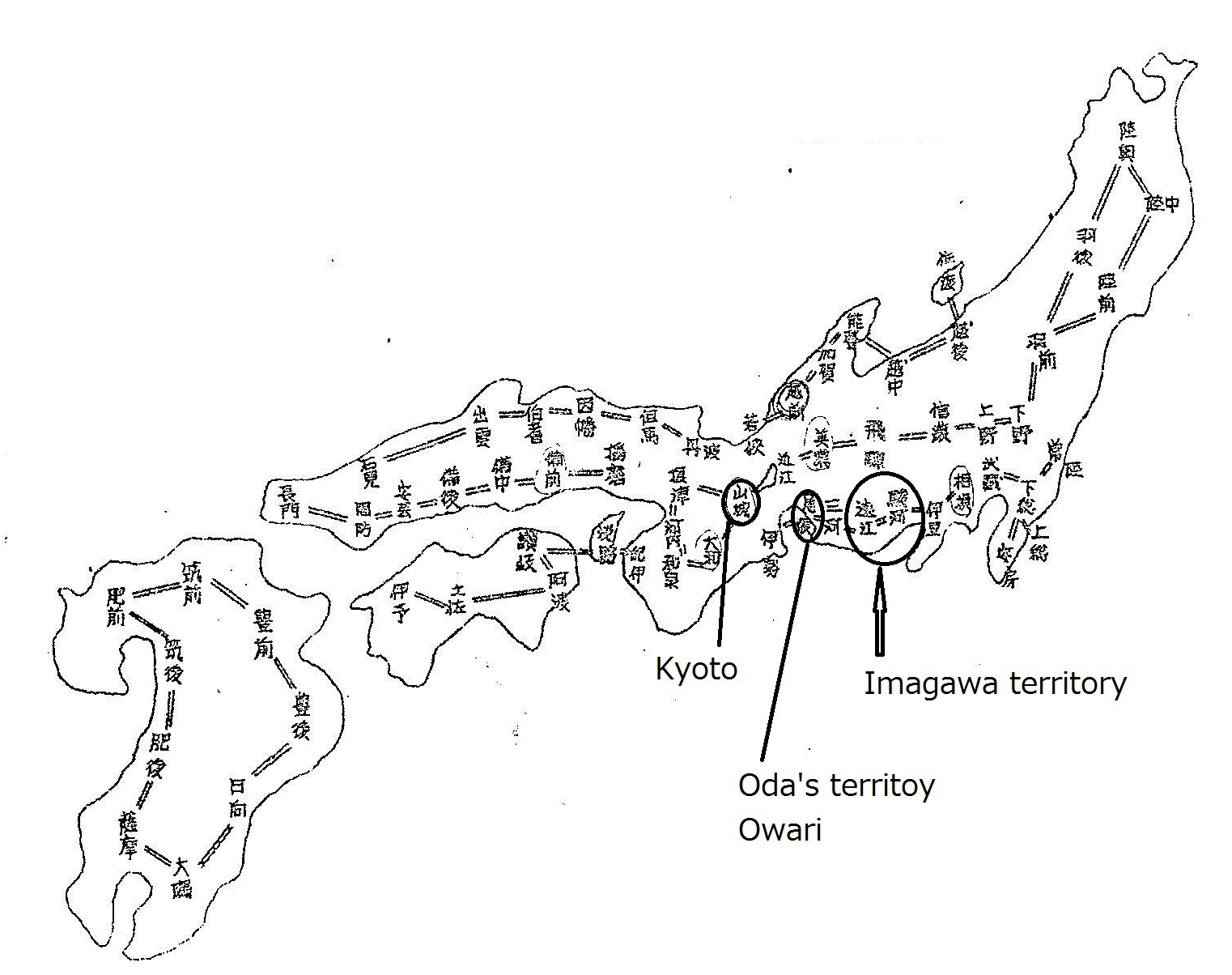
Around 1560, Imagawa Yoshimoto (今川義元) controlled a significant part of Suruga (now Shizuoka Prefecture).  See the map below for the location. He was a powerful Sengoku daimyo, strong enough to be the country’s top ruler. 

The Imagawa clan decided to move their army to Kyoto to take control of the government.  He took 25,000 men with him. On his way to Kyoto, they needed to pass through Owari (尾張: Aichi Prefecture today; see the location below), Oda Nobunaga’s territory.  

Oda Nobunaga (織田信長) was a young man with far fewer resources than Imagawa Yoshimoto.  It was clear that Oda Nobunaga had little chance of defeating Imagawa.  He had just become the head of Owari after his father’s death.  At that time, Nobunaga was called “the idiot of Owari” because of his eccentric behavior (although he was a genius). 

Few people had trusted in Nobunaga.  Among  Od’s vassals, some insisted on staying inside the castle instead of going out to fight, since Nobunaga could only gather  3,000 men.  But in the end, to everyone’s surprise, the Oda side won.  Here is how it happened. 

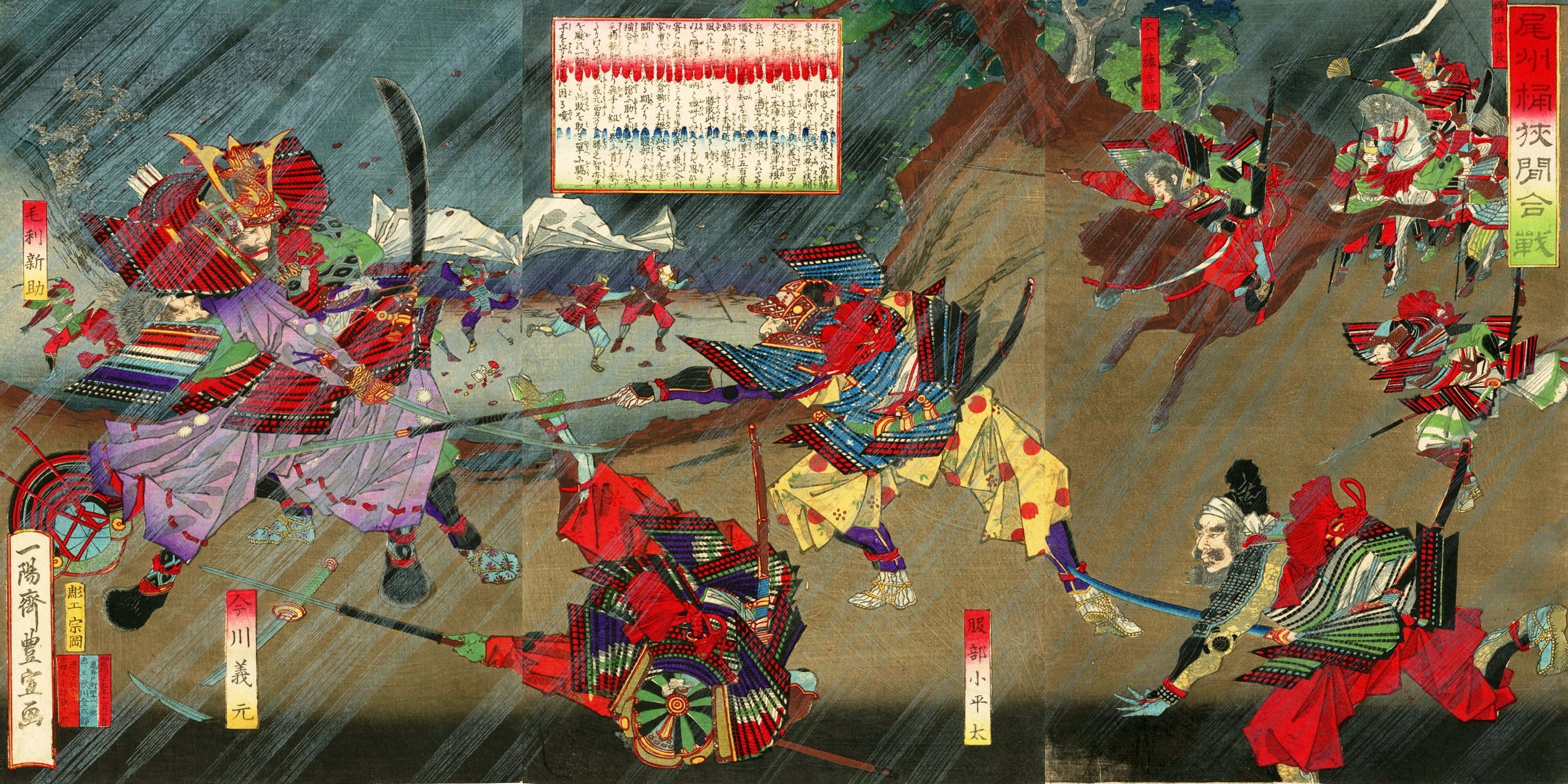
While Imagawa Yoshimoto was advancing, Nobunaga scouted which route Imagawa would take.  Imagawa’s side was confident they would win this easy battle because the Oda clan was small, and the head of the clan was an idiot.  The Imagawa troops decided to stop and rest at a place called Okehazama.  The road passing through Okehazama was long and narrow.  Knowing that Imagawa’s troops would come this way, Nobunaga sent out his men disguised as farmers and offered food and sake to the Imagawa soldiersWhile they were having a good time, Oda Nobunaga launched a surprise attack on the Imagawa troops.  On top of that, it suddenly began raining heavily.  The rain was so intense that the Imagawa troops could not see the Oda troops approaching.  Ultimately, Imagawa Yoshimoto was killed in battle by Oda forces.  Afterward, the Imagawa clan declined.

59 Okehazama drawing

Bishu Okehazama Gassen (備州桶狭間合戦) by Utagawa Toyonobu (歌川豊信)   Public Domain (http://morimiya.net/online/ukiyoe-big-files/U896.html)

59-imagawa-and-oda-map.jpg

Oda Nobunaga(織田信長) and Akechi Mitsuhide(明智光秀)

After the Battle of Okehazama, the Oda clan rapidly expanded.  Oda Nobunaga became the dominant power.  During his rule, he carried out several brutal acts, such as burning the Enryaku-ji temple (延暦寺) and killing many people, including civilians,  yet his economic policies encouraged commercial activities. 

Things were going fairly smoothly for Nobunaga late in his life.  However, in 1582, Nobunaga was killed by his top vassal, Akechi Mitsuhide (明智光秀), at the Hon’nou-ji (本能寺) temple in KyotoNobunaga was 49 years old. 

There are several theories about why Akechi attacked and killed Nobunaga, but we don’t know exactly what happened.  One speculation is that Akechi held a grudge against Nobunaga.  There were numerous incidents where Nobunaga mistreated himAnother theory suggests that Akechi saw an opportunity to attack Nobunaga (Nobunaga was with very few men that day), and he took the chance.  Another one is that Shogun Ashikaga Yoshiaki (足利義昭) and his allies ordered Akechi to kill Nobunaga because Akechi had once worked for him.  Shogun Yoshiaki was afraid Nobunaga would become too powerful.  More theories exist.  We don’t know the true reason; it is still debated today.  It remains one of the big mysteries in Japanese history.  

After this occurred, the news was sent to Toyotomi Hideyoshi, who was Akechi’s counterpart under Nobunaga.  At that time, Hideyoshi was in Bicchu (備中, today’s Okayama Prefecture ), about 230 km (143 miles) from Kyoto (see the map below).   Hideyoshi quickly returned to Kyoto with his troops to avenge his master against Akechi and killed him. 

Here is another mystery.  The time between Nobunaga’s death and Akechi’s death was only ten days.  Hideyoshi was 230 km (143 miles) away, with mountains and rivers between them.  This means that within 10 days, Hideyoshi received news of Nobunaga’s death, packed up, and hurried back 230 km (143 miles) to Kyoto with his large number of soldiers, and fought against Akechi and killed him.  Their means of transportation at the time were limited.  Although Hideyoshi maintained a constant communication channel with Nobunaga’s inner circle, his reaction was somewhat too rapid.  There are also speculations that Akechi and Hideyoshi were both behind together(?) or that there was some other secret plot behind the incidents. 

59-bicchu-map.jpg

After Hideyoshi killed Akechi, he cleverly maneuvered his way to the top of power.  While Hideyoshi was in charge, he mined enormous quantities of gold from the mines he owned.  Records state that Hideyoshi buried a large amount of gold somewhere.  However, it has not yet been found.

Hideyoshi was the son of a poor farmer who rose to become Japan’s most powerful man. His success story fascinates the Japanese people.  Nobunaga, Hideyoshi, and Tokugawa Ieyasu are the most frequently depicted subjects in television shows and films.  After Hideyoshi died of natural causes, Tokugawa Ieyasu became Shogun, and the Edo period began.

The reference source                                                                                                      *Rekijin.com/?p=31448-キャッシュ                                                                                    *Bushoojapan.com/scandal/2019/06/02/51145-キャッシュ            

30| Shin-Shin-To 1781-1867 (Bakumatsu Period Sword 新々刀)

0-timeline - size 24 BakumatsuThe red circle indicates the time we discuss in this section

The later part of the Edo period is called Bakumatsu.  See the circled area on the timeline above.  Swords made during this time are called shin shin-to.   They are also called Fukko-to (復古刀: revived sword).  Fukko-to replicates the shape, hamon, boshi, and other features of the Ko-to and Shin-to swords.  The characteristics of the Shin Shin-to (新々刀) and well-known swordsmiths are listed below.

The Characteristics of Shin Shin-to

  • Katana, wakizashi, and tanto all tend to resemble or imitate the ko-to and shin-to in shape.
  • Many swords often have a Hi or detailed engravings.
  • One swordsmith would create multiple sword styles, such as Soshu-den, Bizen-den, and Shin-to style.
  • Often shows Katai-ha.

30 katai-ha

                                                                  Katai-ha

  • Weak (not tight) Nioi.
  • Yakidashi (2 to 3 inches above machi) is often suguha(straight line hamon), even though the rest of the area has irregular    Boshi is often irregular midare.
  • Detailed engravings are more realistic than those from earlier times.

Well-known swordsmiths of Shin Shin-to

  • Settsu (Osaka area) ——————Gassan Sadayoshi (月山貞吉), Gassan Sadakazu (月山貞一). The Gassan family is known for their detailed carvings.
  • Musashi no Kuni (Tokyo area) ————-Suishinshi Masahide (水心子正秀),  Minamoto Kiyomaro (源 清麿),  Taikei Naotane (大慶直胤),  Taikei Yoshitane (大慶義胤).  Yoshitane is well-known for his carvings.                                               

Minamoto Kiyomaro(源清麿)    Once my family possession

  • Tosa (四国: Shikoku area) ———————————————- Sa Yukihide (左行秀)
  • Satsuma (鹿児島: Kagoshima) ———— Oku Moptohira (奥元平) Namino Hira (波平)

Meiji Ishin-To

Right before the Meiji Restoration, long swords (about 3 feet) without any curvature were made.  Sa Yukihide (from the Tosa area) forged this type of sword.  Saigo Takamori (西郷隆盛) and Sakamoto Ryoma (坂本龍馬) owned such swords.  Both are well-known historical figures from the Meiji Restoration.  Both were part of the Kin’no-to (勤皇党) group, which supported the emperor and reformed the political system.