64| Part 2 of –30 Shin Shin-To : Bakumatsu sword (新々刀)

This Chapter is a detailed Chapter of the 30|Bakumatsu Period, Shin Shin-to.  Please read Chapter 30 before reading this chapter.
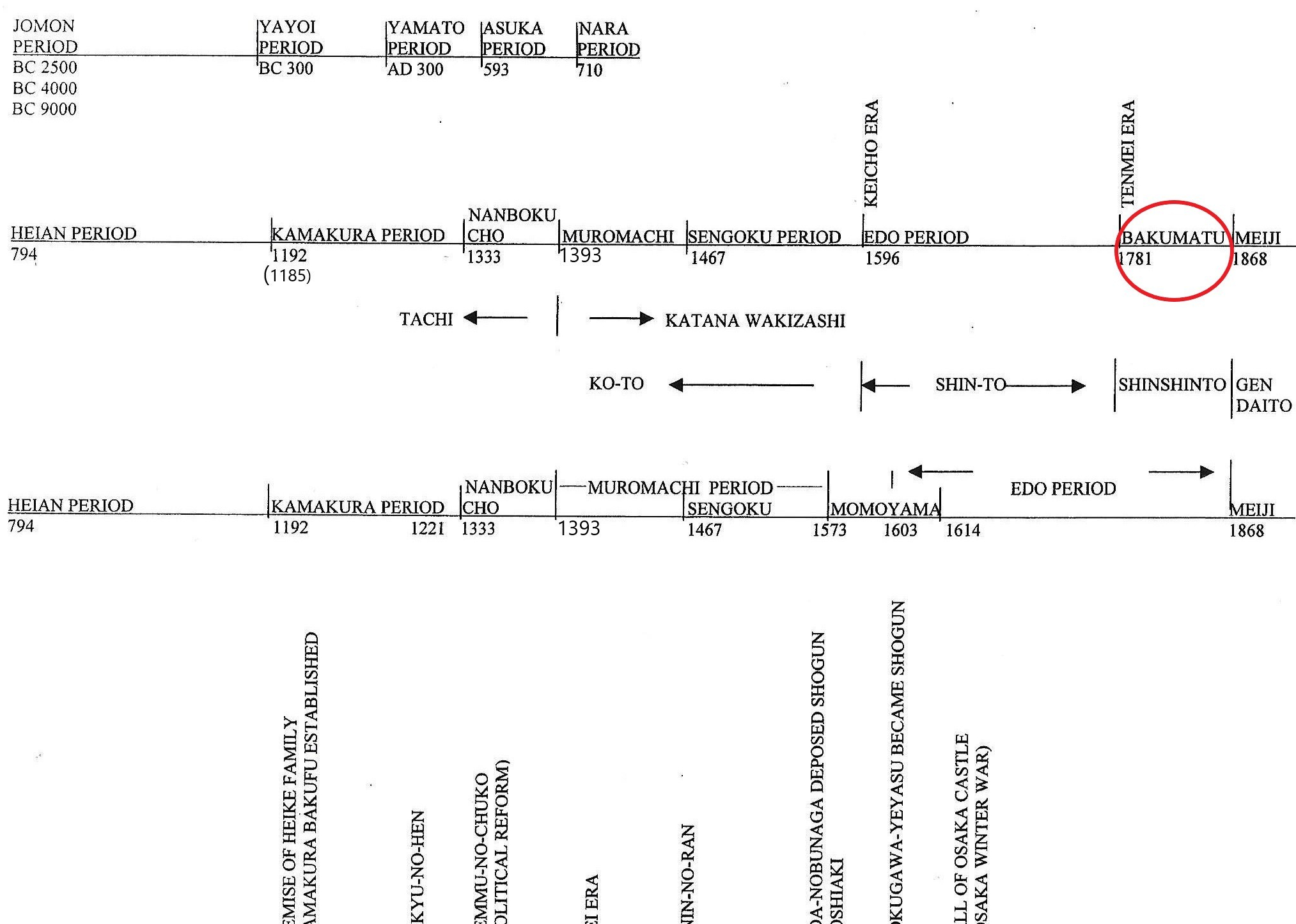
0-timeline - size 24 Bakumatsu

                  The circle Above indicates the time we discuss in this chapter.

Swords made between the Tennmei era (天明 1781) and the end of the Keio era (慶應) are called shin shin-to.  Please refer to the timeline above.  This period was when Japan was moving toward the Meiji Restoration, known as the Bakumatsu era.  During this time, sword-making became active again.  Below are the well-known swordsmiths from the main areas.

Musashi no Kuni  (武蔵の国: Tokyo today)                                                       

Suishinshi Masahide (水心子正秀) ——— When Suishinshi Masahide made Yamashiro-den style swords, their shapes resembled those of ko-to period swords; funbari, an elegant shape; chu-suguha (medium straight); komaru-boshi, with fine wood grain. When he forged in the Bizen style, he made a Koshi-zori shape, similar to a ko-to made by Bizen Osafune.  Nioi with ko-choji, and katai-ha (refer to  30| Bakumatsu Period Sword 新々刀).  In my old sword textbook, I noted that  I saw Suishinshi in November 1970 and October 1971.

Taikei Naotane (大慶直胤) ————————–Although Taikei Naotane was part of the Suishinshi group, he was one of the top swordsmiths.  He had an exceptional ability to forge a wide range of sword styles beautifully.  When he made a Bizen-den style, it resembled Nagamitsu from the Ko-to era, with nioi.  Also, he did sakasa-choji as Katayama Ichimonji had done.  Katai-ha appearsThe notes in my old textbook indicate I saw Naotane in August 1971.

Minamoto no Kiyomaro (源清麿) ————————– Kiyomaro wanted to join the Meiji Restoration movement as a samurai; however, his guardian recognized Kiyomaro’s talent as a master swordsmith and helped him become one.  It is said that because Kiyomaro had a drinking problem, he was not very eager to make swords.  At age 42, he committed seppukuKiyomaro, who lived in Yotsuya (now part of Shinjuku, Tokyo), was called Yotsuya Masamune because he was as good as Masamune.  His swords featured wide-width, shallow sori, stretched kissaki, and fukura-kereru.  The boshi is komaru-boshi.  Fine wood grain ji-gane.

Settsu no Kuni   ( 摂津の国:  Osaka today)

Gassan Sadakazu (月山貞一) ———- Gassan excelled in the Soshu-den and Bizen-den styles, but he was capable of making in any style.  He was as much a genius as Taikei Naotane.  You must pay close attention to notice a sword made by Gassan from genuine ko-to.  He also had remarkable carving skills.  His hirazukuri-kowakizashi, forged in the Soshu-den style, looks just like a Masamune or a Yukimitsu.  He forged in the Yamashiro-den style, with Takenoko-zori, hoso-suguha, or chu-suguha in nie.  Additionally, he forged the Yamato-den style with masame-hada.


40|Part 2 of — 7 Overview of Kamakura Period Sword (鎌倉太刀概要)

This chapter is a detailed part of Chapter 7, an overview of the Kamakura Period Swords.  Please read  Chapter 7, Overview of the Kamakura Period Swords, before reading this section. 

0-timeline - size 24 Kamakura Period

                         The red circle above indicates the time we discuss in this section.

The Kamakura period was a golden age of sword-making.  About half of the well-known swords today were produced during this time.  This is probably because the war between the Genji and the Heishi demanded many swords, and swordsmiths improved their skills through wartime experience.  Also, Emperor Gotoba (後鳥羽) invited many talented swordsmiths to his palace, treated them favorably, and encouraged them to create excellent swords by granting them high ranks.  During the Kamakura period, sword-making techniques greatly improved.

Middle Kamakura Period —- Yamashiro-den (山城伝)

The middle Kamakura period was the height of the Yamashiro-den.  Within the Yamashiro-den, there were three main groups: the Ayanokoji group (綾小路), Awataguchi group (粟田口), and Rai group (来).                                                                                                                       Among the Awataguchi group, six swordsmiths received the honor of “Goban-kaji ” from Emperor Gotoba (後鳥羽上皇).  Awataguchi is the name of an area in Kyoto. 

The Ayanokoji ( 綾小路 ) group lived in the Ayanokoji area of Kyoto.  My sword textbook had a note indicating that I had seen Ayanokoji Sadatoshi (綾小路定利) on March 22, 1972.  My note was brief, only a few words: o-suriage, funbari, narrowbody, and ji-nie

The Rai group originated from Rai Kuniyuki (来国行 ).  Rai Kuniyuki and Ayanokoji Sadatoshi were believed to have been close friends.  Rai Kuniyuki created many well-known swords.  His famous Fudo Kuniyuki (不動国行) was once owned by Shogun Ashikaga Yoshiteru (足利義輝 ), then passed to Matsunaga Danjo (松永弾正), then to Oda Nobunaga ( 織田信長 ), then to Akechi Mitsuhide (明智光秀 ), and eventually to Toyotomi Hideyoshi (豊臣秀吉).  All of them were historically famous and influential daimyo.  It is said that Toyotomi Hideyoshi held this sword during the memorial service for Oda Nobunaga.  Rai Kuniyuki’s son was Niji Kunitoshi.  He also forged well-known swords. 

Middle Kamakura Period —– Bizen-den (備前伝)                                                              

The Bizen-den during the Heian period was called Ko-bizen.  They are similar to those in the Yamashiro-den style.  The true height of the Bizen-den was during the middle Kamakura period.  The Bizen area (today’s Okayama Prefecture) had many ideal conditions for sword-making: a good climate, abundant iron resources, plenty of wood for fuel, and a convenient location.  Naturally, many swordsmiths moved there, and it became a major center for sword production. 

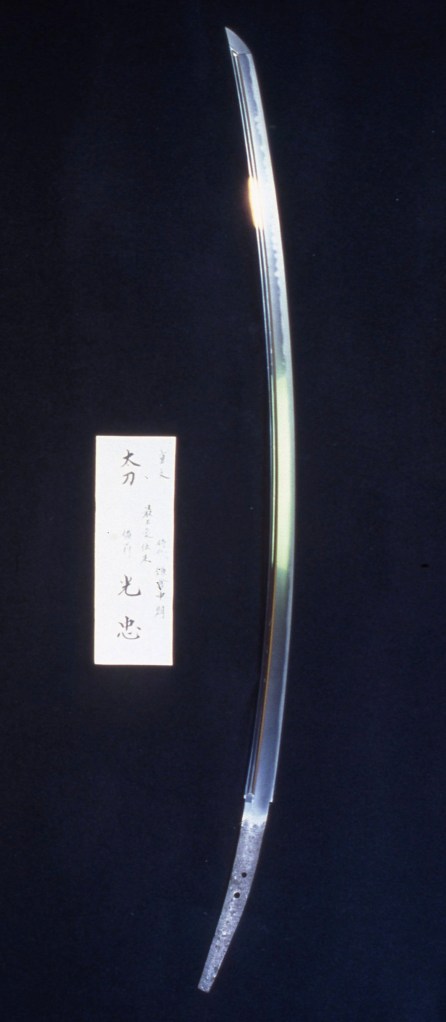
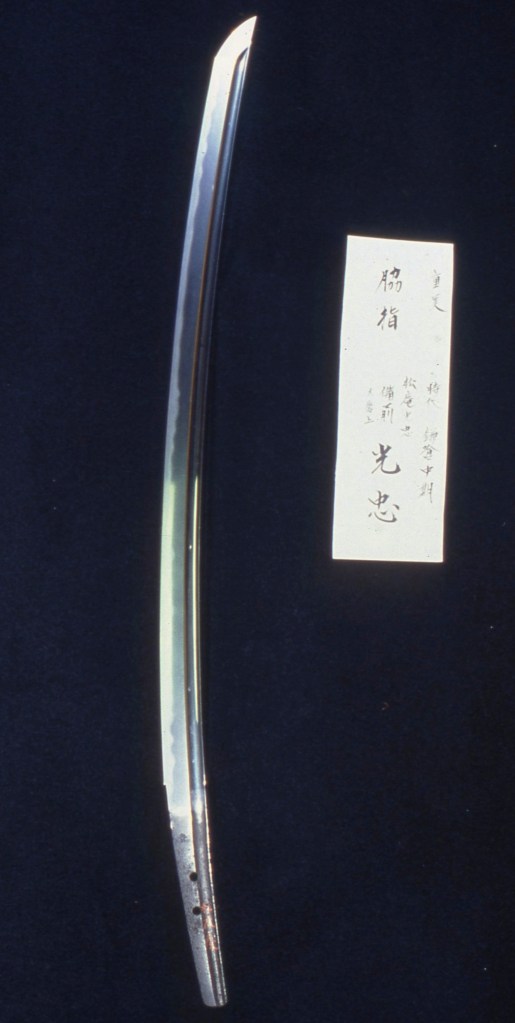
The Bizen region produced many swords of higher quality and superior to those of other sword groups and more famous swordsmiths.  Fukuoka Ichimonji Norimune (則宗) and his son Sukemune (助宗 ) received the honor of the Goban-kaji from Emperor Gotoba.   Among the Osafune group (長船), the famous Mitsutada (光忠) and Nagamitsu (長光) appeared.  My father owned four Mitsutada bladesThree tachis and one tanto.  He was so proud of owning four Mitsutada blades that he asked his tailor to monogram Mitsutada on the inside pocket of his suit jacket. 

From the Hatakeda group (畠田), Hatakeda Moriie (畠田守家), and from the Ugai (鵜飼) group, Unsho (雲生 ) and Unji (雲次) appeared.  The famous Kunimune (国宗) also emerged around this time.   Since many swordsmiths worked in the Bizen-den, many Bizen swords exist today.  Each swordsmith displayed his own characteristics in the swords.  Therefore, doing the kantei of Bizen swords can be quite complex. 

The classification of the sword ranking from the top

  1. Kokuho (国宝: National Treasure)
  2. Jyuyo Bunkazai (重要文化財: Important Cultural Property)
  3. Jyuyo Bijutsu Hin (重要美術品: Important Artwork)
  4. Juyo Token (重要刀剣: Important Sword)        more to follow

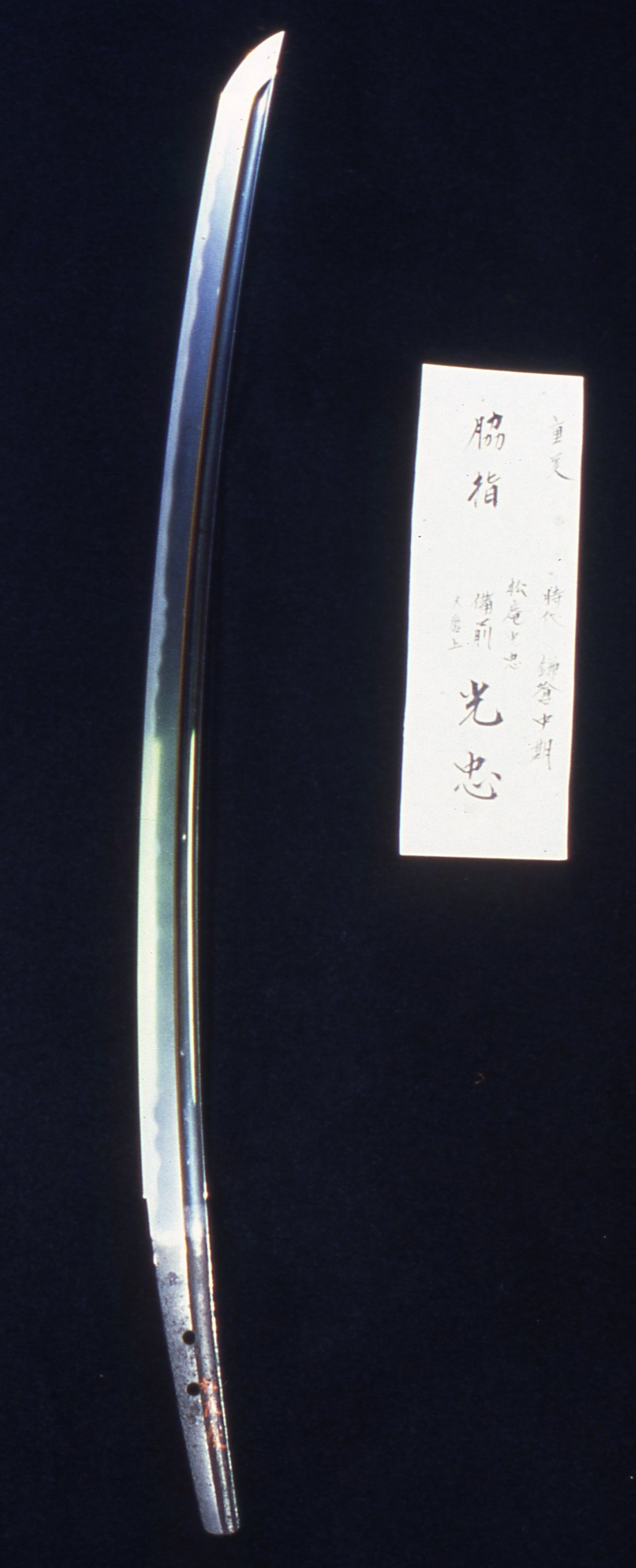
Here are my father’s four Bizen Osafune Mitsutada swords. He took these pictures many years ago at home. It is clear that he was not much of a photographer.  On a rectangular  sheet of white paper, he wrote the name of the swordsmith, the period when the sword was made, the name(s) of the daimyo who owned it in the past, and its classification.

img027               img028                Osafune Mitsutada (Juyo Bukazai)                 Osafune Mitsutada (Juyo Bunakzai)
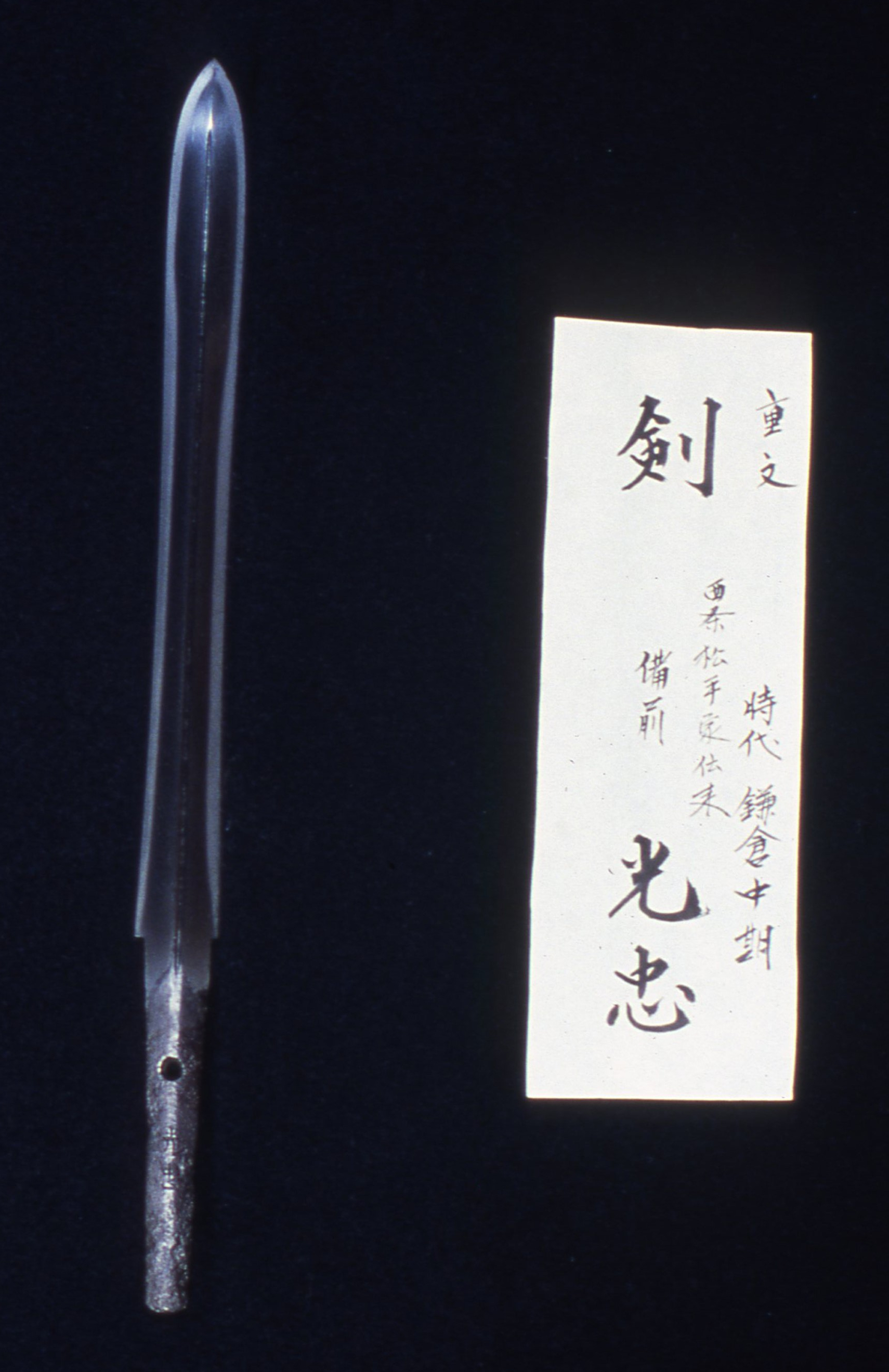
img029            img030 Osafune Mitsutada (Juyo Token)                 Osafune Mitsutada(Juyo Bunkazai)
Late Kamakura Period —– Soshu Den (相州伝 )

Yamashiro-den began to decline in the latter part of the Kamakura period.  At this time, many swordsmiths moved to the Kamakura area under the new power of the Kamakura bakufu (鎌倉幕府), led by the Hojo clan.  The new group, Soshu-den (相州伝 ), began to emerge.  Fukuoka Ichimonji Sukezane (福岡一文字助真) and Kunimune (国宗) from Bizen moved to KamakuraToroku Sakon Kunitsuna (藤六左近国綱) from the Awataguchi group of Yamashiro-den also moved to Kamakura.  These three are considered the founders of the Soshu-den in Kamakura.  Kunitsunas son was Tosaburo Yukimitsu, and his grandson was the famous Masamune (正宗)Outside Kamakura, Yamashiro Rai Kunitsugu (来国次), Go-no-Yoshihiro (郷義弘) from the Ettchu (越中) province, and Samoji  (左文字) from Chikuzen Province (筑前) were active swordsmiths.

11| Ikubi Kissaki (猪首切先)

 
0-timeline - size 24 Middle Kamakura
 
The circle indicates the time we discuss in this chapter.

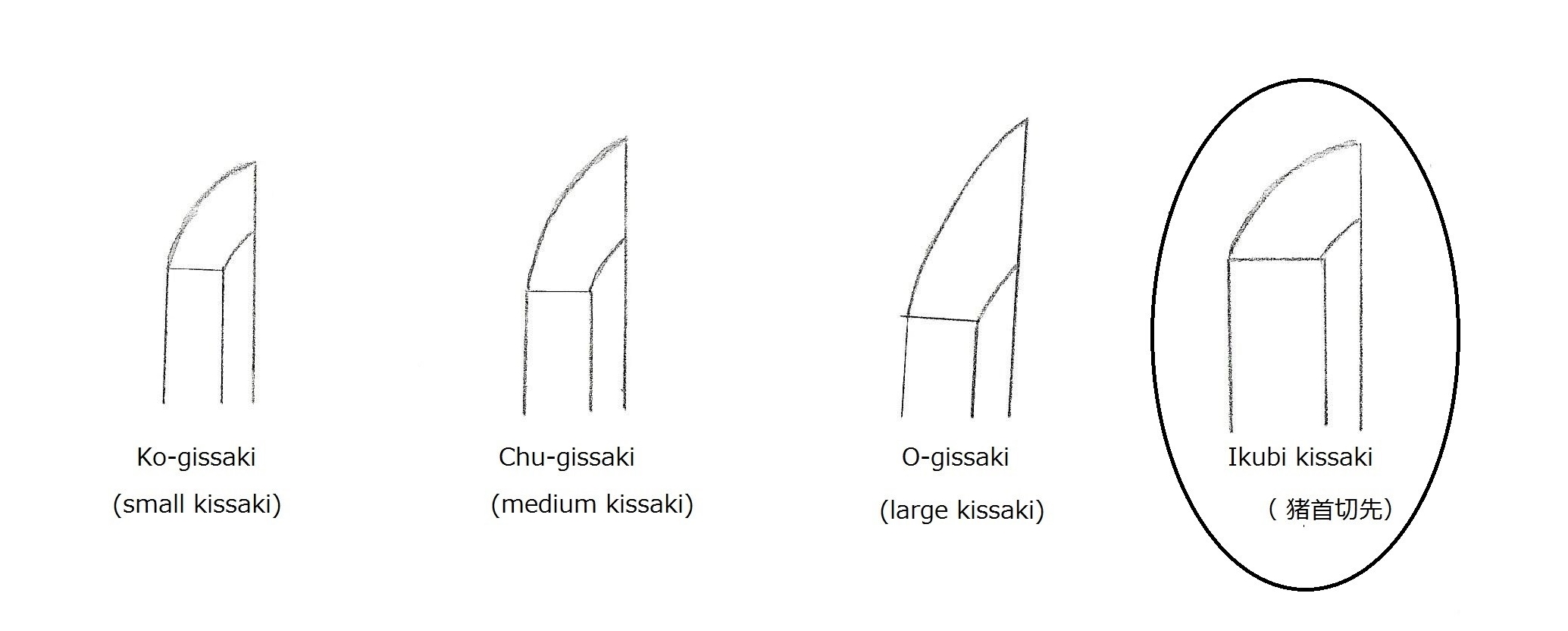
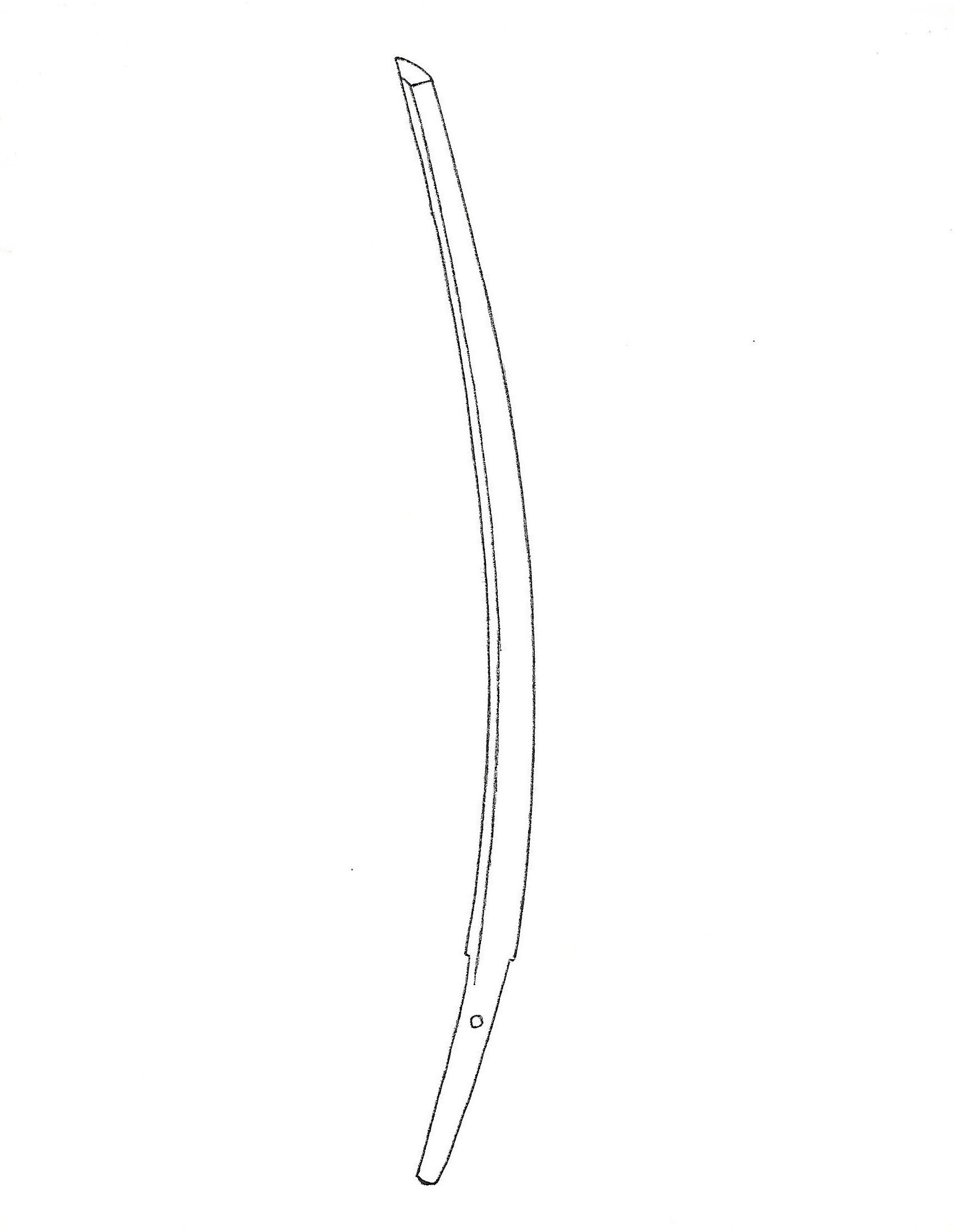
Through the experience of the Jokyu-no-ran war (Chapter 10), the design of the swords shifted to a wider, sturdier, and more impressive style.  The swords made around this time are called “ikubi-kissaki. “  Ikubi means a wild boar’s neck.  The kissaki area of ikubi-kissaki-style swords resembles a boar’s neck, with a somewhat stout appearance.

The middle Kamakura period was the golden age of Japanese sword-making.  Many top swordsmiths created exceptional swords during this time.  Experts agree that there are no mediocre swords among Ikubi-kissaki swords.

IkubiKissakiSword  12 Ikubi Kissaki sword style

SUGATA (shape) —————— Originally 3 feet or longer, these blades were often shortened in later years.  Wide width.  Thick kasane (thick body) with hamaguri-ha, meaning the sword’s cross-section is shaped like a clam.  The difference in width between the near yokote line and the machi is minimal.  The shinogi is high and narrow.  The cross-section of an Ikubi-kissaki sword is shown below. 

12 蛤刃と鎬

KISSAKI  ————- Ikubi-kissakiIkubi means the neck of a wild boar.  It is thick, short, and stout in appearance.  Kissaki is short and wide at the yokote line.  The illustration below shows an exaggerated image of an Ikubi-kissaki.

12 Ikubi Kissak drawing

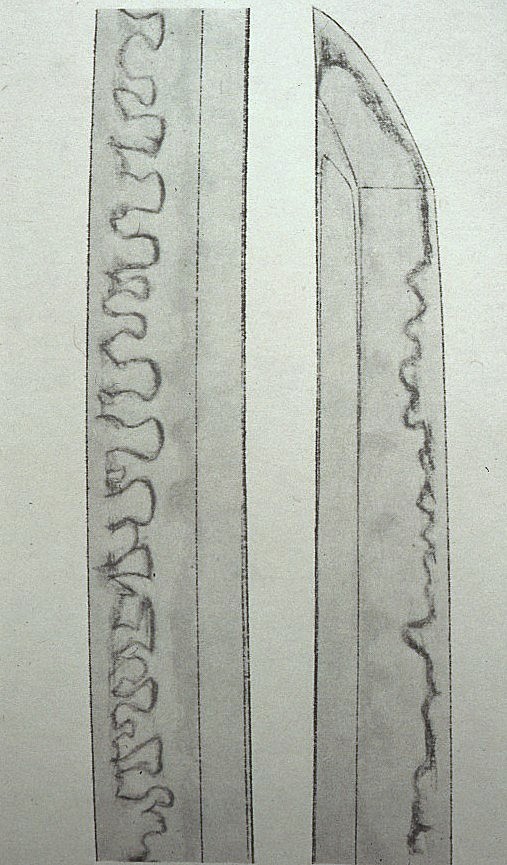
Hamon (刃文) —— Kawazuko-choji (tadpole-head shape pattern). O-choji (large clove-shape pattern), ko-choji (small clove-shape), a mixture of o-choji and ko-choji, or suguha-chojiSuguha-choji features a straight line combined with a choji (clove-shape) pattern.  

12 Hamon Kawazuko-choji                     O-choji                          Ko-choji                  Suguha-choji     (tadpole head)                   (large clove)                (small clove)      (straight and clove)
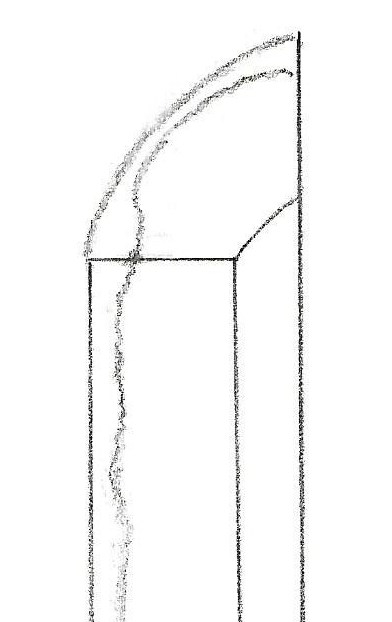
Boshi (鋩子) ——Yakizume: the hamon ends almost at the tip of the kissaki, with no return. Sansaku Boshi: the hamon narrows at the yokote line, created by Nagamitsu (長光), Kagemitsu (景光), and Sanenaga (真長).  See below for Yakizume and Sansaku Boshi.                           


12 Yakizume

   Yakizume       11 Sansaku Boshi(三作Sansaku-boshi

Ikubi Kissaki Sword Smiths

Fukuoka Ichimonji Group (福岡一文字) —————Fukuoka Ichimonji Norimune (則宗) Kamakura Ichimonji Group(鎌倉一文字) ———— Kamakura Ichimonji Sukezane (助真) Soshu Bizen Kunimune Group(相州備前国宗)——– Soshu Bizen Kunimune (国宗)Bizen Osafune Group(長船)——————Bizen Osafune Mitutada(長船光忠) Nagamitsu(長光)   Ugai Group————————————————————————- Ugai Unji (鵜飼雲次)

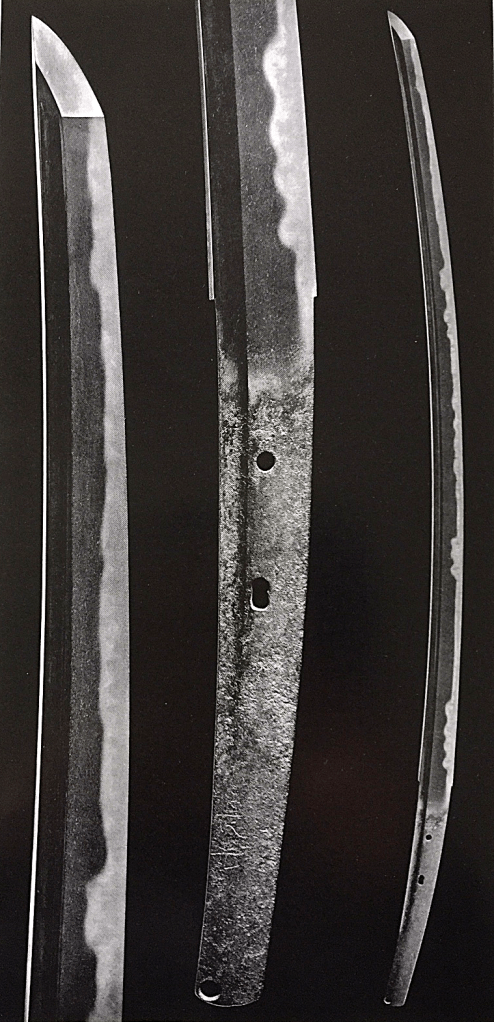
     Osafune Nagamitsu(長船長光)    From Sano Museum Catalogue (permission granted)   

     Osafune Mitsutada(長船光忠)                          Osafune Mitsutada(長船光忠)                   

 Once my family sword.  My father did the calligraphy and took these pictures for himself. 

9 | Middle Kamakura Period: Bizen Den (鎌倉中期備前伝)

0-timeline - size 24 Middle Kamakura
The circle indicates the time we discuss in this section 

Many swordsmiths worked in the Bizen (備前) school during the early Kamakura period.  However, their sword style is generally somewhat similar to the Yamashiro style.  Therefore, they are called Ko-bizen (古備前), meaning old Bizen.

The true Bizen school style appeared during the Middle Kamakura period.  Bizen Province had many advantages for producing great swords.  The area produced high-quality iron and abundant firewood.  Also, its location was conveniently located for people to travel from different regions.  As a result, many swordsmiths gathered there and produced large quantities of swords.  Due to competition among these smiths, the quality of Bizen swords is generally higher than that of other schools.  Therefore, it is often difficult to appraise Bizen swords because of the many subtle differences among the different swordsmiths.

The following three features are the most distinctive characteristics of the Bizen school.  

1.   Nioi-base tempered line.  The Nioi-base tempered line has finer dots than the Nie-base.   These dots are so small that they almost appear as a line. Technically, the tempering processes of these two are identical.  See the illustration below.                        2.   Ji-hada (surface of the body) appears soft.                                                                  3.  Reflection (utsuri) appears on the surface.

10 Nie & Nioi

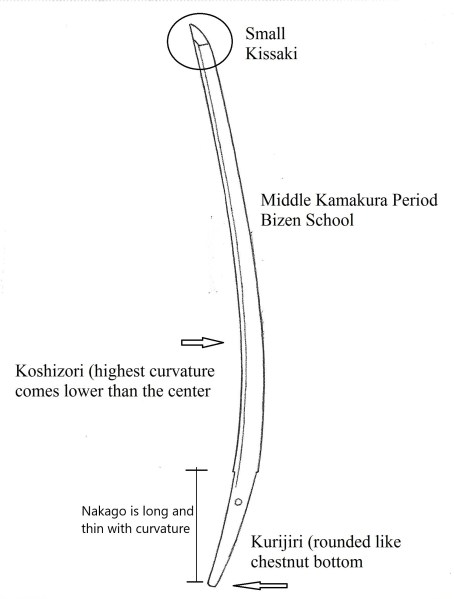
Sugata (shape) —The length is approximately 33 inches ± a few inches. The blade is slightly wide and appears sturdy. The curvature of the blade is koshizori (腰反), meaning the deepest curve is at the lower part.  The body has an average thickness, and the kissaki is small.

 10 Middle Kamakura ---備前刀姿

Horimono (engraving) ——Engravings are rare.  The tip of the hi extends all the way to ko-shinogi, filling the entire area.

8 Hi

Nakago ——– Long and thin with a curve. The end of the nakago is rounded and resembles the bottom of a chestnut (kuri).  This shape is called kurijiri.   Refer to the illustration of the sword above.

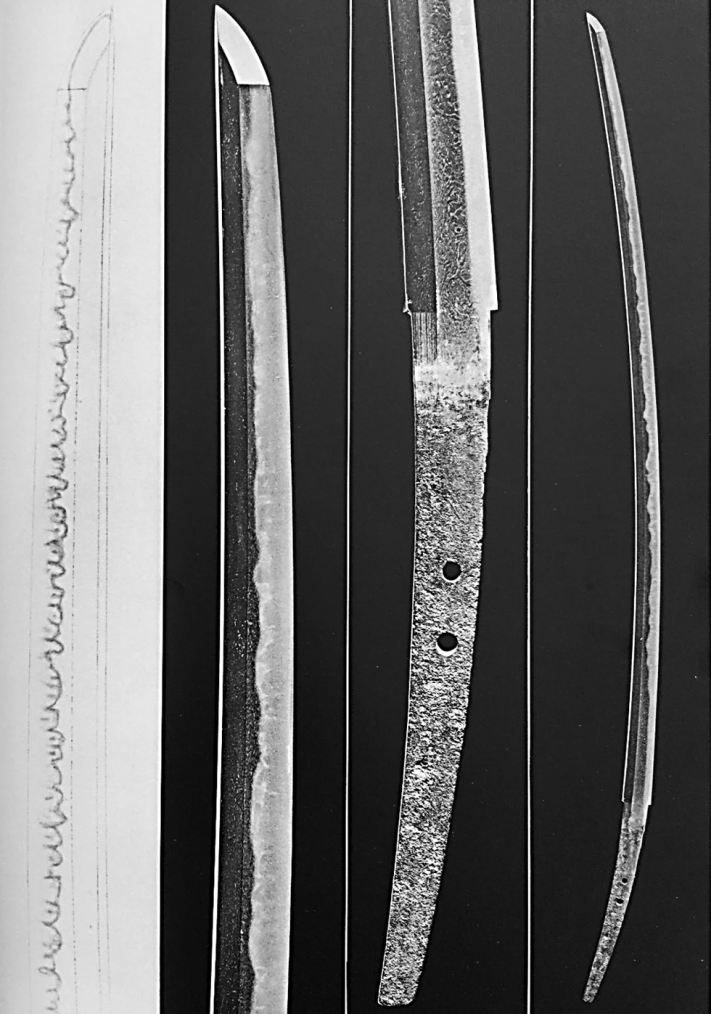
Hamon (tempered area pattern)—— Nioi base. The tempered area is wide and consistent width.  The size of the midare (irregular wavy tempered pattern) is uniform.

Boshi ——– The same tempered pattern continues upward to the boshi area, and it often shows choji- midare (clove-shaped wavy pattern) or yakizume.

10 Boshi --- Bizen

Ji-hada ———— Fine and well forged.  The steel appears soft.  On the steel surface,  small and large wood-grain patterns are mixed.  Chikei (condensation of nie) and utsuri (cloud-like reflection) appear.

Bizen School Sword Smiths during Middle Kamakura Period

  • Fukuoka Ichimonji (福岡一文字) group ————-Norimune (則宗)  Sukemune (助宗) 
  • Yoshioka Ichimonji (吉岡一文字) group ——–Sukeyoshi (助吉) Sukemitsu (助光)        
  • Sho-chu Ichimonji (正中一文字) group —————Yoshiuji (吉氏)   Yoshimori (吉守)     
  • Osafune (長船) group ———–Mitsutada (光忠)  Nagamitsu (長光) Kagemitsu (景光)   
  • Hatakeda(畠田) group ————————————-Moriie (守家)  Sanemori (真守)  
  • Ugai (鵜飼) group ————————————————- Unsho (雲生) Unji (雲次)

              9 Middle Kamakura Bizen Fukuoka ichimonji 

Fukuoka Ichimonji (一文字) from “Nippon-to Art Swords of Japan”                                     The Walter A. Compton Collection