54|Part 2 of — 20|Muromachi Period History (室町時代歴史)

This is a detailed section of Chapter 20, Muromachi Period History.  Please read Chapter 20 before reading this part.


0-timeline - size 24 Nuromach & Sengoku

                      The red circleabove indicate the time we discuss in this chapter

Until the Muromachi (室町) period, the study of political history and sword history ran in parallel.  The timelines above show that the middle line represents sword history, and the bottom line represents political history.  

The styles of swords were distinctly different between the Muromachi and Sengoku periods (戦国時代).  Therefore, for sword study, the Muromachi and Sengoku periods should be separated.   Japanese history textbooks define the Muromachi period as 1393 (the end of the Nanboku-cho) to 1573, when Oda Nobunaga (織田信長) deposed Shogun Ashikaga Yoshiaki (足利義昭) from Kyoto (the fall of the Muromachi bakufu).   In these textbooks, the Sengoku period is considered part of the Muromachi period.  However, we need to distinguish between the Muromachi and Sengoku periods for the study of swords.

 Ashikaga Yoshimitsu (足利義満)

The best period during the Muromachi era was when Shogun Ashikaga Yoshimitsu (足利義満: grandson of Ashikaga Takauji) was in power.  He moved the bakufu to Muromachi (室町) in Kyoto; therefore, this era is called the Muromachi period.  By the time most of the South Dynasty’s samurai had surrendered to the North Dynasty, the South Dynasty had accepted Shogun Yoshimitsu’s offer to stop fighting against the North.  This acceptance established the Ashikaga family’s power within the Muromachi Bakufu

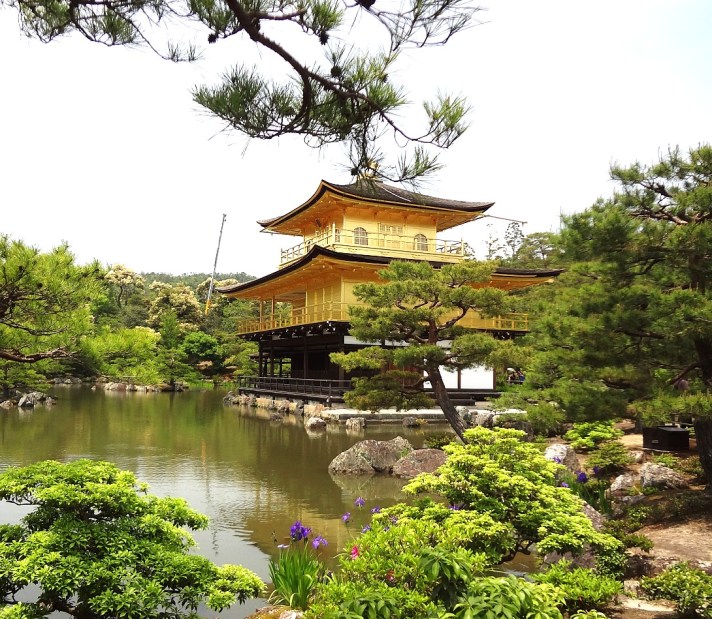
Shogun Ashikaga Yoshimitsu generated tremendous profits from trade with China (Ming). He built a famous resort villa in Kyoto, the Golden Pavilion (Kinkaku-ji Temple 金閣寺*). It is believed that he created the Golden Pavilion to display his power and wealth. The beautiful culture known as Kitayama Bunka (Kitayama culture 北山文化) flourished during this period.

*Golden Pavilion (金閣寺: Kinkaku-ji Temple) —– Its official name is Rokuon-ji Temple (鹿苑寺).  Saionji Kintsune (西園寺公経) originally built it as his resort house during the Kamakura period.  Shogun Yoshimitsu acquired it in 1397 and turned it into his villa.  He also used it as an official guesthouse. 

After Shogun Yoshimitsu’s death, the villa was converted into Rokuon-ji Temple.  It is part of the Rinzaishu Sokoku-ji Temple, which served as the main temple of a Zen sect denomination, called the Rinzaishu Sokoku-ji group (臨済宗相国寺派).  Kinkaku-ji is a reliquary hall that contains relics of the Buddha.  Kinkaku-ji Temple represents the grand Kitayama Bunka (Kitayama culture).  In 1994, it was designated a UNESCO World Cultural Heritage Site. https://www.shokoku-ji.jp/kinkakuji/


57 Kinkakuji trip 2019                                                               My photo  May 2019,

Ashikaga Yoshimasa (足利義政)

After the death of Shogun Ashikaga Yoshimitsu (足利義満), the Muromachi bakufu became less financially stable, and its military power declined.  Consequently, the daimyo (feudal lords) increased their control.  A few generations after Shogun Yoshimitsu, Ashikaga Yoshimasa, the eighth Shogun, took power.  His wife was the well-known Hino Tomiko (see Hino Tomiko in Chapter 20, Muromachi Period History). 

It is said that Shogun Yoshimasa was not interested in his role as shogun; instead, he was more interested in art and culture.  He laid the foundation for today’s Japanese art and culture, including the Japanese garden, Shoin-zukuri (書院造) interior design, the tea ceremony, flower arrangements, painting, and other art forms.  His cultural influence is known as Higashiyama Bunka (Higashiyama culture (東山文化).  

As described in Chapter 20, Muromachi Period History (室町時代), Shogun Yoshimasa did not have any children.  His brother Yoshimi (義視) was expected to become the next Shogun. However, his wife, Hino Tomiko, gave birth to a son, Yoshihisa (義尚).  Hino Tomiko sought support from Yamana Sozen (山名宗全: a powerful family) to back her son.  Meanwhile, the brother, Yoshimi, was connected with Hosokawa Katsumoto (細川勝元: another powerful family).  The problem was that Shogun Yoshimasa paid too much attention to his cultural pursuits and failed to address the issue he created by not being clear about who should succeed him as Shogun.  He did not hand over the shogunate to either party. 

In 1467, in addition to the succession problem and conflicts of interest among powerful daimyo, a civil war, known as “Onin-no-run (応仁の乱),” broke out.  All daimyo were divided, siding with either the Hosokawa or the Yamana factions.   Eventually, the war spread throughout Japan and lasted more than 10 years.  Finally, in 1477, after the deaths of Hosokawa Katsumoto and Yamana Sozen, Shogun Yoshimasa decided to transfer the shogunate to his son Yoshihisa.  As a result of this war, Kyoto was devastated, and the power of the Muromachi Bakufu declined significantly. 

While all this was happening and people were suffering, Yoshimasa continued to spend money on building the Ginkaku-ji Temple (銀閣寺: The Silver Pavilion).  He died before seeing the completion of Ginkaku-ji Temple.  The Onin-no-ran would lead to the next Sengoku period, a 100-year-long Warring States period.

*Shoin-zukuri (書院造)———- A traditional Japanese residential interior style with Tatami mats, a nook, and shoji screens (sliding doors).  This style forms the basis for interior design in modern Japanese homes.

Shoin Zukuri style Japanese room

57 Shoin zukuri

Public Domain   GFDL,cc-by-sa-2.5,2.0,1.0 file: Takagike CC BY-SA 3.0view terms      File: Takagike Kashihara JPN 001.jpg

My japanese room                                                                      My Japanese room

21| Muromachi Period Sword (室町時代刀)

0-timeline - size 24 Muromach

       The red circle above indicates the time we discuss in this section

The Muromachi period was a relatively peaceful and prosperous time until shortly before the “Onin-no-ran,” which occurred at the end of the Muromachi periodRefer to Chapter 20, Muromachi Period History (室町時代歴史).   The Nanboku-cho style long swords became outdated; as a result, they were shortened.  The shortened blade is called suriage.  Overall, the Muromachi period was a declining time for sword-making.

Tachi and Katana 

Until the end of the Nanboku-cho period or the beginning of the Muromachi period, samurai wore swords suspended from their waists with the blade facing down.  When a sword was worn this way, the swordsmith inscribed his name on the side facing outward, meaning the blade is on your right when you see the inscription.  In this case, the sword is called a tachi.

During the Muromachi period, a sword was worn between the belt, with the blade facing up.   The swordsmith inscribed his name so that it faced outward when it was worn. Therefore, when you see the inscription, the cutting edge is to your left.  This is classified as a katana. 

Around the beginning of the Muromachi period, samurai started to wear a pair of swords called dai-sho (大小), meaning large and small.  The longer sword is a katana, and the shorter one is a wakizashi.  In general, a tachi is longer than a katana.  A katana is longer than a wakizashi, and a wakizashi is longer than a tanto.  Here is the order of their lengths. 

                                       Tachi   >   Katana   >   Wakizashi   >  Tanto                                  Tachi and katana differ in how they are worn, not in length.   

O-suriage ( 大磨上: Katana shortened by great length) 

How much the sword should be shortened depends on its original length and how much the owner wants it shortened.  O-suriage is a type of sword that is significantly shortened.  Once the blade is shortened by that length, the inscription of the maker’s name is cut off.  When the Hon’ami family (本阿弥家, a family of sword connoisseurs who have appraised Japanese swords for generations from the Muromachi period to today) appraises such a suriage sword, they write the make of the sword and the swordsmith’s name on the front side of the hilt, and the connoisseur’s name with his kaou (similar to a signature) on the back.  There are several levels of writing.  The level at which it should be done depends on the sword’s quality and the owner’s preference.  Below is the order of levels (high to low).

Shu-Mei (朱明 )————————————————————-name written in Vermilion  Kinpun-Mei (金粉名 )———————————————–name lacquered in gold powder  Gin-Zougan (銀象嵌 )————————————————————name inlaid in silver  Kin-Zougan (金象嵌 )————————————————————-name inlaid in gold

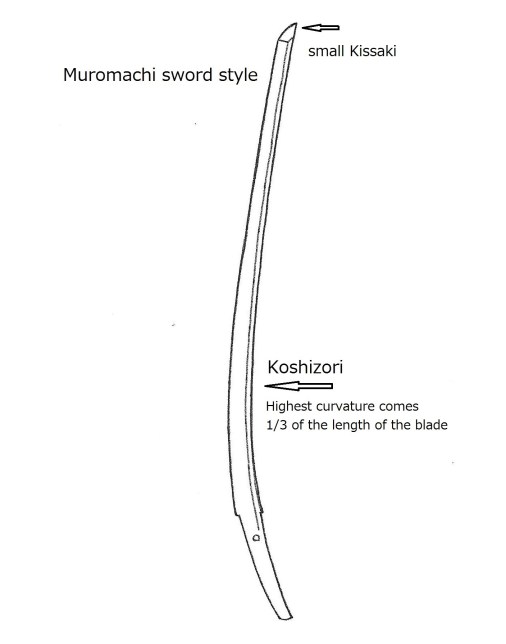
Sugata (姿: Shape) ——— The average length is typically two feet three to four inches (68~71cm).  The shape of the Muromachi period katana is somewhat similar to that of the Heian period tachi.  However, Muromachi katana are less grand or graceful than those from the Heian period swords.  The curvature is usually of the koshizori style.  Koshizori refers to the highest curvature being near the lower part of the blade.  The length and shape are suitable for wearing between the body and the belt.  The width and thickness are well-balanced with the size of the sword.  Small kissaki.

22 Muromachi sword shape

Hirazukuri-Wakizashi ———– Hirazukuri refers to a flat surface without a shinogi or yokote line.  Usually, it is 1 foot and 1 to 2 inches long.  No curvature.  Hirazukuri-wakizashi appeared during the Muromachi period.

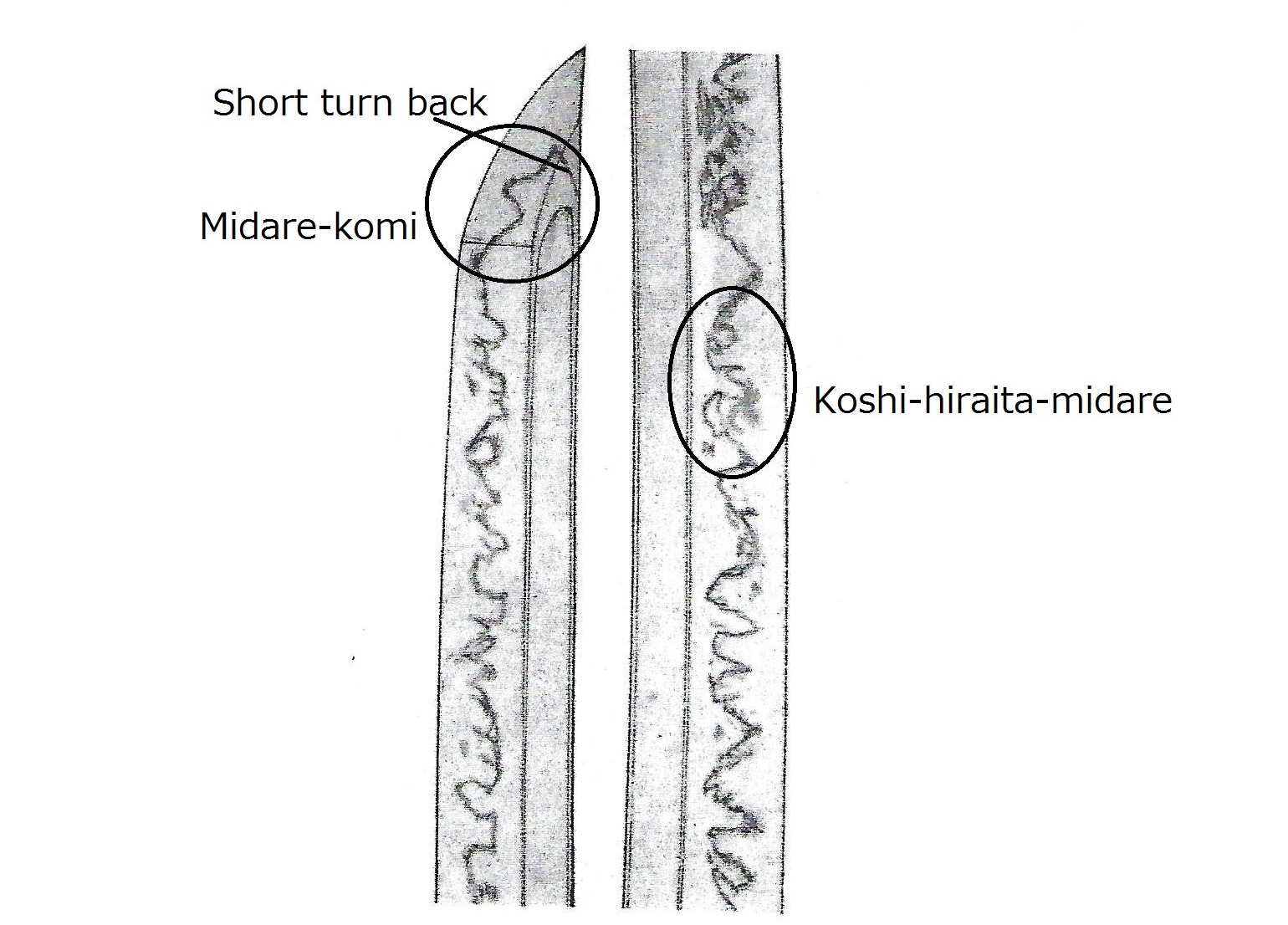
Hamon (刃文: tempered line) ———————- Nioi base.  The tempered area is well balanced with the blade’s width.  Koshi-hiraita-midare is mixed with choji-midare.

22Hamon (Koshi Hiraita midare)
from Sano Museum Catalogue (permission granted)
  • Boshi (Tempered line at Kissaki area) ————– Midare-komi, a short turn back.  See the above illustration.  Midare is an irregular wave-like pattern.
  • Ji-hada (地肌: An area between the tempered line and Shinogi)- Soft look, a large wood grain pattern, Ji-utsuri (faint smoke or cloud-like effect) shows.
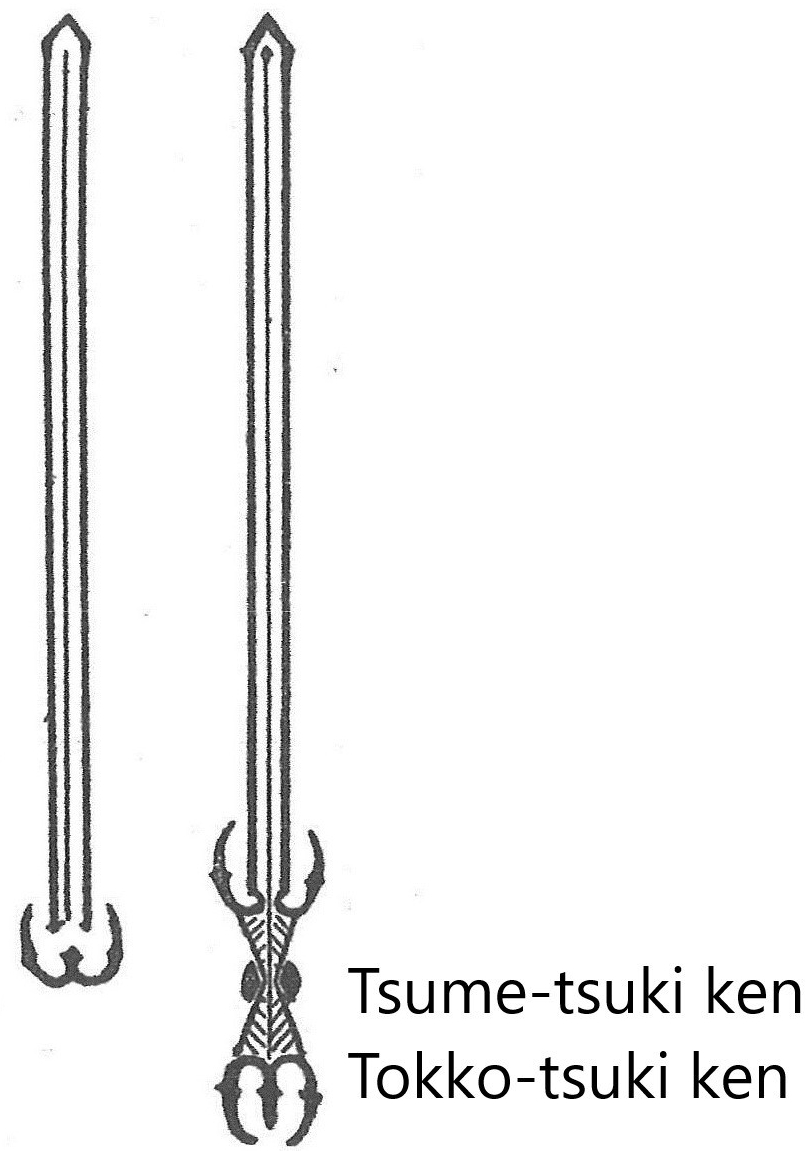
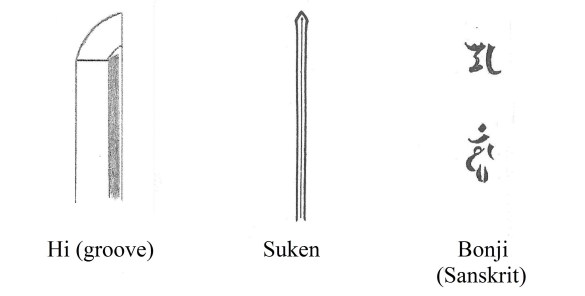
  • Horimono (彫物Engravings) ———- Bo-hi (single groove), Soe-hi (a thin groove alongside the main hi), Futasuji-hi (double narrow groove), Sanskrit, Tokko-tsuki ken, Tsume-tsuki Ken, name of God, and dragon.  Carvings became elaborate.

8 Hi, Suken, Bonji                  21 Tsume-tuki-ken tokko with caption

Sword Smiths during Muromachi Period

  • Bizen Den ——–Osafune Morimitsu (長船盛光), Yasumitsu (康光), Moromitsu (師光)
  • Yamashiro Den————————————————-Yamashiro Nobukuni (山城信国)

21 Muromachi sword from Sano

Ise Masashige (伊勢正重),                     Bizen Osafune Naomitsu (備前長船尚光)         Juyo Token(重要刀剣)                           Sano Museum Catalogue (permission granted)    once my family sword


20|Muromachi Period History (室町時代歴史)    

0-timeline - size 24 Muromach
                   The red circle iabove ndicates the time we discuss in this section

The Muromachi period started after Ashikaga Takauji (足利尊氏) and several other key leaders ended the Nanboku-cho period.  Discussed in 17|Nanboku-cho Period History (1333-1393).

The grandson of Ashikaga Takauji, Ashikaga Yoshimitsu (足利義満, often called Shogun Yoshimitsu), constructed a beautiful new palace in the Muromachi (室町) area of Kyoto.  The palace became the center of government, known as the Muromachi bakufu (室町幕府: Muromachi government).   This is the beginning of the Muromachi period.  Ashikaga Yoshimitsu also built the famous “Kinkaku-ji Temple” * (Golden Pavilion) in Kyoto as his second residence.

Kinkaku-ji Temple* (金閣寺: Golden Pavilion) —————Ashikaga Yoshimitsu (足利義満) built Kinkaku-ji in 1397.   Later, it became a Rinzai-Shu (臨済宗) Buddhist temple, but it was originally built as the secondary residence of Ashikaga Yoshimitsu and a guest house for official visitors.  Today, it is a designated World Heritage site.  The temple was burned down by an arsonist in 1950 but was rebuilt in 1955.  Novelist Mishima Yukio wrote a novel, “Kinkaku-ji,” which relates to this temple and the arsonist.  A famous quote from his book is, “The ho-oh (a mythic golden bird, a Chinese version of the phoenix) on the roof of Kinkaku-ji Temple is stationary, but it flies through time eternally.”

During the Muromachi period, the emperor’s power declined.  The shogun (将軍) held all the political power.  Gradually, several groups of samurai who were officially appointed as shugo daimyo (守護大名: high-ranking officials) began to gain political and economic power by occupying key positions in the Muromachi bakufu.  They also owned extensive land.  Two powerful shugo daimyo families were the Hosokawa (細川) and Yamana (山名).

The Ashikaga family made great efforts to establish the Muromachi bakufu as a stable and strong government through political measures.  The beginning of the Muromachi period was peaceful and prosperous.  However, by the time Ashikaga Yoshimasa (足利義政) became the eighth shogun, the Muromachi bakufu had become severely corrupt.  Shogun Yoshimasa paid little attention to governing the country.  Instead, he pursued women (his mother scolded him for this), spent large amounts of money building the Silver Pavilion called “Ginkaku-ji Temple (銀閣寺),” and retreated there.  Since Shogun Yoshimasa did not have an heir, his brother, Yoshimi (義視), was appointed as the next shogun.

However, later, Yoshimasa’s wife, Hino Tomiko (日野富子)*, gave birth to a son, Yoshihisa (義尚).  Now, brother Yoshimi (義視) allied with the high-ranking officials, the Hosokawa (細川), while his son, Yoshihisa, allied with another powerful family, the Yamana (山名).  Several smaller samurai groups allied with either side, and the war broke out.  This war, called Onin-no-ran (応仁の乱), occurred in 1467.  It spread across the country and lasted for eleven years.

Hino Tomiko (日野富子)*————————-The wife of Shogun Yoshimasa.  She took advantage of her political privileges to generate substantial income by investing in the rice market, thereby controlling prices and selling at high profits.  Then, she loans this money to high-ranking officials at steep interest rates.  The corruption reached an uncontrollable level.

As a result of the Onin-no-ran, beautiful Kyoto was burned to the ground.  The authority of the Muromachi bakufu only extended to small areas of nearby Kyoto.  The Onin-no-ran led to the next period called the Sengoku period (戦国時代), or the Warring States period.  During the Sengoku period, Japan was divided into approximately thirty small, independent states that fought one another until Oda Nobunaga, Toyotomi Hideyoshi, and Tokugawa Ieyasu unified them.

57 Kinkakuji trip 2019

 The photo was taken in May 2019, a family trip to Kyoto

19 | Nanboku-Cho Period Tanto(南北朝短刀)

0-timeline - size 24 Nanboku-cho
The circle indicates the time we discuss in this section

During the Nanboku-cho period, a type of tanto called hirazukuri ko-wakizashi sun-nobi tanto was made.  Hirazukuri means flat swords without the yokote line or shinogi.  Ko-wakizashi refers to a shorter sword.  Sun-nobi tanto means longer than a standard tanto.  This type is also known as Enbun Jyoji ko-wakizashi tanto because most of these tantos were created during the Enbun and Jyoji eras of the imperial period.  In Japan, a new imperial era begins when a new emperor ascends to the throne.  The Enbun era spanned 1356-1361, while the Jyoji period spanned 1362-1368.

20 Enbun Jyoji Kowakizashi Tanto

Sugata (姿: shape) ————A standard tanto measure is approximately one shaku.  Shaku is an old Japanese unit of measurement for length, and one shaku is roughly equal to one foot.  

8.5 sun (the sun is another old Japanese measurement unit of length) is approximately ten inches.  Ten inches is the standard size for a tanto, known as a josun tanto.  Anything longer than a josun tanto is called a sun-nobi tanto.  Anything shorter than a josun is called a sun-zumari tanto. 

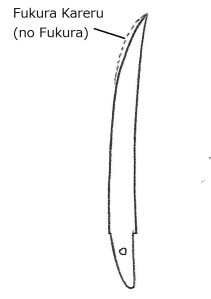
Most of the Nanboku-cho tantos are longer than a josun tanto, approximately one foot two inches.  Therefore, they are called hirazukuri ko-wakizashi sun-nobi tantoSaki-zori (curved outward at the top.  See the illustration above).   Wide in width and thin in body.  Fukura kareru (no fukura means less arc).  Shin-no-mune.  See the drawing below.

20 Fukura           20 Shin-no-Mune

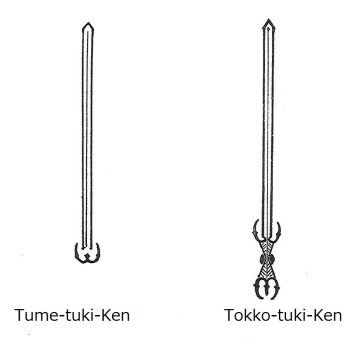
Hi, (: Grooves) and Horimono (彫り物: Engraving) ——- A groove or grooves on the mune side.  Bonji (Sanskrit, see Chapter 16 Late Kamakura Period (Early Soshu-Den Tanto),  koshi-bi (short groove),  tumetuki ken, and tokko-tsuki ken (see below) appear. The ken (dagger) is curved widely and deeply in the upper part and shallower and narrower in the lower part.  This is called Soshu-bori (Soshu-style carving).

20 Tokko, tume Ken

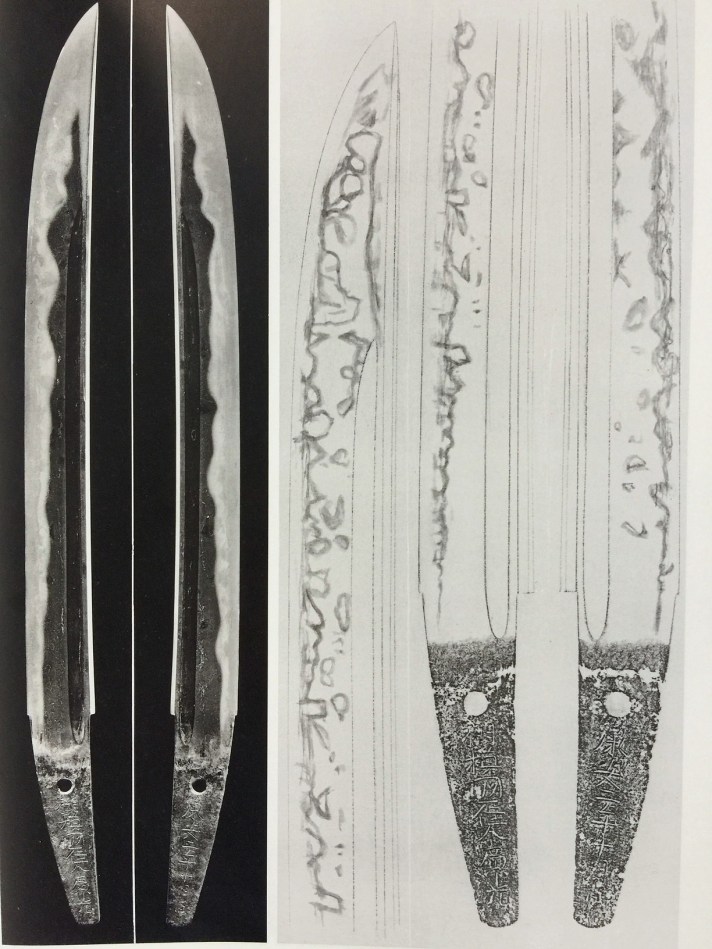
Hamon (: Tempered line) ——- The narrowly tempered section at the lower part gradually widens toward the top.  A similar wide hamon pattern extends into the boshi area.  The hamon in the kissaki area is kaeri-fukashi (deep turn back).  See the illustration below.  Coarse nie.  O-midare (large irregular hamon pattern).

20 Hitatsura

                                        From Sano Museum Catalogue

Ji-hada (地肌: the area between shinogi-ji and the tempered line) ——– a loose wood grain pattern called itame.  Yubashiri (see Chapter 16, Late Kamakura Period) and tobiyaki (irregular patchy tempered spots) appear.  Dense tobiyaki is called hitatsura (see the drawing above).

Nakago (: Tang) —- Short tanago-bara.  Tanago-bara refers to the shape of the belly of a Japanese fish called tanago (bitterling).

20 Tanago Bara

Tanto Swordsmiths during the Nanboku-Cho Period

Soshu Den ———————————————————-Hiromitu( 広光) Akihiro (秋広) Yamashiro Den ————————————————–Hasebe Kunishige (長谷部国重)   Bizen Den ——————————————————— Kanemitu (兼光) Chogi (長義 )

    Soshu Hiromitsu     “Nippon-To Art Sword of Japan “   The Walter A. Compton Collection

18| Nanboku-Cho Period Sword (南北朝太刀)

0-timeline - size 24 Nanboku-cho

                           The circle indicates the time we discuss in this section

During the Nanboku-cho period, samurai sought large, elaborate, impressive, yet practical swords.  The Soshu-den style sword from Nanboku-cho time was just that.    This was the most popular style at the time.  The Nanboku-cho period marked the peak and height of the Soshu-den sword.  Many swordsmiths moved from other provinces to the Kamakura area and forged Soshu-den style swords.  Other schools and provinces outside the Kamakura area also produced Soshu-den-style swords in their own areas.


19 Nanboku-cho Sword style

Sugata (姿: Shape) —————–The original length of a sword ranged from three to five feet, but it was later shortened to about two and a half feet.  A significantly shortened blade is called o-suriage. 

The Nanboku-cho style sword features shallow kyo-zori (also called torii-zori).  Refer to Chapter 5, Heian Period Sword.  The highest curvature occurs around the middle of the body. It has a wide body, high shinogi, narrow shinogi-ji  (Chapter 3, Names of parts),  and thin kasane (blade thickness), which are distinctive features of the Nanboku-cho style.  High gyo-no-mune or shin-no-mune, and sometimes a maru-mune (round back).

19 Nanboku-cho 3 kinds Mune

Hi (: groove) and Horimono (彫刻: engraving) ——– Often, a single hi (bo-hi), double hi, suken (dagger), Bonji (Sanskrit), and/or dragon are engraved on the shinogi-ji area.  Refer to Chapter 3, Names of Parts.

9 Hi, Suken, Bonji

Hamon (: Tempered line) —- The lower part of the body exhibits a narrow-tempered line; gradually, this line becomes wider and showier.  Course nie. O-midare (large, irregular, wavy hamon), Notare-midare (wavy, irregular hamon), and Gunome-midare (a combination of repeated half-circular and irregular hamon). Inazuma and kinsuji (see Chapter 14, Late Kamakura Period Sword) sometimes appear.

19 Hamon Notare 319 Mamon choji gunome19 Hitatsura Hamon Hiromitsu

                                  *From Sano Museum Catalogue ( Permission granted).

Ji-hada (地肌: the area between the shinogi and the tempered line) ———————-Wood-grain pattern (itame 板目). Sometimes tobiyaki (patchy tempered spots) appear on ji-hada.  For ji-hada, refer to Chapter 3, Names of Parts.

Kissaki (切っ先) and Boshi (tempered line at the kissaki area) ———- O-kissaki (long and large kissaki). Fukura kareru (less arc kissaki).  Midare-komi (the body and boshi have a similar tempered pattern), with kaeri-fukashi (hamon deeply turns back), and sometimes hitatsura (entirely tempered).  See the illustration above.

Sword-smiths during Nanboku-Cho Period Soshu Den (school)

  • From Soshu—————————————————Hiromitsu (広光)  Akihiro (秋広)  
  • From Yamashiro ———————————————Hasebe Kunishige (長谷部国重) 
  • From Bizen (called So-den Bizen)——-Chogi (長儀 )group  Kanemitsu (兼光 ) group 
  • From Chikuzen ———————————————————-Samoji (左文字 ) group

Chogi (長義)from The Sano Museum catalog. Permission to use is granted

The distinctive characteristics of the Nanboku-Cho period sword in the photo above      

  • The trace of an engraving of suken on the inside of the nakago indicates that this area was once a part of the main body.
  • Large and long kissaki