64| Part 2 of –30 Shin Shin-To : Bakumatsu sword (新々刀)

This Chapter is a detailed Chapter of the 30|Bakumatsu Period, Shin Shin-to.  Please read Chapter 30 before reading this chapter.
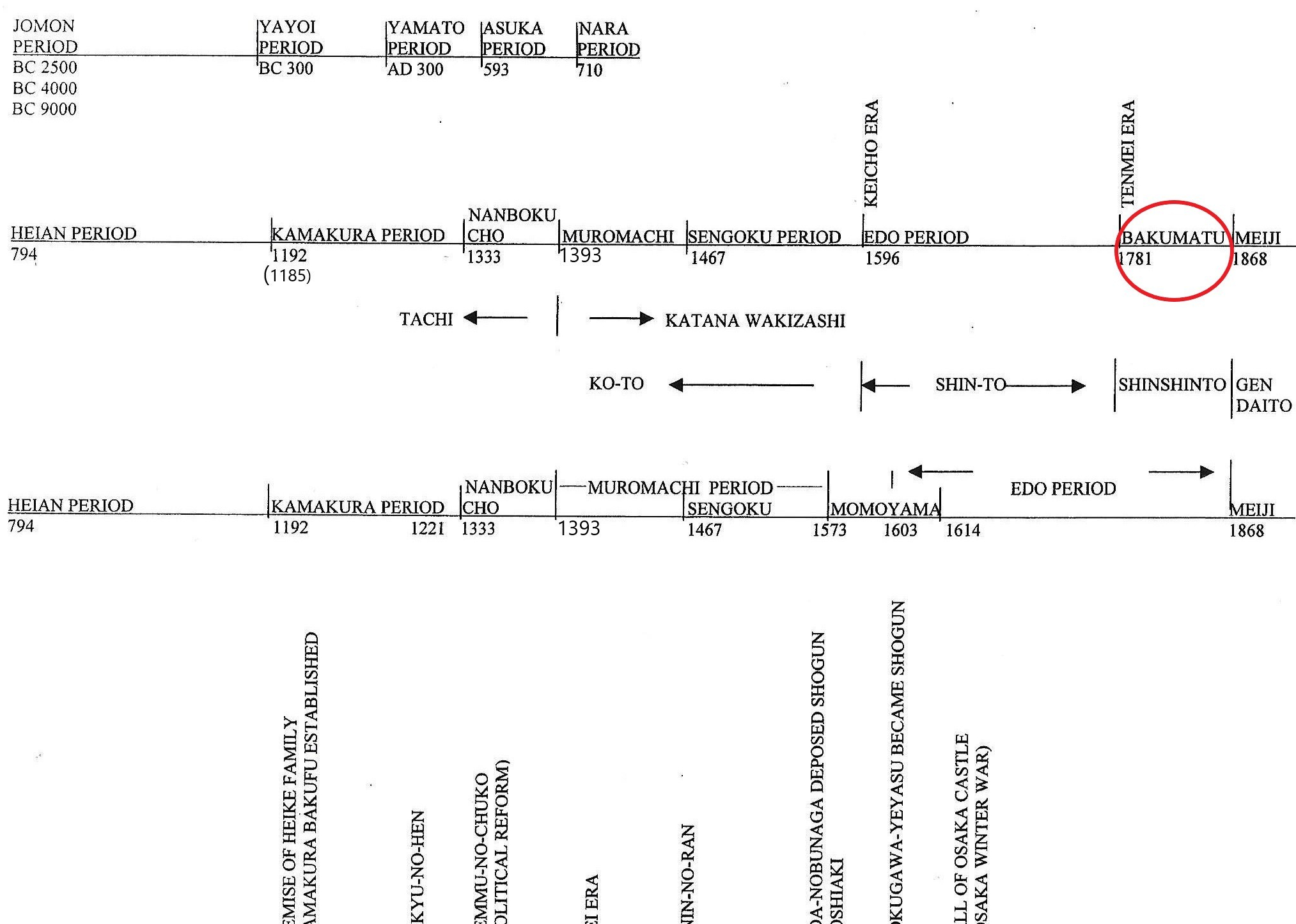
0-timeline - size 24 Bakumatsu

                  The circle Above indicates the time we discuss in this chapter.

Swords made between the Tennmei era (天明 1781) and the end of the Keio era (慶應) are called shin shin-to.  Please refer to the timeline above.  This period was when Japan was moving toward the Meiji Restoration, known as the Bakumatsu era.  During this time, sword-making became active again.  Below are the well-known swordsmiths from the main areas.

Musashi no Kuni  (武蔵の国: Tokyo today)                                                       

Suishinshi Masahide (水心子正秀) ——— When Suishinshi Masahide made Yamashiro-den style swords, their shapes resembled those of ko-to period swords; funbari, an elegant shape; chu-suguha (medium straight); komaru-boshi, with fine wood grain. When he forged in the Bizen style, he made a Koshi-zori shape, similar to a ko-to made by Bizen Osafune.  Nioi with ko-choji, and katai-ha (refer to  30| Bakumatsu Period Sword 新々刀).  In my old sword textbook, I noted that  I saw Suishinshi in November 1970 and October 1971.

Taikei Naotane (大慶直胤) ————————–Although Taikei Naotane was part of the Suishinshi group, he was one of the top swordsmiths.  He had an exceptional ability to forge a wide range of sword styles beautifully.  When he made a Bizen-den style, it resembled Nagamitsu from the Ko-to era, with nioi.  Also, he did sakasa-choji as Katayama Ichimonji had done.  Katai-ha appearsThe notes in my old textbook indicate I saw Naotane in August 1971.

Minamoto no Kiyomaro (源清麿) ————————– Kiyomaro wanted to join the Meiji Restoration movement as a samurai; however, his guardian recognized Kiyomaro’s talent as a master swordsmith and helped him become one.  It is said that because Kiyomaro had a drinking problem, he was not very eager to make swords.  At age 42, he committed seppukuKiyomaro, who lived in Yotsuya (now part of Shinjuku, Tokyo), was called Yotsuya Masamune because he was as good as Masamune.  His swords featured wide-width, shallow sori, stretched kissaki, and fukura-kereru.  The boshi is komaru-boshi.  Fine wood grain ji-gane.

Settsu no Kuni   ( 摂津の国:  Osaka today)

Gassan Sadakazu (月山貞一) ———- Gassan excelled in the Soshu-den and Bizen-den styles, but he was capable of making in any style.  He was as much a genius as Taikei Naotane.  You must pay close attention to notice a sword made by Gassan from genuine ko-to.  He also had remarkable carving skills.  His hirazukuri-kowakizashi, forged in the Soshu-den style, looks just like a Masamune or a Yukimitsu.  He forged in the Yamashiro-den style, with Takenoko-zori, hoso-suguha, or chu-suguha in nie.  Additionally, he forged the Yamato-den style with masame-hada.


58|Part 2 of — 24 Sengoku Period Tanto (戦国時代短刀)

Chapter 58 is a detailed section of Chapter 24, Sengoku Period Tanto.  Please read Chapter 24, Sengoku Period Tanto, before reading this part. 

0-timeline - size 24 Sengoku Period

           The red circle above indicates the time we discuss in this section  

Muramasa (村正)

This chapter discusses the famous Muramasa (村正).  Usually, many well-known swordsmiths come from one of the Goka-den (五家伝: the five main schools: Yamashiro-den, Bizen-den, Soshu-den, Yamato-den, and Mino-den).  However, Muramasa was not from Goka-den but from Ise Province.  The first-generation Muramasa was known as a student of He’ian-jo Nagayoshi (平安城長吉) of Yamashiro-den.  The Muramasa family existed through the mid-Muromachi period.  They spanned three generations from the mid-Muromachi to the Sengoku period

61 Ise map

Below is one of Muramasa’s tantos, made during the Sengoku period.  Since it was made during the Sengoku era, the blade shows the style of Sengoku-period swords.  It reflects Mino-den characteristics, combined with Soshu-den traits. 


 Muramasa (村正) from Sano Museum Catalogue (permission granted)

Characteristics  on this Tanto

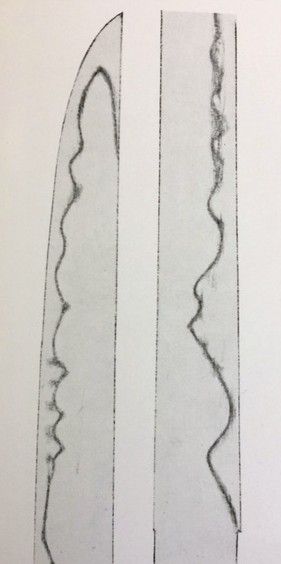
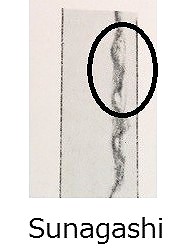
Muramasa’s tantos are typically about ten inches ± half an inch or so.  Hirazukuri (平作り). Thin blades with a sharp look.  The nioi base with small nie and sunagashi patterns (brushed sand-like patterns, as shown in the illustration below) appears.  The boshi (the top part of the hamon) is jizo (a side view of a human head).  The tempered line varies with both wide and narrow areas.  Some areas are so narrow, almost close to the edge of the blade, while others are broader.  Hako midare (box-like shape) and gunome (lined-up bead pattern) appear.  O-notare (large, gentle waviness) is a signature characteristic of Muramasa.  The pointed-tempered line is a typical characteristic of Mino-den (Sanbon-sugi).  Refer to Chapter 23, Sengoku Period Sword, and Chapter 24, Sengoku Period Tanto.


30| Shin-Shin-To 1781-1867 (Bakumatsu Period Sword 新々刀)

0-timeline - size 24 BakumatsuThe red circle indicates the time we discuss in this section

The later part of the Edo period is called Bakumatsu.  See the circled area on the timeline above.  Swords made during this time are called shin shin-to.   They are also called Fukko-to (復古刀: revived sword).  Fukko-to replicates the shape, hamon, boshi, and other features of the Ko-to and Shin-to swords.  The characteristics of the Shin Shin-to (新々刀) and well-known swordsmiths are listed below.

The Characteristics of Shin Shin-to

  • Katana, wakizashi, and tanto all tend to resemble or imitate the ko-to and shin-to in shape.
  • Many swords often have a Hi or detailed engravings.
  • One swordsmith would create multiple sword styles, such as Soshu-den, Bizen-den, and Shin-to style.
  • Often shows Katai-ha.

30 katai-ha

                                                                  Katai-ha

  • Weak (not tight) Nioi.
  • Yakidashi (2 to 3 inches above machi) is often suguha(straight line hamon), even though the rest of the area has irregular    Boshi is often irregular midare.
  • Detailed engravings are more realistic than those from earlier times.

Well-known swordsmiths of Shin Shin-to

  • Settsu (Osaka area) ——————Gassan Sadayoshi (月山貞吉), Gassan Sadakazu (月山貞一). The Gassan family is known for their detailed carvings.
  • Musashi no Kuni (Tokyo area) ————-Suishinshi Masahide (水心子正秀),  Minamoto Kiyomaro (源 清麿),  Taikei Naotane (大慶直胤),  Taikei Yoshitane (大慶義胤).  Yoshitane is well-known for his carvings.                                               

Minamoto Kiyomaro(源清麿)    Once my family possession

  • Tosa (四国: Shikoku area) ———————————————- Sa Yukihide (左行秀)
  • Satsuma (鹿児島: Kagoshima) ———— Oku Moptohira (奥元平) Namino Hira (波平)

Meiji Ishin-To

Right before the Meiji Restoration, long swords (about 3 feet) without any curvature were made.  Sa Yukihide (from the Tosa area) forged this type of sword.  Saigo Takamori (西郷隆盛) and Sakamoto Ryoma (坂本龍馬) owned such swords.  Both are well-known historical figures from the Meiji Restoration.  Both were part of the Kin’no-to (勤皇党) group, which supported the emperor and reformed the political system.


9 | Middle Kamakura Period: Bizen Den (鎌倉中期備前伝)

0-timeline - size 24 Middle Kamakura
The circle indicates the time we discuss in this section 

Many swordsmiths worked in the Bizen (備前) school during the early Kamakura period.  However, their sword style is generally somewhat similar to the Yamashiro style.  Therefore, they are called Ko-bizen (古備前), meaning old Bizen.

The true Bizen school style appeared during the Middle Kamakura period.  Bizen Province had many advantages for producing great swords.  The area produced high-quality iron and abundant firewood.  Also, its location was conveniently located for people to travel from different regions.  As a result, many swordsmiths gathered there and produced large quantities of swords.  Due to competition among these smiths, the quality of Bizen swords is generally higher than that of other schools.  Therefore, it is often difficult to appraise Bizen swords because of the many subtle differences among the different swordsmiths.

The following three features are the most distinctive characteristics of the Bizen school.  

1.   Nioi-base tempered line.  The Nioi-base tempered line has finer dots than the Nie-base.   These dots are so small that they almost appear as a line. Technically, the tempering processes of these two are identical.  See the illustration below.                        2.   Ji-hada (surface of the body) appears soft.                                                                  3.  Reflection (utsuri) appears on the surface.

10 Nie & Nioi

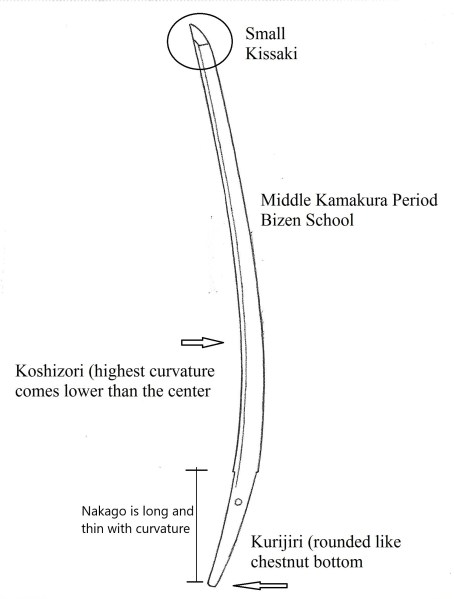
Sugata (shape) —The length is approximately 33 inches ± a few inches. The blade is slightly wide and appears sturdy. The curvature of the blade is koshizori (腰反), meaning the deepest curve is at the lower part.  The body has an average thickness, and the kissaki is small.

 10 Middle Kamakura ---備前刀姿

Horimono (engraving) ——Engravings are rare.  The tip of the hi extends all the way to ko-shinogi, filling the entire area.

8 Hi

Nakago ——– Long and thin with a curve. The end of the nakago is rounded and resembles the bottom of a chestnut (kuri).  This shape is called kurijiri.   Refer to the illustration of the sword above.

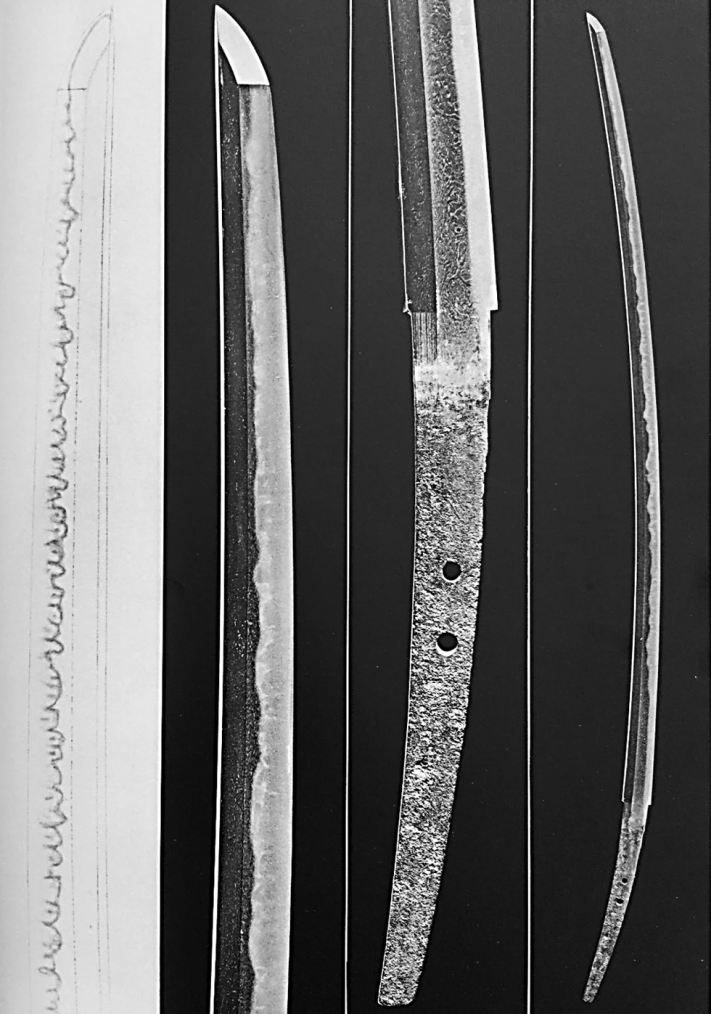
Hamon (tempered area pattern)—— Nioi base. The tempered area is wide and consistent width.  The size of the midare (irregular wavy tempered pattern) is uniform.

Boshi ——– The same tempered pattern continues upward to the boshi area, and it often shows choji- midare (clove-shaped wavy pattern) or yakizume.

10 Boshi --- Bizen

Ji-hada ———— Fine and well forged.  The steel appears soft.  On the steel surface,  small and large wood-grain patterns are mixed.  Chikei (condensation of nie) and utsuri (cloud-like reflection) appear.

Bizen School Sword Smiths during Middle Kamakura Period

  • Fukuoka Ichimonji (福岡一文字) group ————-Norimune (則宗)  Sukemune (助宗) 
  • Yoshioka Ichimonji (吉岡一文字) group ——–Sukeyoshi (助吉) Sukemitsu (助光)        
  • Sho-chu Ichimonji (正中一文字) group —————Yoshiuji (吉氏)   Yoshimori (吉守)     
  • Osafune (長船) group ———–Mitsutada (光忠)  Nagamitsu (長光) Kagemitsu (景光)   
  • Hatakeda(畠田) group ————————————-Moriie (守家)  Sanemori (真守)  
  • Ugai (鵜飼) group ————————————————- Unsho (雲生) Unji (雲次)

              9 Middle Kamakura Bizen Fukuoka ichimonji 

Fukuoka Ichimonji (一文字) from “Nippon-to Art Swords of Japan”                                     The Walter A. Compton Collection