20|Muromachi Period History (室町時代歴史)    

0-timeline - size 24 Muromach
                   The red circle iabove ndicates the time we discuss in this section

The Muromachi period started after Ashikaga Takauji (足利尊氏) and several other key leaders ended the Nanboku-cho period.  Discussed in 17|Nanboku-cho Period History (1333-1393).

The grandson of Ashikaga Takauji, Ashikaga Yoshimitsu (足利義満, often called Shogun Yoshimitsu), constructed a beautiful new palace in the Muromachi (室町) area of Kyoto.  The palace became the center of government, known as the Muromachi bakufu (室町幕府: Muromachi government).   This is the beginning of the Muromachi period.  Ashikaga Yoshimitsu also built the famous “Kinkaku-ji Temple” * (Golden Pavilion) in Kyoto as his second residence.

Kinkaku-ji Temple* (金閣寺: Golden Pavilion) —————Ashikaga Yoshimitsu (足利義満) built Kinkaku-ji in 1397.   Later, it became a Rinzai-Shu (臨済宗) Buddhist temple, but it was originally built as the secondary residence of Ashikaga Yoshimitsu and a guest house for official visitors.  Today, it is a designated World Heritage site.  The temple was burned down by an arsonist in 1950 but was rebuilt in 1955.  Novelist Mishima Yukio wrote a novel, “Kinkaku-ji,” which relates to this temple and the arsonist.  A famous quote from his book is, “The ho-oh (a mythic golden bird, a Chinese version of the phoenix) on the roof of Kinkaku-ji Temple is stationary, but it flies through time eternally.”

During the Muromachi period, the emperor’s power declined.  The shogun (将軍) held all the political power.  Gradually, several groups of samurai who were officially appointed as shugo daimyo (守護大名: high-ranking officials) began to gain political and economic power by occupying key positions in the Muromachi bakufu.  They also owned extensive land.  Two powerful shugo daimyo families were the Hosokawa (細川) and Yamana (山名).

The Ashikaga family made great efforts to establish the Muromachi bakufu as a stable and strong government through political measures.  The beginning of the Muromachi period was peaceful and prosperous.  However, by the time Ashikaga Yoshimasa (足利義政) became the eighth shogun, the Muromachi bakufu had become severely corrupt.  Shogun Yoshimasa paid little attention to governing the country.  Instead, he pursued women (his mother scolded him for this), spent large amounts of money building the Silver Pavilion called “Ginkaku-ji Temple (銀閣寺),” and retreated there.  Since Shogun Yoshimasa did not have an heir, his brother, Yoshimi (義視), was appointed as the next shogun.

However, later, Yoshimasa’s wife, Hino Tomiko (日野富子)*, gave birth to a son, Yoshihisa (義尚).  Now, brother Yoshimi (義視) allied with the high-ranking officials, the Hosokawa (細川), while his son, Yoshihisa, allied with another powerful family, the Yamana (山名).  Several smaller samurai groups allied with either side, and the war broke out.  This war, called Onin-no-ran (応仁の乱), occurred in 1467.  It spread across the country and lasted for eleven years.

Hino Tomiko (日野富子)*————————-The wife of Shogun Yoshimasa.  She took advantage of her political privileges to generate substantial income by investing in the rice market, thereby controlling prices and selling at high profits.  Then, she loans this money to high-ranking officials at steep interest rates.  The corruption reached an uncontrollable level.

As a result of the Onin-no-ran, beautiful Kyoto was burned to the ground.  The authority of the Muromachi bakufu only extended to small areas of nearby Kyoto.  The Onin-no-ran led to the next period called the Sengoku period (戦国時代), or the Warring States period.  During the Sengoku period, Japan was divided into approximately thirty small, independent states that fought one another until Oda Nobunaga, Toyotomi Hideyoshi, and Tokugawa Ieyasu unified them.
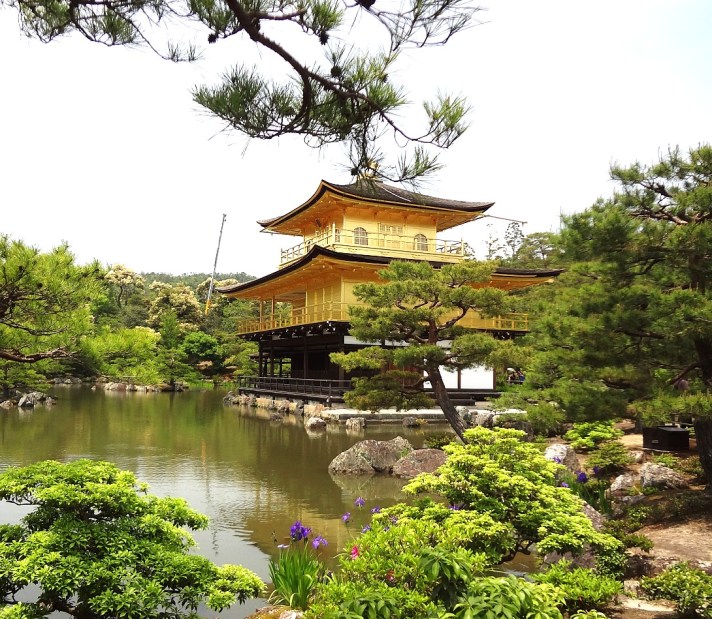
57 Kinkakuji trip 2019

 The photo was taken in May 2019, a family trip to Kyoto

18| Nanboku-Cho Period Sword (南北朝太刀)

0-timeline - size 24 Nanboku-cho

                           The circle indicates the time we discuss in this section

During the Nanboku-cho period, samurai sought large, elaborate, impressive, yet practical swords.  The Soshu-den style sword from Nanboku-cho time was just that.    This was the most popular style at the time.  The Nanboku-cho period marked the peak and height of the Soshu-den sword.  Many swordsmiths moved from other provinces to the Kamakura area and forged Soshu-den style swords.  Other schools and provinces outside the Kamakura area also produced Soshu-den-style swords in their own areas.


19 Nanboku-cho Sword style

Sugata (姿: Shape) —————–The original length of a sword ranged from three to five feet, but it was later shortened to about two and a half feet.  A significantly shortened blade is called o-suriage. 

The Nanboku-cho style sword features shallow kyo-zori (also called torii-zori).  Refer to Chapter 5, Heian Period Sword.  The highest curvature occurs around the middle of the body. It has a wide body, high shinogi, narrow shinogi-ji  (Chapter 3, Names of parts),  and thin kasane (blade thickness), which are distinctive features of the Nanboku-cho style.  High gyo-no-mune or shin-no-mune, and sometimes a maru-mune (round back).

19 Nanboku-cho 3 kinds Mune

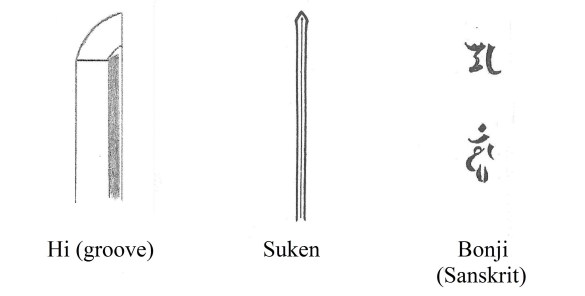
Hi (: groove) and Horimono (彫刻: engraving) ——– Often, a single hi (bo-hi), double hi, suken (dagger), Bonji (Sanskrit), and/or dragon are engraved on the shinogi-ji area.  Refer to Chapter 3, Names of Parts.

9 Hi, Suken, Bonji

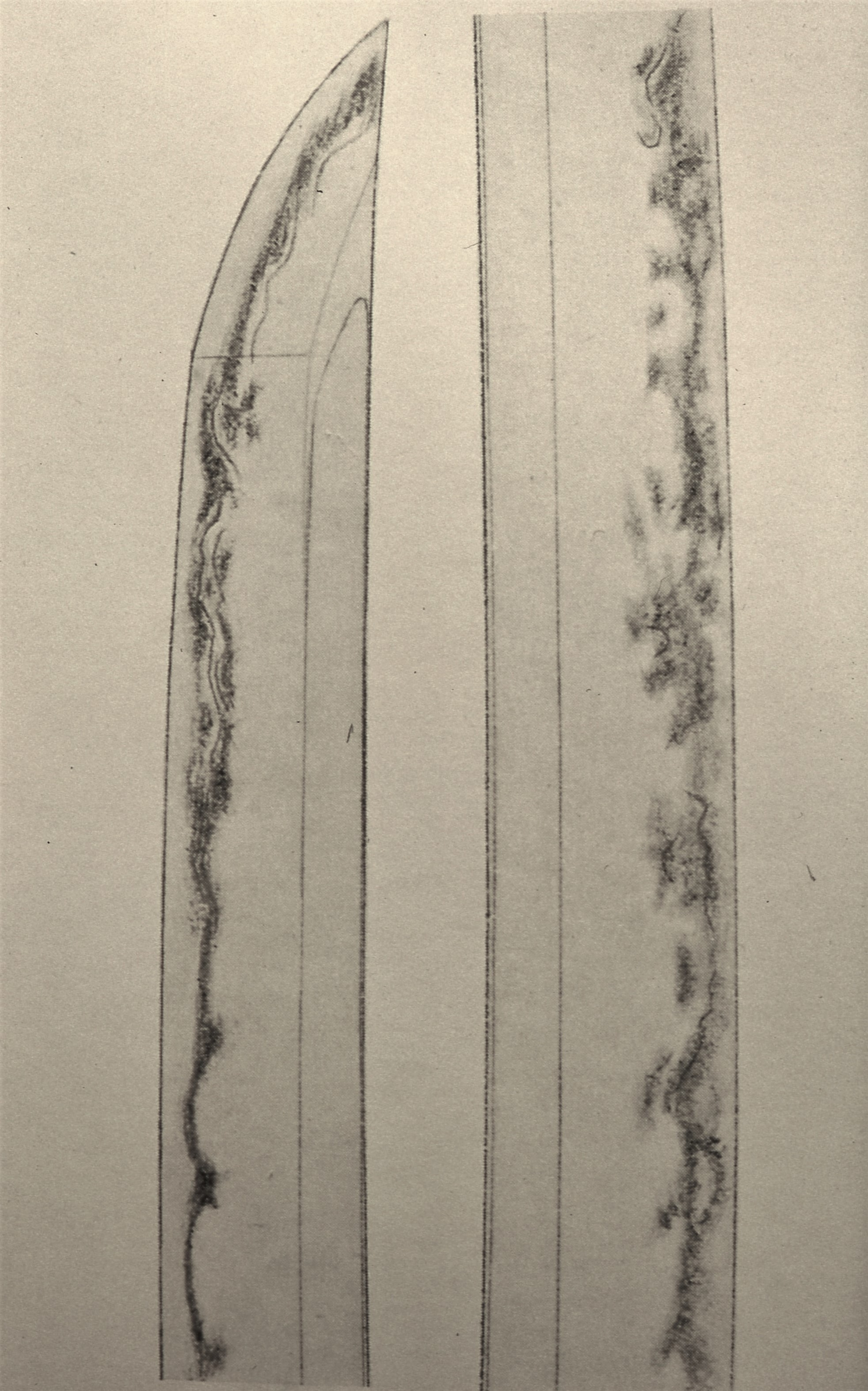
Hamon (: Tempered line) —- The lower part of the body exhibits a narrow-tempered line; gradually, this line becomes wider and showier.  Course nie. O-midare (large, irregular, wavy hamon), Notare-midare (wavy, irregular hamon), and Gunome-midare (a combination of repeated half-circular and irregular hamon). Inazuma and kinsuji (see Chapter 14, Late Kamakura Period Sword) sometimes appear.

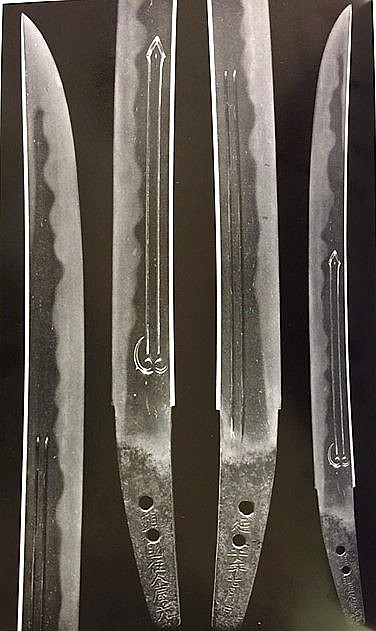
19 Hamon Notare 319 Mamon choji gunome19 Hitatsura Hamon Hiromitsu

                                  *From Sano Museum Catalogue ( Permission granted).

Ji-hada (地肌: the area between the shinogi and the tempered line) ———————-Wood-grain pattern (itame 板目). Sometimes tobiyaki (patchy tempered spots) appear on ji-hada.  For ji-hada, refer to Chapter 3, Names of Parts.

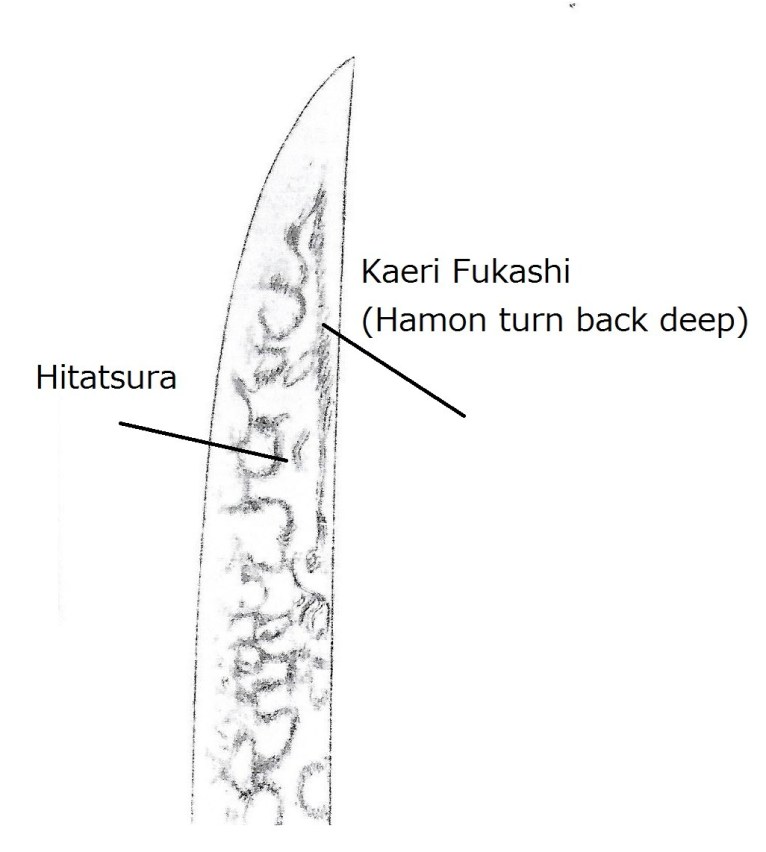
Kissaki (切っ先) and Boshi (tempered line at the kissaki area) ———- O-kissaki (long and large kissaki). Fukura kareru (less arc kissaki).  Midare-komi (the body and boshi have a similar tempered pattern), with kaeri-fukashi (hamon deeply turns back), and sometimes hitatsura (entirely tempered).  See the illustration above.

Sword-smiths during Nanboku-Cho Period Soshu Den (school)

  • From Soshu—————————————————Hiromitsu (広光)  Akihiro (秋広)  
  • From Yamashiro ———————————————Hasebe Kunishige (長谷部国重) 
  • From Bizen (called So-den Bizen)——-Chogi (長儀 )group  Kanemitsu (兼光 ) group 
  • From Chikuzen ———————————————————-Samoji (左文字 ) group

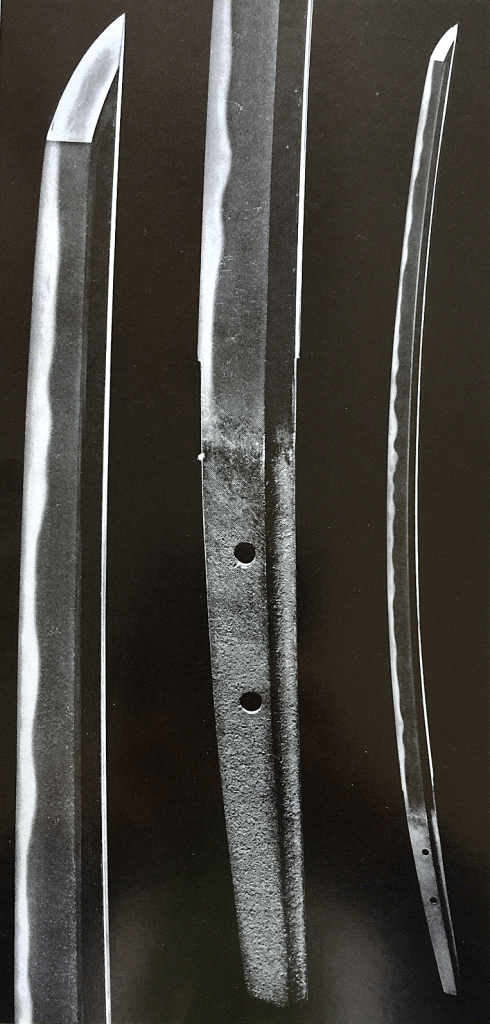
Chogi (長義)from The Sano Museum catalog. Permission to use is granted

The distinctive characteristics of the Nanboku-Cho period sword in the photo above      

  • The trace of an engraving of suken on the inside of the nakago indicates that this area was once a part of the main body.
  • Large and long kissaki

17| Nanboku-cho Period History 1333-1392(南北朝歴史)

0-timeline - size 24 Nanboku-cho

            The red circle above indicates the time we discuss in this section.

After Jokyu-no-ran (Chapter 10 Jokyu-no-ran), the power of the Imperial Court declined significantly.  The successor, the Hojo clan, which was a dominant force during the Kamakura period, also began to face financial difficulties and began to lose control over regional lords.  One reason was the costs incurred by the Mongol invasion.  The Kamakura bakufu (government) could not adequately reward the samurai who fought hard during the war.  As a result, they became very dissatisfied with the bakufu.  Seeing this as an opportunity, Emperor Go-Daigo attempted to attack the Kamakura bakufu twice but failed both times.  He was exiled to Oki Island.  In the meantime, Ashikaga Takauji (足利尊氏) and several groups of anti-Kamakura samurai gathered armed forces and succeeded in destroying the Kamakura bakufu in 1333.  This war ended the Kamakura period.                                                                                                                                                  

Emperor Go-Daigo, who had been exiled to Oki Island, returned to Kyoto and attempted political reforms.  This reform was known as Kenmu-no-chuko (or Kenmu-no-shinsei, 建武の中興).  However, his reforms failed to satisfy most of the ruling class.  Seeing an opportunity, Ashikaga Takauji attacked the Imperial Court in Kyoto, deposed Emperor Go-Daigo, and installed a member of a different branch of the Imperial family as emperor. 

Emperor Go-Daigo, however, insisted on his legitimacy, moved to Yoshino in the south of Kyoto, and established another Imperial court.  Thus, the Northern and  Southern Dynasties began.  With much strife between these rival courts and internal problems within each court,  more samurai groups began to move to the Northern Dynasty.  About sixty years later, the Southern Dynasty was forced to accept the Northern Dynasty’s proposal.  Consequently, the Northern Dynasty became the legitimate imperial court.  This sixty-year period is referred to as the Nanboku-cho or Yoshino-cho period. 

During the Nanboku-cho period, samurai preferred longer, more elaborate, yet practical swords.  The Soshu-den was at the height of its prominence.  However, the Soshu group was not the only one to produce Soshu-den-style swords.  Other schools and provinces in different areas also made Soshu-den-style swords.

Late Kamakura Period Swordsmiths (Early Soshu-Den time)

  • Tosaburo Yukimitsu (藤三郎行光)  
  • Goro Nyudo Masamune (五郎入道正宗)     
  • Hikoshiro Sadamune (彦四郎貞宗)

 17 Masamune hamon (Sano)             Masamune from Sano Museum Catalog (permission granted)
Nanboku-cho Period Swordsmiths  (Middle Soshu-Den time)

  • Hiromitsu (広光)   
  • Akihiro (秋広)

 20 Hitatsura Hiromitsu Hitatura )                  Hiromitsu from Sano Museum Catalog (permission granted)

Muromachi Period Swordsmiths (Late Soshu-Den time)

  • Hiromasa (広正)    
  • Masahiro (正広)