22| Sengoku Period History (戦国時代歴史)

0-timeline - size 24 Sengoku Period 0

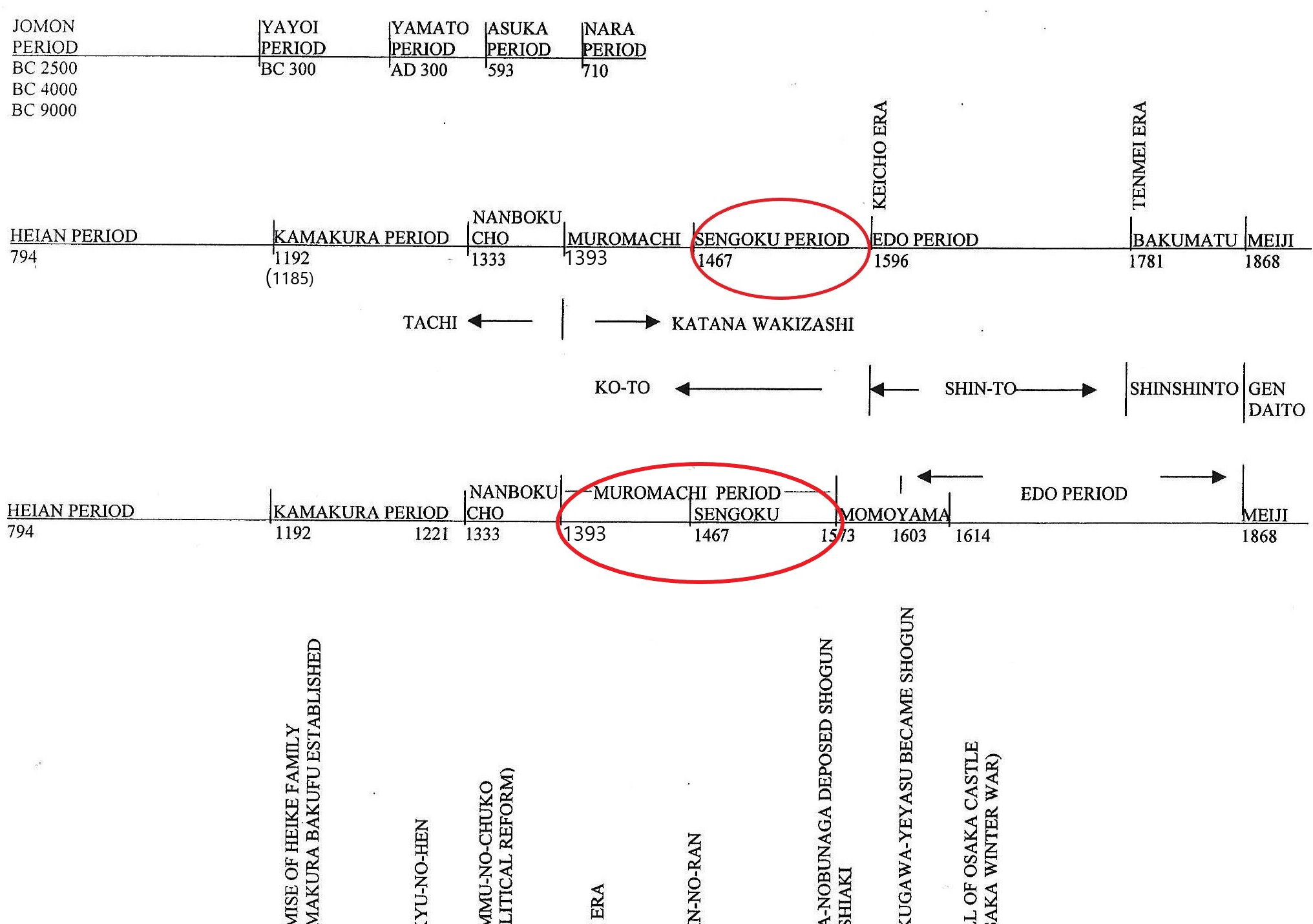
The red circle above indicates the time we discuss in this section

The timeline above shows two circles.  In political history, the Sengoku period (戦国時代) is part of the Muromachi period (室町), which is the lower circle.   However, in sword history, we separate the Muromachi and Sengoku periods (Warring States period), the top circle.  In sword history, we divide the time this way because, during those two periods, sword styles changed, and the environment of sword-making also changed.

After the Onin-no-ran (応仁の乱) began (discussed in 20|Muromachi Period History), the beautiful capital city of Kyoto (京都) was in a devastated condition.  The shogun’s (将軍) power reached only over a small area.  The rest of the country was divided into about thirty small independent states.  The leaders of these independent states were called shugo daimyo (守護大名).  They were originally government officials who were appointed and sent there by the central government.

Powerful local samurai often became the leaders of these states.  They fought against each other to take over each other’s land.  During the Sengoku period, vassals would kill their lords and steal their domains, or farmers would revolt against their lords.  A state like this is called “gekoku-jo” (lower-class samurai overthrow the superior). 

This was the time of the Warring States, known as the Sengoku period.  The leader of each state was called a Sengoku daimyo (戦国大名: Warlord).  The Sengoku period lasted about 100 years.  Gradually, powerful states defeated weaker ones through long, fierce battles, expanding their territory.  Around thirty small countries became twenty, then ten, and so on.  Eventually, only a few dominant sengoku daimyo (warlords) remained.  Each daimyo from those states fought their way to Kyoto and tried to become the top ruler of Japan.  The first one who almost succeeded was Oda Nobunaga (織田信長).  However, he was killed by his vassal, Akechi Mitsuhide (明智光秀), and soon Akechi was killed by his colleague, Toyotomi Hideyoshi (豊臣秀吉).  

After Toyotomi Hideyoshi defeated Akechi Mitsuhide, his troops, and other major warlords, he nearly completed the unification of Japan.  Yet, Hideyoshi still had one more rival to deal with to finish his goal.  That was Tokugawa Iyeyasu (徳川家康).  Now, Toyotomi Hideyoshi and Tokugawa Ieyasu are the last contenders for the top position.  Both recognized that their opponents were smart and capable.  Any wrong move could be disastrous.  Therefore, they decided to maintain a friendly coexistence on the surface for the time being.  Although Toyotomi Hideyoshi tried to make Tokugawa Ieyasu his vassal, Tokugawa Ieyasu somehow managed to avoid that.  In Tokugawa Ieyasu’s mind, being younger than Toyotomi Hideyoshi, he knew he could simply wait until Hideyoshi‘s natural death, which eventually happened. 

After Hideyoshi’s death, Tokugawa Ieyasu fought Hideyoshi’s vassals and won at the Battle of Sekigahara (関ヶ原の戦い) in 1600.  Then, in 1615, at the Battle of the Osaka Natsu-no-jin (Osaka Summer Campaign: 大阪夏の陣), Tokugawa defeated Hideyoshi’s son’s army.  Following this, the Toyotomi clan was dissolved entirely, and the Edo (江戸) period began.  It is called the Edo period because Tokugawa Ieyasu lived in Edo, which is now Tokyo (東京).

*The Sengoku period is frequently depicted in TV dramas and movies.  People who lived through that era had a tough time, but it was also the most exciting time for creating TV shows and films.  The lives of Oda Nobunaga, Toyotomi Hideyoshi, and Tokugawa Ieyasu are among the most popular stories in Japan.  In particular, the story of Toyotomi Hideyoshi is among the most popular.  His background was that of a poor farmer, but he rose to become the top ruler of Japan.  That is a fascinating success story.


23 Toyotomi_hideyoshi

Portrait of Toyotomi Hideyoshi (豊臣秀吉) by Kano Mitsunobu, owned by Kodai-Ji Temple      From Wikimedia Commons, the free media repositon.

21| Muromachi Period Sword (室町時代刀)

0-timeline - size 24 Muromach

       The red circle above indicates the time we discuss in this section

The Muromachi period was a relatively peaceful and prosperous time until shortly before the “Onin-no-ran,” which occurred at the end of the Muromachi periodRefer to Chapter 20, Muromachi Period History (室町時代歴史).   The Nanboku-cho style long swords became outdated; as a result, they were shortened.  The shortened blade is called suriage.  Overall, the Muromachi period was a declining time for sword-making.

Tachi and Katana 

Until the end of the Nanboku-cho period or the beginning of the Muromachi period, samurai wore swords suspended from their waists with the blade facing down.  When a sword was worn this way, the swordsmith inscribed his name on the side facing outward, meaning the blade is on your right when you see the inscription.  In this case, the sword is called a tachi.

During the Muromachi period, a sword was worn between the belt, with the blade facing up.   The swordsmith inscribed his name so that it faced outward when it was worn. Therefore, when you see the inscription, the cutting edge is to your left.  This is classified as a katana. 

Around the beginning of the Muromachi period, samurai started to wear a pair of swords called dai-sho (大小), meaning large and small.  The longer sword is a katana, and the shorter one is a wakizashi.  In general, a tachi is longer than a katana.  A katana is longer than a wakizashi, and a wakizashi is longer than a tanto.  Here is the order of their lengths. 

                                       Tachi   >   Katana   >   Wakizashi   >  Tanto                                  Tachi and katana differ in how they are worn, not in length.   

O-suriage ( 大磨上: Katana shortened by great length) 

How much the sword should be shortened depends on its original length and how much the owner wants it shortened.  O-suriage is a type of sword that is significantly shortened.  Once the blade is shortened by that length, the inscription of the maker’s name is cut off.  When the Hon’ami family (本阿弥家, a family of sword connoisseurs who have appraised Japanese swords for generations from the Muromachi period to today) appraises such a suriage sword, they write the make of the sword and the swordsmith’s name on the front side of the hilt, and the connoisseur’s name with his kaou (similar to a signature) on the back.  There are several levels of writing.  The level at which it should be done depends on the sword’s quality and the owner’s preference.  Below is the order of levels (high to low).

Shu-Mei (朱明 )————————————————————-name written in Vermilion  Kinpun-Mei (金粉名 )———————————————–name lacquered in gold powder  Gin-Zougan (銀象嵌 )————————————————————name inlaid in silver  Kin-Zougan (金象嵌 )————————————————————-name inlaid in gold

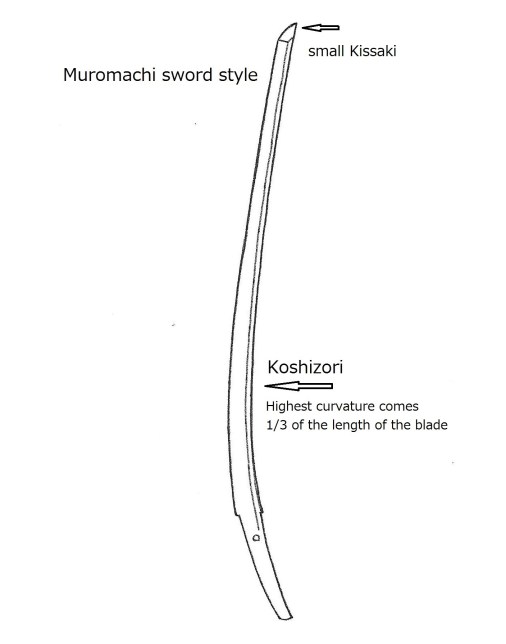
Sugata (姿: Shape) ——— The average length is typically two feet three to four inches (68~71cm).  The shape of the Muromachi period katana is somewhat similar to that of the Heian period tachi.  However, Muromachi katana are less grand or graceful than those from the Heian period swords.  The curvature is usually of the koshizori style.  Koshizori refers to the highest curvature being near the lower part of the blade.  The length and shape are suitable for wearing between the body and the belt.  The width and thickness are well-balanced with the size of the sword.  Small kissaki.

22 Muromachi sword shape

Hirazukuri-Wakizashi ———– Hirazukuri refers to a flat surface without a shinogi or yokote line.  Usually, it is 1 foot and 1 to 2 inches long.  No curvature.  Hirazukuri-wakizashi appeared during the Muromachi period.

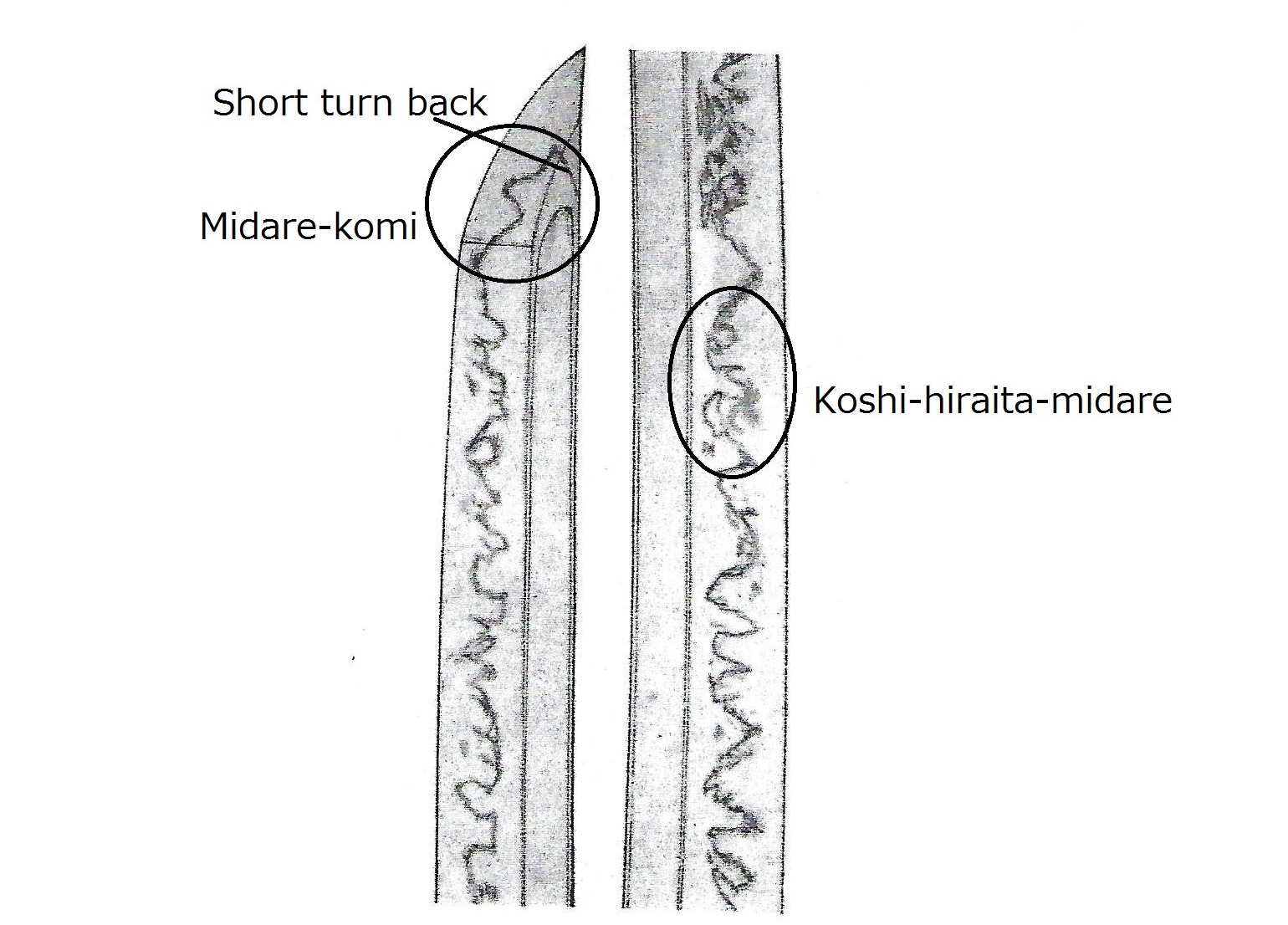
Hamon (刃文: tempered line) ———————- Nioi base.  The tempered area is well balanced with the blade’s width.  Koshi-hiraita-midare is mixed with choji-midare.

22Hamon (Koshi Hiraita midare)
from Sano Museum Catalogue (permission granted)
  • Boshi (Tempered line at Kissaki area) ————– Midare-komi, a short turn back.  See the above illustration.  Midare is an irregular wave-like pattern.
  • Ji-hada (地肌: An area between the tempered line and Shinogi)- Soft look, a large wood grain pattern, Ji-utsuri (faint smoke or cloud-like effect) shows.
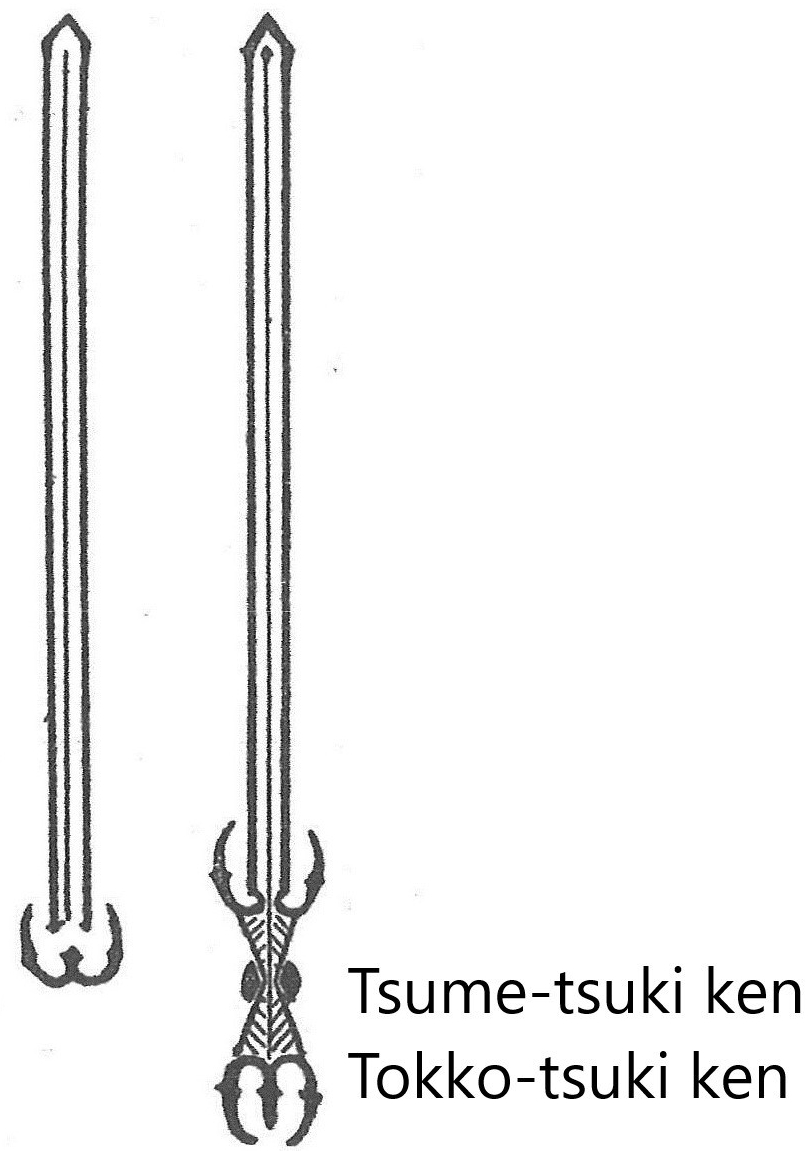
  • Horimono (彫物Engravings) ———- Bo-hi (single groove), Soe-hi (a thin groove alongside the main hi), Futasuji-hi (double narrow groove), Sanskrit, Tokko-tsuki ken, Tsume-tsuki Ken, name of God, and dragon.  Carvings became elaborate.

8 Hi, Suken, Bonji                  21 Tsume-tuki-ken tokko with caption

Sword Smiths during Muromachi Period

  • Bizen Den ——–Osafune Morimitsu (長船盛光), Yasumitsu (康光), Moromitsu (師光)
  • Yamashiro Den————————————————-Yamashiro Nobukuni (山城信国)

21 Muromachi sword from Sano

Ise Masashige (伊勢正重),                     Bizen Osafune Naomitsu (備前長船尚光)         Juyo Token(重要刀剣)                           Sano Museum Catalogue (permission granted)    once my family sword


20|Muromachi Period History (室町時代歴史)    

0-timeline - size 24 Muromach
                   The red circle iabove ndicates the time we discuss in this section

The Muromachi period started after Ashikaga Takauji (足利尊氏) and several other key leaders ended the Nanboku-cho period.  Discussed in 17|Nanboku-cho Period History (1333-1393).

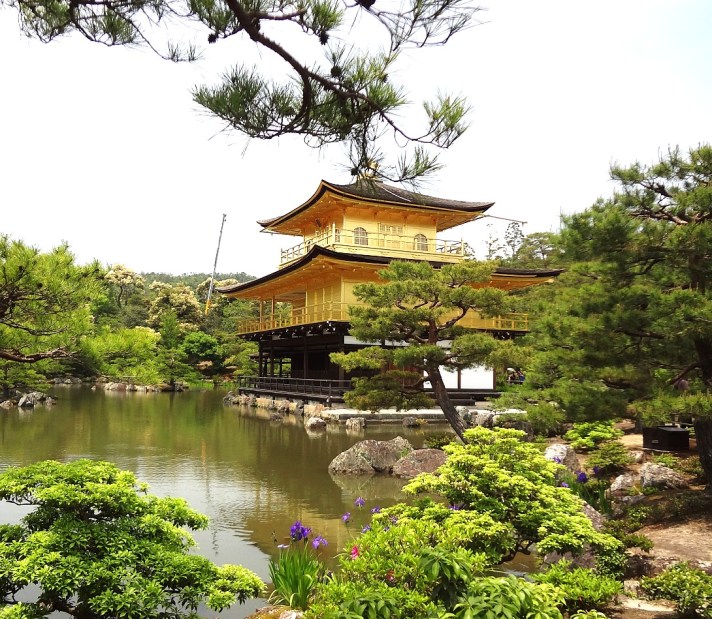
The grandson of Ashikaga Takauji, Ashikaga Yoshimitsu (足利義満, often called Shogun Yoshimitsu), constructed a beautiful new palace in the Muromachi (室町) area of Kyoto.  The palace became the center of government, known as the Muromachi bakufu (室町幕府: Muromachi government).   This is the beginning of the Muromachi period.  Ashikaga Yoshimitsu also built the famous “Kinkaku-ji Temple” * (Golden Pavilion) in Kyoto as his second residence.

Kinkaku-ji Temple* (金閣寺: Golden Pavilion) —————Ashikaga Yoshimitsu (足利義満) built Kinkaku-ji in 1397.   Later, it became a Rinzai-Shu (臨済宗) Buddhist temple, but it was originally built as the secondary residence of Ashikaga Yoshimitsu and a guest house for official visitors.  Today, it is a designated World Heritage site.  The temple was burned down by an arsonist in 1950 but was rebuilt in 1955.  Novelist Mishima Yukio wrote a novel, “Kinkaku-ji,” which relates to this temple and the arsonist.  A famous quote from his book is, “The ho-oh (a mythic golden bird, a Chinese version of the phoenix) on the roof of Kinkaku-ji Temple is stationary, but it flies through time eternally.”

During the Muromachi period, the emperor’s power declined.  The shogun (将軍) held all the political power.  Gradually, several groups of samurai who were officially appointed as shugo daimyo (守護大名: high-ranking officials) began to gain political and economic power by occupying key positions in the Muromachi bakufu.  They also owned extensive land.  Two powerful shugo daimyo families were the Hosokawa (細川) and Yamana (山名).

The Ashikaga family made great efforts to establish the Muromachi bakufu as a stable and strong government through political measures.  The beginning of the Muromachi period was peaceful and prosperous.  However, by the time Ashikaga Yoshimasa (足利義政) became the eighth shogun, the Muromachi bakufu had become severely corrupt.  Shogun Yoshimasa paid little attention to governing the country.  Instead, he pursued women (his mother scolded him for this), spent large amounts of money building the Silver Pavilion called “Ginkaku-ji Temple (銀閣寺),” and retreated there.  Since Shogun Yoshimasa did not have an heir, his brother, Yoshimi (義視), was appointed as the next shogun.

However, later, Yoshimasa’s wife, Hino Tomiko (日野富子)*, gave birth to a son, Yoshihisa (義尚).  Now, brother Yoshimi (義視) allied with the high-ranking officials, the Hosokawa (細川), while his son, Yoshihisa, allied with another powerful family, the Yamana (山名).  Several smaller samurai groups allied with either side, and the war broke out.  This war, called Onin-no-ran (応仁の乱), occurred in 1467.  It spread across the country and lasted for eleven years.

Hino Tomiko (日野富子)*————————-The wife of Shogun Yoshimasa.  She took advantage of her political privileges to generate substantial income by investing in the rice market, thereby controlling prices and selling at high profits.  Then, she loans this money to high-ranking officials at steep interest rates.  The corruption reached an uncontrollable level.

As a result of the Onin-no-ran, beautiful Kyoto was burned to the ground.  The authority of the Muromachi bakufu only extended to small areas of nearby Kyoto.  The Onin-no-ran led to the next period called the Sengoku period (戦国時代), or the Warring States period.  During the Sengoku period, Japan was divided into approximately thirty small, independent states that fought one another until Oda Nobunaga, Toyotomi Hideyoshi, and Tokugawa Ieyasu unified them.

57 Kinkakuji trip 2019

 The photo was taken in May 2019, a family trip to Kyoto