22| Sengoku Period History (戦国時代歴史)

0-timeline - size 24 Sengoku Period 0

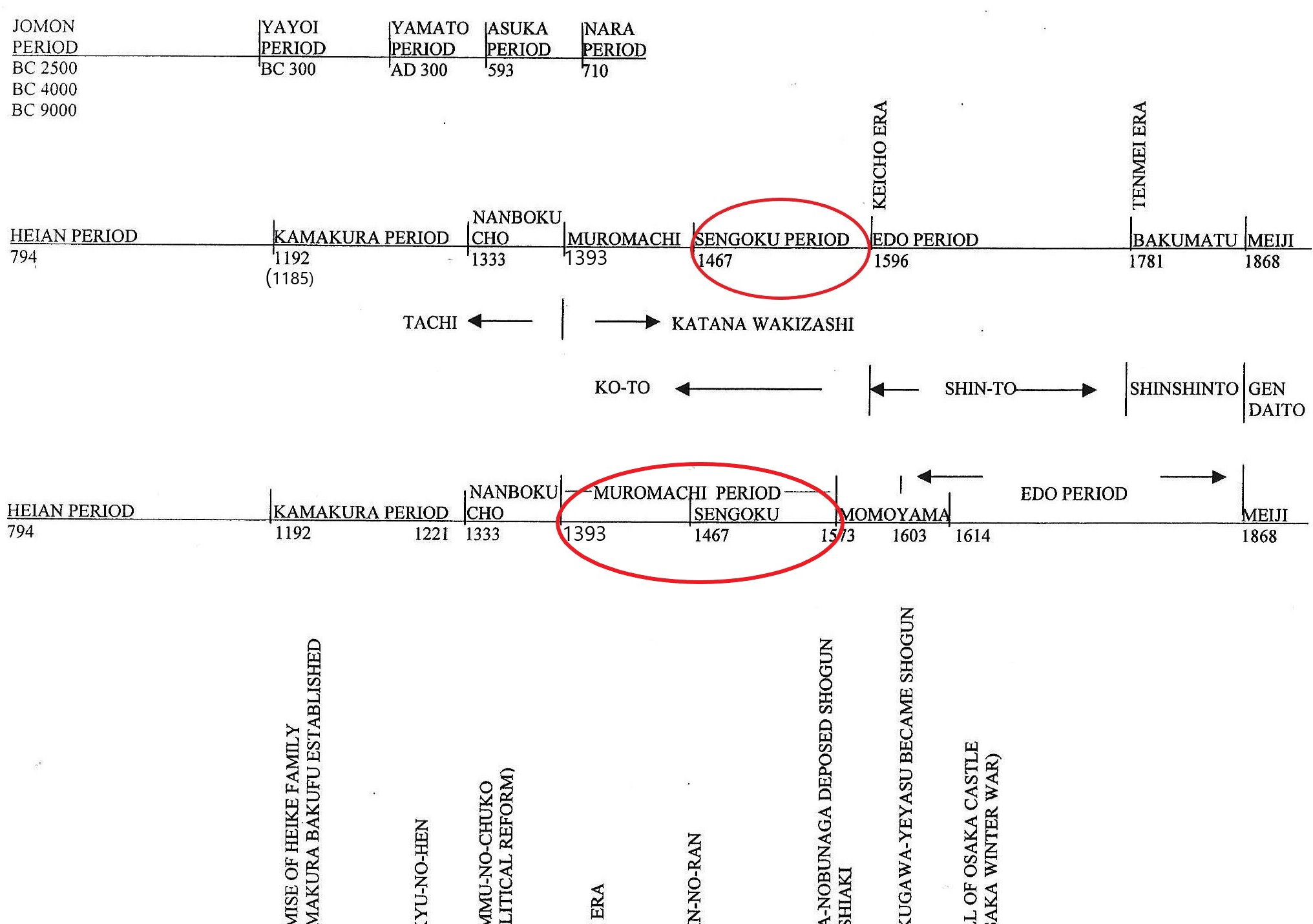
The red circle above indicates the time we discuss in this section

The timeline above shows two circles.  In political history, the Sengoku period (戦国時代) is part of the Muromachi period (室町), which is the lower circle.   However, in sword history, we separate the Muromachi and Sengoku periods (Warring States period), the top circle.  In sword history, we divide the time this way because, during those two periods, sword styles changed, and the environment of sword-making also changed.

After the Onin-no-ran (応仁の乱) began (discussed in 20|Muromachi Period History), the beautiful capital city of Kyoto (京都) was in a devastated condition.  The shogun’s (将軍) power reached only over a small area.  The rest of the country was divided into about thirty small independent states.  The leaders of these independent states were called shugo daimyo (守護大名).  They were originally government officials who were appointed and sent there by the central government.

Powerful local samurai often became the leaders of these states.  They fought against each other to take over each other’s land.  During the Sengoku period, vassals would kill their lords and steal their domains, or farmers would revolt against their lords.  A state like this is called “gekoku-jo” (lower-class samurai overthrow the superior). 

This was the time of the Warring States, known as the Sengoku period.  The leader of each state was called a Sengoku daimyo (戦国大名: Warlord).  The Sengoku period lasted about 100 years.  Gradually, powerful states defeated weaker ones through long, fierce battles, expanding their territory.  Around thirty small countries became twenty, then ten, and so on.  Eventually, only a few dominant sengoku daimyo (warlords) remained.  Each daimyo from those states fought their way to Kyoto and tried to become the top ruler of Japan.  The first one who almost succeeded was Oda Nobunaga (織田信長).  However, he was killed by his vassal, Akechi Mitsuhide (明智光秀), and soon Akechi was killed by his colleague, Toyotomi Hideyoshi (豊臣秀吉).  

After Toyotomi Hideyoshi defeated Akechi Mitsuhide, his troops, and other major warlords, he nearly completed the unification of Japan.  Yet, Hideyoshi still had one more rival to deal with to finish his goal.  That was Tokugawa Iyeyasu (徳川家康).  Now, Toyotomi Hideyoshi and Tokugawa Ieyasu are the last contenders for the top position.  Both recognized that their opponents were smart and capable.  Any wrong move could be disastrous.  Therefore, they decided to maintain a friendly coexistence on the surface for the time being.  Although Toyotomi Hideyoshi tried to make Tokugawa Ieyasu his vassal, Tokugawa Ieyasu somehow managed to avoid that.  In Tokugawa Ieyasu’s mind, being younger than Toyotomi Hideyoshi, he knew he could simply wait until Hideyoshi‘s natural death, which eventually happened. 

After Hideyoshi’s death, Tokugawa Ieyasu fought Hideyoshi’s vassals and won at the Battle of Sekigahara (関ヶ原の戦い) in 1600.  Then, in 1615, at the Battle of the Osaka Natsu-no-jin (Osaka Summer Campaign: 大阪夏の陣), Tokugawa defeated Hideyoshi’s son’s army.  Following this, the Toyotomi clan was dissolved entirely, and the Edo (江戸) period began.  It is called the Edo period because Tokugawa Ieyasu lived in Edo, which is now Tokyo (東京).

*The Sengoku period is frequently depicted in TV dramas and movies.  People who lived through that era had a tough time, but it was also the most exciting time for creating TV shows and films.  The lives of Oda Nobunaga, Toyotomi Hideyoshi, and Tokugawa Ieyasu are among the most popular stories in Japan.  In particular, the story of Toyotomi Hideyoshi is among the most popular.  His background was that of a poor farmer, but he rose to become the top ruler of Japan.  That is a fascinating success story.


23 Toyotomi_hideyoshi

Portrait of Toyotomi Hideyoshi (豊臣秀吉) by Kano Mitsunobu, owned by Kodai-Ji Temple      From Wikimedia Commons, the free media repositon.

18| Nanboku-Cho Period Sword (南北朝太刀)

0-timeline - size 24 Nanboku-cho

                           The circle indicates the time we discuss in this section

During the Nanboku-cho period, samurai sought large, elaborate, impressive, yet practical swords.  The Soshu-den style sword from Nanboku-cho time was just that.    This was the most popular style at the time.  The Nanboku-cho period marked the peak and height of the Soshu-den sword.  Many swordsmiths moved from other provinces to the Kamakura area and forged Soshu-den style swords.  Other schools and provinces outside the Kamakura area also produced Soshu-den-style swords in their own areas.


19 Nanboku-cho Sword style

Sugata (姿: Shape) —————–The original length of a sword ranged from three to five feet, but it was later shortened to about two and a half feet.  A significantly shortened blade is called o-suriage. 

The Nanboku-cho style sword features shallow kyo-zori (also called torii-zori).  Refer to Chapter 5, Heian Period Sword.  The highest curvature occurs around the middle of the body. It has a wide body, high shinogi, narrow shinogi-ji  (Chapter 3, Names of parts),  and thin kasane (blade thickness), which are distinctive features of the Nanboku-cho style.  High gyo-no-mune or shin-no-mune, and sometimes a maru-mune (round back).

19 Nanboku-cho 3 kinds Mune

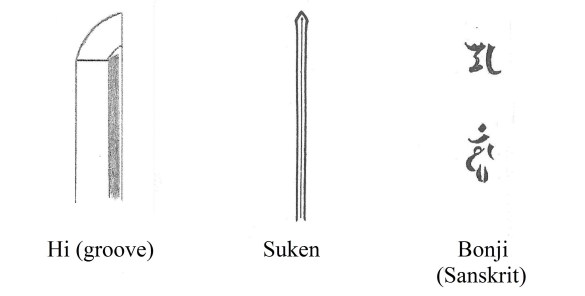
Hi (: groove) and Horimono (彫刻: engraving) ——– Often, a single hi (bo-hi), double hi, suken (dagger), Bonji (Sanskrit), and/or dragon are engraved on the shinogi-ji area.  Refer to Chapter 3, Names of Parts.

9 Hi, Suken, Bonji

Hamon (: Tempered line) —- The lower part of the body exhibits a narrow-tempered line; gradually, this line becomes wider and showier.  Course nie. O-midare (large, irregular, wavy hamon), Notare-midare (wavy, irregular hamon), and Gunome-midare (a combination of repeated half-circular and irregular hamon). Inazuma and kinsuji (see Chapter 14, Late Kamakura Period Sword) sometimes appear.

19 Hamon Notare 319 Mamon choji gunome19 Hitatsura Hamon Hiromitsu

                                  *From Sano Museum Catalogue ( Permission granted).

Ji-hada (地肌: the area between the shinogi and the tempered line) ———————-Wood-grain pattern (itame 板目). Sometimes tobiyaki (patchy tempered spots) appear on ji-hada.  For ji-hada, refer to Chapter 3, Names of Parts.

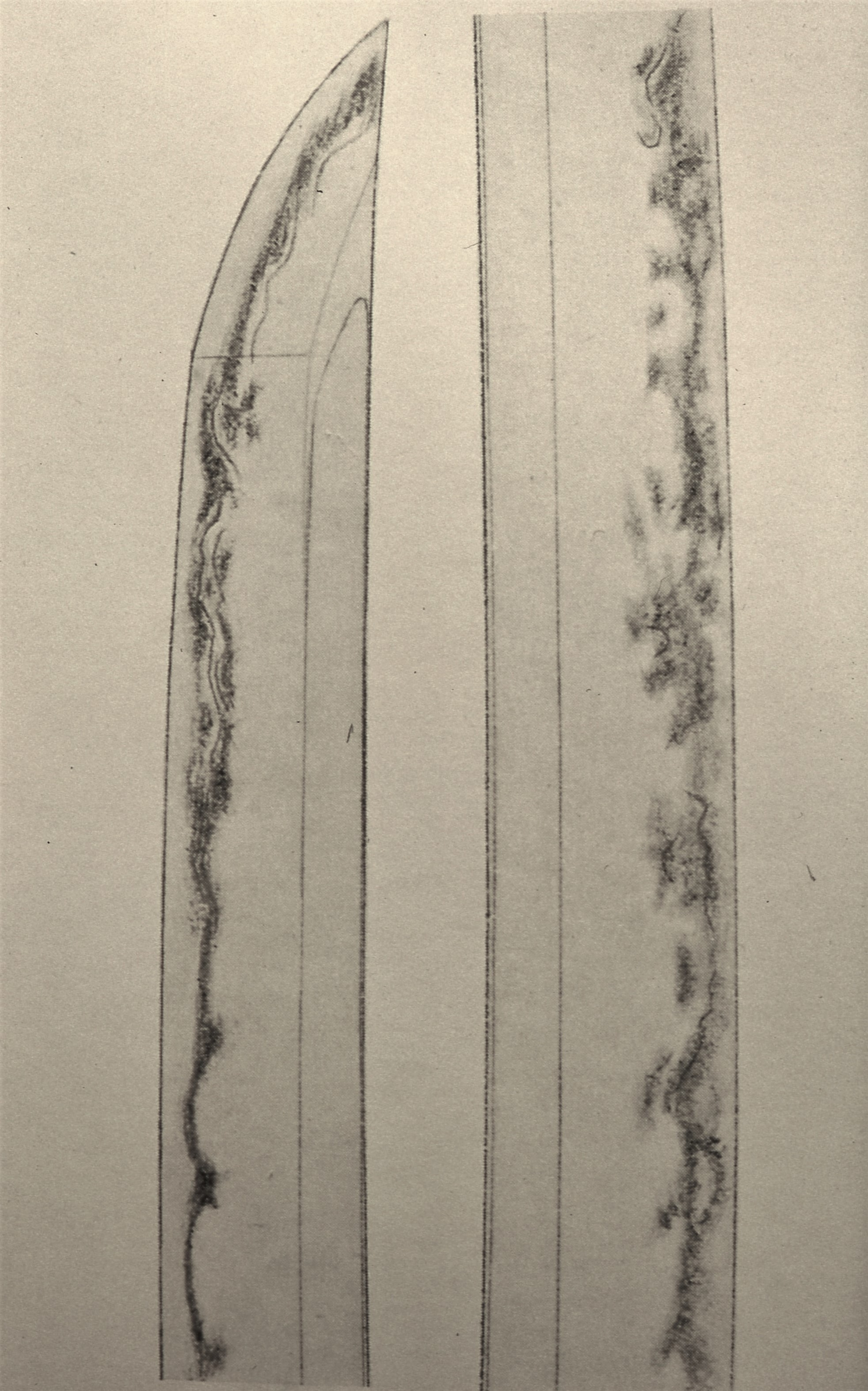
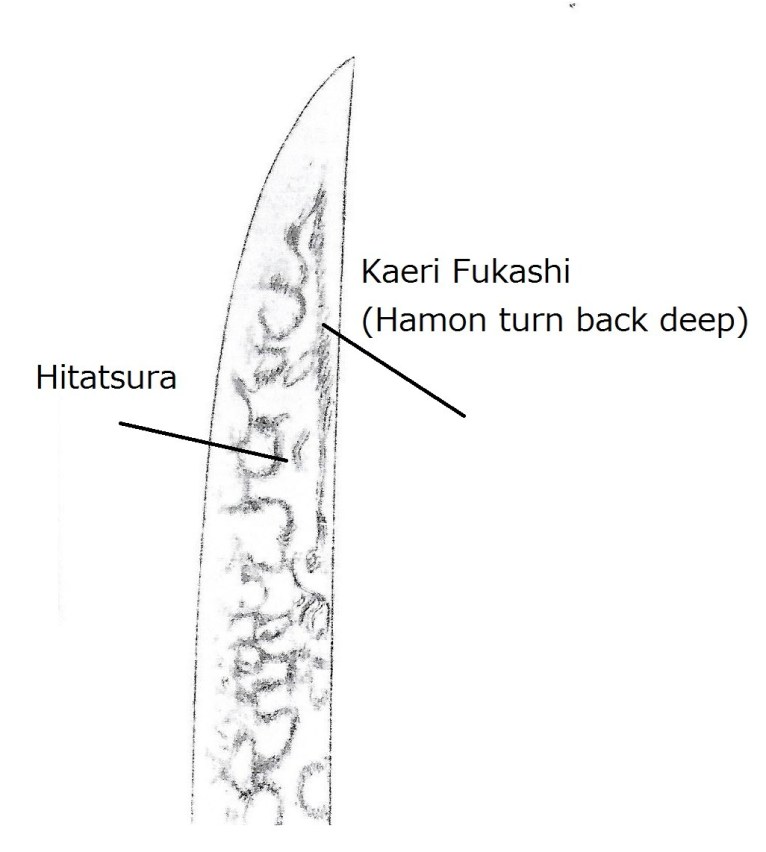
Kissaki (切っ先) and Boshi (tempered line at the kissaki area) ———- O-kissaki (long and large kissaki). Fukura kareru (less arc kissaki).  Midare-komi (the body and boshi have a similar tempered pattern), with kaeri-fukashi (hamon deeply turns back), and sometimes hitatsura (entirely tempered).  See the illustration above.

Sword-smiths during Nanboku-Cho Period Soshu Den (school)

  • From Soshu—————————————————Hiromitsu (広光)  Akihiro (秋広)  
  • From Yamashiro ———————————————Hasebe Kunishige (長谷部国重) 
  • From Bizen (called So-den Bizen)——-Chogi (長儀 )group  Kanemitsu (兼光 ) group 
  • From Chikuzen ———————————————————-Samoji (左文字 ) group

Chogi (長義)from The Sano Museum catalog. Permission to use is granted

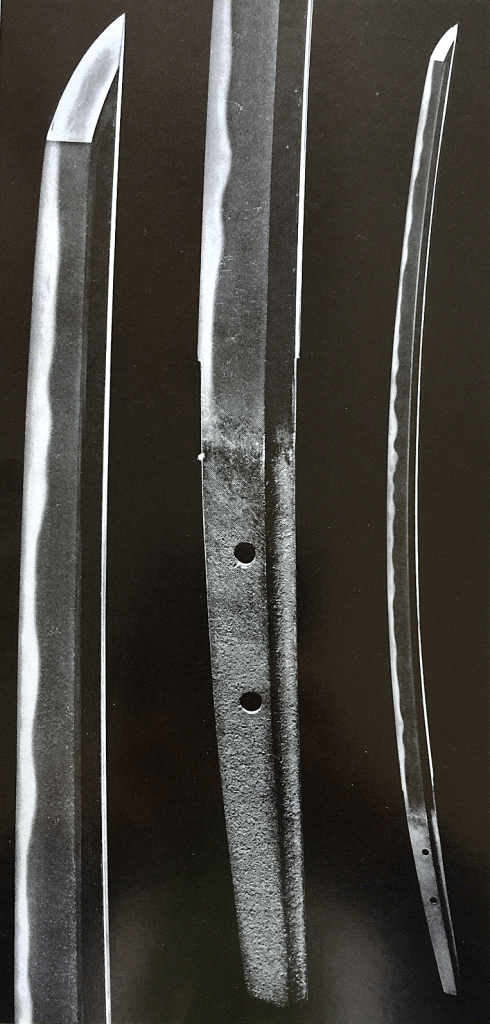
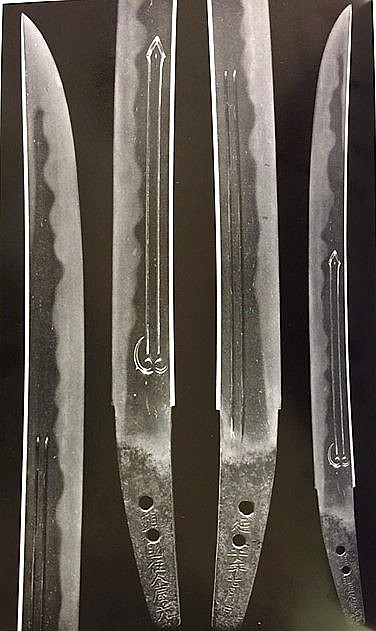
The distinctive characteristics of the Nanboku-Cho period sword in the photo above      

  • The trace of an engraving of suken on the inside of the nakago indicates that this area was once a part of the main body.
  • Large and long kissaki

17| Nanboku-cho Period History 1333-1392(南北朝歴史)

0-timeline - size 24 Nanboku-cho

            The red circle above indicates the time we discuss in this section.

After Jokyu-no-ran (Chapter 10 Jokyu-no-ran), the power of the Imperial Court declined significantly.  The successor, the Hojo clan, which was a dominant force during the Kamakura period, also began to face financial difficulties and began to lose control over regional lords.  One reason was the costs incurred by the Mongol invasion.  The Kamakura bakufu (government) could not adequately reward the samurai who fought hard during the war.  As a result, they became very dissatisfied with the bakufu.  Seeing this as an opportunity, Emperor Go-Daigo attempted to attack the Kamakura bakufu twice but failed both times.  He was exiled to Oki Island.  In the meantime, Ashikaga Takauji (足利尊氏) and several groups of anti-Kamakura samurai gathered armed forces and succeeded in destroying the Kamakura bakufu in 1333.  This war ended the Kamakura period.                                                                                                                                                  

Emperor Go-Daigo, who had been exiled to Oki Island, returned to Kyoto and attempted political reforms.  This reform was known as Kenmu-no-chuko (or Kenmu-no-shinsei, 建武の中興).  However, his reforms failed to satisfy most of the ruling class.  Seeing an opportunity, Ashikaga Takauji attacked the Imperial Court in Kyoto, deposed Emperor Go-Daigo, and installed a member of a different branch of the Imperial family as emperor. 

Emperor Go-Daigo, however, insisted on his legitimacy, moved to Yoshino in the south of Kyoto, and established another Imperial court.  Thus, the Northern and  Southern Dynasties began.  With much strife between these rival courts and internal problems within each court,  more samurai groups began to move to the Northern Dynasty.  About sixty years later, the Southern Dynasty was forced to accept the Northern Dynasty’s proposal.  Consequently, the Northern Dynasty became the legitimate imperial court.  This sixty-year period is referred to as the Nanboku-cho or Yoshino-cho period. 

During the Nanboku-cho period, samurai preferred longer, more elaborate, yet practical swords.  The Soshu-den was at the height of its prominence.  However, the Soshu group was not the only one to produce Soshu-den-style swords.  Other schools and provinces in different areas also made Soshu-den-style swords.

Late Kamakura Period Swordsmiths (Early Soshu-Den time)

  • Tosaburo Yukimitsu (藤三郎行光)  
  • Goro Nyudo Masamune (五郎入道正宗)     
  • Hikoshiro Sadamune (彦四郎貞宗)

 17 Masamune hamon (Sano)             Masamune from Sano Museum Catalog (permission granted)
Nanboku-cho Period Swordsmiths  (Middle Soshu-Den time)

  • Hiromitsu (広光)   
  • Akihiro (秋広)

 20 Hitatsura Hiromitsu Hitatura )                  Hiromitsu from Sano Museum Catalog (permission granted)

Muromachi Period Swordsmiths (Late Soshu-Den time)

  • Hiromasa (広正)    
  • Masahiro (正広)

15| The Revival of Yamato Den(大和伝復活)

0-timeline - size 24 Late Kamakura

        The red circle above indicates the time we discuss in this section

It is believed that sword-making first started in Yamato province (now Nara Prefecture) during the Nara period (710 to 794).  In the early days of sword-making, the forging techniques were primitive.  At that time, many swordsmiths lived in Yamato, but over time, sword-making in this region declined.

At the end of the Kamakura period, several powerful Buddhist temples emerged in the Yamato area, leading to conflicts among them.  Temples held significant political and military power to control large territories called shoen (荘園) through their large numbers of warrior monks, known as sohei (僧兵).  The most dominant group was Nanto Sohei (南都僧兵)*.  These groups of sohei demanded more swords to arm themselves, which revitalized the Yamato-den (school) and increased the number of swordsmiths in the Yamato area.   As a result, the Yamato-den group became active again.  The Yamato-den style is somewhat similar to the Yamashiro-den.    

*Nanto Sohei (南都僧兵)—————-Since around the 11th century, Buddhist temples grew powerful under the protection of the Joko (retired emperors).  These temples had many sohei (low-level monks who also served as soldiers). When power struggles arose among the temples, sohei fought as their soldiers on the battlefields.  Nanto Sohei were such soldiers at Kofuku-Ji Temple (興福寺).  Several large temples, such as Todai-ji (東大寺) Temple, controlled the Yamato area.

Sugata (姿: Shape) —————- Not much difference in style during the early part of Yamatoden and Yamashiro-den.  Shinogi is high.  Mune is thin.   Some Yamato-den have a shallow sori (curvature).

16 Yamato sword cross section

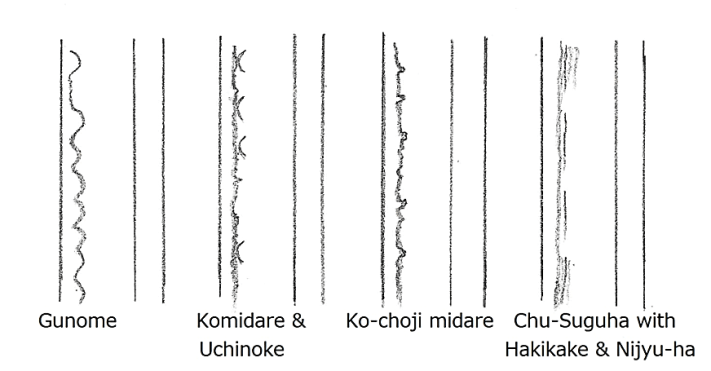
Hamon (刃文Tempered line) ——————Narrow tempered line.  Mainly nie (沸).  Chu-suguha-hotsure (中直刃ほつれ: a medium straight line with a frayed pattern), ko-choji-midare (小丁子: a mixture of small clove-like patterns and irregular wavy lines), ko-midare (小乱: small irregular wavy lines), ko-gunome-komidare (小五の目小乱: small continuous half-circles mixed with wavy lines). 

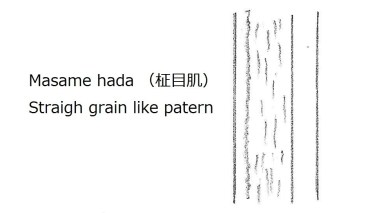
The main features of the Yamatoden style sword are masame (straight grain).  Its tempered line often shows nijyu-ha (double straight lines), hakikake (brush mark trace), uchinoke (a crescent-shaped line), or a combination of these.   See the illustration below.


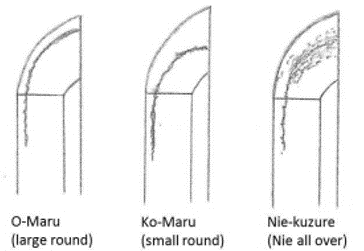
Boshi (鋩子: Tempered line at Kissaki area) ———- In the boshi area, a straight grain hamon pattern appears.  Yakizume or kaen. (Refer to Chapter 12, Middle Kamakura period: Tanto).  O-maru, ko-maru, nie-kuzure.  (Refer to Chapter 14, Late Kamakura Period Sword.  See the illustration below.)


15 Omaru Komaru Niekuzure

Ji-hada (地肌):Area between the shinogi and the tempered line)———— mostly masame-hada (straight grain pattern 柾目肌). Fine ji-nie, chikei, or yubashiri.  (Refer to Chapter 14, Late Kamakura Period Sword (鎌倉末太刀).  See below.)

16 Masame Hada

Nakago (Hilt) ———————– Often displays Higaki Yasuri (檜垣), the finishing file pattern, as illustrated below. 

16 Higaki Yasuri

Names of the Yamato School Sword-smiths

Taema(当麻) Group————–Taema Kuniyuki(当麻国行) Taema Tomokiyo(当麻友清) Shikkake (尻懸) Group———————————————-Shikkake Norinaga (尻懸則長) Tegai (手掻) group ——————Tegai Kanenaga (手掻包永) Tegai Kanekiyo(手掻包清) Hoshou (保昌) group———Hosho Sadayoshi ( 保昌貞吉) Hosho Sadamune (保昌貞宗)

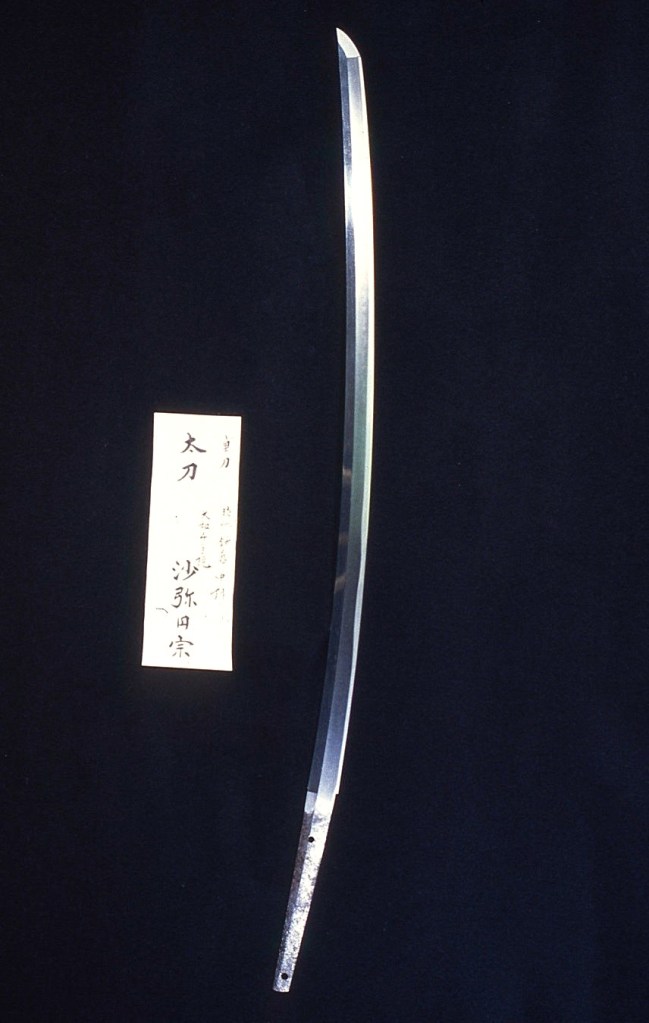
Yamato Senjuin Saya Enso (大和千手院沙弥円宗)  once my family sword

4 | Heian Period History (平安時代歴史) 794 – 1192

The Heian Period (平安時代) began when Emperor Kanmu (桓武天皇) moved the capital to Heian-Kyo (平安京) in 794, which is now known as Kyoto (京都).

0-timeline - size 24 Heian

                             The circle indicates the time we discuss in this section.

During the Heian period, emperors ruled Japan.  However, early in this era, the Fujiwara family, a wealthy aristocratic family, held actual political power. The Fujiwara family managed to marry their daughters to emperors, thereby gaining power through these marriages. The family was called “Sekkan-ke” (摂関家), meaning the guardian’s family or the emperor’s representative.

In those days, aristocrats led an elegant, refined lifestyle while cultivating a graceful culture.  Many essays and novels were written by female authors during that period.  The most famous one is “Tales of Genji (源氏物語)” written by Murasaki Shikibu (紫式部).    The Imperial Court often held ceremonies followed by elaborate, lavish banquets.  This imperial social life played an important role in advancing aristocrats’ political careers.  Women also actively participated in these ceremonies.   Many high-ranking officials owned several large estates.  Sometimes, their daughters inherited these properties and lived there.

Courtship methods were quite different back then.  To start a romantic relationship, a man would write a poem called “waka” for the lady he was interested in and have his servant deliver it to her, hoping she would write him back with a similar poem.  Once she accepted him, he was allowed to visit her for short periods from a distance.  As their relationship grew deeper, he would visit her more frequently and stay longer.  After they married, and if she was his first legal wife, she would live with him in his house.  If she were not his first legal wife, she would remain in her own home, and he would visit her for a few days or longer.  The wife’s family raised their children.  In those days, and until the next Kamakura period, a woman’s lineage was considered important.  By the middle of the Heian period, emperors regained political power because their mothers were not from the Fujiwara family.

     Scenes from the “Tales of Genji”.   Bought in Kyoto.

Origin of Samurai

Although the Heian Imperial court and aristocrats lived with grace and elegance, they lacked the political power to govern the country.  There were numerous thieves, frequent fires, and constant fights everywhere.  Consequently, the Imperial court, aristocrats, and temples began hiring armed guards or security forces to protect themselves and maintain public order.  These hired guards were the origins of bushi (武士) or samurai (侍).  Samurai extended their influence and gained more power by forming groups and suppressing uprisings.  Eventually, two powerful samurai clans emerged: one was the Heishi (平氏), often called the Heike (平家), and the other was the Genji (源氏).  Gradually, they gained power in the Imperial court.   After many power struggles among them, the Heishi started to control the Imperial court by marrying their daughters to the emperors.  In the later Heian period, political power shifted to the Heishi.  They became tyrannical and arrogant.  This behavior created many enemies.  The Genji clan and the Fujiwara family started a war against the Heishi.  The Genji pushed the Heishi to the final battlefield known as Dan-no-ura (壇ノ浦) in 1185 and defeated them.  This battle was the famous Genpei-Gassen (源平合戦).  The fall of the Heishi marked the end of the Heian period.

5-map-dan-no-ura-.jpg

During the Heian period, curved swords appeared for the first time.  Before that, swords had straight blades.  Historical studies of Japanese swords start from this point.  The elegant, refined lifestyle and culture created by the influential Fujiwara family were reflected in the swords’ style.  A group of swordsmiths in the Kyoto area created a distinctive sword style known as Yamashiro-den (den = school).  The shape of their blades exhibits a graceful line.  The most famous sword in the Yamashiro-den is the Mikazuki Munechika, by Sanjo Munechika (三条宗近) below, which is a national treasure today.  The Yamashiro-den style represents the swords of the Heian period.

Sanjo Munechika (三条宗近) from Showa Dai Mei-to Zufu (昭和大名刀図譜)  by NBTHK Owned by the Tokyo National Museum.