50|Part 2 of –16 Late Kamakura Period: Tanto (Early Soshu-Den 鎌倉末短刀, 正宗墓)

Chapter 50 is a detailed part of  Chapter 16, Late Kamakura Period Tanto (Early Soshu-Den).  Please read Chapter 16 before this section.
0-timeline - size 24 Late Kamakura

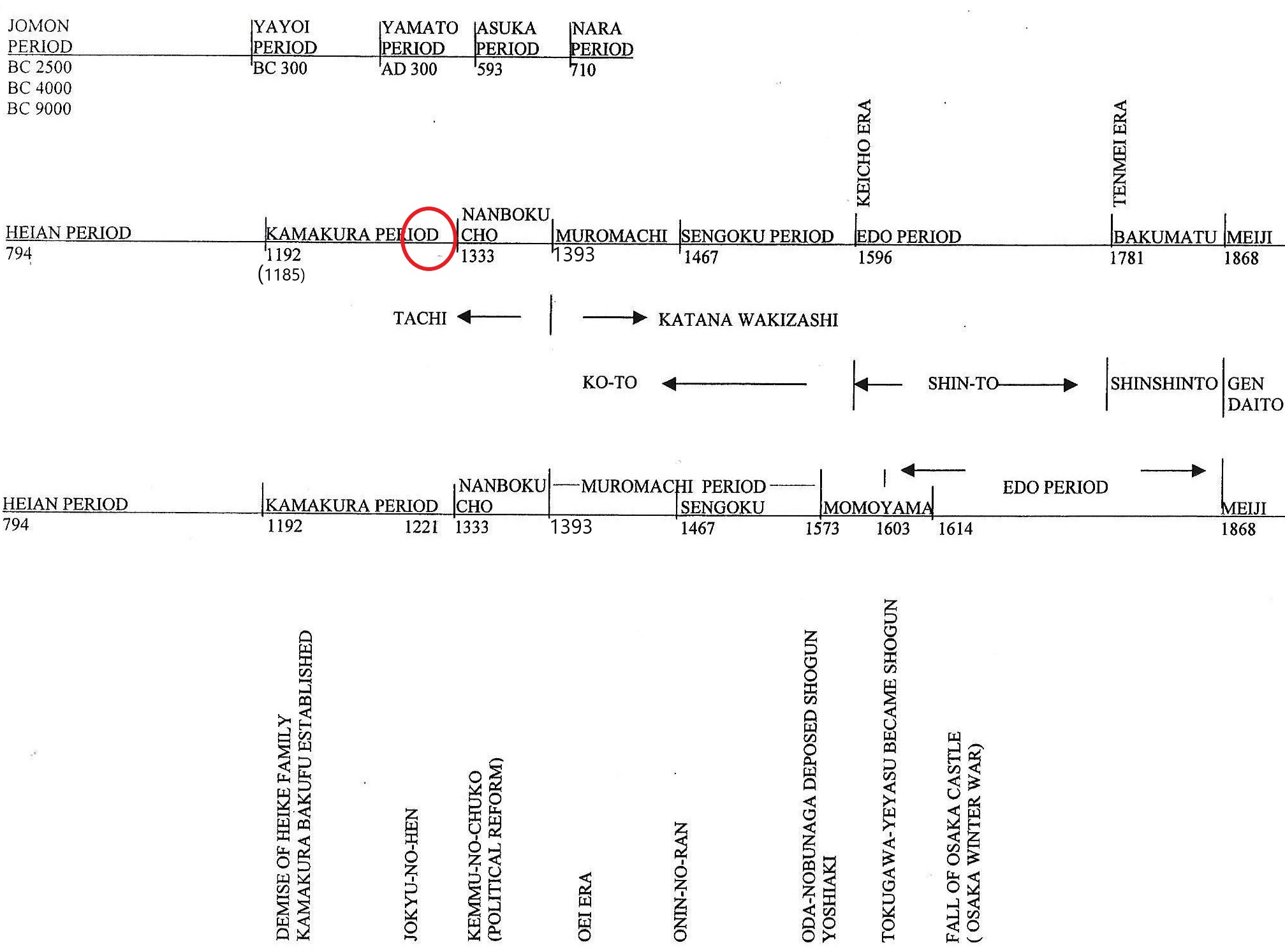
                     The red circle above indicates the time we discuss in this section.

In  Chapter 16, Late Kamakura Period Tanto (Early Soshu-Den), the general features of the late Kamakura period tanto style (early Soshu-den) are described.  The following two photos show the typical characteristics of early Soshu-den tanto.

Masamune

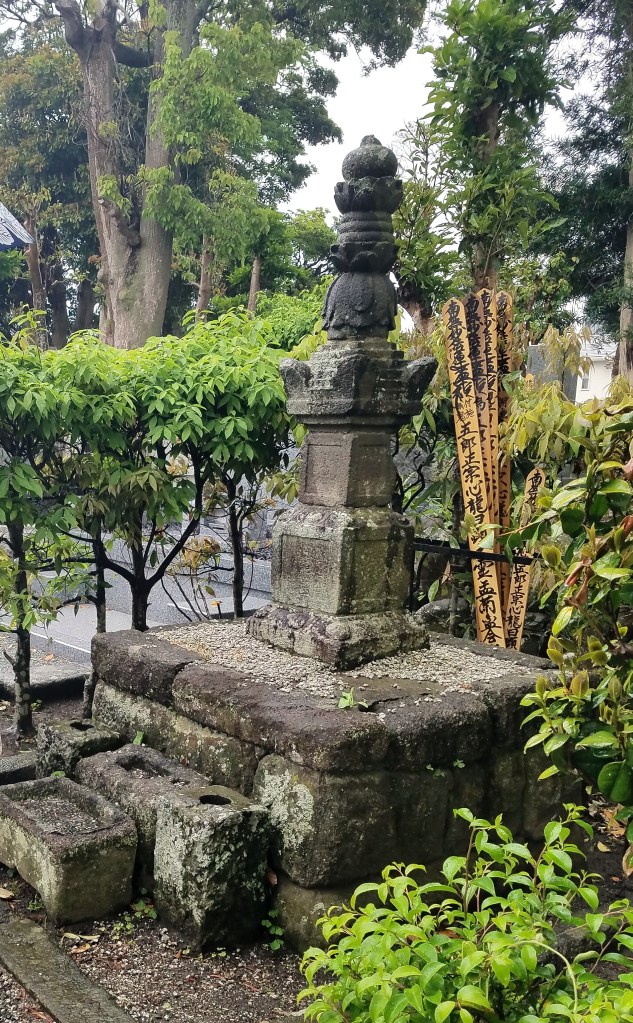
Goro Nyudo Masamune (五郎入道正宗) was born in Kamakura as the son of Tosaburo Yukimitu (藤三郎行光)Today, Masamune is a well-known swordsmith, even among those unfamiliar with Japanese swords.  His father, Tosaburo Yukimitsu, was also among the top swordsmiths in early Soshu-den.  Masamune’s tomb is located at Honkaku-ji (本覚寺) Temple, about a 6-minute walk from Kamakura Station. 
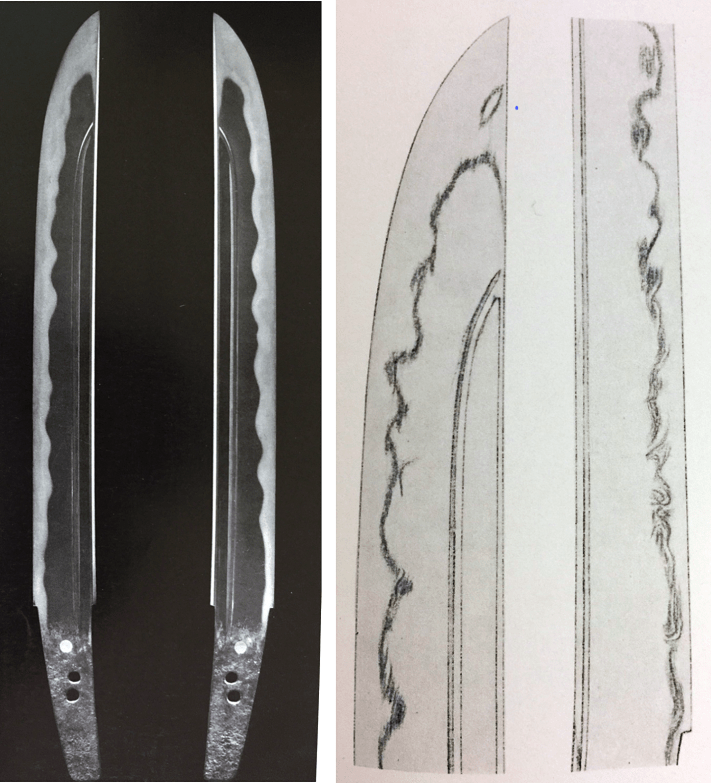
Goro Nyudo Masamune (五郎入道正宗) Sano Museum Catalog (permission granted)

Masamune photo (above) —– Hira-zukuri (flat).  Sakizori is very slightly curved (the tip area curves slightly outward).  Bo-hi and tsure-hi (parallel thin grooves).  Komaru-boshiItame-hada (wood grain pattern).  The Hamon is notare (wavy).  The illustration above shows sunagashi and niju-ba (double hamon).  This type of nakago is called tanago-bara.  The Masamune tanto is often mu-mei (unsigned). This particular tanto is called Komatsu Masamune (小松政宗).  The catalog from the Sano Museum’s description stated that connoisseurs in the past had difficulty determining this as a Masamune swordBecause the wide mihaba with sori and hamon slightly differed from those of another Masamune.  Judging from the clear nie, chikei, and kinsuji, it was determined to be a Masamune tanto.

Enju Photo below

               Higo Province Enju Kunisuke from Sano Museum Catalog (permission granted)

The Enju (延寿) group lived in Higo (肥後) Province on Kyushu.  The characteristics of the Enju group closely resemble those of the Yamashiro-den because Enju Kunimura was related to Rai Kuniyuki, a member of the Yamashiro-den.

Enju (photo above) —-Hamon is hoso-suguha (straight temper line).  The boshi is komaru.  The front engraving is suken (above left photo, left side), and the engraving on the back is gomabashi (left photo, right side).  Tight itame ji-hada.  It can be confusing to kantei (determine who made the sword) a sword like this because, although it is from the late Kamakura period, it does not have the typical early Soshu-den appearance.

Masamune’s Tomb in Honkaku-ji Temple

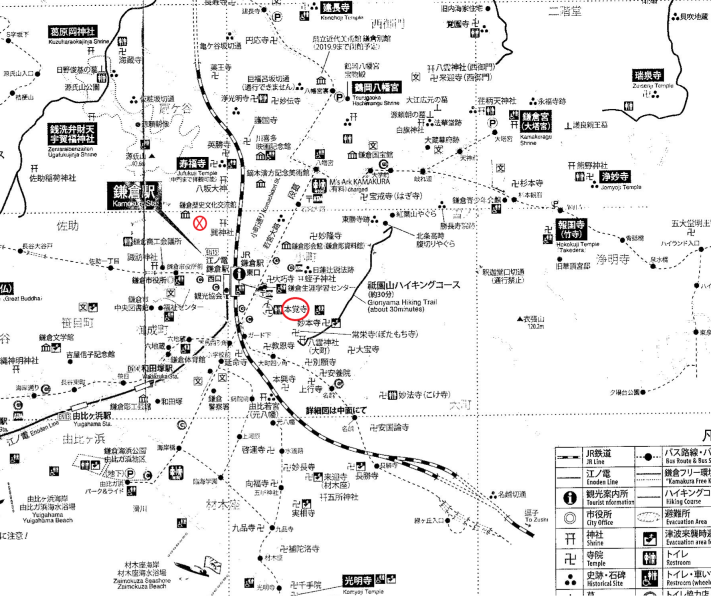
Masamune’s (正宗) tomb is located inside Honkaku-ji Temple (本覚寺) in Kamakura.  Here is a map of Honkaku-ji Temple and the Masamune Kogei store in Kamakura.  The store is owned by Tsunahiro Yamamura, the 24th generation of MasamuneHonkaku-ji Temple is circled on the map, and the Masamune Kogei store is a red circle with an X.  Both are about a 6 to 7-minute walk from Kamakura Station. 

To reach to Honkaku-Ji Temple from Tokyo                                                                           Take the Yokosuka Line train from Tokyo Station (approx. one hour) → Get off at Kamakura Station (one stop after Kita-Kamakura) → Exit through the East Exit (front exit) → Walk straight and cross the street → Turn right and walk to the post office → Turn left at the post office (Honkaku-ji Temple sign is at the corner of the post office)
From Kamakura Tourist map
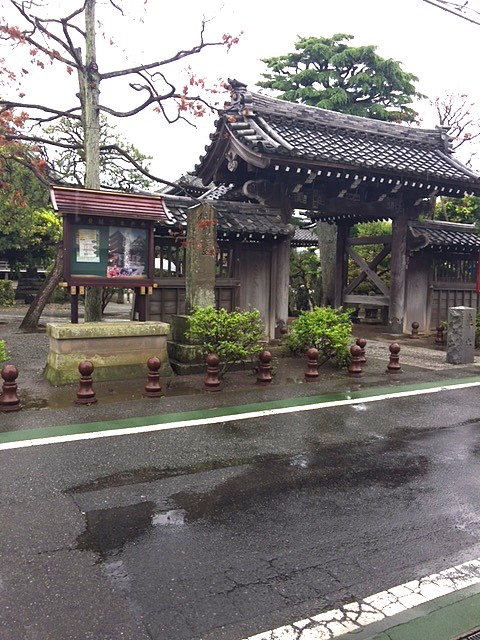
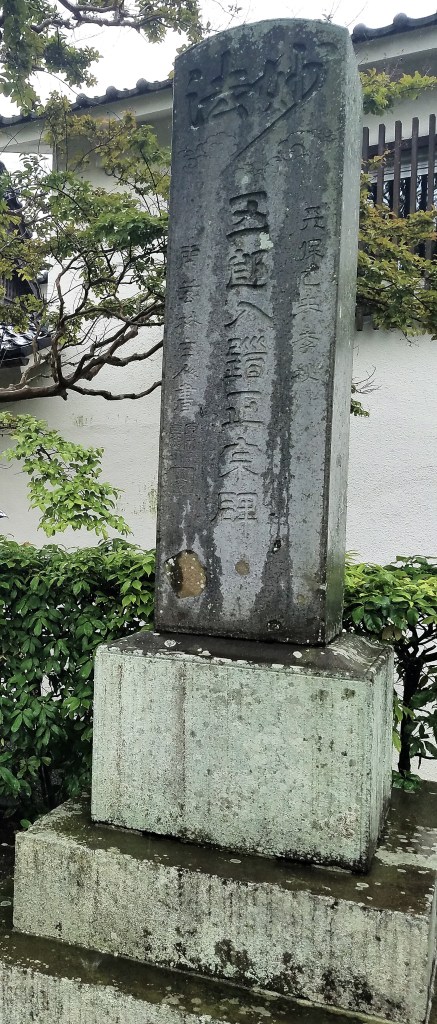
52 Honnkakuji 2 54 large Masamune monument only

52 Honkakuji 54 Small Masamune tomb only

Honkakuji Temple (本覚寺) and Masamune Tomb (正宗墓 )

21| Muromachi Period Sword (室町時代刀)

0-timeline - size 24 Muromach

       The red circle above indicates the time we discuss in this section

The Muromachi period was a relatively peaceful and prosperous time until shortly before the “Onin-no-ran,” which occurred at the end of the Muromachi periodRefer to Chapter 20, Muromachi Period History (室町時代歴史).   The Nanboku-cho style long swords became outdated; as a result, they were shortened.  The shortened blade is called suriage.  Overall, the Muromachi period was a declining time for sword-making.

Tachi and Katana 

Until the end of the Nanboku-cho period or the beginning of the Muromachi period, samurai wore swords suspended from their waists with the blade facing down.  When a sword was worn this way, the swordsmith inscribed his name on the side facing outward, meaning the blade is on your right when you see the inscription.  In this case, the sword is called a tachi.

During the Muromachi period, a sword was worn between the belt, with the blade facing up.   The swordsmith inscribed his name so that it faced outward when it was worn. Therefore, when you see the inscription, the cutting edge is to your left.  This is classified as a katana. 

Around the beginning of the Muromachi period, samurai started to wear a pair of swords called dai-sho (大小), meaning large and small.  The longer sword is a katana, and the shorter one is a wakizashi.  In general, a tachi is longer than a katana.  A katana is longer than a wakizashi, and a wakizashi is longer than a tanto.  Here is the order of their lengths. 

                                       Tachi   >   Katana   >   Wakizashi   >  Tanto                                  Tachi and katana differ in how they are worn, not in length.   

O-suriage ( 大磨上: Katana shortened by great length) 

How much the sword should be shortened depends on its original length and how much the owner wants it shortened.  O-suriage is a type of sword that is significantly shortened.  Once the blade is shortened by that length, the inscription of the maker’s name is cut off.  When the Hon’ami family (本阿弥家, a family of sword connoisseurs who have appraised Japanese swords for generations from the Muromachi period to today) appraises such a suriage sword, they write the make of the sword and the swordsmith’s name on the front side of the hilt, and the connoisseur’s name with his kaou (similar to a signature) on the back.  There are several levels of writing.  The level at which it should be done depends on the sword’s quality and the owner’s preference.  Below is the order of levels (high to low).

Shu-Mei (朱明 )————————————————————-name written in Vermilion  Kinpun-Mei (金粉名 )———————————————–name lacquered in gold powder  Gin-Zougan (銀象嵌 )————————————————————name inlaid in silver  Kin-Zougan (金象嵌 )————————————————————-name inlaid in gold

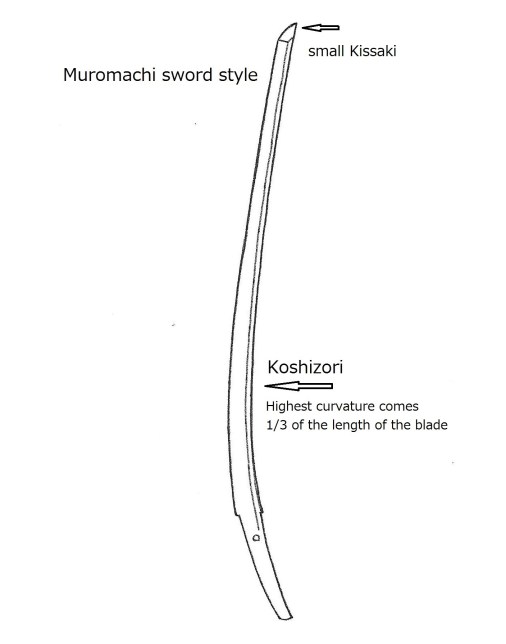
Sugata (姿: Shape) ——— The average length is typically two feet three to four inches (68~71cm).  The shape of the Muromachi period katana is somewhat similar to that of the Heian period tachi.  However, Muromachi katana are less grand or graceful than those from the Heian period swords.  The curvature is usually of the koshizori style.  Koshizori refers to the highest curvature being near the lower part of the blade.  The length and shape are suitable for wearing between the body and the belt.  The width and thickness are well-balanced with the size of the sword.  Small kissaki.

22 Muromachi sword shape

Hirazukuri-Wakizashi ———– Hirazukuri refers to a flat surface without a shinogi or yokote line.  Usually, it is 1 foot and 1 to 2 inches long.  No curvature.  Hirazukuri-wakizashi appeared during the Muromachi period.

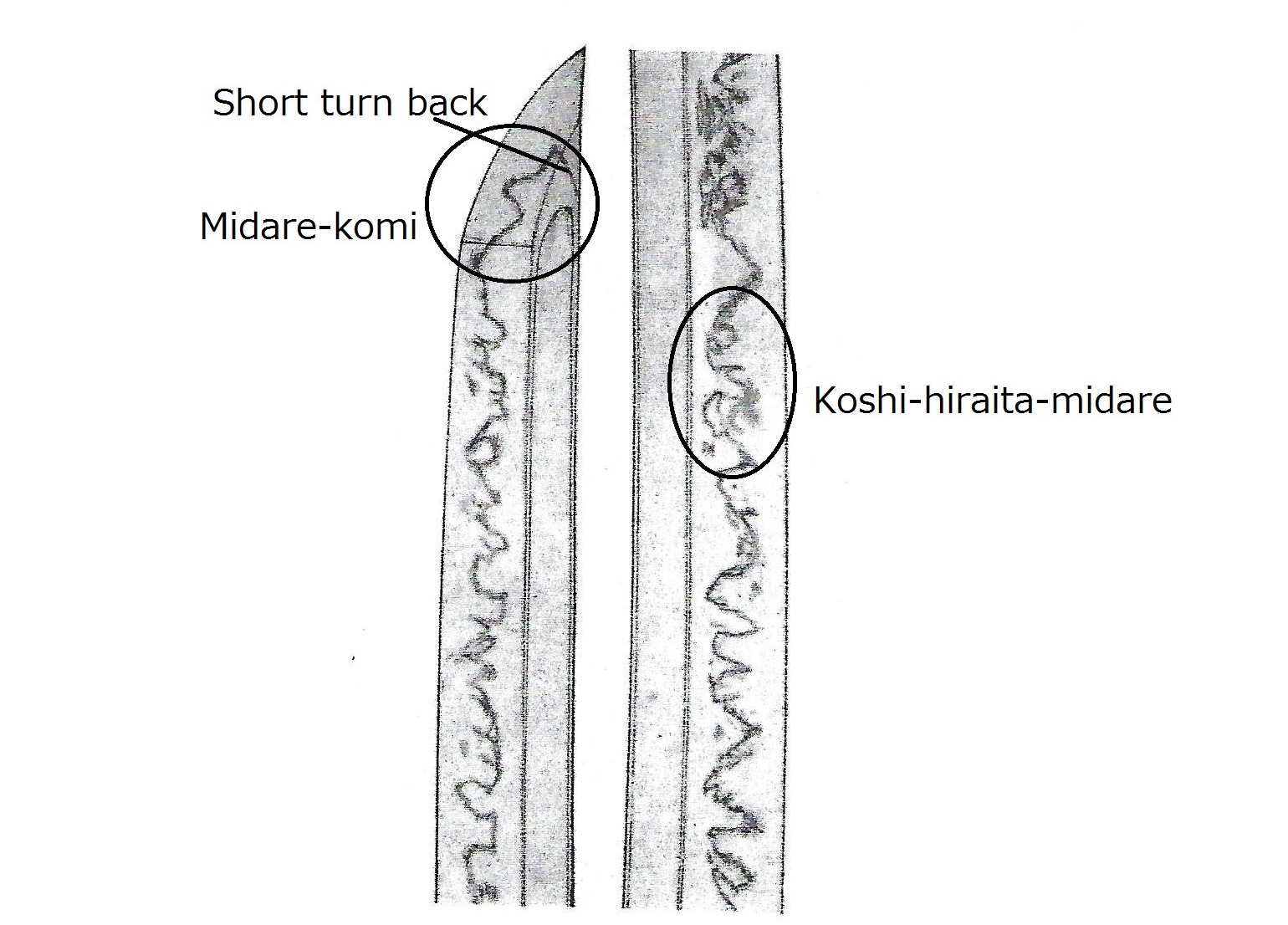
Hamon (刃文: tempered line) ———————- Nioi base.  The tempered area is well balanced with the blade’s width.  Koshi-hiraita-midare is mixed with choji-midare.

22Hamon (Koshi Hiraita midare)
from Sano Museum Catalogue (permission granted)
  • Boshi (Tempered line at Kissaki area) ————– Midare-komi, a short turn back.  See the above illustration.  Midare is an irregular wave-like pattern.
  • Ji-hada (地肌: An area between the tempered line and Shinogi)- Soft look, a large wood grain pattern, Ji-utsuri (faint smoke or cloud-like effect) shows.
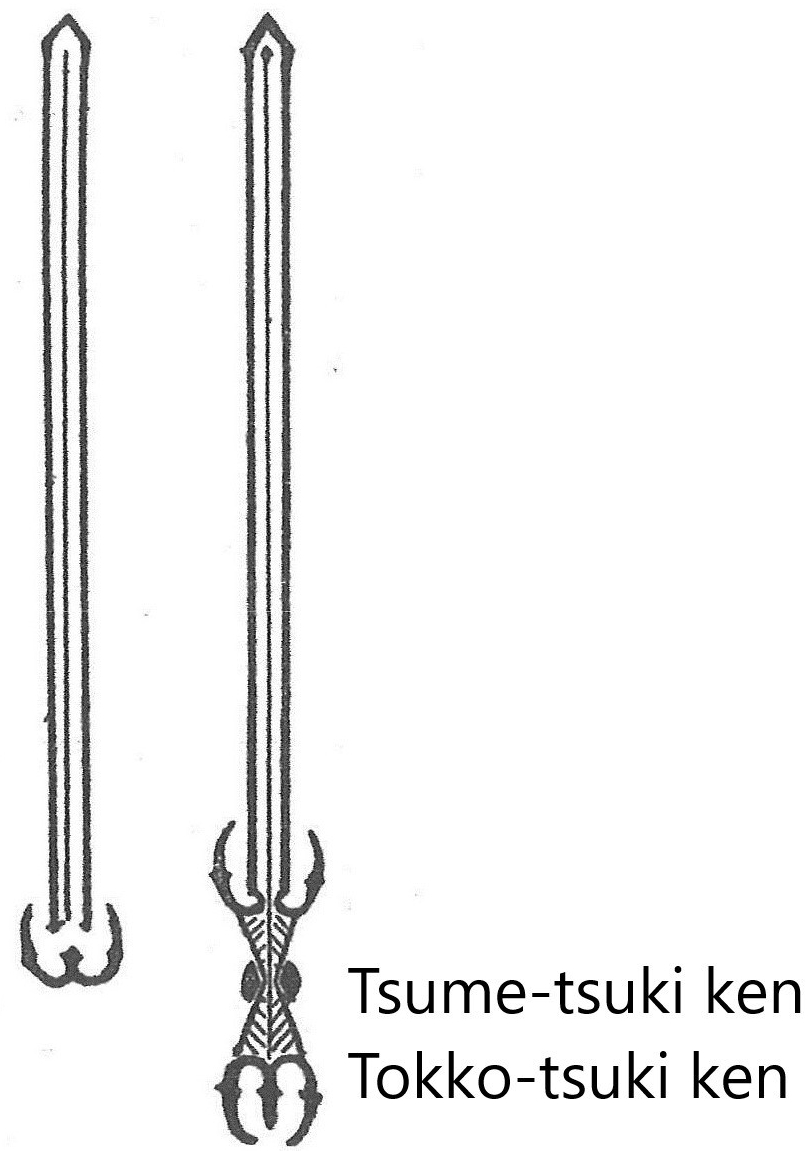
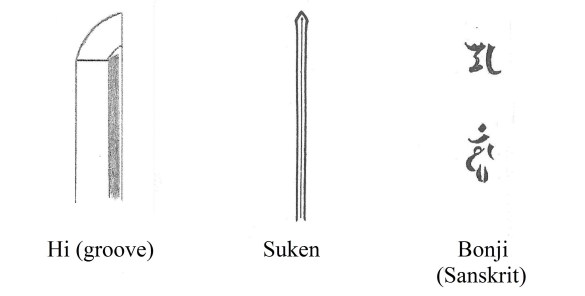
  • Horimono (彫物Engravings) ———- Bo-hi (single groove), Soe-hi (a thin groove alongside the main hi), Futasuji-hi (double narrow groove), Sanskrit, Tokko-tsuki ken, Tsume-tsuki Ken, name of God, and dragon.  Carvings became elaborate.

8 Hi, Suken, Bonji                  21 Tsume-tuki-ken tokko with caption

Sword Smiths during Muromachi Period

  • Bizen Den ——–Osafune Morimitsu (長船盛光), Yasumitsu (康光), Moromitsu (師光)
  • Yamashiro Den————————————————-Yamashiro Nobukuni (山城信国)

21 Muromachi sword from Sano

Ise Masashige (伊勢正重),                     Bizen Osafune Naomitsu (備前長船尚光)         Juyo Token(重要刀剣)                           Sano Museum Catalogue (permission granted)    once my family sword


19 | Nanboku-Cho Period Tanto(南北朝短刀)

0-timeline - size 24 Nanboku-cho
The circle indicates the time we discuss in this section

During the Nanboku-cho period, a type of tanto called hirazukuri ko-wakizashi sun-nobi tanto was made.  Hirazukuri means flat swords without the yokote line or shinogi.  Ko-wakizashi refers to a shorter sword.  Sun-nobi tanto means longer than a standard tanto.  This type is also known as Enbun Jyoji ko-wakizashi tanto because most of these tantos were created during the Enbun and Jyoji eras of the imperial period.  In Japan, a new imperial era begins when a new emperor ascends to the throne.  The Enbun era spanned 1356-1361, while the Jyoji period spanned 1362-1368.

20 Enbun Jyoji Kowakizashi Tanto

Sugata (姿: shape) ————A standard tanto measure is approximately one shaku.  Shaku is an old Japanese unit of measurement for length, and one shaku is roughly equal to one foot.  

8.5 sun (the sun is another old Japanese measurement unit of length) is approximately ten inches.  Ten inches is the standard size for a tanto, known as a josun tanto.  Anything longer than a josun tanto is called a sun-nobi tanto.  Anything shorter than a josun is called a sun-zumari tanto. 

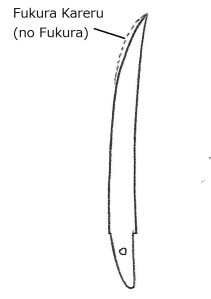
Most of the Nanboku-cho tantos are longer than a josun tanto, approximately one foot two inches.  Therefore, they are called hirazukuri ko-wakizashi sun-nobi tantoSaki-zori (curved outward at the top.  See the illustration above).   Wide in width and thin in body.  Fukura kareru (no fukura means less arc).  Shin-no-mune.  See the drawing below.

20 Fukura           20 Shin-no-Mune

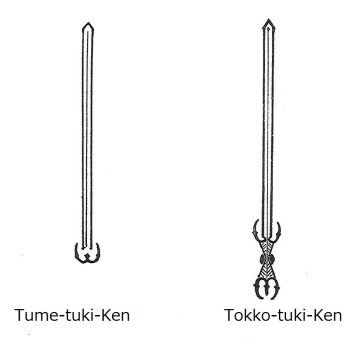
Hi, (: Grooves) and Horimono (彫り物: Engraving) ——- A groove or grooves on the mune side.  Bonji (Sanskrit, see Chapter 16 Late Kamakura Period (Early Soshu-Den Tanto),  koshi-bi (short groove),  tumetuki ken, and tokko-tsuki ken (see below) appear. The ken (dagger) is curved widely and deeply in the upper part and shallower and narrower in the lower part.  This is called Soshu-bori (Soshu-style carving).

20 Tokko, tume Ken

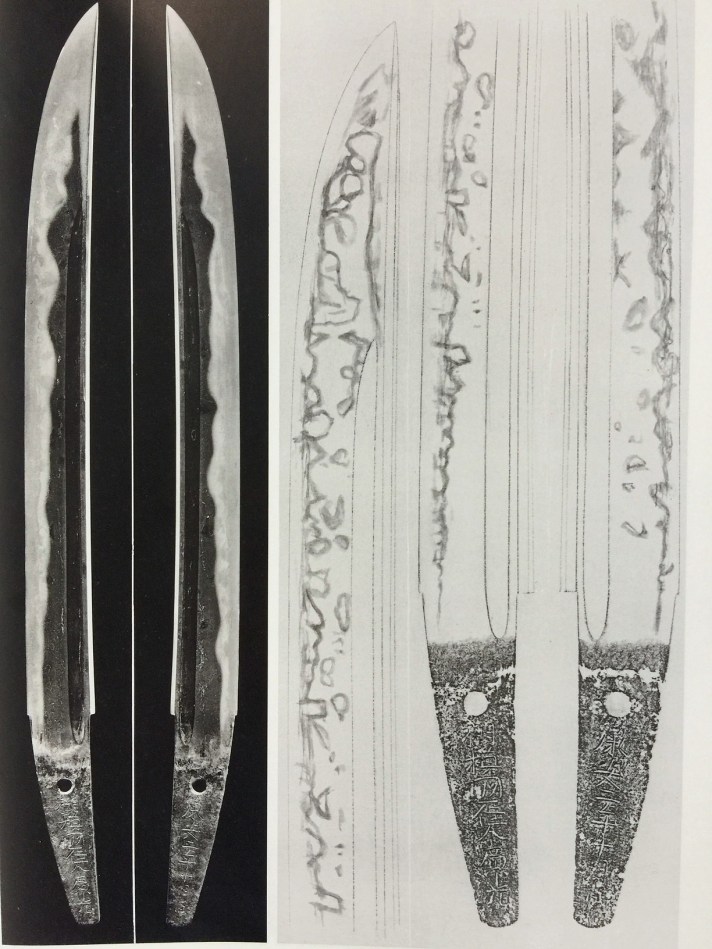
Hamon (: Tempered line) ——- The narrowly tempered section at the lower part gradually widens toward the top.  A similar wide hamon pattern extends into the boshi area.  The hamon in the kissaki area is kaeri-fukashi (deep turn back).  See the illustration below.  Coarse nie.  O-midare (large irregular hamon pattern).

20 Hitatsura

                                        From Sano Museum Catalogue

Ji-hada (地肌: the area between shinogi-ji and the tempered line) ——– a loose wood grain pattern called itame.  Yubashiri (see Chapter 16, Late Kamakura Period) and tobiyaki (irregular patchy tempered spots) appear.  Dense tobiyaki is called hitatsura (see the drawing above).

Nakago (: Tang) —- Short tanago-bara.  Tanago-bara refers to the shape of the belly of a Japanese fish called tanago (bitterling).

20 Tanago Bara

Tanto Swordsmiths during the Nanboku-Cho Period

Soshu Den ———————————————————-Hiromitu( 広光) Akihiro (秋広) Yamashiro Den ————————————————–Hasebe Kunishige (長谷部国重)   Bizen Den ——————————————————— Kanemitu (兼光) Chogi (長義 )

    Soshu Hiromitsu     “Nippon-To Art Sword of Japan “   The Walter A. Compton Collection

18| Nanboku-Cho Period Sword (南北朝太刀)

0-timeline - size 24 Nanboku-cho

                           The circle indicates the time we discuss in this section

During the Nanboku-cho period, samurai sought large, elaborate, impressive, yet practical swords.  The Soshu-den style sword from Nanboku-cho time was just that.    This was the most popular style at the time.  The Nanboku-cho period marked the peak and height of the Soshu-den sword.  Many swordsmiths moved from other provinces to the Kamakura area and forged Soshu-den style swords.  Other schools and provinces outside the Kamakura area also produced Soshu-den-style swords in their own areas.


19 Nanboku-cho Sword style

Sugata (姿: Shape) —————–The original length of a sword ranged from three to five feet, but it was later shortened to about two and a half feet.  A significantly shortened blade is called o-suriage. 

The Nanboku-cho style sword features shallow kyo-zori (also called torii-zori).  Refer to Chapter 5, Heian Period Sword.  The highest curvature occurs around the middle of the body. It has a wide body, high shinogi, narrow shinogi-ji  (Chapter 3, Names of parts),  and thin kasane (blade thickness), which are distinctive features of the Nanboku-cho style.  High gyo-no-mune or shin-no-mune, and sometimes a maru-mune (round back).

19 Nanboku-cho 3 kinds Mune

Hi (: groove) and Horimono (彫刻: engraving) ——– Often, a single hi (bo-hi), double hi, suken (dagger), Bonji (Sanskrit), and/or dragon are engraved on the shinogi-ji area.  Refer to Chapter 3, Names of Parts.

9 Hi, Suken, Bonji

Hamon (: Tempered line) —- The lower part of the body exhibits a narrow-tempered line; gradually, this line becomes wider and showier.  Course nie. O-midare (large, irregular, wavy hamon), Notare-midare (wavy, irregular hamon), and Gunome-midare (a combination of repeated half-circular and irregular hamon). Inazuma and kinsuji (see Chapter 14, Late Kamakura Period Sword) sometimes appear.

19 Hamon Notare 319 Mamon choji gunome19 Hitatsura Hamon Hiromitsu

                                  *From Sano Museum Catalogue ( Permission granted).

Ji-hada (地肌: the area between the shinogi and the tempered line) ———————-Wood-grain pattern (itame 板目). Sometimes tobiyaki (patchy tempered spots) appear on ji-hada.  For ji-hada, refer to Chapter 3, Names of Parts.

Kissaki (切っ先) and Boshi (tempered line at the kissaki area) ———- O-kissaki (long and large kissaki). Fukura kareru (less arc kissaki).  Midare-komi (the body and boshi have a similar tempered pattern), with kaeri-fukashi (hamon deeply turns back), and sometimes hitatsura (entirely tempered).  See the illustration above.

Sword-smiths during Nanboku-Cho Period Soshu Den (school)

  • From Soshu—————————————————Hiromitsu (広光)  Akihiro (秋広)  
  • From Yamashiro ———————————————Hasebe Kunishige (長谷部国重) 
  • From Bizen (called So-den Bizen)——-Chogi (長儀 )group  Kanemitsu (兼光 ) group 
  • From Chikuzen ———————————————————-Samoji (左文字 ) group

Chogi (長義)from The Sano Museum catalog. Permission to use is granted

The distinctive characteristics of the Nanboku-Cho period sword in the photo above      

  • The trace of an engraving of suken on the inside of the nakago indicates that this area was once a part of the main body.
  • Large and long kissaki

8| Middle Kamakura Period: Yamashiro Den (鎌倉中期山城伝)


0-timeline - size 24 Middle Kamakura                          The circle indicates the time we discuss in this section

The characteristics of Yamashiro Den swords

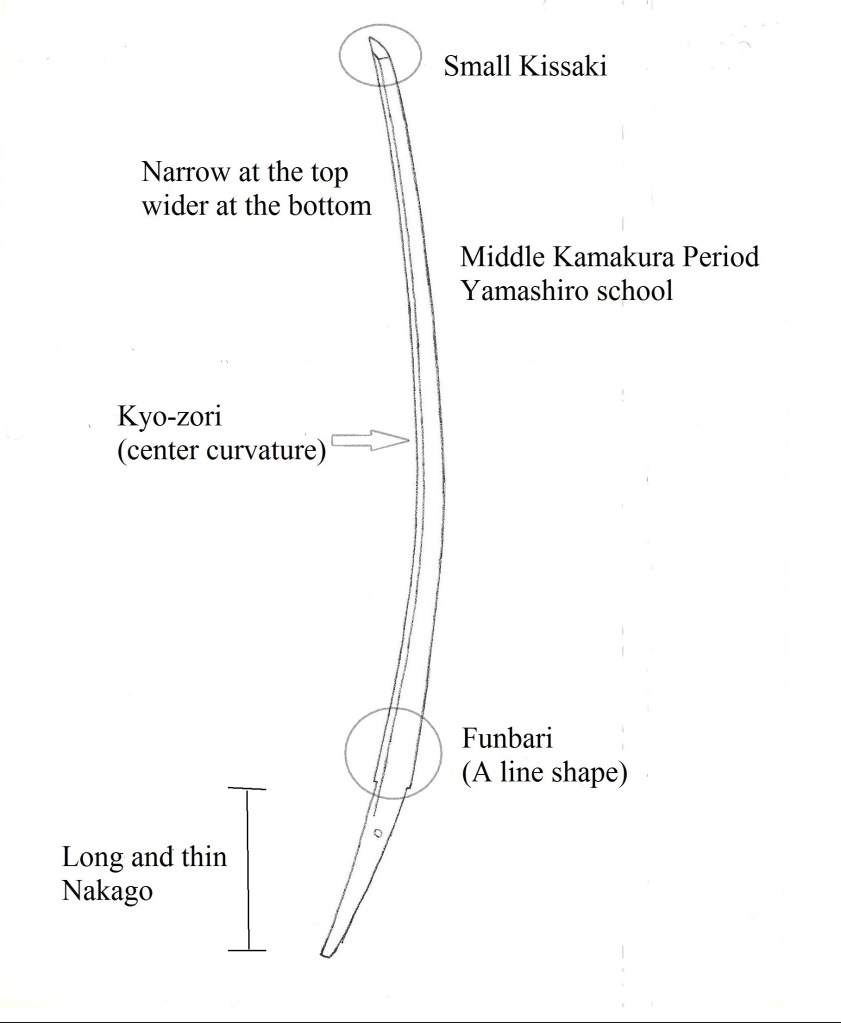
Sugata (shape)—– Generally, the blade is narrow, especially near the yokote line.  The bottom of the blade has funbari (an A-line shape).  Kasane is thick, and the curvature type is usually kyo-zori (the deepest curvature is around the middle).  It has a small kissaki with fukura.   Shinogi is thick, with gyo-no-mune or shin-no-mune.  Please refer to the three illustrations below for sugata.

13 Mune drawing

9 鎌倉中期刀姿

8 Fukura

Horimono (Engraving)—– The tip of a Hi (樋, groove) follows the exact shape of the Ko-shinogi line.  Sometimes you may see Bonj (Sanscrit) and Suken (see the illustration).

9 Hi, Suken, Bonji

Nakago (hilt: 中心) ——————–Long and thin with a slight curve.                                  Hamon (tempered line: 刃文) —————-Mostly suguha (straight line), niju-ba (double hamon), or suguha with an irregular wavy line.  Sometimes, a thin gold lightning-like line called inazuma appears faintly.  The tempered line is mostly nie.  Below is suguha.

 
豊後国行平(Bungo-no-Kuni-Yukihira)  Sano Museum Catalog permission granted

   * Bungo-no-Kuni-Yukihira was a Yamashiro Den swordsmith from the Bungo region.

Boshi(鋩子)——– Komaru-boshi (small round)   Omaru-boshi (large round)                    Ji-hada (地肌) ——-Well forged fine surface.  Small burl pattern.  Jinie (地沸) on the surface.

Names of the swordsmiths during the middle Kamakura period

  • Ayano-Koji group ———————————– Ayano-Koji Sadatoshi (綾小路 定利 )
  • Awataguchi group ————————————- Awataguchi kunitsuna (粟田口国綱)
  • Rai group ————————-Rai kuniyuki (来国行) Rai Nijikunitoshi (来ニ字国俊)

Rai Kunitoshi (来国俊)       Sano Museum Catalogue, Permission granted