55 |Part 2 of —–21 Muromachi Period Sword (室町時代刀)

Chapter 55 is a detailed section of Chapter 21, Muromachi Period Sword.  Please read Chapter 21 before reading this part.

57 Muromach-timeline size 22

                         The circle above indicates the time we discuss in this section

After the Muromachi period, swords shifted to katana(刀) from tachi (太刀), as described in Chapter 21, Muromachi Period Sword.  Refer to Chapter 21, Muromachi Period Sword.  By the end of the Nanboku-cho period, sword lengths had shortened to about 2 feet ± a few inches.  The 3-to-5-foot-long swords seen during the Nanboku-cho period were no longer produced.  This change occurred because, during the Nanboku-cho period, warriors mainly fought on horseback, but after the Muromachi period, infantry combat became more common.

Oei Bizen (応永備前)                                                                                                              The pronunciation of Oei is “O” as in “Oh” and “ei” as in “A” from ABC.  The Muromachi period was a declining time for sword-making.  The swords made during the early Muromachi period in the Bizen area is known as Oei BizenOsafune Morimitsu (長船盛光), Osafune Yasumitsu (長船康光), and Osafune Moromitsu (長船師光) were the main Oei Bizen swordsmiths.  Soshu Hiromasa (相州広正) and Yamashiro Nobukuni (山城信國) were also similar to the Oei Bizen style.  Please refer to Chapter 21, Muromachi Period Sword, for details on the  Muromachi sword shape, Hamon, Boshi, and Ji-hada.
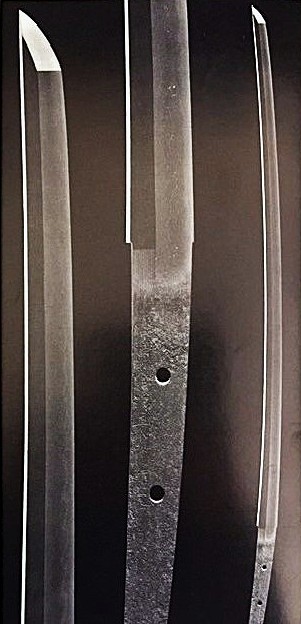
                       Bishu Osafune Moromitsu (備州長船師光)   from Sano Museum Catalogue ((permission granted)

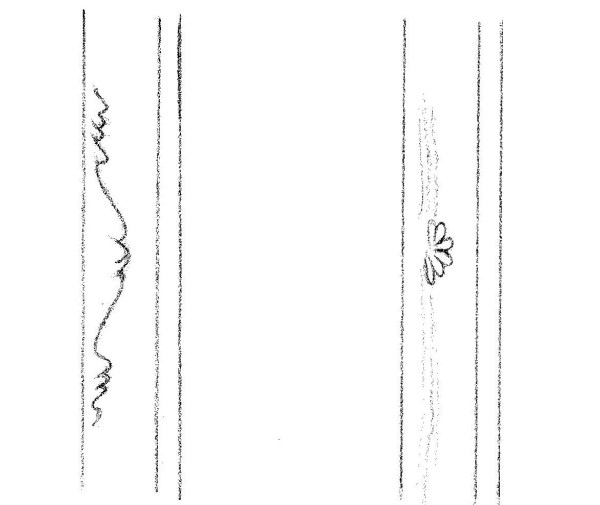
The Osafune Moromitsu sword shown above measures 2 feet 5 inches in length and has a medium kissaki.  Its hamon has a small wave-like pattern with continuous gunome (a lined half-circle pattern).  The boshi area shows irregular waviness with a slightly pointed tip.  Very faint bo-utsuri (a soft shadow shaped like a strip of wood) appears on ji-hadaBo-utsuri is a distinctive feature among all the Oei Bizen

Before the Muromachi period, many swordsmith groups operated in the Bizen region. However, by the Muromachi period, Osafune (長船) was the only remaining group.

Osafune (長船) is the name of a region, but it became the surname of swordsmiths during the Muromachi period.  Two other well-known swordsmiths from Oei Bizen are Osafune Morimitsu (盛光) and Osafune Yasumitsu (康光).  The hamon created by Morimitsu and Yasumitsu is more detailed than that of the sword in the photo above.  Chapter 21, Muromachi period swords, shows the hamon of Morimitsu and Yasumitsu and describes the typical characteristics of swords from the Muromachi period.

                                                 Hirazukuri Ko-Wakizashi Tanto
58 Hirazukuri Ko-Wakizashi Tanto

Hirazukuri Ko-Wakizashi Tanto Shape                                                                       

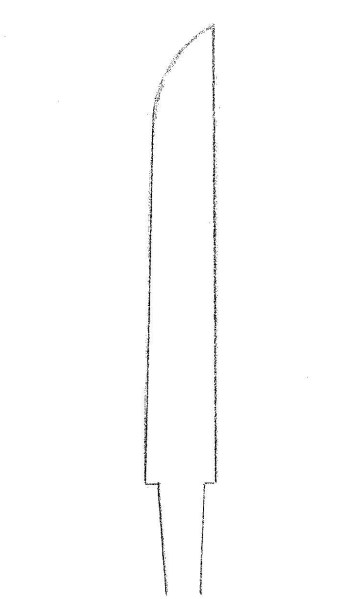
Hirazukuri ko-wakizashi tanto was a popular style during the early Muromachi period. Swordsmiths from various regions produced tantos similar to the one shown above. However, most of these types were made by Oei Bizen swordsmiths.

The characteristics of the Hirazukuri ko-wakizashi tanto ————-Typically about one foot and 1 or 2 inches long.  No yokote line, no shinogi, and no sori (meaning no curvature, straight back).  Average thickness.  Narrow width.  Gyo-no-mune (refer to Chapter 12, Middle Kamakura Period Tanto).
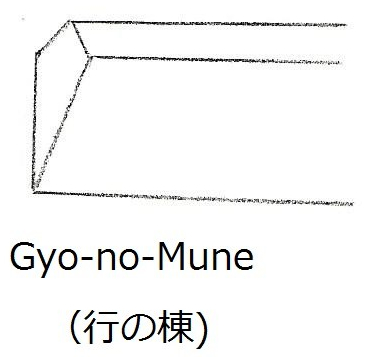
13 Mune drawing

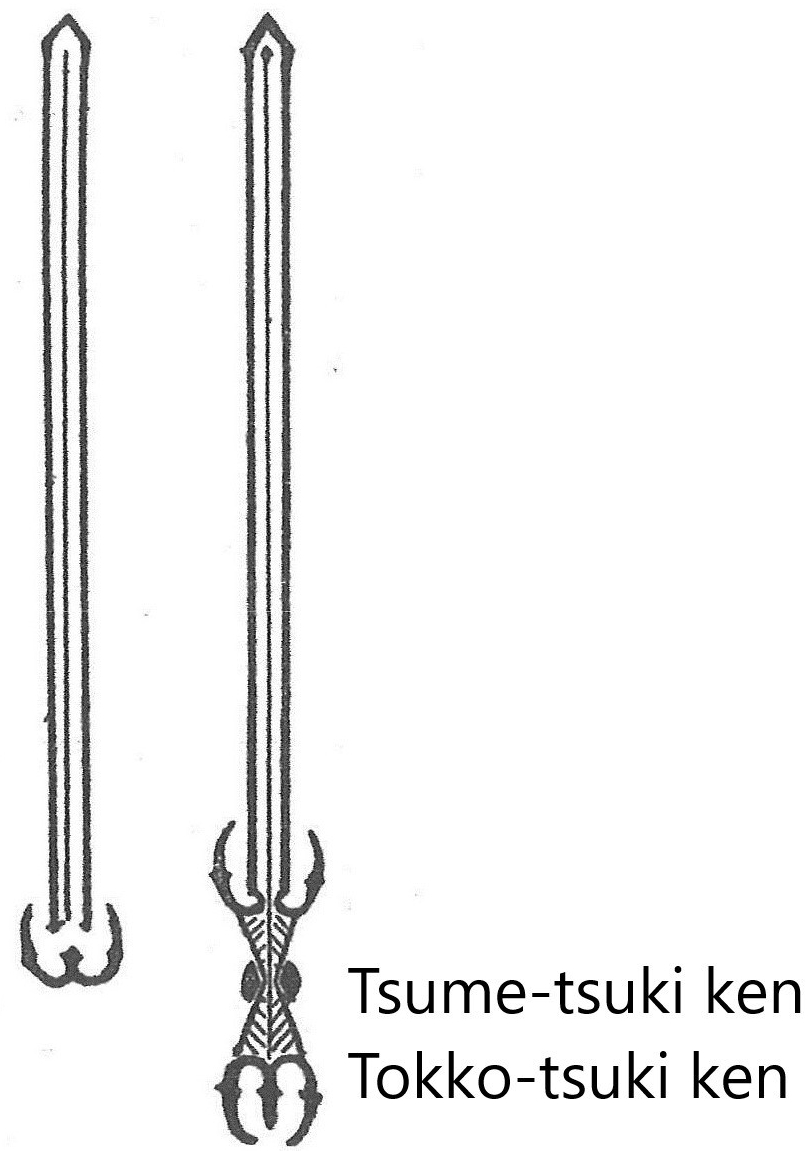
Hirazukuri Ko-wakizashi tanto often shows many engravings.  Hi with soe-hi (double lines, wide and narrow side by side), Tokko-tsuki-ken, Tsume-tsuki-ken, Bonji, and more.

.
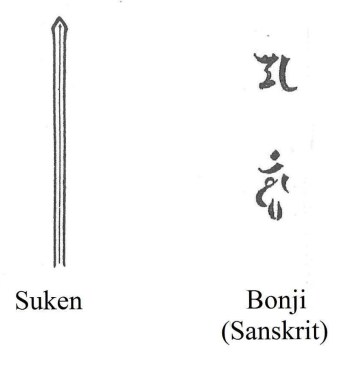
9 Hi, Suken, Bonji20 Tokko, tume Ken  58 tsumetukiken and Hi

*drawings from “Nihonto no Okite to Tokucho” by Honami Koson


26 |Over view of Shinto (新刀概要)

                                   
0-timeline - size 24 Shin-to
                           The circle indicates the subject discuss in this section 

The previous chapter 25 stated that the Edo period lasted from 1603 to 1868.  This is for political history.  The third timeline above shows that the Momoyama period overlaps with the Edo period.  Some people believe the Momoyama period was from 1573 to 1600. In general history, there are several opinions on how to divide these transitional periods.  For sword history, it is straightforward.  Swords made between approximately 1596 (慶長: Keicho era) and 1781 (天明: Tenmei era) are called shin-to.  Swords made between the Tenmei and Meiji eras are referred to as shin-to. 

After Toyotomi Hideyoshi nearly unified the country, the people could enjoy a period of peace.  This period of peace shifted the geographic distribution of swordsmiths. There were three main regions where sword forging took place.  These areas include Kyoto, Osaka, and Edo (Tokyo now).  The remaining swordsmiths gathered near the castles of major daimyo (大名: feudal lords).

Kyoto—- The Umetada Myoju (梅忠明寿) group thrived, followed by swordsmiths such as  Horikawa Kunihiro (堀川国広), Kunimichi (国路), Kunisada (国貞), and Kunisuke (国助).

Osaka——–Osaka was established as a commercial city and became the center of commerce.  It produced swords and distributed them to other regions across the country.  The well-known swordsmiths in Osaka: Tsuda Sukehiro (津田助広) and Inoue Shinkai (井上真改).

Edo————-Many swordsmiths gathered in Edo (江, now Tokyo), where Shogun Tokugawa Iyeyasu livedThe well-known swordsmiths in EdoNagasone Kotetsu (長曽祢虎徹), Yasutsugu (康継), Noda Hannkei (野田繁慶).

By the time Tokugawa Iyeyasu’s grandson, Tokugawa Iyemitsu, became shogun (寛永:Kan’ei era 1624 – 1643), swordsmiths had spread beyond the three areas mentioned above.  In each daimyo territory, swordsmiths operated shops near the castles to meet the needs of the daimyo and their subjects.  By the Genroku era (元禄: 1695), sword-making had declined, and people preferred more picturesque hamon designs, such as kikusui (菊水: flower design) and fujimi (富士見: Mount Fuji).

63 fuji sakura hamon
Fujimi                           Kikusui

Difference between Koto  and Shinto 

The following section describes the differences between Ko-to and Shin-to.   However, remember that there are always exceptions to these rules.

  1. The length of the shin-to katana is typically about two feet three inches ± a little.  The wakizashi is about one foot six inches.   Shallow curvature.  Wide width.  Thick body.   Gyo-no-mune.  Chu-gissaki with a slightly stretched appearance.

13 Mune drawing

  1. The ko-to sword feels light, while the shin-to feels heavy.
  2. The bottom of the hi is rounded above the machi. Shin-to’s bo-hi ends slightly below the yokote line.

27. Hisaki & marudome

  1. Generally, carvings are less common on shin-to. However, some swordsmiths are famous for their carvings.  The designs are refined and detailed.  Umetada Myoju (埋忠明寿) is well-known for his carvings.
  2. For shin-to, if it is mainly nie, it is usually a coarse nie.
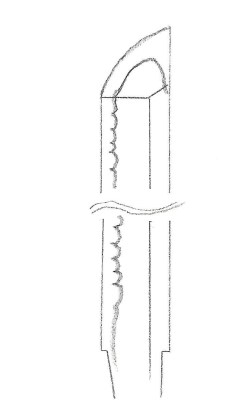
  3. In the machi area, the hamon begins with a straight tempered line (the bottom part of the blade shown in the illustration below), followed by midare, or various types of hamon in the middle, and ends with suguha (straight hamon) in the boshi area (the top part).  Generally, this is the standard Hamon style of shin-to, but there are always exceptions. 

27 Keshou Yasuri & suguha

  1. For shin-to, the type of iron used for the blade is consistent throughout Japan.  A few variations of iron were used across Japan, with a very hard, dark color and a glossy look.
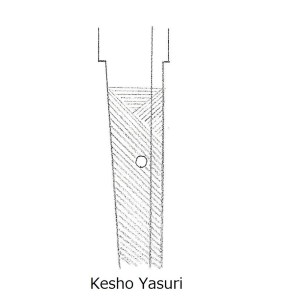
  2. The nakago has a well-balanced shape.  The bottom of the nakagotapers gradually.  The type of yasuri-me (file mark) is often a kesho-yasuri. Engraved inscriptions display the swordsmith’s name, location, province, and year of creation.

27 Keshou Yasuri & suguha

21| Muromachi Period Sword (室町時代刀)

0-timeline - size 24 Muromach

       The red circle above indicates the time we discuss in this section

The Muromachi period was a relatively peaceful and prosperous time until shortly before the “Onin-no-ran,” which occurred at the end of the Muromachi periodRefer to Chapter 20, Muromachi Period History (室町時代歴史).   The Nanboku-cho style long swords became outdated; as a result, they were shortened.  The shortened blade is called suriage.  Overall, the Muromachi period was a declining time for sword-making.

Tachi and Katana 

Until the end of the Nanboku-cho period or the beginning of the Muromachi period, samurai wore swords suspended from their waists with the blade facing down.  When a sword was worn this way, the swordsmith inscribed his name on the side facing outward, meaning the blade is on your right when you see the inscription.  In this case, the sword is called a tachi.

During the Muromachi period, a sword was worn between the belt, with the blade facing up.   The swordsmith inscribed his name so that it faced outward when it was worn. Therefore, when you see the inscription, the cutting edge is to your left.  This is classified as a katana. 

Around the beginning of the Muromachi period, samurai started to wear a pair of swords called dai-sho (大小), meaning large and small.  The longer sword is a katana, and the shorter one is a wakizashi.  In general, a tachi is longer than a katana.  A katana is longer than a wakizashi, and a wakizashi is longer than a tanto.  Here is the order of their lengths. 

                                       Tachi   >   Katana   >   Wakizashi   >  Tanto                                  Tachi and katana differ in how they are worn, not in length.   

O-suriage ( 大磨上: Katana shortened by great length) 

How much the sword should be shortened depends on its original length and how much the owner wants it shortened.  O-suriage is a type of sword that is significantly shortened.  Once the blade is shortened by that length, the inscription of the maker’s name is cut off.  When the Hon’ami family (本阿弥家, a family of sword connoisseurs who have appraised Japanese swords for generations from the Muromachi period to today) appraises such a suriage sword, they write the make of the sword and the swordsmith’s name on the front side of the hilt, and the connoisseur’s name with his kaou (similar to a signature) on the back.  There are several levels of writing.  The level at which it should be done depends on the sword’s quality and the owner’s preference.  Below is the order of levels (high to low).

Shu-Mei (朱明 )————————————————————-name written in Vermilion  Kinpun-Mei (金粉名 )———————————————–name lacquered in gold powder  Gin-Zougan (銀象嵌 )————————————————————name inlaid in silver  Kin-Zougan (金象嵌 )————————————————————-name inlaid in gold

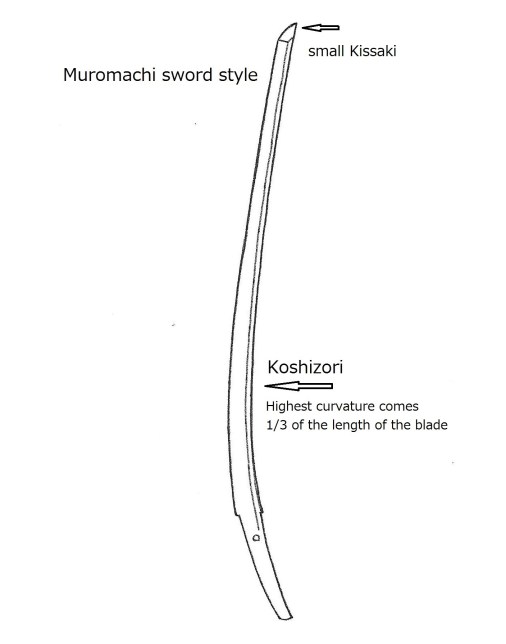
Sugata (姿: Shape) ——— The average length is typically two feet three to four inches (68~71cm).  The shape of the Muromachi period katana is somewhat similar to that of the Heian period tachi.  However, Muromachi katana are less grand or graceful than those from the Heian period swords.  The curvature is usually of the koshizori style.  Koshizori refers to the highest curvature being near the lower part of the blade.  The length and shape are suitable for wearing between the body and the belt.  The width and thickness are well-balanced with the size of the sword.  Small kissaki.

22 Muromachi sword shape

Hirazukuri-Wakizashi ———– Hirazukuri refers to a flat surface without a shinogi or yokote line.  Usually, it is 1 foot and 1 to 2 inches long.  No curvature.  Hirazukuri-wakizashi appeared during the Muromachi period.

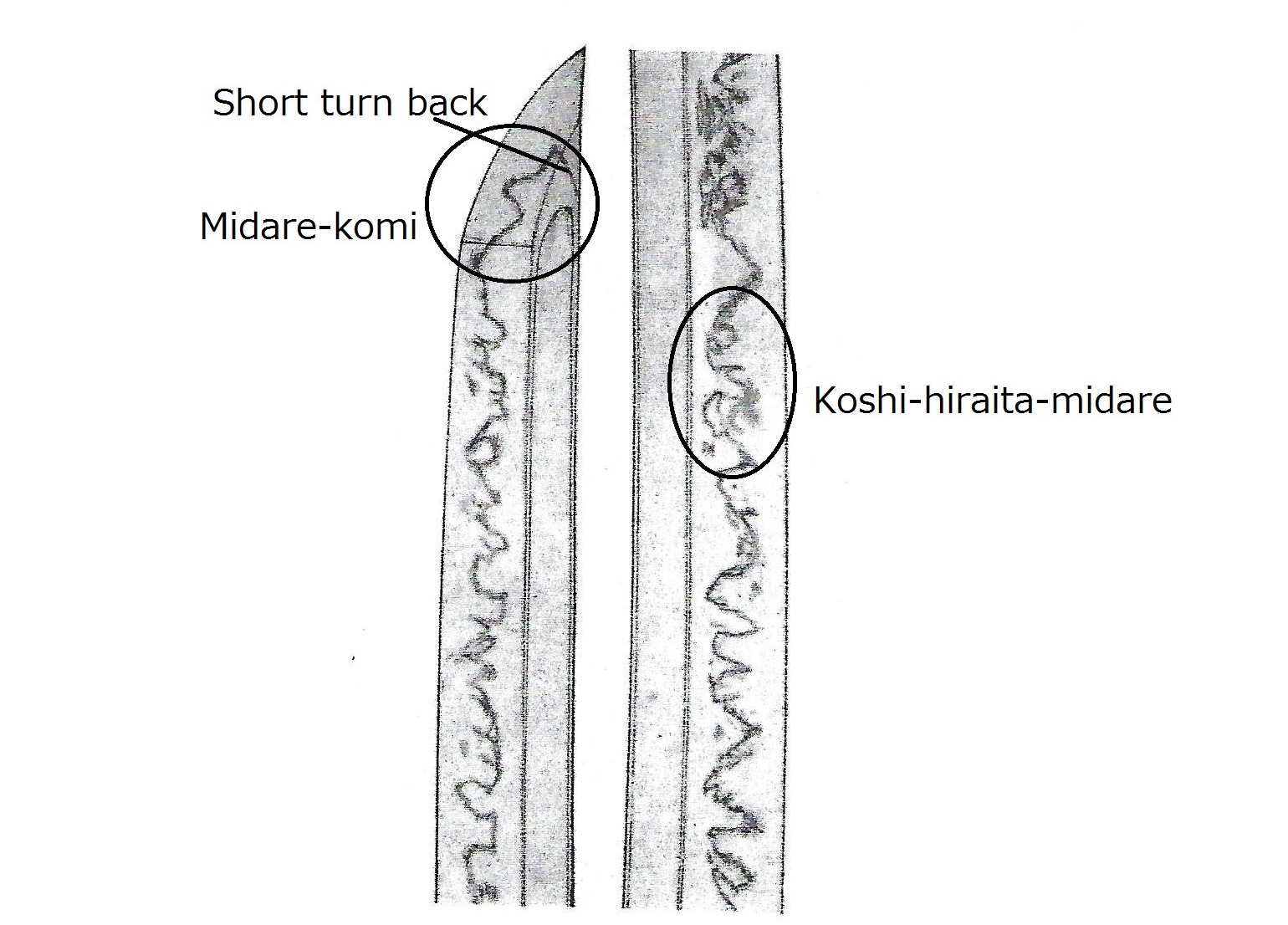
Hamon (刃文: tempered line) ———————- Nioi base.  The tempered area is well balanced with the blade’s width.  Koshi-hiraita-midare is mixed with choji-midare.

22Hamon (Koshi Hiraita midare)
from Sano Museum Catalogue (permission granted)
  • Boshi (Tempered line at Kissaki area) ————– Midare-komi, a short turn back.  See the above illustration.  Midare is an irregular wave-like pattern.
  • Ji-hada (地肌: An area between the tempered line and Shinogi)- Soft look, a large wood grain pattern, Ji-utsuri (faint smoke or cloud-like effect) shows.
  • Horimono (彫物Engravings) ———- Bo-hi (single groove), Soe-hi (a thin groove alongside the main hi), Futasuji-hi (double narrow groove), Sanskrit, Tokko-tsuki ken, Tsume-tsuki Ken, name of God, and dragon.  Carvings became elaborate.

8 Hi, Suken, Bonji                  21 Tsume-tuki-ken tokko with caption

Sword Smiths during Muromachi Period

  • Bizen Den ——–Osafune Morimitsu (長船盛光), Yasumitsu (康光), Moromitsu (師光)
  • Yamashiro Den————————————————-Yamashiro Nobukuni (山城信国)

21 Muromachi sword from Sano

Ise Masashige (伊勢正重),                     Bizen Osafune Naomitsu (備前長船尚光)         Juyo Token(重要刀剣)                           Sano Museum Catalogue (permission granted)    once my family sword


1 | Timeline

Let’s look at the diagram below.  At the beginning of each chapter, a timeline like the one below will be shown.  It will serve as a useful reference for determining which period is being discussed.

0-timeline - size24 original 1

From the Jomon period to the Nara period, (the short top line) is the period we call the Joko-to period in the history of Japanese swords.  The term “Japanese sword” as we use it today refers to swords made after the Heian period (平安 794-1185).  Usually, Joko-to falls under the category of archaeological study.  In the next chapter, we will discuss Joko-to.  The bottom timeline, with short descriptions below, is the one we see in Japan’s general history books.  The middle timeline is more specific to the study of swords.  My discussion will follow the middle timeline.  A timeline diagram will appear at the beginning of each chapter for easy reference.  The swords discussed in this book are grouped based on their shape, style, and the trends of their era.

The difference between Tachi (太刀),  Katana (),  Wakizashi (脇差), Tanto (短刀)

Swords made before the Muromachi period (before 1392) are called tachi (太刀).  Swords made after the Muromachi (室町) period are referred to as katana (刀) and wakizashi (脇差).  Katana and wakizashi were worn together.  A tanto is a short dagger.  Tantos have been made throughout history.  The difference between a tachi and a katana is how they are worn.  A tachi was suspended from the waist belt, with the blade facing down.  The katana and wakizashi (called daisho, 大小, meaning “large and small”) were worn together between the belt and the body, with the blade side up.  Usually, a tachi is longer than a katana.   A wakizashi is shorter than a katana.  The tanto is the shortest.  When facing the swordsmith’s inscribed name, if the blade is on the right, that is a tachi.  When facing the swordsmith’s inscribed name, if the blade is on the left, that indicates a katana or a wakizashi. 

                  Tachi   >  Katana >  Wakizashi   >  Tanto

22 tachi & Katana

Ko-to (古刀)   Shin-to (新刀)   Shinshin-to (新々刀)   Gendai-to (現代刀)

Ko-to are swords made between the Heian period (794-1192) and the beginning of the Keicho Era (1596-1614).  Shin-to are swords made between the Keicho Era (1596-1614) and the Tenmei Era (1781-1789).  Shin shin-to are swords created during the Bakumatsu period (幕末期 1781-1868).  Gendai-to covers the period from the Meiji Restoration (明治1868) to the present day.  Although the names of eras or periods changed overnight due to political or dynastic shifts throughout history, the changes in sword style were always gradual.  In general history, the Bakumatsu period is simply the last part of the Edo period. However, for sword classification, it is from around the Tenmei era (天明 1781) to the beginning of the Meiji period (1868).