Chapter 58 is a detailed section of Chapter 24, Sengoku Period Tanto. Please read Chapter 24, Sengoku Period Tanto, before reading this part.
The red circle above indicates the time we discuss in this section
Muramasa (村正)
This chapter discusses the famous Muramasa (村正). Usually, many well-known swordsmiths come from one of the Goka-den (五家伝: the five main schools: Yamashiro-den, Bizen-den, Soshu-den, Yamato-den, and Mino-den). However, Muramasa was not from Goka-den but from Ise Province. The first-generation Muramasa was known as a student of He’ian-jo Nagayoshi (平安城長吉) of Yamashiro-den. The Muramasa family existed through the mid-Muromachi period. They spanned three generations from the mid-Muromachi to the Sengoku period.
Below is one of Muramasa’s tantos, made during the Sengoku period. Since it was made during the Sengoku era, the blade shows the style of Sengoku-period swords. It reflects Mino-den characteristics, combined with Soshu-den traits.
Muramasa (村正) from Sano Museum Catalogue (permission granted)
Characteristics on this Tanto
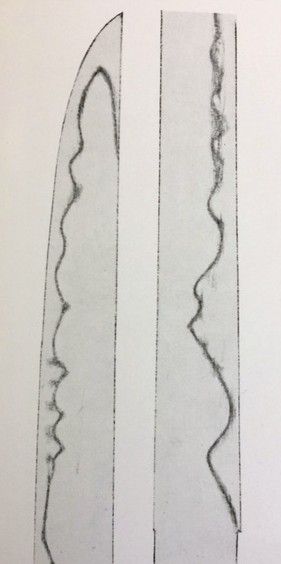
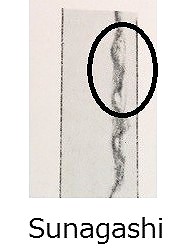
Muramasa’s tantos are typically about ten inches ± half an inch or so. Hirazukuri (平作り). Thin blades with a sharp look. The nioi base with small nie and sunagashi patterns (brushed sand-like patterns, as shown in the illustration below) appears. The boshi (the top part of the hamon) is jizo (a side view of a human head). The tempered line varies with both wide and narrow areas. Some areas are so narrow, almost close to the edge of the blade, while others are broader. Hako midare (box-like shape) and gunome (lined-up bead pattern) appear. O-notare (large, gentle waviness) is a signature characteristic of Muramasa. The pointed-tempered line is a typical characteristic of Mino-den (Sanbon-sugi). Refer to Chapter 23, Sengoku Period Sword, and Chapter 24,Sengoku Period Tanto.
The circle above indicates the time we discuss in this section
In Chapter 12, Middle Kamakura Period: Tanto, it is described that the tanto shape called takenoko-zori appeared during the middle Kamakura period. This type of tanto curves slightly inward at the tip. The drawing below may be somewhat exaggerated to show the curve. The actual curvature of the takenoko-zori is not very noticeable. Perhaps only a few millimeters inward.
Usually, the length of a tanto is around 12 inches. Tantos are categorized as follows: if it is approximately ten inches, it is called a josun tanto (定寸短刀), longer than ten inches is called a sun-nobi tanto (寸延び短刀), and shorter than ten inches is called a sun-zumari tanto (寸詰短刀).
Sun-nobi Tanto (寸延び) > Jyosun Tanto (定寸) > sun-zumari Tanto (寸詰り) (longer than 10 inches) (approx. 10 inches) (less than 10 inches
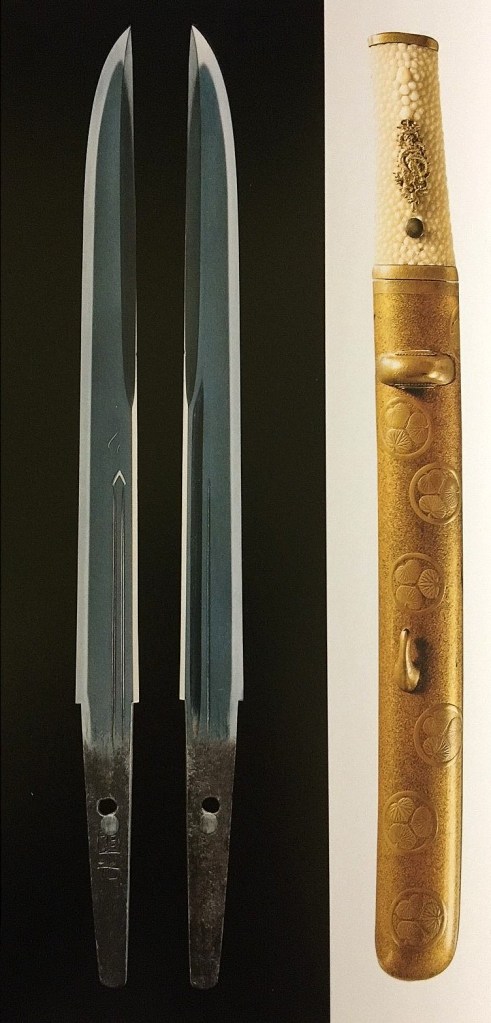
Shintogo Kunimitsu (新藤五国光) Sano Museum Catalogue, permission granted to use
The style above is called kanmuri-otoshi (冠落); the mune side (opposite side of the cutting edge) is shaved off. The length is approx. 10 inches: woodgrain pattern surface with nie on ji (refer to Chapter 3, Names of parts). Very finely forged. The hamon is a medium suguha (straight). The boshi is ko-maru (small round). Due to the kanmuri-otoshi style, it may not be easy to see the takenoko-zori; the mune side slightly curves inward. Shintogo Kunimitsu is regarded as the top tanto maker.
The photo above is also by Shintogo Kunimitsu (新藤五国光), with Saya.Saya is the scabbard. The handle of the scabbard (white part) is made of sharkskin. Both photos are from the Sano Museum Catalog “Reborn.” Permission granted.
The red circle indicates the time we discuss in this section
The later part of the Edo period is called Bakumatsu. See the circled area on the timeline above. Swords made during this time are called shin shin-to. They are also called Fukko-to (復古刀: revived sword). Fukko-to replicates the shape, hamon, boshi, and other features of the Ko-to and Shin-to swords. The characteristics of Shin Shin-to (新々刀) and well-known swordsmiths are listed below.
The Characteristics of Shin Shin-to
Katana, wakizashi, and tanto all tend to resemble or imitate the ko-to and shin-to in shape.
Many swords often have a Hi or detailed engravings.
One swordsmith would create multiple sword styles, such as Soshu-den, Bizen-den, and Shin-to style.
Often shows Katai-ha.
Katai-ha
Weak (not tight) Nioi.
Yakidashi (2 to 3 inches above machi) is often suguha(straight line hamon), even though the rest of the area has irregular Boshi is often irregular midare.
Detailed engravings are more realistic than those from earlier times.
Well-known swordsmiths of Shin Shin-to
Settsu (Osaka area) ——————Gassan Sadayoshi (月山貞吉), Gassan Sadakazu (月山貞一). The Gassan family is known for their detailed carvings.
Musashi no Kuni (Tokyo area) ————-Suishinshi Masahide (水心子正秀), Minamoto Kiyomaro (源 清麿), Taikei Naotane (大慶直胤),Taikei Yoshitane (大慶義胤). Yoshitane is well-known for his carvings.
Minamoto Kiyomaro(源清麿) Once my family possession
Tosa (四国: Shikoku area) ———————————————- Sa Yukihide (左行秀)
Right before the Meiji Restoration, long swords (about 3 feet) without any curvature were made. Sa Yukihide (from the Tosa area) forged this type of sword. Saigo Takamori (西郷隆盛) and Sakamoto Ryoma (坂本龍馬) owned such swords. Both are well-known historical figures from the Meiji Restoration. Both were part of the Kin’no-to (勤皇党) group, which supported the emperor and reformed the political system.
The red circle above indicates the time we discuss in this section
The Muromachi period was a relatively peaceful and prosperous time until shortly before the “Onin-no-ran,” which occurred at the end of the Muromachi period. Refer to Chapter 20, Muromachi Period History (室町時代歴史). The Nanboku-cho style long swords became outdated; as a result, they were shortened. The shortened blade is called suriage. Overall, the Muromachi period was a declining time for sword-making.
Tachi and Katana
Until the end of the Nanboku-cho period or the beginning of the Muromachi period, samurai wore swords suspended from their waists with the blade facing down. When a sword was worn this way, the swordsmith inscribed his name on the side facing outward, meaning the blade is on your right when you see the inscription. In this case, the sword is called a tachi.
During the Muromachi period, a sword was worn between the belt, with the blade facing up. The swordsmith inscribed his name so that it faced outward when it was worn. Therefore, when you see the inscription, the cutting edge is to your left. This is classified as a katana.
Around the beginning of the Muromachi period, samurai started to wear a pair of swords called dai-sho (大小), meaning large and small. The longer sword is a katana, and the shorter one is a wakizashi. In general, a tachi is longer than a katana. A katana is longer than a wakizashi, and a wakizashi is longer than a tanto. Here is the order of their lengths.
Tachi > Katana > Wakizashi > Tanto Tachi and katana differ in how they are worn, not in length.
O-suriage ( 大磨上: Katana shortened by great length)
How much the sword should be shortened depends on its original length and how much the owner wants it shortened. O-suriage is a type of sword that is significantly shortened. Once the blade is shortened by that length, the inscription of the maker’s name is cut off. When the Hon’ami family (本阿弥家, a family of sword connoisseurs who have appraised Japanese swords for generations from the Muromachi period to today) appraises such a suriage sword, they write the make of the sword and the swordsmith’s name on the front side of the hilt, and the connoisseur’s name with his kaou (similar to a signature) on the back. There are several levels of writing. The level at which it should be done depends on the sword’s quality and the owner’s preference. Below is the order of levels (high to low).
Shu-Mei (朱明 )————————————————————-name written in Vermilion Kinpun-Mei (金粉名 )———————————————–name lacquered in gold powder Gin-Zougan (銀象嵌 )————————————————————name inlaid in silver Kin-Zougan (金象嵌 )————————————————————-name inlaid in gold
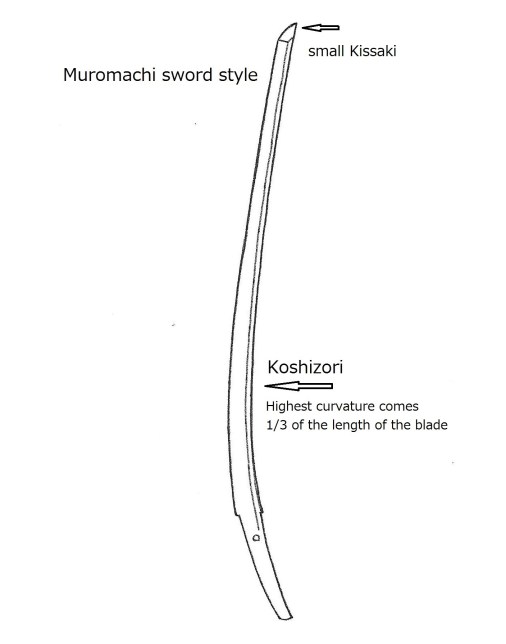
Sugata (姿: Shape) ——— The average length is typically two feet three to four inches (68~71cm). The shape of the Muromachi period katana is somewhat similar to that of the Heian period tachi. However, Muromachi katana are less grand or graceful than those from the Heian period swords. The curvature is usually of the koshizori style. Koshizori refers to the highest curvature being near the lower part of the blade. The length and shape are suitable for wearing between the body and the belt. The width and thickness are well-balanced with the size of the sword. Small kissaki.
Hirazukuri-Wakizashi ———– Hirazukuri refers to a flat surface without a shinogi or yokote line. Usually, it is 1 foot and 1 to 2 inches long. No curvature. Hirazukuri-wakizashi appeared during the Muromachi period.
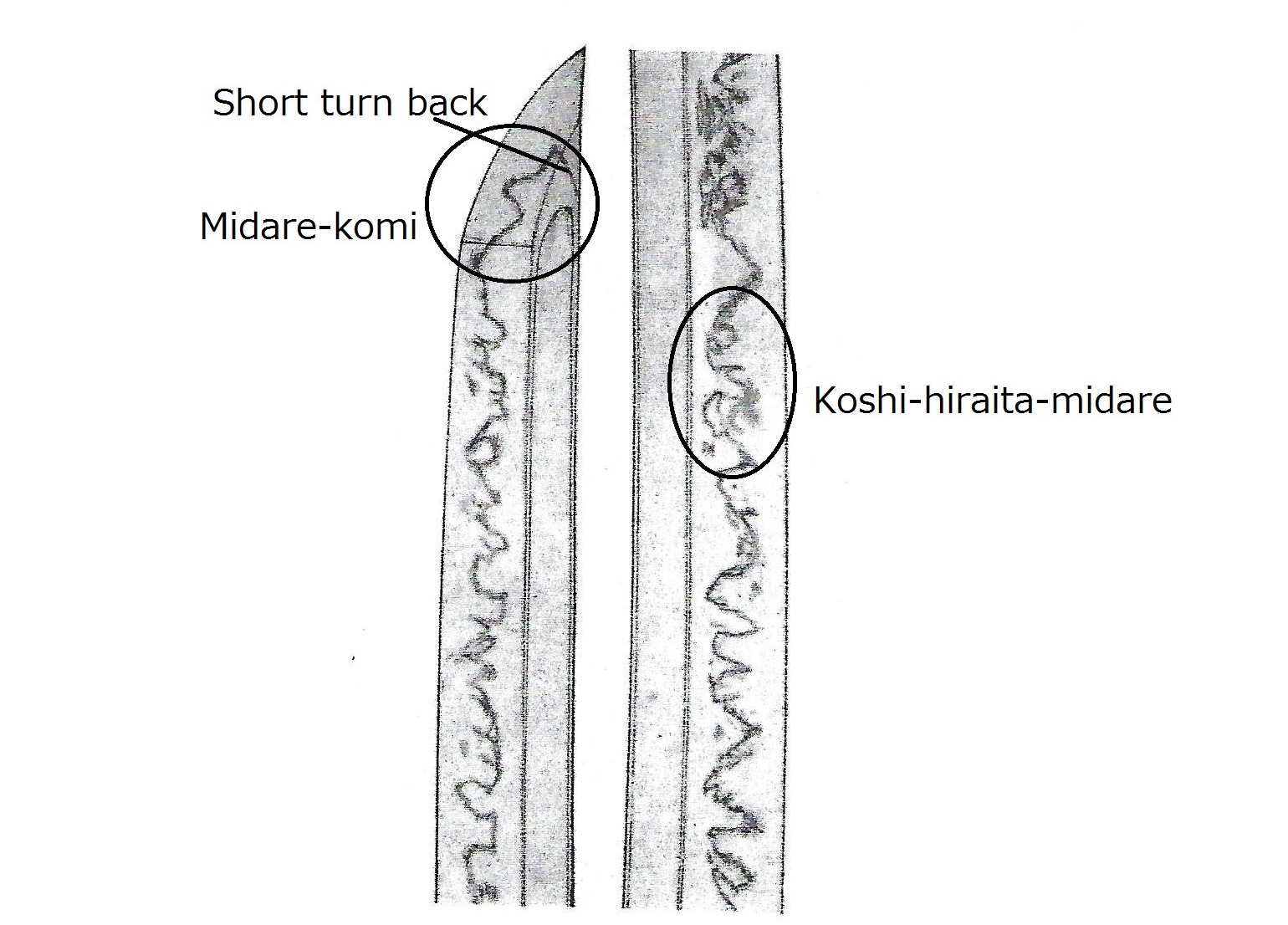
Hamon (刃文: tempered line) ———————- Nioi base. The tempered area is well balanced with the blade’s width. Koshi-hiraita-midare is mixed with choji-midare.
from Sano Museum Catalogue (permission granted)
Boshi (Tempered line at Kissaki area) ————– Midare-komi, a short turn back. See the above illustration. Midare is an irregular wave-like pattern.
Ji-hada (地肌: An area between the tempered line and Shinogi)- Soft look, a large wood grain pattern, Ji-utsuri (faint smoke or cloud-like effect) shows.
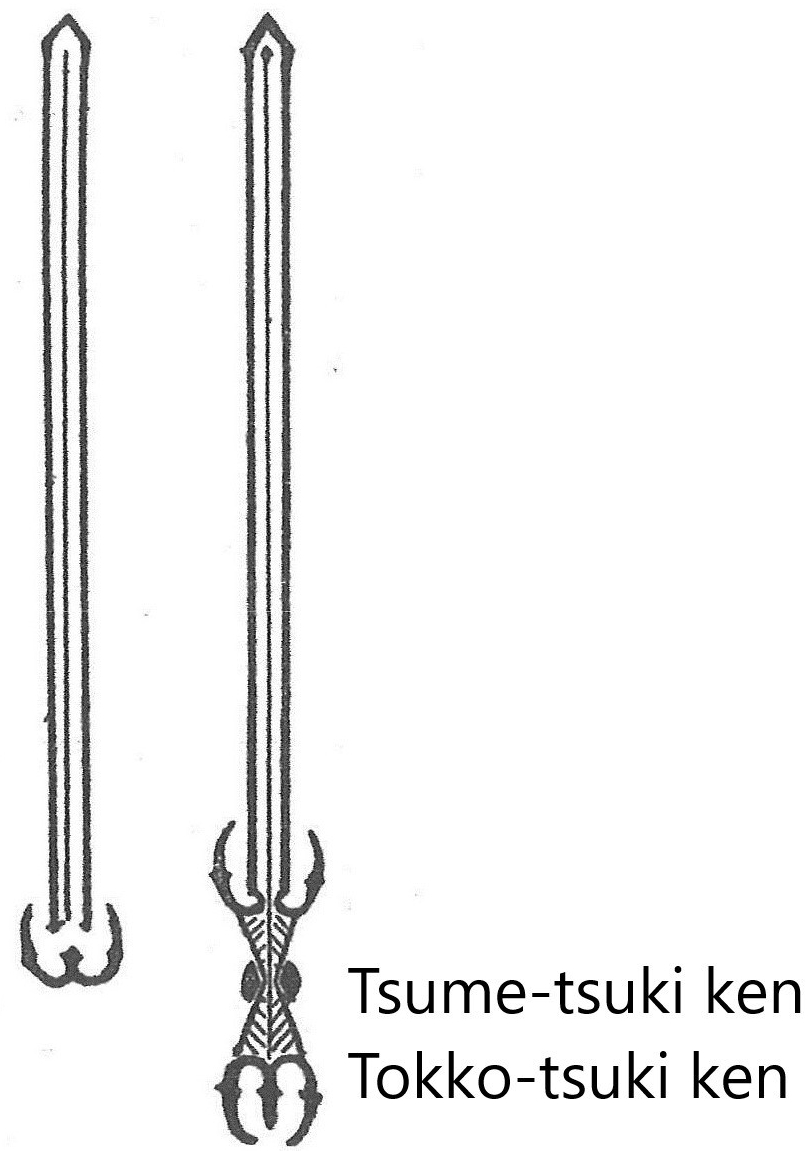
Horimono (彫物:Engravings) ———-Bo-hi (single groove), Soe-hi (a thin groove alongside the main hi), Futasuji-hi (double narrow groove), Sanskrit, Tokko-tsuki ken, Tsume-tsuki Ken, name of gods, and dragon. Carvings became elaborate.
Sword Smiths during Muromachi Period
Bizen Den ——–Osafune Morimitsu (長船盛光), Yasumitsu (康光), Moromitsu (師光)
The red circle indicates the area we discuss in this chapter
It is rare to find a tanto (短刀 dagger) made during the Heian period. During the middle Kamakura period, many high-quality tanto were produced. They were called takenoko-zori shaped tanto, with “takenoko” meaning bamboo shoot. The back of the tanto curves inward slightly.
Middle Kamakura Period Yamashiro School Tanto
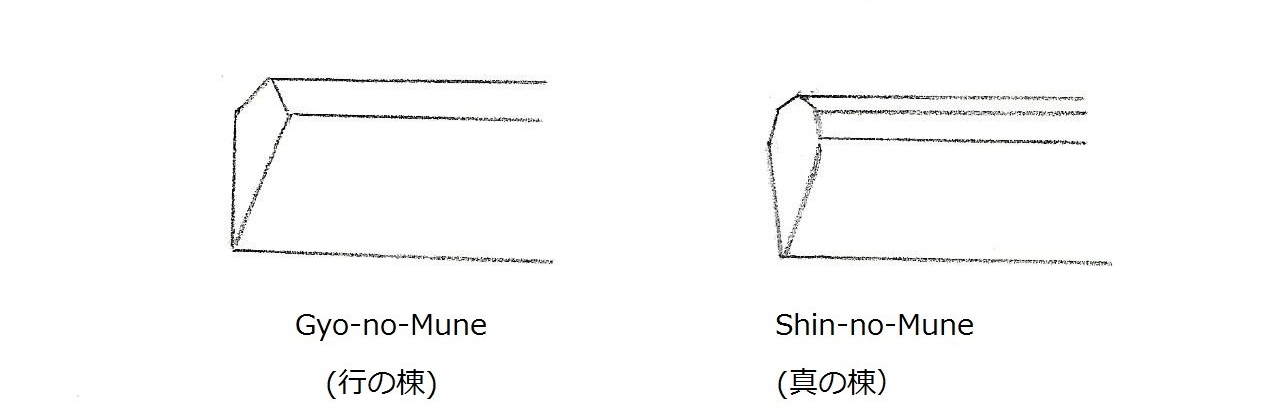
Sugata (shape)———-Hirazukuri. This means there is no shinogi, no yokote line. See the illustration above. The standard tanto length is approximately ten inches. The width is neither too wide nor too narrow, making it well-proportioned. The body is slightly thick. High gyo-no-mune (行の棟) and shin-no-mune (真の棟).
Hamon (刃文) ——————— The tempered area is narrow. Nie base. Suguha-midare (a straight-line pattern with an irregular wavy shape) or suguha-choji (a straight-line pattern with small choji). The tempered edge line may display a frayed pattern.
Boshi(tempered line at Kissaki area) ———Yakizume, Kaen, Nie-kuzure.
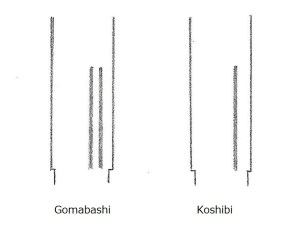
Engravings (彫刻) ———- Often, various types of engravings are applied to the lower part of the body. These may include one or two grooves, Sanskrit, suken (spear), dragon, etc. For the Sanskrit and spear, refer to the illustration in Chapter 8.
Tanto Swordsmiths in the Middle Kamakura Period
Awataguchi group(粟田口)———————————Awataguchi Yoshimitu (粟田口吉光) Rai group (来) ——————————————————————-Rai Kunitoshi(来国俊) Soushu Group (相州) ——————————————Shintougo Kunimitu (新藤五国光) Bizen group (備前) —————————————————— Bizen Kagemitu (備前景光) Bungo no Kuni Group (豊後の国) ——————–Bungo-no-kuni Yukihira (豊後の国行平)
来国光(Rai Kunimitsu)
ThisPhoto by an unknown author is licensed under CC BY-SA Creative Commons Free Media Attribution-Share Alike 3.0 Unported (CC BY-SA 3.0)










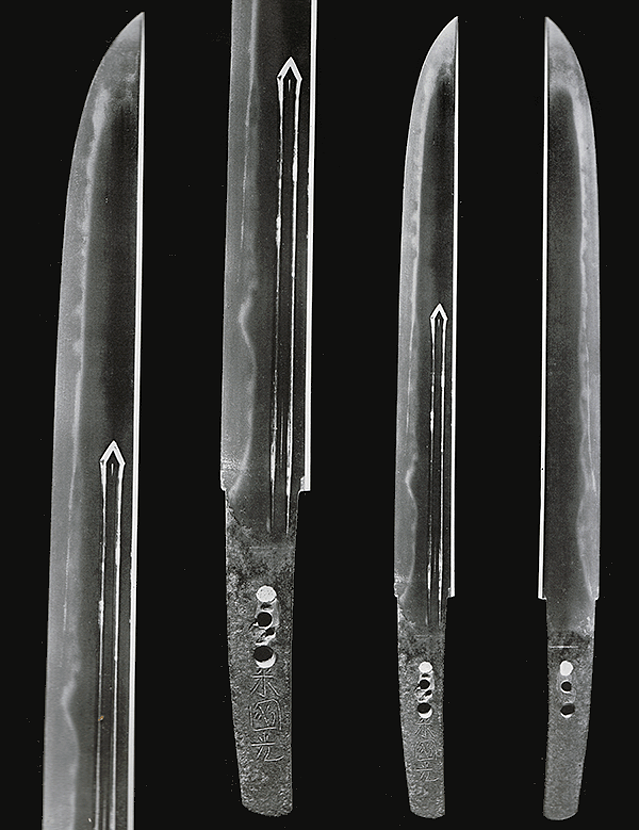 来国光(Rai Kunimitsu)
 Study of Japanese Sword