58|Part 2 of — 24 Sengoku Period Tanto (戦国時代短刀)

Chapter 58 is a detailed section of Chapter 24, Sengoku Period Tanto.  Please read Chapter 24, Sengoku Period Tanto, before reading this part. 

0-timeline - size 24 Sengoku Period

           The red circle above indicates the time we discuss in this section  

Muramasa (村正)

This chapter discusses the famous Muramasa (村正).  Usually, many well-known swordsmiths come from one of the Goka-den (五家伝: the five main schools: Yamashiro-den, Bizen-den, Soshu-den, Yamato-den, and Mino-den).  However, Muramasa was not from Goka-den but from Ise Province.  The first-generation Muramasa was known as a student of He’ian-jo Nagayoshi (平安城長吉) of Yamashiro-den.  The Muramasa family existed through the mid-Muromachi period.  They spanned three generations from the mid-Muromachi to the Sengoku period

61 Ise map

Below is one of Muramasa’s tantos, made during the Sengoku period.  Since it was made during the Sengoku era, the blade shows the style of Sengoku-period swords.  It reflects Mino-den characteristics, combined with Soshu-den traits. 


 Muramasa (村正) from Sano Museum Catalogue (permission granted)

Characteristics  on this Tanto

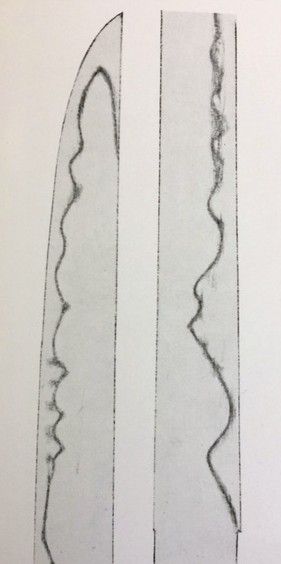
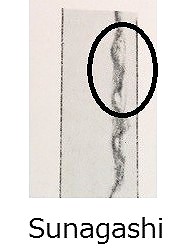
Muramasa’s tantos are typically about ten inches ± half an inch or so.  Hirazukuri (平作り). Thin blades with a sharp look.  The nioi base with small nie and sunagashi patterns (brushed sand-like patterns, as shown in the illustration below) appears.  The boshi (the top part of the hamon) is jizo (a side view of a human head).  The tempered line varies with both wide and narrow areas.  Some areas are so narrow, almost close to the edge of the blade, while others are broader.  Hako midare (box-like shape) and gunome (lined-up bead pattern) appear.  O-notare (large, gentle waviness) is a signature characteristic of Muramasa.  The pointed-tempered line is a typical characteristic of Mino-den (Sanbon-sugi).  Refer to Chapter 23, Sengoku Period Sword, and Chapter 24, Sengoku Period Tanto.


5 |Heian Period Swords  (平安時代太刀)

0-timeline - size 24 Heian

                       
                                      The circle indicates the time we discuss in this section

The Heian period is when the sword shape changed to the current curved form.  Before that, swords were straight.  It is widely accepted that the study of Japanese swords begins in the Heian period.   Swords made before the Heian period are considered archaeological artifacts.  The main reason is that sword-making techniques improved significantly after the start of the Heian period.

The elegant and graceful lifestyle of Heian culture is reflected in the style of swords.  A group of swordsmiths in the Kyoto region developed a specific sword style called Yamashiro-den (Yamashiro School).  The shape of their swords exhibits a graceful line.  The most famous sword of this period is Sanjo-Munechika (三条宗近 page 20), a national treasure today.  The Yamashiro-den represents the swords of the Heian period.                                                                                                                                 


                                                                                                      6a Heian period sword style

General Heian period sword style

The shape —————The length of a sword is about 30 inches ± a few inches.  It has an elegant, graceful shape, with a narrow blade and a small kissaki (小切先).  The curvature is deep.  This style is called Kyo-zori (京反り) or Torii-zori (鳥居ぞり).  In the Kyo-zori style, the deepest part of the curvature is near the middle of the blade.  The lower part of the sword flares out, creating an A-line shape similar to the lower part of the Eiffel Tower.  This flared shape is called funbari (踏ん張り).                                                                      

6b A line bottom

Hamon(刃文)———- Hamon is the line formed during the process of tempering.  The hamon on Heian period swords is narrow and usually suguha (直刃).  Suguha means a straight line.  The hamon is also Nie-based.  Nie(沸) are tiny particles in the hamon.   As shown below, if you look closely, you can see fine sand-like particles within the hamon line.

6 Straigh tempered line(Suguha)

10 Nie & Nioi

Ji-hada (地肌) ——–Fine wood-grained pattern.  The location of ji-hada (or ji-tetsu) is between the hamon and shinogi (see Chapter 3 |Names of Parts).

Nakago (中心)——– The nakago is the hilt area.  Sword makers inscribed their names there. During the Heian period, the nakago was often shaped like a kijimomo (雉腿), meaning a pheasant’s thigh.

6 Kijimomo-nakago

Hi and engrave ———- Hi (樋) means an engraved straight line.  Hi and other engraved designs were rare during the Heian period.  These became more common later on.

Kissaki (切先) ———– The shape of kissaki on a Heian sword is ko-gissaki, meaning small kissaki. The hamon line at the kissaki is called boshi.  During this period, the type of boshi design is called komaru, meaning small, round, and wrapping around the tip.

Names of the Heian period swordsmiths

  • Yamashiro School——–  Sanjo Munechika(三条宗近) Sanjo Yoshiie(三条吉家)                                                 Gojo Kanenaga(五条兼長) Gojo Kuninaga (五条国永)
  • Yamato School ————-Senju-in (千手院)
  • Bizen School ————— Bizen Tomonari(備前友成) Bizen Masatsune(備前正恒)                                                  Bizen Kanehira (備前包平)
  • Hoki (伯耆) —————–  Yasutsuna (安綱) Sanemori (真守)
  • Buzen (豊前) ————–   Cho-en (長円) Sinsoku (神息)
  • Satsuma (薩摩) ———— Naminohira (波平)