56| Part 2 of — 22 Sengoku Period History (戦国時代歴史) 

Chapter 56 is a detailed section of Chapter 22, Sengoku Period History.  Please read Chapter 22, Sengoku Period History, before reading this part.


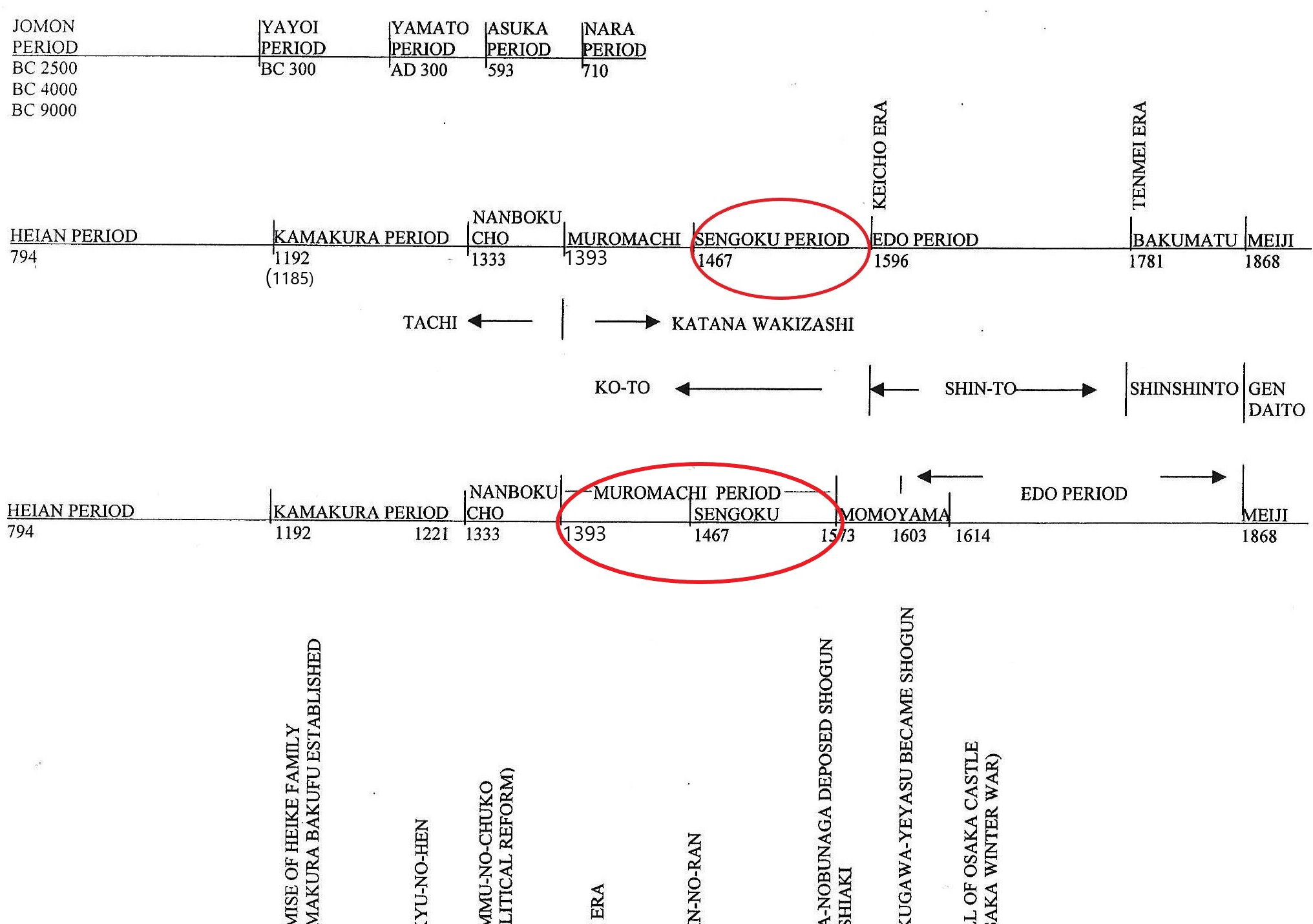
0-timeline - size 24 Sengoku Period                               
                               The circle above indicate the time we discuss in this section

Chapter 22, Sengoku Period History, explains why we divide the Muromachi period into the Muromachi and Sengoku periods based on sword styles.  The center timeline above indicates that the Sengoku period (戦国時代) ended in 1596, according to sword history. 

1596 is the start of the Keicho (慶長) era.  Swords made during and after the Keicho era are called shin-to (new swords), and swords before the Keicho era are called ko-to (old swords).  Therefore, the start of the Keicho era is the dividing line.  The swords made during the Keicho time are technically shin-to, but they are specially called Keicho shin-to.                  

Chapter 22, Sengoku Period History, describes an overview of the Sengoku period.  At the beginning of the Sengoku period, about thirty small Sengoku daimyo (warlords) fought fiercely against each other.  They formed alliances with neighboring territories on and off, and occasionally betrayed one another.  The more powerful daimyo took over the territories of the weaker ones.  Gradually, the number of daimyo decreased.   Well-known powerful daimyo include Imagawa Yoshimoto (今川義元), Takeda Shingen (武田信玄), Uesugi Kenshin (上杉謙信), Hojo Soun (北条早雲), Oda Nobunaga (織田信長),  Tokugawa Ieyasu  (徳川家康), and Toyotomi Hideyoshi (豊臣秀吉).  Their ultimate goal was to defeat their rivals and advance to Kyoto (京都) to establish themselves as the supreme political power.    

Oda Nobunaga (織田信長) defeated Imagawa Yoshimoto in Okehazama (桶狭間)

Around 1560, Imagawa Yoshimoto (今川義元) controlled a significant part of Suruga (now Shizuoka Prefecture).  See the map below for the location. He was a powerful Sengoku daimyo, strong enough to be the country’s top ruler. 

The Imagawa clan decided to move their army to Kyoto to take control of the government.  He took 25,000 men with him. On his way to Kyoto, they needed to pass through Owari (尾張: Aichi Prefecture today; see the location below), Oda Nobunaga’s territory.  

Oda Nobunaga (織田信長) was a young man with far fewer resources than Imagawa Yoshimoto.  It was clear that Oda Nobunaga had little chance of defeating Imagawa.  He had just become the head of Owari after his father’s death.  At that time, Nobunaga was called “the idiot of Owari” because of his eccentric behavior (although he was a genius). 

Few people had trusted in Nobunaga.  Among  Od’s vassals, some insisted on staying inside the castle instead of going out to fight, since Nobunaga could only gather  3,000 men.  But in the end, to everyone’s surprise, the Oda side won.  Here is how it happened. 

While Imagawa Yoshimoto was advancing, Nobunaga scouted which route Imagawa would take.  Imagawa’s side was confident they would win this easy battle because the Oda clan was small, and the head of the clan was an idiot.  The Imagawa troops decided to stop and rest at a place called Okehazama.  The road passing through Okehazama was long and narrow.  Knowing that Imagawa’s troops would come this way, Nobunaga sent out his men disguised as farmers and offered food and sake to the Imagawa soldiersWhile they were having a good time, Oda Nobunaga launched a surprise attack on the Imagawa troops.  On top of that, it suddenly began raining heavily.  The rain was so intense that the Imagawa troops could not see the Oda troops approaching.  Ultimately, Imagawa Yoshimoto was killed in battle by Oda forces.  Afterward, the Imagawa clan declined.
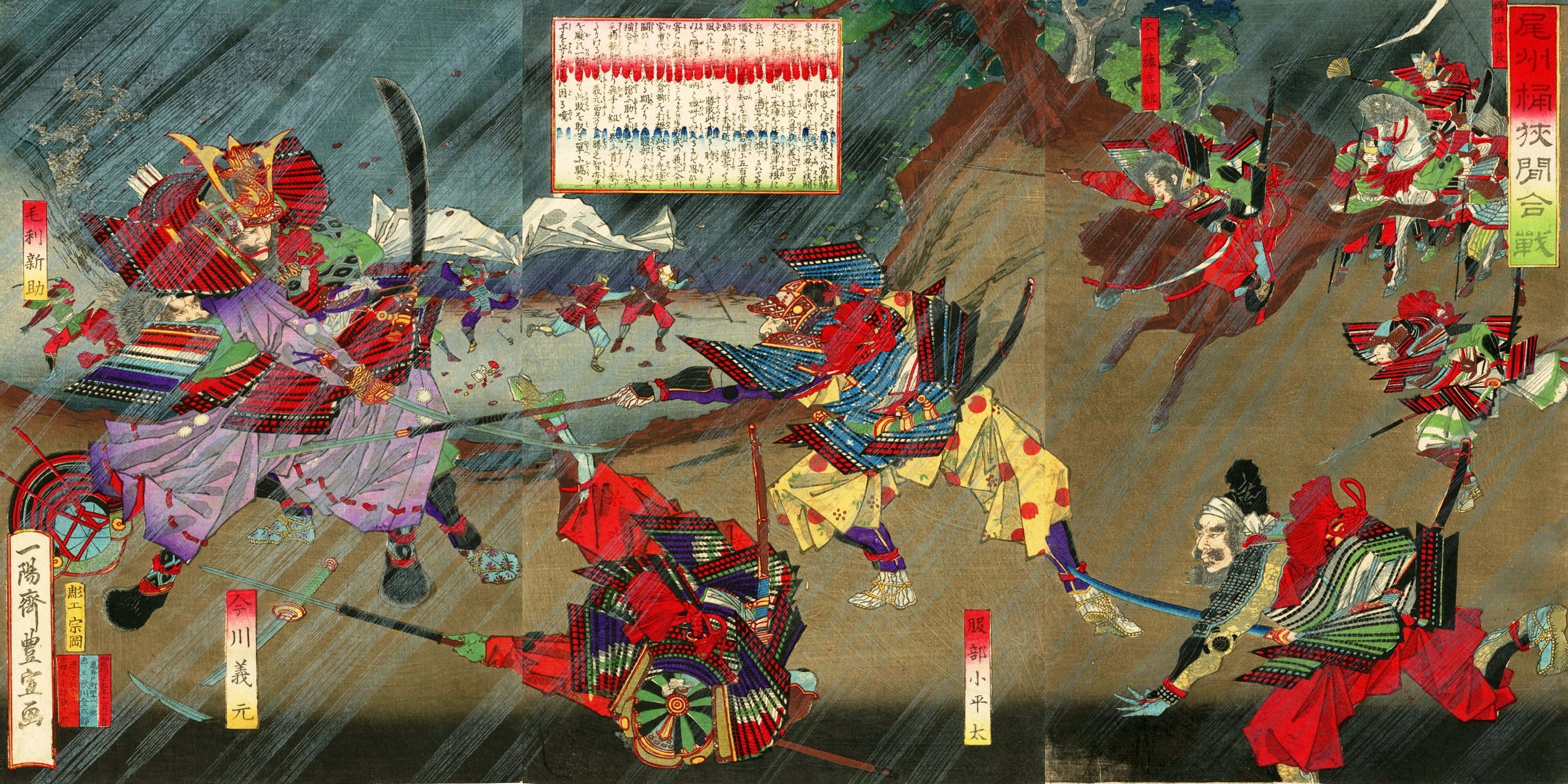
59 Okehazama drawing

Bishu Okehazama Gassen (備州桶狭間合戦) by Utagawa Toyonobu (歌川豊信)   Public Domain (http://morimiya.net/online/ukiyoe-big-files/U896.html)
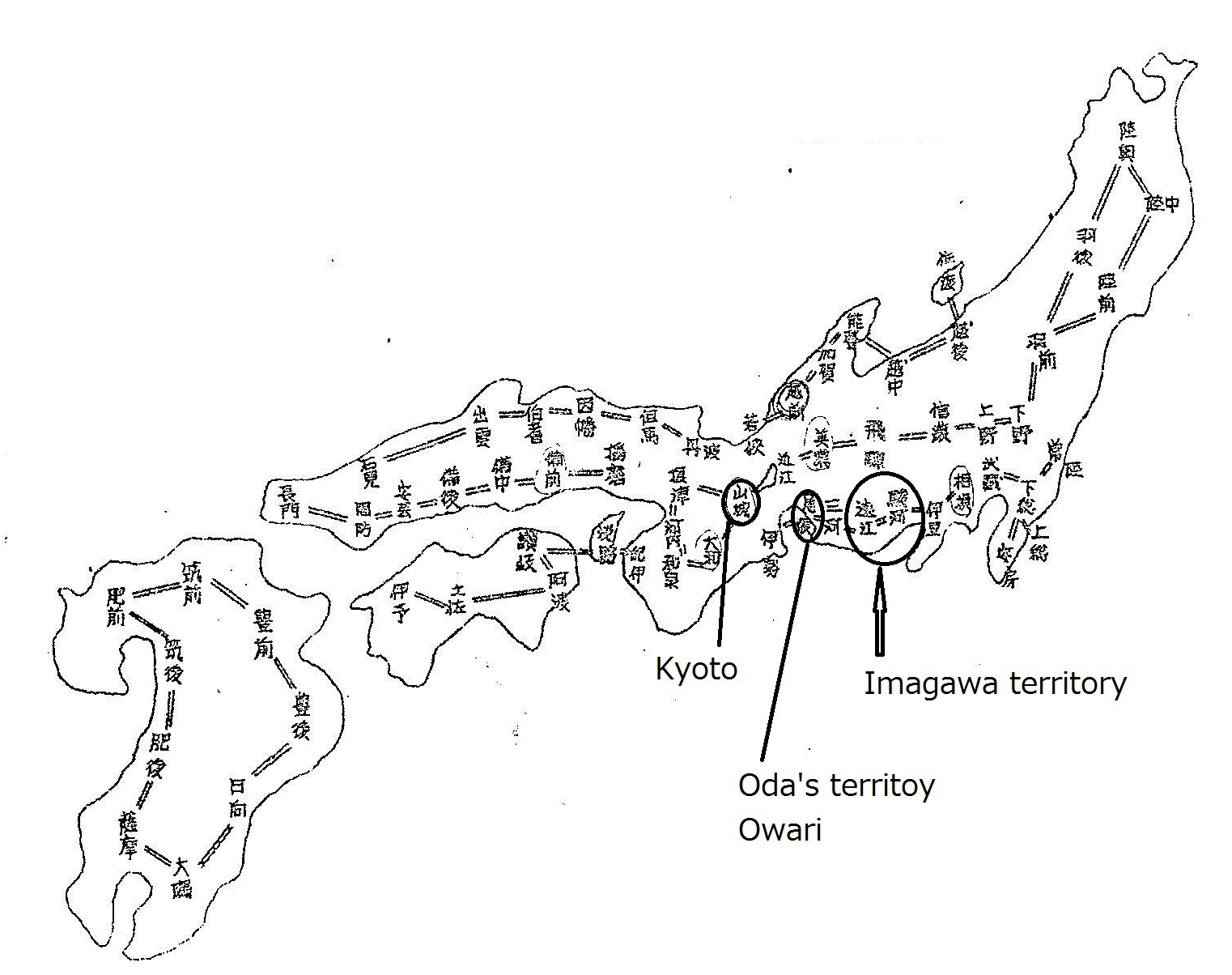
59-imagawa-and-oda-map.jpg

Oda Nobunaga(織田信長) and Akechi Mitsuhide(明智光秀)

After the Battle of Okehazama, the Oda clan rapidly expanded.  Oda Nobunaga became the dominant power.  During his rule, he carried out several brutal acts, such as burning the Enryaku-ji temple (延暦寺) and killing many people, including civilians,  yet his economic policies encouraged commercial activities. 

Things were going fairly smoothly for Nobunaga late in his life.  However, in 1582, Nobunaga was killed by his top vassal, Akechi Mitsuhide (明智光秀), at the Hon’nou-ji (本能寺) temple in KyotoNobunaga was 49 years old. 

There are several theories about why Akechi attacked and killed Nobunaga, but we don’t know exactly what happened.  One speculation is that Akechi held a grudge against Nobunaga.  There were numerous incidents where Nobunaga mistreated himAnother theory suggests that Akechi saw an opportunity to attack Nobunaga (Nobunaga was with very few men that day), and he took the chance.  Another one is that Shogun Ashikaga Yoshiaki (足利義昭) and his allies ordered Akechi to kill Nobunaga because Akechi had once worked for him.  Shogun Yoshiaki was afraid Nobunaga would become too powerful.  More theories exist.  We don’t know the true reason; it is still debated today.  It remains one of the big mysteries in Japanese history.  

After this occurred, the news was sent to Toyotomi Hideyoshi, who was Akechi’s counterpart under Nobunaga.  At that time, Hideyoshi was in Bicchu (備中, today’s Okayama Prefecture ), about 230 km (143 miles) from Kyoto (see the map below).   Hideyoshi quickly returned to Kyoto with his troops to avenge his master against Akechi and killed him. 

Here is another mystery.  The time between Nobunaga’s death and Akechi’s death was only ten days.  Hideyoshi was 230 km (143 miles) away, with mountains and rivers between them.  This means that within 10 days, Hideyoshi received news of Nobunaga’s death, packed up, and hurried back 230 km (143 miles) to Kyoto with his large number of soldiers, and fought against Akechi and killed him.  Their means of transportation at the time were limited.  Although Hideyoshi maintained a constant communication channel with Nobunaga’s inner circle, his reaction was somewhat too rapid.  There are also speculations that Akechi and Hideyoshi were both behind together(?) or that there was some other secret plot behind the incidents. 

59-bicchu-map.jpg

After Hideyoshi killed Akechi, he cleverly maneuvered his way to the top of power.  While Hideyoshi was in charge, he mined enormous quantities of gold from the mines he owned.  Records state that Hideyoshi buried a large amount of gold somewhere.  However, it has not yet been found.

Hideyoshi was the son of a poor farmer who rose to become Japan’s most powerful man. His success story fascinates the Japanese people.  Nobunaga, Hideyoshi, and Tokugawa Ieyasu are the most frequently depicted subjects in television shows and films.  After Hideyoshi died of natural causes, Tokugawa Ieyasu became Shogun, and the Edo period began.

The reference source                                                                                                      *Rekijin.com/?p=31448-キャッシュ                                                                                    *Bushoojapan.com/scandal/2019/06/02/51145-キャッシュ            

29| Bakumatsu Period History 1781 – 1868 (幕末歴史 )


0-timeline - size 24 Bakumatsu

The red circle above  indicate the time we discuss in this chapter

The Bakumatsu period is the last part of the Edo period in sword history. See the circle on the middle timeline above. However, political history does not divide the Edo and Bakumatsu periods, and there is no specific date that separates them.

The Azuchi-Momoyama period (安土桃山) falls between when Oda Nobunaga (織田信長) deposed Shogun Ashikaga Yoshiaki (将軍足利義昭) in 1573 until Tokugawa Iyeyasu became shogun in 1603, or when Tokugawa Iyeyasu defeated Toyotomi Hideyori (Hideyoshi’s son) during the Osaka Winter Campaign in 1615.  The Azuchi-Momoyama period was a brief era during which Oda Nobunaga (織田信長), Toyotomi Hideyoshi (豊臣秀吉), and Tokugawa Iyeyasu (徳川家康) engaged in intricate political struggles.  During this period, Japan experienced significant cultural and economic growth.  After a long period of war, the country was finally reunited and entered a peaceful period. 

The stories of Oda Nobunaga, Toyotomi Hideyoshi, and Tokugawa Iyeyasu are the most popular among the Japanese. These stories are often shown on TV programs and  movies. The Tokugawa family ruled Japan during the Edo period. 

The Tokugawa government was called the Tokugawa Bakufu.   Throughout the Edo period, the Tokugawa family’s direct descendants, usually the firstborn sons, became the shoguns.  However, the emperors co-existed at the same time.  Even though they did not hold political power, the imperial family still maintained imperial status.

The Edo period was peaceful. Unlike previous periods, there were no wars. Yet, later in the period, the long-lasting Edo period (which lasted about 260 years) became stagnant and began to show structural and financial problems in its rule. This is the Bakumatsu (幕末) time,  the final phase of the Edo bakufu 

In the previous chapter, Chapter 25, Edo Period History explained that the Edo bakufu closed the country to the outside world for most of that era.  The only place in Japan with access to foreign countries was Dejima in Nagasaki (the southern part of Japan).  During the Bakumatsu period, several European ships visited Japan, asking (more like demanding) that Japan open its ports to provide water and other supplies for whaling ships.  Also,  some countries sought to trade with Japan.   Those countries were England, Russia, America, and others.

In 1792, the Russian government sent an official messenger to Japan, demanding that Japan open its ports to trade.  In 1853, Commodore Perry from the U.S. arrived with four massive warships at the port of Uraga (浦賀: now in Kanagawa Prefecture) and demanded that Japan open its ports to water, fuel, and other supplies for  U.S. whaling ships. 

At the end of the Bakumatsu period, the Tokugawa bakufu faced political and financial difficulties in governing the country.  Also, intellectuals feared that Japan might face trouble, similar to that China faced during the Opium War (1839-1842) with England.  Pressures to open the country were building up.  It became evident that Japan could no longer keep the country closed.  At that time, Commodore Perry arrived at Uraga with four massive black warships and demanded that Japan open its ports.   These warships scared the Japanese and fueled the wave of anti-bakufu sentiment.    The Meiji Revolution was ready to happen, and Perry’s warships were the final push.

The Tokugawa bakufu signed treaties with several foreign countries and opened a few ports for trade.   The bakufu’s authority weakened, and Japan was divided into several political groups.  While they fought chaotically, the Meiji Restoration movement continued.  In 1868, the Tokugawa bakufu vacated Edo Castle in Edo (now Tokyo), and the Meiji Emperor moved in.  The Meiji Shin Seifu (Meiji’s new government) was formed, centered around the Meiji Emperor, and the Tokugawa bakufu came to an end. 

Commodore-Perry-Visit-Kanagawa-1854       File:Commodore-Perry-Visit-Kanagawa-1854.jpg      From ja.wikipedia.org/wiki/黒船 Public Domain
Commodore Matthew C. Perry’s visit of Kanagawa, near the site of present-day Yokohama on March 8, 1854. Lithography. New York: E. Brown, Jr.

26 |Over view of Shinto (新刀概要)

                                   
0-timeline - size 24 Shin-to
                           The circle indicates the subject discuss in this section 

The previous chapter 25 stated that the Edo period lasted from 1603 to 1868.  This is for political history.  The third timeline above shows that the Momoyama period overlaps with the Edo period.  Some people believe the Momoyama period was from 1573 to 1600. In general history, there are several opinions on how to divide these transitional periods.  For sword history, it is straightforward.  Swords made between approximately 1596 (慶長: Keicho era) and 1781 (天明: Tenmei era) are called shin-to.  Swords made between the Tenmei and Meiji eras are referred to as shin-to. 

After Toyotomi Hideyoshi nearly unified the country, the people could enjoy a period of peace.  This period of peace shifted the geographic distribution of swordsmiths. There were three main regions where sword forging took place.  These areas include Kyoto, Osaka, and Edo (Tokyo now).  The remaining swordsmiths gathered near the castles of major daimyo (大名: feudal lords).

Kyoto—- The Umetada Myoju (梅忠明寿) group thrived, followed by swordsmiths such as  Horikawa Kunihiro (堀川国広), Kunimichi (国路), Kunisada (国貞), and Kunisuke (国助).

Osaka——–Osaka was established as a commercial city and became the center of commerce.  It produced swords and distributed them to other regions across the country.  The well-known swordsmiths in Osaka: Tsuda Sukehiro (津田助広) and Inoue Shinkai (井上真改).

Edo————-Many swordsmiths gathered in Edo (江, now Tokyo), where Shogun Tokugawa Iyeyasu livedThe well-known swordsmiths in EdoNagasone Kotetsu (長曽祢虎徹), Yasutsugu (康継), Noda Hannkei (野田繁慶).

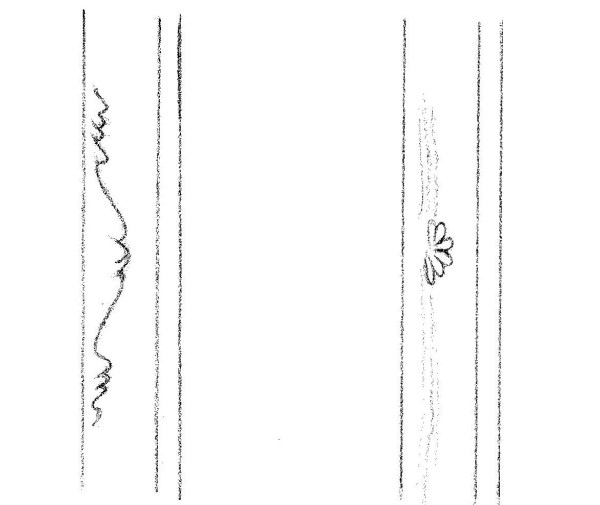
By the time Tokugawa Iyeyasu’s grandson, Tokugawa Iyemitsu, became shogun (寛永:Kan’ei era 1624 – 1643), swordsmiths had spread beyond the three areas mentioned above.  In each daimyo territory, swordsmiths operated shops near the castles to meet the needs of the daimyo and their subjects.  By the Genroku era (元禄: 1695), sword-making had declined, and people preferred more picturesque hamon designs, such as kikusui (菊水: flower design) and fujimi (富士見: Mount Fuji).

63 fuji sakura hamon
Fujimi                           Kikusui

Difference between Koto  and Shinto 

The following section describes the differences between Ko-to and Shin-to.   However, remember that there are always exceptions to these rules.

  1. The length of the shin-to katana is typically about two feet three inches ± a little.  The wakizashi is about one foot six inches.   Shallow curvature.  Wide width.  Thick body.   Gyo-no-mune.  Chu-gissaki with a slightly stretched appearance.

13 Mune drawing

  1. The ko-to sword feels light, while the shin-to feels heavy.
  2. The bottom of the hi is rounded above the machi. Shin-to’s bo-hi ends slightly below the yokote line.

27. Hisaki & marudome

  1. Generally, carvings are less common on shin-to. However, some swordsmiths are famous for their carvings.  The designs are refined and detailed.  Umetada Myoju (埋忠明寿) is well-known for his carvings.
  2. For shin-to, if it is mainly nie, it is usually a coarse nie.
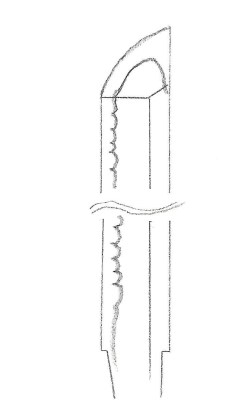
  3. In the machi area, the hamon begins with a straight tempered line (the bottom part of the blade shown in the illustration below), followed by midare, or various types of hamon in the middle, and ends with suguha (straight hamon) in the boshi area (the top part).  Generally, this is the standard Hamon style of shin-to, but there are always exceptions. 

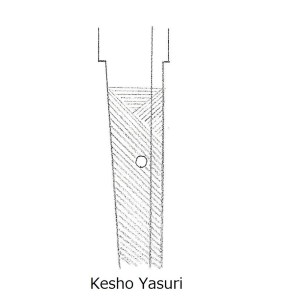
27 Keshou Yasuri & suguha

  1. For shin-to, the type of iron used for the blade is consistent throughout Japan.  A few variations of iron were used across Japan, with a very hard, dark color and a glossy look.
  2. The nakago has a well-balanced shape.  The bottom of the nakagotapers gradually.  The type of yasuri-me (file mark) is often a kesho-yasuri. Engraved inscriptions display the swordsmith’s name, location, province, and year of creation.

27 Keshou Yasuri & suguha

25| Edo Period History 1603 – 1867  (江戸時代歴史)

 
edo Period with Momoym
The circle above indicates where we discuss in this chapter.

Between the Sengoku period (戦国時代) and the Edo period (江戸時代) in Japanese political history, there was a time called the Azuchi-Momoyama period (安土桃山).  It lasted from around 1573 to 1614, as shown in the third (bottom) timeline above.  This was the era when Oda Nobunaga (織田信長), Toyotomi Hideyoshi (豊臣秀吉), and Tokugawa Ieyasu (徳川家康) played central roles in politics. 

After Tokugawa Ieyasu (徳川家康) won the Battle of Sekigahara (関ヶ原の戦い) in 1600 and defeated Toyotomi’s vassals (Toyotomi Hideyoshi had already passed away by then), Tokugawa Iyeyasu became the shogun (将軍) in 1603.  This marked the start of the Edo Period (江戸).  In sword history, as shown in the middle timeline above, the Edo period follows immediately after the Sengoku period.

At the end of the Sengoku period and throughout the Azuchi-Momoyama period, the economy grew significantly, and new cultures flourished.  Beautiful and impressive art forms, such as paintings, architecture, and interior design, were created.  The tea ceremony was developed by Sen No Rikyu (千の利休), and Kabuki began to be performed during this period.  This era was somewhat similar to the European Renaissance. Interestingly, this emergence occurred in Japan and Europe around the same time.  

Around this time, many Europeans came to Japan.  That was during the era of European exploration in the East.  They were from England, Spain, Holland, and Portugal.  The novel “Shogun” by James Clavell is based on the true stories of William Adams and Jan Joosten Van Londersteyn*¹ from that period.  Today, you can see Jan Joosten’s statue at Tokyo Station.  I stay at a hotel near Tokyo Station on my yearly trip to Japan.  I often pass by in front of “Jan Joosten’s” statue.   It is located underground inside Tokyo Station, right in the busy shopping area.  It can be easily missed unless you look for it.  There is also another statue of him outside the station.

Shogun Tokugawa Iyeyasu hired William Adams and Jan Joosten (the Japanese call him Jan Joosten, not his full name) as his advisors, and he gained information about Europe from them.  Shogun Tokugawa Iyeyasu treated them well.  The area where Jan Joosten lived is now called Yaesu (八重洲), named after him.  William Adams changed his name to Miura Anjin and lived in the Miura area.  This place is about an hour and a half south of Tokyo today.  The records of these two men are well-kept and easily accessible. 

Europeans introduced many European goods and ideas to Japan.  Although Christianity became popular and spread widely during the early Azuchi-Momoyama period, Toyotomi Hideyoshi later banned it.  After the Meiji Era (1868), religious restrictions were lifted.

The Edo period started when Tokugawa Iyeyasu became shogun (1603) and ended with the Meiji (明治) Restoration in 1868. The Tokugawa bakufu, or Tokugawa government, was the sole governing entity in the country during this period.  Although emperors still existed, political power shifted to the Tokugawa bakufu.  

Gradually, ports for European ships were restricted.  Eventually, Spaniards were no longer allowed to come to Japan, and then the Portuguese.  The Japanese were also banned from traveling abroad.  By around 1640, Dejima, a port town in Hirato, Nagasaki Prefecture, was the only place in Japan where foreigners could do business with the Japanese.  Only the Dutch were allowed to arrive from Europe.  Japan isolated itself from the outside world until the Meiji Restoration (1868).

During the Azuchi-Momoyama and early Edo periods, many European ships visited Japan. Strangely, a lot of these ships wrecked near Japan’s shores. One reason is that Japan is a volcanic island. Even if the sea’s surface appears calm, there are many obstacles beneath the surface, such as underwater mountains and large hidden reefs. The Europeans lacked the waterway information common among Japanese seamen.

Additional stories to share just for fun

Another reason many ships were wrecked was that they were searching for gold.  When Marco Polo traveled to China, he heard from the Chinese people about a small island country farther to the east.  This land was prosperous, and the emperor’s palace was made of gold and silver.  After Marco Polo returned to Italy, he published a book (in the late 1300s) about his journey.  In his book, he mentioned what he had heard about the island nation of Japan in China, even though he had never visited Japan himself.  The book was widely read across many European countries.  Once traveling to the East became possible for Europeans, they came to Japan in search of gold. 

Yes, Japan produced a large amount of gold.  However, for the Europeans, it was too late.  By then, the Fujiwara family had already mined most of the gold in the Oh-shu area (奥州, northern Japan).  This area includes the present-day prefectures of Aomori, Akita, Fukushima, and Miyagi, where the devastating tsunami hit in 2011.  Toyotomi Hideyoshi also owned many gold mines, but they had already been mined as much as possible with the skills available at that time.  Japan once had many gold and silver mines across the country.  Those mines are now depleted, and only a few remain available for mining today.

Throughout history, there have been facts and rumors about “maizo-kin: 埋蔵金.”  Maizo-kin refers to gold buried or hidden by people such as the Tokugawa Shogun, Toyotomi Hideyoshi, wealthy daimyo, and merchants.  Without vaults, the only way to store gold was to bury it in secret places.  Several maizo-kins have been discovered, including one in the middle of Tokyo, Ginza.  There are still several large ones that haven’t been found yet.  These include Hideyoshi’s maizo-kin, the Tokugawa bakufu maizo-kin, and several othersAlthough several maps indicated the locations of these maizo-kin, they were, of course, fake.  Today, whenever the ground is dug up to build a large structure, people start discussing the discovery of a big maizo-kin.

Gold gradually flowed out of Japan over the centuries until the Meiji Restoration, because the exchange rate between gold and silver was much cheaper in Japan than elsewhere. Today, we still mine gold on a small scale.

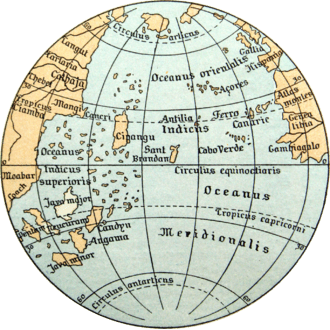
It is said that the name of the country, Japan, originates from Marco Polo’s book.  He referred to Japan as “Chipangu,” which means “gold country,” in his book. *²   From “Chipangu” to “Zipang” to ‘Jipang,” it eventually became “Japan.”  The Japanese don’t call the country Japan but “Nihon” or “Nippon” (日本).

ヤン ヨーステン Jan Joosten van Lodenstijn https://www.weblio.jp Or Jan Joosten van Londensteyn 

*² Wikipedia “Names of Japan” or Check (Click) right to go to the link Jipangu 

26 map of Cipangu1492

Cipangu was described in 1492 by Martin Beham’s globe                                                    From Wikimedia Commons, the free media repository (Names of Japan)

22| Sengoku Period History (戦国時代歴史)

0-timeline - size 24 Sengoku Period 0

The red circle above indicates the time we discuss in this section

The timeline above shows two circles.  In political history, the Sengoku period (戦国時代) is part of the Muromachi period (室町), which is the lower circle.   However, in sword history, we separate the Muromachi and Sengoku periods (Warring States period), the top circle.  In sword history, we divide the time this way because, during those two periods, sword styles changed, and the environment of sword-making also changed.

After the Onin-no-ran (応仁の乱) began (discussed in 20|Muromachi Period History), the beautiful capital city of Kyoto (京都) was in a devastated condition.  The shogun’s (将軍) power reached only over a small area.  The rest of the country was divided into about thirty small independent states.  The leaders of these independent states were called shugo daimyo (守護大名).  They were originally government officials who were appointed and sent there by the central government.

Powerful local samurai often became the leaders of these states.  They fought against each other to take over each other’s land.  During the Sengoku period, vassals would kill their lords and steal their domains, or farmers would revolt against their lords.  A state like this is called “gekoku-jo” (lower-class samurai overthrow the superior). 

This was the time of the Warring States, known as the Sengoku period.  The leader of each state was called a Sengoku daimyo (戦国大名: Warlord).  The Sengoku period lasted about 100 years.  Gradually, powerful states defeated weaker ones through long, fierce battles, expanding their territory.  Around thirty small countries became twenty, then ten, and so on.  Eventually, only a few dominant sengoku daimyo (warlords) remained.  Each daimyo from those states fought their way to Kyoto and tried to become the top ruler of Japan.  The first one who almost succeeded was Oda Nobunaga (織田信長).  However, he was killed by his vassal, Akechi Mitsuhide (明智光秀), and soon Akechi was killed by his colleague, Toyotomi Hideyoshi (豊臣秀吉).  

After Toyotomi Hideyoshi defeated Akechi Mitsuhide, his troops, and other major warlords, he nearly completed the unification of Japan.  Yet, Hideyoshi still had one more rival to deal with to finish his goal.  That was Tokugawa Iyeyasu (徳川家康).  Now, Toyotomi Hideyoshi and Tokugawa Ieyasu are the last contenders for the top position.  Both recognized that their opponents were smart and capable.  Any wrong move could be disastrous.  Therefore, they decided to maintain a friendly coexistence on the surface for the time being.  Although Toyotomi Hideyoshi tried to make Tokugawa Ieyasu his vassal, Tokugawa Ieyasu somehow managed to avoid that.  In Tokugawa Ieyasu’s mind, being younger than Toyotomi Hideyoshi, he knew he could simply wait until Hideyoshi‘s natural death, which eventually happened. 

After Hideyoshi’s death, Tokugawa Ieyasu fought Hideyoshi’s vassals and won at the Battle of Sekigahara (関ヶ原の戦い) in 1600.  Then, in 1615, at the Battle of the Osaka Natsu-no-jin (Osaka Summer Campaign: 大阪夏の陣), Tokugawa defeated Hideyoshi’s son’s army.  Following this, the Toyotomi clan was dissolved entirely, and the Edo (江戸) period began.  It is called the Edo period because Tokugawa Ieyasu lived in Edo, which is now Tokyo (東京).

*The Sengoku period is frequently depicted in TV dramas and movies.  People who lived through that era had a tough time, but it was also the most exciting time for creating TV shows and films.  The lives of Oda Nobunaga, Toyotomi Hideyoshi, and Tokugawa Ieyasu are among the most popular stories in Japan.  In particular, the story of Toyotomi Hideyoshi is among the most popular.  His background was that of a poor farmer, but he rose to become the top ruler of Japan.  That is a fascinating success story.


23 Toyotomi_hideyoshi

Portrait of Toyotomi Hideyoshi (豊臣秀吉) by Kano Mitsunobu, owned by Kodai-Ji Temple      From Wikimedia Commons, the free media repositon.