
The red circle above indicates the time we discuss in this section
The Muromachi period was a relatively peaceful and prosperous time until shortly before the “Onin-no-ran,” which occurred at the end of the Muromachi period. Refer to Chapter 20, Muromachi Period History (室町時代歴史). The Nanboku-cho style long swords became outdated; as a result, they were shortened. The shortened blade is called suriage. Overall, the Muromachi period was a declining time for sword-making.
Tachi and Katana
Until the end of the Nanboku-cho period or the beginning of the Muromachi period, samurai wore swords suspended from their waists with the blade facing down. When a sword was worn this way, the swordsmith inscribed his name on the side facing outward, meaning the blade is on your right when you see the inscription. In this case, the sword is called a tachi.
During the Muromachi period, a sword was worn between the belt, with the blade facing up. The swordsmith inscribed his name so that it faced outward when it was worn. Therefore, when you see the inscription, the cutting edge is to your left. This is classified as a katana.
Around the beginning of the Muromachi period, samurai started to wear a pair of swords called dai-sho (大小), meaning large and small. The longer sword is a katana, and the shorter one is a wakizashi. In general, a tachi is longer than a katana. A katana is longer than a wakizashi, and a wakizashi is longer than a tanto. Here is the order of their lengths.
Tachi > Katana > Wakizashi > Tanto Tachi and katana differ in how they are worn, not in length.

O-suriage ( 大磨上: Katana shortened by great length)
How much the sword should be shortened depends on its original length and how much the owner wants it shortened. O-suriage is a type of sword that is significantly shortened. Once the blade is shortened by that length, the inscription of the maker’s name is cut off. When the Hon’ami family (本阿弥家, a family of sword connoisseurs who have appraised Japanese swords for generations from the Muromachi period to today) appraises such a suriage sword, they write the make of the sword and the swordsmith’s name on the front side of the hilt, and the connoisseur’s name with his kaou (similar to a signature) on the back. There are several levels of writing. The level at which it should be done depends on the sword’s quality and the owner’s preference. Below is the order of levels (high to low).
Shu-Mei (朱明 )————————————————————-name written in Vermilion Kinpun-Mei (金粉名 )———————————————–name lacquered in gold powder Gin-Zougan (銀象嵌 )————————————————————name inlaid in silver Kin-Zougan (金象嵌 )————————————————————-name inlaid in gold
Sugata (姿: Shape) ——— The average length is typically two feet three to four inches (68~71cm). The shape of the Muromachi period katana is somewhat similar to that of the Heian period tachi. However, Muromachi katana are less grand or graceful than those from the Heian period swords. The curvature is usually of the koshizori style. Koshizori refers to the highest curvature being near the lower part of the blade. The length and shape are suitable for wearing between the body and the belt. The width and thickness are well-balanced with the size of the sword. Small kissaki.
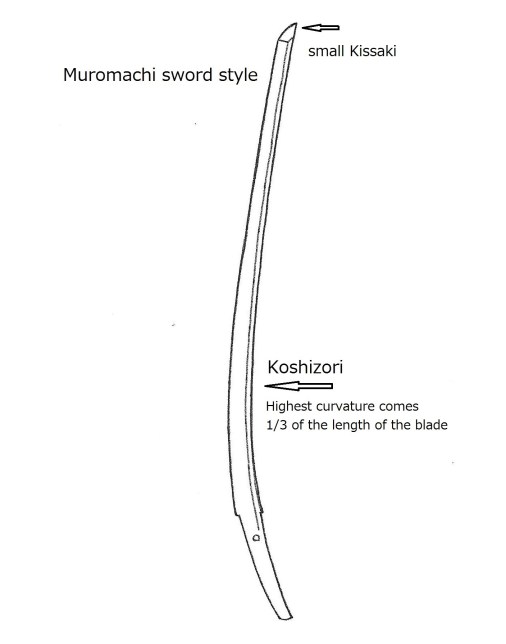
Hirazukuri-Wakizashi ———– Hirazukuri refers to a flat surface without a shinogi or yokote line. Usually, it is 1 foot and 1 to 2 inches long. No curvature. Hirazukuri-wakizashi appeared during the Muromachi period.
Hamon (刃文: tempered line) ———————- Nioi base. The tempered area is well balanced with the blade’s width. Koshi-hiraita-midare is mixed with choji-midare.
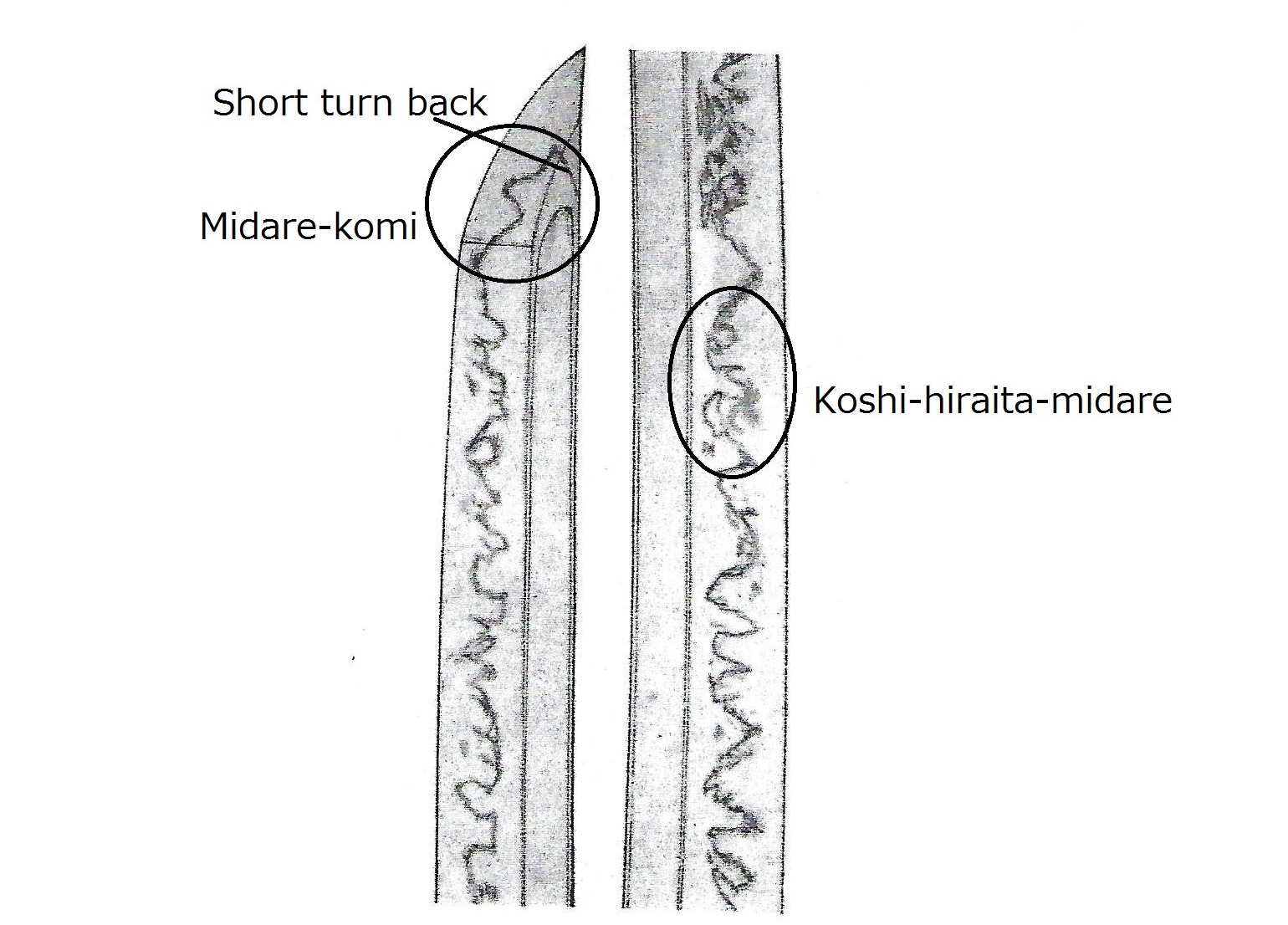
- Boshi (Tempered line at Kissaki area) ————– Midare-komi, a short turn back. See the above illustration. Midare is an irregular wave-like pattern.
- Ji-hada (地肌: An area between the tempered line and Shinogi)- Soft look, a large wood grain pattern, Ji-utsuri (faint smoke or cloud-like effect) shows.
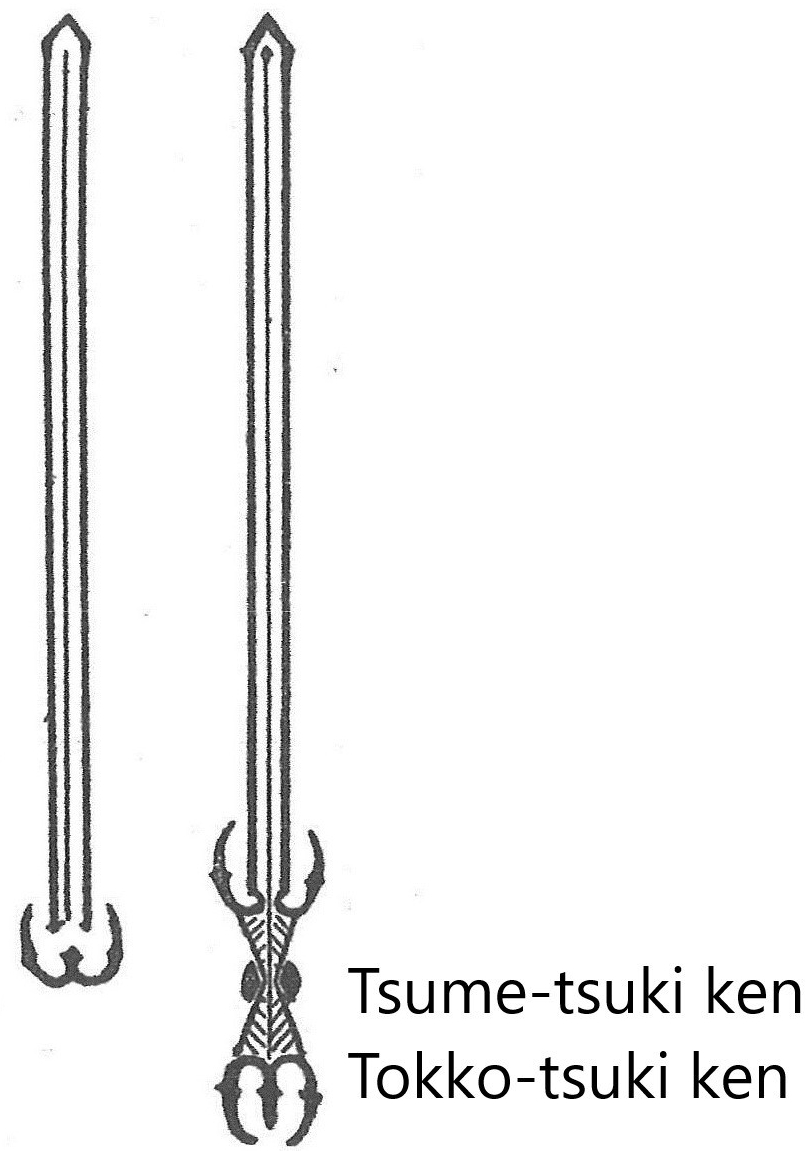
- Horimono (彫物:Engravings) ———- Bo-hi (single groove), Soe-hi (a thin groove alongside the main hi), Futasuji-hi (double narrow groove), Sanskrit, Tokko-tsuki ken, Tsume-tsuki Ken, name of gods, and dragon. Carvings became elaborate.

Sword Smiths during Muromachi Period
- Bizen Den ——–Osafune Morimitsu (長船盛光), Yasumitsu (康光), Moromitsu (師光)
- Yamashiro Den————————————————-Yamashiro Nobukuni (山城信国)


Ise Masashige (伊勢正重), Bizen Osafune Naomitsu (備前長船尚光) Juyo Token(重要刀剣) Sano Museum Catalogue (permission granted) once my family sword

 Study of Japanese Sword
Hello. I really enjoyed your paper and greatly appreciated the way that you presented it. I have been struggling with finding out who the sword smith was on a wonderful tanto that I discovered from the above mentioned period. I would greatly appreciate it if you would take a moment to view the tanto and signature. I will send the images abboone your approval.
Regards
Eric Sheffield
LikeLike
Maybe yu can send me the photo of the Nakago area.
I can not promise I can tell, but at lease I can try.
Yurie
LikeLike
Thank you again. I have forwarded you a link through comments. Please let me know if you didn’t receive it or it does not work.
Regards
Eric
LikeLike
Thank you so much for your time. Please let me know if you have trouble with the link below. It was the only way that I could figure out how to get the image to you. It’s through IMGUR.
Regards;
Eric
LikeLike
It looks like it says,
備前長船住[?] [?] (Bizen Osafune Jyu [?] [?] ).
[?] [?] is not readable.
Please don’t quote me on this. It is only by the picture.
I don’t want to take responsibility.
Yurie
LikeLike
Thank you so much for your time and translation. I will dig deeper into it over time and figure this one out. It’s so special to think that this sword was being created when so much of the rest of the world was still so crude. The Japanese culture is so special to me and yet I have never been to japan.
Thank you again
Eric Sheffield.
On Tue, Feb 5, 2019 at 2:54 PM Study of Japanese Sword wrote:
> Yurie Endo 遠藤由利江 commented: “It looks like it says, 備前長船住[?] [?] (Bizen > Osafune Jyu [?] [?] ). [?] [?] is not readable. Please don’t quote me on > this. It is only by the picture. I don’t want to take responsibility. Yurie > ” >
LikeLike
Good morning Yuri san
I have recently found your paper and find it very informative and easy to digest . Please continue to write, do you have a website i can visit.
I am a iaido practitioner and a recent member of the english Token society
Thank you for passing on your knowledge
Robert (london)
LikeLike
I sent you an Email to your Email address, bobtrend@btinternet.com.
LikeLike
Domo arigatou sensei
Shitsureishimasu
On Sat, 24 Oct 2020 at 9:54 am Study of Japanese Sword wrote:
> Yurie Endo 遠藤由利江 posted: ” The circle indicate the time we are discussing > in this section The Muromachi period was a relatively peaceful and > prosperous time until a little before “Onin-no Ran,” which was the later > part of the Muromachi Period. Refer 20|Muromachi Pe” >
LikeLike
hi Yurie, just came across your book and was planning to buy with Hard cover and apparently Alphobook publisher doesn’t ship to canada, really would prefer harcover over the soft .if you can help with that i am in British Columbia.
also i would love to ask your opinion on a blade i just inherited if you want to contact me directly on y email that would be awesome ( looks to be muromachi era but my knowledge is still limited)
thanks
Michael
LikeLike
Alpha book publisher fix the order link. They should be able to ship the hardcover to Canada now. If you still have a problem, please write to them in the “Contact us” tab at the bottom right or top tab.
LikeLike