36| Part 2 — 3 Names of the Parts

This chapter is a continuation of Chapter 3, Names of Parts.  Please read Chapter 3, Names of Parts, before reading this section.

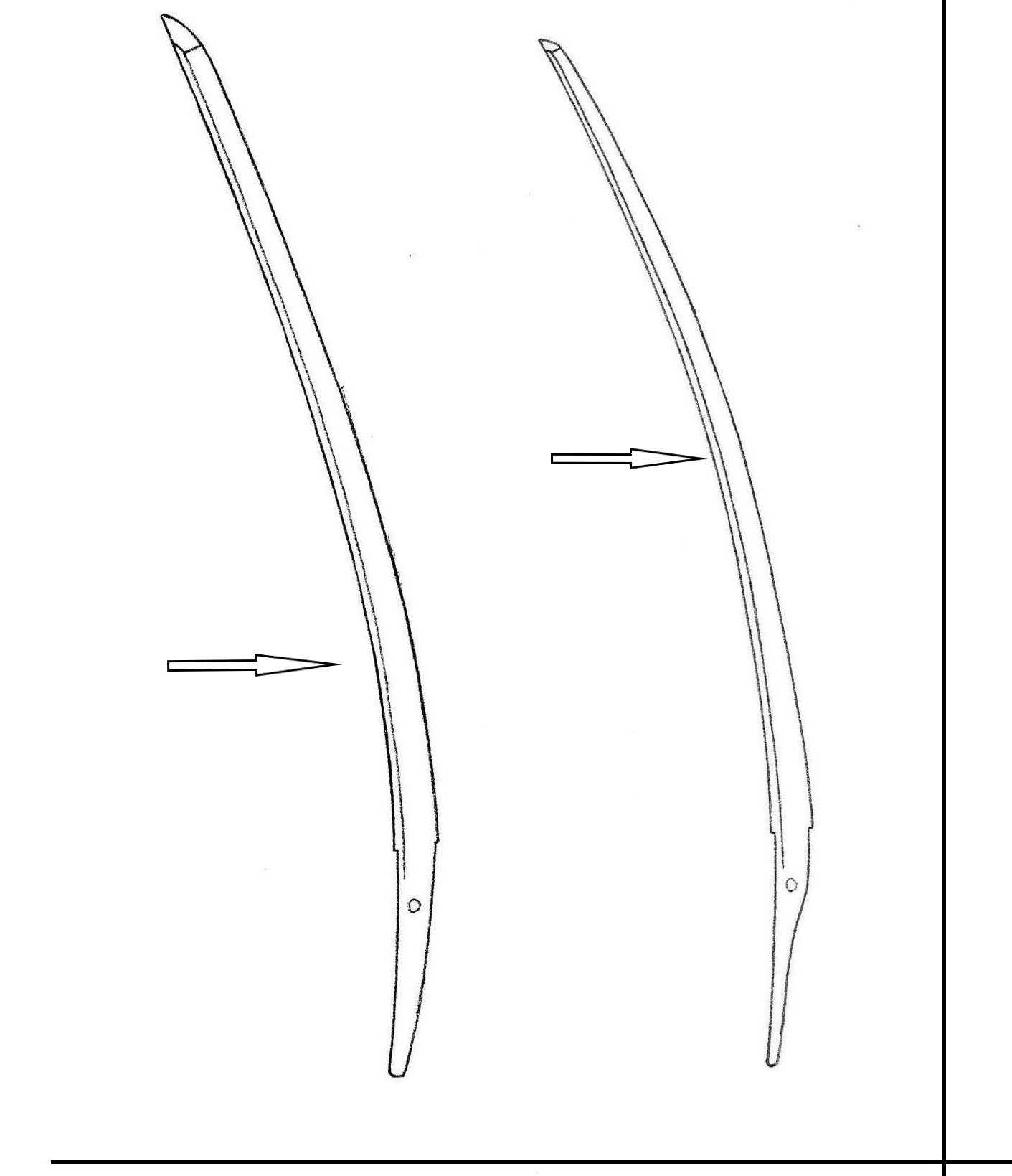
This chapter explains how to identify the koshi-zori or chukan-zoriChukan-zori is also called torii-zori or kyo-zori.   Chukan-zori means that the most curved part of the sword’s body is around the middle, and for koshi-zori, the most curved part is located lower than the center of the blade, approximately 1/3 down the body.   Every sword seems to have its curvature around the middle area, especially when looking at photos of swords in books.  This is because these swords are positioned to fit nicely within a given rectangular photo space. 

The correct way to check for the curvature is to hold the nakago (茎) vertically.  This way, you can see the location of the curvature more accurately.  If the nakago is not vertical, the curvature appears in the middle section of every sword.  When examining a sword, the first step is to hold the sword and make sure the nakago stands vertically. When looking at a sword in a book, rotate (shift or slide) the book slightly so that the nakago is perpendicular.  This way, you can see the precise location of the curvature.  Keep in mind that the difference can sometimes be subtle.

36 part 2 of -- 3 Sori (2)


35|Part 2 of — 2 Joko-To (上古刀)

This chapter is a detailed part of Chapter 2,  Joko-to (上古刀).  Please read Chapter 2 before this section. 
0-timeline - size 24 Yamato
 
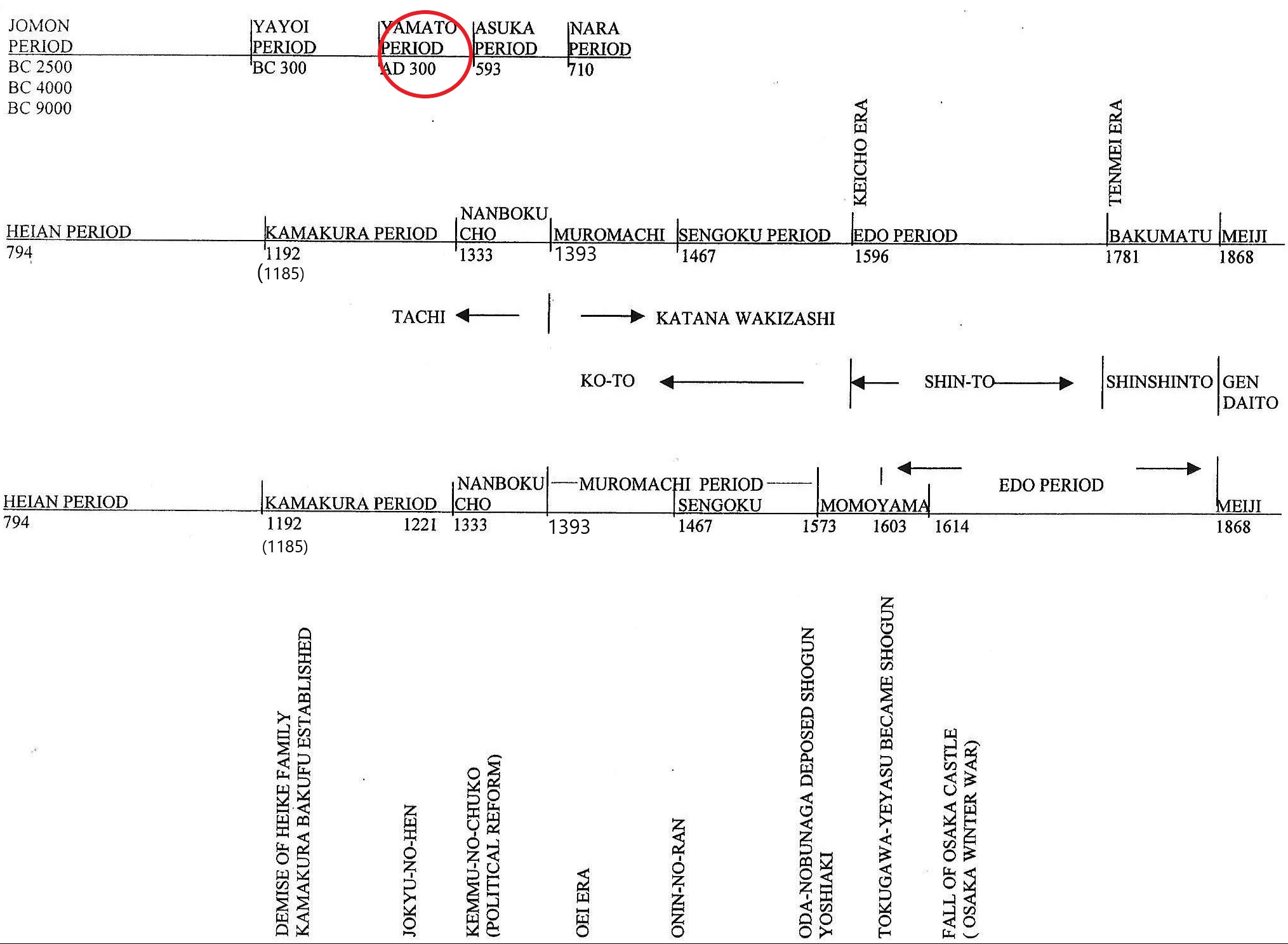
                             The red circle indicates the time we discuss this section.

The Kofun (古墳) culture emerged around the fourth to sixth centuries.  Kofun are massive burial sites built for powerful rulers.  They are often Zenpo-koen-fun (前方後円墳), meaning the front part is square, and the back is rounded.  When viewed from above, their shape resembles a keyhole.  The largest kofun is the Nintoku Tenno Ryo (仁徳天皇陵) in Osaka.  This is the tomb of Emperor Nintoku.  Its size is 480 m X 305 m, and it is  roughly 35 meters high. Inside the kofun, we found swords, armor, bronze mirrors, jewelry, iron, and metal tools.  Sometimes, iron itself was found.  Only the ruling class owned iron because it was considered a precious item at the time.  On the outskirts of the kofun, many haniwa*¹ were placed.  There are several theories about the purpose of haniwa.  One suggests they served as retaining walls, while others say they act as a dividing line between sacred and common areas.  There are several more theories. 

Originally, haniwa were simple tube shapes.  Over time, they became interesting clay figurines, including smiling people, smiling soldiers, dogs with bells around their necks, women with hats, farmers, houses, monkeys, ships, and birds.  Some of these were very elaborately made and very cute.  Judging by their appearance, people in those times seemed to have worn elaborate clothing.  Haniwa figurines are quite popular among children in Japan.  We used to have a children’s TV show where haniwa was the main character. 

Haniwas suggests what people’s lives were like back then. Their facial expressions are happy and smiling.  According to the old Japanese history book Nihon Shoki (日本書紀, the oldest Japanese history book completed during the Nara period), haniwa replaced martyrs, although this has not yet been proven.

At another huge kofun, Ogonzuka Kofun (黄金塚古墳) in Osaka, they discovered swords, bronze mirrors, and other artifacts.  Refer to Chapter 2|Joko-to.  The writing below is from my college days notebook.   

My college professor explained how to determine the age of a specific item by reading partially faded characters on objects, such as a bronze mirror or a sword.  For example, there was a sword with a hilt made in Japan and a blade made in China.  It had a round hilt and, on it, showed some Chinese characters.  It read, “中平[ ]年.”   The third letter was not legible.  But we knew that the 中平 year was between 184 and 189 A.D., and “年” indicated “year.”  Therefore, it was made sometime between 184 and 189.  This sword was found in a fourth-century tomb. 

He also explained that many nested doutaku (銅鐸)*² had been excavated from various sites.  They were discovered nested inside one another.  Doutaku was a musical instrument used in rituals.  Therefore, scholars believe that people hurriedly hid the doutaku and fled quickly when enemies attacked.

In many countries, excavation can be a time-consuming and tedious process.  It often takes a long time to find anything.  However, in Japan, it is not as difficult as in other countries.   We often discover things.  They might not be what you are looking for, but we dig up artifacts quite often.

398px-群馬県大泉町古海出土_埴輪_腰かける巫女

   *ᴵ腰かける巫女 (群馬県大泉町古海出土)  国立博物館蔵    Sitting Shrine Maiden           (Excavated from Gunma Prefecture) Owned by National Museum,  Public Domain Photo

                   滋賀県野洲市小篠原字大岩山出土_突線紐5式銅鐸

*² 滋賀県野洲市小篠原字大岩屋出土突線紐5式銅鐸  東京国立博物館展示  Public Domain Photo     Dotaku:  Excavated from Shiga prefecture  Displayed at Tokyo National Museum.    
34| Part 2 — 1 Timeline

Chapter 34 is a continued part of Chapter 1 Time line.   Please read Chapter 1 before reading this section.

   0 timeline - Gendai-to                             The red circle indicates the time we discuss here

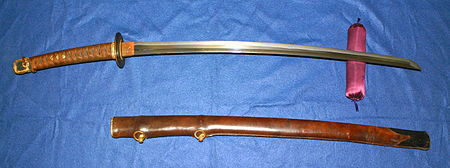
In the “Chapter 1 Timeline,” the gendai-to (現代刀) are swords made from the Meiji Restoration (明治維新1868) up to the present day.  It has been about 150 years since the Meiji Restoration.  Although all swords made after the Meiji Restoration are grouped under the gendai-to, there are many differences in quality and style.  One notably different type is the gun-to (軍刀).  These are military swords forged during World War I and World War II.  Some of them have a saber-like handle.  With a few exceptions, these were made without using traditional sword-making techniques of heating and folding.  Among the gendai-to, gun-to are usually considered less valuable.  The guns-to-swords made around and during World War II are called Showa-to.  It often has a brown leather scabbard.  Gun-to is not a part of the study of the Japanese sword.

*Refer to” https://en.wikipedia.org/wiki/Gunt%C5%8D”  for the Japanese military sword.

                                Gun-to    From Wikimedia Commons, the free media repository

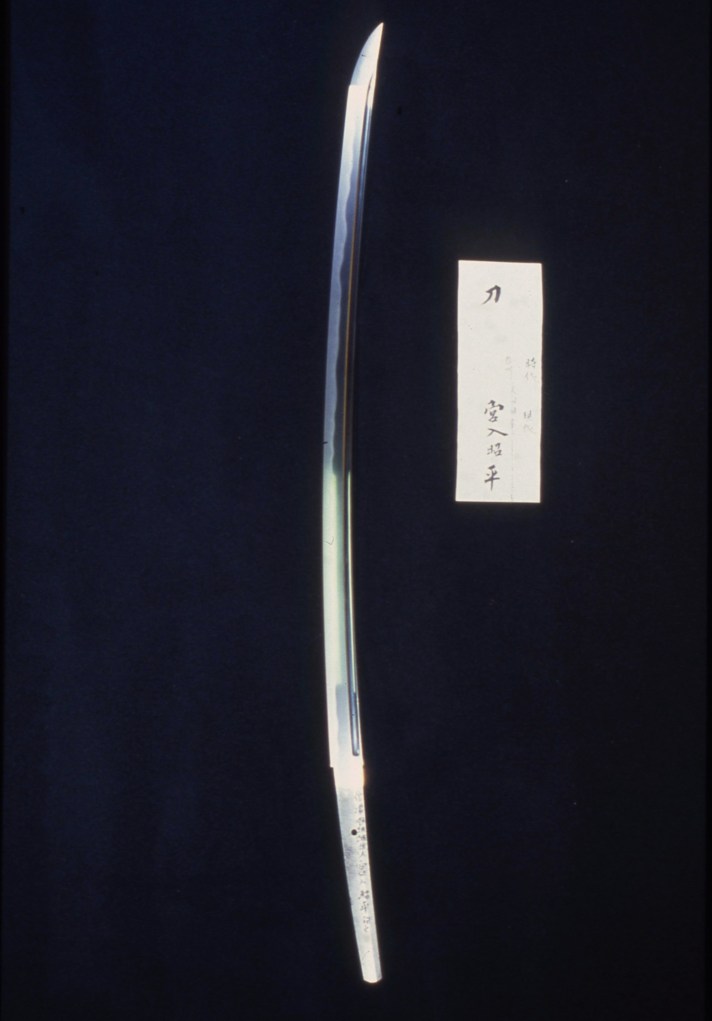
At the time of the Meiji Restoration (明治維新), swords called Meiji-ishin-to (明治維新刀) or Kin’no-to (勤王刀) were made.  These swords were owned by famous historical figures such as Saigo Takamori (西郷隆盛) and Sakamoto Ryoma (坂本龍馬).  They are important historical figures who advanced the Meiji Restoration.  These swords are long, with some almost 3 feet long, and have no curvature.

Today, many famous swordsmiths are making excellent swords.  Some are recognized as living national treasures.  Gendai-to refers to swords made after the Meiji Restoration to the present, but keep in mind that there is a wide range of differences in quality, type, and purpose among them.

36img077

                       Sword forged by a Living National Treasure, Mr. Miyairi Shohei (宮入昭平)                         owned by my brother