19 | Nanboku-Cho Period Tanto(南北朝短刀)

0-timeline - size 24 Nanboku-cho
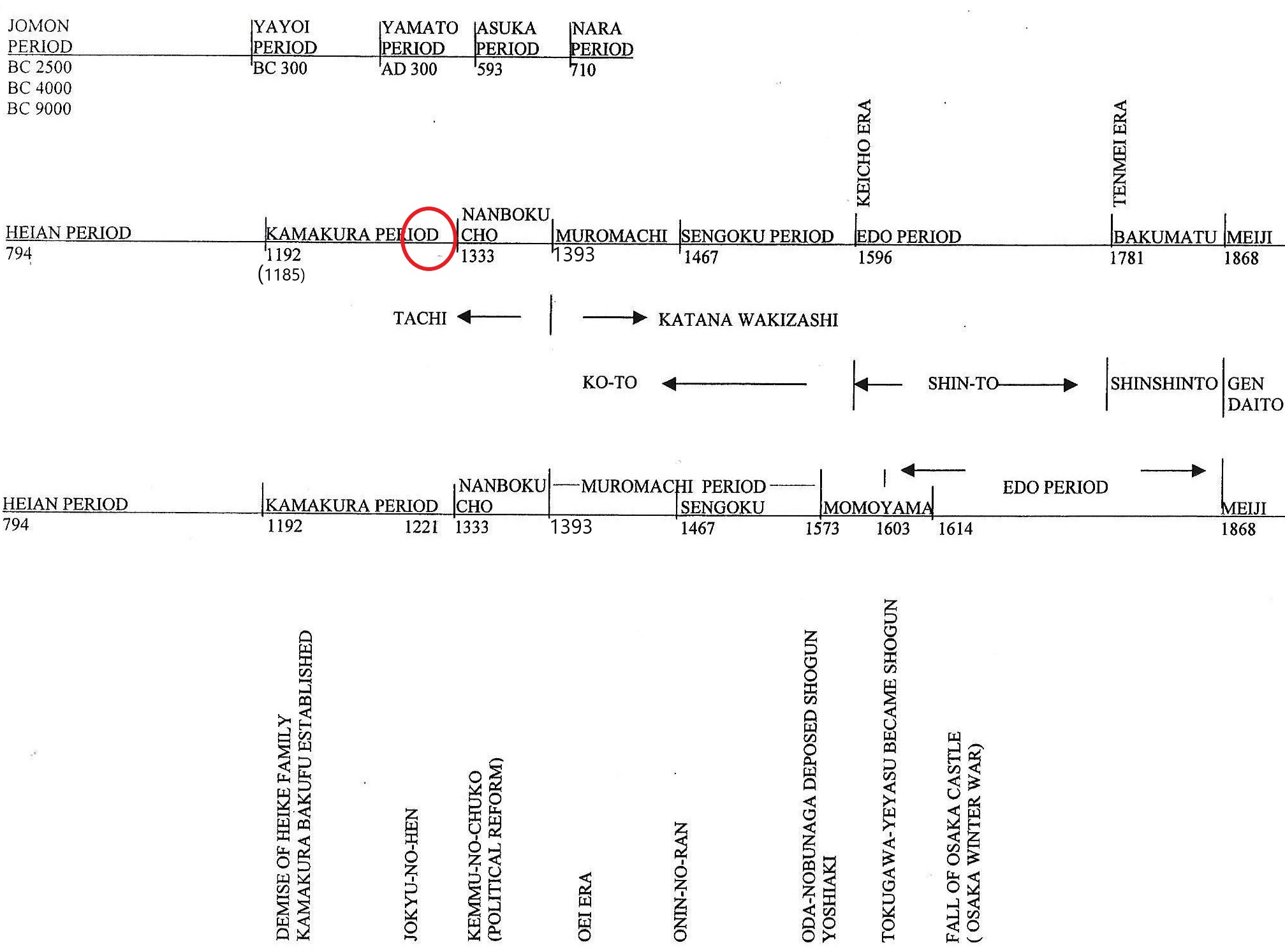
The circle indicates the time we discuss in this section

During the Nanboku-cho period, a type of tanto called hirazukuri ko-wakizashi sun-nobi tanto was made.  Hirazukuri means flat swords without the yokote line or shinogi.  Ko-wakizashi refers to a shorter sword.  Sun-nobi tanto means longer than a standard tanto.  This type is also known as Enbun Jyoji ko-wakizashi tanto because most of these tantos were created during the Enbun and Jyoji eras of the imperial period.  In Japan, a new imperial era begins when a new emperor ascends to the throne.  The Enbun era spanned 1356-1361, while the Jyoji period spanned 1362-1368.

20 Enbun Jyoji Kowakizashi Tanto

Sugata (姿: shape) ————A standard tanto measure is approximately one shaku.  Shaku is an old Japanese unit of measurement for length, and one shaku is roughly equal to one foot.  

8.5 sun (the sun is another old Japanese measurement unit of length) is approximately ten inches.  Ten inches is the standard size for a tanto, known as a josun tanto.  Anything longer than a josun tanto is called a sun-nobi tanto.  Anything shorter than a josun is called a sun-zumari tanto. 

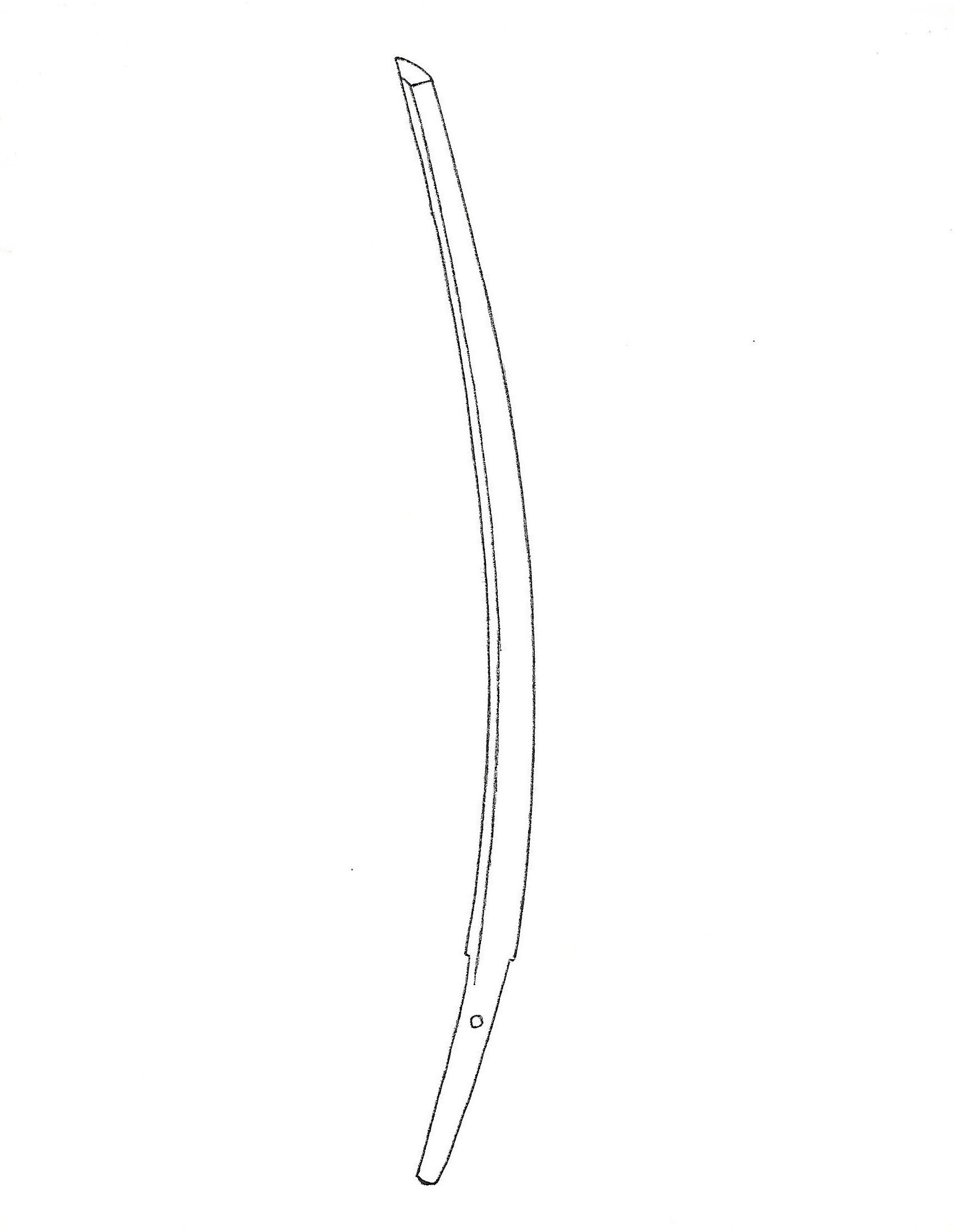
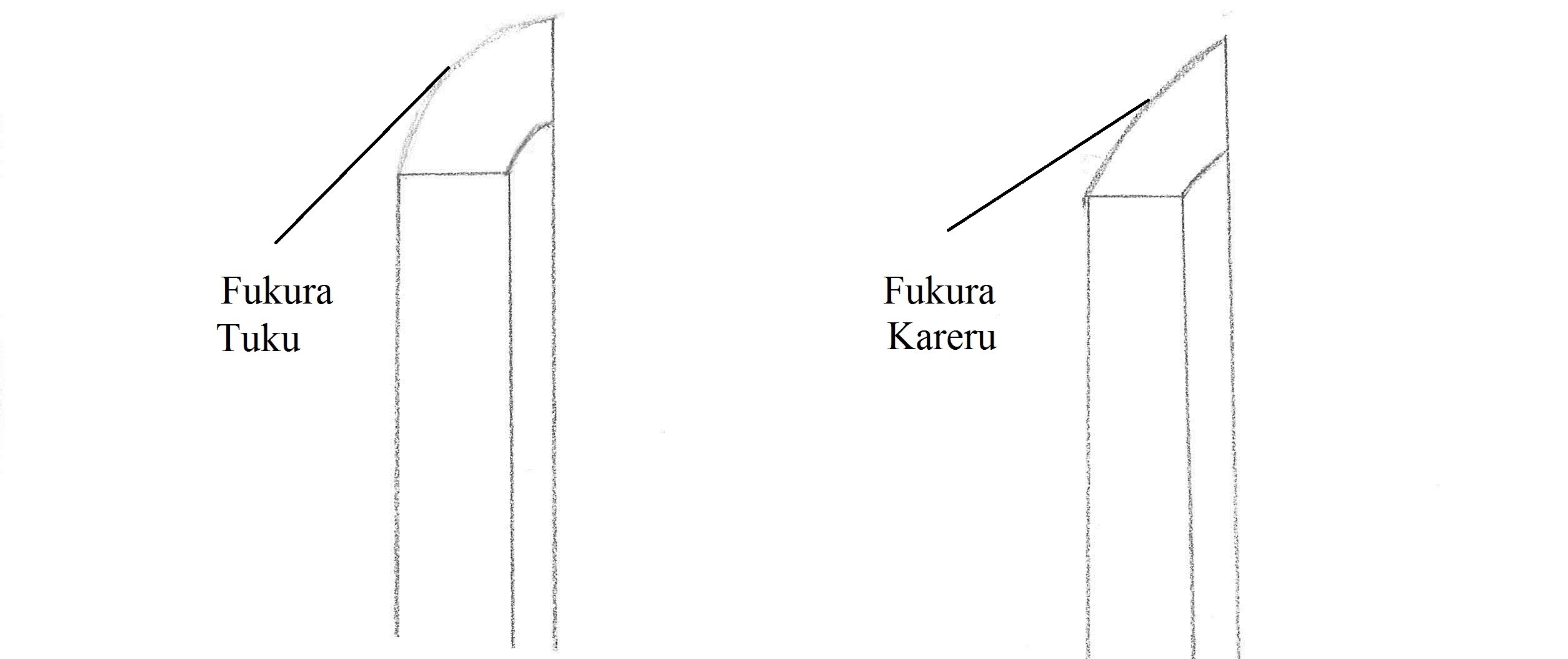
Most of the Nanboku-cho tantos are longer than a josun tanto, approximately one foot two inches.  Therefore, they are called hirazukuri ko-wakizashi sun-nobi tantoSaki-zori (curved outward at the top.  See the illustration above).   Wide in width and thin in body.  Fukura kareru (no fukura means less arc).  Shin-no-mune.  See the drawing below.
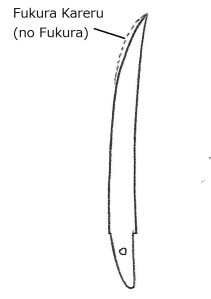
20 Fukura           20 Shin-no-Mune

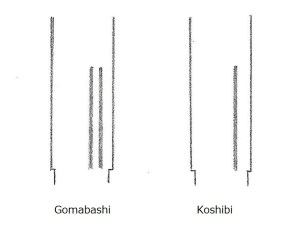
Hi, (: Grooves) and Horimono (彫り物: Engraving) ——- A groove or grooves on the mune side.  Bonji (Sanskrit, see Chapter 16 Late Kamakura Period (Early Soshu-Den Tanto),  koshi-bi (short groove),  tumetuki ken, and tokko-tsuki ken (see below) appear. The ken (dagger) is curved widely and deeply in the upper part and shallower and narrower in the lower part.  This is called Soshu-bori (Soshu-style carving).
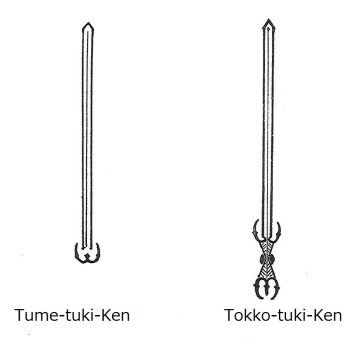
20 Tokko, tume Ken

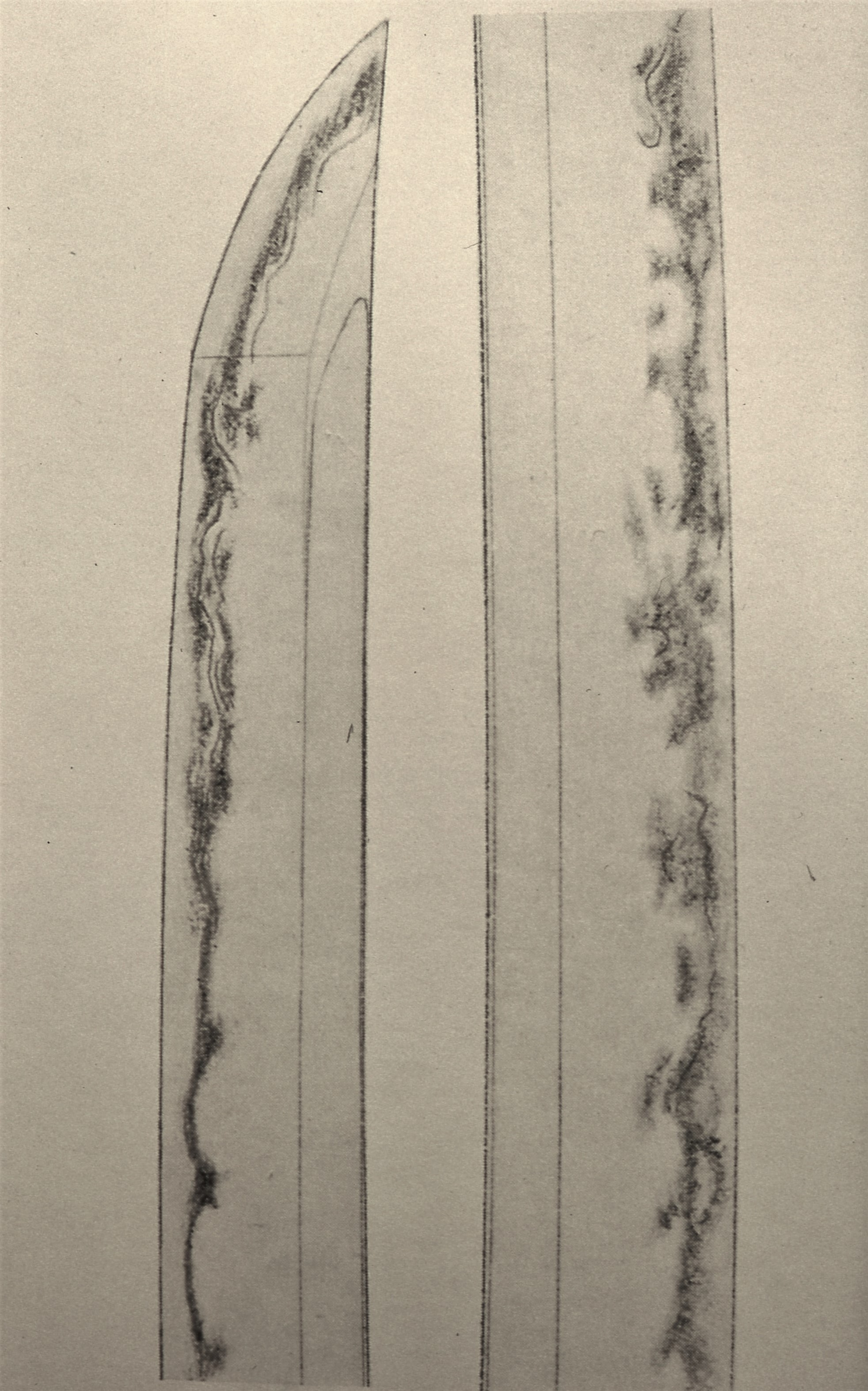
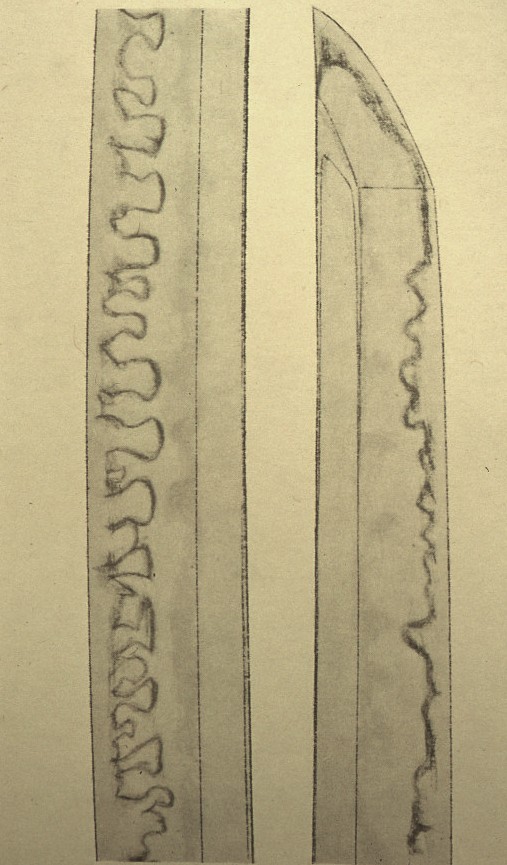
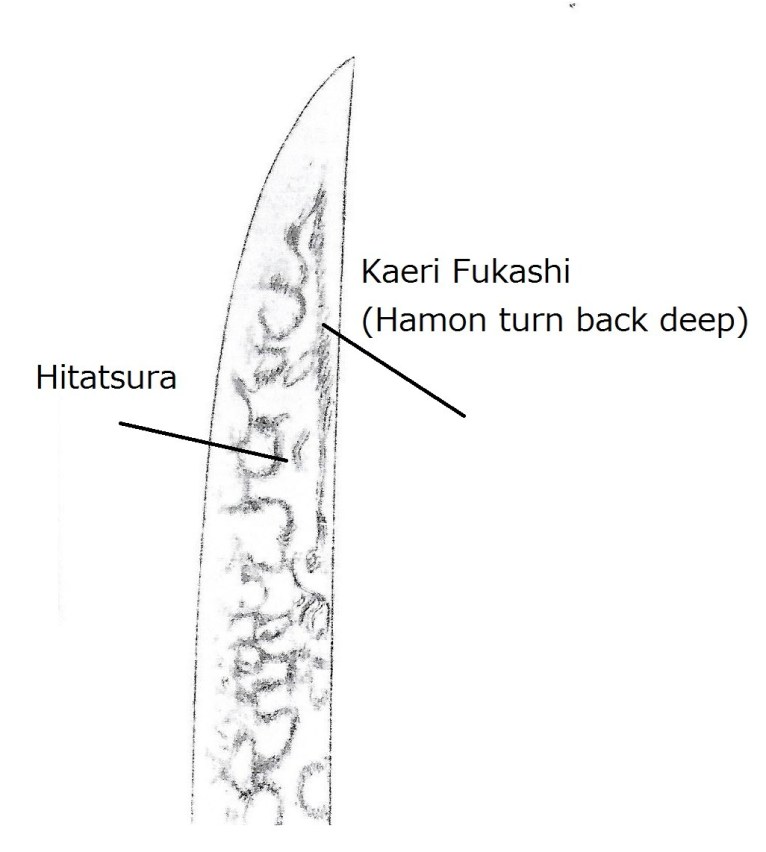
Hamon (: Tempered line) ——- The narrowly tempered section at the lower part gradually widens toward the top.  A similar wide hamon pattern extends into the boshi area.  The hamon in the kissaki area is kaeri-fukashi (deep turn back).  See the illustration below.  Coarse nie.  O-midare (large irregular hamon pattern).

20 Hitatsura

                                        From Sano Museum Catalogue

Ji-hada (地肌: the area between shinogi-ji and the tempered line) ——– a loose wood grain pattern called itame.  Yubashiri (see Chapter 16, Late Kamakura Period) and tobiyaki (irregular patchy tempered spots) appear.  Dense tobiyaki is called hitatsura (see the drawing above).

Nakago (: Tang) —- Short tanago-bara.  Tanago-bara refers to the shape of the belly of a Japanese fish called tanago (bitterling).

20 Tanago Bara

Tanto Swordsmiths during the Nanboku-Cho Period

Soshu Den ———————————————————-Hiromitu( 広光) Akihiro (秋広) Yamashiro Den ————————————————–Hasebe Kunishige (長谷部国重)   Bizen Den ——————————————————— Kanemitu (兼光) Chogi (長義 )
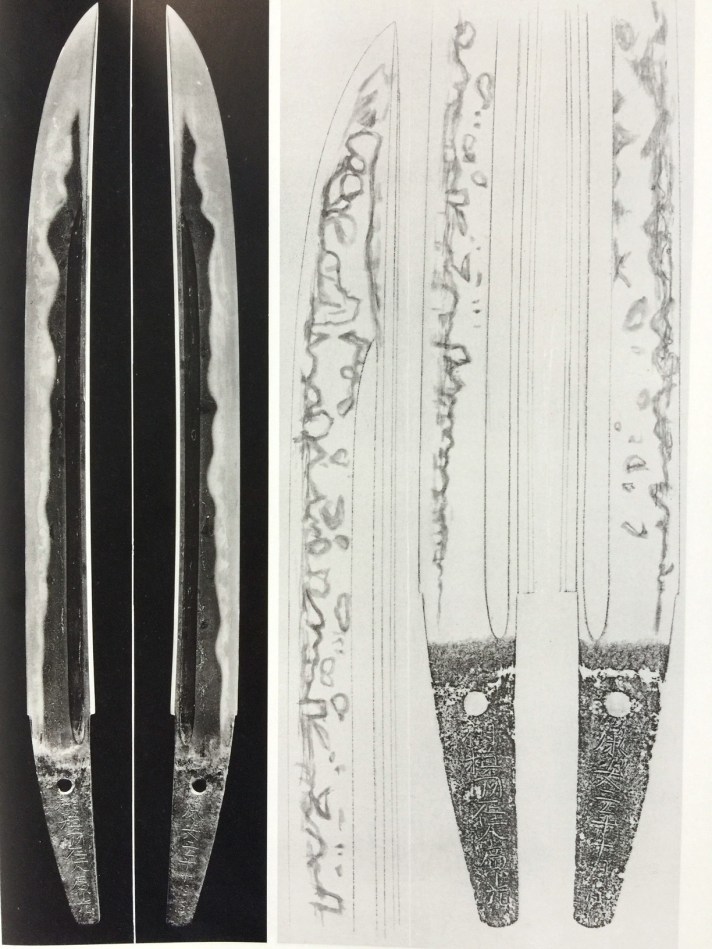
    Soshu Hiromitsu     “Nippon-To Art Sword of Japan “   The Walter A. Compton Collection

18| Nanboku-Cho Period Sword (南北朝太刀)

0-timeline - size 24 Nanboku-cho

                           The circle indicates the time we discuss in this section

During the Nanboku-cho period, samurai sought large, elaborate, impressive, yet practical swords.  The Soshu-den style sword from Nanboku-cho time was just that.    This was the most popular style at the time.  The Nanboku-cho period marked the peak and height of the Soshu-den sword.  Many swordsmiths moved from other provinces to the Kamakura area and forged Soshu-den style swords.  Other schools and provinces outside the Kamakura area also produced Soshu-den-style swords in their own areas.


19 Nanboku-cho Sword style

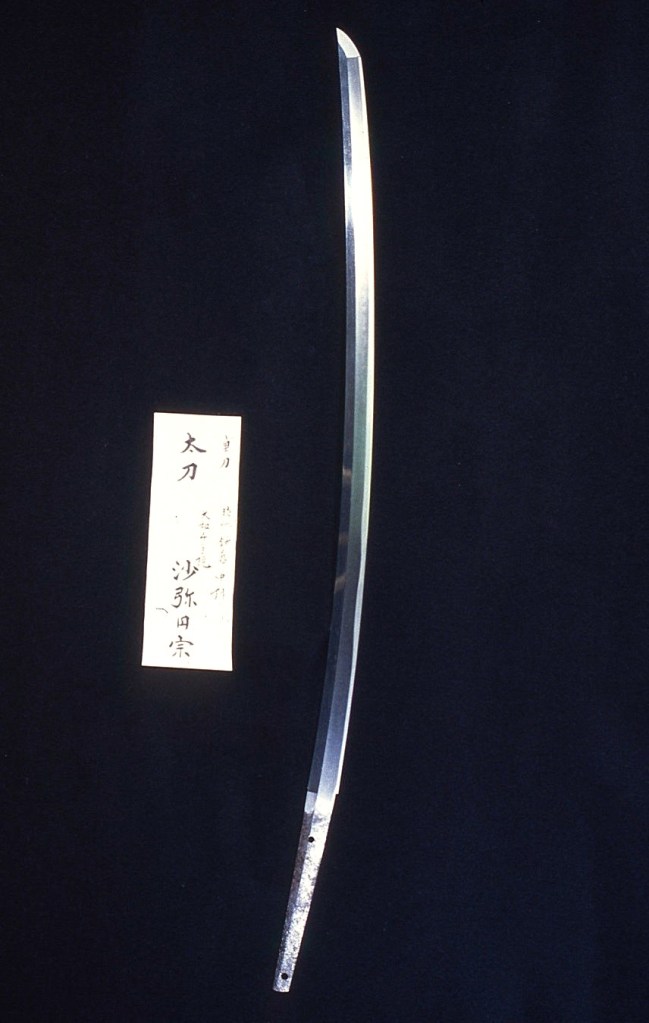
Sugata (姿: Shape) —————–The original length of a sword ranged from three to five feet, but it was later shortened to about two and a half feet.  A significantly shortened blade is called o-suriage. 

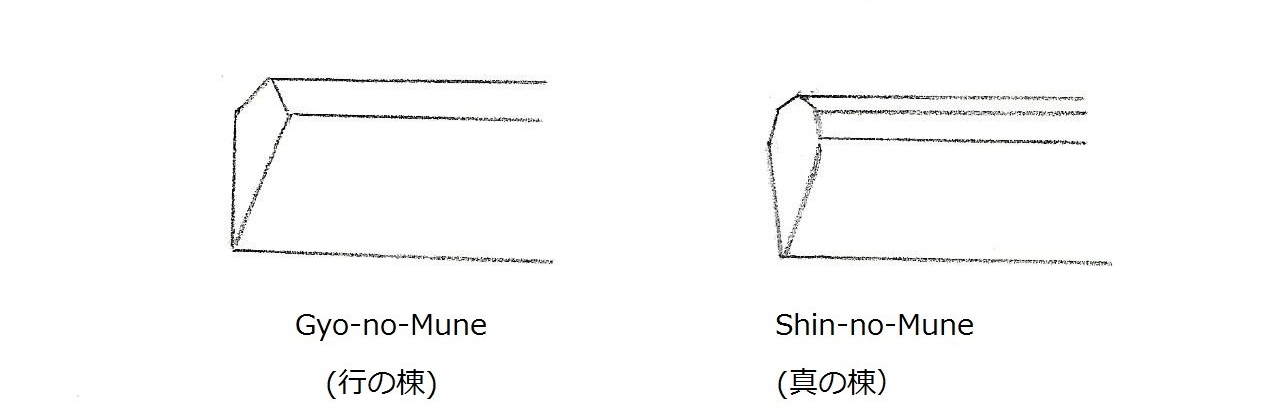
The Nanboku-cho style sword features shallow kyo-zori (also called torii-zori).  Refer to Chapter 5, Heian Period Sword.  The highest curvature occurs around the middle of the body. It has a wide body, high shinogi, narrow shinogi-ji  (Chapter 3, Names of parts),  and thin kasane (blade thickness), which are distinctive features of the Nanboku-cho style.  High gyo-no-mune or shin-no-mune, and sometimes a maru-mune (round back).

19 Nanboku-cho 3 kinds Mune

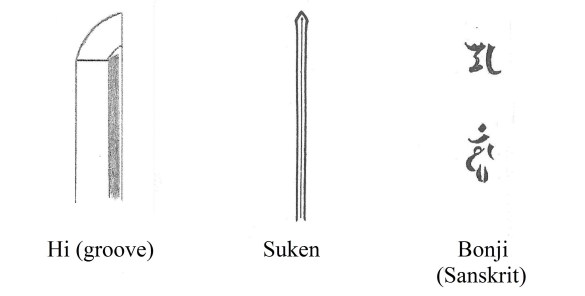
Hi (: groove) and Horimono (彫刻: engraving) ——– Often, a single hi (bo-hi), double hi, suken (dagger), Bonji (Sanskrit), and/or dragon are engraved on the shinogi-ji area.  Refer to Chapter 3, Names of Parts.

9 Hi, Suken, Bonji

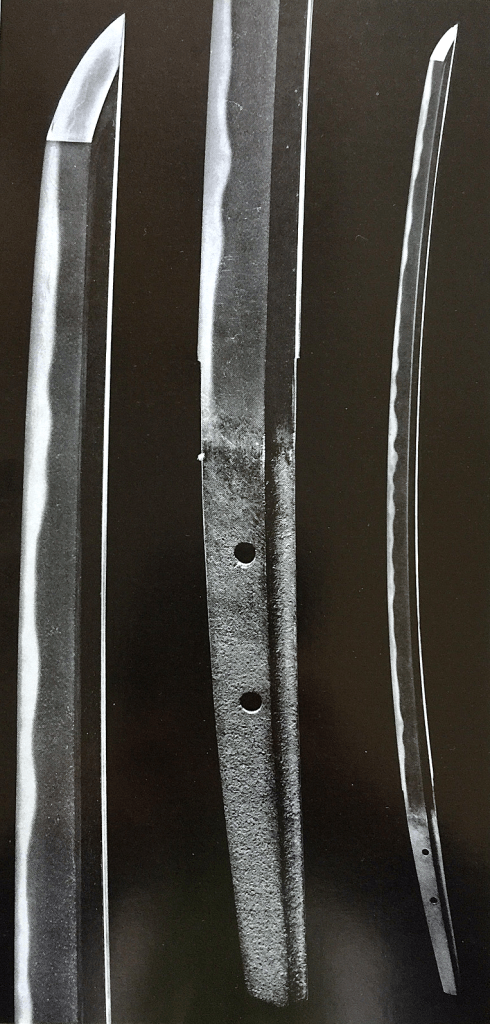
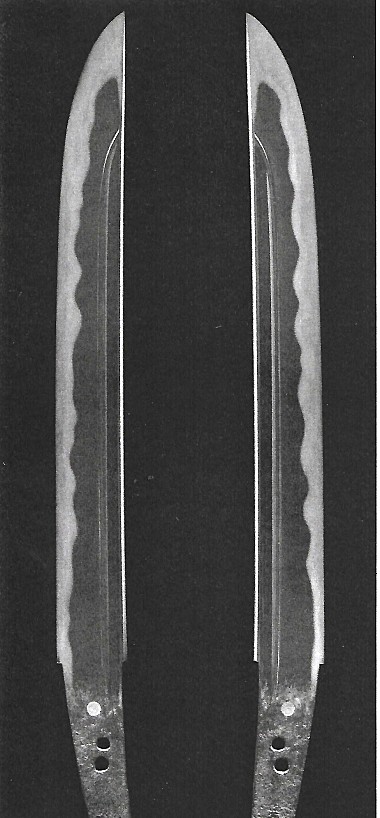
Hamon (: Tempered line) —- The lower part of the body exhibits a narrow-tempered line; gradually, this line becomes wider and showier.  Course nie. O-midare (large, irregular, wavy hamon), Notare-midare (wavy, irregular hamon), and Gunome-midare (a combination of repeated half-circular and irregular hamon). Inazuma and kinsuji (see Chapter 14, Late Kamakura Period Sword) sometimes appear.

19 Hamon Notare 319 Mamon choji gunome19 Hitatsura Hamon Hiromitsu

                                  *From Sano Museum Catalogue ( Permission granted).

Ji-hada (地肌: the area between the shinogi and the tempered line) ———————-Wood-grain pattern (itame 板目). Sometimes tobiyaki (patchy tempered spots) appear on ji-hada.  For ji-hada, refer to Chapter 3, Names of Parts.

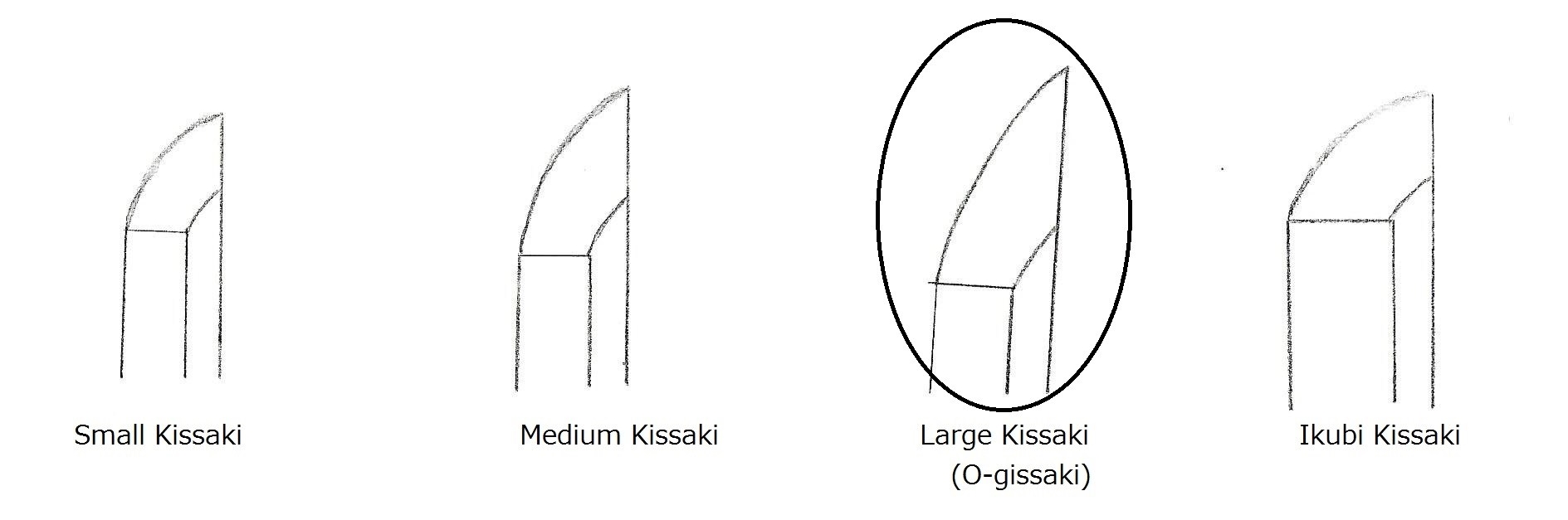
Kissaki (切っ先) and Boshi (tempered line at the kissaki area) ———- O-kissaki (long and large kissaki). Fukura kareru (less arc kissaki).  Midare-komi (the body and boshi have a similar tempered pattern), with kaeri-fukashi (hamon deeply turns back), and sometimes hitatsura (entirely tempered).  See the illustration above.

Sword-smiths during Nanboku-Cho Period Soshu Den (school)

  • From Soshu—————————————————Hiromitsu (広光)  Akihiro (秋広)  
  • From Yamashiro ———————————————Hasebe Kunishige (長谷部国重) 
  • From Bizen (called So-den Bizen)——-Chogi (長儀 )group  Kanemitsu (兼光 ) group 
  • From Chikuzen ———————————————————-Samoji (左文字 ) group

Chogi (長義)from The Sano Museum catalog. Permission to use is granted

The distinctive characteristics of the Nanboku-Cho period sword in the photo above      

  • The trace of an engraving of suken on the inside of the nakago indicates that this area was once a part of the main body.
  • Large and long kissaki

17| Nanboku-cho Period History 1333-1392(南北朝歴史)

0-timeline - size 24 Nanboku-cho

            The red circle above indicates the time we discuss in this section.

After Jokyu-no-ran (Chapter 10 Jokyu-no-ran), the power of the Imperial Court declined significantly.  The successor, the Hojo clan, which was a dominant force during the Kamakura period, also began to face financial difficulties and began to lose control over regional lords.  One reason was the costs incurred by the Mongol invasion.  The Kamakura bakufu (government) could not adequately reward the samurai who fought hard during the war.  As a result, they became very dissatisfied with the bakufu.  Seeing this as an opportunity, Emperor Go-Daigo attempted to attack the Kamakura bakufu twice but failed both times.  He was exiled to Oki Island.  In the meantime, Ashikaga Takauji (足利尊氏) and several groups of anti-Kamakura samurai gathered armed forces and succeeded in destroying the Kamakura bakufu in 1333.  This war ended the Kamakura period.                                                                                                                                                  

Emperor Go-Daigo, who had been exiled to Oki Island, returned to Kyoto and attempted political reforms.  This reform was known as Kenmu-no-chuko (or Kenmu-no-shinsei, 建武の中興).  However, his reforms failed to satisfy most of the ruling class.  Seeing an opportunity, Ashikaga Takauji attacked the Imperial Court in Kyoto, deposed Emperor Go-Daigo, and installed a member of a different branch of the Imperial family as emperor. 

Emperor Go-Daigo, however, insisted on his legitimacy, moved to Yoshino in the south of Kyoto, and established another Imperial court.  Thus, the Northern and  Southern Dynasties began.  With much strife between these rival courts and internal problems within each court,  more samurai groups began to move to the Northern Dynasty.  About sixty years later, the Southern Dynasty was forced to accept the Northern Dynasty’s proposal.  Consequently, the Northern Dynasty became the legitimate imperial court.  This sixty-year period is referred to as the Nanboku-cho or Yoshino-cho period. 

During the Nanboku-cho period, samurai preferred longer, more elaborate, yet practical swords.  The Soshu-den was at the height of its prominence.  However, the Soshu group was not the only one to produce Soshu-den-style swords.  Other schools and provinces in different areas also made Soshu-den-style swords.

Late Kamakura Period Swordsmiths (Early Soshu-Den time)

  • Tosaburo Yukimitsu (藤三郎行光)  
  • Goro Nyudo Masamune (五郎入道正宗)     
  • Hikoshiro Sadamune (彦四郎貞宗)

 17 Masamune hamon (Sano)             Masamune from Sano Museum Catalog (permission granted)
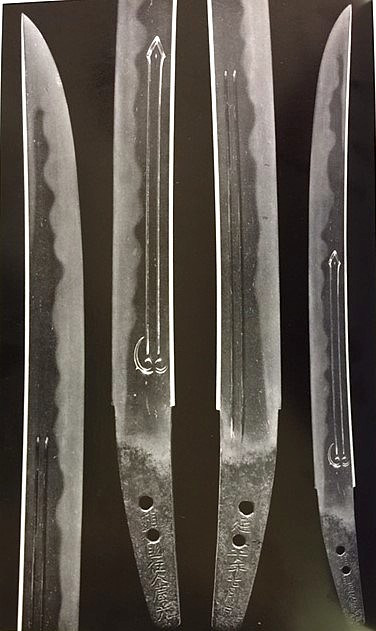
Nanboku-cho Period Swordsmiths  (Middle Soshu-Den time)

  • Hiromitsu (広光)   
  • Akihiro (秋広)

 20 Hitatsura Hiromitsu Hitatura )                  Hiromitsu from Sano Museum Catalog (permission granted)
Muromachi Period Swordsmiths (Late Soshu-Den time)

  • Hiromasa (広正)    
  • Masahiro (正広)

16| Late Kamakura period: Soshu Den Tanto (相州伝短刀)

0-timeline - size 24 Late KamakuraThe red circle above indicates the time we discuss in this section

17 Soshu Tanto

Sugata (Style 姿)—-Three types of Tanto appeared (as below)

  1. Takenoko-Zori —– Approximately 10 inches long.  However, during the middle Kamakura period, they were slightly longer than 10 inches.  Hirazukuri shape.  The width is a little wider than that of the mid-Kamakura period.  Refer Chapter 12|  Middle Kamakura Period: Tanto (Dagger: 鎌倉中期短刀) (dagger, knife).
  2. Chukan-Zori—–Mune side is straight.  Hirazukuri.  Wide mihaba (width).  Slightly thick body.  Fukura Kareru, see below.
  3. Saki-Zori —–bend outward at the top, hirazukuri, fukura kareru. (illustration below)

16 Three Tanto

9 Boshi Fukura

Hi (: Grooves) and Horimono (彫り物: Engravings)————-Often, hi (groove) is shown on the mune side.  Sometimes, ken (dagger) and Bonji (Sanskrit) are curved inside the wide hi.  Refer to Chapter 12, Middle Kamakura Period: Tanto,  for hi.

17 Bonji Suken          17 Gomabashi Hi

Hamon (刃文: tempered line) ————- Hamon closely resembles that of the Late Kamakura period.  Refer to Chapter 14, Late Kamakura Period Sword.   Some tanto may have a wide hamon, while others may have a narrow one.  Often, a narrow hamon appears at the lower part,  followed by a wider hamon at the top.  The hamon work around the fukura area is the widest and most showy.

15 Late Kamakura Soshu Hamon         17 Masamune Hamon


 Ji-hada (地肌: the area between hamon and shinogi)  ——-Ji-hada is excellent, showing a lot of ji-nie (nie work on ji-hada).  Yubashiri and chikei  (clusters of nie) are shown.

17 Yubashiri, Chikei

Yubashiri, Chikei both are created by the collection of Nie

Early Soshu Den (school) swordsmiths at the late Kamakura Period

Soshu den (school) —————–Yukimitsu (行光), Masamune (正宗), Sadamune (貞宗)  Yamashiro Den (school)———————-Rai Kunitsugu (来国次), Rai Kunimitsu (来国光) Yamato Den (shool) —————————————————-Taema Kuniyuki (当麻国行) Ettchu Province ———————————————————-Ettsu Norishige (越中則重) Chikuzen province—————————————————Chikuzen Samoji (筑前左文字)

                                                                Enju Kuniyoshi (延寿国吉) once family sword


                         Goro-Nyudo Masamune (Sano Museum catalog permission granted)  This Tanto shape is rare for Masamune.

15| The Revival of Yamato Den(大和伝復活)

0-timeline - size 24 Late Kamakura

        The red circle above indicates the time we discuss in this section
It is believed that sword-making first started in Yamato province (now Nara Prefecture) during the Nara period (710 to 794).  In the early days of sword-making, the forging techniques were primitive.  At that time, many swordsmiths lived in Yamato, but over time, sword-making in this region declined.

At the end of the Kamakura period, several powerful Buddhist temples emerged in the Yamato area, leading to conflicts among them.  Temples held significant political and military power to control large territories called shoen (荘園) through their large numbers of warrior monks, known as sohei (僧兵).  The most dominant group was Nanto Sohei (南都僧兵)*.  These groups of sohei demanded more swords to arm themselves, which revitalized the Yamato-den (school) and increased the number of swordsmiths in the Yamato area.   As a result, the Yamato-den group became active again.  The Yamato-den style is somewhat similar to the Yamashiro-den.    

*Nanto Sohei (南都僧兵)—————-Since around the 11th century, Buddhist temples grew powerful under the protection of the Joko (retired emperors).  These temples had many sohei (low-level monks who also served as soldiers). When power struggles arose among the temples, sohei fought as their soldiers on the battlefields.  Nanto Sohei were such soldiers at Kofuku-Ji Temple (興福寺).  Several large temples, such as Todai-ji (東大寺) Temple, controlled the Yamato area.

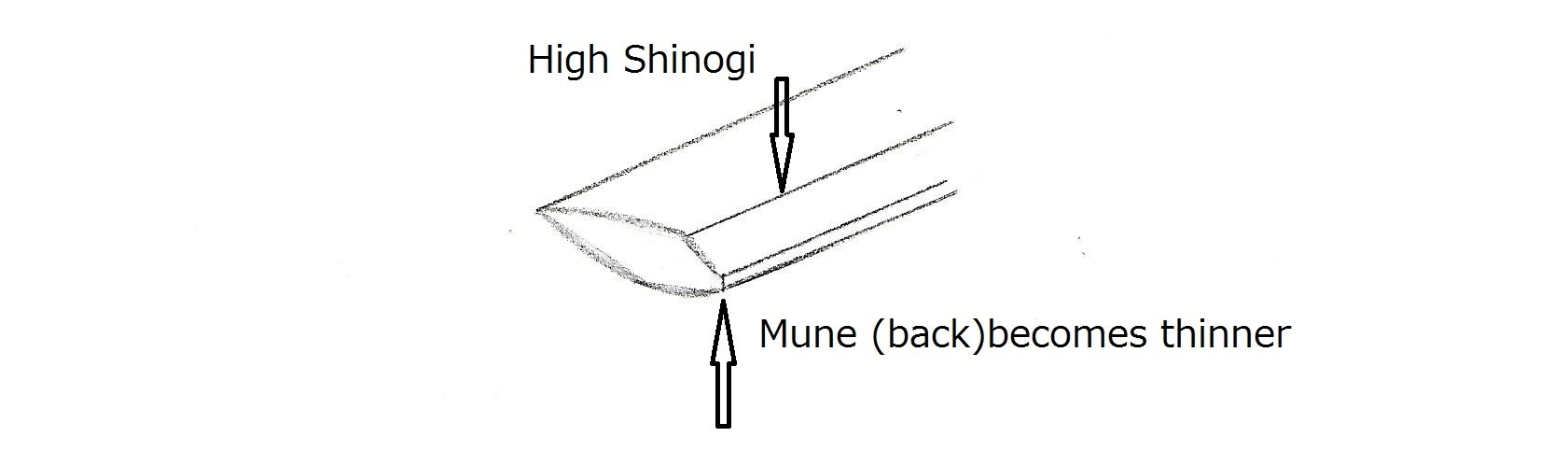
Sugata (姿: Shape) —————- Not much difference in style during the early part of Yamatoden and Yamashiro-den.  Shinogi is high.  Mune is thin.   Some Yamato-den have a shallow sori (curvature).

16 Yamato sword cross section

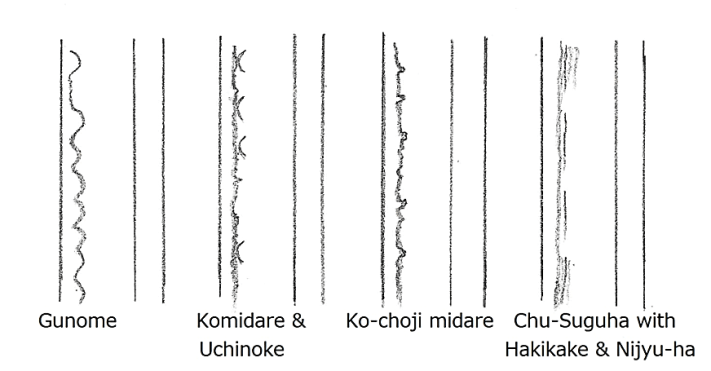
Hamon (刃文Tempered line) ——————Narrow tempered line.  Mainly nie (沸).  Chu-suguha-hotsure (中直刃ほつれ: a medium straight line with a frayed pattern), ko-choji-midare (小丁子: a mixture of small clove-like patterns and irregular wavy lines), ko-midare (小乱: small irregular wavy lines), ko-gunome-komidare (小五の目小乱: small continuous half-circles mixed with wavy lines). 

The main features of the Yamatoden style sword are masame (straight grain).  Its tempered line often shows nijyu-ha (double straight lines), hakikake (brush mark trace), uchinoke (a crescent-shaped line), or a combination of these.   See the illustration below.


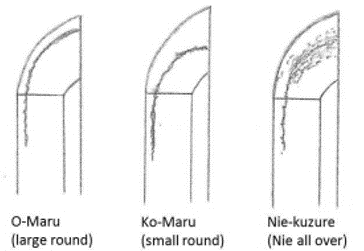
Boshi (鋩子: Tempered line at Kissaki area) ———- In the boshi area, a straight grain hamon pattern appears.  Yakizume or kaen. (Refer to Chapter 12, Middle Kamakura period: Tanto).  O-maru, ko-maru, nie-kuzure.  (Refer to Chapter 14, Late Kamakura Period Sword.  See the illustration below.)


15 Omaru Komaru Niekuzure

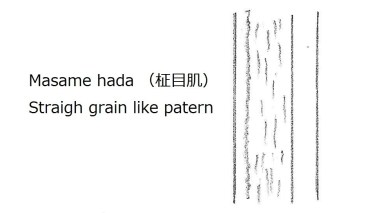
Ji-hada (地肌):Area between the shinogi and the tempered line)———— mostly masame-hada (straight grain pattern 柾目肌). Fine ji-nie, chikei, or yubashiri.  (Refer to Chapter 14, Late Kamakura Period Sword (鎌倉末太刀).  See below.)

16 Masame Hada

Nakago (Hilt) ———————– Often displays Higaki Yasuri (檜垣), the finishing file pattern, as illustrated below. 

16 Higaki Yasuri

Names of the Yamato School Sword-smiths

Taema(当麻) Group————–Taema Kuniyuki(当麻国行) Taema Tomokiyo(当麻友清) Shikkake (尻懸) Group———————————————-Shikkake Norinaga (尻懸則長) Tegai (手掻) group ——————Tegai Kanenaga (手掻包永) Tegai Kanekiyo(手掻包清) Hoshou (保昌) group———Hosho Sadayoshi ( 保昌貞吉) Hosho Sadamune (保昌貞宗)

Yamato Senjuin Saya Enso (大和千手院沙弥円宗)  once my family sword

14| Late Kamakura Period Sword (鎌倉末太刀)

0-timeline - size 24 Late Kamakura

The red circle above indicates the time we discuss in this section

The beginning of the Soshu style

A new sword style called Soshu-den appeared after the Mongolian invasion during the later part of the Kamakura period.  The Kamakura region became prosperous under the rule of the Hojo family (北条).  Many swordsmiths moved to Kamakura.  These included the Kunitsuna group (国綱)  from the Yamashiro area and Fukuoka Ichimonji Sukezane (福岡一文字助真) and Kunimune (国宗) from the Bizen area.  They are the originators of Soshu-den (相州伝).  A well-known swordsmith, Goro-Nyudo-Masamune (五郎入道正宗), emerged during this time.

15 Soshu sword with explanation

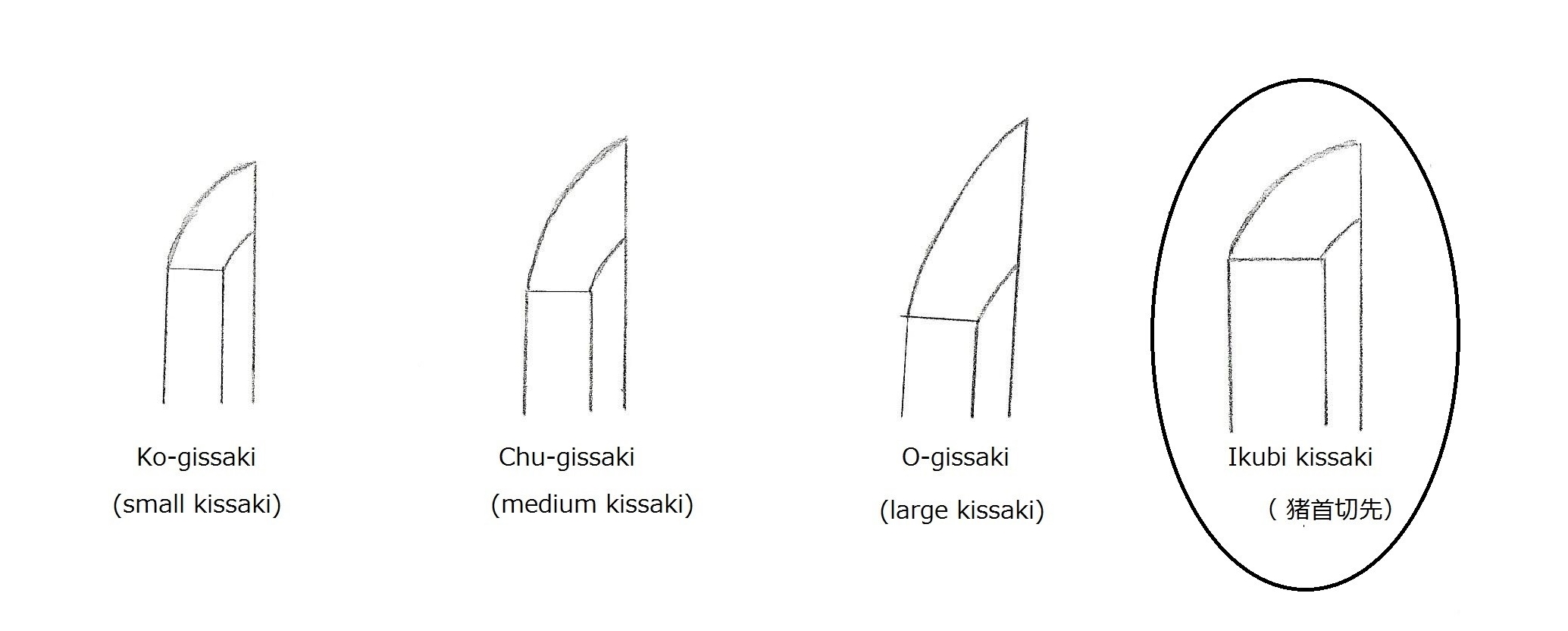
Sugata (Shape 姿) ——- Okissaki (large kissaki: 大切先) and chu-kissaki (medium kissaki: 中切先).   The tip of the hi ends lower (see the illustration below).  Hamaguriha is no longer in style.  The body has become thinner.  The original length was approximately three feet or longer, but most were later shortened to two feet, three inches, or four inches.  The shortened sword is called o-suriage (大磨上).

15 Kissak shape of 4

14 Hi end lower

Hamon——————–Narrow Hamon and wide Hamon.     

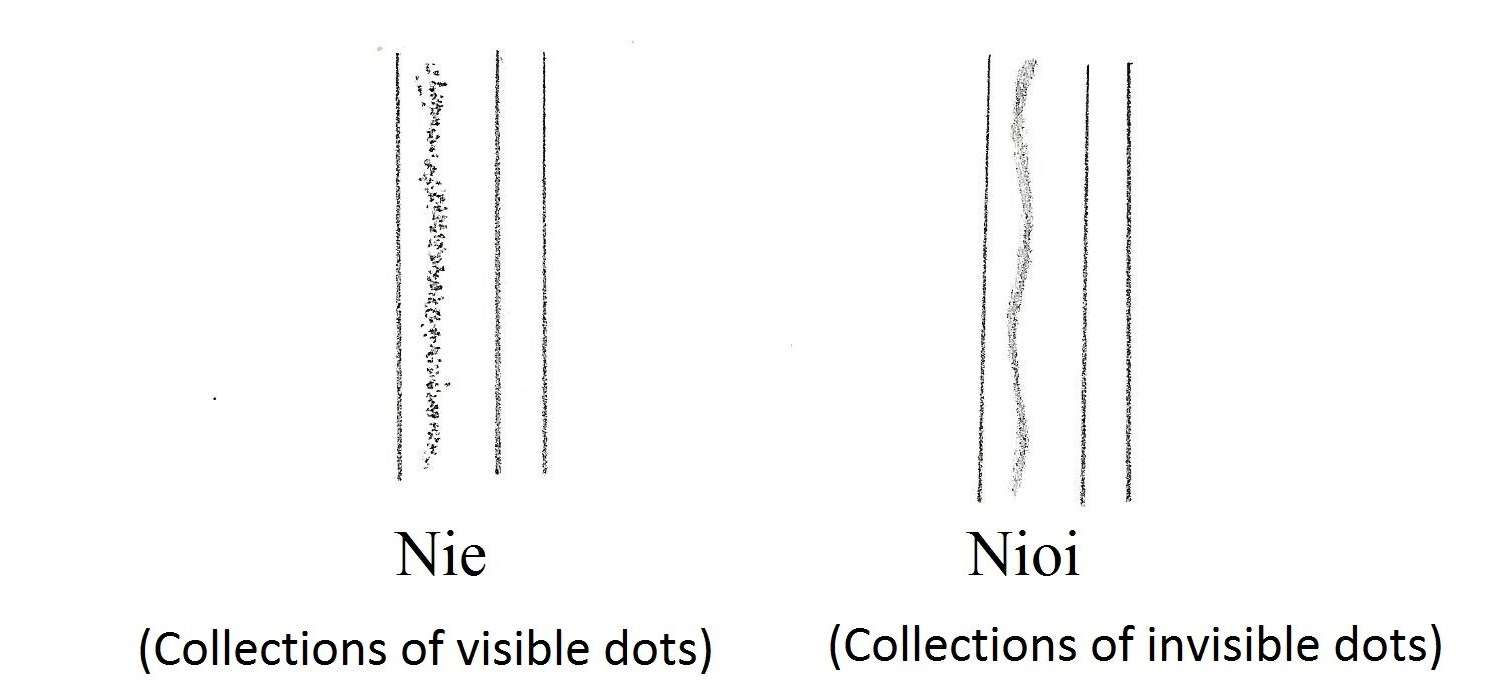
Narrow Hamon ——- A mix of Suguha (straight),  Ko-choji (small clove-like pattern), and Ko-gunome (small half-circle pattern).  Small Nie base. (shown below)

10 Nie & Nioi

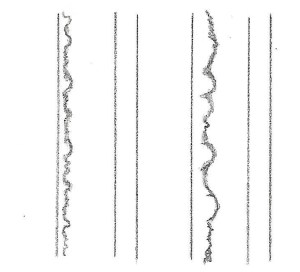
Wide Hamon ——– Notare midare (wavy).  O-gunome.  Nie base.  Ashi-iri (short line toward the blade, the right drawing below). Inazuma (lightning-like line) or kinsuji (bright line) may appear on a tempered line.  However, inazuma and kinsuji require trained eyes to detect.  It is difficult for beginners to see inazuma or kinsuji.  

15 Late Kamakura Soshu Hamon

Boshi————The main body and boshi have the same type of hamon.  At the tip of the kissaki, angle it back slightly or yakizume.  You might also see o-maru (large round), ko-maru (small round), kaen (flame-like), or nie-kuzureYakizume and kaen (Chapter 12).

15 three boshi name

Ji-hada (between the shinogi and the tempered line) ——-Strong ji-nie (地沸), which are sand-like small dots appearing on the ji (between the tempered line and the mune).  Yubashiri (a cluster of ji-nie), kinsuji (a bright, radiant line formed by nie), inazuma (a lightning-like irregular line), or chikei (similar to kinsuji) may appear on the ji-hada.

15 Yubashiri, Chikei, Inazuma

Late Kamakura Period Soshu School Sword Smiths

From Bizen————–Fukuoka Ichimonji Sukezane (福岡一文字助真) Kunimune (国宗 )   From Yamashiro ————————————–Toroku- Sakon- Kunituna (藤六左近国綱) 

The three swordsmiths mentioned above originated the Soshu-den (school) in Kamakura.  Later, Tosaburo Yukimitu and his son, the famous Goro Nyudo Masamune, emerged.

More  Soshu Den swordsmiths other than above

From Yamashiro (山城)———- Rai Kunitsugu (来国次), Hasebe Kunishige (長谷部国重) From Etchu (越中) province ———————Gou- no-Yoshihiro (郷義弘) Norishige (則重) From   Mino (美濃) province ——————————————-Kaneuji (兼氏) Kinjyu (金重) From   Chikuzen (筑前) province —————————————————-Samoji (左文字)

Goro Nyudo Masamune (正宗): his hamon is like ocean waves. (Sano Museum permission granted)        

Masamune  (政宗)                                          Yoshioka Ichimonji (吉岡一文字)

Once owned by my family


13| Late Kamakura Period: Genko (鎌倉末元寇)

0-timeline - size 24 Late Kamakura

                       The circle represents the time we discuss in this section
GENKO 元寇  (1274 and 1281)

Kublai Khan, the grandson of Genghis Khan, attempted to invade Japan twice, in 1274 and 1281.  Both times, a powerful typhoon struck Japan.  The Mongols sent a large number of soldiers, along with all kinds of supplies, on numerous ships to Japan.  These ships had to stay very close to each other, side by side, front and back, within the limited offshore area of Kyushu.  When the strong winds arrived, the ships swayed, collided, and capsized.  Many people fell into the ocean, drowned, and lost supplies in the water.

Although Mongol soldiers landed and fought against the Japanese army, they had little choice but to retreat from Japan due to a typhoon and shipwrecks.   As a result of this strong wind, Japan was saved, and it seemed like Japan had won.  This was when the famous Japanese word “kamikaze” (divine wind) was created.

The Mongols had far superior weapons compared to the Japanese.  They had guns, which the Japanese did not.  Their team fighting tactics were far more effective than the Japanese’s one-on-one combat style.

After the Mongolian invasion, it became clear that the Ikubi-kissaki style sword needed to change.  When swords were used in battle, the most frequently damaged part was the kissaki.  Japanese soldiers primarily used ikubi-kissaki swords in this war.  An ikubi-kissaki tachi has a short kissaki.  When the damaged part of the kissaki is whetted out, the top part of the yakiba (tempered area) disappears, and the hi (a groove) rises too high into the boshi area (the top, triangle-like section).  The short ikubi-kissaki becomes even shorter, and the hi rises too high into the boshi area.  Aesthetically, this appears unattractive.  Functionally, it does not work well.  To fix this flaw, a new style started to emerge toward the end of the Kamakura period.

14 Ikubi kissaki Damadge

During the latter part of the Kamakura period, swordsmiths began creating a new style to address this flaw.  Additionally, pride and confidence grew among people after driving the Mongols away, which was reflected in the appearance of swords.  Generally, the hamon and the sword’s shape became stronger, more pronounced, and showier.

The Kamakura area prospered under the Hojo family’s rule.  Many swordsmiths moved to Kamakura from Bizen, Kyoto, and other regions during this time and created a new style.  This marks the beginning of the Soshuden (Soshu is the Kanagawa area today).  Many renowned swordsmiths appeared during this period.

One of the famous swordsmiths is Goro-nyudo Masamune (五郎入道正宗).  You can easily visit Masamune’s tomb in Kamakura.  It is located at Honkaku-Ji Temple, about a 5 to 6-minute walk from Kamakura train station. 

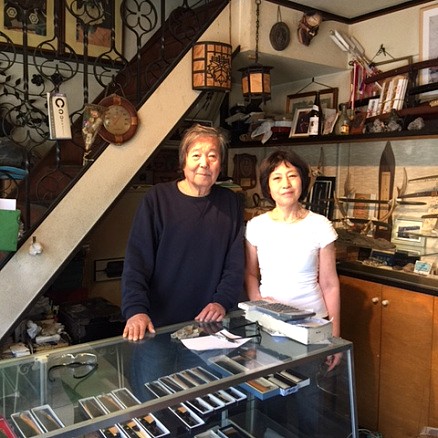
While I was attending Mori Sensei’s (teacher) sword study group, I studied with a student who is a twenty-fourth-generation descendant of Masamune.   Although he does not carry the Masamune name, he has been making excellent swords in Kamakura.  He also makes high-quality kitchen knives.  His shop is called “Masamune Kogei (正宗工芸).”  It is a short walk from Kamakura Station.  To find his shop, ask at the information center at the train station.

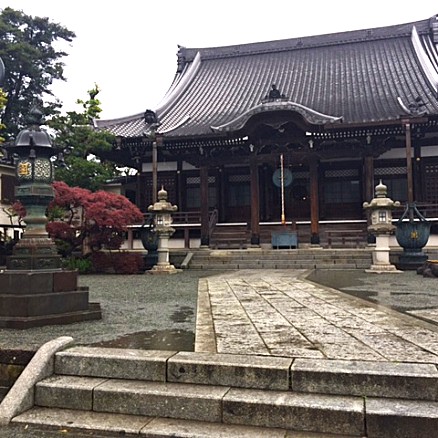
            with  Mr. Tsunahiro Yamamura                    Honkaku-Ji Temple

12| The Middle Kamakura Period: Tanto (Dagger 鎌倉中期短刀)

0-timeline - size 24 Middle Kamakura

The red circle indicates the area we discuss in this chapter 

It is rare to find a tanto (短刀 dagger) made during the Heian period.  During the middle Kamakura period, many high-quality tanto were produced.  They were called takenoko-zori shaped tanto, with “takenoko” meaning bamboo shoot.  The back of the tanto curves inward slightly.


                              Middle Kamakura Period                                                                                                      Yamashiro School Tanto

12Tanto drawing Mid Kamakur

Sugata (shape)———-Hirazukuri.  This means there is no shinogi, no yokote line.  See the illustration above.  The standard tanto length is approximately ten inches.  The width is neither too wide nor too narrow, making it well-proportioned.  The body is slightly thick.  High gyo-no-mune (行の棟) and shin-no-mune (真の棟). 

13 Mune drawing

Hamon (刃文) ——————— The tempered area is narrow.  Nie base.  Suguha-midare (a straight-line pattern with an irregular wavy shape) or suguha-choji (a straight-line pattern with small choji)The tempered edge line may display a frayed pattern.

Boshi(tempered line at Kissaki area) ———Yakizume,   Kaen,   Nie-kuzure.

13 Hamon and Hi

Engravings (彫刻) ———- Often, various types of engravings are applied to the lower part of the body.   These may include one or two grooves, Sanskrit, suken (spear), dragon, etc.  For the Sanskrit and spear, refer to the illustration in Chapter 8.

13 Hamon and Hi

Tanto Swordsmiths in the Middle Kamakura Period

Awataguchi group(粟田口)———————————Awataguchi Yoshimitu (粟田口吉光)  Rai group (来) ——————————————————————-Rai Kunitoshi(来国俊)  Soushu Group  (相州) ——————————————Shintougo Kunimitu (新藤五国光)  Bizen group (備前) —————————————————— Bizen Kagemitu (備前景光) Bungo no Kuni Group (豊後の国) ——————–Bungo-no-kuni Yukihira (豊後の国行平)

                          来国光(Rai Kunimitsu)

This Photo by an unknown author is licensed under CC BY-SA        Creative Commons Free Media  Attribution-Share Alike 3.0 Unported (CC BY-SA 3.0)


11| Ikubi Kissaki (猪首切先)

 
0-timeline - size 24 Middle Kamakura
 
The circle indicates the time we discuss in this chapter.

Through the experience of the Jokyu-no-ran war (Chapter 10), the design of the swords shifted to a wider, sturdier, and more impressive style.  The swords made around this time are called “ikubi-kissaki. “  Ikubi means a wild boar’s neck.  The kissaki area of ikubi-kissaki-style swords resembles a boar’s neck, with a somewhat stout appearance.

The middle Kamakura period was the golden age of Japanese sword-making.  Many top swordsmiths created exceptional swords during this time.  Experts agree that there are no mediocre swords among Ikubi-kissaki swords.

IkubiKissakiSword  12 Ikubi Kissaki sword style

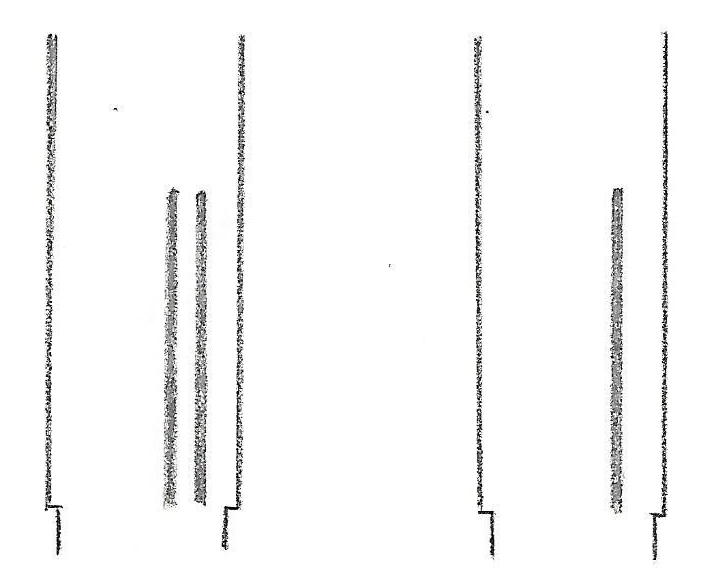
SUGATA (shape) —————— Originally 3 feet or longer, these blades were often shortened in later years.  Wide width.  Thick kasane (thick body) with hamaguri-ha, meaning the sword’s cross-section is shaped like a clam.  The difference in width between the near yokote line and the machi is minimal.  The shinogi is high and narrow.  The cross-section of an Ikubi-kissaki sword is shown below. 
12 蛤刃と鎬

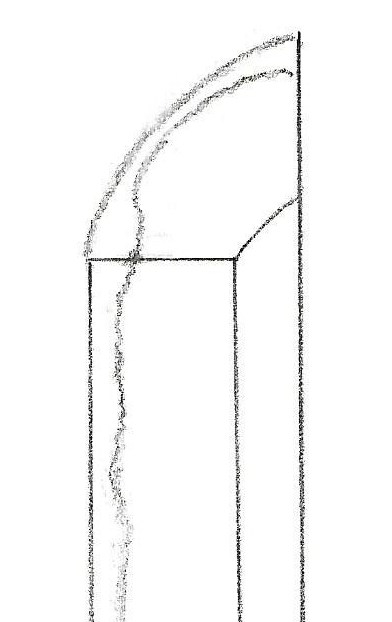
KISSAKI  ————- Ikubi-kissakiIkubi means the neck of a wild boar.  It is thick, short, and stout in appearance.  Kissaki is short and wide at the yokote line.  The illustration below shows an exaggerated image of an Ikubi-kissaki.
12 Ikubi Kissak drawing

Hamon (刃文) —— Kawazuko-choji (tadpole-head shape pattern). O-choji (large clove-shape pattern), ko-choji (small clove-shape), a mixture of o-choji and ko-choji, or suguha-chojiSuguha-choji features a straight line combined with a choji (clove-shape) pattern.  

12 Hamon Kawazuko-choji                     O-choji                          Ko-choji                  Suguha-choji     (tadpole head)                   (large clove)                (small clove)      (straight and clove)
Boshi (鋩子) ——Yakizume: the hamon ends almost at the tip of the kissaki, with no return. Sansaku Boshi: the hamon narrows at the yokote line, created by Nagamitsu (長光), Kagemitsu (景光), and Sanenaga (真長).  See below for Yakizume and Sansaku Boshi.                           


12 Yakizume

   Yakizume       11 Sansaku Boshi(三作Sansaku-boshi

Ikubi Kissaki Sword Smiths

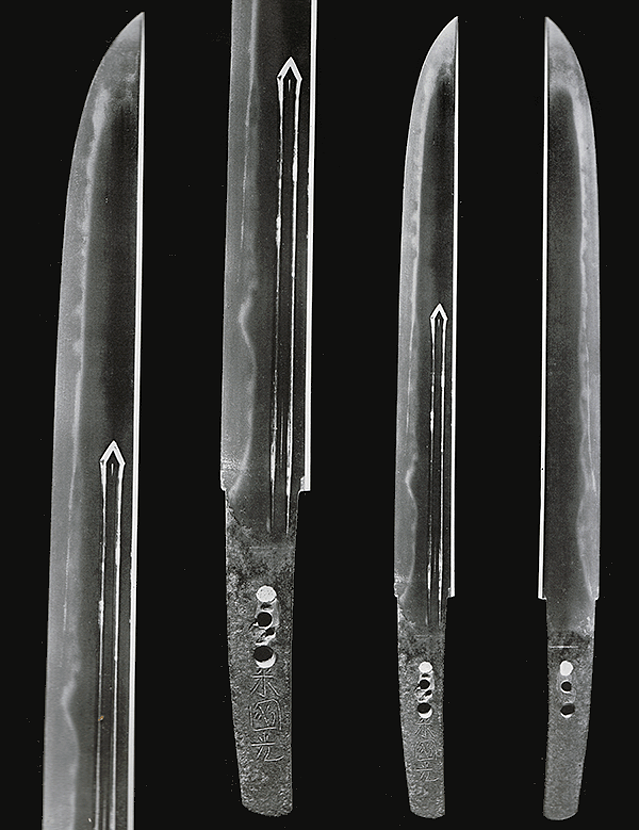
Fukuoka Ichimonji Group (福岡一文字) —————Fukuoka Ichimonji Norimune (則宗) Kamakura Ichimonji Group(鎌倉一文字) ———— Kamakura Ichimonji Sukezane (助真) Soshu Bizen Kunimune Group(相州備前国宗)——– Soshu Bizen Kunimune (国宗)Bizen Osafune Group(長船)——————Bizen Osafune Mitutada(長船光忠) Nagamitsu(長光)   Ugai Group————————————————————————- Ugai Unji (鵜飼雲次)

     Osafune Nagamitsu(長船長光)    From Sano Museum Catalogue (permission granted)   

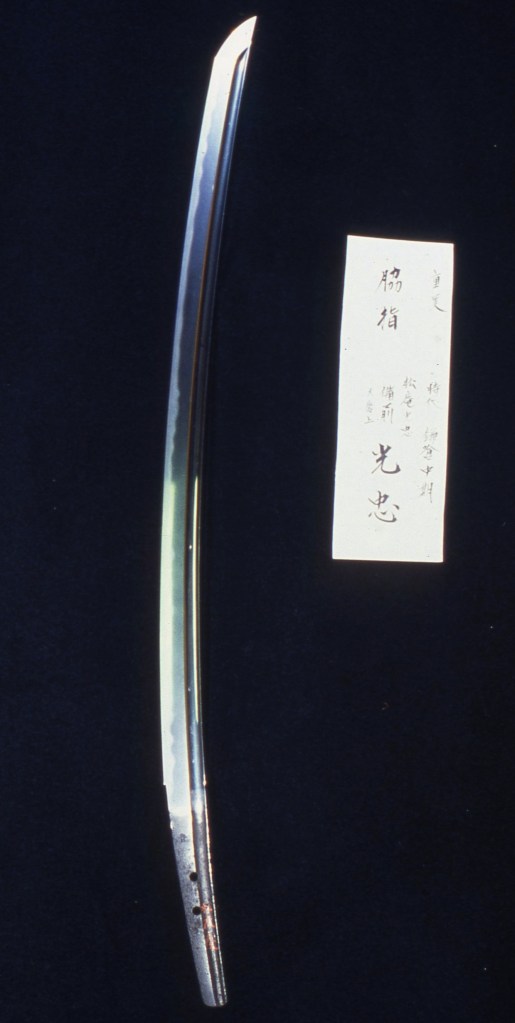
     Osafune Mitsutada(長船光忠)                          Osafune Mitsutada(長船光忠)                   

 Once my family sword.  My father did the calligraphy and took these pictures for himself. 

10| Jokyu-no-ran 1221 (承久の乱)

0-timeline - size 24 jyokyuu no ran
 
 The circle indicates the time we discuss in this section.

Jyokyu-no-Ran (承久の乱)

After Minamoto-no-Yoritomo (源頼朝) died, his son, Yoriie (頼家), became shogun.  His mother, Hojo Masako (北条政子), Yoritomo‘s wife, thought her son was too incompetent.  She worried others might take over the Kamakura bakufu (Kamakura government).  To prevent this, she established a council of 13 members, including herself, her father, Hojo Tokimasa (北条時政), and her brother, Hojo Yoshitoki (北条義時). 

Shogun Yoriie’s in-laws gained power over time.  During the Heian and Kamakura periods, the wife’s family was considered very important.  To suppress her son’s in-laws, Masako and her father, Tokimasa, planned and carried out Yoriie’s assassination.

After Yoriie‘s death, Masako’s younger son, Sanetomo (実朝), became the next shogun.  Now, his grandfather, Hojo Tokimasa’s second wife, wanted her son-in-law to be the next shogun.  To please his young wife, Hojo Tokimasa attempted to kill Sanetomo but failed.  When she found out about the plot, Hojo Masako imprisoned her father, Tokimasa.  Although Sanetomo was Masako’s son, she was once again very disappointed by his incompetence.  Ultimately, Shogun Sanetomo was killed by his nephew Kugyo, the son of the previous shogun, Yoriie

After all these incidents, Masako’s brother, Hojo Yoshitoki, took control of the Kamakura bakufu and installed a figurehead from the Fujiwara family, a powerful aristocratic family in Kyoto.   After all the turmoil, the Hojo family eventually gained complete control of the Kamakura bakufu (government).

Meanwhile, in Kyoto, Emperor Gotoba was planning an attack on the Kamakura bakufu.  He had built up military strength.  When Sanetomo was killed, Emperor Gotoba saw an opportunity to attack Kamakura.  He ordered local feudal lords to attack the Kamakura bakufu, but few obeyed.  Instead, the Hojo family captured the emperor and exiled him to Oki Island.  This occurred in 1221 and is known as Jokyu-no-ran or Jokyu-nohen.

Emperor Gotoba encouraged sword-making and showed respect for swordsmiths.     After the Jokyu-no-ran, the Imperial family’s power declined, and the Kamakura bakufu became a strong and stable regime.  From the time of Minamoto-no-Yoritomo‘s death until the end of the Jokyu-no-ran, the Kamakura bakufu remained unstable.  It was Hojo Masako who led the Kamakura bakufu to a stable regime.  She was called “Ama Shogun” or “Nun Shogun.”   She was a sharp, talented, yet tough, critical, and often harsh politician.

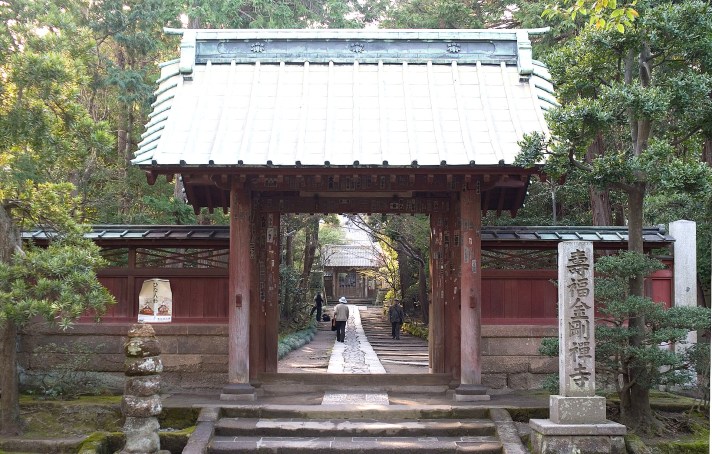
Kamakura locals, including myself, hold Hojo Masako in high regard Minamoto-no- Yoritomo and Hojo Masako are both buried in Kamakura City.  Minamoto-no-Yoritomo is at Shirahata Shrine (白幡神社), and Hojo Masako is at Jufukuji Temple (寿福寺). 

Kamakura is roughly an hour from Tokyo by train on the Yokosuka Line.  Both Jufuku-ji Temple and Shirahata Shrine are within walking distance of Kamakura Station.


Jufuku-ji (寿福寺) Temple, sourced from Wikimedia Commons, the free media repository

The tomb of Minamoto-no-Yoritomo.  From Wikimedia Commons, the free media repository.