64| Part 2 of –30 Shin Shin-To : Bakumatsu sword (新々刀)

This Chapter is a detailed Chapter of the 30|Bakumatsu Period, Shin Shin-to.  Please read Chapter 30 before reading this chapter.

0-timeline - size 24 Bakumatsu

                  The circle Above indicates the time we discuss in this chapter.

Swords made between the Tennmei era (天明 1781) and the end of the Keio era (慶應) are called shin shin-to.  Please refer to the timeline above.  This period was when Japan was moving toward the Meiji Restoration, known as the Bakumatsu era.  During this time, sword-making became active again.  Below are the well-known swordsmiths from the main areas.

Musashi no Kuni  (武蔵の国: Tokyo today)                                                       

Suishinshi Masahide (水心子正秀) ——— When Suishinshi Masahide made Yamashiro-den style swords, their shapes resembled those of ko-to period swords; funbari, an elegant shape; chu-suguha (medium straight); komaru-boshi, with fine wood grain. When he forged in the Bizen style, he made a Koshi-zori shape, similar to a ko-to made by Bizen Osafune.  Nioi with ko-choji, and katai-ha (refer to  30| Bakumatsu Period Sword 新々刀).  In my old sword textbook, I noted that  I saw Suishinshi in November 1970 and October 1971.

Taikei Naotane (大慶直胤) ————————–Although Taikei Naotane was part of the Suishinshi group, he was one of the top swordsmiths.  He had an exceptional ability to forge a wide range of sword styles beautifully.  When he made a Bizen-den style, it resembled Nagamitsu from the Ko-to era, with nioi.  Also, he did sakasa-choji as Katayama Ichimonji had done.  Katai-ha appearsThe notes in my old textbook indicate I saw Naotane in August 1971.

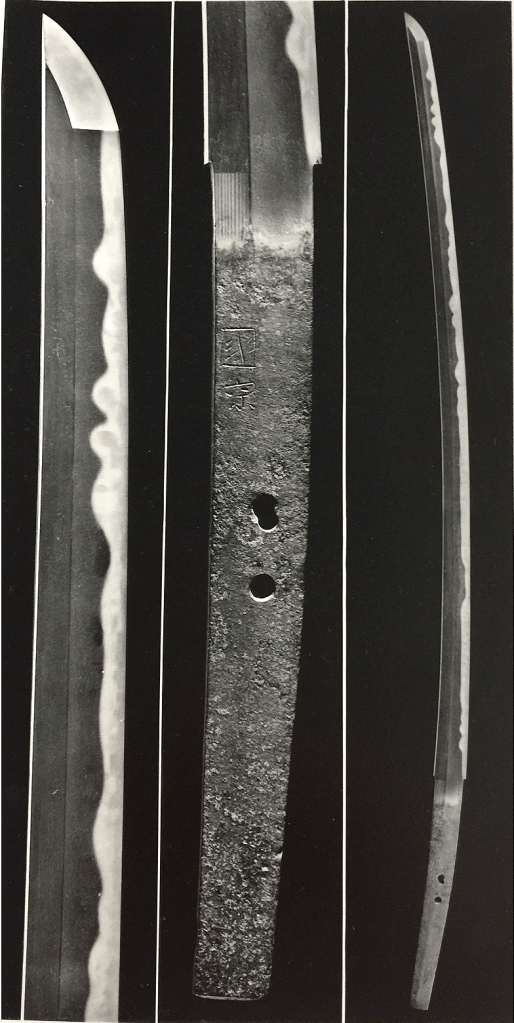
Minamoto no Kiyomaro (源清麿) ————————– Kiyomaro wanted to join the Meiji Restoration movement as a samurai; however, his guardian recognized Kiyomaro’s talent as a master swordsmith and helped him become one.  It is said that because Kiyomaro had a drinking problem, he was not very eager to make swords.  At age 42, he committed seppukuKiyomaro, who lived in Yotsuya (now part of Shinjuku, Tokyo), was called Yotsuya Masamune because he was as good as Masamune.  His swords featured wide-width, shallow sori, stretched kissaki, and fukura-kereru.  The boshi is komaru-boshi.  Fine wood grain ji-gane.

Settsu no Kuni   ( 摂津の国:  Osaka today)

Gassan Sadakazu (月山貞一) ———- Gassan excelled in the Soshu-den and Bizen-den styles, but he was capable of making in any style.  He was as much a genius as Taikei Naotane.  You must pay close attention to notice a sword made by Gassan from genuine ko-to.  He also had remarkable carving skills.  His hirazukuri-kowakizashi, forged in the Soshu-den style, looks just like a Masamune or a Yukimitsu.  He forged in the Yamashiro-den style, with Takenoko-zori, hoso-suguha, or chu-suguha in nie.  Additionally, he forged the Yamato-den style with masame-hada.


62|Part 2 of — 28 Shin-To Main 7 Region (part B)

This chapter is a detailed part of Chapter 28, Shin-t Main 7 Regions (part B).  Please read Chapter 28 before reading this chapter.  Below are regions 3 and 7.

0-timeline - size 24 Shin-to                           The red circle above indicates the time we discuss in this section    

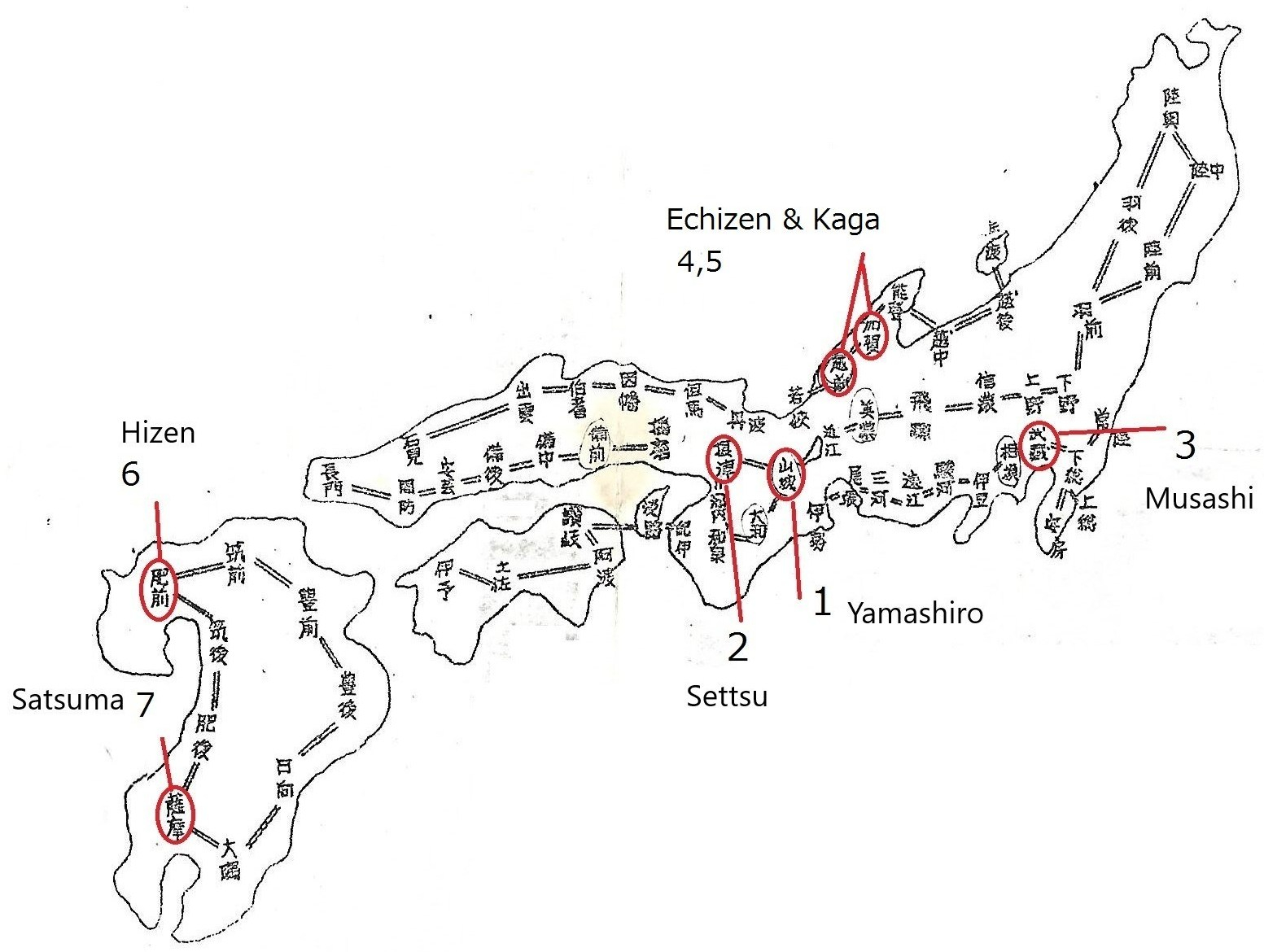
29 Map with number 7

3.Musashi (Edo)

We also find many famous swordsmiths in Edo.  They were Yasutsugu (康継), Kotetsu (虎徹), Noda Hankei (野田繁慶), Hojoji Masahiro (法成寺正弘), and their followers.

Two photos below are swordsmiths from Musashi (武蔵: Tokyo).  

                       Yasutsugu  From the Sano Museum Catalogue.  (Permission to use granted)

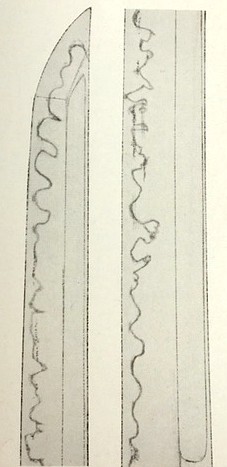
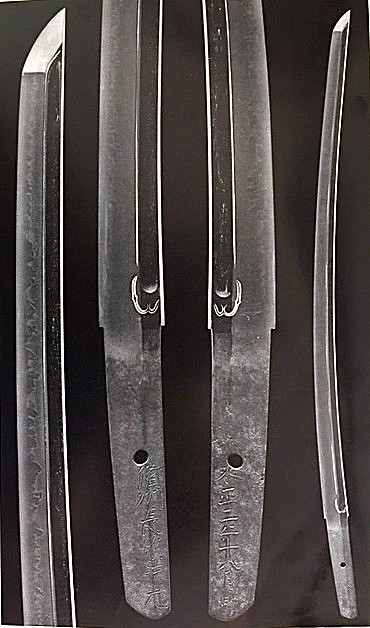
Characteristics of Yasutusgu (康継) ——Shallow curvature; chu-gissaki (medium kissaki); a wide notare hamon, midare, or o-gunome (occasionally double gunome); traces of Soshu-den and Mino-den; a wood-grain pattern mixed with masame on the shinogi-ji.


              Kotetsu (虎徹) from Sano Museum Catalogue, (permission to use granted)

Here is the famous Kotetsu.  His formal name was Nagasone Okisato Nyudo Kotetsu (長曽祢興里入道虎徹).   Kotetsu started making swords after turning 50.  Before that, he was an armor maker.  

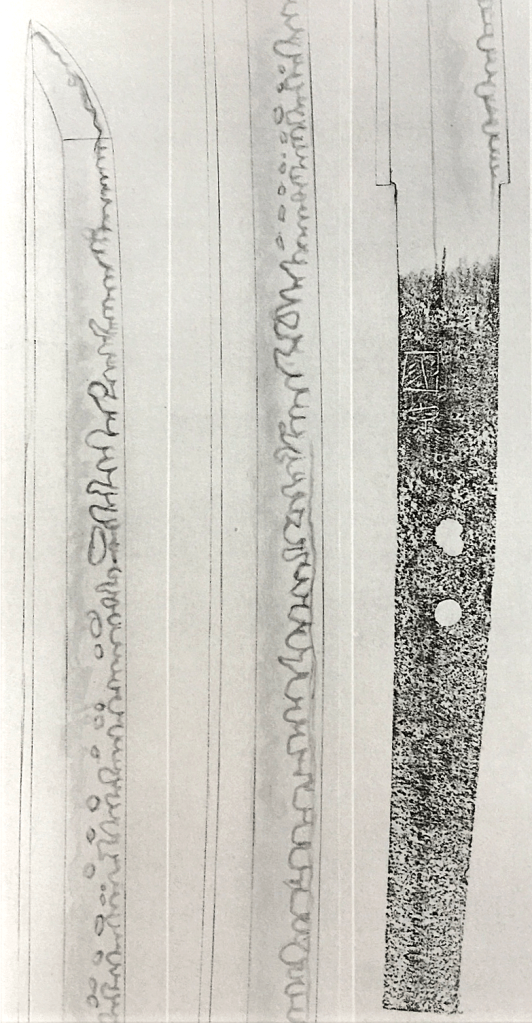
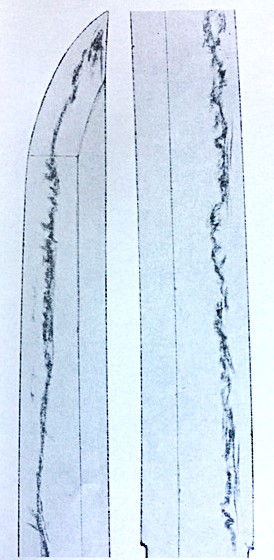
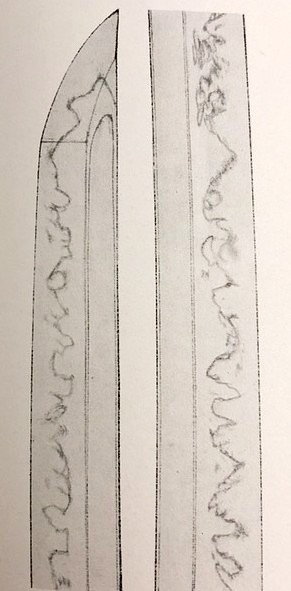
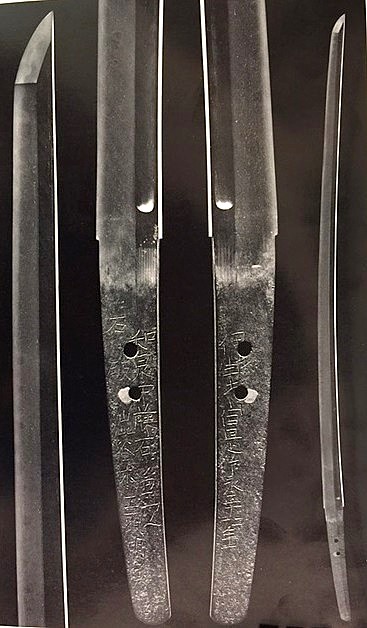
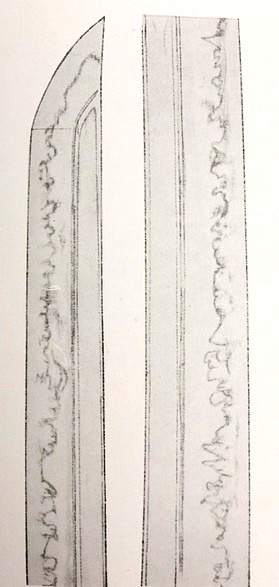
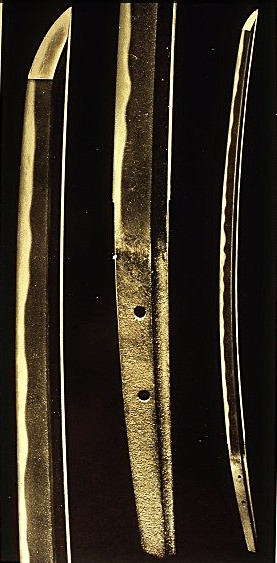
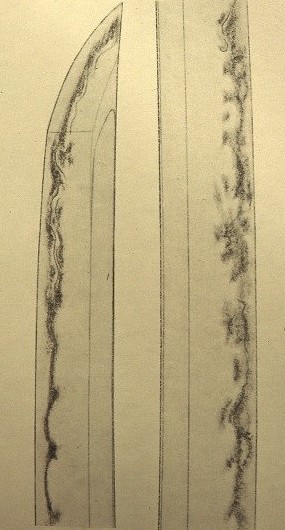
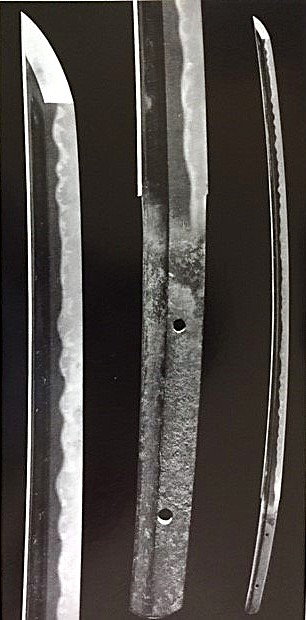
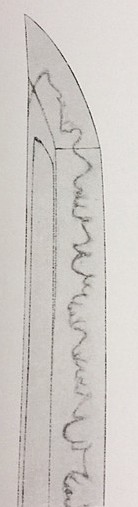
The characteristics of Kotetsu ———————— A shallow curvature and wide width, a wide tempered line with nie.  A small irregular hamon surrounds the machi area, transitioning into a wide suguha-like notare in the upper area.  Fine nie, komaruboshi with a short turn backThe ji-hada is a fine-grained wood with burl.  Occasionally, o-hada (black core iron shows through) appears in the lower part above the machi area.  The illustration above shows a thick-tempered line with nie, a typical feature of Kotetsu. Once you see it, you will remember it.   The next region is 7 (skip 4, 5, and 6)


  1. Satsuma (Kyushu) 

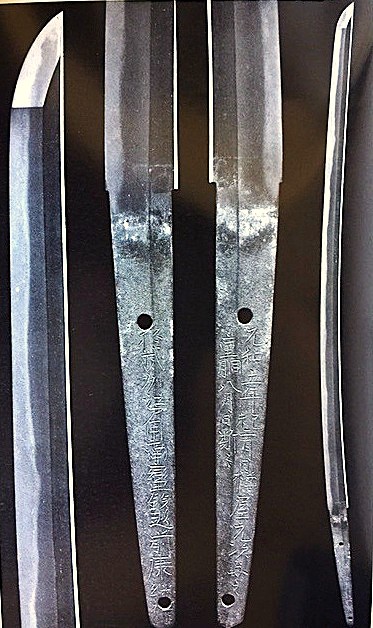
  Miyahara Mondonosho Masakiyo (宮原主水正正清) from Sano Museum Catalogue (permission to use granted).

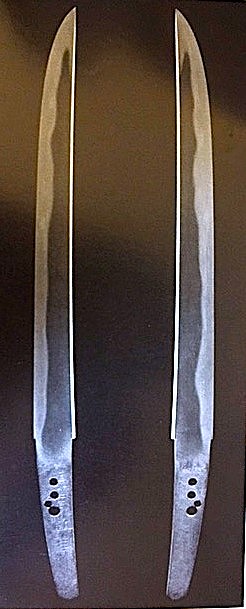
Miyahara Mondonosho Masakiyo was highly respected by the Shimazu family of Satsuma- han (the Satsuma domain in Kyushu).  Later, he was chosen to travel to Edo to forge swords for Shogun Yoshimune

Mondonosho Masakiyo’s characteristics————- Well-balanced sword shape, shallow curvature, and wide and narrow hamon mixed with squarish hamon and pointed hamon as shown in the photo above.  He engraved the Tokugawa family’s Aoi crest (the hollyhock crest) on the nakago.

57| Part 2 of — 23 Sengoku Period Sword (戦国時代刀)

Chapter 57 is a detailed section of Chapter 23, Sengoku Period Sword.  Please read Chapter 23, Sengoku Period Sword, before reading this part.

0-timeline - size 24 Sengoku Period

                         The red circle above indicates the time we discuss in this section

During the Sengoku period (Warring States era), the Mino-den and Bizen Osafune groups were the leading sword makers.  For nearly 100 years during the Warring States period, all daimyo needed numerous swords.  Having suppliers nearby was more advantageous.  Many Sengoku daimyo (戦国大名: warlords) could easily access the Mino region because of its central location.  Since the Heian period, Mino swordsmiths have been producing swords there.  One of the well-known swordsmiths of Mino-den at the end of the Kamakura period was Shizu Kane’uji (志津兼氏).  He was one of the Masamune juttettu (正宗十哲)*.  However, the true peak of the Mino-den came during the Sengoku periodDuring the Sengoku period, the Shizu and Tegai groups from the Yamato region, and swordsmiths from the Yamashiro area, moved to Mino.  Mino became the busiest center for sword-making, producing practical swords for feudal lords.

60-mino-map.jpg

*Masamune Juttetsu (正宗十哲) ———-The original meaning of Masamune Juttetsu was the top 10 Masamune studentsHowever, the term was later used more broadly.  Masamune Juttetsu (正宗十哲):https://www.touken-world.jp/tips/7194/

Three examples of Sengoku period swords

The three swords listed below are examples of swords from the Sengoku period.  Note that each sword is unique.  Even when the same swordsmith forged swords, each one is different.  Please refer to Chapter 23, Sengoku Period Sword, for the key characteristics of swords made during the Sengoku period.

            Bizen Osafune Yosozaemon Sukesada (備前国住長船与三左衛門尉祐定) from Sano Museum Catalog (permission granted).

 Characteristis on the sword above

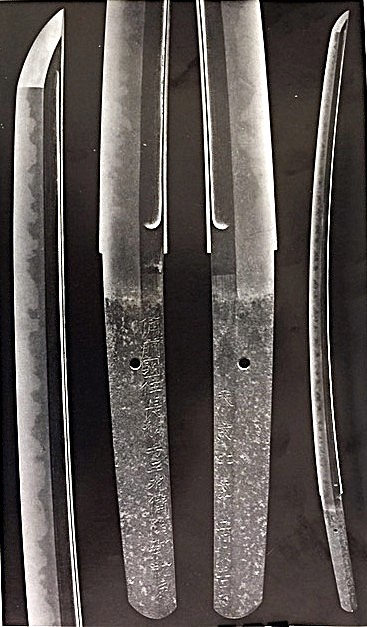
Hamon is Kani-no-tsume (crab-claw pattern; see the hamon above).  The Kani-no-tsume pattern hamon never appeared during the Heian, Kamakura, or Nanboku-cho periods.  This type of hamon is one of the key factors in determining whether a sword is from the  Sengoku Period.  Marudome-hi (the end of the groove is rounded) often appears on Bizen-den swords during the Sengoku period.  Wide tempered area.  The midare-komi boshi (where the hamon on the body and the boshi share the same pattern) has a long turn-back that stops abruptly.  The hamon has a nioi base, and most Bizen swords feature nioi, though a few exceptions exist.

60 kanesada illustration Izuminokami Fujiwara Kanesada (和泉守藤原兼) from Sano Museum Catalog

Characteristic  on the sword above

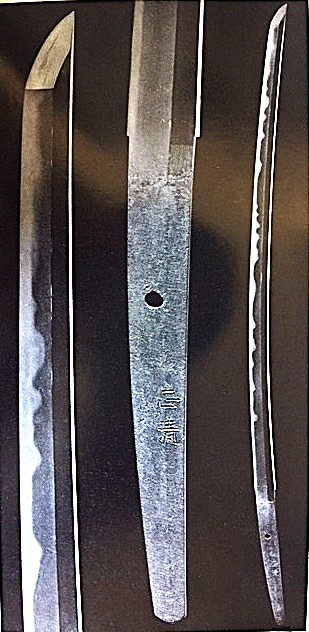
The last character of the kanji (Chinese characters) in the swordsmith’s name above is “.”  We use this uncommon character instead of the standard “定” for him.  Because there are two Kanesada.  To distinguish him from the other Kanesada (兼定), we use the character “ “and call him Nosada “のさだ.”

Izuminokami Fujiwara Kanesada (AKA Nosada) was the leading swordsmith of Mino-den during that time.  The sword’s shape is typical of the Sengoku period: shallow curvature, a chu-gissaki (medium-sized kissaki), and a pointed gunome hamon.  The hamon width can be wide and narrow.  Nosada and other Mino-den swordsmiths often exhibit wood-grain patterns with masame on the ji-hadaNioi base, mixed with coarse nie. 

      Bizen Osafune Norimitsu (備前長船法光) from Sano Museum Catalog, permission granted.

Characteristic of the sword above

Shallow curvature.  Sturdy appearance.   Marudome-hi (the hi ends are rounded)The pointed hamon is called togari-ba (尖り刃).  Nioi base, mixed with nie.  Slight masame and wood grain patterns on Ji-hada.


48|Part 2 of — 14|Late Kamakura Period Sword : Early Soshu Den (鎌倉末刀)

This is a detailed section of Chapter 14| Late Kamakura Period Sword.  Please read Chapter 14 before this part.

0-timeline - size 24 Late Kamakura

                         The red circle above indicates the time we discuss in this section.

14 Ikubi kissaki Damadge

In Chapter 14, “Late Kamakura Period Sword (鎌倉末太刀),” the ikubi-kissaki sword is explained.  The illustration above shows a flaw caused when the damaged area was repaired.  To compensate for this flaw, swordsmiths developed a new sword style during the late Kamakura period.  They forged swords with a longer kissaki and lowered the tip of the hi below the yokote line.   This way, if the yokote line were lowered during repairs, the tip of the hi would remain below the yokote line.

15 Masamune (Sano)   15 Masamune hamon (Sano)

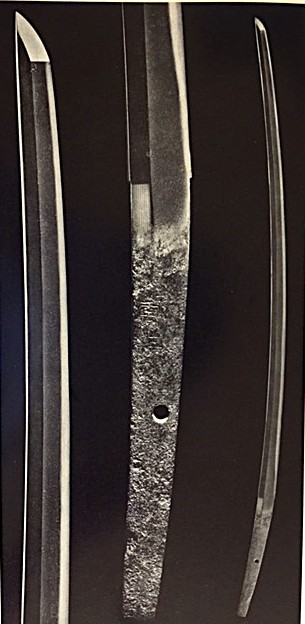
The above photo shows a sword by Goro Nyudo Masamune (五郎入道正宗).  Please observe the size and shape of the kissaki.  This differs from the previous ikubi-kissaki and ko-gissaki stylesThis style represents a typical late Kamakura period kissaki style.  It is o-suriage (a largely shortened form). 

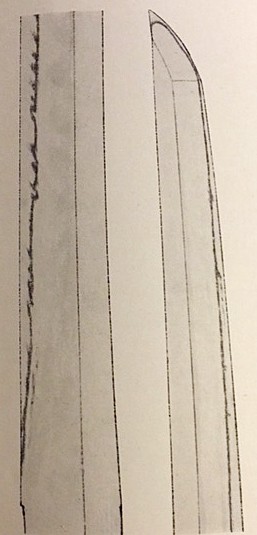
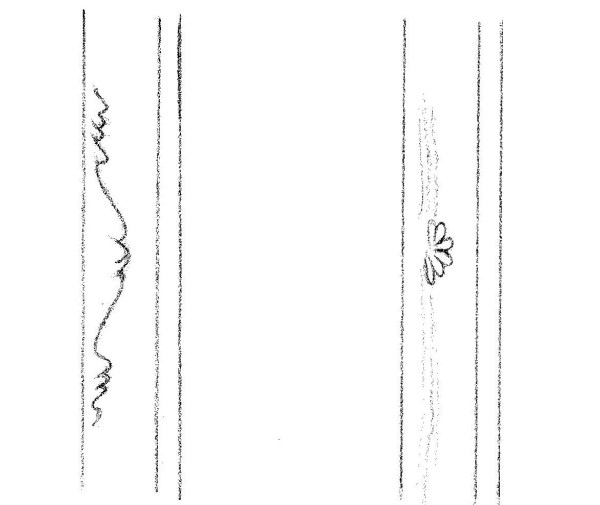
Under the Kamakura Bakufu, many swordsmiths moved to KamakuraThey were Toroku Sakon Kunituna (藤六左近国綱) of the Yamashiro Awataguchi group (山城粟田口), Fukuoka Ichimonji Sukezane (福岡一文字助真), and Kunimune (国宗) from the Bizen area.  They were the origin of Soshu-den (相州伝)Eventually, Tosaburo Yukimitsu (藤三郎行光) and his famous son, Masamune (正宗), emergedIn the drawing above, kinsuji and inazuma are shown within the hamon.  The shining lines inside the hamon are inazuma and kinsuji.  Inazuma and kinsuji are collections of nie.  Masamune is well-known for his inazuma and kinsuji.  He lived in Kamakura, a seaside town, and his hamon resembles ocean waves when viewed from the side.

50 part 2 of 15 吉岡.photo 50 part 2 of 15 吉岡

The picture above shows a sword made by the swordsmith Yoshioka Ichimonji group (吉岡一文字).  The kissaki resembles one of Masamune’s swordsIt is longer than the previous ikubi-kissaki or ko-gissaki.  This is chu-gissaki.  The kissaki, like this, is one of the key points in determining the period when the sword was made.  The hamon has choji, gunome, togariba (pointed tip), and very tight nie.

50 part 2 of 15 運生 photo 50 part 2 of 15 運生 

The photo above shows a sword by Ukai Unsho (鵜飼雲生) from Bizen-den.  This sword is also from the late Kamakura period, but it has a ko-gissaki.  This sword does not have the late Kamakura period chu-gissaki style.  Narrow hoso-suguha are more characteristic of an earlier time than the late Kamakura periodThis sword indicates that swords do not always exhibit the style of their period.  To kantei*: first examine the style and shape, then give yourself an idea of the period it was made in.  However, the kissaki in this case does not indicate the late Kamakura period.  The next step is to look at the various characteristics of the sword one by one, such as the hamon, nie or nioi, ji-hada, etc., to determine the period, the den, and the province, and then come up with the name. This process is called kantei.

*Kantei – the process of identifying a swordsmith’s name by analyzing the sword’s characteristics without seeing the mei (the inscribed smith’s name).  The mei might be gone if it has been shortened.   All the photos above are from the Sano Museum Catalogue.  Permission to use them is granted.

45|Part 2 of –11 Ikubi Kissaki (continued from Chapter 44)

This chapter is a detailed section of Chapter 11, Ikubi-kissaki, and continues from Chapter 44|Part 2 of 11 Ikubi-kissaki Sword.  Please read Chapter 11 and Chapter 44 before proceeding with this section.

0-timeline - size 24 Middle Kamakura

 The red circle above indicates the time we discuss in this section.

Bizen Saburo Kunimune (備前三郎国宗)

Another swordsmith worth mentioning in this section is Bizen Saburo Kunimune (備前三郎国宗).  During the middle Kamakura period, the Hojo clan invited top swordsmiths to Kamakura.  Awataguchi Kunitsuna (粟田口国綱) from Yamashiro in Kyoto, Fukuoka Ichimonji Sukezane (福岡一文字助真) from the Bizen area, and Bizen Kunimune (備前国宗) from the Bizen area moved to Kamakura with their circle of people.  These three groups started the Soshu-den (相州伝).  Refer to Chapter 14, Late Kamakura Period Swords.

  • Sugata (shape)  ——————— Ikubi-kissaki style.  Sometimes Chu-gissaki.  Thick body.  Koshi-zori. Narrow Shinogi width.                                                                                                
  • Horimono (Engravings)  —————- Often narrow Bo-hi (single groove)
  • Hamon (Tempered line) ————- O-choji Midare (irregular large clove shape) with Ashi.  Or Ko-choji Midare (irregular small clove shape) with AshiNioi base with Ji-nie (Nie in the Hada area).  Some Hamon appear squarish with less Kubire (less narrow at the bottom of the clove).   Hajimi (刃染み rough surface) may show.  The Kunimune swords often show a lower part with Choji and an upper part with less activity without Ashi                                                                                                                                                                                                                        

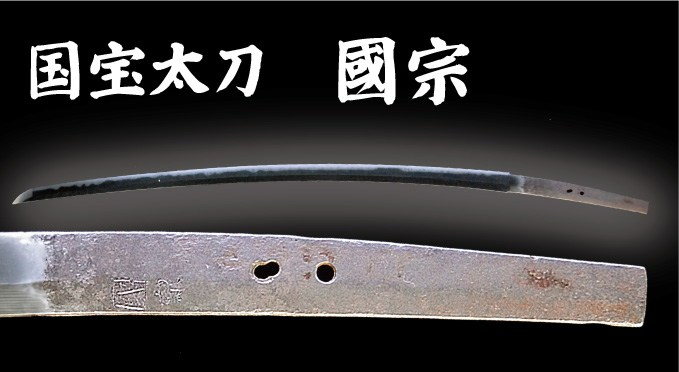
Kunimune Compton 1 Kunimune Compton 2Bizen Saburo Kunimune (備前三郎国宗)   Photo from “Nippon-to Art Sword of Japan, ” The Walter A. Compton Collection.   National Treasure

  • Boshi  ———————— Small irregular.  Yakizume or short turn back.
  • Ji-hada —————-Wood-grain pattern.  Fine Ji-hada with some Ji-nie (Nie inside Ji-hada).  Midare-utsuri (irregular shadow) is visible.  A few Hajimi (rough surface).
12 (second part 2) 照国神社The above photo is from the official website of the Terukuni Jinja Shrine in Kyushu.    http://terukunijinja.pkit.com/page222400.html

This is the national treasure, Kunimune, preserved at the Terukuni Jinja Shrine in Kagoshima Prefecture.  See the photos on the previous page.  This Kunimune sword was lost after WWII.  Dr. Compton, chairman of the board at Miles Laboratories in Elkhart, Indiana, found it in an antique shop in Atlanta.  I mentioned Dr. Compton in Chapter 32, Japanese Swords, after World War II.  When he saw this sword, he realized it was not just an ordinary sword.  He bought it and inquired at the Nihon Bijutsu Token Hozon Kyokai (The Japanese Sword Museum) in Tokyo.  It turned out to be the famous missing national treasure, Kunimune, from the Terukuni Jinja shrineHe returned the sword to the shrine without compensation in 1963. 

My father became close friends with him around this time through Dr. Homma and Dr. Sato, both leading sword experts.  Later, Dr. Compton asked Dr. Honma and my father to examine his collection of swords at his house, where he had many, as well as those at the Metropolitan Museum of Art in New York, the Philadelphia Museum of Art, and the Museum of Fine Arts in Boston.  My father wrote about this trip and the swords he examined in those museums and published a book in 1965 titled “Katana Angya (刀行脚).” 

For Dr. Compton and my father, those days must have been the best times of their lives.  Their business was doing well, and they could spend a lot of time on their interests and enjoy themselves.  It was also the best time for me.  One time, when I visited Compton’s house, he spent hours showing me his swords in the basement for hours, nearly all day.  His house was large, and the basement, which he had built as his study, had a fire prevention system. The lighting system was perfect for viewing swords and other art objects. 

His wife, Phoebe, told him he shouldn’t keep a young girl (I was a college student at the time) in the basement all day.  He agreed and took me to his cornfield to pick some corn for dinner.  From a basement to a cornfield, not much of an improvement?  So, Phoebe decided to take me shopping and have lunch in Chicago.  Good idea,  but it was too far.  Compton’s house was in Elkhart, Indiana.  The distance between Elkhart and Chicago was about 2.5 hours by car. It was too far just for shopping and lunch.  To my surprise, the company’s employee flew us to the rooftop of a department store, we did some shopping, had lunch, and then flew back.

Miles Laboratories and a well-known Japanese large pharmaceutical company had a business partnership at that time.  Dr. Compton frequently traveled to Japan for business purposes.  However, whenever he visited Japan, he spent days with sword people, including my father, and I usually followed him.  One of the female workers’ jobs at this pharmaceutical company was to translate the sword book into English. 

My parents’ house was filled with Miles’ products.  Miles Laboratories had a large research facility in Elkhart, Indiana.  I visited there several times.  One day, I sat with Dr. Compton in his office, looking into a sword book with our heads close together.  That day, movie actor John Forsythe visited the research lab.  He was the host of a TV program sponsored by  Miles Laboratories.  All the female employees were making a big fuss over him.  Then he entered Dr. Compton’s room to greet him, expecting the chairman to be sitting in his big chair at his desk, looking like a chairman.  But he saw Dr. Compton looking into the sword book seriously, with his head against mine.  Dr. Compton’s appearance was just like that of any chairman of the board of a major company, as one might imagine, and I was a Japanese college student looking like a college student.  John Forsythe showed a strange expression as if he did not know what to think.


26 |Over view of Shinto (新刀概要)

                                   
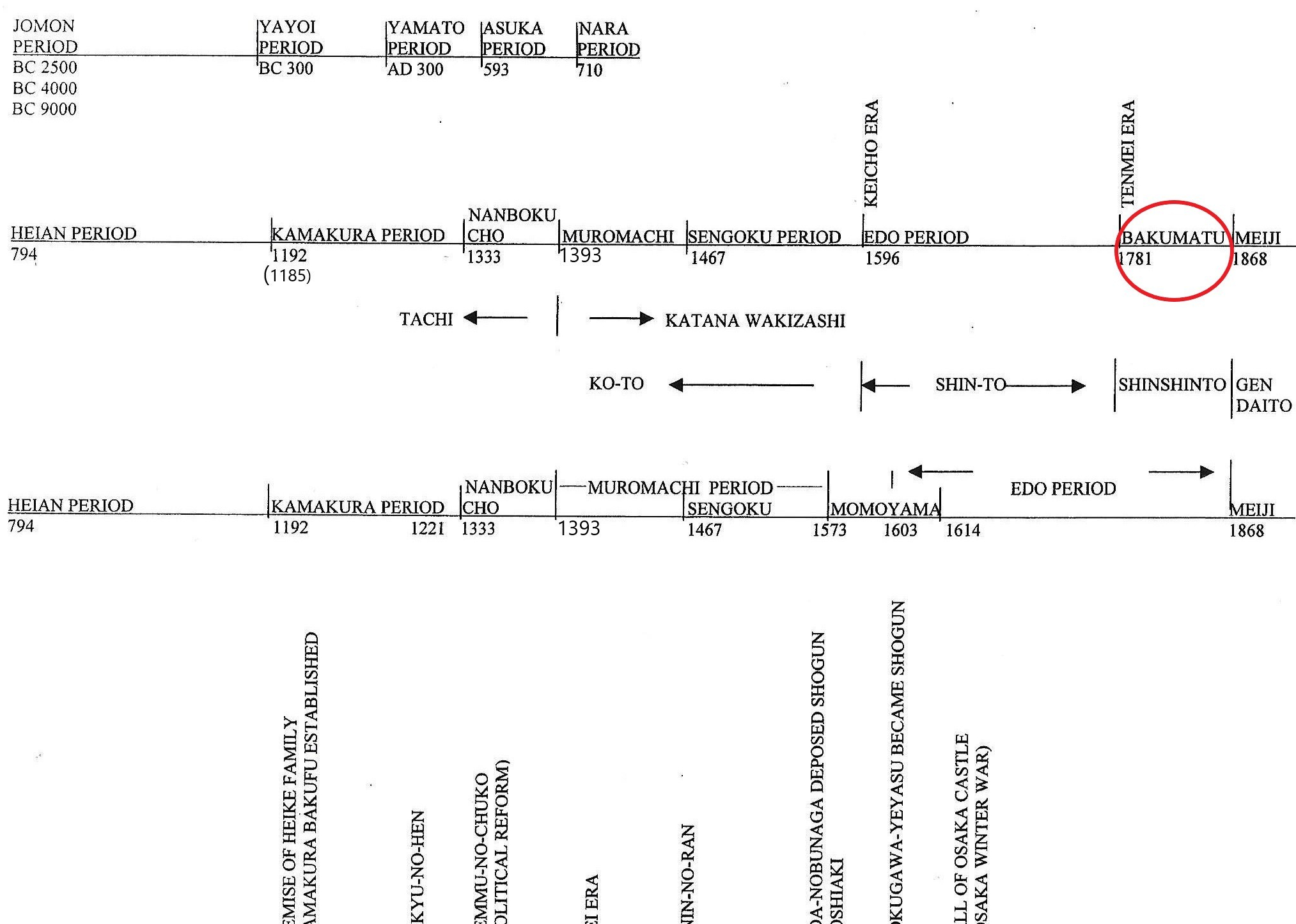
0-timeline - size 24 Shin-to
                           The circle indicates the subject discuss in this section 

The previous chapter 25 stated that the Edo period lasted from 1603 to 1868.  This is for political history.  The third timeline above shows that the Momoyama period overlaps with the Edo period.  Some people believe the Momoyama period was from 1573 to 1600. In general history, there are several opinions on how to divide these transitional periods.  For sword history, it is straightforward.  Swords made between approximately 1596 (慶長: Keicho era) and 1781 (天明: Tenmei era) are called shin-to.  Swords made between the Tenmei and Meiji eras are referred to as shin-to. 

After Toyotomi Hideyoshi nearly unified the country, the people could enjoy a period of peace.  This period of peace shifted the geographic distribution of swordsmiths. There were three main regions where sword forging took place.  These areas include Kyoto, Osaka, and Edo (Tokyo now).  The remaining swordsmiths gathered near the castles of major daimyo (大名: feudal lords).

Kyoto—- The Umetada Myoju (梅忠明寿) group thrived, followed by swordsmiths such as  Horikawa Kunihiro (堀川国広), Kunimichi (国路), Kunisada (国貞), and Kunisuke (国助).

Osaka——–Osaka was established as a commercial city and became the center of commerce.  It produced swords and distributed them to other regions across the country.  The well-known swordsmiths in Osaka: Tsuda Sukehiro (津田助広) and Inoue Shinkai (井上真改).

Edo————-Many swordsmiths gathered in Edo (江, now Tokyo), where Shogun Tokugawa Iyeyasu livedThe well-known swordsmiths in EdoNagasone Kotetsu (長曽祢虎徹), Yasutsugu (康継), Noda Hannkei (野田繁慶).

By the time Tokugawa Iyeyasu’s grandson, Tokugawa Iyemitsu, became shogun (寛永:Kan’ei era 1624 – 1643), swordsmiths had spread beyond the three areas mentioned above.  In each daimyo territory, swordsmiths operated shops near the castles to meet the needs of the daimyo and their subjects.  By the Genroku era (元禄: 1695), sword-making had declined, and people preferred more picturesque hamon designs, such as kikusui (菊水: flower design) and fujimi (富士見: Mount Fuji).

63 fuji sakura hamon
Fujimi                           Kikusui

Difference between Koto  and Shinto 

The following section describes the differences between Ko-to and Shin-to.   However, remember that there are always exceptions to these rules.

  1. The length of the shin-to katana is typically about two feet three inches ± a little.  The wakizashi is about one foot six inches.   Shallow curvature.  Wide width.  Thick body.   Gyo-no-mune.  Chu-gissaki with a slightly stretched appearance.

13 Mune drawing

  1. The ko-to sword feels light, while the shin-to feels heavy.
  2. The bottom of the hi is rounded above the machi. Shin-to’s bo-hi ends slightly below the yokote line.

27. Hisaki & marudome

  1. Generally, carvings are less common on shin-to. However, some swordsmiths are famous for their carvings.  The designs are refined and detailed.  Umetada Myoju (埋忠明寿) is well-known for his carvings.
  2. For shin-to, if it is mainly nie, it is usually a coarse nie.
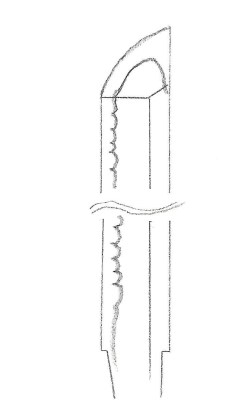
  3. In the machi area, the hamon begins with a straight tempered line (the bottom part of the blade shown in the illustration below), followed by midare, or various types of hamon in the middle, and ends with suguha (straight hamon) in the boshi area (the top part).  Generally, this is the standard Hamon style of shin-to, but there are always exceptions. 

27 Keshou Yasuri & suguha

  1. For shin-to, the type of iron used for the blade is consistent throughout Japan.  A few variations of iron were used across Japan, with a very hard, dark color and a glossy look.
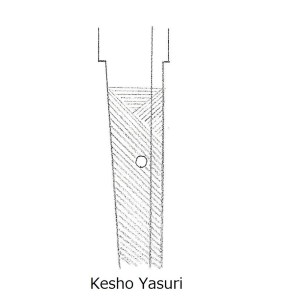
  2. The nakago has a well-balanced shape.  The bottom of the nakagotapers gradually.  The type of yasuri-me (file mark) is often a kesho-yasuri. Engraved inscriptions display the swordsmith’s name, location, province, and year of creation.

27 Keshou Yasuri & suguha