34| Part 2 — 1 Timeline

Chapter 34 is a continued part of Chapter 1 Time line.   Please read Chapter 1 before reading this section.

   0 timeline - Gendai-to                             The red circle indicates the time we discuss here

In the “Chapter 1 Timeline,” the gendai-to (現代刀) are swords made from the Meiji Restoration (明治維新1868) up to the present day.  It has been about 150 years since the Meiji Restoration.  Although all swords made after the Meiji Restoration are grouped under the gendai-to, there are many differences in quality and style.  One notably different type is the gun-to (軍刀).  These are military swords forged during World War I and World War II.  Some of them have a saber-like handle.  With a few exceptions, these were made without using traditional sword-making techniques of heating and folding.  Among the gendai-to, gun-to are usually considered less valuable.  The guns-to-swords made around and during World War II are called Showa-to.  It often has a brown leather scabbard.  Gun-to is not a part of the study of the Japanese sword.

*Refer to” https://en.wikipedia.org/wiki/Gunt%C5%8D”  for the Japanese military sword.
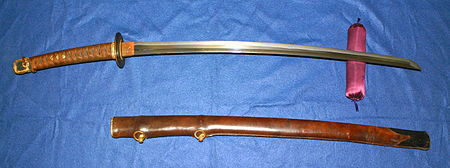
                                Gun-to    From Wikimedia Commons, the free media repository

At the time of the Meiji Restoration (明治維新), swords called Meiji-ishin-to (明治維新刀) or Kin’no-to (勤王刀) were made.  These swords were owned by famous historical figures such as Saigo Takamori (西郷隆盛) and Sakamoto Ryoma (坂本龍馬).  They are important historical figures who advanced the Meiji Restoration.  These swords are long, with some almost 3 feet long, and have no curvature.

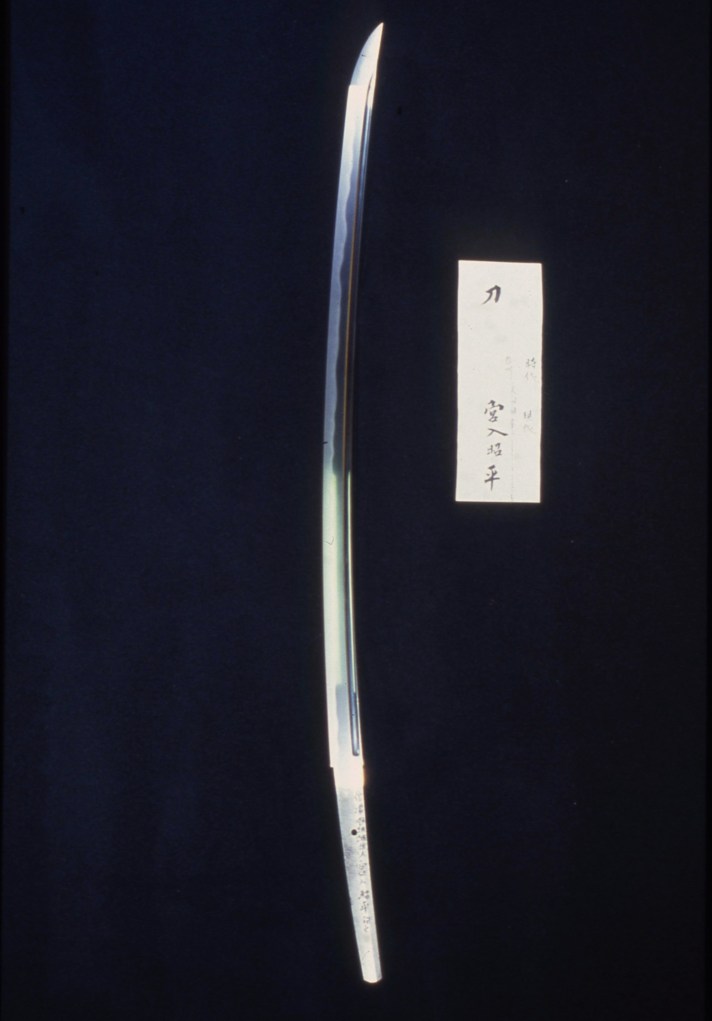
Today, many famous swordsmiths are making excellent swords.  Some are recognized as living national treasures.  Gendai-to refers to swords made after the Meiji Restoration to the present, but keep in mind that there is a wide range of differences in quality, type, and purpose among them.
36img077

                       Sword forged by a Living National Treasure, Mr. Miyairi Shohei (宮入昭平)                         owned by my brother

1 | Timeline

Let’s look at the diagram below.  At the beginning of each chapter, a timeline like the one below will be shown.  It will serve as a useful reference for determining which period is being discussed.

0-timeline - size24 original 1

From the Jomon period to the Nara period, (the short top line) is the period we call the Joko-to period in the history of Japanese swords.  The term “Japanese sword” as we use it today refers to swords made after the Heian period (平安 794-1185).  Usually, Joko-to falls under the category of archaeological study.  In the next chapter, we will discuss Joko-to.  The bottom timeline, with short descriptions below, is the one we see in Japan’s general history books.  The middle timeline is more specific to the study of swords.  My discussion will follow the middle timeline.  A timeline diagram will appear at the beginning of each chapter for easy reference.  The swords discussed in this book are grouped based on their shape, style, and the trends of their era.

The difference between Tachi (太刀),  Katana (),  Wakizashi (脇差), Tanto (短刀)

Swords made before the Muromachi period (before 1392) are called tachi (太刀).  Swords made after the Muromachi (室町) period are referred to as katana (刀) and wakizashi (脇差).  Katana and wakizashi were worn together.  A tanto is a short dagger.  Tantos have been made throughout history.  The difference between a tachi and a katana is how they are worn.  A tachi was suspended from the waist belt, with the blade facing down.  The katana and wakizashi (called daisho, 大小, meaning “large and small”) were worn together between the belt and the body, with the blade side up.  Usually, a tachi is longer than a katana.   A wakizashi is shorter than a katana.  The tanto is the shortest.  When facing the swordsmith’s inscribed name, if the blade is on the right, that is a tachi.  When facing the swordsmith’s inscribed name, if the blade is on the left, that indicates a katana or a wakizashi. 

                  Tachi   >  Katana >  Wakizashi   >  Tanto

22 tachi & Katana

Ko-to (古刀)   Shin-to (新刀)   Shinshin-to (新々刀)   Gendai-to (現代刀)

Ko-to are swords made between the Heian period (794-1192) and the beginning of the Keicho Era (1596-1614).  Shin-to are swords made between the Keicho Era (1596-1614) and the Tenmei Era (1781-1789).  Shin shin-to are swords created during the Bakumatsu period (幕末期 1781-1868).  Gendai-to covers the period from the Meiji Restoration (明治1868) to the present day.  Although the names of eras or periods changed overnight due to political or dynastic shifts throughout history, the changes in sword style were always gradual.  In general history, the Bakumatsu period is simply the last part of the Edo period. However, for sword classification, it is from around the Tenmei era (天明 1781) to the beginning of the Meiji period (1868).