57| Part 2 of — 23 Sengoku Period Sword (戦国時代刀)

Chapter 57 is a detailed section of Chapter 23, Sengoku Period Sword.  Please read Chapter 23, Sengoku Period Sword, before reading this part.

0-timeline - size 24 Sengoku Period

                         The red circle above indicates the time we discuss in this section

During the Sengoku period (Warring States era), the Mino-den and Bizen Osafune groups were the leading sword makers.  For nearly 100 years during the Warring States period, all daimyo needed numerous swords.  Having suppliers nearby was more advantageous.  Many Sengoku daimyo (戦国大名: warlords) could easily access the Mino region because of its central location.  Since the Heian period, Mino swordsmiths have been producing swords there.  One of the well-known swordsmiths of Mino-den at the end of the Kamakura period was Shizu Kane’uji (志津兼氏).  He was one of the Masamune juttettu (正宗十哲)*.  However, the true peak of the Mino-den came during the Sengoku periodDuring the Sengoku period, the Shizu and Tegai groups from the Yamato region, and swordsmiths from the Yamashiro area, moved to Mino.  Mino became the busiest center for sword-making, producing practical swords for feudal lords.

60-mino-map.jpg

*Masamune Juttetsu (正宗十哲) ———-The original meaning of Masamune Juttetsu was the top 10 Masamune studentsHowever, the term was later used more broadly.  Masamune Juttetsu (正宗十哲):https://www.touken-world.jp/tips/7194/

Three examples of Sengoku period swords

The three swords listed below are examples of swords from the Sengoku period.  Note that each sword is unique.  Even when the same swordsmith forged swords, each one is different.  Please refer to Chapter 23, Sengoku Period Sword, for the key characteristics of swords made during the Sengoku period.
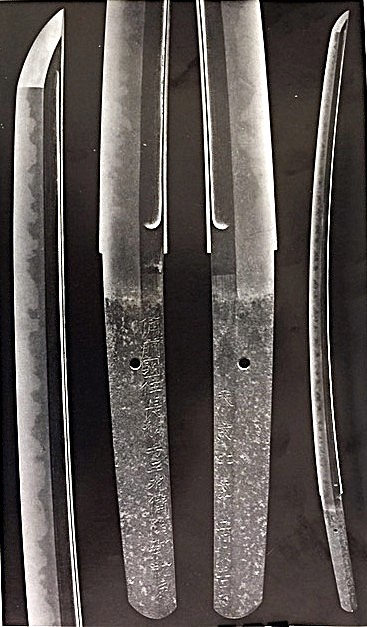
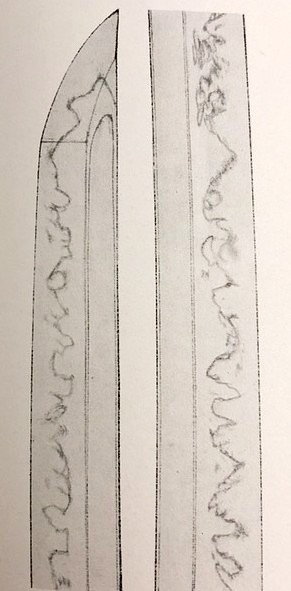
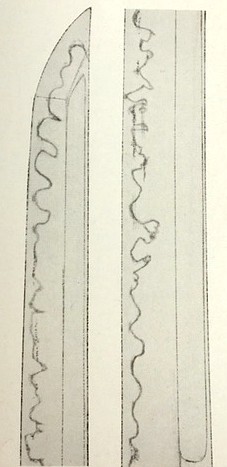
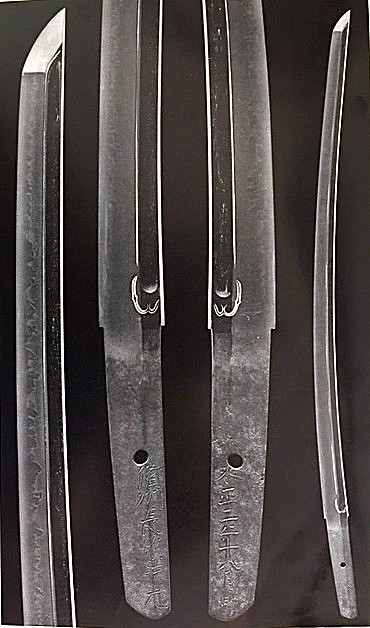
            Bizen Osafune Yosozaemon Sukesada (備前国住長船与三左衛門尉祐定) from Sano Museum Catalog (permission granted).

 Characteristis on the sword above

Hamon is Kani-no-tsume (crab-claw pattern; see the hamon above).  The Kani-no-tsume pattern hamon never appeared during the Heian, Kamakura, or Nanboku-cho periods.  This type of hamon is one of the key factors in determining whether a sword is from the  Sengoku Period.  Marudome-hi (the end of the groove is rounded) often appears on Bizen-den swords during the Sengoku period.  Wide tempered area.  The midare-komi boshi (where the hamon on the body and the boshi share the same pattern) has a long turn-back that stops abruptly.  The hamon has a nioi base, and most Bizen swords feature nioi, though a few exceptions exist.
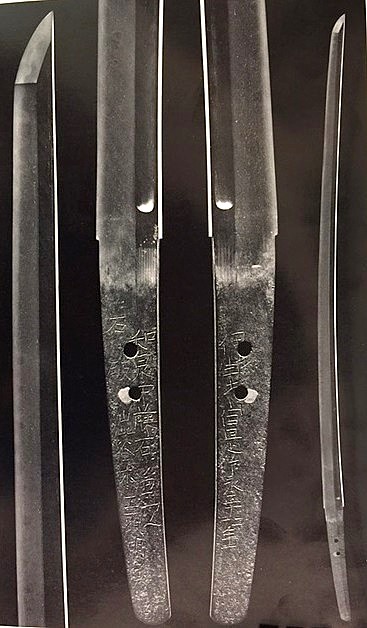
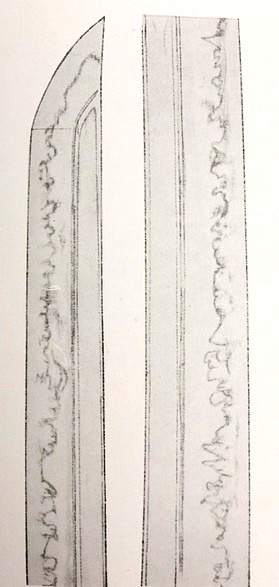
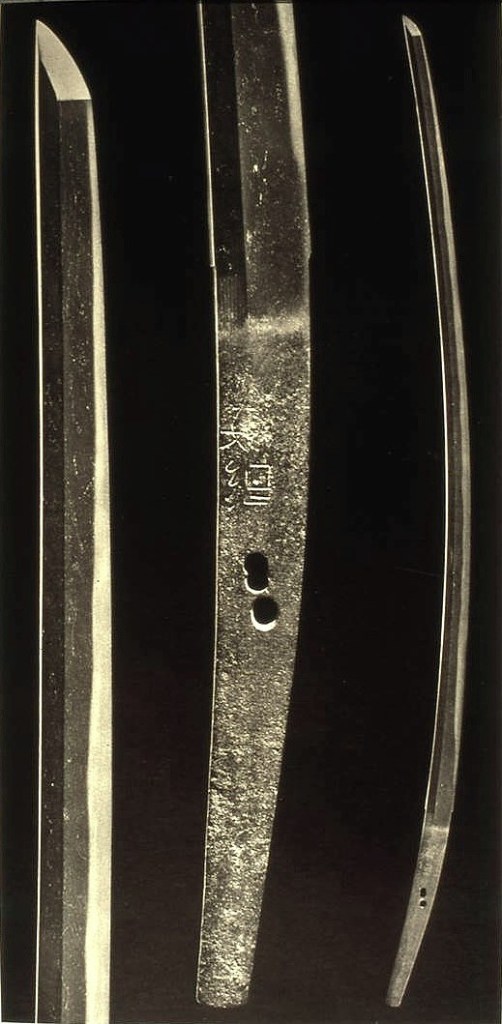
60 kanesada illustration Izuminokami Fujiwara Kanesada (和泉守藤原兼) from Sano Museum Catalog

Characteristic  on the sword above

The last character of the kanji (Chinese characters) in the swordsmith’s name above is “.”  We use this uncommon character instead of the standard “定” for him.  Because there are two Kanesada.  To distinguish him from the other Kanesada (兼定), we use the character “ “and call him Nosada “のさだ.”

Izuminokami Fujiwara Kanesada (AKA Nosada) was the leading swordsmith of Mino-den during that time.  The sword’s shape is typical of the Sengoku period: shallow curvature, a chu-gissaki (medium-sized kissaki), and a pointed gunome hamon.  The hamon width can be wide and narrow.  Nosada and other Mino-den swordsmiths often exhibit wood-grain patterns with masame on the ji-hadaNioi base, mixed with coarse nie. 

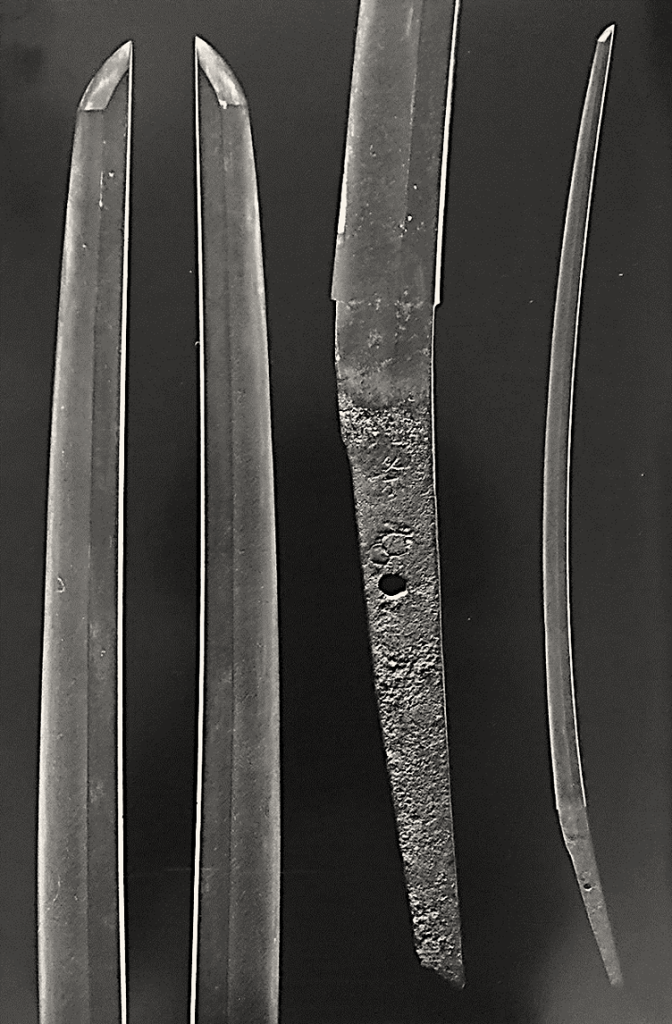
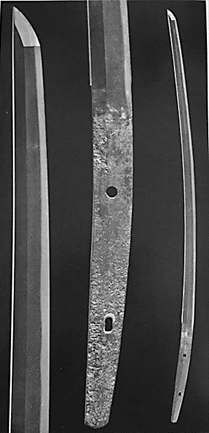
      Bizen Osafune Norimitsu (備前長船法光) from Sano Museum Catalog, permission granted.

Characteristic of the sword above

Shallow curvature.  Sturdy appearance.   Marudome-hi (the hi ends are rounded)The pointed hamon is called togari-ba (尖り刃).  Nioi base, mixed with nie.  Slight masame and wood grain patterns on Ji-hada.


38|Part 2 of — 5 Heian Period Sword 794-1192 (平安太刀)

This chapter is a detailed part of  Chapter 5, Heian Period Sword.  Please read Chapter 5 before this section.  More sword terminology will be used in the upcoming chapters.  These terms were explained in Chapters 1-31.  If you encounter unfamiliar sword terms, please refer to Chapters 1 through 31.

0-timeline - size 24 Heian                   The red circle above indicates the time we discuss in this sect         

During the Heian period, several swordsmith schools were active.  We use the word “den” to refer to these schools.  These include Yamashiro-den (山城伝), Yamato-den (大和伝), and Bizen-den (備前伝).  Additionally, the following regions had other active groups during the Heian period: Hoki-no-kuni (伯耆の国) and Oo-u (奥羽).   Oo-u is pronounced “Oh,” and “U” as in uber.

 Yamashiro Den (山城伝 )

During the Heian period, among Yamashiro-den swords, the most famous sword was the “Mikazuki Munechika“ (三日月宗近) by Sanjo Munechika (三条宗近).  Mikazuki means crescent.  It was named Mikazuki Munechika because the crescent-shaped uchinoke (collection of Nie) pattern appears in the hamon.  It has a graceful shape, a narrow body, koshi-zori, funbari, and a small kissaki.  The sword shows a wood grain pattern on its surface, with suguha with nie mixed with small irregular lines, and sometimes a nijyu-ha (double hamon: 二重刃) appears.  Sanjo Munechika lived in the Sanjo area of Kyoto.  His sword style was passed down through his sons and grandsons: Sanjo Yoshiie (三条吉家), Gojo Kanenaga (五条兼永), and Gojo Kuninaga (五条国永).  Gojo is also a district in Kyoto

    三日月宗近    Mikazuki Munechika  東京国立博物館蔵 Tokyo National Museum           Photo from “Showa Dai Mei-to Zufu 昭和大名刀図譜” published by NBTHK

Houki -no-Kuni (伯耆の国)

Houki-no-kuni is the area now called Tottori Prefecture.  It is known for producing high-quality iron.  The sword, “Doujigiri Yasutsuna” (童子切安綱), made by Hoki-no-yasutsuna (伯耆の安綱), was one of the most famous swords of its time.                                                                                                 

The characteristics of Yasutsuna’s sword ——- It has a graceful shape with a small kissaki, a narrow hamon (often suguha with ko-choji), coarse nie in the hamon area, and a large wood grain pattern mixed with masame on the ji-hada.  The hamon area often shows inazuma and kinsuji.  The boshi area is yakizume, and the kaen (pronounced ka as in calf, en as in engineer) has a slight turn back. 

   伯耆の安綱 (Hoki no Yasutsuna) 佐野美術館図録 (Sano Musem Catalogue)                     Permission to use granted 

Bizen Den (備前伝 )

Bizen is in Okayama Prefecture today.  It is known for producing high-quality iron.  From the Heian period to the present, Bizen has been famous for its sword-making tradition.  The sword-making group in this area during the Heian period was called the Ko-bizen group.  The most famous swordsmiths in the Ko-bizen group included Bizen Tomonari (備前友成), Bizen Masatsune (備前正恒), and Bizen Kanehira (備前包平).                                                                   

Ko-bizen group’s characteristics ———- A graceful, narrow body, a small kissaki, and a narrow-tempered line with ko-choji (small irregular) with inazuma and kin-suji.  The ji-hada displays a small wood-grain pattern.

   Bizen Kanehira (備前包平) Sano Museum Catalogue (佐野美術館図録)                          (Permission to use granted)

I saw Ko-bizen Sanetsune (真恒) at Mori Sensei’s house.  That was one of the kantei-to of that day.  I received a dozen*ᴵ.  The book written by Hon’ami Koson was used as our textbook.  Each time I saw a sword at Mori Sensei’s house, I recorded the date next to the swordsmith’s name in the book we used.  It was Nov. 22, 1970.  It had a narrow body line, a small kissaki (Ko-bizen komaru), kamasu*2 (no fukura), and suguha.  Kamasu is a condition in which the fukura (arc) is much less than usual.  Looking back, it is amazing that we had the opportunity to study such famous swords as our study materials.

Kantei-Kai

Kantei-kai is a study meeting.  Usually, several swords are displayed, with the nakago area covered.  Attendees try to guess the sword maker’s name and submit their answer sheets to the judge.  Below are the grades.

Atari —– If your answer is the exact correct name, you get Atari. That is the best answer.

Dozen —— The second best is a dozen.  It means nearly a correct answer. The subject sword was made by the family or clan of the right den.   A dozen is considered very good.  It indicates that the student has solid knowledge of the particular group.

Kaido Yoshi —– This means it is correct regarding the line, but not about the family.

Jidai Yoshi — it means the time or period is correct.  Each Kantei-kai has its own grading system.  Some may not have a “Jidai Yoshi” grade.

Hazure——– the wrong answer. 

Once all answer sheets are submitted, they are graded and returned. The judge reveals the correct answer and explains why.

*1 Dozen:  Almost the same as the correct answer. *2 Kamasu:  A name of a fish that has a narrow, pointed head.


37|Part 2of — 4 Heian Period History  794-1192   (平安時代歴史)

This chapter continues from Chapter 4, Heian Period History. Please read Chapter 4 before proceeding with this section.

0-timeline - size 24 Heian

The circle above indicates the time we discuss in this section

Around the middle of the Heian period, a novel, “Genji Monogatari” (The Tales of Genji,源氏物語), was written by a female author, Murasaki Shikibu (紫式部).  She was a high-ranking court lady.  Her father, Fujiwara Tametoki (藤原為時), was a scholar. While several novels and essays were written by female authors around that time, “The Tales of Genji” is a world-renowned literary masterpiece, considered the greatest Japanese literary work.  “The Tales of Genji“ is a treasure for the Japanese.  We love this novel so much that the Japan Mint issued a 2000-yen bill*ᴵ.  See the photo below.  The author herself is shown in the lower right corner on the back of the bill.  The bill is so beautiful that people just keep it instead of using it.   Therefore, it does not circulate much.  I have four of these bills, and I cannot bring myself to use them.  It is too nice to use. 

The novel is about Hikaru Genji’s (the hero, 光源氏) love history (yes, history) from when he was around 16 years old until his death.  Ten chapters after his death are titled “Uji Jyu-jyo.”  This section tells the story of his son and grandson.  The chapter in which the hero Hikaru Genji dies is titled “Vanishes into the Cloud (雲隠れ),” a very poetic title.  The Tales of Genji depict the daily life, customs, lifestyle, and thoughts of the people in the aristocratic society of that time.  Surprisingly, although they did not have the technology we have today, their way of thinking was not significantly different from ours.  The description of the courting process is in Chapter 4, Heian Period History. 

The author created Hikaru Genji (光源氏), the main character, as a high-ranking aristocrat and the illegitimate son of an emperor. He is portrayed as a charming, handsome, intelligent, and sophisticated aristocrat, and all the women fall for him.  He would go around with various women, one after another: a beautiful woman, a not-so-attractive but brilliant woman, a young woman, an older woman, even his stepmother, a wealthy or not-so-wealthy woman, and more.   It sounds like a story from a tabloid magazine.  Still, Murasaki Shikibu depicted the heroes’ and heroines’ thoughts, emotions, and daily lives, as well as how the men thought about the women and vice versa, with her excellent writing skills.  The author, Murasaki Shikibu, wrote this novel to entertain the female audience at the court where she resided.  It became so popular that even the emperor asked her how the next story would develop.  “Genji Monogatari” has been translated into English.  You can purchase the translated book on Amazon or go to YouTube and search for “Genji Monogatari” or “The Tales of Genji.”   You will find many “Genji Monogatari” in anime, old TV programs, and classic movies, available in whole or as short clips. 

Another female author, Sei Sho-nagon (清少納言), wrote an essay titled “Makura no Soshi “(枕草子) around the same time.  In it, she described the daily lives of court ladies.   In one chapter, she mentioned kakigori (shaved ice: かき氷).  High-status people then must have had the chance to enjoy shaved ice, even though the ice was not easy to come by during the summer in the middle of the Heian period.  

Once you understand the life of a Heian aristocrat, you will see why the Heian sword is shaped the way it is.  It becomes easier to distinguish a Heian sword from other swords made in different periods and regions.  All sword styles reflect the society in which the swordsmiths lived.  During the Heian period, the Yamashiro-den style represented the sword style.  In the next chapter, the focus will be on the Yamashiro-den, even though other sword groups existed in different regions.

*1  The back of 2000 yen bill

39 Part 2 Shikibu with arrow

5 Heian 3 photoes.jpgPart of the Burke Album, a property of Mary Griggs Burke (Public Domain).  Paintings by Mitsukuni (土佐光国), 17th century.   The scenes are based on “The Tales of Genji.


4 | Heian Period History (平安時代歴史) 794 – 1192

The Heian Period (平安時代) began when Emperor Kanmu (桓武天皇) moved the capital to Heian-Kyo (平安京) in 794, which is now known as Kyoto (京都).

0-timeline - size 24 Heian

                             The circle indicates the time we discuss in this section.

During the Heian period, emperors ruled Japan.  However, early in this era, the Fujiwara family, a wealthy aristocratic family, held actual political power. The Fujiwara family managed to marry their daughters to emperors, thereby gaining power through these marriages. The family was called “Sekkan-ke” (摂関家), meaning the guardian’s family or the emperor’s representative.

In those days, aristocrats led an elegant, refined lifestyle while cultivating a graceful culture.  Many essays and novels were written by female authors during that period.  The most famous one is “Tales of Genji (源氏物語)” written by Murasaki Shikibu (紫式部).    The Imperial Court often held ceremonies followed by elaborate, lavish banquets.  This imperial social life played an important role in advancing aristocrats’ political careers.  Women also actively participated in these ceremonies.   Many high-ranking officials owned several large estates.  Sometimes, their daughters inherited these properties and lived there.

Courtship methods were quite different back then.  To start a romantic relationship, a man would write a poem called “waka” for the lady he was interested in and have his servant deliver it to her, hoping she would write him back with a similar poem.  Once she accepted him, he was allowed to visit her for short periods from a distance.  As their relationship grew deeper, he would visit her more frequently and stay longer.  After they married, and if she was his first legal wife, she would live with him in his house.  If she were not his first legal wife, she would remain in her own home, and he would visit her for a few days or longer.  The wife’s family raised their children.  In those days, and until the next Kamakura period, a woman’s lineage was considered important.  By the middle of the Heian period, emperors regained political power because their mothers were not from the Fujiwara family.

     Scenes from the “Tales of Genji”.   Bought in Kyoto.

Origin of Samurai

Although the Heian Imperial court and aristocrats lived with grace and elegance, they lacked the political power to govern the country.  There were numerous thieves, frequent fires, and constant fights everywhere.  Consequently, the Imperial court, aristocrats, and temples began hiring armed guards or security forces to protect themselves and maintain public order.  These hired guards were the origins of bushi (武士) or samurai (侍).  Samurai extended their influence and gained more power by forming groups and suppressing uprisings.  Eventually, two powerful samurai clans emerged: one was the Heishi (平氏), often called the Heike (平家), and the other was the Genji (源氏).  Gradually, they gained power in the Imperial court.   After many power struggles among them, the Heishi started to control the Imperial court by marrying their daughters to the emperors.  In the later Heian period, political power shifted to the Heishi.  They became tyrannical and arrogant.  This behavior created many enemies.  The Genji clan and the Fujiwara family started a war against the Heishi.  The Genji pushed the Heishi to the final battlefield known as Dan-no-ura (壇ノ浦) in 1185 and defeated them.  This battle was the famous Genpei-Gassen (源平合戦).  The fall of the Heishi marked the end of the Heian period.

5-map-dan-no-ura-.jpg

During the Heian period, curved swords appeared for the first time.  Before that, swords had straight blades.  Historical studies of Japanese swords start from this point.  The elegant, refined lifestyle and culture created by the influential Fujiwara family were reflected in the swords’ style.  A group of swordsmiths in the Kyoto area created a distinctive sword style known as Yamashiro-den (den = school).  The shape of their blades exhibits a graceful line.  The most famous sword in the Yamashiro-den is the Mikazuki Munechika, by Sanjo Munechika (三条宗近) below, which is a national treasure today.  The Yamashiro-den style represents the swords of the Heian period.

Sanjo Munechika (三条宗近) from Showa Dai Mei-to Zufu (昭和大名刀図譜)  by NBTHK Owned by the Tokyo National Museum.


1 | Timeline

Let’s look at the diagram below.  At the beginning of each chapter, a timeline like the one below will be shown.  It will serve as a useful reference for determining which period is being discussed.

0-timeline - size24 original 1

From the Jomon period to the Nara period, (the short top line) is the period we call the Joko-to period in the history of Japanese swords.  The term “Japanese sword” as we use it today refers to swords made after the Heian period (平安 794-1185).  Usually, Joko-to falls under the category of archaeological study.  In the next chapter, we will discuss Joko-to.  The bottom timeline, with short descriptions below, is the one we see in Japan’s general history books.  The middle timeline is more specific to the study of swords.  My discussion will follow the middle timeline.  A timeline diagram will appear at the beginning of each chapter for easy reference.  The swords discussed in this book are grouped based on their shape, style, and the trends of their era.

The difference between Tachi (太刀),  Katana (),  Wakizashi (脇差), Tanto (短刀)

Swords made before the Muromachi period (before 1392) are called tachi (太刀).  Swords made after the Muromachi (室町) period are referred to as katana (刀) and wakizashi (脇差).  Katana and wakizashi were worn together.  A tanto is a short dagger.  Tantos have been made throughout history.  The difference between a tachi and a katana is how they are worn.  A tachi was suspended from the waist belt, with the blade facing down.  The katana and wakizashi (called daisho, 大小, meaning “large and small”) were worn together between the belt and the body, with the blade side up.  Usually, a tachi is longer than a katana.   A wakizashi is shorter than a katana.  The tanto is the shortest.  When facing the swordsmith’s inscribed name, if the blade is on the right, that is a tachi.  When facing the swordsmith’s inscribed name, if the blade is on the left, that indicates a katana or a wakizashi. 

                  Tachi   >  Katana >  Wakizashi   >  Tanto

22 tachi & Katana

Ko-to (古刀)   Shin-to (新刀)   Shinshin-to (新々刀)   Gendai-to (現代刀)

Ko-to are swords made between the Heian period (794-1192) and the beginning of the Keicho Era (1596-1614).  Shin-to are swords made between the Keicho Era (1596-1614) and the Tenmei Era (1781-1789).  Shin shin-to are swords created during the Bakumatsu period (幕末期 1781-1868).  Gendai-to covers the period from the Meiji Restoration (明治1868) to the present day.  Although the names of eras or periods changed overnight due to political or dynastic shifts throughout history, the changes in sword style were always gradual.  In general history, the Bakumatsu period is simply the last part of the Edo period. However, for sword classification, it is from around the Tenmei era (天明 1781) to the beginning of the Meiji period (1868).