27|Shinto Sword — Main Seven Regions (Part A :主要7刀匠地)

0-timeline - size 24 Shin-to

                            The red circle indicates the subject we discuss in this section

During the Shinto era, there were seven main prosperous regions where many swordsmiths gathered and actively forged swords.  These are Yamashiro (山城) in Kyoto, Settsu (摂津) in Osaka, Musashi (武蔵 ) in Edo, Hizen (肥前) in Saga, Satsuma (薩摩) in Kagoshima, Echizen (越前) in Fukui,  and Kaga (加賀) in Kanazawa.  Swordsmiths from each area shared common regional characteristics of their places.  Knowing each of these characteristics is the easiest way to understand Shin-to.  However, it is important to remember that each swordsmith within a group had their own unique way of sword-making.  The following are only general descriptions of these characteristics.

Below is a map of Japan.  Hokkaido is not shown on the map because swords were not made there during that time.
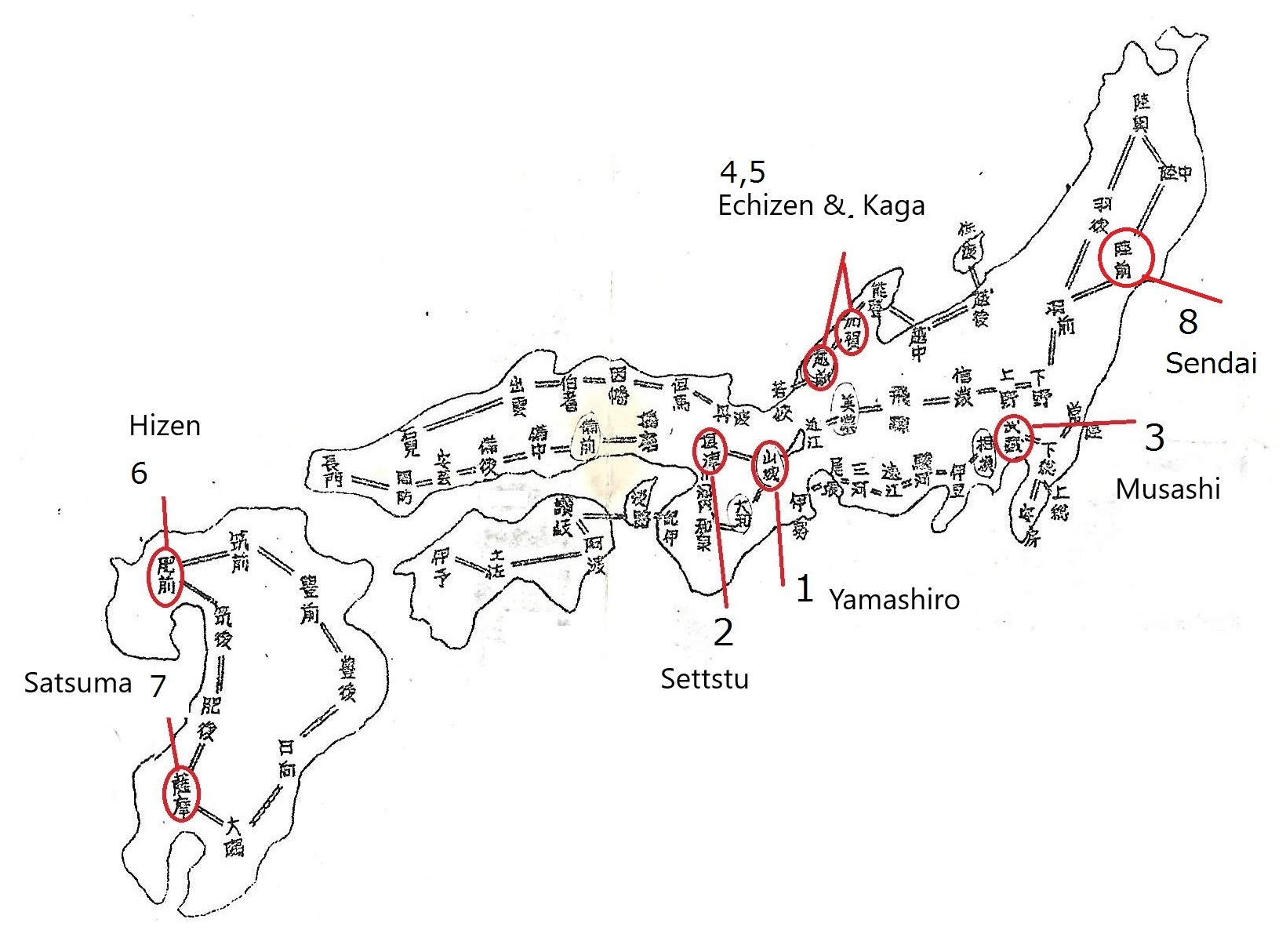
64Map with number with 8

1.  Yamashiro (山城) Kyoto

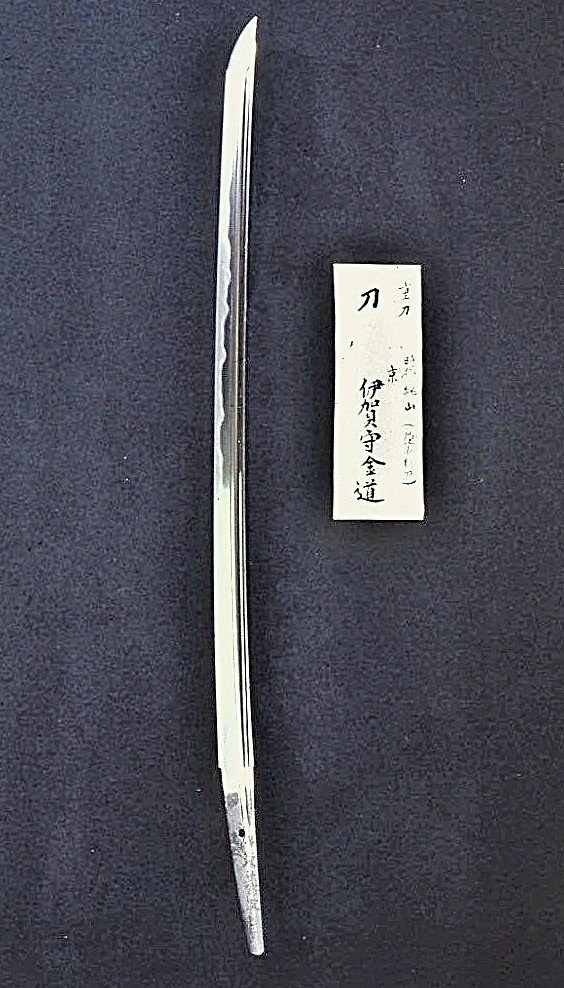
The Yamashiro shin-to sword has a solid and strong look.  The hamon near the lower part of the blade, just above the machi (区) area, shows suguha (straight hamon).  This is called kyo-yakidashi (京焼出し, meaning it starts with a straight hamon.  Then, it shows a sudden shift to a design of o-midare (大乱).  The o-midare (large irregular waviness) becomes less wavy about one or two inches below the yokote line, then continues into the boshi as a wavy hamon.  The design in the boshi is komaru-boshi.   See the illustration below. 

Ji-hada ———— Somewhat rough, (depending on the swordsmith).  Masame-hada (straight grain pattern) may show on shinogi-ji (between the ridgeline and back). 

Among the Yamashiro shin-to group, there was a group called the Mishina group (三品).  They were related to Mino-den (美濃).  Therefore, their boshi was often jizo-boshi (地蔵鋩子).  This is called Mishina-boshi (三品鋩子).  Jizo-boshi is an image of a man’s head.

The Well-known swordsmiths in Yamashiro area: Umetada Myoju (梅忠明寿)                                                                                                   Horikawa Kunihiro (堀川国広)                                                                                               Dewadaijyo Kunimichi (出羽大掾国路)

28 Mishina-Boshi Komaru-boshi, Kyo-Yakidashi

                                                        Iganokami Kinnmichi (伊賀守金道) Yamashiro Den, once my family sword

2.Settu (摂津) Osaka (大阪)

Settsu (Osaka) produced more wakizashi than katana.  They tend to make it slightly sakizori (the top half curving outward) with a slightly stretched boshi. A Settsu sword also shows yakidashi, similar to the previous Yamashiro sword.  However, unlike Yamashiro’s sword, the transition is not abrupt but relatively smooth, where suguha changes into notare (wavy pattern).  This is called Osaka Yakidashi.

Osaka Boshi ——-Hamon continues up to the yokote line, then komaru with a turn back.   Ji-hada————-Very fine,  almost no pattern, a solid surface like, especially, shinogi-ji (between the ridgeline and the back).  This is called Osaka-tetsu (iron).

29 Osaka Yakidashi Komaru Boshi

Well-known swordsmiths in Settsu area— Osaka Tsuda Sukehiro (大阪津田助広)                                                                                 Tsuda Sukenao (津田助直)                                                                                                   Ikkanshi Tadatsuna (一竿子 忠綱)
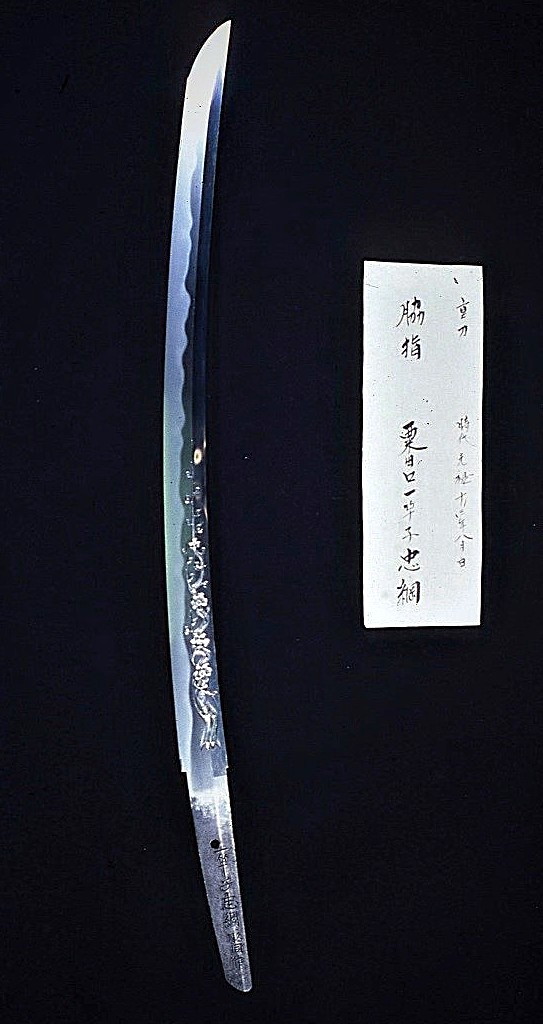
                                                                 Ikkanshi Tadatsuna (一竿子忠綱), once my family sword 

15| The Revival of Yamato Den(大和伝復活)

0-timeline - size 24 Late Kamakura

        The red circle above indicates the time we discuss in this section

It is believed that sword-making first started in Yamato province (now Nara Prefecture) during the Nara period (710 to 794).  In the early days of sword-making, the forging techniques were primitive.  At that time, many swordsmiths lived in Yamato, but over time, sword-making in this region declined.

At the end of the Kamakura period, several powerful Buddhist temples emerged in the Yamato area, leading to conflicts among them.  Temples held significant political and military power to control large territories called shoen (荘園) through their large numbers of warrior monks, known as sohei (僧兵).  The most dominant group was Nanto Sohei (南都僧兵)*.  These groups of sohei demanded more swords to arm themselves, which revitalized the Yamato-den (school) and increased the number of swordsmiths in the Yamato area.   As a result, the Yamato-den group became active again.  The Yamato-den style is somewhat similar to the Yamashiro-den.    

*Nanto Sohei (南都僧兵)—————-Since around the 11th century, Buddhist temples grew powerful under the protection of the Joko (retired emperors).  These temples had many sohei (low-level monks who also served as soldiers). When power struggles arose among the temples, sohei fought as their soldiers on the battlefields.  Nanto Sohei were such soldiers at Kofuku-Ji Temple (興福寺).  Several large temples, such as Todai-ji (東大寺) Temple, controlled the Yamato area.

Sugata (姿: Shape) —————- Not much difference in style during the early part of Yamatoden and Yamashiro-den.  Shinogi is high.  Mune is thin.   Some Yamato-den have a shallow sori (curvature).

16 Yamato sword cross section

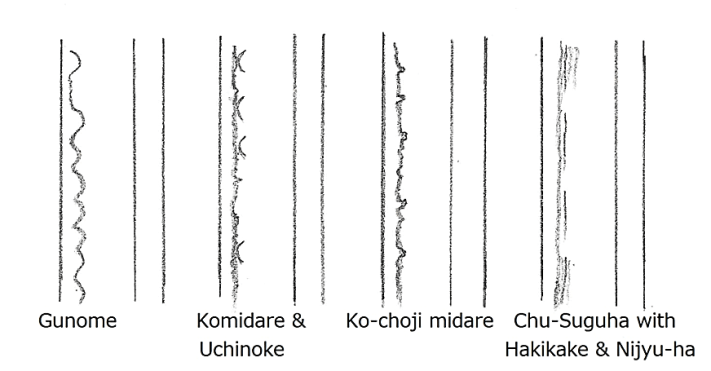
Hamon (刃文Tempered line) ——————Narrow tempered line.  Mainly nie (沸).  Chu-suguha-hotsure (中直刃ほつれ: a medium straight line with a frayed pattern), ko-choji-midare (小丁子: a mixture of small clove-like patterns and irregular wavy lines), ko-midare (小乱: small irregular wavy lines), ko-gunome-komidare (小五の目小乱: small continuous half-circles mixed with wavy lines). 

The main features of the Yamatoden style sword are masame (straight grain).  Its tempered line often shows nijyu-ha (double straight lines), hakikake (brush mark trace), uchinoke (a crescent-shaped line), or a combination of these.   See the illustration below.


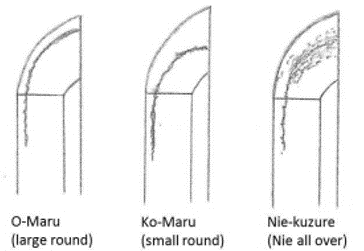
Boshi (鋩子: Tempered line at Kissaki area) ———- In the boshi area, a straight grain hamon pattern appears.  Yakizume or kaen. (Refer to Chapter 12, Middle Kamakura period: Tanto).  O-maru, ko-maru, nie-kuzure.  (Refer to Chapter 14, Late Kamakura Period Sword.  See the illustration below.)


15 Omaru Komaru Niekuzure

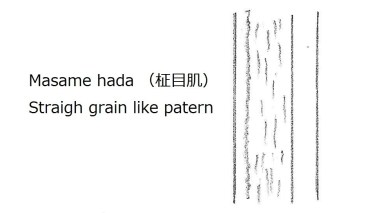
Ji-hada (地肌):Area between the shinogi and the tempered line)———— mostly masame-hada (straight grain pattern 柾目肌). Fine ji-nie, chikei, or yubashiri.  (Refer to Chapter 14, Late Kamakura Period Sword (鎌倉末太刀).  See below.)

16 Masame Hada

Nakago (Hilt) ———————– Often displays Higaki Yasuri (檜垣), the finishing file pattern, as illustrated below. 

16 Higaki Yasuri

Names of the Yamato School Sword-smiths

Taema(当麻) Group————–Taema Kuniyuki(当麻国行) Taema Tomokiyo(当麻友清) Shikkake (尻懸) Group———————————————-Shikkake Norinaga (尻懸則長) Tegai (手掻) group ——————Tegai Kanenaga (手掻包永) Tegai Kanekiyo(手掻包清) Hoshou (保昌) group———Hosho Sadayoshi ( 保昌貞吉) Hosho Sadamune (保昌貞宗)

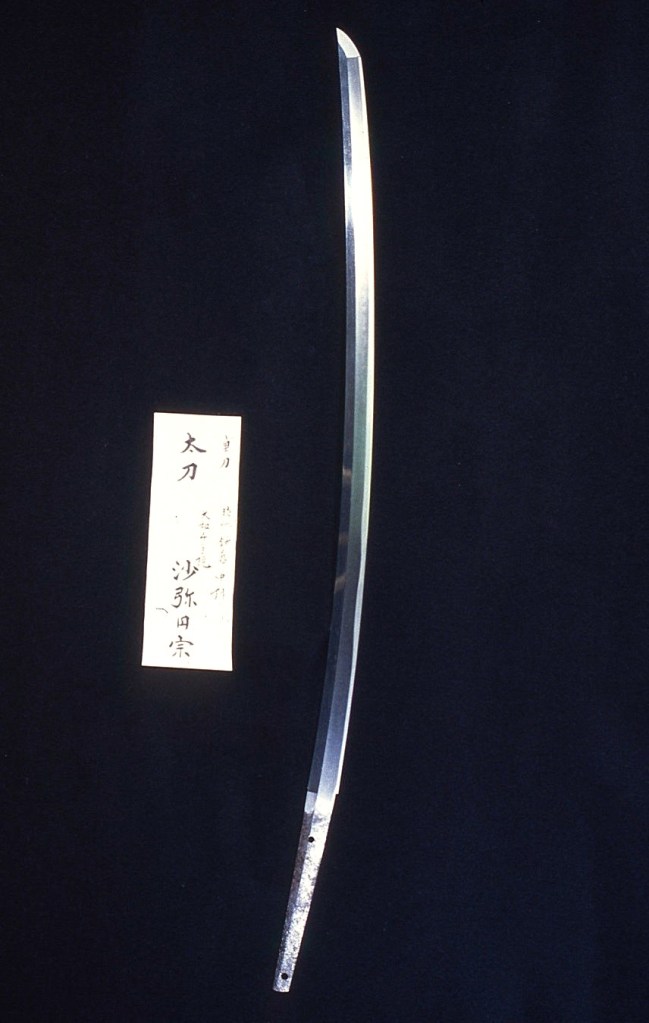
Yamato Senjuin Saya Enso (大和千手院沙弥円宗)  once my family sword