49| Part 2 of — 15 The Revival of Yamato Den (大和伝復活)

This chapter is a detailed part of Chapter 15, Revival of Yamato Den.  Please read Chapter 15 before reading this section.

0-timeline - size 24 Late Kamakura                          The red circle above indicates the time we discuss in this section

At the end of the Kamakura period, powerful temples expanded their territories in the Yamato region.  Refer to the map below for the location of the Yamato region.  Several prominent temples, especially those with large territories, held political and military power to control the area at the end of the Kamakura period.  These large territories were called shoen (荘園).  They employed many monk soldiers known as so-hei.  The demand for swords increased because of the rising number of Sohei (僧兵).  This increased demand revived the Yamatoden.  

Some prominent temples had their own swordsmiths within their territories. Todaiji Temple (東大寺) supported the Tegai (手掻) sword group.  The Senjuin (千手院) sword group lived near Senju-do (千手堂), where Senju Kannon (千手観音) is enshrined.  The Taima sword group originated from the Taima-ji Temple (当麻寺).  The Shikkake group (尻懸) and the Hosho group (保昌) were also part of the Yamato-den sword groups.  These five groups are known as Yamato Goha (the Yamato five groups).

51 Japan map Yamato

General Characteristic of Yamato Den

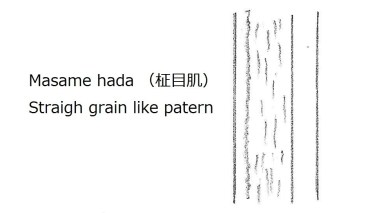
The Yamato-den (大和伝) sword always shows masame (柾目: straight grain-like pattern) somewhere on the ji-hada, ji-gane, or hamon.  Refer to Chapter 15, Revival of Yamato Den.   Masame is sometimes mixed with mokume (burl-like pattern) or itame (wood-grain-like pattern).  Either way, Yamato-den always shows masame somewhere.  Some swords display masame across the entire blade, while others show less.  Because of the masame, the hamon often shows sunagashi (a brush stroke-like pattern) or a double line called niju-ha.

Taima (or Taema) group (当麻)

  • Shape ———————– Middle Kamakura period style and Ikubi-kissaki style    
  • Hamon ———–Mainly medium Suguha.  Double HamonSuguha mixed with Choji.  Often shows Inazuma and Kinsuji, especially Inazuma appear under the Yokote line.
  • Boshi ————————- Often Yakizume.  Refer Yakizume on 15| The Revival of Yamato Den(大和伝復活)
  • Ji-hada ——————– Small wood grain pattern and well-kneaded surface.  At the top part of the sword, the wood grain pattern becomes Masame.

Shikkake Group (尻懸 

  • Shape —————- Late Kamakura period shape. Refer 14| Late Kamakura Period: Sword (鎌倉末太刀) 
  • Hamon ————————- Mainly Nie (we say Nie-hon’i).  Medium frayed Suguha, mixed with small irregular and Gunome (half-circle pattern).  A double-lined, brush-stroke-like Pattern may appear.  Small Inazuma and Kinsuji may also be shown.      
  • Boshi ———————— Yakizume, Hakikake (bloom trace like pattern) and Ko-maru (small round)     
  • Ji-hada ———- Small burl mixed with Masame.  The Shikkake group sometimes shows Shikkake-hada (the Ha side shows Masame, and the mune side shows burl.)

Tegai Group ( 手掻 )

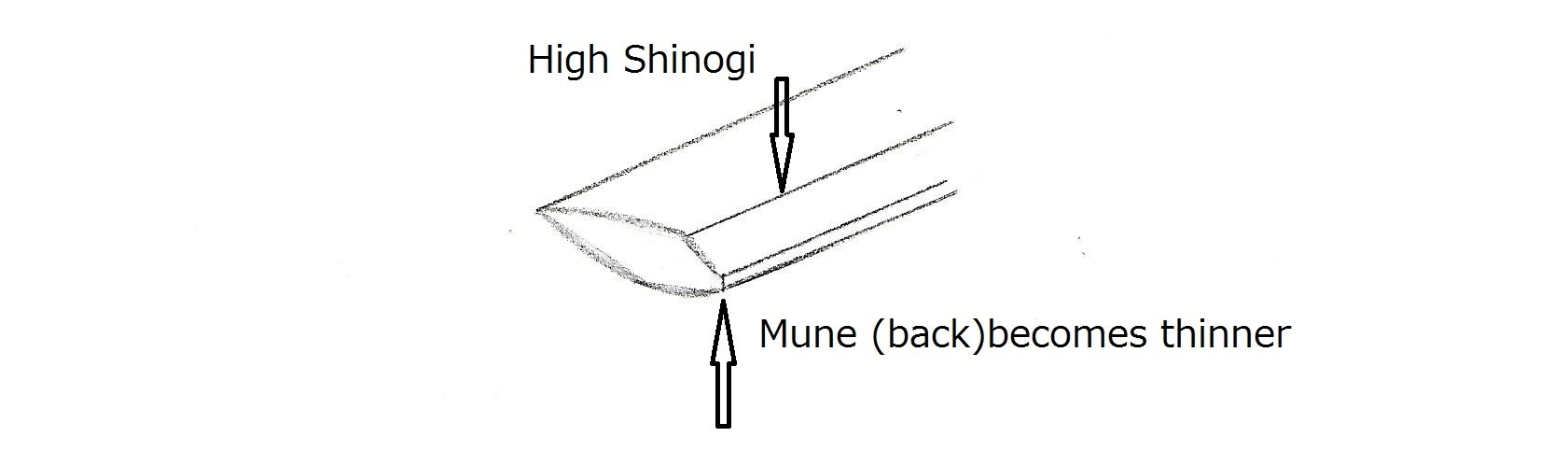
  • Shape —— Early Kamakura style with thick Kasane (body).  High ShinogiKoshizori.
  • Hamon ————- Narrow tempered line with medium Suguha hotsure (frayed Suguha).   Mainly Nie.   Double tempered line.  Inazuma and Kinsuji may show.                                                                 
  • Boshi ————————————— Yakizume (no turn back), Kaen (flame-like).   
  • Ji-Hada ————————————————— Fine burl mixed with Masame. 
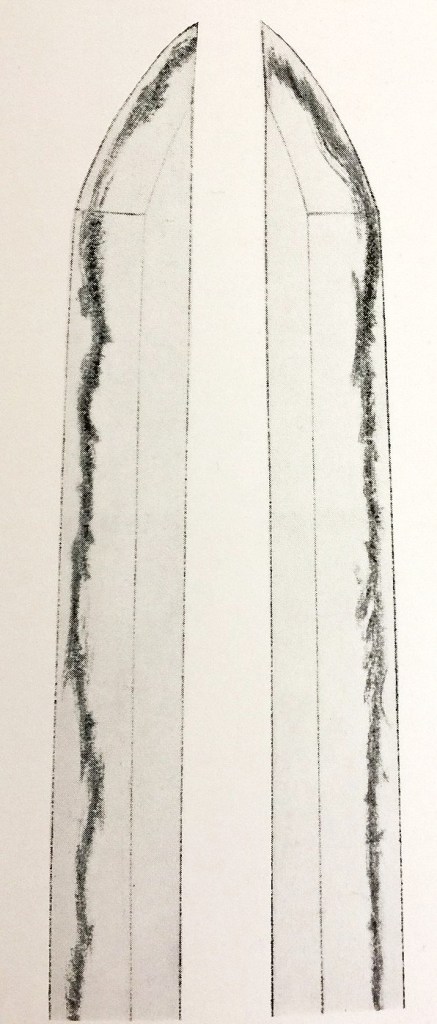
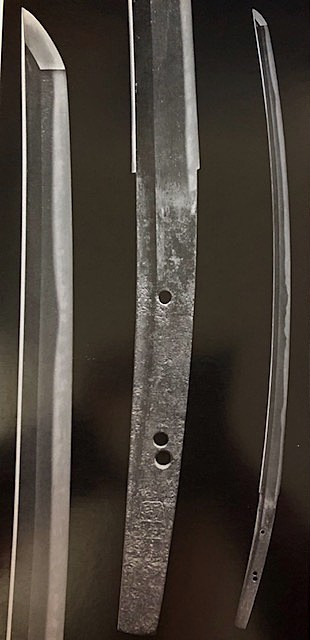
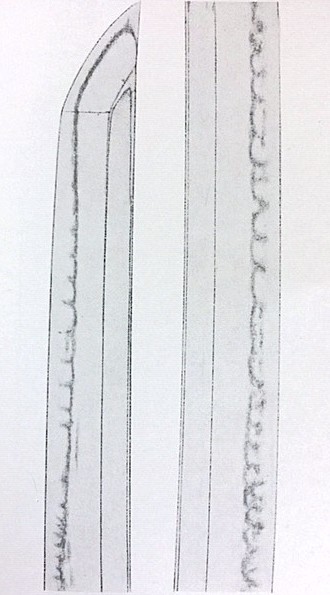
51 Kanenaga photo Yamato51 Kanenaga ilustration Yamato

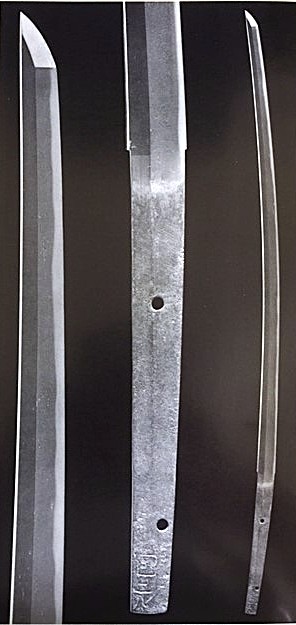
Tegai Kanenaga of Yamato.  From the Sano Museum Catalogue (permission granted).   The illustration (called Oshigata) shows notare (wave-like hamon) and suguha-hotsure (frayed suguha pattern) with kinsuji.

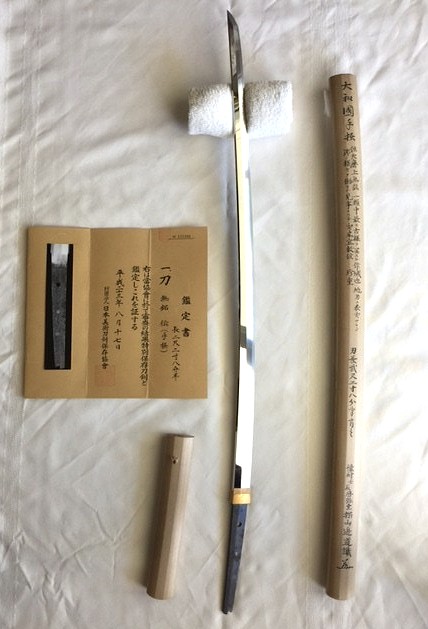
My Yamato sword Acquired at the Annual San Francisco Swords Show.

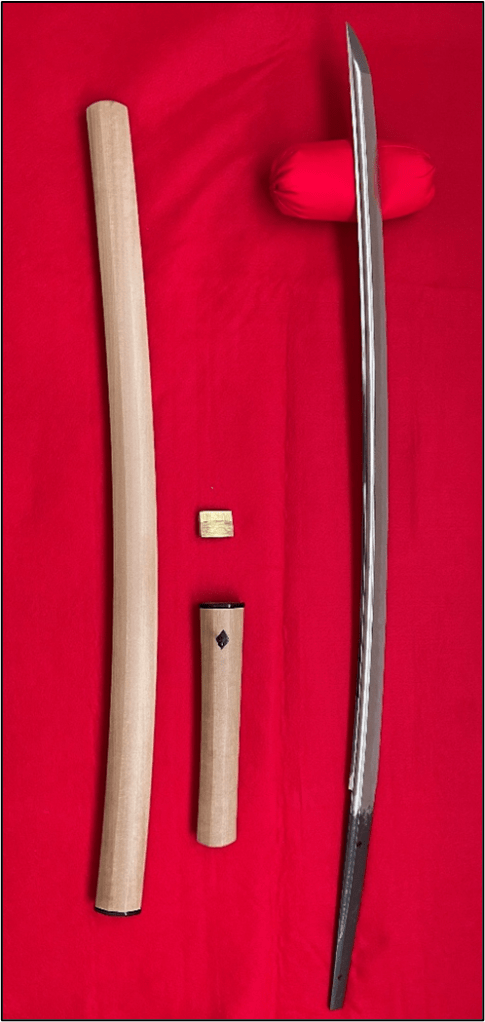
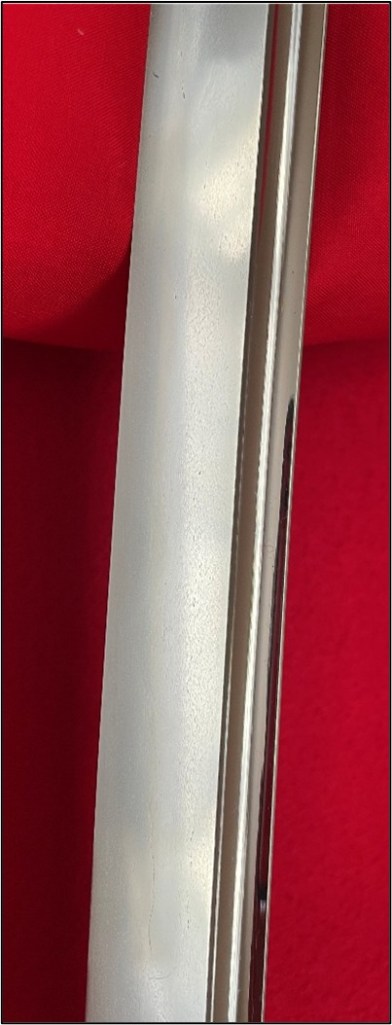
Characteristics: Munei (shortened and without signature).  Yamato-den, Tegai-ha (Yamato school Tegai group).  Length is two shaku, two sun, eight &1/2 bu (27 1/4 inches), small kissaki and funbari. HamonNiju-ba, Sunagashi.  Boshi: Yakizume.  Ji-hada: Itame with masame, Nie-hon’i .                                                                                                                                     
My Yamato sword

The full view of the sword and Kantei-sho (NBTHK Certification). “Tokubetsu Hozon Token”.

My Yamato sword 5

My Yamato sword 4

My Yamato sword.jpg 2

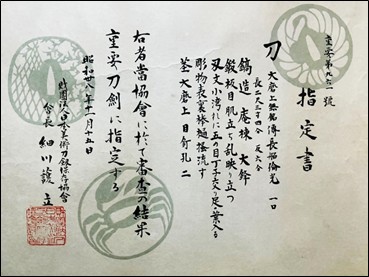
My sword: acquired at Dai Token Ichi (大刀剣市)Bizen Osafune Tomomitsu (備前長船倫光) Length: 2 feet 4 inches,  Shape: Shinogi zukuri,  Hada:itame midare-utsuri, Hamon: konotare gunome choji
46|Part 2 of — 12|Middle Kamakura Period: Tanto 鎌倉中期短刀

This chapter is a datiled part of chapter of 12| Middle Kamakura Period Tanto ( 短刀) .  Please read Chapter 12 before reading this section.

0-timeline - size 24 Middle Kamakura

                   The circle above indicates the time we discuss in this section


In Chapter 12, Middle Kamakura Period: Tanto, it is described that the tanto shape called takenoko-zori appeared during the middle Kamakura period.  This type of tanto  curves slightly inward at the tip.  The drawing below may be somewhat exaggerated to show the curve.  The actual curvature of the takenoko-zori is not very noticeable.  Perhaps only a few millimeters inward. 

Usually, the length of a tanto is around 12 inches.  Tantos are categorized as follows: if it is approximately ten inches, it is called a josun tanto (定寸短刀), longer than ten inches is called a sun-nobi tanto (寸延び短刀), and shorter than ten inches is called a sun-zumari tanto (寸詰短刀).

12Tanto drawing Mid Kamakur

Sun-nobi Tanto (寸延び)   >   Jyosun Tanto (定寸)   >  sun-zumari Tanto (寸詰り)  (longer than 10 inches)           (approx. 10 inches)                (less than 10 inches

13 «Part 2» Tanto photo

 46 Shintogo Kunimitsu Oshigata

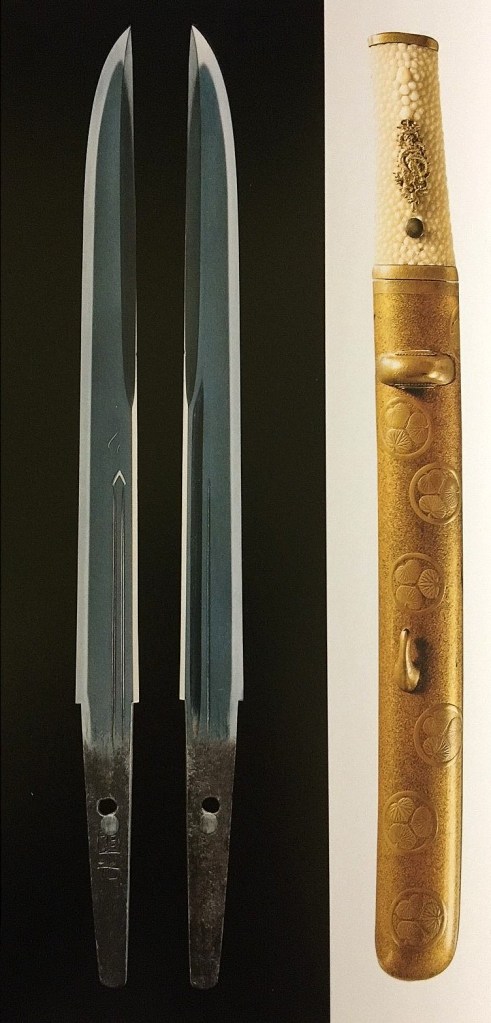
Shintogo Kunimitsu (新藤五国光)  Sano Museum Catalogue, permission granted to use

The style above is called kanmuri-otoshi (冠落); the mune side (opposite side of the  cutting edge) is shaved off.  The length is approx. 10 inches: woodgrain pattern surface  with nie on ji (refer to Chapter 3, Names of parts).   Very finely forgedThe hamon is a medium suguha (straight).  The boshi is ko-maru (small round).  Due to the kanmuri-otoshi style, it may not be easy to see the takenoko-zori; the mune side slightly bends inward.  Shintogo Kunimitsu is regarded as the top tanto maker.

13 «Part 2»Tanto photo with Saya

The above photo is also by Shintogo Kunimitsu (新藤五国光) with Saya.  Saya is the scabbard.  The handle of the scabbard (white part) is made of sharkskin.  Both photos are from the  Sano Museum Catalog “Reborn.”  Permission granted.                                                                     

41| Part 2 of — 8 Middle Kamakura Period: Yamashiro Den 鎌倉中期山城伝

This chapter is a detailed part of Chapter 8| Middle Kamakura Period –Yamashiro Den(鎌倉中期山城伝).   Please read Chapter 8 before reading this chapter.

0-timeline - size 24 Middle Kamakura

      The red circle indicates the time we discuss in this section

During the middle Kamakura period, the Yamashiroden consisted of 3 main groups: the Ayano-koji (綾小路) group, the Awataguchi (粟田口) group, and the Rai (来) group.

When referring to a specific group, we use terms like “xxx ha,” “xxx ippa,” or “xxx ichimon.”   We use these three terms interchangeably.  They all mean “group.”   For example, when we say “Ayano-koji ippa,” we refer to the Ayano-koji group.

Ayano-koji Ippa (綾小路)

Sugata (shape) —————–Generally, a gentle or graceful kyo-zori shape.  The difference in width between the yokote line and the machi is minimal.  The sword is slender, yet thick, with a small kissaki.                                                                                                                         

Hi and Engraving ———————– Bo-hi (single groove) or futasuji-hi (double grooves) 

Hamon ——————— Nie base with ko-choji (small clove shape) and ko-midare (small irregular).  Small inazuma (lightning-like lines) and kinsuji (golden streaks) may be present.   Double ko-choji (two ko-choji side by side) may appear.   

Boshi (tempered line at the kissaki area) ———————– Ko-maru (small round), yakizume (see the illustration below ), and kaen (flame-like pattern)   

Ji-hada —————– Small wood grain with a little masame (straight grain).  Ji-nie shows. 

Nakago (hilt) ———————— Long, slightly thick feel  

Ayano-koji Ippa swordsmiths ———-Ayano-koji Sadatoshi (綾小路定利)  Sadanori (定則)        

Awataguchi Ichimon (粟田口)

Many swordsmiths from the Awataguchi Ichimon (or Awataguchi group) were honored as the Goban Kaji (the top swordsmith) by Gotoba Joko, Emperor Gotoba (後鳥羽上皇).  Their general characteristics are as follows.

Sugata (Shape) ————————- Elegant torii-zori (or kyo-zori) shape.     

Hi and Engraving ————– The tip of the hi extends all the way up and fills in the ko-shinogi.   The end of the hi can be maru-dome (the end is round), kaku-dome (the end is square), or kakinagashi.


9 «part 2» 大小丸,焼詰,丸角止, 掻流     

              Maru-dome (rounded end)             Kaku-dome (square)          Kakinagashi

  • Hamon ———— The slightly wider tempered line at the bottom, then it becomes narrower at the top.  Nie base (called Nie-hon’i).  A straight tempered line mixed with ko-choji (small cloves) or a wide straight line combined with choji.  Awataguchi-nie appears.  Awataguchi-nie, which refers to a fine, deep, sharp, shiny nie that appears around the tempered line area. Fine inazuma (lightning-like lines) and kinsuji (golden streaks) emerge.

  • Boshi (tempered line at the tip area) —————— Ko-maru (small round)  and/or O-maru (large round).   The return is sharrow.  Yakizume, Nie Kuzure, and Kaen (flame)9-«part-2»-大小丸焼詰丸角止-掻流-1-e1547925390685.jpg

       Yakizume      O-maru     Ko-maru         Yakikuzure

  • Ji-hada ————– Fine ko-mokume (wood swirls) with ji-nie.  Ji-nie is nie on ji-hada. Yubashiri and/or chikei appear.                                                                               
  • Nakago ——————————– Often featuresa two-letter inscription
  • Names of Awataguchi swordsmiths —– Awataguchi Kunitomo (粟田口国友 ),  Hisakuni (久国), Kuniyasu (国安),  Kuniyasu (国安), Kunikiyo (国清)

 Rai Ha ()

The general characteristics of the Rai group are as follows.  However, each swordsmith has their own unique traits.

Sugata (shape) ——– Graceful and dignified.  Thick body.  Rai forged Ikubi Kissaki.         Hi and Engravings ————————- Wide and shallow hi.                                      Hamon ————————- Nie base.  Suguha (straight).  Wide suguha with ko-midare (small irregular) and choji (cloves).  Sometimes, there is a large choji at the lower part and a narrow suguha at the top.  Inazuma and Kinsuji appear around the yokote area.      Boshi ————————————- Komaru, yakizume (see the illustration above)            Ji-hada ——————— Finely forged itame (small wood grain).  Sometimes mixed with masame (parallel grain).  Fine nie.  Rai group’s swords occasionally show yowai tetsu (weak surface), which may be the core iron.    

Rai Ha swordsmiths———————- Rai Kuniyuki (来国行),  Rai Kunitoshi (来国俊) or Niji Kunitoshi (二字国俊),  Ryokai (了戒 ).  Rai Kunitoshi is said to be the son of Rai Kuniyuki. Ryokai is said to be the son of Rai Kunitoshi.

img017

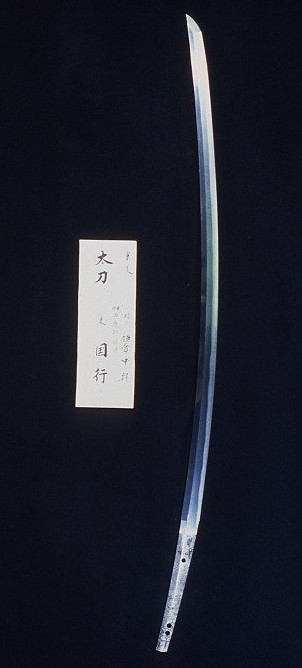
    Rai Kuniyuki (来国行)Once my family sword, photo taken by my father with his  writing.    
9 «part 2» Rai Kuniyuki photo.jpg       Rai Kuniyuki hamon
 
Rai Kuniyuki (来国行)Sano Museum Catalogue (佐野美術館)  (permission granted)

15| The Revival of Yamato Den(大和伝復活)

0-timeline - size 24 Late Kamakura

        The red circle above indicates the time we discuss in this section

It is believed that sword-making first started in Yamato province (now Nara Prefecture) during the Nara period (710 to 794).  In the early days of sword-making, the forging techniques were primitive.  At that time, many swordsmiths lived in Yamato, but over time, sword-making in this region declined.

At the end of the Kamakura period, several powerful Buddhist temples emerged in the Yamato area, leading to conflicts among them.  Temples held significant political and military power to control large territories called shoen (荘園) through their large numbers of warrior monks, known as sohei (僧兵).  The most dominant group was Nanto Sohei (南都僧兵)*.  These groups of sohei demanded more swords to arm themselves, which revitalized the Yamato-den (school) and increased the number of swordsmiths in the Yamato area.   As a result, the Yamato-den group became active again.  The Yamato-den style is somewhat similar to the Yamashiro-den.    

*Nanto Sohei (南都僧兵)—————-Since around the 11th century, Buddhist temples grew powerful under the protection of the Joko (retired emperors).  These temples had many sohei (low-level monks who also served as soldiers). When power struggles arose among the temples, sohei fought as their soldiers on the battlefields.  Nanto Sohei were such soldiers at Kofuku-Ji Temple (興福寺).  Several large temples, such as Todai-ji (東大寺) Temple, controlled the Yamato area.

Sugata (姿: Shape) —————- Not much difference in style during the early part of Yamatoden and Yamashiro-den.  Shinogi is high.  Mune is thin.   Some Yamato-den have a shallow sori (curvature).

16 Yamato sword cross section

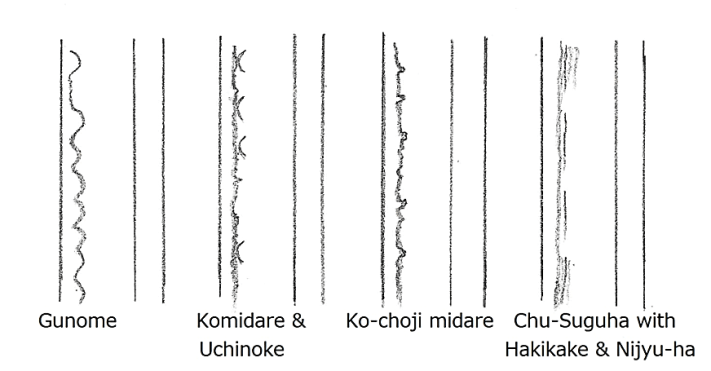
Hamon (刃文Tempered line) ——————Narrow tempered line.  Mainly nie (沸).  Chu-suguha-hotsure (中直刃ほつれ: a medium straight line with a frayed pattern), ko-choji-midare (小丁子: a mixture of small clove-like patterns and irregular wavy lines), ko-midare (小乱: small irregular wavy lines), ko-gunome-komidare (小五の目小乱: small continuous half-circles mixed with wavy lines). 

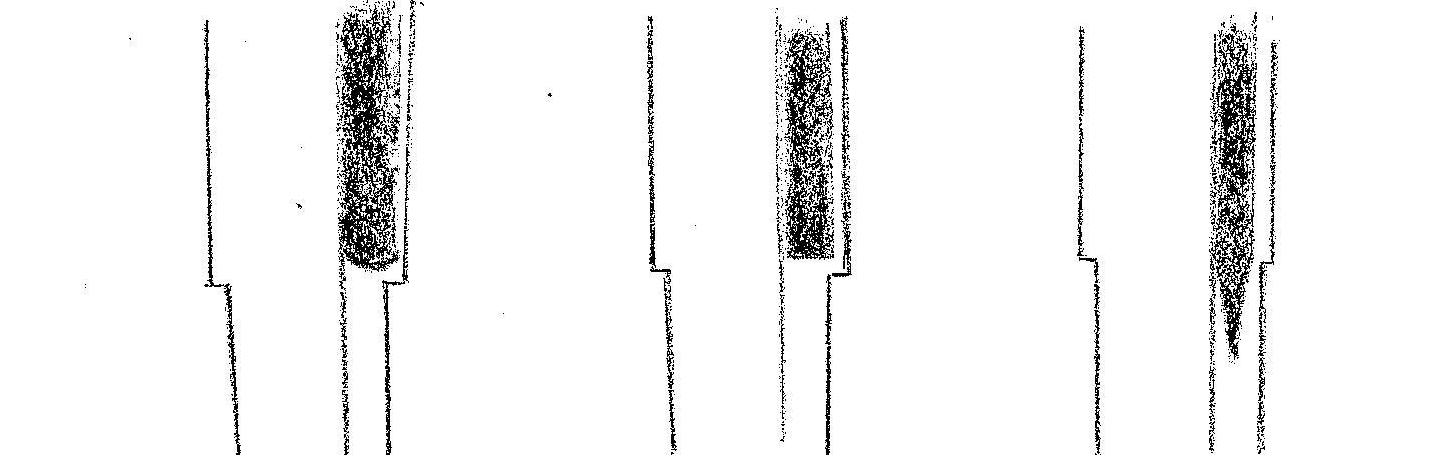
The main features of the Yamatoden style sword are masame (straight grain).  Its tempered line often shows nijyu-ha (double straight lines), hakikake (brush mark trace), uchinoke (a crescent-shaped line), or a combination of these.   See the illustration below.


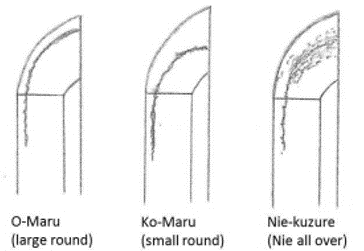
Boshi (鋩子: Tempered line at Kissaki area) ———- In the boshi area, a straight grain hamon pattern appears.  Yakizume or kaen. (Refer to Chapter 12, Middle Kamakura period: Tanto).  O-maru, ko-maru, nie-kuzure.  (Refer to Chapter 14, Late Kamakura Period Sword.  See the illustration below.)


15 Omaru Komaru Niekuzure

Ji-hada (地肌):Area between the shinogi and the tempered line)———— mostly masame-hada (straight grain pattern 柾目肌). Fine ji-nie, chikei, or yubashiri.  (Refer to Chapter 14, Late Kamakura Period Sword (鎌倉末太刀).  See below.)

16 Masame Hada

Nakago (Hilt) ———————– Often displays Higaki Yasuri (檜垣), the finishing file pattern, as illustrated below. 

16 Higaki Yasuri

Names of the Yamato School Sword-smiths

Taema(当麻) Group————–Taema Kuniyuki(当麻国行) Taema Tomokiyo(当麻友清) Shikkake (尻懸) Group———————————————-Shikkake Norinaga (尻懸則長) Tegai (手掻) group ——————Tegai Kanenaga (手掻包永) Tegai Kanekiyo(手掻包清) Hoshou (保昌) group———Hosho Sadayoshi ( 保昌貞吉) Hosho Sadamune (保昌貞宗)

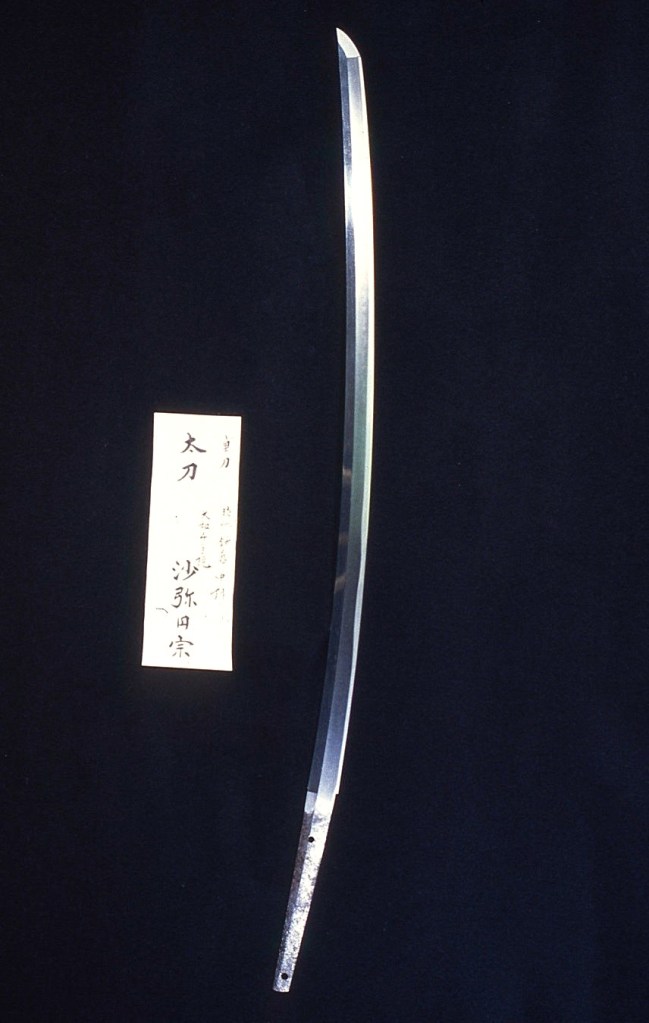
Yamato Senjuin Saya Enso (大和千手院沙弥円宗)  once my family sword

14| Late Kamakura Period Sword (鎌倉末太刀)

0-timeline - size 24 Late Kamakura

The red circle above indicates the time we discuss in this section

The beginning of the Soshu style

A new sword style called Soshu-den appeared after the Mongolian invasion during the later part of the Kamakura period.  The Kamakura region became prosperous under the rule of the Hojo family (北条).  Many swordsmiths moved to Kamakura.  These included the Kunitsuna group (国綱)  from the Yamashiro area and Fukuoka Ichimonji Sukezane (福岡一文字助真) and Kunimune (国宗) from the Bizen area.  They are the originators of Soshu-den (相州伝).  A well-known swordsmith, Goro-Nyudo-Masamune (五郎入道正宗), emerged during this time.

15 Soshu sword with explanation

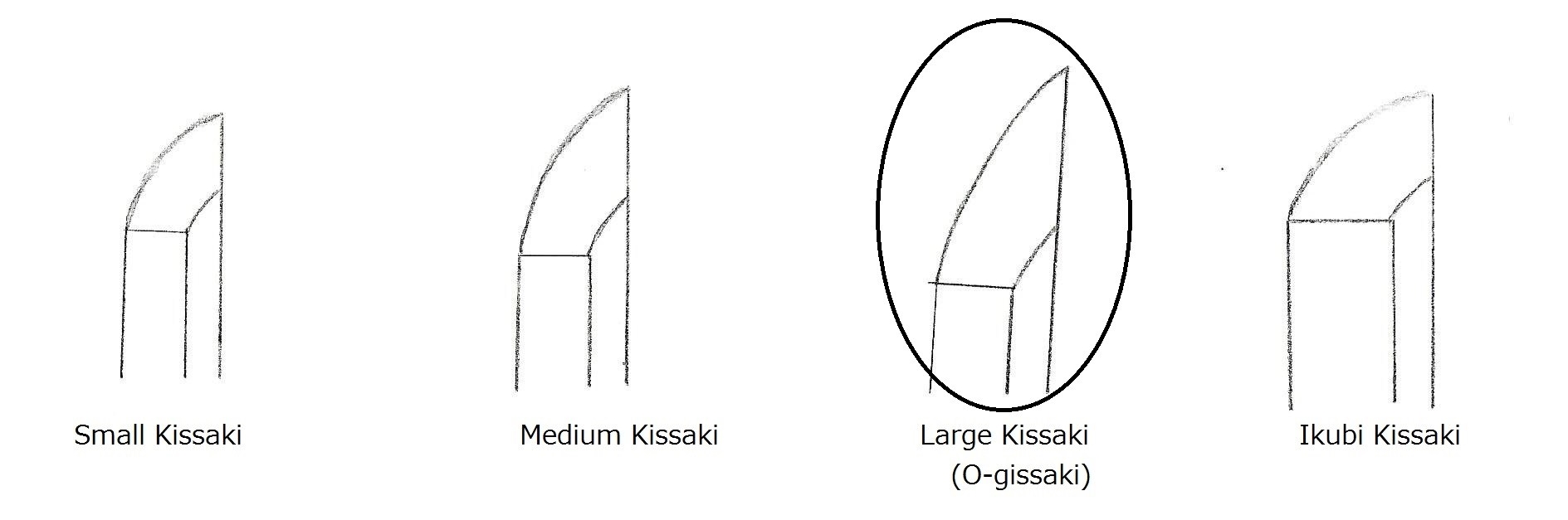
Sugata (Shape 姿) ——- Okissaki (large kissaki: 大切先) and chu-kissaki (medium kissaki: 中切先).   The tip of the hi ends lower (see the illustration below).  Hamaguriha is no longer in style.  The body has become thinner.  The original length was approximately three feet or longer, but most were later shortened to two feet, three inches, or four inches.  The shortened sword is called o-suriage (大磨上).

15 Kissak shape of 4

14 Hi end lower

Hamon——————–Narrow Hamon and wide Hamon.     

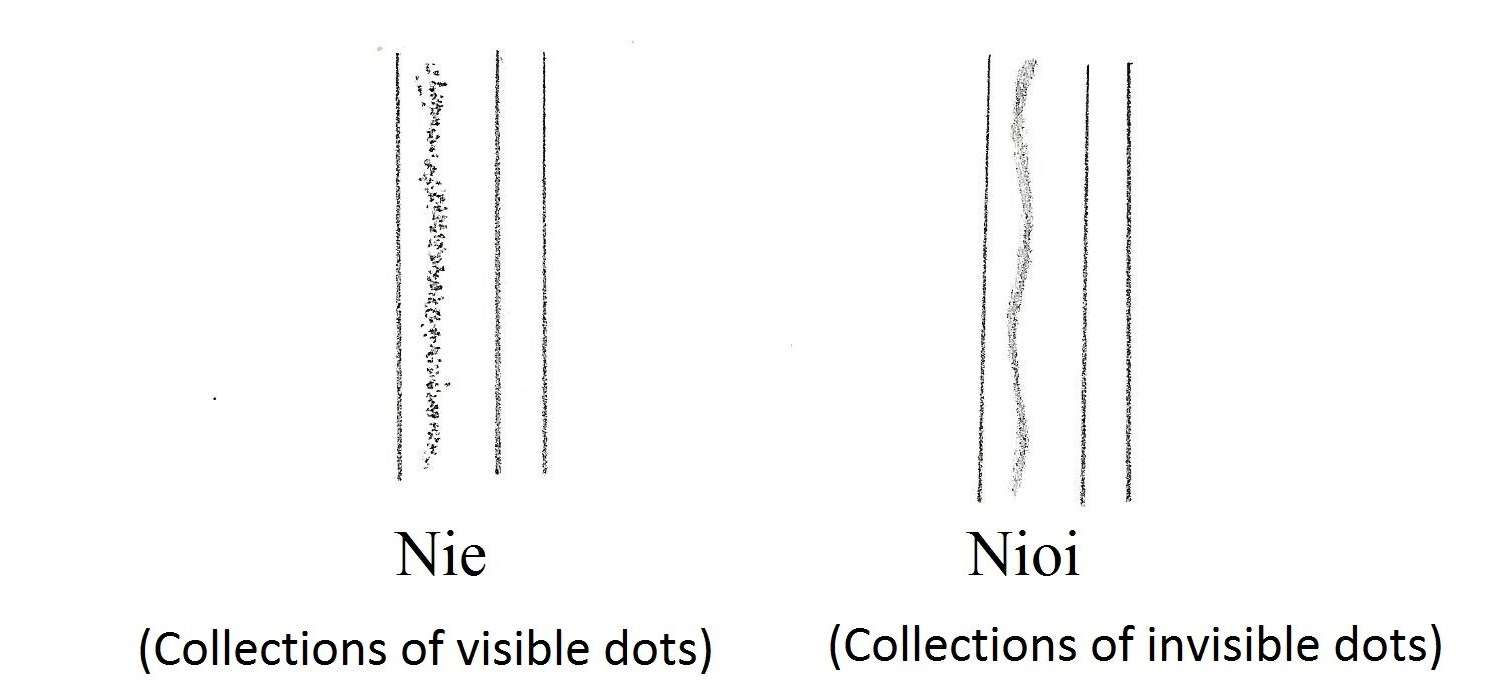
Narrow Hamon ——- A mix of Suguha (straight),  Ko-choji (small clove-like pattern), and Ko-gunome (small half-circle pattern).  Small Nie base. (shown below)

10 Nie & Nioi

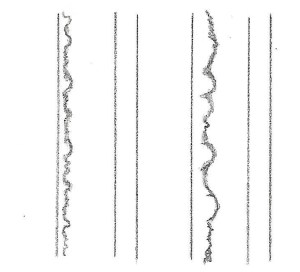
Wide Hamon ——– Notare midare (wavy).  O-gunome.  Nie base.  Ashi-iri (short line toward the blade, the right drawing below). Inazuma (lightning-like line) or kinsuji (bright line) may appear on a tempered line.  However, inazuma and kinsuji require trained eyes to detect.  It is difficult for beginners to see inazuma or kinsuji.  

15 Late Kamakura Soshu Hamon

Boshi————The main body and boshi have the same type of hamon.  At the tip of the kissaki, angle it back slightly or yakizume.  You might also see o-maru (large round), ko-maru (small round), kaen (flame-like), or nie-kuzureYakizume and kaen (Chapter 12).

15 three boshi name

Ji-hada (between the shinogi and the tempered line) ——-Strong ji-nie (地沸), which are sand-like small dots appearing on the ji (between the tempered line and the mune).  Yubashiri (a cluster of ji-nie), kinsuji (a bright, radiant line formed by nie), inazuma (a lightning-like irregular line), or chikei (similar to kinsuji) may appear on the ji-hada.

15 Yubashiri, Chikei, Inazuma

Late Kamakura Period Soshu School Sword Smiths

From Bizen————–Fukuoka Ichimonji Sukezane (福岡一文字助真) Kunimune (国宗 )   From Yamashiro ————————————–Toroku- Sakon- Kunituna (藤六左近国綱) 

The three swordsmiths mentioned above originated the Soshu-den (school) in Kamakura.  Later, Tosaburo Yukimitu and his son, the famous Goro Nyudo Masamune, emerged.

More  Soshu Den swordsmiths other than above

From Yamashiro (山城)———- Rai Kunitsugu (来国次), Hasebe Kunishige (長谷部国重) From Etchu (越中) province ———————Gou- no-Yoshihiro (郷義弘) Norishige (則重) From   Mino (美濃) province ——————————————-Kaneuji (兼氏) Kinjyu (金重) From   Chikuzen (筑前) province —————————————————-Samoji (左文字)

Goro Nyudo Masamune (正宗): his hamon is like ocean waves. (Sano Museum permission granted)        

Masamune  (政宗)                                          Yoshioka Ichimonji (吉岡一文字)

Once owned by my family